








Introduction
Directed Energy Weapons Statistics: Directed Energy Weapons (DEWs) signify contemporary military innovations, employing concentrated energy sources such as lasers, microwaves, and particle beams to engage and neutralise targets accurately.
They provide precision, swift response, and cost efficiency, with applications in missile defence, countering drones, and achieving accurate targeting. However, technical challenges and ethical issues pose obstacles to fully realising their potential. Nevertheless, ongoing research aims to enhance DEW technology, reinforcing its significance in modern defence strategies.
Directed Energy Weapons (DEWs) are sophisticated military systems that utilise concentrated electromagnetic energy, including lasers, microwaves, and particle beams, to incapacitate or eliminate targets at light speed. These systems deliver high precision and low cost per engagement against drones, missiles, and vehicles, with the global market anticipated to expand from approximately USD 5.3 billion in 2023 to considerably higher figures by the early 2030s.
Editor’s Choice
- In 2023, the revenue for the Directed Energy Weapons market was recorded at USD 5.3 billion.
- In 2018, the market’s revenue was noted at USD 2.01 billion, reflecting a slight increase to USD 2.1 billion in 2019.
- Millimetre wave weapons function within a wavelength spectrum of 1 to 10 millimetres and are capable of producing power that surpasses 1 kilowatt.
- High-powering microwave weapons generate microwaves that have longer wavelengths in comparison to millimetre wave weapons and high-energy lasers.
- A recent report from the U.S. Government Accountability Office reveals that the U.S. Department of Defence is investing approximately $1 billion annually in the development of “directed energy” weapons.
- On August 23, 2025, India conducted further tests of an Integrated Air Defence Weapon System, which is engineered to neutralise high-speed UAVs and multi-copter drones.
General Directed Energy Weapons Statistics
- In 2023, the revenue for the Directed Energy Weapons market was recorded at USD 5.3 billion.
- The Directed Energy Weapons Warfare sector is anticipated to witness steady growth, with projected revenues of 2.64 billion by 2027.
- Millimetre wave weapons function within a wavelength spectrum of 1 to 10 millimetres and can produce power levels exceeding 1 kilowatt.
- High-power microwave weapons can generate more than 100 megawatts of power, which is roughly 150,000 times the output of a standard household microwave oven.
- In October 2020, Raytheon Missiles and Defence secured a contract from the AFRL to perform tests on the Counter-Electronic High-Power Microwave Extended-Range Air Base Defence (CHIMERA) system.
- A recent report from the U.S. Government Accountability Office indicates that the U.S. Department of Defence is allocating around $1 billion each year towards the development of “directed energy” weapons, which include high-energy lasers designed to target and neutralise drones in flight.
- The UK Ministry of Defence allocated around £72.5 million to UK industry consortia spearheaded by Raytheon UK and Thales for the manufacturing of Directed Energy Weapons in September 2021.
Directed Energy Weapons Market Size Statistics
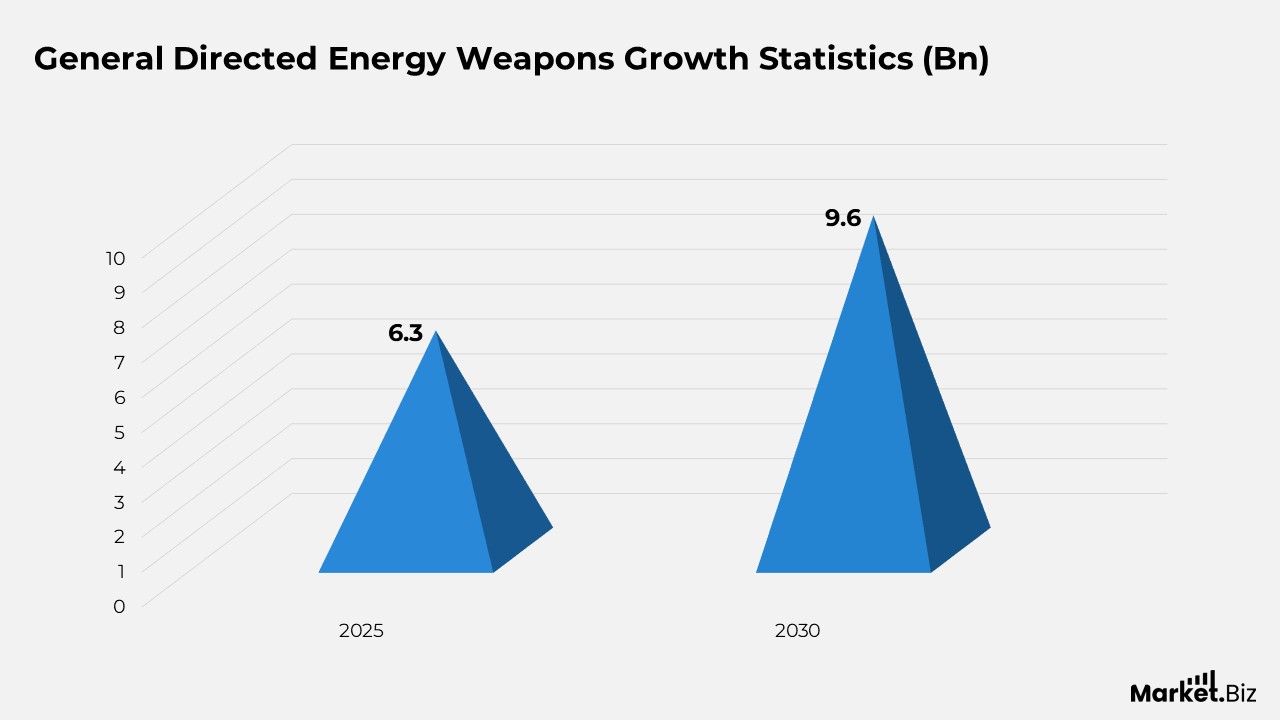
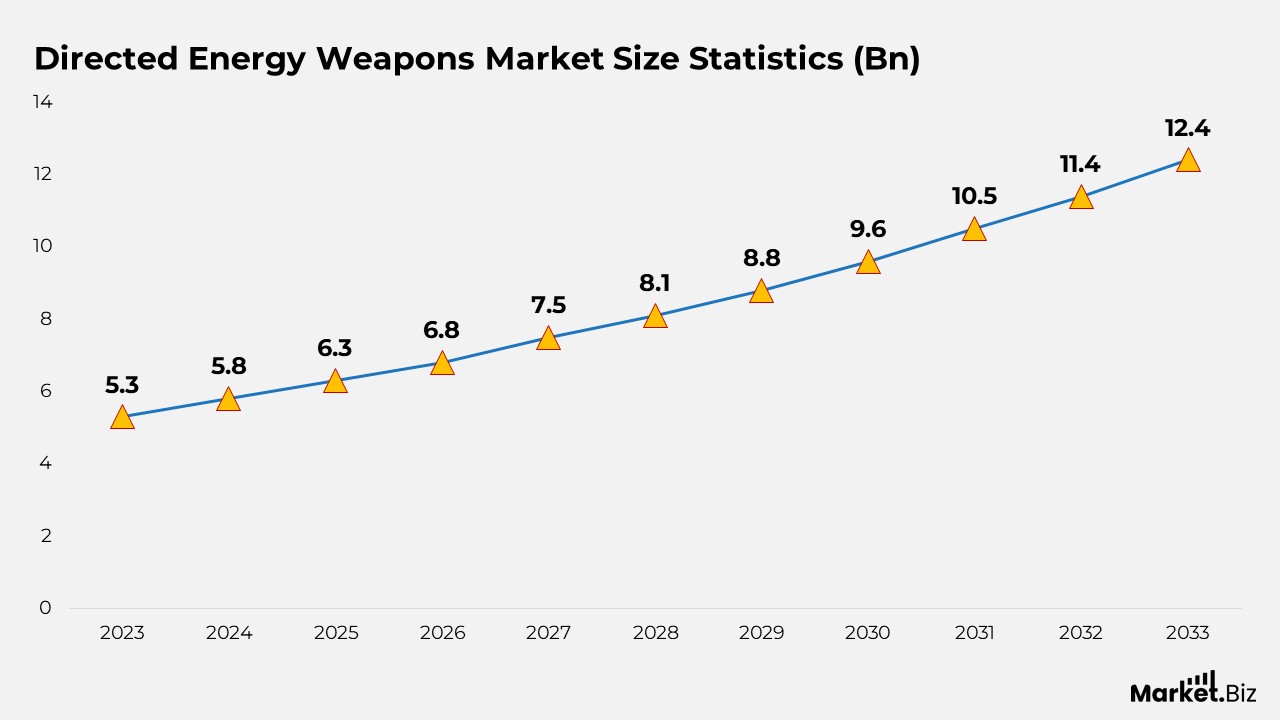
- In 2023, the revenue of the market was recorded at USD 5.3 billion, with an expectation to rise to USD 5.8 billion in 2024.
- This upward trend is projected to persist, leading the market to achieve USD 6.3 billion in 2025, USD 6.8 billion in 2026, and USD 7.5 billion in 2027.
- As we progress into the future, the Directed Energy Weapons market is set for even greater growth, with anticipated revenues of USD 8.1 billion in 2028, USD 8.8 billion in 2029, and USD 9.6 billion in 2030.
- The growth outlook remains positive, with forecasts indicating that the market will exceed USD 10 billion in 2031, reaching USD 10.5 billion, and ultimately surpassing the USD 11 billion threshold in 2032, culminating at USD 11.4 billion.
- By 2033, the Directed Energy Weapons market is projected to reach a revenue of USD 12.4 billion.
Directed Energy Weapon Warfare Market Statistics
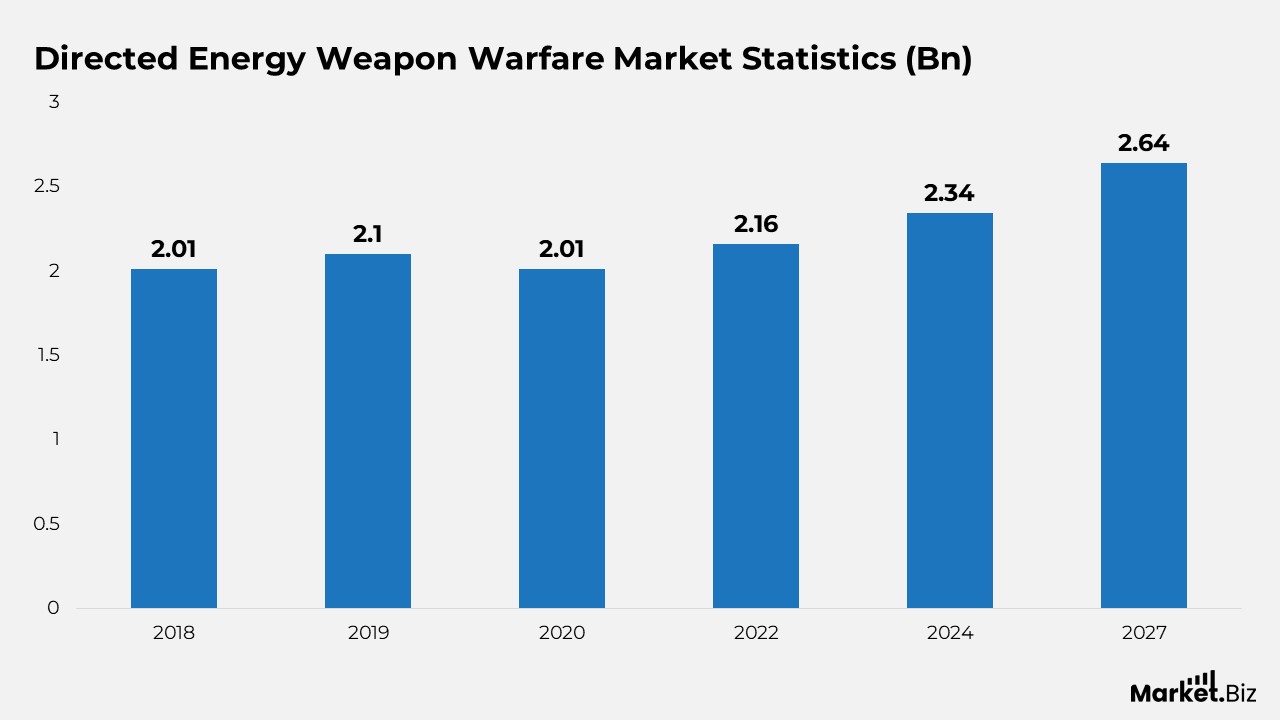
- In 2018, the market’s revenue was noted at USD 2.01 billion, reflecting a slight increase to USD 2.1 billion in 2019.
- However, in 2020, the revenue returned to USD 2.01 billion, signifying a short period of stagnation. Following this, in 2022, there was a modest increase, with the market achieving USD 2.16 billion.
- Looking forward, the market is anticipated to undergo gradual growth, with projected revenues of USD 2.34 billion in 2024 and USD 2.64 billion in 2027.
Millimetre Wave Weapons Statistics
- Millimetre wave weapons function within a wavelength spectrum of 1 to 10 millimetres and are capable of producing power that surpasses 1 kilowatt.
- One notable benefit of millimetre wave weapons is their wider beam coverage in comparison to high-energy lasers, enabling them to affect several targets at the same time.
High Power Microwave Weapons Statistics
- High-power microwave weapons generate microwaves that have longer wavelengths in comparison to millimetre wave weapons and high-energy lasers.
- These weapons can produce more than 100 megawatts of power, which is roughly 150,000 times the power output of a typical household microwave oven.
- Like millimetre wave weapons, their wider beam size allows them to affect several targets at the same time.
Directed Energy Weapons Investments Statistics
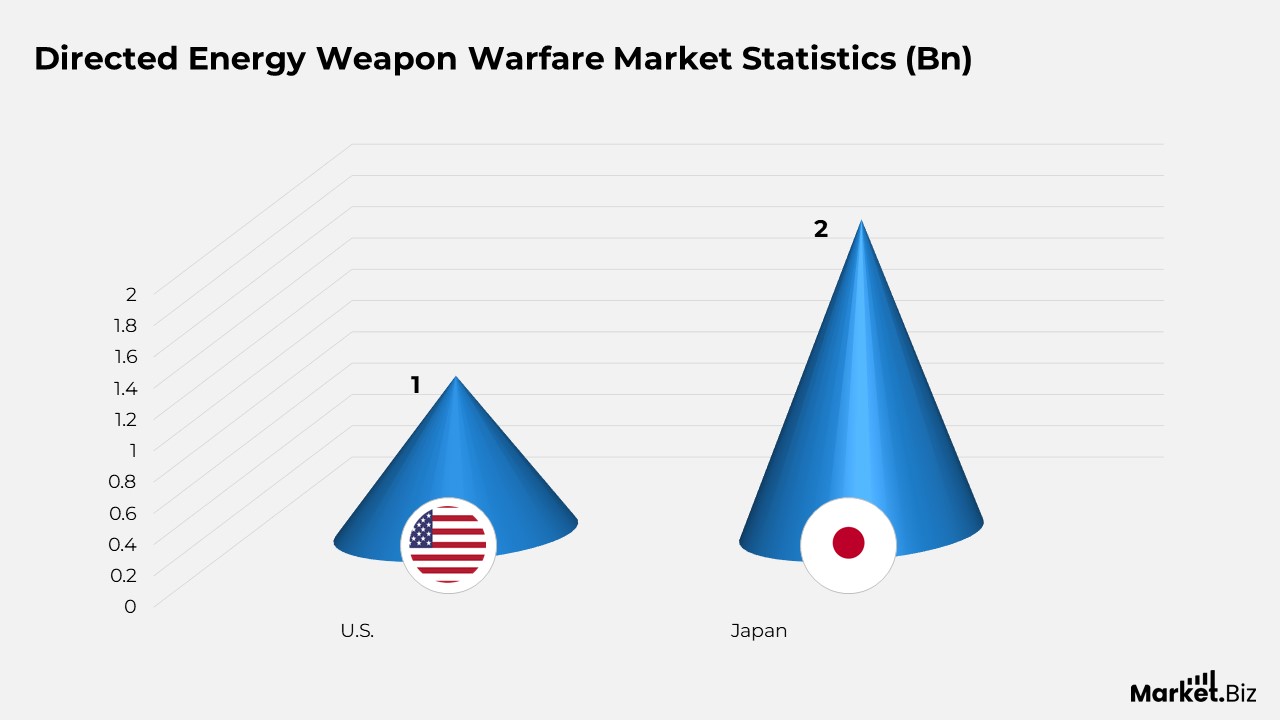
- A recent report from the U.S. Government Accountability Office reveals that the U.S. Department of Defence is investing approximately $1 billion annually in the development of “directed energy” weapons.
- Japan is allocating $2 billion from its defence budget for the research and development of hypersonic technology.
- ALTA has established a partnership with Mitsubishi Heavy Industries to engage in research on HVGP and HCM, with HVGP expected to be operational by 2026.
- In July 2020, Australia published two defence documents that offer direction for its Integrated Investment Program and the 2016 Defence White Paper.
- These documents designate AU$9.3 billion for hypersonic weaponry and the development of technologies, including directed-energy systems.
- The 2020 Force Structure Plan and Defence Strategic Update will oversee funding for disruptive weapons technology, building upon a prior commitment of AU$ 730 million for research in fields like advanced sensors, hypersonic weapons, and directed-energy capabilities.
- India’s DRDO has invested $4.5 million in the development of the HTDV prototype.
- In the next 5 years, they intend to carry out three additional tests to evolve it into a fully operational hypersonic weapon capable of carrying both conventional and nuclear warheads.
Tactical High-Power Operational Responder Statistics
- Further, the AFRL, in partnership with industry collaborators, has created the Tactical High-Power Microwave Operational Responder technology demonstrator aimed at establishing an efficient Directed Energy Counter-Unmanned Aircraft System specifically intended for the short-range protection of air bases.
- THOR is housed within a standardised 20-foot transport container, ensuring compatibility with C-130 transport aircraft for straightforward deployment.
- Reports indicate that users can set up the system in under three hours and can navigate its user interface with minimal training.
- As stated by the Air Force, THOR has successfully completed a two-year testing period and will act as a basis for future prototype projects such as Mjölnir.
Directed Energy Weapons: Recent Development
- Further, the U.S. Department of Defence (DoD) has made substantial investments in Directed Energy Weapons (DEW), with funding for DE Programs in Fiscal Year 2023 exceeding $1.6 billion, aimed at the integration of laser and microwave technologies across naval and ground platforms.
- Moreover, in January 2023, Epirus Inc. was awarded a contract worth $66.1 million to provide the U.S. Army with Leonidas high-power microwave systems intended for countering unmanned aerial vehicles (UAVs).
- Further, on August 23, 2025, India conducted further tests of an Integrated Air Defence Weapon System, which is engineered to neutralise high-speed UAVs and multi-copter drones.
Directed Energy Weapons Future Predictions
- Forecasts suggest that the market will surpass USD 10 billion by 2031, achieving USD 10.5 billion, and eventually exceeding the USD 11 billion mark in 2032, culminating at USD 11.4 billion.
- By 2033, the Directed Energy Weapons market is anticipated to generate a revenue of USD 12.4 billion.
Conclusion
In conclusion, Directed Energy Weapons (DEWs) represent advanced military technologies that provide accuracy, swift response, and economic efficiency. Their applications span multiple domains, including missile defence and drone countermeasures, and they are consistently advancing with enhanced power and integration features.
Although DEWs present significant potential for contemporary defence strategies, they also bring forth ethical and legal dilemmas. Nevertheless, they continue to be a central theme in research and development, influencing the future landscape of military and security operations.
FAQ’s
DEWs represent sophisticated military technologies that utilise concentrated energy forms, including lasers, microwaves, or particle beams, to accurately target and neutralise adversaries.
The categories of DEWs consist of High-Energy Lasers (HEL), Microwave Weapons, and Particle Beam Weapons, each designed for particular uses.
DEWs face various technical difficulties, such as issues related to power generation and energy propagation, along with ethical dilemmas concerning their deployment.

