








Introduction
Aviation cybersecurity statistics offer quantitative insight into how the aviation industry is strengthening its defences amid growing digital and operational connectivity. As airlines, airports, and air navigation systems increasingly rely on networked technologies, cloud platforms, and automated controls, cyber risks have become a critical concern across the aviation value chain.
These statistics illustrate the extent and types of cyber threats targeting aviation operations, passenger data systems, and critical infrastructure, and highlight patterns in security spending, regulatory compliance, and incident response.
Overall, aviation cybersecurity statistics serve as a benchmark for understanding how effectively the sector manages cyber risk while maintaining safety, reliability, and operational continuity in a highly interconnected environment.
Editor’s Choice
- Cybersecurity is the top IT priority for aviation in 2025, ranked among the top three focus areas by 66% of organizations, reflecting heightened concern over digital threats.
- Aviation organizations are steadily increasing IT and cybersecurity spending, with 72% expecting budget growth in 2025, signaling a long-term commitment to cyber resilience.
- Planned aviation IT spending peaked at USD 49.6 billion in 2019 and is projected to stabilize around USD 37 billion in 2024, following pandemic-driven volatility.
- Data platform adoption is nearly universal, with 90% of aviation organizations already operating a data lake or data warehouse to support analytics and security use cases.
- Artificial intelligence is now widely embedded in aviation cybersecurity, with 78% of organizations using AI to detect threats and monitor anomalies.
- The technology stack is rapidly evolving, as 56% of aviation organizations prioritize generative AI and large language models for future investment.
- Cybersecurity investment is shifting toward operations, with operating expenditure consistently accounting for a larger share of IT budgets than capital expenditure.
- Despite rising investment, 30% of airlines still cite managing cyber threats and regulatory compliance as a major operational challenge.
- Organizational transformation remains the biggest barrier to digital and cyber maturity, with 53% of airlines identifying business process and culture change as their primary challenge.
Planned Aviation IT and Cybersecurity Spending Trends
- Planned IT and cybersecurity spending in aviation shows a fluctuating but overall upward trend, rising from USD 49.6 billion in 2019 to a planned USD 37 billion in 2024, following a sharp dip during the pandemic.
- In 2020, total IT spend declined significantly to USD 29 billion, reflecting cost-cutting measures adopted by airlines and aviation operators amid operational disruptions.
- Spending recovered gradually in subsequent years, rising to USD 32 billion in 2021, stabilising around USD 30 billion in 2022, and then climbing further to USD 33 billion in 2023.
- As a share of organizational revenue, total IT spend peaked at 7.6% in 2020, indicating heightened reliance on digital systems during crisis management and operational restructuring.
- IT spending as a percentage of revenue moderated to 4.7% in 2021 and 4.1% in 2022, before easing further to 3.6% in 2023 and a planned 3.8% in 2024.
- Operating expenditure consistently accounts for the larger portion of IT budgets, accounting for around 2.4% of revenue in 2020 and stabilising at 1.7–2.1% in the post-pandemic years.
- Capital expenditure remains comparatively lower, ranging between 1.6% and 1.9% of revenue, reflecting measured investment in long-term IT and cybersecurity infrastructure.
(Sources: Sita Aero)
Aviation IT and Cybersecurity Spending Statistics
- In 2023, the majority of aviation organisations (87%) reported increased IT and technology spending, indicating strong post-disruption investment momentum.
- Only 5% of organizations kept IT spending unchanged in 2023, while 8% reported a decline, showing limited budget contraction during that year.
- For 2024 (planned), expectations shifted slightly, with 74% of organizations planning to increase IT spending, reflecting a more cautious but still growth-oriented approach.
- The share of organizations expecting IT budgets to remain stable rose to 14% in 2024, suggesting tighter financial controls and prioritization of efficiency.
- At the same time, 13% of respondents anticipated a decrease in IT spending in 2024, highlighting ongoing cost pressures in parts of the aviation sector.
- Looking ahead to 2025 (expected), 72% of organizations anticipate increasing IT and cybersecurity spending, reinforcing the long-term importance of digital resilience and cyber protection.
- The proportion of organizations expecting flat IT budgets is projected to rise further to 20% in 2025, indicating a shift toward spending optimization rather than rapid expansion.
- A smaller share, 8%, expects IT spending to decline in 2025, signaling that outright budget cuts are becoming less common as technology remains mission-critical.
- Overall, the trend shows aviation organizations moving from aggressive recovery-driven investment toward more balanced, strategically planned IT and cybersecurity spending.
(Sources: Sita Aero)
Aviation IT Resource Priorities
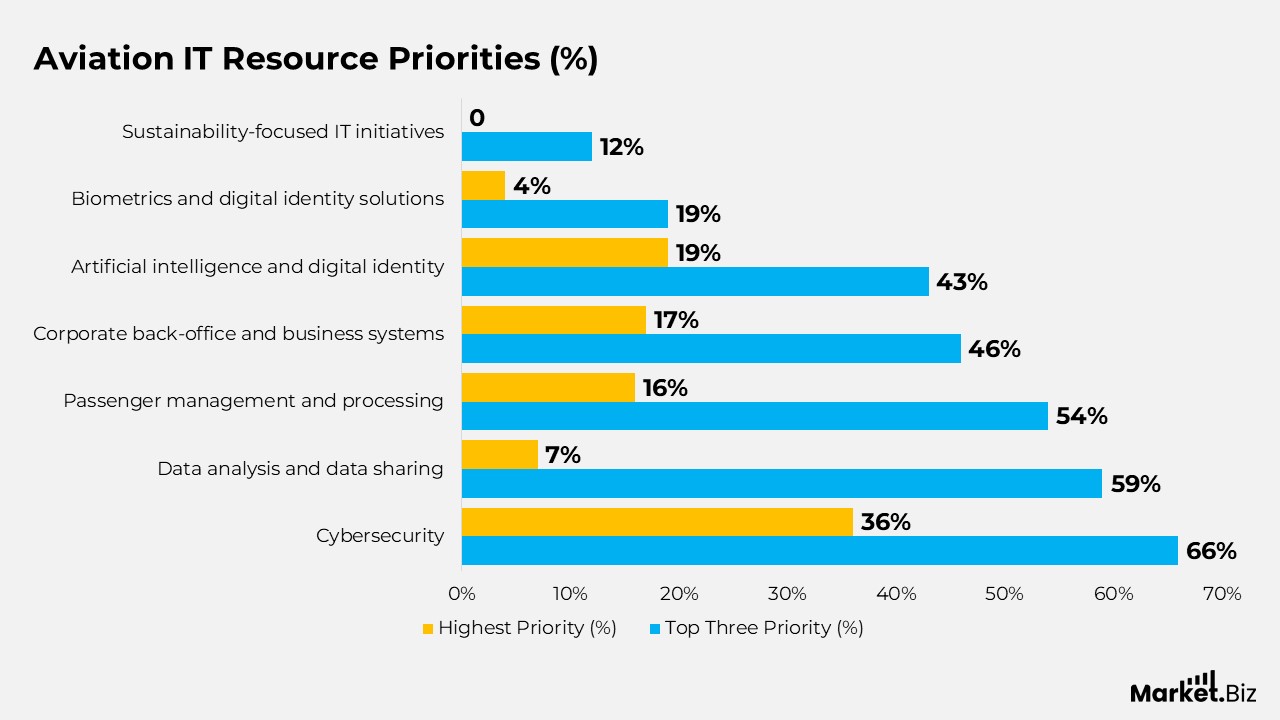
- Cybersecurity stands out as the leading IT focus area for aviation organizations in 2025, with 66% ranking it among their top three priorities and 36% identifying it as the single highest priority.
- Data analysis and data sharing rank next, with 59% of respondents placing them in their top three IT priorities, though only 7% consider them their top priority, indicating broad importance but lower urgency.
- Passenger management and processing systems remain a major focus, as 54% of organizations include them in their top three priorities and 16% rank them as their top IT investment area.
- Corporate back-office and business systems continue to receive attention, with 46% of respondents listing them among top priorities and 17% assigning them the highest priority.
- Artificial intelligence implementation and digital identity initiatives are gaining traction, with 43% of organisations ranking them among their top three priorities and 19% selecting them as their top focus area.
- Biometrics and digital identity solutions are a secondary priority for many organisations, ranking in the top three for 19% of respondents, while only 4% rank them as the top priority.
- Sustainability-focused IT initiatives remain relatively low on the priority list, with only 12% including them among their top three priorities, reflecting selective, longer-term investment planning.
(Sources: Sita Aero, Statista)
Key Areas of Highest IT Investment in Aviation
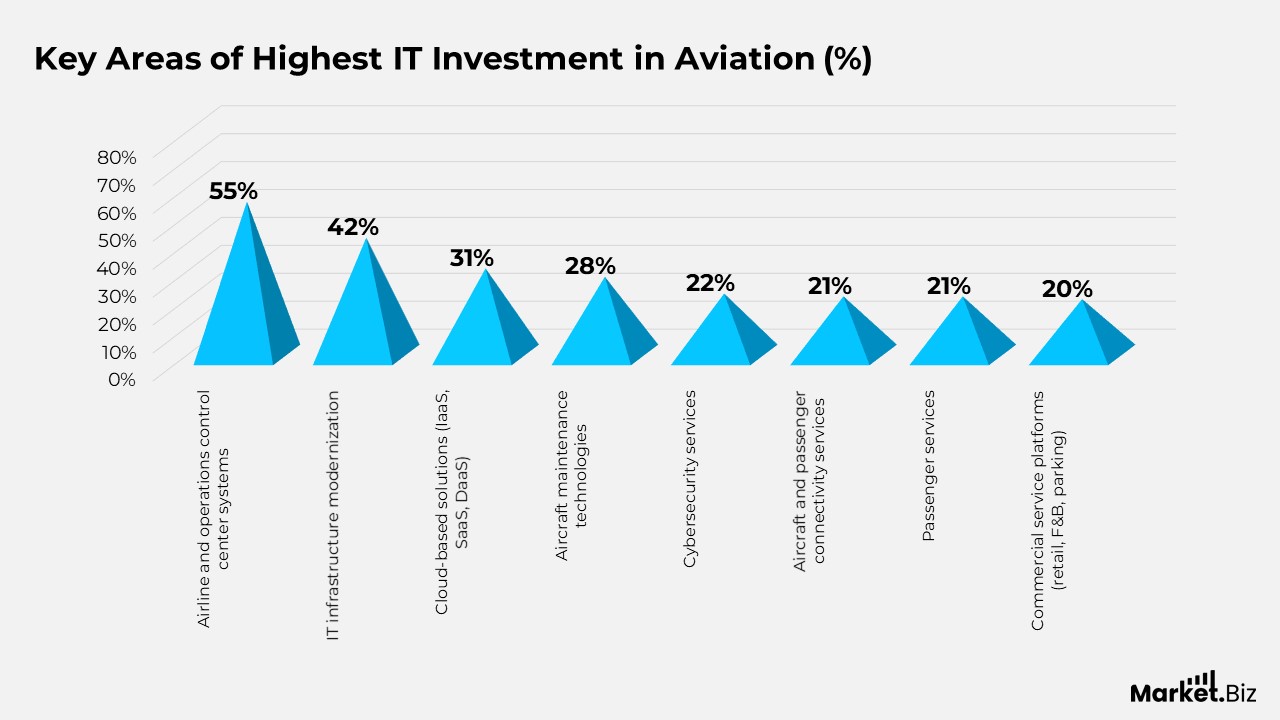
- Airline and operations control centre systems receive the highest level of IT investment, with 55% of aviation organisations prioritising real-time flight operations and optimisation tools.
- IT infrastructure modernisation ranks second, with 42% of organisations investing in deploying new infrastructure or upgrading existing systems to support growing digital demands.
- Cloud-based solutions continue to attract strong investment, with 31% of organisations allocating budgets to infrastructure-as-a-service, software-as-a-service, and desktop-as-a-service models.
- Aircraft maintenance technologies account for 28% of IT investment focus, driven by the need for real-time aircraft data collection, analytics, and data distribution.
- Cybersecurity services represent a growing investment area, with 22% of organizations allocating higher budgets to protect critical aviation systems and data assets.
- Aircraft and passenger connectivity services are prioritized by 21% of organizations, reflecting increased demand for in-flight connectivity and seamless digital passenger experiences.
- Passenger services also receive significant attention, with 21% of respondents investing in digital tools to enhance traveller engagement and service delivery.
- Commercial service platforms, including retail, food and beverage, and parking systems, attract IT investment from 20% of aviation organizations.
(Sources: Sita Aero, Statista)
Top Technology Investment Priorities in Aviation
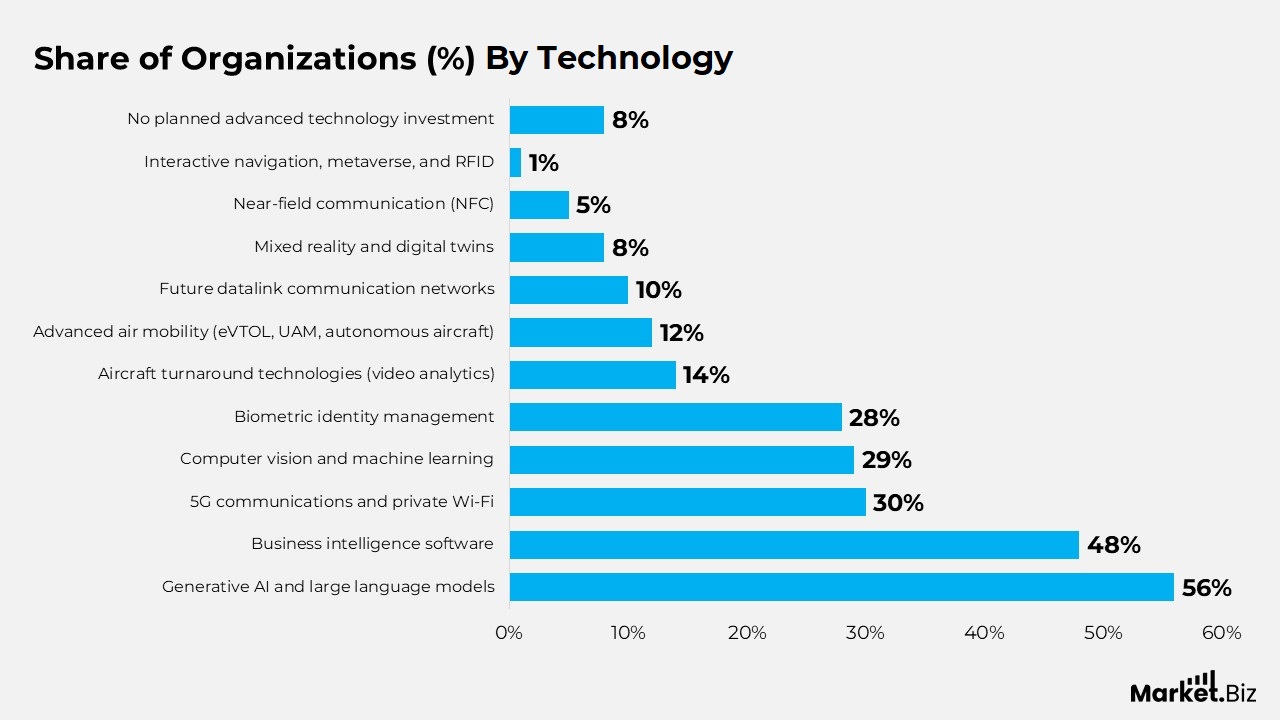
- Generative AI and large language models represent the leading technology focus, with 56% of aviation organizations planning to allocate the highest level of resources to these solutions.
- Business intelligence software follows closely, as 48% of organizations prioritize advanced analytics to support data-driven operational and strategic decisions.
- Connectivity upgrades remain a major focus area, with 30% of respondents investing heavily in 5G communications and private Wi-Fi networks.
- Computer vision and machine learning technologies are attracting significant attention, with 29% of organisations allocating resources to automation, monitoring, and predictive capabilities.
- Biometric identity management solutions for passengers and staff are prioritised by 28% of organisations, reflecting a growing emphasis on secure, seamless identity verification.
- Aircraft turnaround technologies, including video analytics, receive focused investment from 14% of respondents to improve operational efficiency and on-ground performance.
- Advanced air mobility initiatives, such as eVTOL, urban air mobility, and autonomous aircraft systems, account for 12% of planned technology investment.
- Future datalink communication networks, including hyper-connected air traffic management systems, are prioritized by 10% of organizations.
- Emerging digital solutions, including mixed reality (e.g., digital twins and augmented or virtual reality technologies), attract 8% of investment focus.
- Near-field communication technologies used for checkpoints and payments are selected by 5% of respondents.
- A smaller share of organizations allocate resources to interactive navigation systems, metaverse services, and RFID tracking, each accounting for 1% or less.
- Approximately 8% of respondents report no planned investment in any of the listed advanced technologies over the next twelve months.
(Sources: Sita Aero, Statista)
Top Technology Investment Priorities in Aviation
- Generative AI and large language models represent the leading technology focus, with 56% of aviation organizations planning to allocate the highest level of resources to these solutions.
- Business intelligence software follows closely, as 48% of organizations prioritize advanced analytics to support data-driven operational and strategic decisions.
- Connectivity upgrades remain a major focus area, with 30% of respondents investing heavily in 5G communications and private Wi-Fi networks.
- Computer vision and machine learning technologies are attracting significant attention, with 29% of organisations allocating resources to automation, monitoring, and predictive capabilities.
- Biometric identity management solutions for passengers and staff are prioritised by 28% of organisations, reflecting a growing emphasis on secure, seamless identity verification.
- Aircraft turnaround technologies, including video analytics, receive focused investment from 14% of respondents to improve operational efficiency and on-ground performance.
- Advanced air mobility initiatives, such as eVTOL, urban air mobility, and autonomous aircraft systems, account for 12% of planned technology investment.
- Future datalink communication networks, including hyper-connected air traffic management systems, are prioritized by 10% of organizations.
- Emerging digital solutions, including mixed reality (e.g., digital twins and augmented or virtual reality technologies), attract 8% of investment focus.
- Near-field communication technologies used for checkpoints and payments are selected by 5% of respondents.
- A smaller share of organizations allocate resources to interactive navigation systems, metaverse services, and RFID tracking, each accounting for 1% or less.
- Approximately 8% of respondents report no planned investment in any of the listed advanced technologies over the next twelve months.
(Sources: Sita Aero, Statista)
Aviation Data Platform Integration and AI Readiness
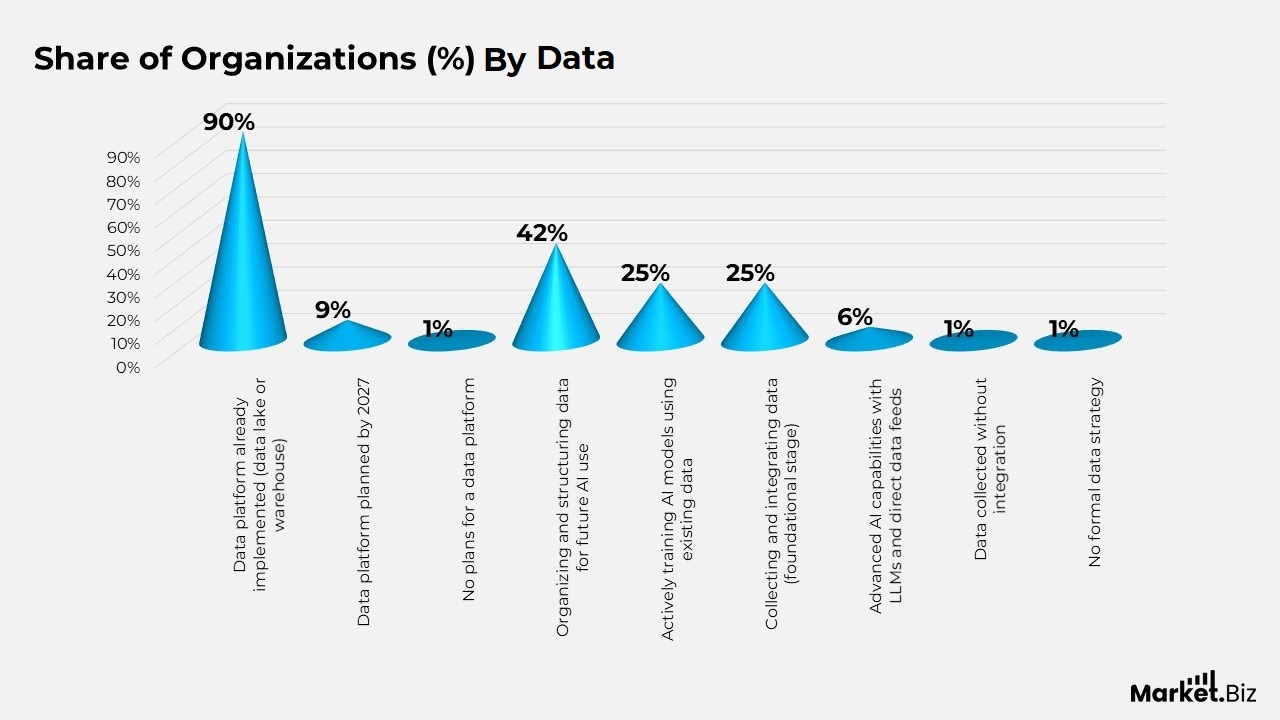
- Data platform adoption is already widespread across the aviation sector, with 90% of organisations reporting that a data platform, such as a data lake or data warehouse, is already in place.
- A further 9% of organizations plan to have a data platform in place by the end of 2027, indicating near-universal adoption in the medium term.
- Only 1% of respondents report having no plans to implement a centralized data platform, showing minimal resistance to data integration initiatives.
- In terms of data and AI maturity, 42% of aviation organizations are currently focused on organizing and structuring data to support future AI initiatives.
- Around 25% are actively training AI models using the data they collect, reflecting early-stage but practical AI deployment.
- Another 25% primarily focus on collecting and integrating data, suggesting foundational data management efforts are still ongoing.
- A smaller group, 6%, has advanced capabilities in place, including large language models with direct data feeds supporting AI-driven operations.
- Only 1% of organisations collect data without integration, and another 1% report having no formal data strategy, indicating that data immaturity is now rare in the aviation industry.
(Sources: Sita Aero, Statista)
Current Applications of Artificial Intelligence in Aviation Operations
- Cybersecurity is the most common area for AI deployment, with 78% of aviation organizations using AI tools to detect threats, monitor anomalies, and strengthen digital defences.
- Customer service and passenger communications follow closely, as 74% of organisations use AI in chatbots, virtual assistants, and automated service interactions.
- Flight optimisation is a major use case, with 56% of respondents leveraging AI to improve routing efficiency, fuel usage, and scheduling decisions.
- Passenger processing in retail environments is supported by AI in 51% of organisations, thereby enhancing personalisation and transaction efficiency.
- Automated predictive insights for flight disruption events are used by 50% of operators, helping them anticipate delays and manage operational risks.
- 46% adopt simulation capabilities for optimal decision-making, supporting scenario planning and operational resilience.
- Operational condition and disruption planning uses AI in 43% of aviation organizations to improve response coordination.
- Passenger processing for core operations is AI-enabled in 42% of cases, streamlining check-in, boarding, and flow management.
- AI-driven tools for understanding passenger preferences and behaviors are used by 39%, supporting targeted services and experience optimization.
- Real-time information notification via passenger mobile data platforms is applied by 36% of organizations.
- Baggage processing benefits from AI adoption in 36% of aviation operations, reducing mishandling and improving tracking accuracy.
- s30% of respondents reported using AI to integrate and automate solutions across airline communication and operational systems.
- AI supports scalable airline operations, including ramp-up and ramp-down based on demand, in 29% of organizations.
- Human resources support functions leverage AI in 29%, particularly for workforce planning and internal services.
- In 29% of cases, communication between airline service stakeholders is AI-enabled to improve coordination.
- AI-driven tools for tracking aircraft turnaround are used by 27% of organizations.
- AI-supported mobile device integration for staff access to operational information is supported by 27% of aviation organisations.
(Sources: Sita Aero, Statista)
Major IT and Data Challenges Facing Airlines
- Transforming business processes and organizational culture remains the most significant challenge, cited by 53% of airlines, highlighting that change management extends beyond technology deployment.
- Building agile and flexible work structures is a key concern for 31% of airlines as they adapt to rapidly changing operational demands.
- Managing cyber threats and complying with evolving regulations are identified as major challenges by 30% of respondents, reflecting growing security and compliance pressures.
- Using data effectively to improve operational efficiency remains difficult for 23% of airlines, despite increased data availability.
- Data maturity remains a constraint for 23% of organisations, indicating gaps in governance, quality, and readiness for analytics.
- Democratising data access across airline teams is a challenge for 20% of organisations as they work to enable broader data-driven decision-making.
- Securing financing for IT and data programs is cited by 19% of airlines, underscoring budget prioritization challenges.
- Data sharing between airports, airlines, and external partners presents difficulties for 18% of respondents due to interoperability and governance issues.
- Integrating data across systems is a challenge for 16% of airlines, reflecting legacy infrastructure and system silos.
- Collecting and consuming aircraft data in real time is reported as a challenge by 13%, highlighting technical and operational constraints.
- Retaining and recruiting skilled IT staff remains an issue for 12% of airlines amid competitive talent markets.
- Leveraging technology to support cross-department sustainability objectives is a concern for 6% of respondents.
- Adherence to and adoption of airport data governance frameworks challenges 4% of airlines.
- Integrating large language models into AI workflows is a challenge for 3% of respondents, indicating early-stage adoption.
- Lack of real-time data from external stakeholders affects 1% of airlines.
- Diversifying IT offerings for commercial or self-funded initiatives is also cited by 1% of respondents.
(Sources: Sita Aero, Statista)
Conclusion
In conclusion, aviation cybersecurity statistics highlight how deeply cyber resilience has become embedded in the industry’s operational and safety priorities. As airlines and airports expand their use of connected systems, cloud platforms, and data-driven technologies, investment in cybersecurity, IT infrastructure, and advanced analytics continues to rise. However, the data also reveals ongoing challenges, including sophisticated threat activity, regulatory pressures, legacy system constraints, and uneven levels of data and cyber maturity.
While cyber security is increasingly treated as a strategic priority rather than a technical add-on, long-term effectiveness depends on coordinated governance, skilled talent, and the integration of security into broader digital transformation initiatives. Overall, these trends confirm that robust cybersecurity is essential to maintaining safe, reliable, and trusted aviation operations in a highly interconnected environment.
FAQ’s
Aviation cybersecurity refers to the principles, frameworks, and practices used to protect aviation systems, networks, data, and digital infrastructure from cyber threats. It encompasses both information technology and operational technology environments that support flight operations, airport management, and air traffic control.
Aviation cybersecurity statistics capture measurable data on cyber risk exposure, security preparedness, technology adoption, and incident trends within the aviation sector. These statistics provide a structured way to evaluate how cyber threats evolve and how effectively organizations respond over time.
Cybersecurity is critical in aviation because digital systems directly support safety-critical operations, passenger services, and airspace management. A cyber incident can disrupt operations, compromise sensitive data, or affect system integrity, making cyber resilience essential to overall aviation safety.
In theory, cyber threats can affect aviation by undermining system availability, data integrity, and operational continuity. Attacks may target communication networks, navigation systems, passenger data platforms, or operational software, leading to cascading operational and safety risks if not properly managed.
Data and connectivity form the foundation of modern aviation operations, enabling real-time decision-making, automation, and system integration. From a cybersecurity perspective, increased connectivity expands the attack surface, making robust data governance and secure system design essential.