









Introduction
CRISPR Statistics: CRISPR (Clustered Regularly Interspaced Short Palindromic Repeats) has significantly advanced the field of genetic research by providing precise and efficient gene-editing tools. Since its inception, CRISPR has driven groundbreaking progress across medicine, agriculture, and biotechnology.
This technology enables scientists to accurately alter DNA, offering potential solutions for genetic diseases, improved crop resilience, and the development of disease-resistant organisms. In medicine, CRISPR enables targeted therapies for conditions such as sickle cell anemia and cystic fibrosis, while in agriculture, it helps develop crops that can better withstand disease and environmental challenges.
As CRISPR technology continues to evolve, it opens up tremendous opportunities for further scientific breakthroughs. Ongoing research, clinical trials, and regulatory developments highlight its expanding impact. The statistics on CRISPR reflect its transformative potential, offering valuable insights into its current applications, challenges, and future role in advancing genetic research and industry innovation.
Editor’s Choice
- More than 100 clinical trials globally are exploring CRISPR-based treatments for genetic disorders such as sickle cell anemia, muscular dystrophy, and various cancers.
- In 2024, CRISPR research attracted over USD 2.8 billion in global funding, reflecting the growing interest and investment in gene-editing technologies.
- With more than 10,000 scientific publications, CRISPR is a significant focus of ongoing research across diverse fields.
- In 2024, more than 1,000 CRISPR-related patents were granted worldwide, underscoring its commercial potential and broad industry interest.
- Ethical and policy discussions surrounding CRISPR have gained momentum, with over 50 countries implementing guidelines and regulations to address ethical concerns.
- Investments in CRISPR technology are increasing rapidly, driven by substantial funding from government agencies, biotech companies, and venture capitalists.
- Leading countries like the United States, China, and the United Kingdom are at the forefront of CRISPR technology development and research.
CRISPR Technology Market Size Statistics
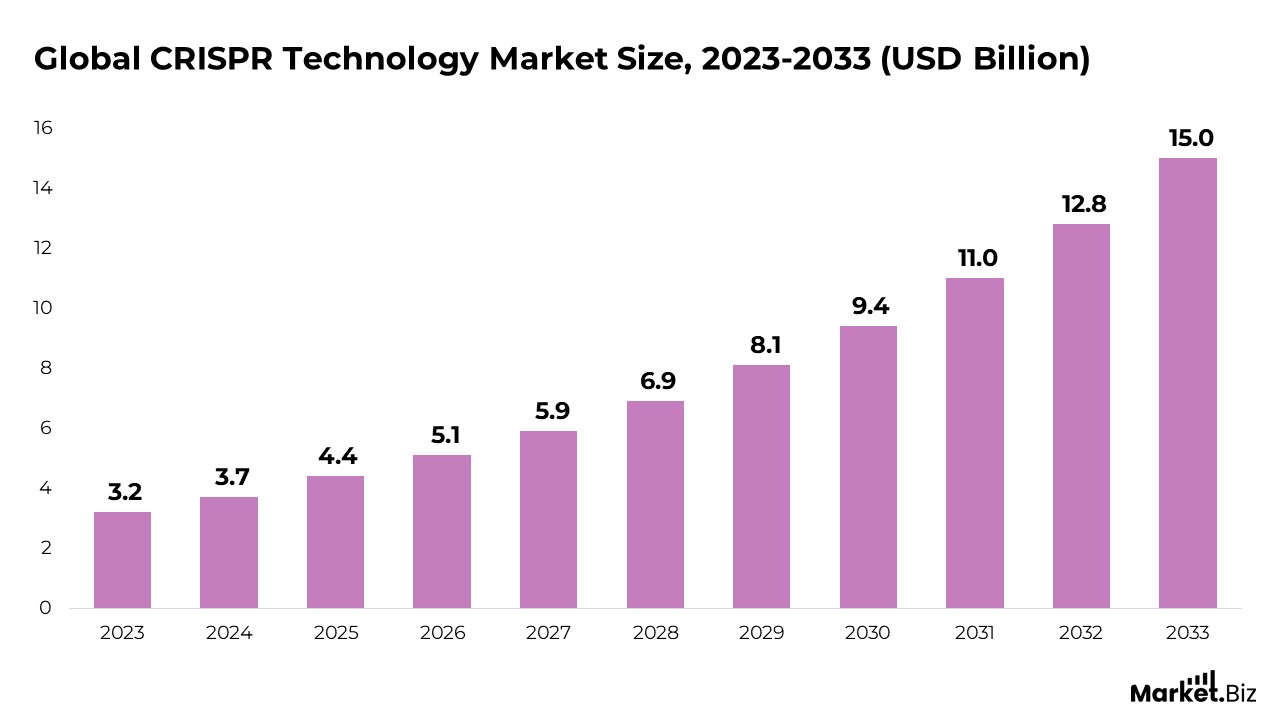
- According to Market.us, the global CRISPR technology market is projected to grow from $4.4 billion in 2025 to $12.8 billion by 2032, reflecting a compound annual growth rate (CAGR) of 16.7% from 2023 to 2033.
- The expansion of the CRISPR market is driven by the rising demand for precision medicine, broader applications in agriculture and livestock, increased investment in biotechnology, and a growing need for personalized treatments.
- In 2023, CRISPR-based products accounted for 64% of the market, indicating widespread acceptance and demand. These products serve diverse applications, ranging from gene therapy and agriculture to pharmaceuticals and research tools. CRISPR enables scientists to manipulate genes with unmatched precision and specificity.
- CRISPR technology holds a significant 45% market share in biomedical applications, which include gene therapy, precision medicine, disease modeling, and drug discovery. Researchers and healthcare providers leverage CRISPR’s accuracy to deliver personalized treatments for genetic disorders, cancer, and infectious diseases.
- The pharmaceutical and biopharmaceutical sectors lead the adoption of CRISPR technology, accounting for 42% of the market share. These companies use CRISPR for drug discovery, target identification, and preclinical research, and to accelerate the development of novel therapeutics and biologics for a range of diseases.
- North America led the market with a 38% revenue share in 2023, followed closely by Europe, driven by advanced R&D infrastructure and increased research investments.
- The Asia-Pacific region is expected to experience significant growth, driven by its reliance on agriculture and the rising incidence of genetic disorders and infertility.
(Source: Market.us)
Key Moments in the History of CRISPR Statistics
| Date | Event |
|---|---|
| December 1987 | Discovery of the CRISPR device |
| 18 Jan 2000 | Identification of additional clustered repeats in archaea and bacteria, named Short Regularly Spaced Repeats |
| March 2002 | First publication of the term ” Cas9-CRISPR “ |
| 2005 | Jillian Banfield and Jennifer Doudna began investigating CRISPR |
| 1 Aug 2005 | First commercialisation of CRISPR-Cas9 technology |
| 11 Nov 2005 | American scientists recognized new families of Cas genetic factors aiding in bacterial protection. |
| 23 Mar 2007 | First demonstration of CRISPR with Cas9 DNA segment protecting bacteria from viruses |
| 2008 | Gene is the molecular objective of most CRISPR-Cas classifications. |
| February 2008 | Introduction of the duration ‘protospacer’ for viral sequences corresponding to ‘spacers’ in CRISPR-Cas9 |
| August 2008 | RNA dispensation pathway in the CRISPR system is characterized |
| December 2008 | Hinxton Group’s concerns statement addressing moral and ethical questions on CRISPR |
| 2011 | Proposal for CRISPR-Cas method classification |
| March 2011 | Jennifer Doudna and Emmanuelle Charpentier began working on the Cas9 enzyme. |
| April 2012 | The first report on gene editing in human embryos has ignited a global ethical debate. |
| May 2012 | Primary patent submission for CRISPR-Cas9 submitted |
| 17 Aug 2012 | Journal of novel gene editing technique expanding the CRISPR-Cas9 method |
| 25 Sep 2012 | Vilnius University circulated on the likelihood of CRISPR-Cas9 for DNA editing. |
| 12 Dec 2012 | Fast-track CRISPR-Cas9 application submitted to the US patent workplace |
| January 2013 | CRISPR-Cas used in human genome elimination |
| January 2013 | CRISPR-Cas is used to edit the zebrafish genome. |
| February 2013 | CRISPR-Cas is used to program gene activation and repression. |
| March 2013 | CRISPR-Cas was utilized in the genome removal of Saccharomyces cerevisiae (yeast) |
| 1 Apr 2013 | CRISPR-Cas is used to regulate endogenous infectious genes. |
| August 2013 | CRISPR-Cas is used to engineer a rat’s genome. |
| August 2013 | CRISPR-Cas engineers plant genomes, including wheat, rice, sorghum, Arabidopsis, and tobacco. |
| March 2015 | Use of CRISPR/Cas9 with stem cells for transgenic pig organs for human transplant possibilities |
| 26 Mar 2015 | US researchers call for a moratorium on genome editing in human germline cells. |
| 15 Apr 2015 | NIH announces no funding for genome editing expertise in human embryos |
| 22 Apr 2015 | UK Nuffield Council on Bioethics forms working group for genome editing policies |
| 1 May 2015 | A new base-elimination technique has been developed to alter genomes without cleaving DNA or requiring a donor template. |
| 2 Sep 2015 | Leading UK investigation associations support other genome and CRISPR editing techniques. |
| 11 Sep 2015 | CRISPR/Cas9 is used to genetically modify mosquitoes to prevent malaria genetically genetically. |
| 15 Sep 2015 | UK Nuffield Council workshop discusses ethical implications of genome editing. |
| 18 Sep 2015 | UK researchers seek a license to transform human embryos for genetic study. |
| 25 Sep 2015 | Novel protein Cpf1 discovered for simplified gene editing |
| 5 Oct 2015 | CRISPR/Cas9 was used to modify 60 genetic factors in pig embryos for potential human organ transplants |
| 6 Oct 2015 | UNESCO calls for a ban on hereditary excision of human germline |
| 16 Nov 2015 | US researchers have developed a method for overwriting alterations made by CRISPR/Cas9. |
| 23 Nov 2015 | CRISPR is used to edit gene limitations in pre-implantation human embryos to inhibit heart disease |
| 1 Dec 2015 | International Summit on Human Gene Editing discusses ethics, science, and governance. |
| 31 Dec 2015 | CRISPR is used to target the muscle in a mouse model of Duchenne muscular dystrophy |
| 6 Jan 2016 | Improved CRISPR/Cas9 developed with concentrated off-target DNA disruptions |
| 1 Feb 2016 | UK scientists have approved the genetic modification of human embryos with CRISPR-Cas9. |
| 16 May 2016 | U.S. nationwide colleges approve CRISPR in germline trials. |
| 21 Jun 2016 | First clinical experimental disbursing CRISPR/Cas9 greenlit by NIH for patient treatment |
| February 2017 | Antibodies targeting Cas9 proteins have been identified, affecting the risk of gene therapy. |
| 13 Apr 2017 | CRISPR is a sensitive diagnostic instrument for RNA or DNA targets |
| 13 May 2017 | CRISPR was used to remove HIV in sick mice |
| 2 Aug 2017 | Recent developments in base editing using CRISPR have been reported to alter specific DNA nucleotides. |
| September 2017 | Human embryos modified to study infertility bases using CRISPR-Cas9. |
| 23 Sep 2017 | Gene related to beta-thalassemia edited in humanoid embryos utilizing the base elimination method. |
| 25 Oct 2017 | New RNA editing technique published |
| 25 Oct 2017 | Chinese scientist Jiankui has announced the birth of primary gene-modified babies. |
| 5 Jan 2018 | CRISPR restores the efficacy of chemotherapy in lung cancer treatment. |
| 27 Aug 2018 | First CRISPR-Cas9 clinical trial launched. |
| 24 Nov 2018 | Chinese scientist Jiankui has pronounced the first gene-modified babies. |
| 14 Dec 2018 | The novel gene modification technique CRISPR regulates gene expression. |
| 21 Dec 2018 | A novel DNA-editing method termed ‘prime editing’ has been reported. |
| 23 Jan 2019 | CRISPR is utilized to regulate genetic traits in mice. |
| 30 Jul 2019 | WHO calls for a ban on investigations important to gene-edited babies |
| 21 Oct 2019 | Research casts doubt on the safety of CRISPR-Cas9 for human embryo modification. |
| 30 Dec 2019 | A scientist in China, Jiankui, was imprisoned for using CRISPR on human children. |
| 4 Mar 2020 | A small clinical trial demonstrates CRISPR’s potential to enhance immune cells’ ability to fight cancer. |
| June 2020 | The first patient receives CRISPR therapy, flexibly managed, with interest in the body. |
| 7 Oct 2020 | The Nobel Prize in Chemistry was awarded to Doudna and Charpentier for their pioneering work in changing the CRISPR-Cas9 gene-editing technology. |
| 27 Sep 2022 | FDA approves Vertex’s submission for CRISPR-based therapy to treat sickle cell disease and beta-thalassemia |
| 10 Nov 2022 | The UK grants conditional approval for a primary CRISPR-Cas9 gene therapy for blood disorders. |
| 23 Nov 2022 | New CRISPR tools found in thousands of phages |
| 15 Nov 2023 | UK gives conditional approval for primary CRISPR-Cas9 gene therapy for blood disorders. |
| 6 May 2024 | CRISPR gene therapy shows promise for inherited vision loss in phase 1/2 trial |
(Source: National Institute of Health, What is Biotechnology)
NIH Support for CRISPR-Related Research Statistics
The growing potential of CRISPR-Cas9 gene editing is evident in the rapid increase in federal research funding and scientific publications on CRISPR.
| Fiscal Year | Number of Projects | Total Funding (Dollars) |
|---|---|---|
| 2011 | 7 | $5,070,129 |
| 2012 | 9 | $7,432,520 |
| 2013 | 30 | $12,505,507 |
| 2014 | 161 | $85,298,742 |
| 2015 | 551 | $267,055,410 |
| 2016 | 1,245 | $603,205,999 |
| 2017 | 2,031 | $947,465,783 |
| 2018 | 2,651 | $1,155,385,840 |
| Total | 6,685 | $3,083,419,930 |
(Source: Congressional Research Service)
Trend of CRISPR-Related Publications Statistics
| Fiscal Year | Number of Projects |
|---|---|
| 2011 | 87 |
| 2012 | 137 |
| 2013 | 300 |
| 2014 | 670 |
| 2015 | 1,457 |
| 2016 | 2,594 |
| 2017 | 3,738 |
| 2018 | 3,917 |
| Total | 12,900 |
(Source: Congressional Research Service)
Investment and Funding for CRISPR Statistics
- In March 2025, the Charcot-Marie-Tooth Association (CMTA) secured $300,000 in funding for a gene editing initiative to develop a CRISPR-based therapy for CMT2A. The CMTA Strategy to Accelerate Research (CMTA-STAR) project focuses on creating a unified solution for multiple MFN2 mutations, opening doors for future genetic treatments for CMT.
- In March 2025, Synvect, Inc. raised $3 million to expedite the development and deployment of its CRISPR-based technology.
- In January 2025, the Innovative Genomics Institute received $1.25 million from the Rett Syndrome Research Trust (RSRT) to enhance CRISPR tools for brain editing. This research aims to develop CRISPR-based therapies for Rett syndrome, a severe neurodevelopmental condition.
- In January 2025, Colossal Biosciences, a de-extinction company, raised $200 million from TWG Global to further develop its genetic engineering technologies.
- In January 2024, Xcellerant Ventures raised $10 million to support CRISPR QC, a platform designed to precisely analyze the quality of the CRISPR/Cas9 gene editing system.
- In February 2023, CRISPR Therapeutics secured $280 million in funding to advance ongoing clinical trials in oncology, cardiovascular diseases, and diabetes, and to further accelerate its autoimmune and in vivo gene-editing programs.
(Source: Company Press Release)
Applications of CRISPR
- Gene Editing: CRISPR enables precise genetic modifications across various organisms, including plants, animals, and humans. It holds great promise for treating genetic disorders by correcting or modifying defective genes that cause these conditions.
- Biomedical Research: CRISPR allows researchers to explore gene function by selectively disabling or modifying genes in model organisms. This facilitates a deeper understanding of gene functions and identifies potential therapeutic targets.
- Disease Modeling: With CRISPR, scientists can create animal models with specific genetic mutations to study diseases and evaluate potential treatments. This provides valuable insights into disease mechanisms and aids in the development of new therapies.
- Therapeutics: CRISPR-based therapies offer a promising avenue for treating genetic disorders and certain cancers. Researchers are investigating various approaches, such as gene replacement, correction, regulation, and maintenance, as potential treatment solutions.
- Bioengineering: CRISPR is a powerful tool in bioengineering, enabling the modification of microorganisms for various applications, including biofuel production, drug development, and the synthesis of valuable chemicals.
(Source: National Institute of Health, ScienceDirect)
Top CRISPR Startups Across the Globe Statistics
Editas Medicine
- Editas Medicine is developing various potential therapies to treat various genetic disorders. Their flagship program, EDIT-101, is an investigational gene-editing treatment targeting Leber congenital amaurosis type 10 (LCA10), a rare inherited retinal disease. EDIT-101 seeks to correct a mutation in the CEP290 gene associated with LCA10.
- Editas Medicine raised approximately $120 million to advance its CRISPR technology and genome-editing initiatives.
- The company has also entered into a three-year research and development (R&D) collaboration with the San Raffaele Telethon Institute for Gene Therapy to advance next-generation stem cell and T-cell therapies for the treatment of rare diseases.
- In 2021, Editas Medicine secured $210 million in funding for its CRISPR-based gene-editing projects, representing a fivefold increase from the funding received in 2017.
(Source: Statista)
CRISPR Therapeutics AG
- CRISPR Therapeutics boasts a strong clinical pipeline of investigational therapies. As of September 2021, the company was conducting clinical trials for several programs, including CTX001 for beta-thalassemia and sickle cell disease, CTX110 for relapsed or refractory CD19+ B-cell malignancies, and CTX120 for relapsed or refractory multiple myeloma.
- In 2021, CRISPR Therapeutics secured approximately $127 million in funding to support its ongoing research and development efforts.
(Source: Statista, Market.us)
Beam Therapeutics
- Beam Therapeutics has secured significant funding to advance its research and development initiatives.
- By April 2021, Beam Therapeutics was the leading CRISPR startup globally in funding, with a total of $222 million.
(Source: Statista, Market.us)
Barriers in CRISPR Gene Editing Techniques
- Off-Target Effects: One of the main concerns with CRISPR technology is the unintended modification of “off-target” genes, which were not meant to be altered. These unintended edits could lead to adverse outcomes, including cellular malfunction, disease progression, or other unforeseen consequences.
- Delivery Challenges: Delivering CRISPR-Cas9 to the correct target cells remains a significant hurdle. Current delivery methods, including viral vectors, microinjection, and electroporation, face limitations. For example, viral vectors may provoke immune responses, and the size of Cas9 proteins can restrict their use in certain vectors. Meanwhile, non-viral methods are less efficient and can place additional stress on the cells.
- Editing Efficiency Limitations: CRISPR-Cas9 doesn’t always achieve precise edits. Sometimes, it may cause unintended insertions or deletions at the target site (indels), resulting in frameshift mutations and other undesirable outcomes.
- In Vivo Editing: While CRISPR has shown significant promise for gene editing in cultured cells (in vitro), applying this technology to edit genes in living organisms (in vivo) presents additional challenges. These include difficulties delivering the technology inside the organism and managing potential off-target effects.
- P53 Activation: Research suggests that CRISPR-Cas9 may activate p53, a critical protein involved in cancer prevention. This protein helps repair DNA damage or triggers cell death if the damage is beyond repair. Activation of p53 could hinder CRISPR’s effectiveness or promote the selection of cells with dysfunctional p53, increasing the risk that those cells become cancerous.
(Source: National Institute of Health, Market.us)
Recent Developments
Product Launches
- In January 2025, EditCo Bio, a company specializing in cellular models and genetic engineering solutions, introduced XDel Knockout Cells, a groundbreaking advancement to transform the CRISPR gene editing landscape.
- In August 2024, CRISPR QC launched three innovative products as part of its CRISPR Analytics Platform. These new offerings provide in-depth insights into various stages of CRISPR workflows, enabling researchers to fine-tune their experiments with greater precision.
Acquisitions and Mergers
- In April 2024, Cellistic acquired the Artisan Bio technology platform, which includes the STAR-CRISPR Cas-12 gene-editing technology. It enhanced its ability to perform precise custom edits on cell therapy candidates compared with traditional CRISPR methods.
- In 2022, Vertex acquired ViaCyte and CRISPR to advance its gene-edited allogeneic stem cell therapies for diabetes treatment, utilising ViaCyte cells under the terms of its collaboration.
Consumer Trends
- In April 2024, Cellistic acquired the Artisan Bio technology platform, which includes the STAR-CRISPR Cas-12 gene-editing technology. It enhanced its ability to perform precise custom edits in cell therapy candidates compared with traditional CRISPR methods.
- In 2022, Vertex acquired ViaCyte and partnered with CRISPR to advance its gene-edited allogeneic stem cell therapies for diabetes treatment, utilising ViaCyte cells under the terms of its collaboration.
Regulatory Landscape
- In April 2024, Cellistic acquired the Artisan Bio technology platform, which includes the STAR-CRISPR Cas-12 gene-editing technology. It enhanced its ability to perform precise custom edits in cell therapy candidates compared with traditional CRISPR methods.
- In 2022, Vertex acquired ViaCyte and partnered with CRISPR to advance its gene-edited allogeneic stem cell therapies for diabetes treatment, utilising ViaCyte cells under the terms of its collaboration.
Conclusion
CRISPR Statistics: CRISPR technology has become a game-changing tool with vast potential in medicine, agriculture, and biotechnology. Its rapid development is evident in the growing number of scientific publications, increasing investments, and the broadening scope of clinical and commercial applications.
With substantial funding, improvements in gene-editing precision, and promising trial outcomes targeting genetic disorders and cancers, CRISPR is driving the future of innovative treatments and advances.
However, challenges like off-target effects, delivery difficulties, and regulatory concerns persist. As technology advances, these challenges will likely be overcome, thereby unlocking CRISPR’s full potential for transformative breakthroughs.
FAQ’s
CRISPR (Clustered Regularly Interspaced Short Palindromic Repeats) is an advanced gene-editing tool that enables scientists to precisely modify DNA in various organisms, including plants, animals, and humans. It has many applications in medicine, agriculture, and biotechnology.
Currently, there are more than 100 clinical trials worldwide using CRISPR, focusing on genetic disorders like sickle cell anemia, muscular dystrophy, and various types of cancer. CRISPR is being tested for applications ranging from gene correction to cancer immunotherapy.
The success rate of CRISPR in clinical trials varies depending on the application, but early results are promising. For example, success rates have reached 60-70% in trials for sickle cell anaemia, with patients benefiting from long-term improvements through CRISPR-based treatments.
CRISPR faces several challenges, including off-target effects (unintended genetic alterations), delivery issues (the difficulty of efficiently introducing CRISPR components into cells), and regulatory hurdles. Researchers are continually working to improve the precision of CRISPR and refine delivery methods to overcome these obstacles.
The future of CRISPR appears promising, with ongoing advances in gene-editing accuracy, delivery systems, and clinical applications. It is expected to revolutionize the treatment of genetic disorders, cancer therapies, and agricultural practices. Ongoing research and investments will likely unlock further breakthroughs and expand CRISPR’s impact in these fields.