









Introduction
DNA statistics is a specialised discipline that applies statistical methods to interpret and analyse genetic data. It plays an essential role across multiple fields, such as genetics, forensic science, evolutionary biology, and medicine. By examining genetic sequences, DNA statistics help reveal inheritance patterns, genetic variation, and evolutionary relationships among species.
In forensic science, it is used to compare DNA samples from crime scenes with potential suspects, providing vital evidence in criminal cases. Furthermore, DNA statistics are crucial in studying genetic diversity within populations and identifying the genetic factors behind diseases, aiding the development of personalised medical treatments. As sequencing technologies continue to advance, the importance of DNA statistics in these areas is growing, offering deeper insights into human biology and healthcare management.
Editor’s Choice
- DNA statistics support personalised healthcare by enabling doctors to customise treatments based on an individual’s genetic profile.
- It assists in monitoring the spread of genetic diseases, providing valuable insights for early detection and intervention.
- DNA-based statistics inform population genetics and contribute to the development of targeted public health strategies.
- The field plays an important role in shaping policy decisions related to genetic health. Ensuring more informed and effective healthcare initiatives.
- DNA profiles stored in systems like CODIS have contributed to nearly 170,000 investigations by providing crucial leads.
- 98% of human DNA is noncoding, and the scientific community is only beginning to elucidate its functions.
- 22% of jurors expect DNA evidence to be presented in every criminal trial.
- 99.9% of human genetic material is identical across all individuals.
- DNA has an indefinite half-life, but humans share roughly 50% of their DNA with bananas.
- Each cell in the human body contains 6 feet 5 inches of DNA strands.
- Human DNA is organised into 23 pairs of chromosomes, tightly packed within the cell nucleus.
- Humans share 98% of their DNA with other primates. Chimpanzees and bonobos, as well as siblings, typically share approximately 50% of their genetic material.
(Source: Seed Scientific, Forensic Science Simplified, Market.us, National Human Genome Research Institute, Nature)
DNA Modifying Enzymes Market Size
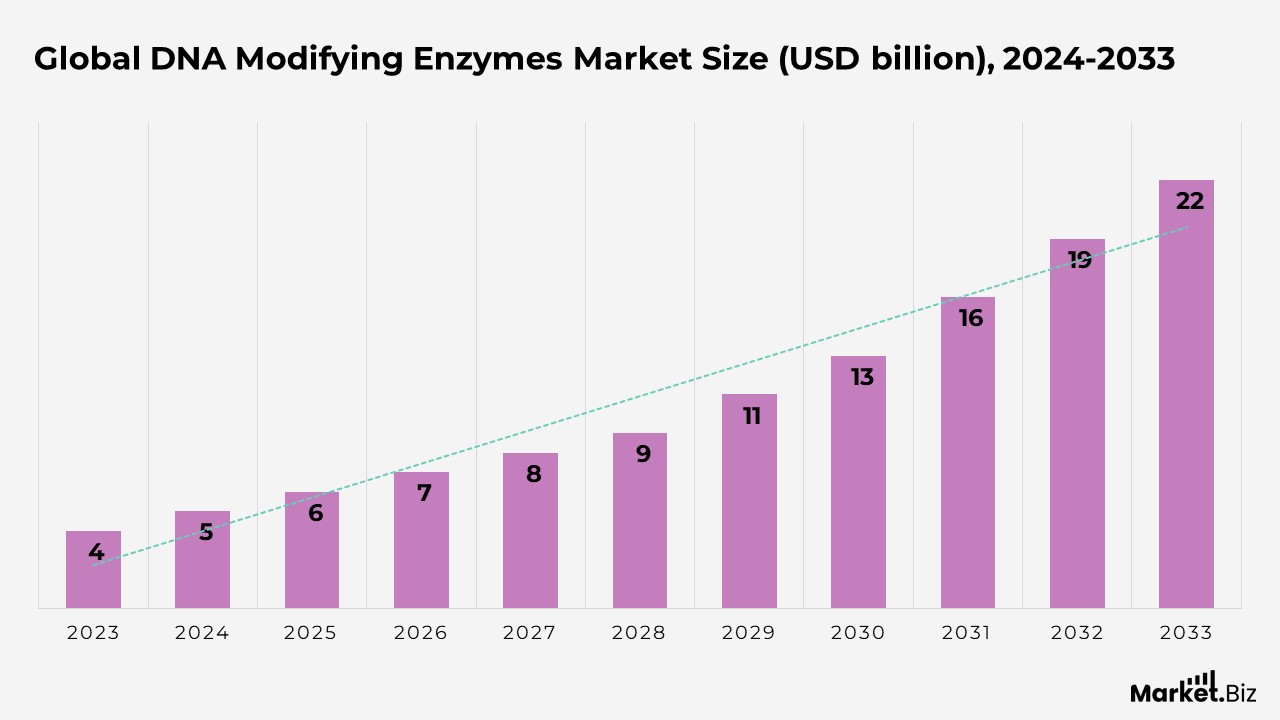
- According to Market.us, the global market for DNA-modifying enzymes is anticipated to expand from $6 billion in 2025 to $19 billion by 2032, reflecting a compound annual growth rate (CAGR) of 18.3% from 2024 to 2033.
- The expansion of the DNA-modifying enzymes market is primarily fueled by advancements in pharmaceutical and biotechnology products. Breakthroughs in gene editing technologies, rising cases of genetic diseases, improvements in DNA sequencing technologies, and growing investments in biotechnology research.
- In 2023, DNA ligases accounted for the largest share of the product category, at 41.2%. Continued advances in research and development, particularly in exploring DNA ligases as potential cancer therapies, are expected to drive market growth. Additionally, the increasing incidence of infectious diseases. Genetic disorders and higher birth rates are contributing to the widespread use of DNA ligases.
- In terms of applications, pharmaceutical and biotechnology research accounted for 59.3% of the total in 2023. DNA-modifying enzymes are critical in maintaining and expressing genetic information, making them indispensable in pharmaceutical and biotech research.
- Pharmaceutical and biotechnology companies dominate the end-user segment, accounting for 58.4% of the market. Growing consumer awareness, the expanding global population, and increased understanding of genetic disorders are expected to drive further utilisation of DNA-modifying enzymes in drug development and delivery.
- North America holds the largest share of 38.2% in the regional market, thanks to government initiatives, well-established biopharmaceutical companies, and robust technological advancements. The region’s standardised industrial infrastructure also contributes to its market leadership.
DNA Sequencing Market Size
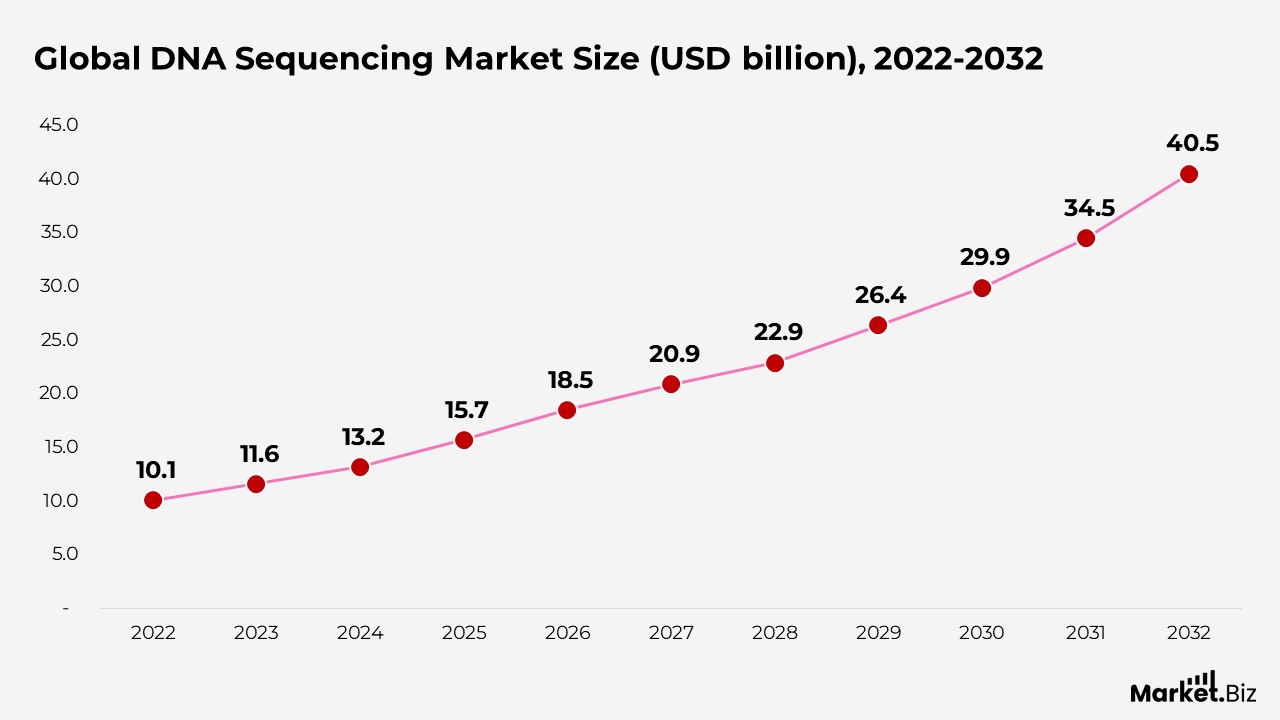
- According to Market.us, the global DNA sequencing market is projected to grow from $15.7 billion in 2025 to $40.5 billion by 2032, reflecting a compound annual growth rate (CAGR) of 15.3% from 2022 to 2032.
- The growth of the DNA sequencing market is driven by advances in sequencing technologies, declining costs, expanding applications across sectors, and the rising prevalence of genetic disorders.
- Among products, the consumables segment accounts for the largest share of revenue. This dominance is primarily due to the wide array of reagents and kits required for different stages of library preparation, including DNA fragmentation, adapter ligation, amplification, quality control, and enrichment.
- The Next-Generation Sequencing (NGS) segment holds the largest share among sequencing types and is expected to maintain this leadership through the forecast period. NGS has transformed genome sequencing by reducing costs, increasing speed, and improving accuracy, driven by continuous technological advancements and declining per-base sequencing costs.
- The oncology segment leads in terms of application revenue share. This is driven by the significant role of NGS technology in cancer research, diagnostics, and treatment development, which enables the rapid identification of clinically relevant genetic variants across multiple genes in a single test.
- The academic and research institutes segment accounts for the largest revenue share, driven by the widespread use of Next-Generation Sequencing (NGS) and Sanger sequencing technologies in research. Increased funding and investments in these institutions have further bolstered their market dominance.
- North America is expected to maintain its market leadership with a projected share of 44.3%. The region’s dominance is attributed to the growing demand for personalized medicine, an increased need for genome sequencing, and the widespread adoption of cutting-edge sequencing technologies..
Interesting Facts About DNA
Human Genome Composition
- The human genome consists of approximately 3 billion base pairs of DNA.
- Each human cell comprises 23 sets of chromosomes, totalling 46 chromosomes. These chromosomes carry 100 to 1,000 genes that provide essential instructions for protein synthesis, which are crucial for various bodily functions.
Genetic Similarity Among Humans
- Humans are 99.9% genetically identical.
- Single, 0.01% of the 3 billion base pairs in the human genome are unique to each individual. This small percentage is responsible for the genetic differences observed across the human population.
DNA Half-Life
- The half-life of DNA is estimated to be 521 years.
- Under certain conditions, such as a burial temperature of 13.1°C, DNA degradation can be slowed by up to 400-fold, potentially extending its half-life.
DNA Shared with Other Species
- Humans share approximately 50% of their DNA with bananas.
- We share about half of our DNA despite the vast differences between humans and bananas. Similarly, humans share 85% of DNA with mice and 61% with fruit flies, highlighting the surprising genetic similarities between species.
Chromosome Length
- The longest chromosomes contain around 250 million nucleotide pairs.
- Chromosomes are composed of long DNA strands that vary in length; those with more base pairs are longer.
Chromosome Organization in Humans
- Human DNA is organised into 23 pairs of chromosomes.
- The first 22 pairs are autosomes, whereas the 23rd pair comprises the sex chromosomes, which determine an individual’s biological sex. Males possess one X and Y chromosome (XY), while females have two X chromosomes (XX). The father contributes the X chromosome, while the mother contributes either an X or a Y chromosome, determining the offspring’s sex.
DNA Similarity with Primates
- Humans share 98.7% of their DNA with chimpanzees and bonobos.
- These primates are our closest living relatives, as humans, chimpanzees, and bonobos share a common ancestor estimated to have lived around six to seven million years ago.
Genes and DNA Composition
- Only about 3% of our DNA comprises genes.
- The remaining 97% remains largely unexplained, although scientists believe it plays a key role in regulating transcription and translation.
Ancient Viruses in Our DNA
- Around 8% of human DNA is derived from ancient viruses.
- Studies show that humans accumulated retroviruses over evolutionary history, which have left traces in our genetic material.
Data Storage in DNA
- One gram of DNA can store approximately 455 exabytes of data.
- To put this in perspective, 1 exabyte could hold the contents of around 320 billion King James Bible editions.
DNA Shared Between Siblings
- On average, siblings share about 50% of their DNA.
- This might seem surprising, as most assume siblings share more of their genetic code. Half-siblings share 25% of their DNA, whereas identical twins share 100%.
Environmental Impact on DNA Statistics
- DNA undergoes between 1,000 and 1,000,000 instances of damage per cell daily.
- This accumulated damage over time contributes to the gradual deterioration of DNA, as replication is not perfect and environmental factors take their toll.
Accuracy of DNA Testing Statistics
- Fewer than 10% of DNA tests are inaccurate.
- Over the years, DNA testing has improved significantly, and modern methods offer high accuracy. With frequent use, DNA testing processes continue to become more precise.
Progeria Prevalence
- Progeria, or Hutchinson-Gilford syndrome, affects approximately 1 in 200,000 newborns in the U.S.
- This condition, caused by a mutation in the LMNA gene, leads to accelerated aging. Although there is no cure, advanced DNA technology has enhanced detection methods, including the ability to identify the syndrome in fetuses.
(Source: SeedScientific)
Forensic Pathologist Earnings Potential
- DNA analysts working in forensic labs typically earn between $50,000 and $90,000 annually.
- The median salary for forensic science technicians is approximately $61,000 per year. The bottom 10% earn approximately $36,000, while the top 10% earn more than $98,000.
- Forensic pathologists, who are specialized medical doctors, command higher salaries, with annual earnings ranging from $150,000 to $300,000, influenced by experience and location.
- Forensic psychologists, who apply psychological principles in legal and criminal justice settings, typically earn between $80,000 and $100,000 annually, with compensation varying with qualifications and experience.
(Source: SeedScientific)
Recent Advancements in DNA Sequencing Statistics
Recent innovations in DNA sequencing have transformed genomics, making genetic analysis faster, more precise, and significantly more affordable. Key advancements include:
Next-Generation Sequencing (NGS)
Technologies such as Illumina and PacBio have substantially boosted sequencing throughput and reduced costs, enabling in-depth genome analysis. With remarkable speed and accuracy, these platforms facilitate whole-genome sequencing, transcriptome profiling, and epigenetic studies.
Third-Generation Sequencing
Third-generation sequencing technologies, such as Oxford Nanopore, provide real-time, long-read sequencing. This advancement overcomes the constraints of short-read sequencing methods, enhancing the accuracy of analyzing complex genomic regions and structural variants.
Single-Cell Sequencing
Single-cell RNA sequencing has gained widespread adoption, allowing scientists to explore gene expression at the level of individual cells. This technology provides critical insights into cellular diversity, advancing our understanding of development, cancer biology, and immune function.
Portable DNA Sequencers Statistics
Portable sequencing devices such as Oxford Nanopore’s MinION have made DNA analysis accessible beyond traditional laboratory settings. These mobile sequencers support on-site DNA analysis, particularly useful for field research, clinical diagnostics, and real-time outbreak monitoring.
CRISPR and Gene Editing
Advances in DNA sequencing have played a pivotal role in refining gene-editing technologies like CRISPR. These advancements enable precise tracking of CRISPR edits, facilitating more effective gene therapies and advancing the field of genetic research.
(Source: DrOmics Research Lab)
Evolution of Human Genome Sequencing
- The NHGRI projected that the procedure would cost around $300 million.
- The Human Genome Project (HGP), a global research initiative, completed the first draft of the human genome in 2001.
- The human genome comprises approximately 3 billion base pairs and encodes 20,000 to 25,000 genes.
- The HGP required an investment of roughly $2.7 billion and took 13 years to finish.
- While the initial Human Genome Project cost approximately $2.7 billion, the cost of sequencing had dropped significantly by 2008, to $10 million per complete genome sequence.
- Currently, the cost of sequencing a human genome can range from $1,000 to $2,000, depending on the technology used and the service provider.
(Source: Biostate AI)
Recent Developments
Product Launches
- In February 2025, F. Hoffmann-La Roche Ltd. introduced sequencing by expansion (SBX) technology, designed to address the limitations of current sequencing methods.
- In April 2024, NewBiologix SA unveiled its optical mapping platform and next-generation sequencing (NGS) to provide comprehensive genomic analysis services for the biopharmaceutical industry.
Investments and Fundings
- In February 2025, F. Hoffmann-La Roche Ltd. introduced sequencing by expansion (SBX) technology, designed to address the limitations of current sequencing methods.
- In April 2024, NewBiologix SA unveiled its optical mapping platform and next-generation sequencing (NGS) to provide comprehensive genomic analysis services for the biopharmaceutical industry.
Consumer Trends
- The increasing demand for personalized medicine has driven the adoption of DNA testing services, resulting in a 30% rise in direct-to-consumer genetic testing compared to the previous year.
- A growing trend is integrating genetic testing into standard healthcare practices, such as prenatal screening and personalized medicine.
Research and Development Investment
- Biotechnology firms and research institutions have dedicated significant resources to the research and development of DNA sequencing technology. Global investments in genomic advancements and market growth initiatives are estimated at $3.5 billion.
Regulatory Landscape
- Regulatory bodies have established guidelines to ensure the accuracy of DNA testing and protect privacy, enforcing compliance with quality standards and safeguarding patient confidentiality in genetic testing services.
Conclusion
DNA Statistics: DNA sequencing has undergone significant progress, marked by advancements in both technology and accessibility. What began as an expensive endeavor with the Human Genome Project has evolved into a more affordable and accessible service.
Further, the growing demand for personalized medicine, driven by consumer interest in health-related insights, has played a key role in the widespread adoption of genetic testing services.
With ongoing technological breakthroughs that lower costs and enhance efficiency. DNA sequencing is set to become a cornerstone of healthcare. Offering personalized solutions and deepening our understanding of human genetics. The future of DNA testing appears promising, with continued advances in data analysis and the integration of these services into standard healthcare practices.
FAQ’s
DNA, or deoxyribonucleic acid, is a fundamental molecule that carries the genetic blueprint for the growth, development, functioning, and reproduction of all living organisms.
DNA replication is a cellular process in which a cell creates an exact copy of its DNA. This process takes place during cell division. The two strands of the DNA molecule unwind, and each strand serves as a template for the formation of a new complementary strand. As a result, two duplicate DNA molecules are designed, each consisting of one original strand and one newly synthesized strand.
DNA sequencing is a method used to control the exact sequence of nucleotides—adenine (A), thymine (T), cytosine (C), and guanine (G)—in a DNA molecule. This technique enables scientists to analyze the genetic code, providing insights into gene structure and function, essential for studying genetics and understanding biological processes.
The reduction in DNA sequencing costs is primarily driven by advances in sequencing technologies, increased competition among service providers, and improvements in data processing and analysis.
The future of DNA sequencing is promising, with ongoing technological advancements expected to further reduce costs, accelerate processing times, and enable more detailed analyses. Moreover, the technology is likely to see broader adoption in healthcare, especially for early detection of diseases, personalized treatments, and precision medicine. Additionally, integrating artificial intelligence will play a key role in enhancing the interpretation of genetic data, thereby improving clinical outcomes.

