









Introduction
Enterprise IT Statistics provide a data-driven snapshot of how organizations design, manage, and modernize their technology environments to support core business operations and long-term growth.
These statistics reflect enterprise spending patterns, infrastructure choices, cloud adoption, cybersecurity priorities, software deployment models, and workforce transformation trends as IT becomes central to productivity, resilience, and competitiveness.
By tracking how enterprises invest in emerging technologies such as cloud computing, artificial intelligence, and automation, Enterprise IT Statistics offer clear insight into technology maturity levels, shifting investment priorities, and the expanding role of IT as a strategic business enabler across industries.
Editor’s Choice
- Agentic AI in the Enterprise IT Market size is expected to be worth around USD 182.9 Billion By 2034.
- 56% of enterprise leaders describe their organizations as strong advocates of AI adoption, highlighting growing executive confidence in enterprise AI strategies.
- Nearly 87% of enterprises have already secured leadership approval for AI initiatives, indicating strong top-level alignment on digital transformation.
- IT teams are more than 10× more likely to push for faster AI adoption than sales, marketing, HR, and customer service functions.
- Despite high interest, only 21% of enterprises have adopted AI at an organization-wide level, showing that large-scale implementation remains limited.
- 63% of enterprise leaders report that AI benefits are already visible across multiple business functions.
- Enterprises with deeply embedded AI solutions report widespread benefits at 76%, compared to just 36% among those running pilot projects.
- Workforce readiness remains a bottleneck, with only 29% of employees believing AI capability development is fully supported today.
- Generative AI use remains uneven, with 66%–91% of enterprise employees reporting no current use across most business functions.
- Agentic AI adoption is accelerating, with 41% of organizations actively investing in AI agents to support service operations and workflow automation.
- Looking ahead, 92% of enterprises plan to increase investments in generative AI over the next three years, signaling sustained momentum in enterprise IT spending.
Enterprise AI Adoption Momentum
- 56% of enterprise leaders describe their organizations as strong advocates of AI adoption, reflecting widespread internal enthusiasm for AI-driven change.
- Only 4% of enterprises do not consider AI a priority, while just 3% believe AI does not justify the attention it receives.
- IT departments are more than 10 times as likely as sales, marketing, HR, and customer service teams to push for faster AI adoption.
- Nearly 87% of enterprises report securing leadership approval to move forward with AI initiatives.
- Employees are 3 times more likely to be actively using AI tools than senior leaders expect.
(Sources: Zapier, McKinsey)
AI Resistance in the Enterprise
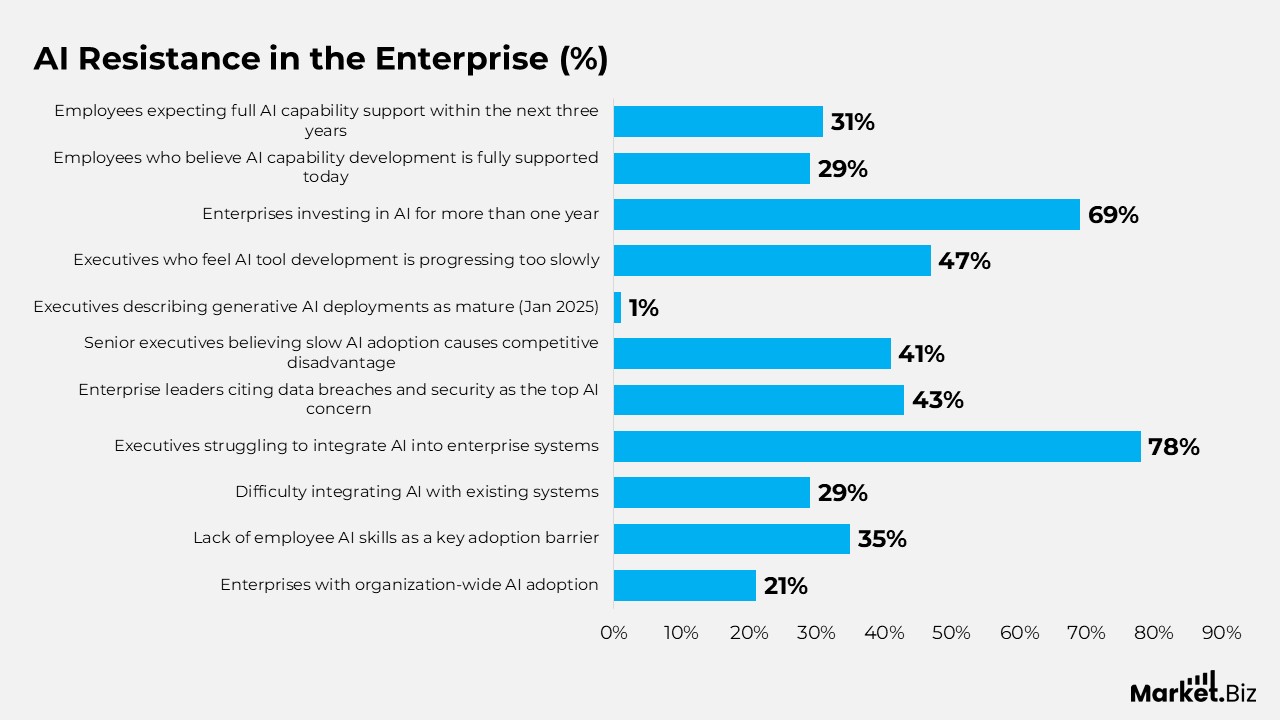
- Only 21% of enterprises have adopted AI at an organisational-wide level, indicating limited maturity in enterprise-scale deployments.
- The most common AI adoption barriers include a lack of employee AI skills (35%), system integration challenges (29%), and data quality limitations (29%).
- IT teams and executive leadership are the two internal groups most frequently responsible for delaying AI adoption initiatives.
- Around 78% of executives report continued difficulty integrating AI into existing enterprise systems.
- Data breaches and security risks are cited as the primary AI concern by 43% of enterprise leaders.
- 41% of senior executives believe that slow AI adoption is already causing their organisations to lose ground to the competition.
- As of January 2025, just 1% of executives describe their generative AI deployments as mature.
- Nearly 47% of executives feel their enterprises are progressing too slowly with AI tools, despite 69% having invested in AI for more than one year.
- Only 29% of employees believe AI capability development is fully supported today, while 31% expect full support within the next three years.
(Sources: Zapier, McKinsey)
AI Benefits in the Enterprise
- 63% of enterprise leaders believe AI benefits are already visible across multiple business functions.
- Enterprises that have deeply embedded AI into operations report widespread benefits at 76%, compared to 36% among organizations limited to pilot projects.
- Time savings rank as the leading AI benefit for 25% of enterprise leaders, significantly ahead of cost savings at 8%.
- In the second half of 2024, an average of 51% of AI-using enterprises reported cost reductions across their business operations.
- Employees with AI-related skills earn approximately 56% higher wages than those without AI expertise.
(Sources: Zapier, McKinsey, PwC)
Key AI Use Cases in the Enterprise
- Customer success management, lead management, and marketing communication represent the most widely adopted enterprise AI use cases.
- Further, marketing, IT, and project management roles show the highest levels of AI usage across enterprise environments.
- Approximately 50% of financial services IT professionals report that their organisations have active AI deployments.
- Text generation remains the most common AI application at 63%, followed by image creation at 36% and code generation at 27%.
(Sources: Zapier, McKinsey, IBM)
Enterprise AI Solutions and Vendor Challenges
- High vendor pricing is the most frequently cited challenge when enterprises evaluate AI solutions.
- Concerns about vendor security affect 38% of enterprise leaders, while 33% worry about long-term vendor dependency.
- About 23% of enterprises report difficulties integrating third-party AI tools with existing IT systems.
- Conversational AI tools dominate enterprise workflows, with large language models leading adoption.
- Roughly 78% of enterprises prefer in-house AI tools to maintain stronger control over data security and governance.
(Sources: Zapier, Writer)
The Future of AI in the Enterprise
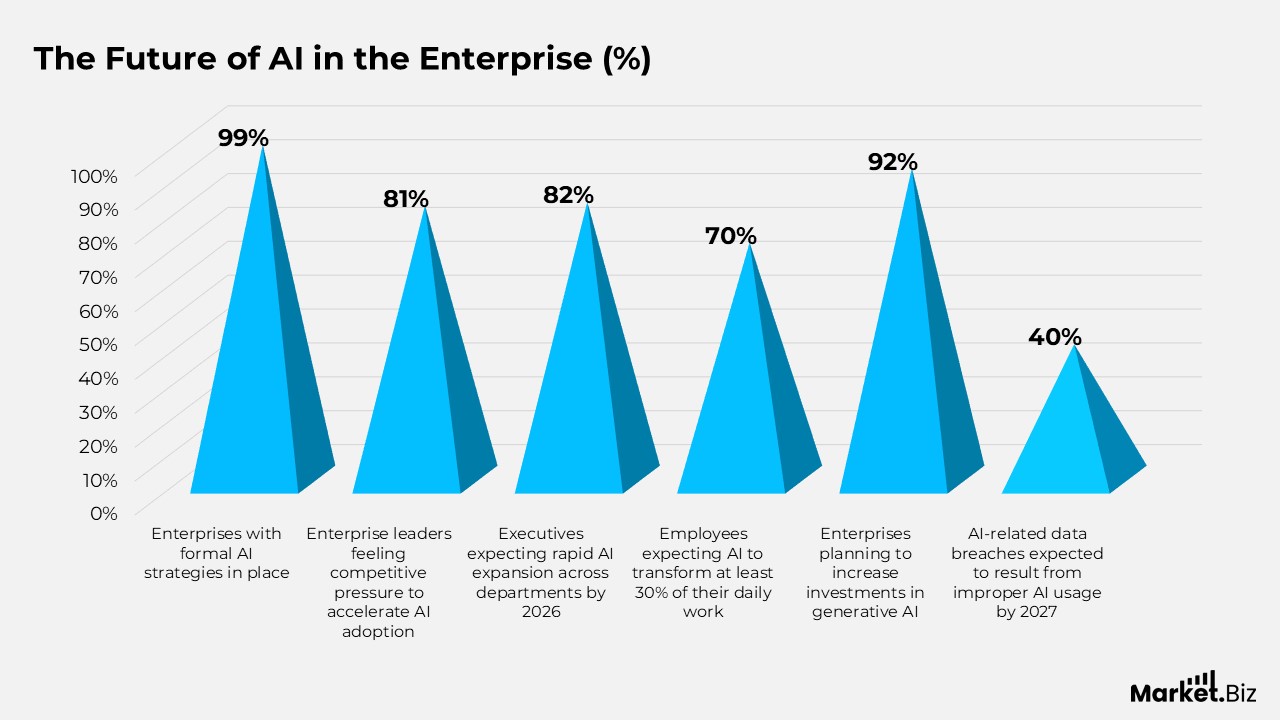
- 99% of enterprise leaders say their organizations have formal AI strategies in place.
- Around 81% of enterprise leaders feel moderate to high competitive pressure to accelerate AI adoption.
- 82% of enterprise executives expect AI usage to expand rapidly across departments by 2026.
- Over 70% of employees believe AI will transform at least 30% of their daily work within the next two years.
- 92% of enterprises plan to increase investments in generative AI over the next three years.
- By 2027, more than 40% of AI-related data breaches are expected to result from improper AI use.
(Sources: Zapier, Writer, McKinsey, Gartner)
Functional Adoption Levels of Generative AI Across the Enterprise
- Across enterprise functions, 66% to 91% of respondents report no current use of generative AI, indicating that non-adoption remains the dominant state across most business areas.
- Experimental or limited use of generative AI typically ranges from 8% to 15% across functions, indicating early-stage engagement rather than scaled deployment.
- Regular or repeat use of generative AI remains low, generally falling between 3% and 7%, depending on the function.
- Advanced or fully embedded generative AI usage accounts for only 1% to 4% of respondents across enterprise functions.
- Digitally oriented functions show relatively lower non-adoption rates at around 66% to 73%, compared to more operational or governance-heavy functions.
- Functions with higher regulatory or process constraints report non-usage levels exceeding 80%, reflecting slower AI penetration.
- Even in the most AI-exposed functions, fewer than 10% of respondents report consistent or advanced use of generative AI.
(Sources: Zapier, Writer, McKinsey)
Retail and E-Commerce Agentic AI Statistics
- 41% of organizations report active investments in AI agents, particularly to enhance case management and customer service operations that require agility and real-time responsiveness.
- By 2028, AI-powered agents are expected to manage 20% of interactions across human-facing digital storefronts.
- More than 50% of high-income millennials and 25% of baby boomers have already used or plan to use AI tools for online shopping experiences.
- AI-driven communication strategies have delivered measurable commercial outcomes, including a 9.7% rise in new sales calls, a $77 million increase in annual gross profit, and a 47% reduction in store call volumes.
- Customer experience improvements linked to agentic AI adoption are reflected in strong satisfaction metrics, including an NPS score of 65, alongside the execution of 350 production-level releases across retail locations.
(Sources: IDC, Gartner, PwC)
Agentic AI Statistics in Supply Chain and Logistics
- By 2030, nearly 50% of cross-functional supply chain management solutions are expected to rely on intelligent agents for autonomous decision execution.
- About 62% of supply chain leaders report that AI agents embedded into workflows significantly accelerate decision-making, recommendations, and communications.
- Organisations with higher AI investment levels in supply chain operations experience revenue growth that is 61% higher than that of industry peers.
- AI-powered supply chain innovations are estimated to reduce logistics costs by 15%, optimize inventory levels by 35%, and improve service performance by 65%.
- AI-driven demand forecasting solutions have achieved prediction accuracy exceeding 90%, supporting waste reduction and inventory optimization across large retail networks.
(Sources: Gartner, IBM, Microsoft)
IT and Telecommunications Industry Agentic AI Statistics
- 53% of US enterprises deploying AI agents report active use within IT operations and cybersecurity functions.
- Within the telecommunications sector, 97% of specialists are either adopting or evaluating AI solutions, while 49% are already using them operationally.
- Agentic AI is expected to account for more than 26% of global IT spending within five years, reaching approximately $1.3 trillion by 2029.
- Moreover, AI agents deployed for authentication and service management have significantly reduced reliance on human agents while maintaining strong security standards.
(Sources: PwC, NVIDIA, IDC)
Agentic AI Statistics in Legal Services
- 87% of legal professionals anticipate AI will have a major impact on the legal profession within the next five years.
- Global legal technology spending is forecast to reach $50 billion by 2027, driven by agentic AI, automation, analytics, and secure cloud adoption.
- 51% of AI executives report that AI has already delivered a transformative or high impact on their organization’s legal function.
- Further, AI-powered legal research tools have reduced research time by 60%, improved accuracy, and enabled attorneys to allocate more time to client engagement and strategic work.
(Sources: Thomson Reuters, Gartner, KPMG)
Agentic AI Statistics in the Automotive Industry
- 56% of car owners and lessees believe AI agents will simplify vehicle maintenance and ownership experiences.
- By 2030, highly autonomous AI-powered vehicles are expected to represent 10% to 15% of new vehicle sales.
- Moreover, 61% of consumers want AI agents to recommend optimal vehicle choices, 63% seek AI-guided navigation personalization, and 70% would use AI agents for real-time diagnostics and issue resolution.
(Sources: Salesforce, McKinsey)
ROI Benchmarks for Enterprise Agentic AI
- Enterprise AI agents deliver compounding value as they learn and scale, with organisations reporting ROI ranging from 5x to 10x per dollar invested.
- 61% of CFOs say AI agents are reshaping how ROI is evaluated, shifting focus beyond traditional financial metrics toward broader business outcomes.
- 88% of executives report observing early returns from their AI investments, reinforcing confidence in agentic AI as a long-term strategic asset.
(Sources: Salesforce, PwC)
Conclusion
Enterprise IT statistics reflect how technology has evolved from a back-end support role into a central driver of business performance, scalability, and competitive strength. Insights across areas such as cloud infrastructure, cybersecurity, AI adoption, automation, and digital platforms show that enterprises are steadily increasing investments to modernize systems while managing legacy complexity and growing risk exposure.
However, adoption remains uneven across functions, reinforcing that IT transformation progresses in stages rather than through immediate enterprise-wide deployment. Overall, the data indicate that organizations achieving the strongest outcomes are those that closely align IT strategy with business objectives, workforce capabilities, and long-term digital architecture planning.
FAQ’s
Enterprise IT statistics track how large organizations invest in, deploy, and manage technology across infrastructure, software, cybersecurity, cloud services, data platforms, and emerging technologies such as AI and automation. They provide insight into spending patterns, adoption maturity, operational efficiency, and digital readiness.
These statistics help enterprises benchmark their technology strategies against industry trends, identify gaps in digital capabilities, and support data-driven decision-making. They also assist leadership teams in aligning IT investments with business goals, risk management, and long-term growth plans.
Enterprise IT statistics typically focus on cloud computing, cybersecurity, enterprise software, data analytics, AI and machine learning, automation tools, networking, and IT services. Increasing attention is also given to hybrid infrastructure, governance, and compliance-related technologies.
Enterprise IT statistics evolve continuously as organizations adjust to new technologies, regulatory requirements, and market conditions. Metrics related to AI adoption, cybersecurity threats, and cloud usage tend to change more rapidly than those tied to core infrastructure or legacy systems.
Enterprise IT statistics are widely used by CIOs, IT leaders, business executives, investors, consultants, policymakers, and technology vendors. They support strategic planning, budgeting decisions, market analysis, and evaluations of digital transformation progress.