









Introduction
Open AI Statistics: OpenAI has become a leading force in artificial intelligence, with its success largely driven by advanced statistical methods that underpin its models like GPT. These statistical techniques are crucial for processing and analyzing large datasets, enabling the development of algorithms that can learn, adapt, and make accurate predictions across various contexts.
By applying cutting-edge statistics, OpenAI ensures its AI systems deliver high performance, accuracy, and adaptability in real-world applications. The integration of these methods not only enhances the capabilities of its models but also drives innovation in machine learning, natural language processing, and AI-driven decision-making, positioning OpenAI as a key player in shaping the future of artificial intelligence.
Editor’s Choice
- OpenAI is projected to be valued at over $300 billion.
- Since its inception in 2015, OpenAI has secured more than $57.9 billion in funding.
- The company forecasts a revenue of $12.7 billion by 2025.
- Users aged 25 to 34 represent 33.17% of OpenAI’s total traffic.
- More than 209 educational organizations have incorporated OpenAI’s technology.
- OpenAI Codex supports over 12 programming languages.
- The United States accounts for 14.31% of OpenAI’s traffic, while India contributes 6.86%.
- ChatGPT reached 1 million users in just 5 days after launch.
- ChatGPT.com attracts around 4.61 billion visits each month.
- Users generate 2.5 billion prompts daily on OpenAI’s platform.
- About 62% of ChatGPT’s social media traffic comes from YouTube.
- 15% of ChatGPT’s user base is from the United States.
- Over 45% of ChatGPT users are under the age of 25.
- OpenAI aims to hit 1 billion users by the close of 2025.
- With a valuation of $29 billion, OpenAI is ranked as the 6th most valuable private company in the U.S.
- OpenAI has raised approximately $11 billion in total funding.
- In 2022, OpenAI generated around $35 million in revenue, with projections for that to reach $1 billion by 2024.
- OpenAI’s user demographic is predominantly male, with 70% male users and 30% female users.
- ChatGPT achieved 1 million users in just 5 days and expanded to 100 million users within 2 months.
- A staggering 99.99% of OpenAI’s traffic is organic, indicating that most visitors come through unpaid channels.
- OpenAI’s image-generating tool, DALL-E, has 3 million users and produces around 4 million images daily.
- OpenAI is available in 156 countries.
General OpenAI Statistics
- OpenAI is currently available in 163 countries worldwide.
- The primary users of OpenAI are companies with 10,000 or more employees.
- Breakdown of companies using OpenAI based on their employee size:
- Below 10 employees: 63 companies
- 10 to 49 employees: 89 companies
- 50 to 199 employees: 91 companies
- 200 to 499 employees: 56 companies
- 500 to 999 employees: 45 companies
- 1000 to 5000 employees: 139 companies
- 5000 to 10,000 employees: 70 companies
- Above 10,000 employees: 214 companies
- OpenAI’s services are utilized by 282 companies with annual revenues exceeding $1 billion.
- As of 2025, “ChatGPT” ranks as the top search term on openai.com, with 138.5 million searches, according to Semrush.
- In Texas, 27 companies use OpenAI, while in Florida, 16 companies do.
- Over 209 educational organizations have integrated OpenAI’s technology into their systems.
- More than 251 tech companies are leveraging OpenAI for various applications.
- Within the first 9 months of GPT-3’s statement, over 300 applications were developed.
- Noteworthy investors in OpenAI include Thrive Capital, Andreessen Horowitz, SVA, Wisdom Ventures, Sequoia Capital, Microsoft, K2 Global, Matthew Brown Companies, and Bedrock Capital.
- OpenAI’s published research papers have accumulated over 16,800 citations.
(Source: Usesignhouse, Websiterating.com, Enterpriseappstoday, answeriq)
OpenAI Employees Statistics
- OpenAI has around 500 employees worldwide as of 2025.
- In its early stages, OpenAI operated with a small team of just 25 employees.
- Since 2020, OpenAI’s workforce has grown 20 times to meet the increasing demands of its expanding operations.
- During its early years, OpenAI started with just 25 employees.
- By 2025, the company’s team grew to 500 employees.
(Source: Skillademia, Statista, DemandSage)
Generative AI in Pharmaceutical Market Size
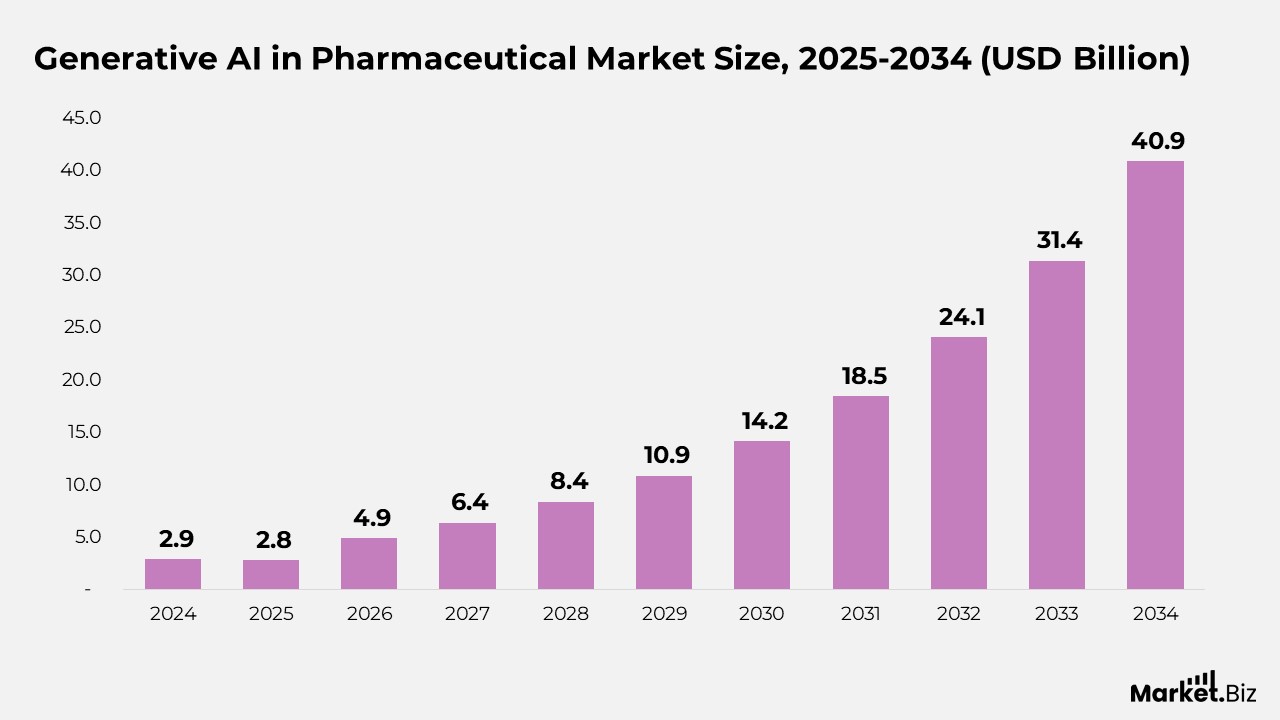
- According to Market.us, the global generative AI in pharmaceutical market is expected to rise from $3.8 billion in 2025 to $40.9 billion by 2034, representing a compound annual growth rate (CAGR) of 19% from 2025 to 2034.
- Advancements in AI models and technology are propelling market growth, driven by continuous improvements in AI algorithms and capabilities.
- Deep learning models led the market in 2024, capturing 27.4% of the market share, due to their ability to analyze large, complex datasets and predict molecular behaviors effectively.
- In the pharmaceutical industry, deep learning models play a vital role in drug discovery, helping design new compounds and enhance target identification through sophisticated data processing.
- Text generation holds the largest market share of 39.7%, facilitating automated content creation, regulatory reporting, and synthetic patient data generation, thereby improving operational efficiency.
- R&D remains the leading application of generative AI in the pharmaceutical market, accounting for 22.4% of the share, as it accelerates drug discovery and clinical development, reducing time-to-market.
- North America dominates the market with a 46.8% share, driven by widespread AI adoption and the concentration of major biotech firms, pharmaceutical companies, and cutting-edge AI research institutions.
- The U.S. stands out as a hub for AI-driven drug discovery, clinical trial optimization, and personalized medicine, benefiting from strong investments, groundbreaking research, and collaborative efforts between AI developers and pharmaceutical leaders.
(Source: Market.us)
Generative AI in Agriculture Market Size
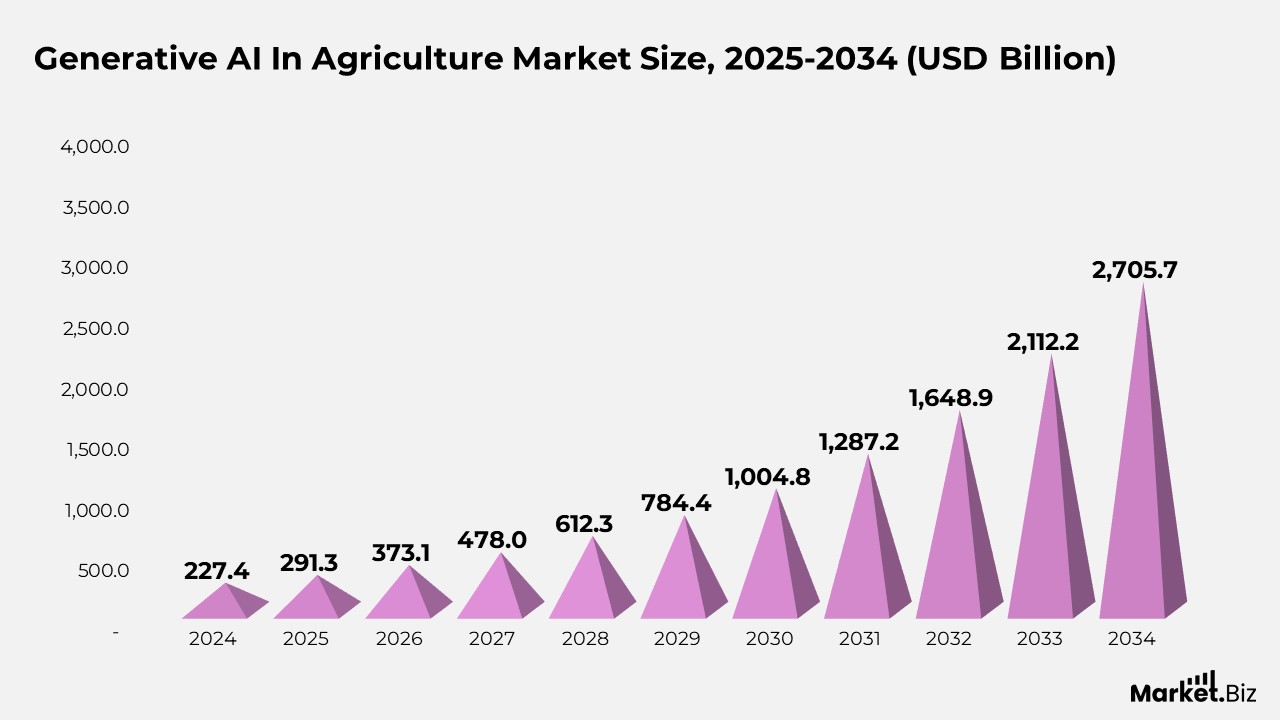
- According to Market.us, the global generative AI in agriculture market is expected to rise from $291.30 million in 2025 to $2,705.71 million by 2034, representing a compound annual growth rate (CAGR) of 28.1% from 2025 to 2034.
- The market is driven by the urgent need for food security, addressing climate change, population growth, and resource depletion through generative AI solutions that optimize farming practices.
- In 2024, the machine learning segment dominated the market with over 43.5% share, owing to its flexibility, maturity, and ability to handle diverse agricultural data.
- Machine learning remains a key technology in farming operations, offering scalability and adaptability for various agricultural needs.
- The agricultural robotics and automation segment held over 38.7% of the market in 2024, showcasing its vital role in transforming farm operations globally.
- AI-powered automation platforms, such as autonomous tractors, robotic weeders, and drones, have become critical in addressing labor shortages and improving resource utilization.
- North America led the market with a 37.5% share and USD 85.27 million in revenue, driven by its advanced digital infrastructure, strong research ecosystem, and rapid adoption of AI in precision farming.
(Source: Market.us)
OpenAI Users
- As of April 2025, OpenAI has surpassed 500 million weekly active users, making ChatGPT one of the most widely used AI platforms worldwide.
- In its first year, ChatGPT achieved 100 million monthly active users within just two months, a milestone that Instagram took 2.5 years to reach.
- In December 2022, OpenAI had 1 million users.
- By January 2023, the user base had grown to 100 million.
- By August 2023, the user count remained at 100 million.
- In October 2024, OpenAI’s user base expanded to 250 million.
- By December 2024, OpenAI had reached 300 million users.
- February 2025 saw OpenAI hit 400 million users.
- As of April 2025, the user base reached 500 million users, according to the CEO.
(Source: CNBC, Barron’s, Exploding Topics)
OpenAI Valuation
- OpenAI achieved a valuation of $300 billion in March 2025, cementing its position as one of the most valuable private companies worldwide.
- With this valuation, OpenAI ranks just behind SpaceX ($350 billion) and on par with ByteDance (the parent company of TikTok) among the world’s most valuable private firms.
- In July 2019, OpenAI was valued at $1 billion.
- By April 2021, the company’s valuation had risen to $14 billion.
- In January 2023, OpenAI reached a valuation of $29 billion.
- By February 2024, its valuation surged to $86 billion.
- In October 2024, OpenAI was valued at $157 billion.
- Finally, in March 2025, OpenAI’s valuation reached $300 billion.
(Source: CNBC, New York Times, TapTwice LLC)
OpenAI Investors
- OpenAI has a total of 52 investors, comprising 48 institutional stakeholders and 4 angel investors. Notable investors include Amazon, Microsoft, NVIDIA, and Elon Musk.
- SoftBank invested $30 billion in OpenAI.
- Microsoft contributed $14 billion across multiple funding rounds.
- Thrive Capital invested $1.2 billion in OpenAI.
- NVIDIA invested $100 million in October 2024 as part of OpenAI’s Series E funding round.
- Elon Musk, a co-founder of OpenAI, initially invested $45 million during the company’s early stages.
- Other investors contributed a total of $12.6 billion to OpenAI.
(Source: TechCrunch, Yahoo Finance, CNBC, Tracxn, Reuters)
Traffic Source Breakdown for OpenAI
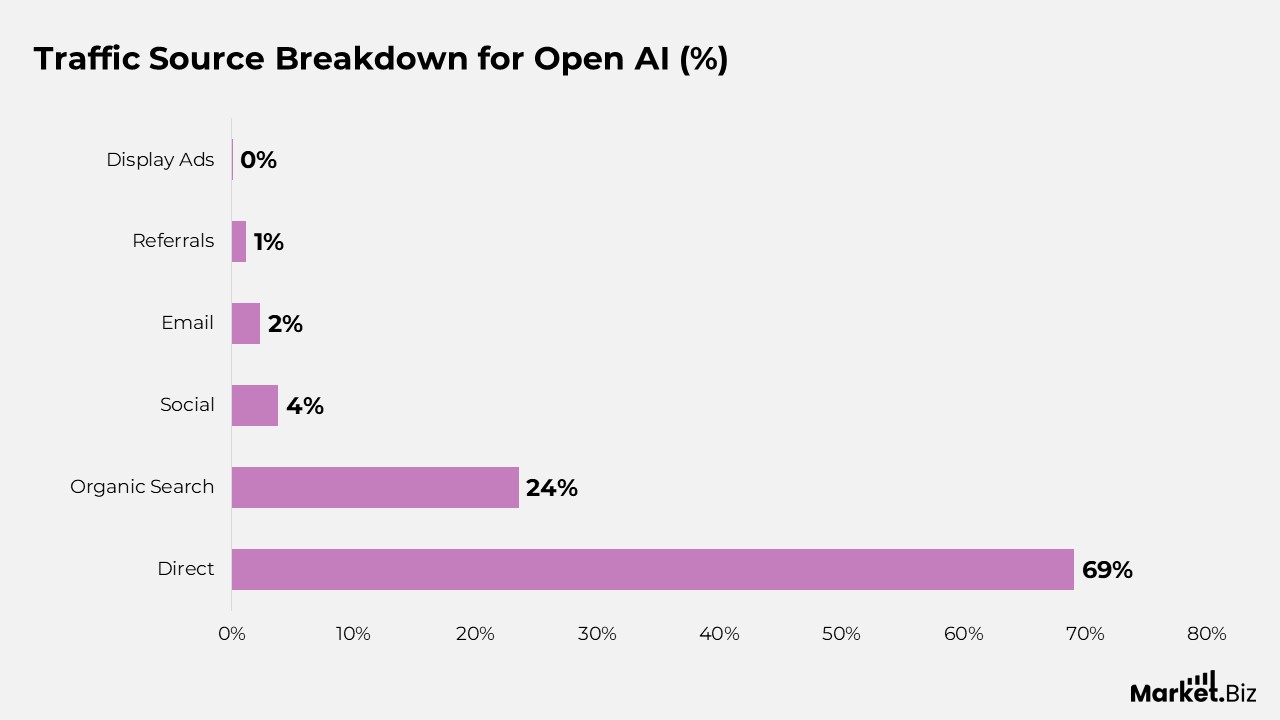
- 69.10% of the traffic visits OpenAI directly.
- 23.54% of the traffic originates from organic search.
- 3.83% of the traffic is sourced from social media.
- 2.34% of the traffic arrives through email.
- 1.14% of the traffic is referred from other websites.
- 0.03% of the traffic is generated through display ads.
(Source: Productmint, Statista, DmemandSage)
Employee Distribution Across Various Roles at OpenAI
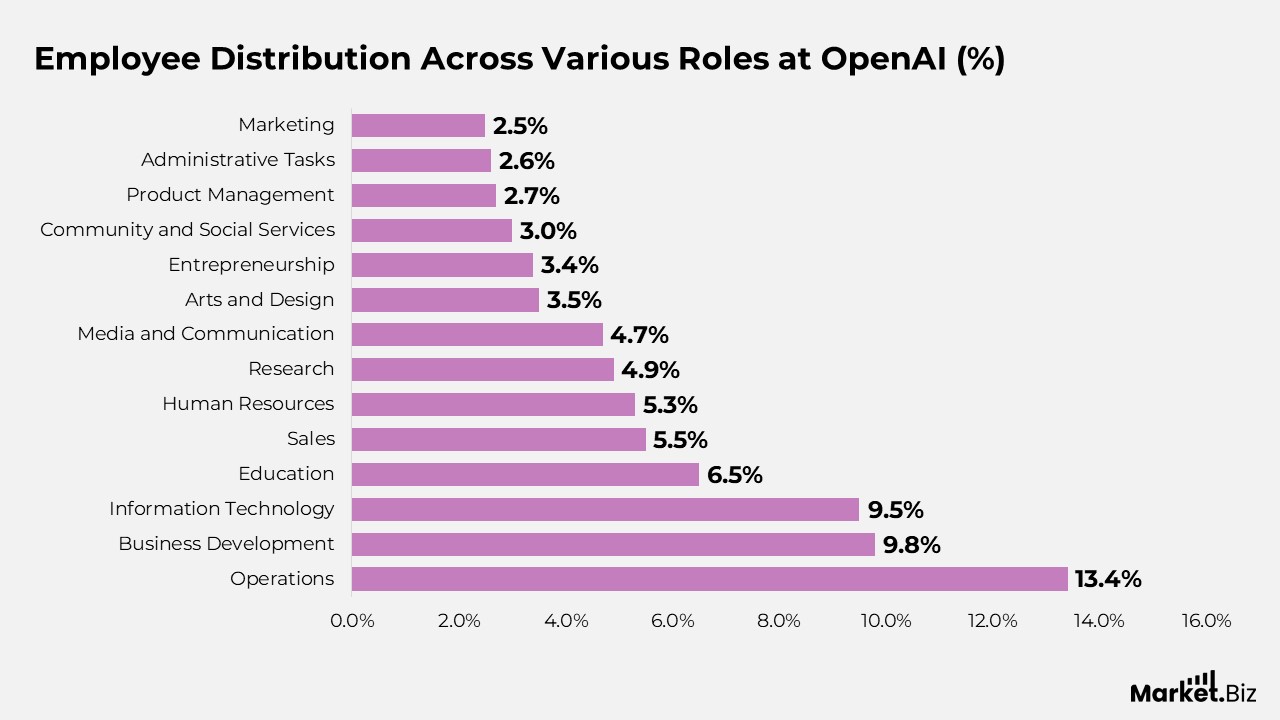
- A large portion of OpenAI’s workforce, 33.9% (1,199 employees), works in the engineering department.
- 13.4% (474 employees) are part of the operations team.
- 9.8% (346 employees) focus on business development.
- 9.5% (335 employees) work in information technology.
- 6.5% (230 employees) are in the education sector.
- 5.5% (196 employees) handle sales.
- 5.3% (188 employees) are in human resources.
- 4.9% (173 employees) are part of the research team.
- 4.7% (167 employees) work in media and communication.
- 3.5% (122 employees) specialize in arts and design.
- 3.4% (119 employees) are involved in entrepreneurship.
- 3.0% (106 employees) work in community and social services.
- 2.7% (94 employees) focus on product management.
- 2.6% (91 employees) handle administrative tasks.
- 2.5% (87 employees) are in marketing.
(Source: Statista, DemandSage)
What Are the Fields of Study of OpenAI’s Workforce?
- 800 employees (35.6%) of OpenAI’s workforce studied Computer Science.
- 623 employees (27.7%) specialized in Computational Science.
- 144 employees (6.4%) have a background in Economics.
- 116 employees (5.2%) studied Mathematics.
- 107 employees (4.8%) have degrees in Political Science and Government.
- 98 employees (4.4%) studied Business Administration and Management.
- 87 employees (3.9%) specialized in Electrical and Electronics Engineering.
- 85 employees (3.8%) have degrees in Computer Engineering.
- 78 employees (3.5%) studied Artificial Intelligence.
- 74 employees (3.3%) have a background in Physics.
- 67 employees (3.0%) studied Computer Software Engineering.
- 63 employees (2.8%) specialized in Computer Engineering Technologies/Technicians.
- 58 employees (2.6%) have a background in Finance.
- 55 employees (2.4%) studied Electrical Engineering and Computer Science.
- 50 employees (2.2%) have degrees in Psychology.
(Source: Statista, SEO.AI, DemandDage)
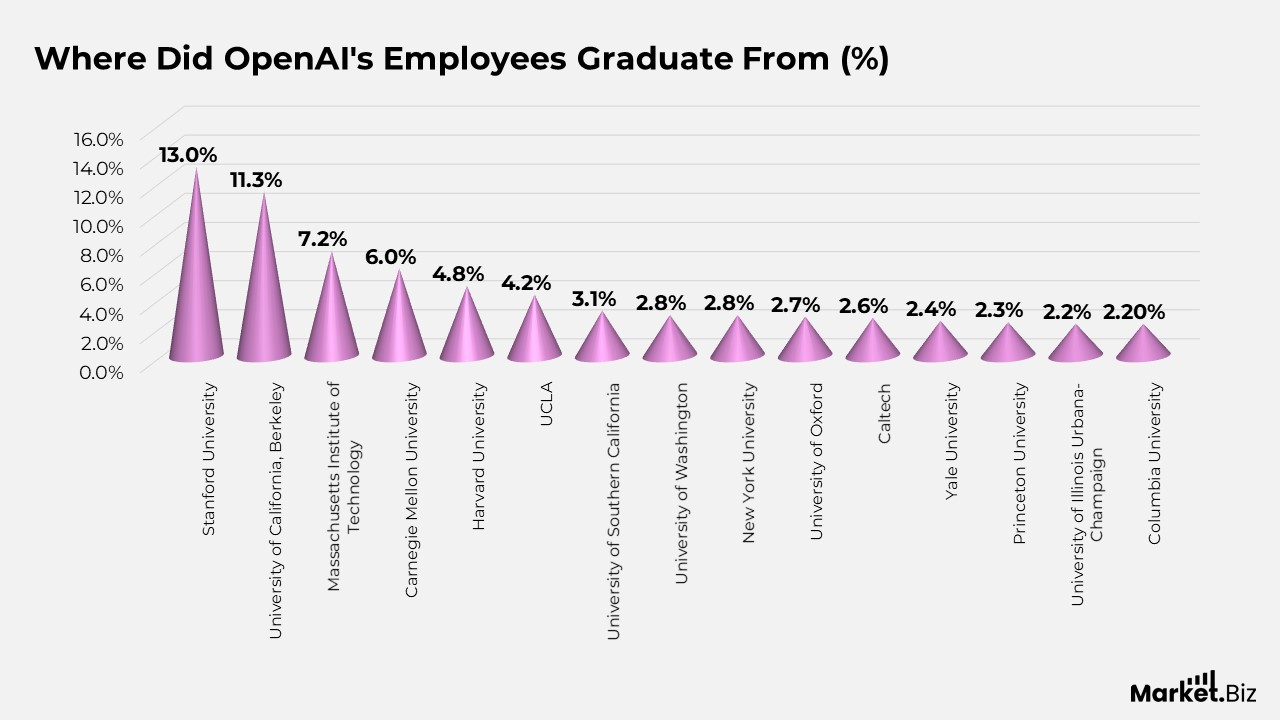
Where Did OpenAI’s Employees Graduate From?
- 192 employees (13.0%) are graduates of Stanford University.
- 167 employees (11.3%) are alumni of the University of California, Berkeley.
- 107 employees (7.2%) studied at the Massachusetts Institute of Technology.
- 89 employees (6.0%) graduated from Carnegie Mellon University.
- 71 employees (4.8%) attended Harvard University.
- 62 employees (4.2%) are from UCLA.
- 46 employees (3.1%) graduated from the University of Southern California.
- 42 employees (2.8%) attended the University of Washington.
- 41 employees (2.8%) are alumni of New York University.
- 40 employees (2.7%) graduated from the University of Oxford.
- 38 employees (2.6%) studied at Caltech.
- 36 employees (2.4%) are from Yale University.
- 34 employees (2.3%) graduated from Princeton University.
- 33 employees (2.2%) are alumni of the University of Illinois Urbana-Champaign.
- 32 employees (2.2%) attended Columbia University.
(Source: Statista, SEO.AI, DemandDage)
Conclusion
OpenAI has shown remarkable growth and innovation, solidifying its position as a global leader in artificial intelligence. Since its inception, the company has made significant progress in developing advanced AI technologies that have transformed various industries and sectors.
Through its focus on enhancing machine learning, natural language processing, and generative AI, OpenAI has gained widespread adoption, attracting interest from businesses, educational institutions, and individual users. As the company continues to break new ground in AI, its impact and transformative capabilities are poised to play an increasingly crucial role in shaping the future of both technology and society.
FAQ’s
OpenAI’s high valuation is driven by its innovative advancements in AI technology, widespread adoption across various industries, strong investor backing, and its increasing impact in fields such as healthcare, education, and technology.
OpenAI attracts significant funding through its groundbreaking AI research, the transformative potential of its technologies across multiple industries, and strategic partnerships with leading tech companies and investors.
OpenAI’s projected revenue growth is supported by the rising demand for AI-driven solutions, the continuous evolution of its advanced models like GPT and Codex, and the growing adoption of AI in sectors such as business, education, and automation.
OpenAI’s user base primarily consists of younger individuals, especially those in the 25-34 age range, who are early adopters of new technology and have a strong interest in AI applications for both personal and professional purposes.
Educational institutions utilize OpenAI’s tools to improve learning experiences, streamline administrative processes, facilitate research, and enhance educational outcomes through personalized, AI-powered solutions.