









Introduction
Voice Assistant Use at Workplace Statistics: Voice assistants have changed the modern workplace, allowing tasks to be more efficient and increasing productivity. In the next two years, the number of voice assistants around the world will reach about 8.4 billion. In fact, in 2025 there will be more voice assistants than the world population, and you know that number don’t lie, there’s no denying that voice assistants and their presence in every part of work.
According to the reports US alone have 153.5 million voice assistant users, 2.5% up from a year ago. The growth in the voice assistants use is a lot to do with employees completing tasks like they have always done, and now using voice technology to do it, meaning tasks and scheduling. Some ideas are shifting to voice first, or even solely on voice. Additionally, according to the report, 91% of voice assistant users use voice assistants on their mobile phones. The implication is that voice is mobile.
Finally, worth noticing, the voice recognition market was worth $12 billion in 2022, but will be on track to be worth about $50 billion by 2029. The statistic provided show how much influence voice assistants have for workers and workplace and how they will continue to expand and grow forward.
Editor’s Choice
- In 2024, the global usage of voice assistants was expected to be 8.4 million worldwide.
- The AI voice assistant market is expected to grow annually at 30% and $26 billion by 2030.
- 70% of millennials are at ease using AI avatar assistants, which shows generational acceptance.
- According to reports, the global voice assistant application market is expected to grow from $5.61 billion in 2024 to $7.26 billion in 2025, representing an annual growth rate of 29.4%.
- According to an IMB study, the implementation of voice AI boosted customer satisfaction by 30%.
- In some locations, for instance, Taiwan and China, people are using AI chatbots as mental health substitutes due to their availability, unity, and price.
- Apple agreed to a $95 million settlement based on a claim asserting Siri was recording its users without user consent.
General Voice Assistant Use at Workplace Statistics
- In 2024, the global usage of voice assistants was expected to be 8.4 million worldwide.
- Mobile devices are trending on #1 in the voice assistant industry, as 91% of voice assistant users use their smartphones to access them.
- Voice assistants are growing faster in the customer service industry, as 60% of organisations plan to use AI virtual assistants by the end of 2025.
- Organisations use virtual assistants to handle administrative tasks, where most of them reported 40% increase in productivity.
- The AI voice assistant market is expected to grow annually at 30% and $26 billion by 2030.
- Organisations that uses AI voices reported a sudden 30% increase in customer retention and an 85% improvement in agent efficiency.
- The AI voice assistants in the healthcare industry is expected to reach at a market value of $1.5 billion.
- AI assistant manage approximately 30% of customer inquiries in e-commerce to help businesses manage their customer needs.
Moreover
- 50% of voice assistant users trust AI assistants for usual activities such as shopping advice and customer service.
- Organisations are able to make more rapid decisions with data using voice activated analytic tooling such as Tableau and Microsoft Power BI.
- AI voice meeting assistants led to a 25% reduction in meeting durations, shortening the amount of productivity and accountability.
- Retailers using AI voice assistant tools are generating 20% more sales.
- Financial institutions increased their use of voice authentication technology by 28% in 2023 creating a much higher level of security and customer experience.
- Education platforms using voice AI are seeing engagement rates increase by as much as 40% indicating more effective learning experiences.
- Legal firms adopting voice to text AI technology reduced documentation time by 30%.
- Travel and tourism organisations reported a 22% increase in bookings conducted through voice search, demonstrating the future of their industry.
- Voice enabled chatbots completed 35% of customer inquiries in 2023, reducing the workload of customer service agents.
- Energy sector adopting and using analytic technology on customer calls reported increasing their efficiency by 12% improving overall customer service efficiency.
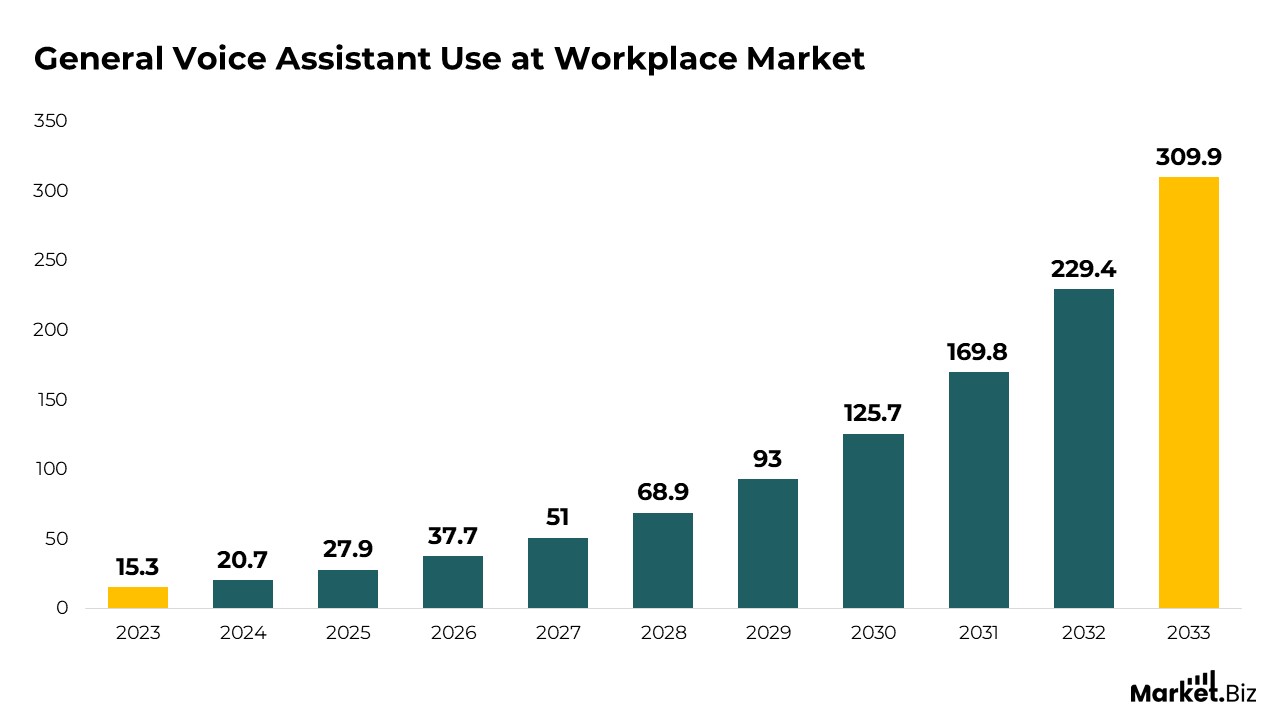
(Source: Market.US)
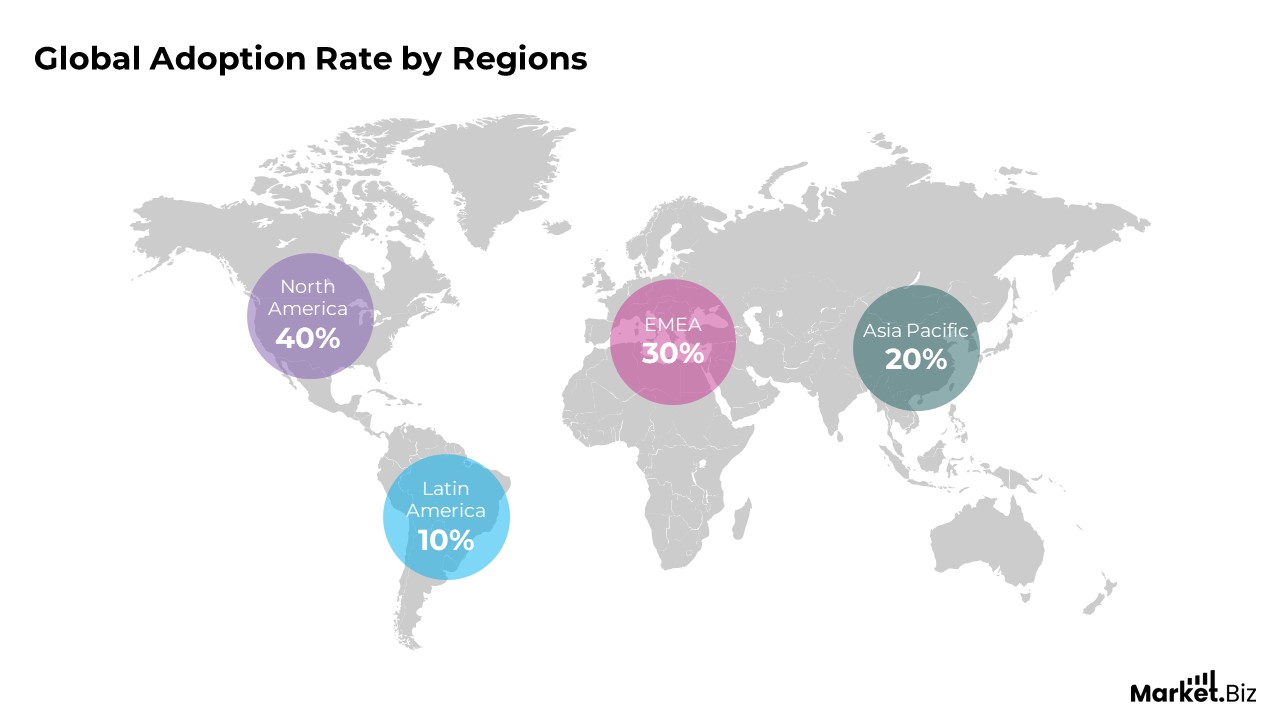
Global Adoption Rate
- More than four billion people across the globe currently use AI virtual assistants, which shows their global presence.
- It is expected that the global virtual assistant market will generate $8.1 billion by the end of 2025, which is further evidence to show that they are being adopted quickly across industries.
- 41% of businesses plan to adopt AI and virtual assistants for business process automation, which indicates that will be used for productivity and efficiency primarily.
- AI virtual assistants can improve workplace productivity of up to 25% and this can be achieved through task management and multi-tasking functionality.
- AI virtual assistants typically reduce customer service department costs by up to 30%, which is a huge benefit to businesses.
- AI virtual assistants can complete up to 80% of repetitive tasks in the workplace on behalf of employees, and the employees can spend their time on more profitable activities.
- Using AI virtual assistants for appointment management can save businesses up to 70% in time and other resources.
Moreover
- Using AI virtual assistants has improved sales process conversation rates by 40% for revenue generation for businesses.
- 63% of customers prefer communicating with businesses through the use of AI virtual assistants, which indicates the preferences that have shifted.
- The health care industries are using AI virtual assistants to coordinate the process of patient care, to improve the service delivery to patients.
- The e-commerce industries are adopting AI virtual assistants to improve the customer shopping experience, when shopping online, leading to an overall better shopping experience.
- It has been forecast that cloud-based AI virtual assistants will take over the marketplace soon with scalable services to help companies.
- 70% of millennials are at ease using AI avatar assistants and it shows how generational acceptance has occurred.
- North America is the largest market in terms of voice assistant adoption, although Asia Pacific is expected to be the fastest-growing region in the coming years.
- The education sector is applying AI virtual assistants as a personalized, interactive learning experience which keeps students engage.
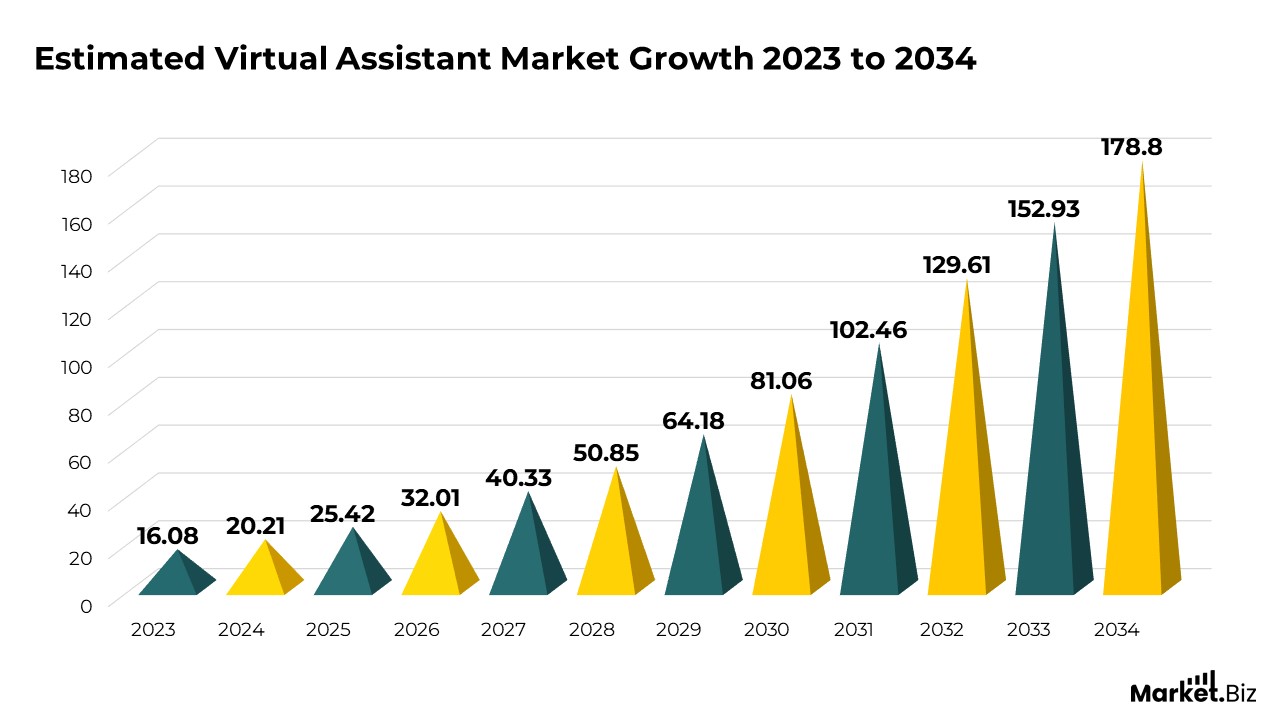
Estimated Market Growth
- According to reports, the global voice assistant application market is expected to grow from $5.61 billion in 2024 to $7.26 billion in 2025, representing an annual growth rate of 29.4%.
- The global voice assistant application market is expected to reach $23.3 billion by 2029 as AI advances and voice assistants are increasingly incorporated into the workplace.
- The larger voice assistant market is expected to grow from the $7.35 billion in 2024 to $33.74 billion by 2030 with a compound annual growth rate of 26.5%.
- Voice recognition, which is an integral component for a voice assistant, was valued at $12 billion in 2022 and it is projected to grow to $50 billion by 2029.
- Smart speakers, which are a closely related market to voice assistants, are projected to grow from $14.63 billion in 2024 to $46.87 billion by 2023.
- According to a report by McKinsey, 92% of executives are planning to increase investment in AI, which includes investment in AI, which includes voice assistants, over the next three years.
- In the US voice assistant users are anticipated to be 153.5 million by the end of 2025, indicating the current and growing use in professional settings.
- The number of voice assistants globally was projected to reach 8.4 billion in 2024.
- Voice assistants are helping to improve the customer experience in the retail sector, which is in turn driving greater sales and market growth.
- The increased use of voice assistants in vehicles for navigation and control is aiding in their market growth.
(Source: Coolest-Gadgets, WP-Content)
Benefits of Voice Assistants at the Workplace
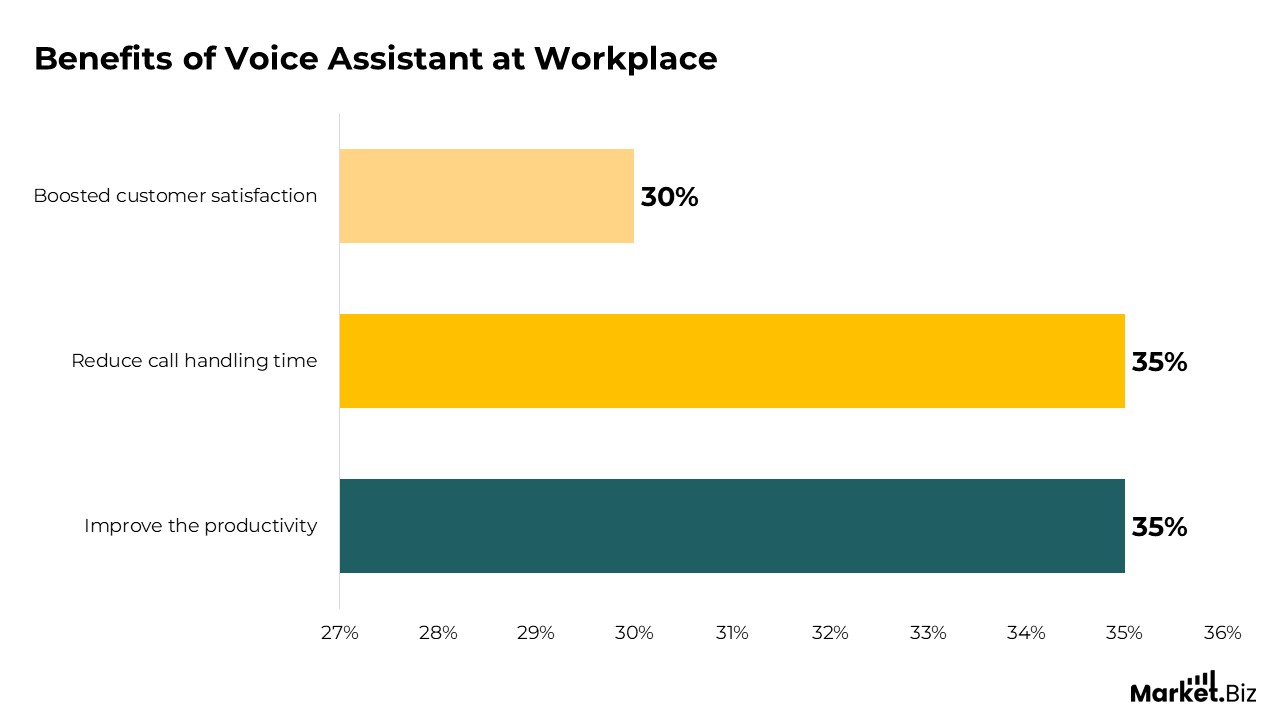
- Voice assistants can improve the productivity of a workforce by as much as 35% because they are freed up to focus on more strategic duties.
- By adopting a virtual assistant to take care of basic tasks, companies save on average of 22 minutes a day per employee.
- A large telecom, for example, used voice AI capabilities to reduce call handling time by 35%.
- According to an IMB study, the implementation of voice AI boosted customer satisfaction by 30%.
- In manufacturing and healthcare, voice assistants will allow users to operate hands free, limiting the number of times physical interaction needs to happen.
- 75% of users rely on AI voice assistants to undertake daily reminders, organize tasks, and schedule their day away from technological distractions.
- Voice assistants can automate routine tasks, such as reminders, meeting invitations, and emails, keeping an employee’s overall productivity high.
- 85% of employees who work remotely said they saw productivity gains while working from home and much of this was attributed to virtual assistants.
- Using voice assistants in the workplace enables users to reduce timesheet mistakes, making employee timesheet updates much smoother.
- Voice assistants are available to workers at any time and place, and they give employees the ability to accomplish skills such as checking email and planning meetings without being at their desk.
- Voice assistants can have fast recovery of information, helping employees obtain a response faster and make better decisions quickly.
Voice Assistants in Different Sectors
- About 51% of voice assistant users use them for researching products, while 22% uses them for making purchases with voice commands.
- Among healthcare employees, approximately 68% believe that voice search will be important for patient engagement, with 42% who have or will adopt voice assistant technology.
- 46% of travellers have engaged voice search for researching or booking accommodations, and 61% of hotel guests have used voice-activated devices to manipulate room features.
- 55% of teens and 41% of adults use voice search to actually find restaurants, and 61% of diners have used voice search to also place restaurant reservations.
- 62% of car owners who use voice assistants in their cars have used voice search for finding nearby businesses, including auto services.
- Increasingly, voice assistants are being used in educational services, as well as helping perform some administrative functions.
- Approximately 42% of consumers use voice search in the context of financial services, e.g., checking account balances or finding nearby ATMs.
- Voice assistants help increase operational efficiency for 20.5% of entities with respect to marketing, enabling as examples, management of campaigns and customer engagement.
- In sales and prospecting efforts, 14% of organisations use voice assistants in one or another aspect of their efforts to achieve efficiency.
- In operating aspects, voice assistants improve a workflow and efficiency for 9.7% of organisations.
- Voice assistants also add value for clients in customer service for 6.3% of organisations and lead to quick responses.
- Voice assistants add value in finance and bookkeeping for 4.3% of organisations, which also improve efficiency and the chance for human error.
- Voice assistants are used in other categories by 7.5% of organisations, showing different areas in which voice assistants can help improve or solve operational needs.
Impact of Voice-Enabled ChatBots
- The annual savings for businesses attributed to task automation via chatbots, inclusive of voice-enabled chatbots, totalled around $23 billion.
- Chatbots are estimated to save businesses as well as consumers 2.5 billion hours by 2024 through automating and streamlining interactions and processes.
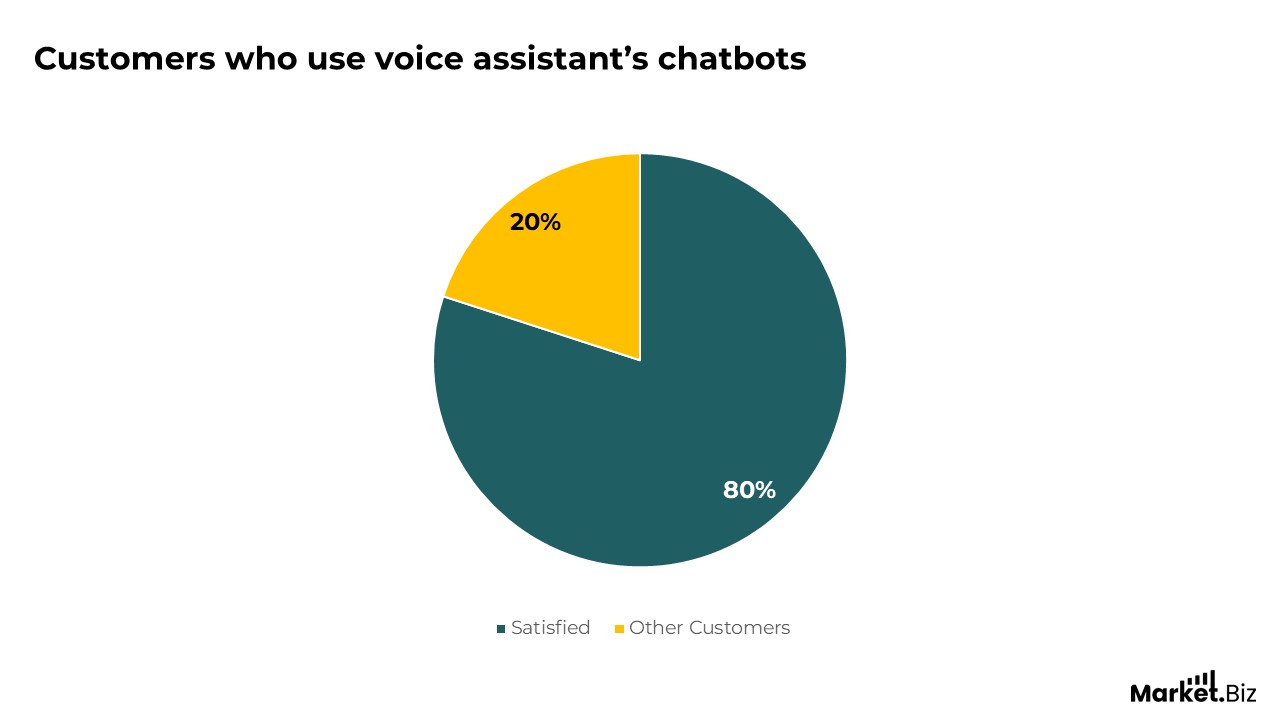
- About 80% of customers who use voice assistant chatbots to shop will be satisfied with the shopping experience.
- Approximately 70% of health systems report improved patient care through voice AI as a service delivery tool.
- Voice enabled chatbots provide an environment for real-time continuous chat making the chat interaction even more compelling and pleasurable to user and therefore drive users engagement which leads to satisfaction.
- Voice chatbots also provide a hands-free experience which makes them accessible for all users including the user with disabilities, as well other users who are doing multiple tasks.
- In some locations, for instance Taiwan and China, people are using AI chatbots as mental health substitutes due to their availability, unity, and price.
- Most users report satisfaction with their voice assistants, signifying a good user experience for many people.
- Research shows that while the heavy users of voice-based chatbots develop frequent and habitual usage patterns, loneliness and emotional dependence may develop over time.
- By 2027, it is estimated that 40 percent of enterprise chatbots will be multimodal in how they are delivered.
Privacy Concerns with Voice Assistants
- A study revealed that 49% of voice assistant users do not know that voice assistants are always listening for a wake word to record voice inputs; any activation of a voice assistant will result in recording.
- Approximately 40% of voice assistant users have been contemplating who is listening and how their voice data is used.
- 68% of voice assistant users have never attempted to enhance the privacy of their voice assistants.
- There are documented incidents of Siri accidentally activating and posing a risk to privacy.
- Amazon confirmed Alexa recordings are provided to law enforcement, indicating users have a data privacy concern.
- Voice assistants may monetize voice interaction attribution to an individual user, which could include any invasions of privacy as a bonus.
- There is concern that voice data collected by voice assistants could serve as data for targeted advertising, where user consent is bypassed.
- There is evidence that suggests third-party venal skills can use voice assistants to eavesdrop or take user data.
- Apple agreed to a $95 million settlement based on a claim asserting Siri was recording its users without user consent.
- Only 57% of users feel in control of their data when using voice assistants. A clear lack of transparency can be seen on how the voices assistants collect, retain and use user data.
- Always-on devices can be intrusive in places where we might want privacy, such as therapy or legal consultations.
- Connected toys with voice assistants have raised cautionary issues regarding the recording of personal conversations between children and the handling of their data by third parties.
- The increasing usage of voice assistants globally is still limited; brief interactions driven by convenience seem to be the only market opportunities, with privacy remaining a stubborn barrier.
Conclusion
The increase of voice assistant use in the workplace is significant as more companies realize the time savings and efficiency benefits. From facilitating meetings to answering questions from customer, AI voice assistants, which offer many fantastic advantages in virtually every industry, are becoming valuable tools.
There are also noticeable increases in global adoption rate, and steady growth just may continue for the market in the upcoming years. There are still serious privacy concerns still exist for a lot of users. It is inevitable that as there is more technological advancements voice assistants will eventually become the norm foe how we work every day.
Companies that jump on this technology sooner than later may get a distinct competitive advantage when it comes to productivity and innovation.
FAQ’s
Voice assistants are becoming more common at work, with about 50% of businesses already using them for tasks like scheduling and customer support.
Yes, many organisations report up to a 15% boost in employee productivity when using AI-powered voice assistants for routine tasks.
Yes, privacy is a concern. Around 40% of users worry about voice assistants recording conversations or sharing data without clear consent.