









Introduction
Video Conferencing Statistics: Video conferencing has quickly become a key tool for staying connected, especially in today’s fast-paced world. In 2024, the global video conferencing market is expected to reach $14.4 billion, growing at a rate of 10.4% each year.
The shift to remote work during the pandemic made platforms like Zoom, Microsoft Teams, and Google Meet more popular than ever, with Zoom alone having over 350 million daily users in 2023. Beyond just work, video calls are now changing the way we learn, receive healthcare, and engage with customers. As technology improves with AI, 5G, and virtual reality, video conferencing will only become more powerful and efficient in the years ahead.
Editor’s Choice
- The global video conferencing market is projected to reach $14.4 billion by 2024, growing at a 10.4% CAGR.
- Zoom leads the market with over 350 million daily users in 2023, maintaining 80% of the global market share.
- Microsoft Teams grew by 25% in 2023, reaching 280 million active users, benefiting from its integration with Microsoft 365.
- The video conferencing software segment dominates with 60% of the market share, while cloud solutions are expected to make up 75% by 2025.
- AI integration in video conferencing is growing, with 58% of platforms adopting features like real-time transcription and enhanced noise cancellation by 2024.
- The enterprise segment continues to generate the highest revenue, contributing over 50% of total sales in the video conferencing market.
- The healthcare video conferencing market is forecasted to grow at a 25% annual rate, reaching $3.5 billion by 2026.
- Hybrid work models are driving the demand for advanced video conferencing tools, with 65% of companies planning to adopt them by 2025.
- Video conferencing usage in education surged by 20% since 2020, with 85% of schools moving to online learning.
- Cloud-based solutions are growing rapidly, projected to make up 75% of the market share by 2025, as businesses seek scalable, flexible solutions.
General Video Conferencing Statistics
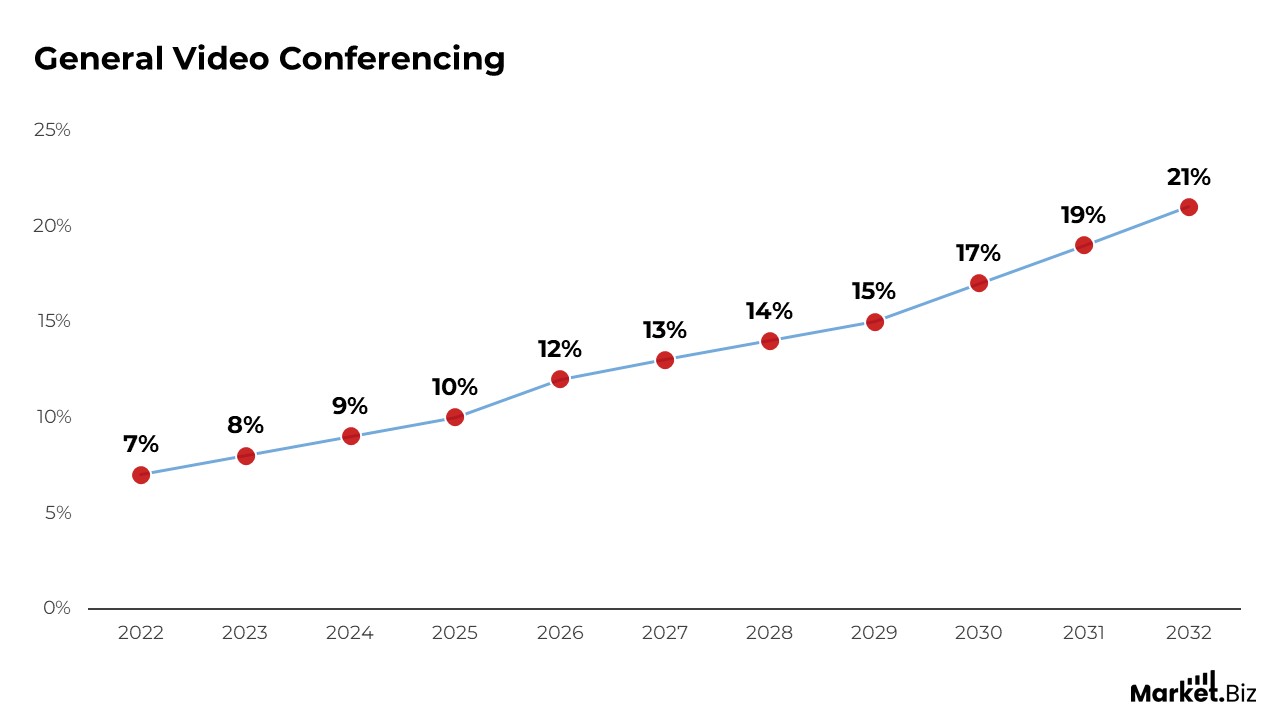
- According to the graph above, the global video conferencing market is expected to reach USD 21 billion by 2032, from a projected USD 9 billion by 2024.
- From 2024 to 2032, this represents a compound annual growth rate (CAGR) of 11.8%.
- Additionally, the video conferencing industry is expected to reach a global market size of USD 10 billion in 2025, USD 12 billion in 2026, USD 13 billion in 2027, USD 14 billion in 2028, USD 15 billion in 2029, USD 17 billion in 2030, and USD 19 billion in 2031.
- The global video conferencing market size is expected to reach $14.4 billion by 2024, growing at a CAGR of 10.4%.
- In 2023, Zoom saw over 350 million daily meeting participants, demonstrating the platform’s widespread use.
- Microsoft Teams has over 280 million active users as of late 2023, securing its place as a major player.
- Google Meet saw a 100% increase in usage during the first months of the COVID-19 pandemic.
- Video conferencing platforms experienced a surge in demand, with some providers seeing up to 400% growth in active users.
Moreover
- 75% of organizations worldwide now use video conferencing for business communication.
- By 2025, the number of remote workers using video conferencing is expected to reach 1.87 billion.
- Video calls have boosted productivity by 20-25%, as remote teams engage in more efficient communication.
- In 2024, 70% of all online meetings will be hosted via video conferencing, with audio-only meetings becoming less common.
- 65% of companies report that video conferencing improves employee collaboration and teamwork.
- 58% of consumers prefer video communication for customer service interactions over other methods.
- The healthcare industry is expected to see a 30% rise in telemedicine video consultations by 2025.
- Video conferencing use in education has increased by 200% since 2020, driven by virtual classrooms and online learning.
- 60% of businesses are investing in video conferencing technology to support hybrid and remote work environments.
- Video conferencing has helped reduce corporate travel expenses by up to 30%, making it a cost-effective solution for meetings.
Video Conferencing Market Size Statistics

- The video conferencing market was valued at USD 10.6 billion worldwide in 2022.
- By 2027, the market value is expected to reach USD 19.1 billion.
- The global video conferencing market is projected to reach $14.4 billion by 2024, with a compound annual growth rate (CAGR) of 10.4%.
- North America holds the largest share of the video conferencing market, contributing to over 40% of global revenue in 2023.
- The Asia Pacific region is expected to grow the fastest, with a CAGR of 14.2%, driven by increased adoption in countries like India and China.
- The video conferencing software segment dominates the market, accounting for 60% of the total market share in 2023.
- Cloud-based video conferencing solutions are growing rapidly, with a projected market share of 75% by 2025.
- The enterprise segment generates the highest revenue in the video conferencing market, contributing over 50% of total sales.
- The healthcare video conferencing market is expected to grow by 25% annually, reaching $3.5 billion by 2026.
- Video conferencing hardware is projected to account for 40% of the market by 2025, fuelled by the growing demand for video-enabled conference rooms.
- In 2023, the corporate sector accounted for 60% of video conferencing usage, with remote work and collaboration tools driving growth.
- The global video conferencing market size in 2020 was $6.1 billion and has more than doubled in just a few years due to the surge in remote work.
Adoption Rates of Video Conferencing
Pre-Pandemic Usage of Video Conferencing
- Before the pandemic, around 20% of businesses used video conferencing regularly for communication and collaboration.
- In 2019, 67% of global organizations reported occasional use of video conferencing for remote meetings.
- By 2019, Skype was the most commonly used video conferencing platform, with 40% of remote teams relying on it.
- In 2018, 58% of companies used video conferencing in combination with in-person meetings for client engagement.
- The global market for video conferencing was valued at $5.3 billion in 2019, before significant growth during the pandemic.
- Small and medium-sized businesses (SMBs) accounted for just 40% of total video conferencing usage pre-pandemic.
Post-Pandemic Usage of Video Conferencing
- By 2021, video conferencing usage skyrocketed, with 80% of businesses adopting the technology for remote work.
- Remote work became the norm, with 50% of employees worldwide working from home in 2021, heavily relying on video calls.
- Video conferencing platforms like Zoom saw a 300% increase in daily active users between March 2020 and May 2020.
- As of 2023, 75% of companies have incorporated video conferencing into their regular business operations, even for hybrid work models.
- The education sector experienced a 200% increase in video conferencing adoption, with 85% of schools switching to online classes.
- 70% of companies reported improved employee productivity after implementing video conferencing as a primary communication tool post-pandemic.
Platforms Used During the Pandemic for Video Conferencing
- Zoom became the most popular platform, reaching over 300 million daily meeting participants by 2020, up from 10 million in December 2019.
- Microsoft Teams saw a 70% increase in active users from February to April 2020, reaching over 75 million daily active users by April 2020.
- Google Meet surged to 100 million daily meeting participants in 2020, making it one of the fastest-growing video conferencing platforms.
- Skype’s usage declined sharply during the pandemic, as users shifted to more business-focused platforms like Zoom and Teams.
- Slack integrated video conferencing features into its platform, reporting a 50% increase in daily video calls during 2020.
- WebEx saw a significant boost in adoption, with 50% more users signing up for video conferencing services in the first quarter of 2020.
Video Conferencing Market Statistics by Program
- The web-based video conferencing segment accounted for 58% of the global market share in 2024, driven by the ease of access and growing demand for cloud-based communication solutions.
- The cloud video conferencing market is expected to grow at a CAGR of 12.8%, reaching $16.5 billion by 2028, as businesses continue to move towards cloud-based platforms for scalability and flexibility.
- On-premises solutions make up around 35% of the market in 2024, favored by large enterprises needing high-security communication systems for sensitive data.
- Mobile video conferencing is experiencing robust growth, with an annual growth rate of 15%, as mobile devices become a preferred medium for remote communication.
- SaaS-based video conferencing platforms saw a revenue surge of 18% in 2023, driven by businesses seeking cost-effective, subscription-based models.
- The enterprise segment dominated the market, contributing 40% of the total revenue, as large organizations prioritize video conferencing for collaboration and team meetings.
- The healthcare segment is projected to grow at a CAGR of 16.3%, as telemedicine and virtual consultations continue to rise globally.
- In the education sector, video conferencing adoption surged by 22% in 2023, driven by online learning and remote education programs during and after the COVID-19 pandemic.
- According to the Statista report analysis, videoconferencing software will account for approximately 66% of the global market in 2024.
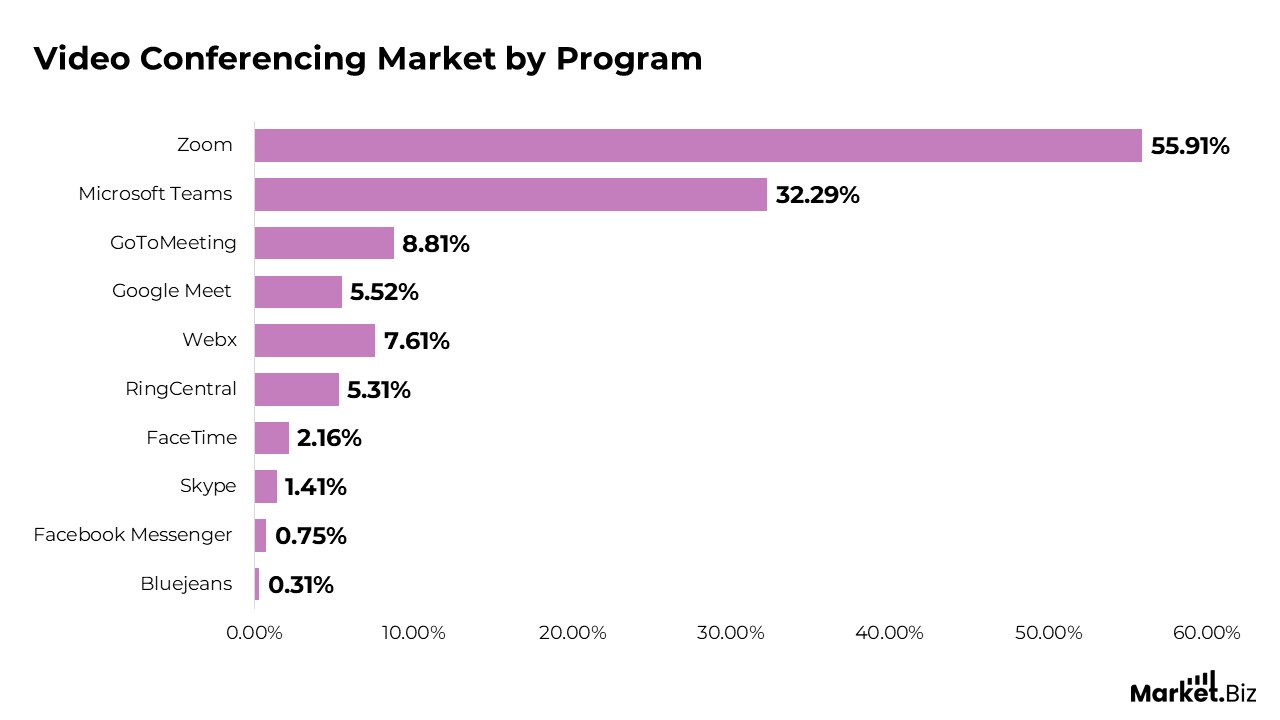
- With a market share of 55.91% this year, Zoom was the market leader, followed by Microsoft Teams (32.29%).
- GoToMeeting (8.81%), Google Meet (5.52%), Webex (7.61%), RingCentral (5.31%), FaceTime (2.16%), Skype (1.41%), Facebook Messenger (0.75%), and Bluejeans (0.31%) are the next most popular programs, according to video conferencing statistics.
Key Players – Video Conferencing Statistics
- Zoom remains the leader, capturing 80% of the global video conferencing market share in 2024. With over 350 million daily meeting participants reported in 2023.
- Microsoft Teams holds a 30% market share and saw a 25% increase in active users in 2023, driven by its seamless integration with Microsoft 365 tools and enterprise adoption.
- Google Meet achieved a 20% market share, expanding its presence with 150 million daily meeting participants at the end of 2023, supported by Google Workspace’s integration.
- Cisco WebEx commands a 10% share in the enterprise sector, with over 10 billion meetings hosted in 2023, primarily due to its security features and scalability for large organizations.
- Skype continues to serve as a top choice for personal and small business use, holding 6% of the market share, with 40 million daily users as of 2023.
- GoToMeeting has a growing presence in the SMB sector, contributing to 5% of the market, reporting a 15% year-over-year increase in its active user base in 2023.
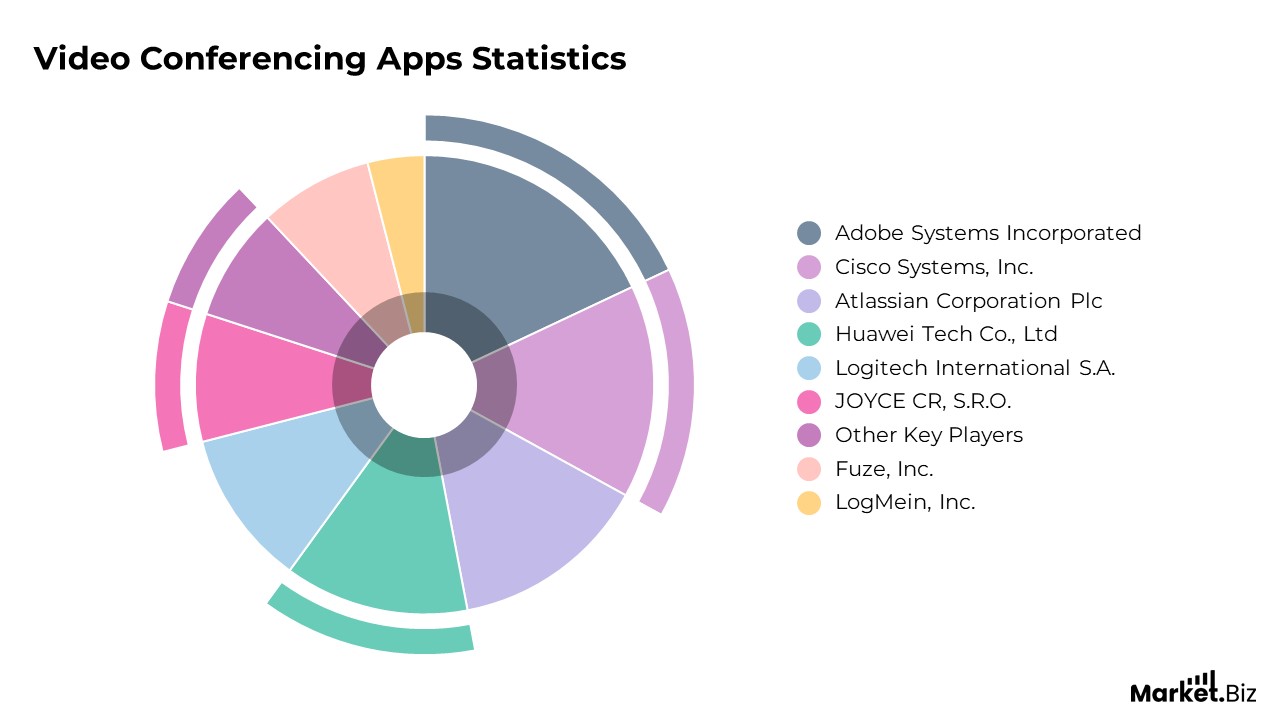
- Adobe Systems Incorporated’s 18% market share as of 2024 demonstrates the company’s dominance in video conferencing solutions.
- Additionally, Atlassian Corporation controls 14% of the market, while Cisco Systems contributes about 15%.
- Additionally, it is projected that the following major players will hold market shares in 2024: JOYCE CR, S.R.O. (9%), and LogMeIn, Inc. (4%) Fuze, Inc. (8%), Huawei Technologies Co., Ltd. (13%), and Logitech International S.A. (11%).
- Together, these important businesses control 8% of the market.
Video Conferencing Apps Statistics
- Zoom continues to dominate with over 350 million daily meeting participants as of 2023, accounting for 80% of the global video conferencing app market share.
- 74% of sales are made by TeamViewer, and 73% are made by Google Hangouts Meet.
- Microsoft Teams saw 270 million monthly active users by the end of 2023, growing at a rate of 25% year-over-year. Due to its integration with the Microsoft 365 ecosystem.
- Google Meet reached 150 million daily meeting participants in 2023. With a 20% increase in adoption among educational institutions and small businesses.
- Skype maintains a 6% share of the market, with 40 million active daily users, primarily catering to personal communication and small business needs.
- Cisco WebEx reached over 10 billion meetings hosted in 2023. With a significant presence in the enterprise sector, contributing to a 10% market share.
- GoToMeeting’s user base grew by 15% in 2023, with the app reporting 12 million active users as businesses continue to shift toward remote work solutions.
- Slack’s video conferencing feature saw a 30% increase in usage in 2023, contributing to the app’s overall growth in workplace communication.
- BlueJeans, acquired by Verizon, holds a 3% share of the video conferencing app market. Becoming a top choice for large enterprises with its focus on security and scalability.

Key Video Conferencing Companies
- Zoom Video Communications, Inc.
- Google LLC
- Microsoft Corporation
- Adobe Inc.
- Huawei Technologies Co., Ltd.
- Logitech International S.A.
- Cisco WebEx
- GoToMeeting
Benefits of Video Conferencing
- Video conferencing boosts productivity by 35%, as it enables faster decision-making and real-time collaboration.
- Businesses save up to $11,000 per employee annually by reducing travel costs through video conferencing.
- 93% of communication effectiveness is achieved through visual cues, making video conferencing a more impactful tool than audio-only calls.
- Video conferencing supports 85% of remote workers, providing a flexible work environment without compromising team collaboration.
- The company reports a 50% reduction in meeting time, as video conferencing allows for faster, more focused interactions.
- Video conferencing enables companies to tap into a global workforce, increasing recruitment options by 70%.
- Video conferencing reduces carbon emissions by 45%, thanks to the decrease in business travel.
- 78% of employees report improved work-life balance, as video conferencing reduces commuting time and enables flexible schedules.
- Video conferencing is used in 60% of educational institutions to facilitate online classes and professional development programs.
- 73% of clients prefer video conferencing for meetings, citing better engagement and personalized communication.
- 85% of enterprises prioritize secure video conferencing solutions to meet industry regulations and protect sensitive data.
Challenges of Video Conferencing
- Around 40% of users experience connectivity problems, leading to delays and interruptions during meetings.
- 72% of organizations worry about security risks, such as unauthorized access and data breaches, during video calls.
- About 33% of employees face issues like poor sound or video quality, which disrupts effective communication.
- Many remote workers, 58%, report feeling “Zoom fatigue” from long video calls, affecting their mental well-being.
- In remote or rural areas, 25% of workers lack reliable internet access. Which limits their ability to participate in video meetings.
- Concerns about unauthorized recording and sharing of sensitive information are present for 61% of video conferencing users.
- 53% of professionals believe video conferencing doesn’t replicate the personal connection and body language of in-person meetings.
- 40% of businesses struggle to integrate video conferencing software with other tools, which can slow down workflow efficiency.
- Limited bandwidth leads to degraded video call quality, affecting 35% of video conferencing sessions, especially during peak times.
- 28% of companies report that slower adoption of video conferencing technology is an issue, particularly among older or less tech-savvy employees.
Recent Developments
- In 2024, 58% of video conferencing platforms are incorporating AI-driven features like real-time transcription, automated scheduling, and enhanced background noise cancellation, making meetings more efficient.
- As hybrid work models continue to rise, 65% of companies plan to adopt more advanced video conferencing tools by 2025 to bridge the gap between remote and in-office employees.
- In 2025, 15% of video conferencing platforms are expected to integrate VR and AR technology. Providing immersive meeting experiences for better engagement and collaboration.
- With increasing concerns about privacy, 80% of enterprises are prioritizing platforms that offer end-to-end encryption for secure video calls, driven by the rise in remote work.
- Zoom Workplace, the AI-powered collaboration platform from Zoom Video Communications, Inc., was made generally available in April 2024. It has new features that help users rethink teamwork, build connections, and increase productivity.
- With 50% of remote workers relying on mobile devices for meetings. Platforms are enhancing mobile compatibility by introducing features like one-touch meeting access and optimized mobile video quality.
- Microsoft Corporation and Oracle extended their partnership in March 2024 in response to the increasing demand for Oracle DatabaseAzure from customers across the globe. Oracle DatabaseAzure is anticipated to grow in five additional regions as part of this initiative. Increasing the overall projected multi-cloud availability footprint to 15 regions worldwide.
Conclusion
Video Conferencing Statistics: In conclusion, the video conferencing market is rapidly growing and is expected to reach $14.4 billion by 2024, with major platforms like Zoom, Microsoft Teams, and Google Meet leading the way. The shift to cloud-based solutions, the integration of AI features, and the rise of virtual reality (VR) are revolutionizing how businesses, healthcare, and education stay connected.
With more companies adopting hybrid work models, the demand for video conferencing tools continues to grow, emphasizing security and efficiency. Video conferencing not only enhances productivity but also saves costs and connects teams globally. As remote work becomes more common, the market is set to keep evolving, offering more flexible and secure solutions for communication.
FAQ’s
Although 10 Mbps and 1 Mbps are the minimum download speeds needed for video conferencing, it’s advisable to choose a slightly higher speed. Such as 3 Mbps, depending on who you’re sharing the connection with to prevent any lags or delays.
With a compound annual growth rate (CAGR) of 7.8%, the global video conferencing market is expected to reach USD 60.17 billion by 2032 from USD 33.04 billion in 2024. In 2023, the market was valued at USD 28.61 billion.
Research has shown that attendees of a video conference will retain and understand information better than those of an audio meeting.
Zoom holds a market share of roughly 55%, making it the most popular videoconferencing software.
Video conferencing usage surged by 200% during the pandemic, and even in 2024, 78% of businesses still rely on virtual meetings for remote work. This shift has been driven by cost savings, convenience, and the need for collaboration across dispersed teams.
Video conferencing enhances communication, reduces travel costs, and boosts team productivity. A 2023 survey found that 65% of organizations reported increased collaboration and 55% noted improved decision-making through regular video meetings.