









Introduction
Paid Holiday Statistics: Paid holidays are a vital aspect of employee benefits, with global averages revealing significant variations. For instance, European countries like France and Finland offer up to 30 paid vacation days annually. While the U.S. averages just 10 days, with no federal mandate for paid leave. In contrast, countries like Brazil and India provide 20-30 days, reflecting cultural and legal differences.
According to a 2023 study, 77% of employees consider paid holidays a key factor in job satisfaction. Highlighting its impact on retention and productivity. These statistics underscore the importance of aligning paid leave policies with regional norms and employee expectations to remain competitive in the global talent market.
Key Takeaways
- European countries like France and Finland offer up to 30 paid holidays annually, while the U.S. averages only 10 days, highlighting stark global differences in paid leave policies.
- 77% of employees regard paid holidays as important to their job satisfaction, underscoring their impact on retention and productivity across regions.
- Post-pandemic, 68% of employees are advocating for more paid holidays, with mental health and overall well-being being key motivators for this demand.
- Tech companies provide 12-15 paid holidays annually, while small businesses average 8 days, reflecting the differences in holiday policies across industries.
- Teams offering paid holiday benefits report 30% higher morale, contributing to positive workplace culture and better job satisfaction.
- Offering more paid holidays increases employee retention, with companies providing unlimited paid leave reporting a 25% retention rate boost.
- While 85% of salaried employees receive paid holidays, only 22% of hourly workers do, showcasing a significant disparity in paid leave benefits.
- Countries like Brazil and Spain guarantee 30 days of paid vacation, reinforcing cultural differences in vacation norms that prioritize relaxation and personal time.
- With the rise of remote work, 31% of companies now offer paid holidays aligning with global public holidays to ensure inclusivity and equity for remote employees.
- Paid holidays contribute $240 billion annually to the U.S. economy, driven by increased spending on travel and leisure during employee time off.
General Paid Holiday Statistics
- Employees worldwide receive an average of 10-15 paid holidays annually, with significant variations by region and industry.
- In the U.S., the average worker gets 7-10 paid holidays per year, with federal holidays like Thanksgiving and Christmas being the most common.
- European countries lead globally, with France offering 30 paid holidays annually, including public and mandatory vacation days.
- Japan provides 16 paid holidays annually, often tied to cultural and national celebrations.
- Small businesses offer an average of 8 paid holidays, while large corporations provide 12 or more.
- Tech companies offer 12-15 paid holidays, while retail workers receive 6-8 days on average.
- Companies with remote work policies report a 20% increase in floating paid holiday usage, allowing employees to choose their days off.
- In Spain, workers are legally entitled to 22 paid holidays per year, one of the highest in the world.
- Around 30% of U.S. employees do not use all their paid holidays, forfeiting an average of 2-3 days annually.
- Women are 15% more likely to use all their paid holidays compared to men, who often prioritize work commitments.
- Paid holidays contribute $240 billion annually to the U.S. economy through travel and leisure spending.
- The U.S. ranks last among OECD countries in paid holidays, offering 7-10 days compared to the OECD average of 20 days.
- Companies with unlimited paid holiday policies report a 25% increase in employee retention rates.
- Post-pandemic, 68% of employees demand more paid holidays, citing mental health and well-being as key reasons.
- Employees with 15+ paid holidays annually report 30% higher job satisfaction compared to those with fewer days
Employees’ Attitude towards Paid Holidays
- 78% of employees believe paid holidays improve their productivity, as they return to work refreshed and motivated
- Companies offering generous paid holidays experience 25% lower turnover rates, as employees value work-life balance
- 65% of employees report reduced stress levels due to paid holidays, leading to better mental health and job satisfaction
- 82% of job seekers prioritize paid leave benefits when considering job offers, making it a key factor in talent acquisition
- Teams with paid holiday policies report 30% higher morale, fostering a positive workplace culture
- Employees with access to paid holidays are 40% less likely to experience burnout, according to a study by Deloitte
- Millennials and Gen Z employees rank paid holidays as their top workplace benefit, surpassing even healthcare
- Employees in the EU enjoy an average of 25 paid holidays annually, compared to just 10 in the U.S., impacting global workforce satisfaction
- Small businesses offering paid holidays see a 20% increase in employee loyalty, despite budget constraints
- 70% of employees prefer paid holidays during festive seasons, as it allows them to spend quality time with family
- Remote workers with paid holidays report 35% higher job satisfaction, as they can disconnect fully during breaks
- Paid holidays contribute to a $160 billion boost in the travel and hospitality industry annually, as employees use their time off for vacations
- On average, 55% of employees do not use all their paid holidays, often due to fear of falling behind at work
- Countries with mandatory paid holiday laws, like France and Germany, report higher employee happiness scores compared to those without.
- According to a report by Glassdoor, employees who have access to paid holidays report a 15% improvement in work-life balance satisfaction.
Benefits of Giving Paid Holidays
- Studies show that employees who take regular paid holidays are 25% more productive compared to those who don’t. Paid holidays help workers return refreshed and more focused.
- Paid holidays help reduce burnout. According to Deloitte, 63% of employees who take their paid time off report feeling less stressed and more energized at work.
- A report by the American Psychological Association found that 72% of employees experience lower stress levels after taking paid holidays, improving overall mental well-being.
- Research by Gallup reveals that organizations offering paid holidays have 17% higher employee engagement, as workers feel valued and cared for.
- According to a Forbes survey, 79% of employees express greater job satisfaction when they are provided with paid holidays, leading to better employee retention.
- Companies offering paid holidays are less likely to face high turnover. A report by SHRM found that 60% of employees would stay longer at companies that offer generous paid time off.
Moreover
- Paid holidays are a key factor for attracting top talent. A Glassdoor survey revealed that 59% of job seekers consider paid time off an essential benefit when evaluating job offers.
- Offering paid holidays fosters a healthy organizational culture. 70% of employees agree that taking holidays leads to better collaboration and positive workplace dynamics.
- Employees who take paid holidays show improved creativity. A study by the Journal of Applied Psychology suggests that taking time off can boost creative problem-solving skills by 20%.
- A study by the U.S. Travel Association found that paid holidays reduce unscheduled absenteeism by 10%, as employees are less likely to take sick days when they get proper breaks.
- Paid holidays play a critical role in maintaining work-life balance. According to a report by Glassdoor, employees who use their paid time off report a 15% improvement in work-life balance satisfaction.
- Providing paid holidays enhances loyalty. LinkedIn’s research reveals that 58% of employees would feel more committed to their employer if they had more paid leave days.
How Do Paid Holidays Affect Hourly and Salaried Employees?
Hourly Employees
- Hourly employees typically do not receive pay for time off, including paid holidays. A 2020 report from the U.S. Bureau of Labor Statistics showed that only 22% of hourly workers in the private sector receive paid holidays.
- According to SHRM, hourly workers often rely on overtime to make up for any lost wages during holiday periods.
- Paid holidays can increase job satisfaction for hourly employees. The National Opinion Research Center found that 61% of hourly workers feel more valued when offered paid holidays, contributing to better employee morale.
- When hourly employees do not have access to paid holidays, turnover rates tend to increase. A study from Work Institute revealed that 32% of hourly employees leave companies for better benefits, including paid time off.
- Hourly employees often forgo taking holidays due to financial constraints, which can lead to burnout. According to the American Psychological Association, 62% of hourly employees report higher stress when they don’t receive paid time off.
- Hourly employees who have paid holidays are 18% more motivated and report feeling more connected to their employer compared to those who don’t, according to Gallup’s research.
- Unions significantly influence the availability of paid holidays for hourly workers. In the U.S., 75% of unionized hourly workers receive paid holidays, compared to only 22% of non-union workers.
- A study by the U.S. Travel Association showed that hourly employees who receive paid holidays report 20% fewer unscheduled absences, as they feel more energized and less likely to take sick leave.
Salaried Employees
- Salaried employees are often guaranteed pay during holidays, regardless of whether they work or not. According to SHRM, 85% of salaried employees in the U.S. receive paid holidays.
- Paid holidays contribute significantly to job satisfaction for salaried employees. A study by Gallup shows that salaried workers report a 21% higher satisfaction rate when they receive paid time off.
- Paid holidays provide salaried employees with a better work-life balance, improving overall happiness. The Harvard Business Review found that 72% of salaried workers report improved work-life balance with access to paid time off.
- Research by Deloitte found that salaried employees who take paid holidays report 40% lower levels of burnout and stress, leading to better mental health and engagement.
- Offering paid holidays is a key factor in retaining salaried employees. A survey by LinkedIn found that 58% of salaried employees said they would stay with their employer longer if they received more paid leave.
- Salaried employees who take paid holidays often return to work with higher productivity. According to a report by the Journal of Applied Psychology, employees who take their paid leave are 30% more productive after the break.
- Paid holidays are an attractive benefit for salaried workers, particularly when seeking new job opportunities. Glassdoor’s survey shows that 63% of salaried professionals prioritize paid time off when considering job offers.
- Salaried employees often associate paid holidays with a positive company culture. The National Business Group on Health found that companies offering paid holidays have 28% better overall employee satisfaction, especially among salaried employees.
Countries with the Most and Least Paid Holiday
Most Paid Holiday
- France offers one of the highest numbers of paid holidays, with 30 days of paid leave annually. This is supported by the French labor law, promoting strong work-life balance.
- In Germany, workers receive 30 days of paid leave per year, making it one of the best countries for paid holidays.
- Brazilian employees are entitled to 30 days of paid vacation, in addition to various public holidays, ensuring a strong focus on relaxation.
- Spain mandates a minimum of 30 paid days off annually, alongside numerous public holidays, promoting employee well-being.
- Swedish workers enjoy 25 paid vacation days, plus several public holidays, fostering a healthy work-life balance.
- In Austria, employees are entitled to 25 days of paid leave, with several additional public holidays, contributing to one of Europe’s top holiday benefits.
- Italy offers 20 days of paid vacation, with additional public holidays, ensuring employees enjoy time off throughout the year.
- Denmark provides 25 paid vacation days per year, alongside additional public holidays, promoting an employee-friendly environment.
- Finland guarantees 25 days of paid leave per year, making it one of the top countries for work-life balance.
Least Paid Holiday
- The U.S. has no federal mandate for paid holidays, leaving it to employers to decide. As a result, only 77% of employees have paid holidays, and the average is 10 days per year.
- In India, the legal minimum for paid holidays is 12 days per year, which is significantly lower compared to many Western countries.
- Mexico provides just 6 days of paid holidays, which is one of the lowest in OECD countries, despite a large number of public holidays.
- In China, employees are entitled to only 5 days of paid vacation after one year of employment, which increases with longer tenure.
- Japan mandates only 10 days of paid holidays per year, despite its high number of public holidays, with many employees not taking full advantage of this time.
- South Korea offers a minimum of 15 paid vacation days per year, which is low compared to European standards, despite growing work-life balance movements.
- Thailand guarantees only 6 paid holidays per year for its workers, one of the lowest among Southeast Asian countries.
- In Vietnam, employees receive only 12 days of paid leave per year, which is quite limited compared to other Asian nations.
- While not the lowest, Canada provides a minimum of 10 paid holidays per year, which is below the global average for paid time off.
Countries with the Most Paid Vacation Days
| Country | Number of Vacation Days |
|---|---|
| Andorra | 44 |
| Bahrain | 44 |
| Bhutan | 44 |
| Iran | 53 |
| Madagascar | 43 |
| Monaco | 42 |
| Niger | 43 |
| San Marino | 46 |
| Togo | 43 |
| Yemen | 45 |
Most Commonly Offered Paid Holidays in the US
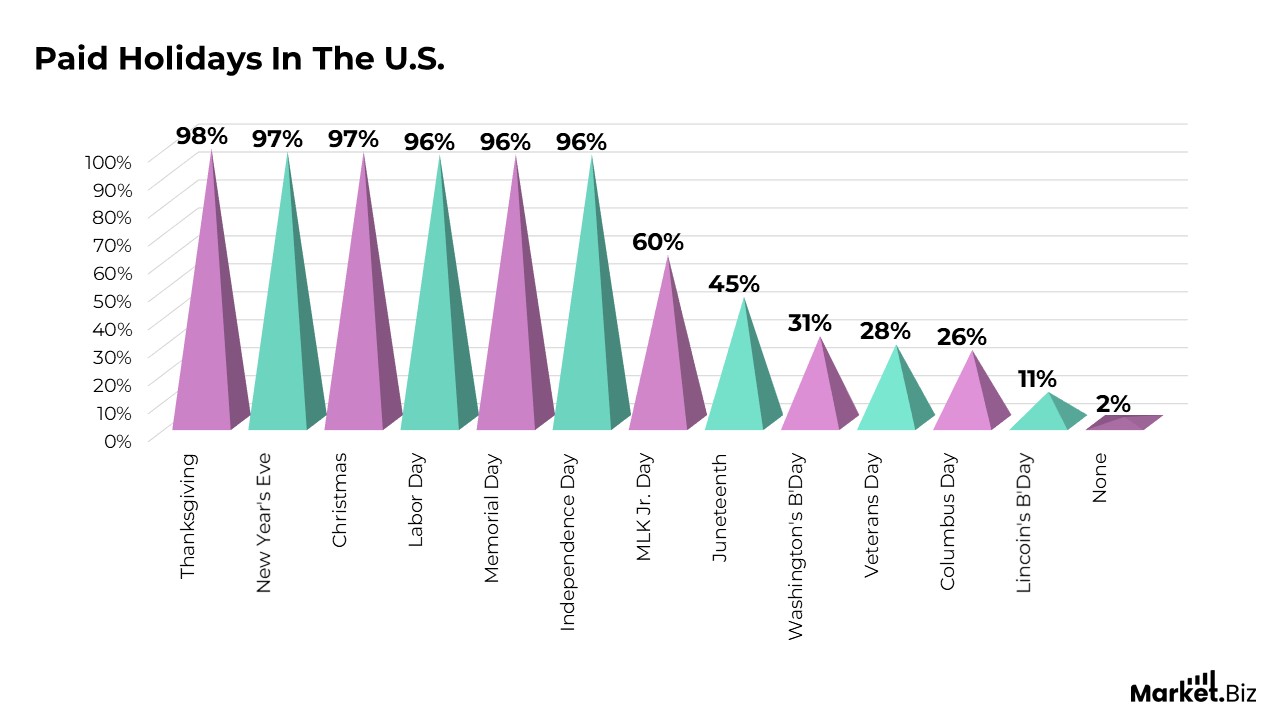
- New Year’s Eve is one of the most commonly offered paid holidays in the U.S., with 97% of employers providing it as a paid day off.
- Christmas Day is recognized by 97% of U.S. employers as a paid holiday, making it one of the most widely observed holidays in the workplace.
- 98% of employers in the U.S. offer paid time off for Thanksgiving, reflecting the cultural significance of this holiday.
- Labor Day is offered by 96% of U.S. employers as a paid holiday, emphasizing the country’s celebration of the workforce.
- Memorial Day is a paid holiday for 96% of U.S. workers, particularly in industries that observe national remembrance.
- 96% of employers offer paid time off for Independence Day, marking one of the top national holidays in the U.S.
- Veterans Day is a paid holiday for 28% of U.S. employees, with public sector jobs leading in observance.
- Around 72% of U.S. employers in certain regions or industries provide paid time off for Good Friday.
- Easter Monday is offered by 70% of U.S. employers, especially in sectors with large religious workforces.
- 26% of U.S. employers offer paid holidays for Columbus Day, though it is less common in private sector jobs.
- Martin Luther King Jr. Day is recognized by 60% of U.S. employers as a paid holiday, reflecting the importance of civil rights in American history.
- 45% of employers offer Juneteenth as a paid holiday, with it being more common in federal and state jobs.
- Many U.S. employers provide an extended holiday, with 31% offering paid time off for Washington’s Birthday.
- Similarly, 11% of employers offer paid time off for Lincoln’s Birthday, reflecting its status as a major American holiday.
(Source: coolest-gadgets, wp-content)
How Many Paid Holidays Do U.S. Companies Offer?
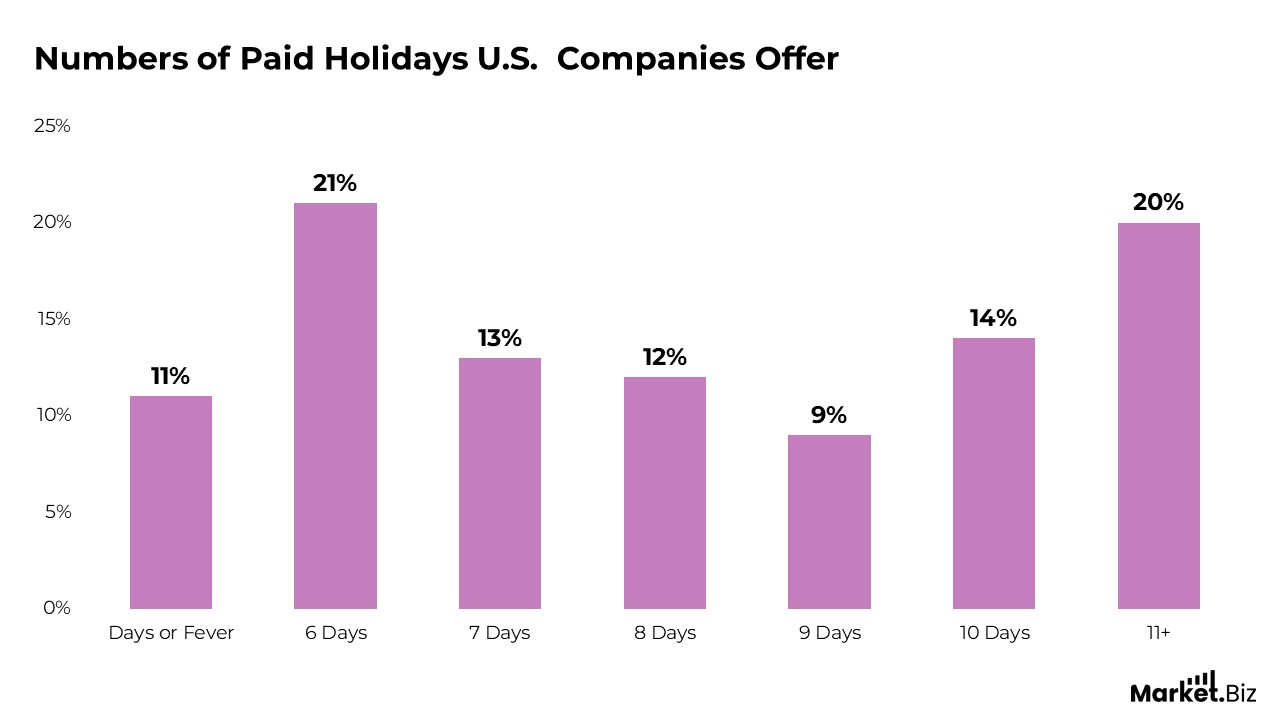
- U.S. companies offer an average of 10 paid holidays annually, with many employers providing additional time off for specific occasions.
- The majority of U.S. companies observe 6-8 federal holidays, such as New Year’s Day, Independence Day, and Christmas, as paid time off.
- Private companies often provide fewer paid holidays, with 77% of employees in the private sector receiving an average of 8-9 paid holidays each year.
- Industries like education, government, and healthcare offer more paid holidays, averaging 12-15 days annually, compared to the average in private-sector businesses.
- Full-time employees in the U.S. typically receive between 9 and 11 paid holidays per year, according to data from the Bureau of Labor Statistics.
- Only 18% of part-time workers in the U.S. receive paid holidays, highlighting a significant discrepancy compared to full-time workers.
- Companies on the East Coast tend to offer more paid holidays compared to businesses in other regions, with employees receiving an average of 12 days off per year.
- Larger companies (1,000+ employees) are more likely to offer a higher number of paid holidays, with 82% of these companies providing 10 or more paid days off.
(Source: coolest-gadgets, wp-content)
New Trends on Paid Holidays in 2024
- In 2024, 26% of U.S. companies are increasing paid holidays specifically for mental health, following growing recognition of its importance in employee well-being.
- With the rise of global remote teams, 31% of companies are offering paid holidays that align with multiple countries’ public holidays to ensure inclusivity and fair time off.
- An emerging trend in 2024 is offering unlimited paid time off to employees, with 17% of businesses adopting this policy, emphasizing trust and flexibility in the workplace
- In 2024, 22% of companies are expanding paid holidays to include paid family leave for caregiving purposes, reflecting an increased focus on work-life balance and family support.
Conclusion
European countries like France and Spain offer up to 30 days. While the U.S. averages just 10 days, this significantly impacts employee satisfaction and retention.
As 77% of employees consider paid holidays crucial for job satisfaction, companies offering more paid leave report increased productivity, lower turnover, and better employee morale.
With 68% of workers demanding more time off for mental health reasons, adapting holiday policies to regional expectations is essential for staying competitive in attracting and retaining top talent.
FAQs
Iran leads the world in both the number of public holidays and the total number of paid holidays; employees are legally entitled to a full month of paid holidays, and there are an extra 27 paid holidays throughout the year.
12 working days of paid leave, also referred to as yearly leave, are granted to any worker or employee who has worked 240 days or more in a calendar year under the Factories Act of 1948. The government has set some minimum requirements that all organizations must follow.
According to a 2018 Bureau of Labor Statistics (BLS) poll, more than three out of four civilian workers receive paid holidays, and American workers receive an average of eight paid holidays annually.