









Introduction
Employee On-boarding Statistics: Employee on-boarding is a crucial process that significantly impacts a company’s ability to retain and engage new talent. Statistics show that 69% of employees are more likely to stay with a company for three years if they experience a well-structured on-boarding program. Effective on-boarding not only accelerates employee productivity but also enhances job satisfaction and performance.
In fact, companies with strong on-boarding practices improve new hire retention by 50%. However, many organizations still overlook the importance of this process, with only 12% of employees reporting an exceptional on-boarding experience. This highlights a substantial opportunity for businesses to invest in more comprehensive, data-driven on-boarding strategies that drive long-term success.
Editor’s Choice
- 69% of employees are more likely to stay with a company for three years if they have a well-structured on-boarding program.
- Companies with strong on-boarding programs experience a 50% higher new hire retention rate within the first year.
- Only 12% of employees report an exceptional on-boarding experience, revealing a significant opportunity for improvement.
- 58% of employees are more likely to stay with a company for at least three years after a structured on-boarding process.
- 70% of new hires show higher engagement with effective on-boarding programs.
- Employees with mentors during on-boarding are 72% more likely to remain with the company.
- 46% of employees believe cultural integration is a key part of their on-boarding experience.
- 69% of employees who undergo effective on-boarding perform better in their roles.
- Companies with poor on-boarding processes see 40% higher turnover rates among new employees.
- 54% of organizations use digital tools to facilitate remote on-boarding.
- 60% of remote employees report higher job satisfaction when on-boarded via virtual platforms.
- 64% of companies begin the on-boarding process before the new hire’s first day, improving retention by 30%.
General Employee On-boarding Statistics
- Employees who undergo a structured on-boarding process are 58% more likely to stay with the company for at least three years.
- Organizations with effective on-boarding programs experience a 70% improvement in new hire engagement.
- 33% of employees are more likely to stay at a company for over three years if their on-boarding experience is positive.
- On boarded employees reach full productivity 25% faster than those who go through a less structured process.
- Companies with robust on-boarding programs have 50% higher new hire retention rates within the first year.
- 54% of companies now use digital tools for remote on-boarding, providing flexibility for new hires.
- Employees with assigned mentors during on-boarding are 72% more likely to stay with the company.
- 90% of employees report that effective on-boarding and training directly impact their job performance and satisfaction.
- 46% of employees say company culture integration is a key part of their on-boarding experience.
- 69% of employees who undergo effective on-boarding are more likely to perform well in their roles.
- Companies with poor on-boarding processes see a 40% higher turnover rate among new employees.
- 40% of Millennials prefer tech-driven, flexible on-boarding experiences compared to traditional methods.
- Employees who have positive on-boarding experiences are 60% more likely to report higher job satisfaction.
- The average time for a new employee to be fully on-boarded is 3 to 6 months.
- Companies with inclusive on-boarding practices see a 25% higher increase in diversity within their teams.
- 60% of organizations are adopting on-boarding software to streamline tasks and improve new hire experience.
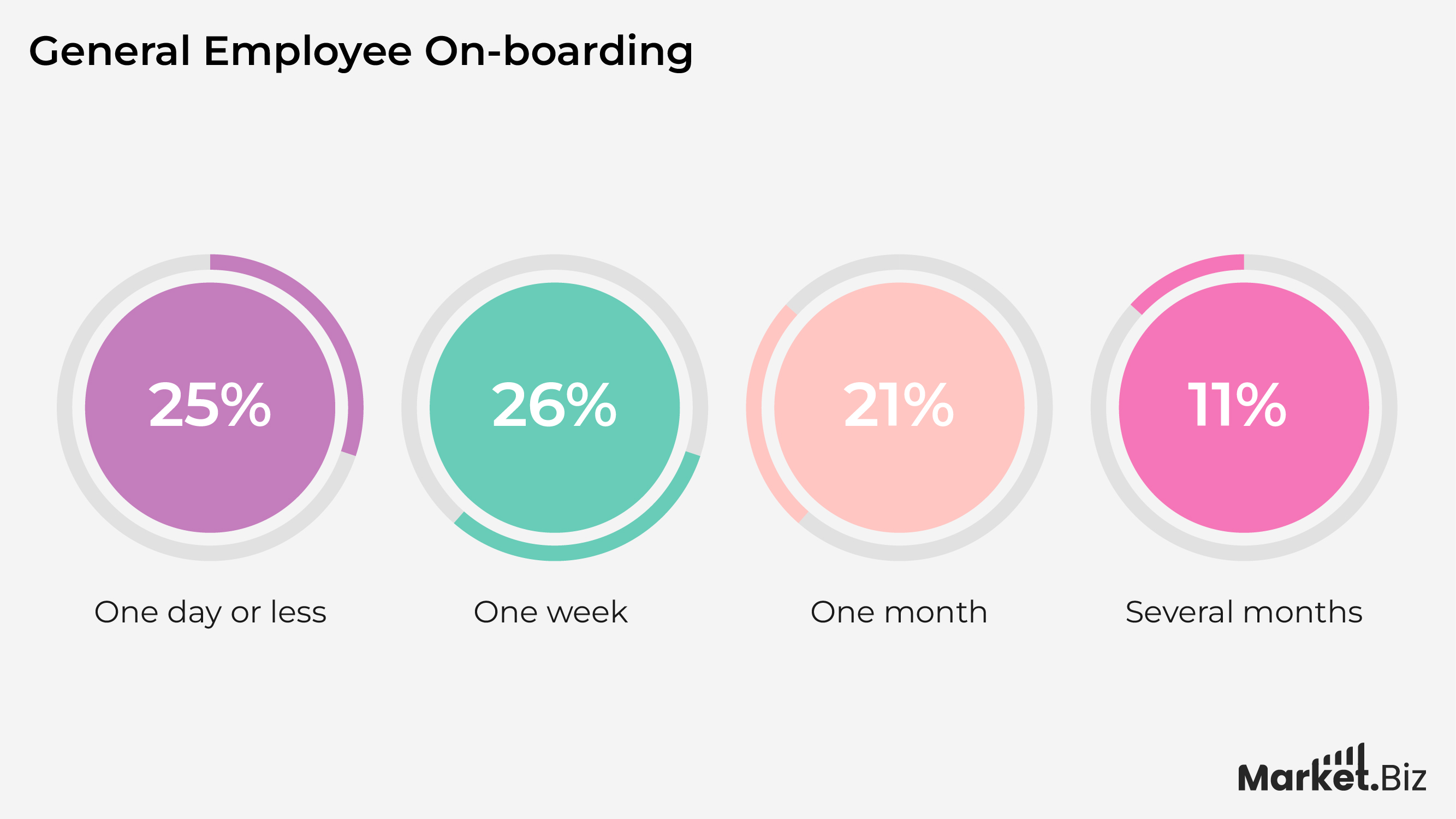
(Source: Zippia, WP-Content)
Moreover
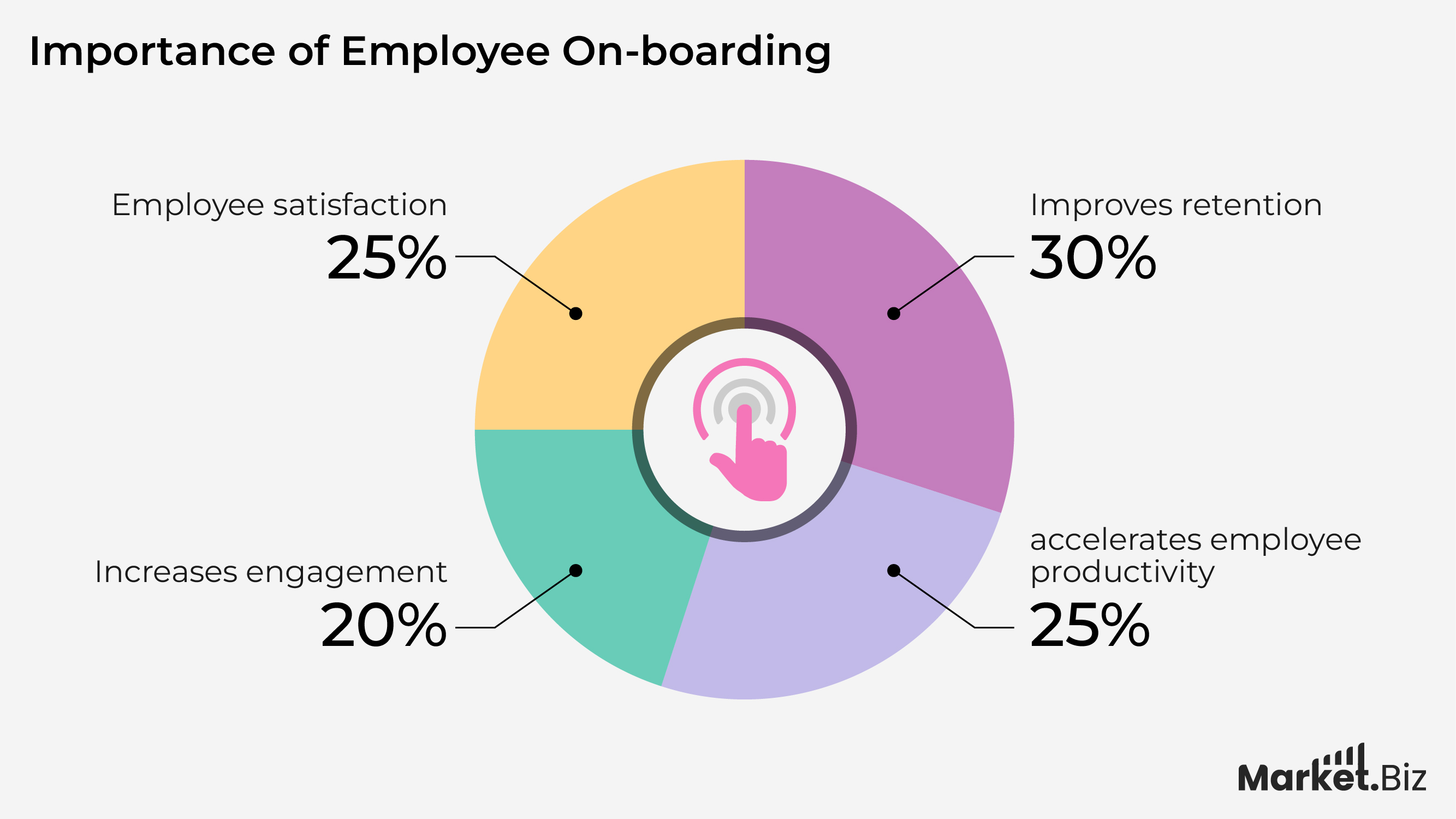
- Employee on-boarding improves retention, with organizations that have effective programs seeing 30% higher new hire retention rates within the first year.
- On-boarding accelerates employee productivity; new hires become fully productive 25% faster when they undergo a structured on-boarding process.
- A strong on-boarding process increases engagement, with 20% of employees who have an engaging on-boarding experience reporting higher engagement levels.
- Companies with formal on-boarding programs are 25% more likely to report higher levels of employee satisfaction.
- A positive on-boarding experience can increase employee performance, as 19% of employees are more likely to perform well when on-boarded effectively.
- On-boarding enhances job satisfaction, with employees who experience thorough on-boarding 60% more likely to express job satisfaction.
- Structured on-boarding helps integrate new hires into company culture, which is a key factor in retention, with 26% of employees saying cultural integration is crucial during on-boarding.
- Effective on-boarding reduces turnover, as companies with poor on-boarding programs face a 40% higher turnover rate among new hires.
- On-boarding improves time-to-productivity, enabling new employees to reach full productivity 25% faster than those who do not receive structured on-boarding.
- Mentorship during on-boarding can significantly improve retention, with 22% of employees who have a mentor during on-boarding more likely to stay with the company.
- On-boarding plays a critical role in diversity, with companies that implement inclusive on-boarding practices seeing a 25% increase in diversity within their teams.
- Digital on-boarding solutions are becoming essential, with 20% of companies adopting on-boarding software to improve efficiency and reduce manual tasks.
Cost of Onboarding Statistics
- The average cost of onboarding a new employee ranges between $1,000 to $4,000, depending on the company’s size and the complexity of the process.
- Companies that invest in effective on-boarding programs see a 62% higher revenue per employee, making the initial investment worthwhile in the long run.
- On-boarding costs can escalate significantly for global organizations, with international on-boarding costing up to 20% more due to additional legal and compliance requirements.
- Poorly executed on-boarding programs can lead to increased turnover, with new hires leaving within the first year costing companies as much as 33% of the employee’s annual salary to replace.
- Research indicates that companies with structured on-boarding processes save an average of $1,500 per new hire in turnover-related costs.
- Remote on-boarding can reduce costs, with 54% of companies using digital tools, saving on travel, paperwork, and administrative time.
- On-boarding software and automation tools can lower costs by streamlining tasks, reducing manual work, and saving up to 40% in on-boarding-related administrative costs.
- Companies with efficient on-boarding processes can reduce the time-to-productivity for new hires by 25%, minimizing the cost of delayed output during the initial training period.
- Employee turnover due to poor on-boarding can increase recruiting costs by 50%, emphasizing the financial importance of a robust on-boarding strategy.
- The hidden costs of on-boarding include the time managers and team members spend training new hires, which can amount to several thousand dollars per year.
- Effective on-boarding can significantly lower training costs, with research showing that structured on-boarding reduces training expenses by 17% for new hires.
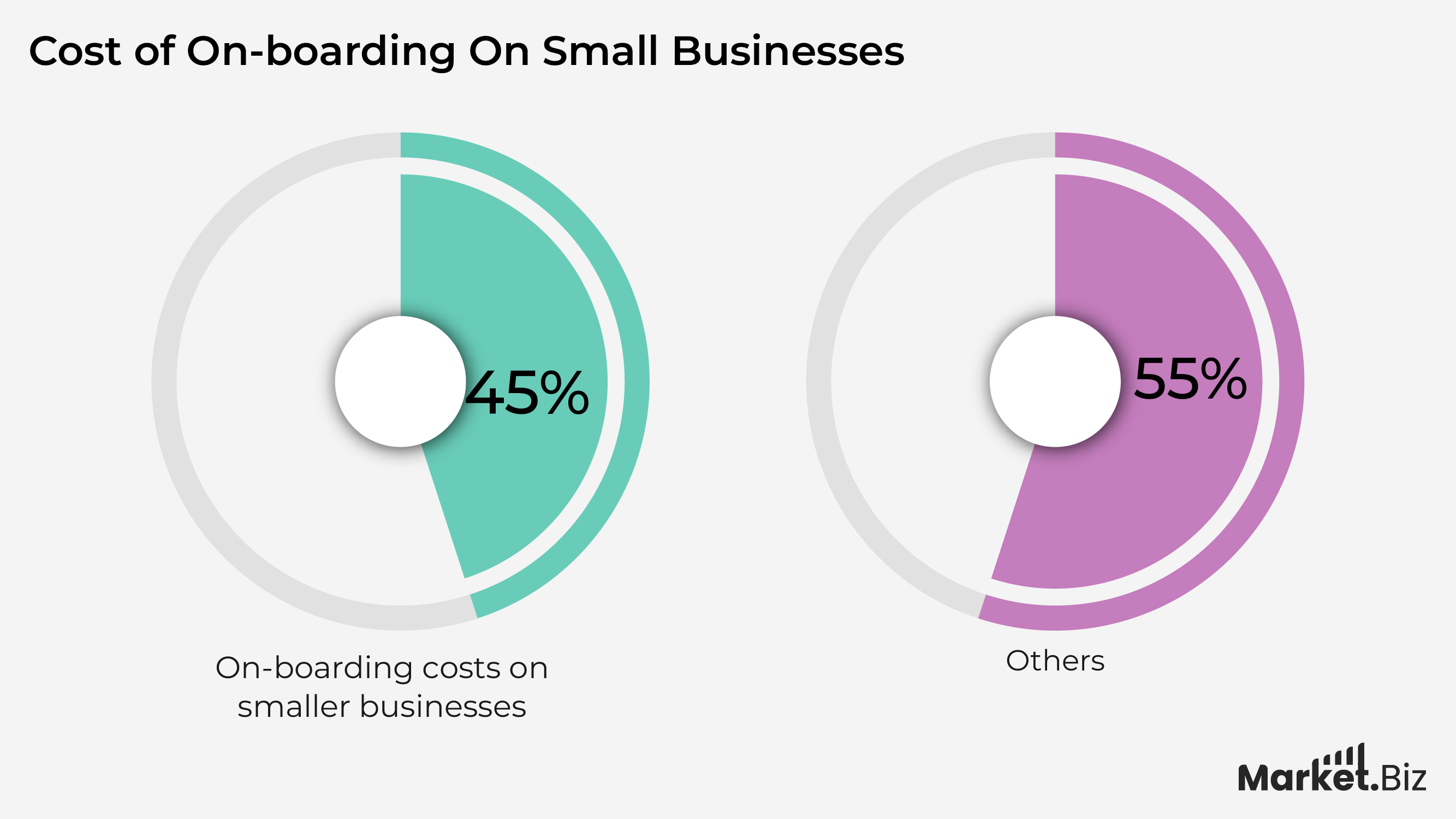
- On-boarding costs are higher for smaller businesses, with some studies showing that small companies spend up to 45% more per new hire on on-boarding than larger organizations.
Remote On-boarding Statistics
- 54% of companies have shifted to digital on-boarding tools to accommodate remote employees, ensuring efficiency in virtual settings.
- 79% of remote employees feel more engaged when their on-boarding experience is thorough and well-structured.
- Remote on-boarding processes reduce on-boarding time by 20%, thanks to digital tools that streamline administrative tasks and training.
- Companies that provide strong remote on-boarding are 30% more likely to retain their new hires for at least a year.
- 62% of remote companies use collaboration platforms like Zoom and Slack as key tools during the on-boarding process.
- Remote on-boarding cuts costs by up to 40%, reducing the need for in-person training materials and travel expenses.
- On average, remote on-boarding takes 10-15% longer than in-person on-boarding due to the additional time needed for virtual training and integration.
- 72% of remote employees report higher job satisfaction when they are on-boarded via virtual platforms, particularly if the process includes personalized experiences.
- Remote on-boarding processes help new employees reach full productivity 25% faster by utilizing automated training modules and virtual resources.
- 68% of remote companies use specialized on-boarding software, which allows for smoother integration and ensures all tasks are tracked and completed.
- 33% of companies are exploring virtual reality on-boarding experiences, which provide immersive and engaging training for remote employees.
- Remote employees are 20% less likely to complete their on-boarding tasks on time without proper follow-up and automated reminders.
- 64% of remote employees with a designated on-boarding mentor are more likely to feel connected and stay with the company longer.
- 46% of remote employees state that virtual introductions to company culture and values during on-boarding make them feel more connected to their teams.
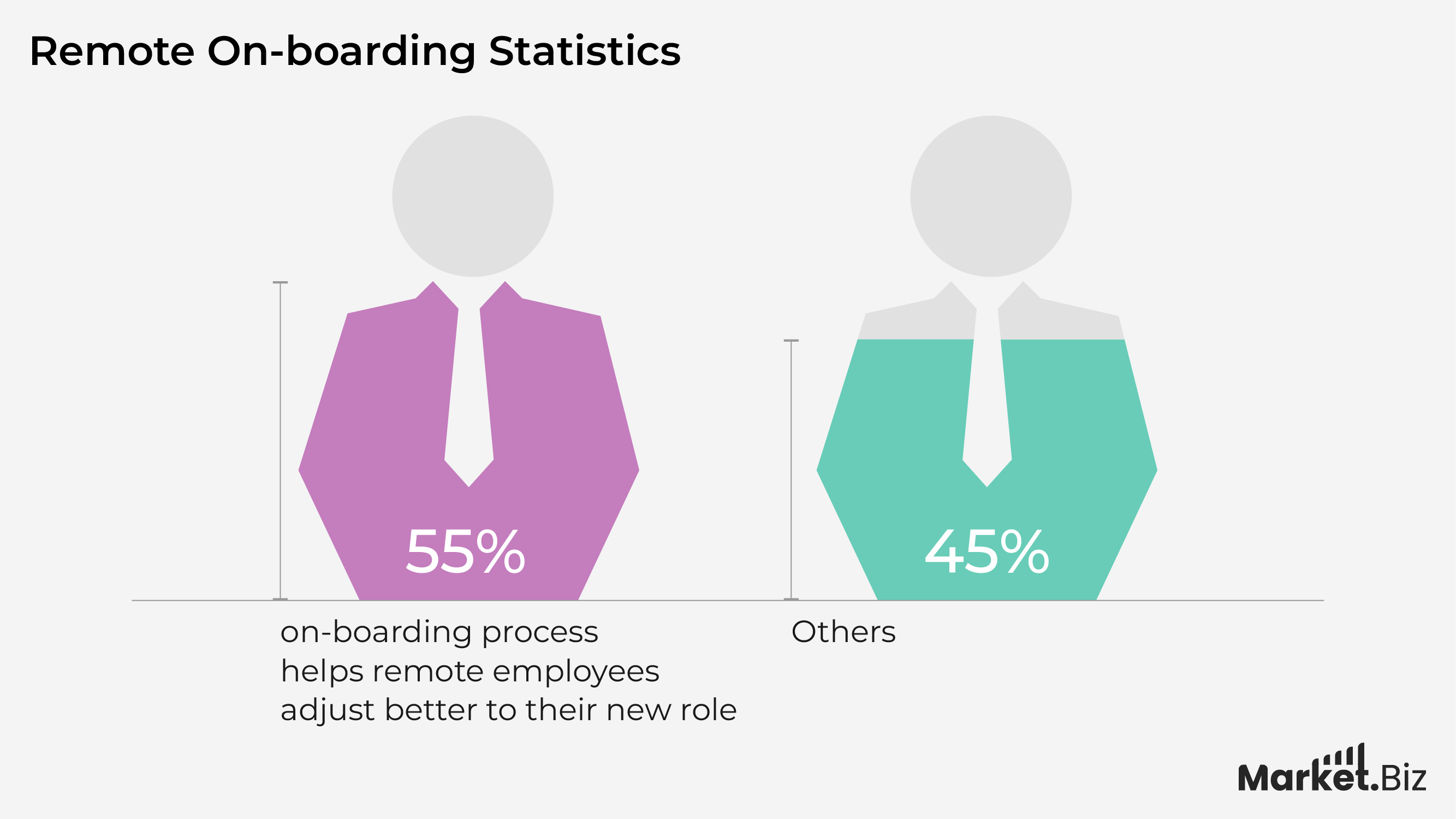
- 55% of remote employees say that receiving regular feedback during the on-boarding process helps them adjust better to their new role.
On-boarding Challenges
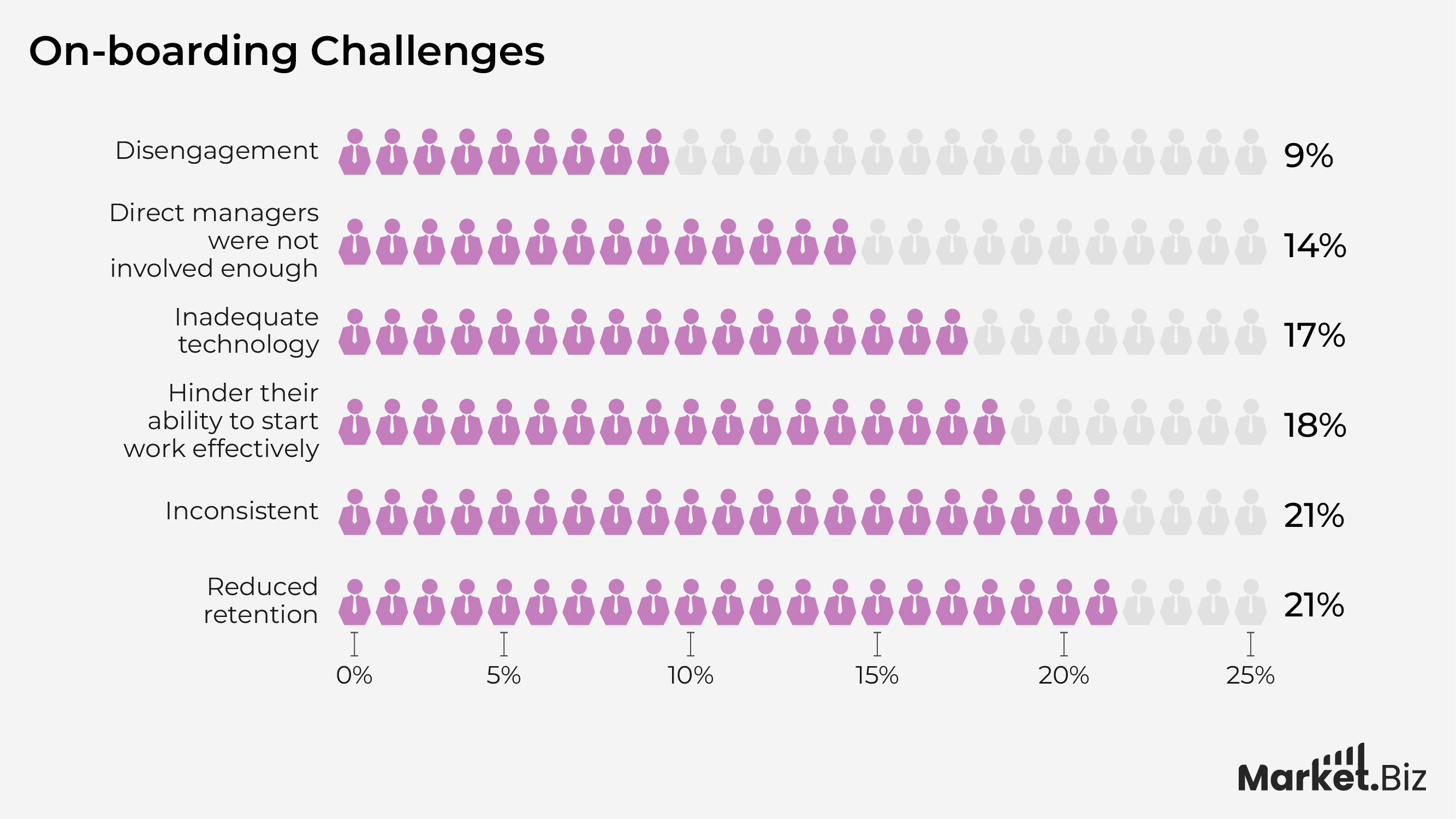
- 9% of employees feel on-boarding is too generic and doesn’t cater to their specific needs, leading to disengagement early on.
- 21% of new hires report that their on-boarding experience was inconsistent across teams, which affects their overall experience and integration.
- 17% of organizations struggle with inadequate technology, leading to inefficient on-boarding and poor employee experiences.
- 18% of new hires experience delays in receiving necessary resources and equipment, which can hinder their ability to start work effectively.
- 21% of new employees feel overwhelmed by the sheer amount of information they receive during on-boarding, leading to reduced retention of key details.
- 14% of employee’s report that their direct managers were not involved enough in their on-boarding process, which negatively affects their integration.
- 35% of remote employees struggle with feeling disconnected and lack sufficient guidance during virtual on-boarding sessions.
- 49% of new hires feel that their on-boarding didn’t adequately help them understand or adapt to the company culture.
Moreover
- 39% of new employees experience delays in receiving training schedules, prolonging their path to productivity.
- 41% of new hires feel they don’t receive enough feedback during their on-boarding process, which hinders their ability to improve and adapt quickly.
- 33% of companies expect new hires to self-train without adequate support, leading to feelings of isolation and frustration.
- 38% of employees report that their roles and expectations were unclear during the on-boarding process, leading to confusion and early job dissatisfaction.
- 26% of new hires struggle with unclear or ineffective communication, which impacts their ability to engage fully with their roles.
- 32% of employees feel that there was no sufficient follow-up after the initial on-boarding process, affecting their long-term engagement and productivity.
- 44% of organizations report difficulties in adjusting on-boarding processes for remote workers, leading to inconsistencies in training and integration.
- 51% of businesses cite the high cost of on-boarding programs as a challenge, particularly for small to mid-sized organizations with limited budgets.
Digital On-boarding Trends
- 62% of organizations are adopting digital on-boarding platforms to streamline administrative tasks and enhance new hire experiences.
- Virtual on-boarding tools have increased by 54%, with companies leveraging video conferencing and digital training modules for a more flexible process.
- 45% of businesses use mobile on-boarding apps, allowing new hires to complete training and paperwork on-the-go, increasing accessibility and engagement.
- Companies that use automated on-boarding systems report a 30% reduction in time spent on administrative tasks, freeing up HR teams for more strategic activities.
- 70% of employees say that digital on-boarding, including e-learning and virtual collaboration tools, has helped them feel more prepared for their new roles.
- 39% of companies now use gamification in their digital on-boarding process to engage new hires, with 60% reporting improved completion rates.
- The use of virtual reality (VR) for on-boarding is growing, with 33% of organizations planning to incorporate VR to provide immersive, hands-on training experiences.
Moreover
- 68% of remote companies have adopted digital on-boarding systems that allow seamless integration for new hires, regardless of their location.
- AI-powered on-boarding tools are gaining popularity, with 24% of businesses using AI catboats to answer new hire questions and provide instant support.
- 46% of organizations are utilizing online social platforms during on-boarding to help remote employees feel connected to their teams and company culture.
- Cloud-based on-boarding systems are becoming standard, with 55% of companies storing employee data on the cloud to ensure easy access and security.
- 53% of companies are adopting video introductions and virtual tours as part of their on-boarding process, helping new hires familiarize themselves with the company culture.
- 41% of companies report that digital on-boarding has reduced new hire turnover by improving engagement and easing the transition process.
- The use of data analytics to track on-boarding effectiveness is on the rise, with 36% of organizations measuring new hire progress through performance metrics and feedback.
Role of Technology in Onboarding
- 13% of companies use technology to automate on-boarding tasks, reducing HR workload.
- 26% of businesses leverage on-boarding software to streamline document collection and minimize errors.
- 15% of companies use video conferencing for remote on-boarding, facilitating connections with teams.
- 28% of companies use AI-powered platforms to offer personalized on-boarding experiences.
- 21% of organizations use LMS for digital training, allowing new hires to learn at their own pace.
- 64% of companies use cloud-based on-boarding platforms for easy, accessible on-boarding.
- 39% of companies incorporate gamification in on-boarding software to boost engagement and completion.
- 22% of companies use Chabot’s for real-time answers, enhancing new hire experiences.
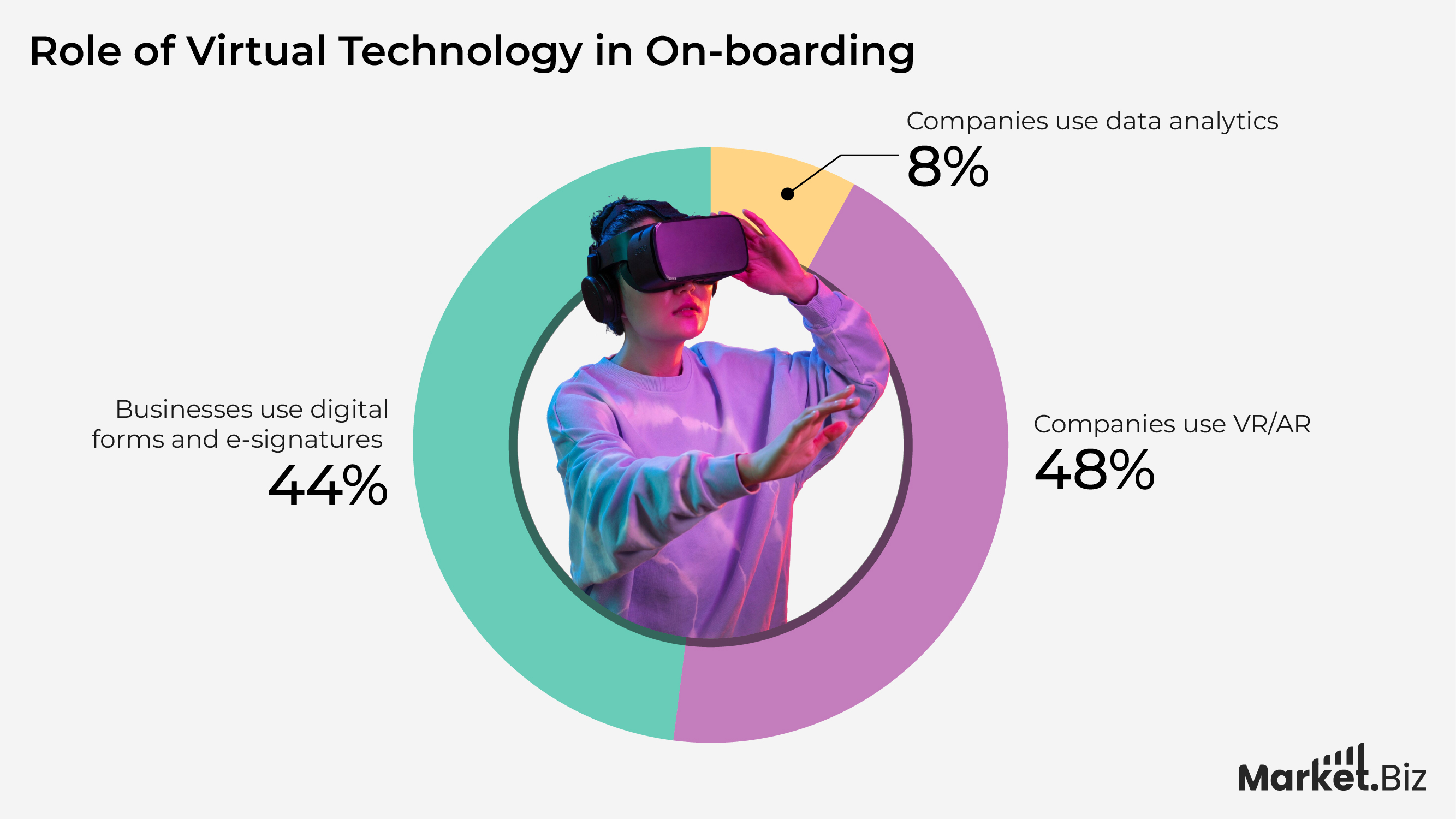
- 44% of businesses use digital forms and e-signatures to speed up documentation and ensure compliance.
- 38% of companies offer mobile on-boarding apps, providing flexibility for remote employees.
- 48% of companies use VR/AR for immersive, interactive on-boarding training.
- 8% of companies use data analytics to track and optimize new hire on-boarding processes.
Start Time of Employee On-boarding
- 64% of companies begin the on-boarding process before the employee’s first day, providing early access to resources and company materials.
- 38% of businesses initiate on-boarding within a week of hiring, ensuring new hires are engaged immediately after accepting the offer.
- 45% of companies kick off on-boarding within 1-2 days of an employee’s start date to ensure a smooth transition and immediate engagement.
- 27% of organizations delay on-boarding by over a week, leading to new hires feeling disconnected and underprepared.
- 71% of new hires prefer starting the on-boarding process before their first day, which helps them feel more prepared and less anxious.
- 55% of companies with remote workers begin on-boarding as soon as the employee signs the offer letter, leveraging digital tools for efficiency.
- 52% of employers who start on-boarding before day one see a 30% improvement in new hire retention within the first year.
- 30% of companies begin on-boarding immediately after the job offer is accepted, sending welcome emails and initial paperwork to create excitement.
- 63% of companies that begin on-boarding before day one report higher engagement levels among new employees.
- 40% of companies struggle with starting on-boarding late, which can delay training and lower new hire productivity.
- 50% of companies offering pre-boarding materials (e.g., handbooks, welcome videos) report a smoother integration for new hires.
- 42% of new hires feel more prepared and valued when on-boarding starts before their first day, improving overall satisfaction.
Onboarding for Different Generations
- 22% of Millennials prefer digital on-boarding tools, valuing flexibility and tech-driven experiences.
- Gen Z employees are 38% more likely to engage with gamified on-boarding, seeking interactive and dynamic experiences.
- 25% of Baby Boomers prefer in-person on-boarding for personal connection and clarity in role expectations.
- 60% of Gen X workers value structured, detailed on-boarding processes that align with their need for work-life balance.
- 67% of Gen Z employees expect on-boarding to include digital mentorship programs, aligning with their desire for immediate feedback.
- 51% of Millennials say on-boarding success directly influences their decision to stay with the company beyond the first year.
- Gen X employees are 48% more likely to appreciate on-boarding programs with clear, self-paced learning options.
- Baby Boomers are 34% more likely to prefer traditional, face-to-face training during on-boarding, prioritizing human interaction.
- 40% of Millennials report that on-boarding technology, like mobile apps, significantly impacts their engagement and job satisfaction.
- 62% of Gen Z employees expect their on-boarding to integrate social media or company apps for better team collaboration.
Technology Used in The On-boarding Process
- 62% of companies use on-boarding software to automate administrative tasks and ensure a streamlined process for new hires.
- 48% of businesses use learning management systems (LMS) to deliver training modules and track employee progress during on-boarding.
- 33% of organizations utilize AI-driven catboats to assist new hires with questions and provide real-time support.
- 55% of companies leverage video conferencing tools like Zoom for virtual on-boarding, enabling remote employee integration.
- 41% of organizations use e-signature platforms to streamline document signing, reducing time and paperwork during on-boarding.
- 39% of companies integrate mobile apps into their on-boarding process, allowing new hires to access materials and complete tasks on-the-go.
- 28% of businesses use virtual reality (VR) for immersive on-boarding experiences, particularly for hands-on or safety training.
- 44% of organizations adopt cloud-based platforms to store on-boarding data, providing centralized access and ensuring data security.
- 36% of companies use gamification techniques within on-boarding platforms to increase engagement and improve completion rates.
- 53% of companies use social media platforms to help integrate new hires into company culture and enhance collaboration during on-boarding.
Future of On-boarding
- 52% of HR professionals predict that AI-driven on-boarding systems will be the standard by 2027. Automating repetitive tasks and enhancing personalized experiences.
- 40% of organizations plan to incorporate VR/AR for immersive on-boarding experiences, especially for hands-on training and remote on-boarding.
- 65% of companies expect to offer mobile-first on-boarding experiences in 2025, enabling new hires to access materials, complete tasks, and engage with their teams from anywhere.
- 58% of organizations plan to implement more personalized on-boarding processes by using data analytics to tailor experiences to individual employee needs and preferences.
- By 2026, 44% of businesses aim to incorporate automated feedback tools in on-boarding to continuously improve the experience and boost employee satisfaction.
- 50% of companies foresee a shift toward fully remote on-boarding as remote work continues to grow. Emphasizing the need for robust digital tools to ensure smooth integration.
- 37% of companies expect to expand the use of gamification in on-boarding. As interactive elements increase engagement and training retention rates.
- 43% of businesses are integrating wellness programs into the on-boarding process. Recognizing the importance of mental and physical well-being for long-term employee success.
Conclusion
Employee on-boarding plays a pivotal role in ensuring long-term retention, engagement, and productivity. When employees experience an effective on-boarding process, they are more likely to stay with the company for an extended period, creating a valuable opportunity for organizations to improve retention.
Investing in strategies like mentorship and digital tools can lead to higher retention rates and faster time-to-productivity. As remote work continues to rise, more companies are adopting digital on-boarding tools. Signifying a shift towards more flexible and efficient processes.
FAQs
A structured on-boarding process significantly boosts employee retention, with employees being more likely to stay with the company for at least three years. This leads to a reduction in turnover and an increase in overall workforce stability.
Effective on-boarding accelerates productivity, allowing new employees to reach full productivity 25% faster than those who undergo less structured on-boarding processes, ultimately benefiting the company’s bottom line.
Digital tools have become crucial in streamlining on-boarding, especially for remote employees. These tools help automate administrative tasks, enhance engagement, and provide flexibility, making the process more efficient and accessible.
Mentorship during on-boarding significantly increases retention rates, with employees who have a mentor during this phase being much more likely to stay with the company. This support fosters better integration and engagement.
On-boarding costs vary but can range from $1,000 to $4,000 per new hire. Investing in efficient on-boarding programs. Such as digital tools and automated systems, can reduce costs by streamlining processes and improving retention, ultimately offering long-term savings.