









Introduction
Workplace Automation Statistics: Workplace automation has rapidly transformed industries across the globe. Around 45% of work activities could be automated with current technologies, potentially affecting 1.2 billion workers worldwide. This shift is being driven by advancements in artificial intelligence, machine learning, and robotics.
As businesses strive for efficiency, 69% of organizations have already started implementing some form of automation. This trend is expected to increase, with automation-related spending forecast to reach $200 billion in 2025, as companies look to reduce operational costs and boost productivity. Understanding these statistics is key to navigating the future of work.
Editor’s Choice
- 45% of global work tasks could be automated by 2030, affecting 1.2 billion workers.
- 69% of companies have adopted automation to boost efficiency.
- Automation spending is expected to reach $200 billion in 2025.
- Automation may displace 85 million jobs but create 97 million new roles in 2025.
- AI and machine learning will drive 70% of automation by 2027.
- 80% of customer service inquiries will be handled by chatbots in 2025.
- Healthcare automation will grow by 30% annually through 2027.
- 70% of workers will need reskilling due to automation.
- 52% of SMEs plan to adopt automation in the next 2-3 years.
- HR automation reduces time-to-hire by 40%.
- 74% of companies say automation boosts remote work productivity.
- By 2030, automation will replace 20 million manufacturing jobs but create 12 million new tech roles.
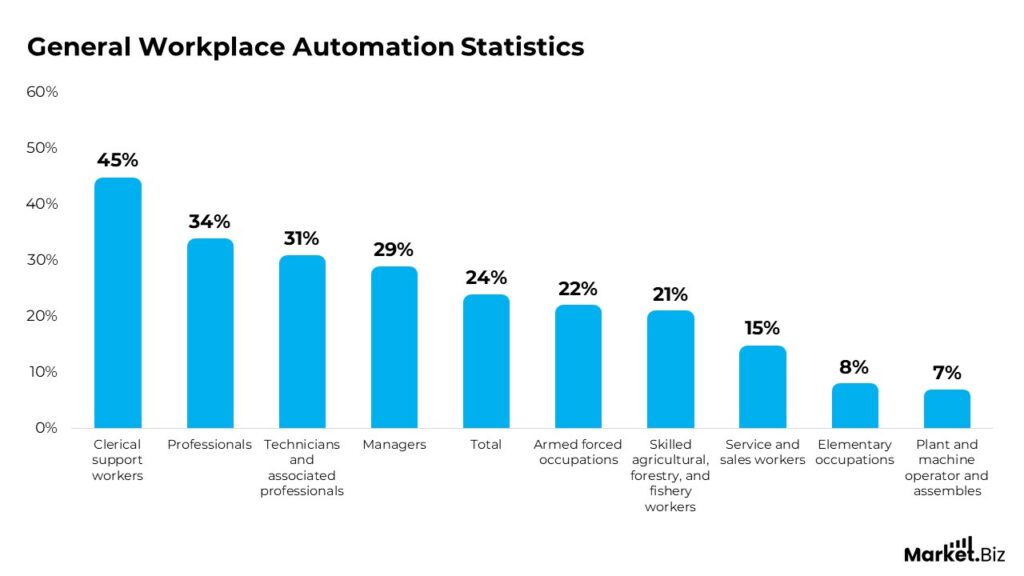
(Source: Statista)
General Workplace Automation Statistics
- Approximately 45% of tasks in the global workforce could be automated by 2030, affecting around 1.2 billion workers.
- 69% of organizations have already implemented automation to streamline operations and improve efficiency.
- In 2025, it’s estimated that 85 million jobs may be displaced due to automation, while 97 million new roles could emerge in advanced technology sectors.
- Businesses using automation technologies have seen a 30% reduction in operational costs on average.
- Manufacturing, retail, and logistics are among the industry’s leading in automation adoption, with automation rates exceeding 50% in some sectors.
- AI and machine learning technologies are expected to contribute to 70% of workplace automation by 2027.
- Automation tools in remote work settings have risen by 60%, facilitating virtual collaboration and task management.
- The automation sector is expected to generate over 3.5 million new jobs in 2025, particularly in programming, engineering, and data analysis.
- Global spending on robotic process automation (RPA) and other automation technologies is forecast to reach $200 billion in 2025.
- Companies implementing automation report a 20-30% increase in worker productivity due to task optimization.
- 80% of customer service inquiries are expected to be handled by catboats and automated systems in 2025.
- 52% of small and medium-sized enterprises (SMEs) are planning to adopt automation technologies in the next 2-3 years to compete with larger firms.
- Healthcare automation, including patient data management and robotic surgery, is predicted to grow by 30% annually through 2027.
- 70% of workers impacted by automation will need reskilling to transition into new roles, with a focus on digital and technical skills.
- By 2026, 60% of all data analysis tasks will be automated, allowing companies to make faster, data-driven decisions.
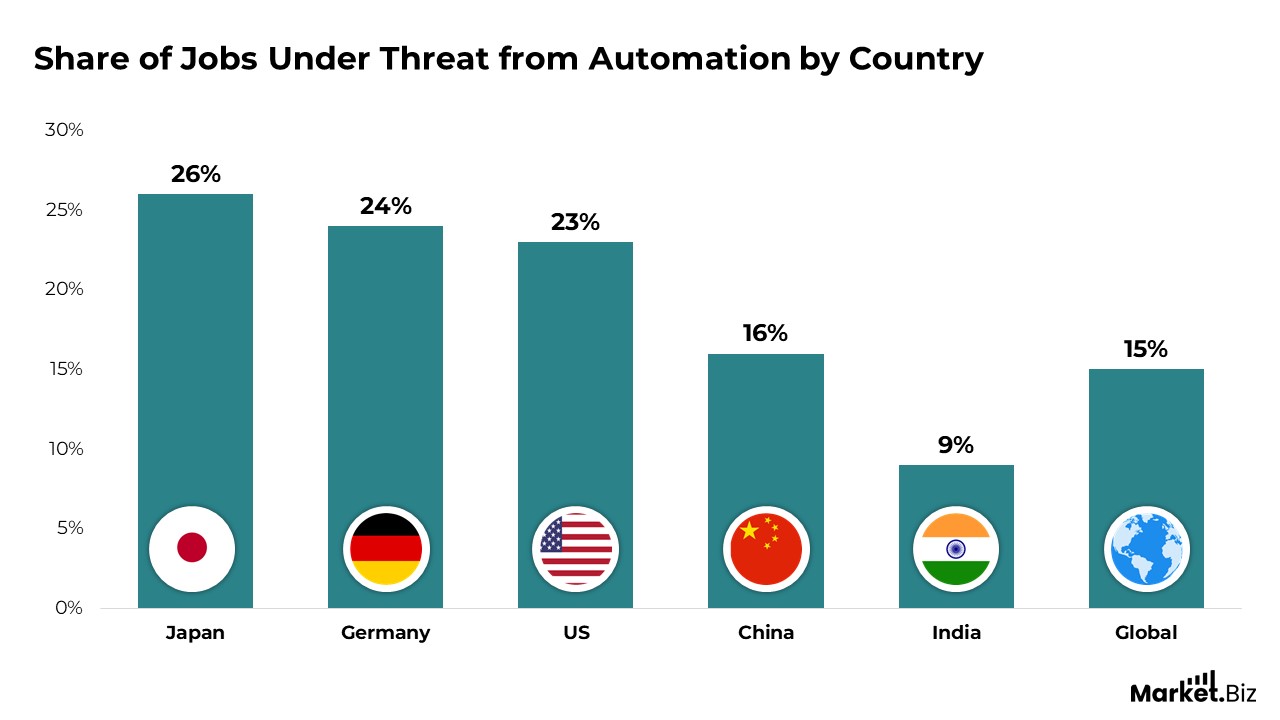
(Source: Amazonaws)
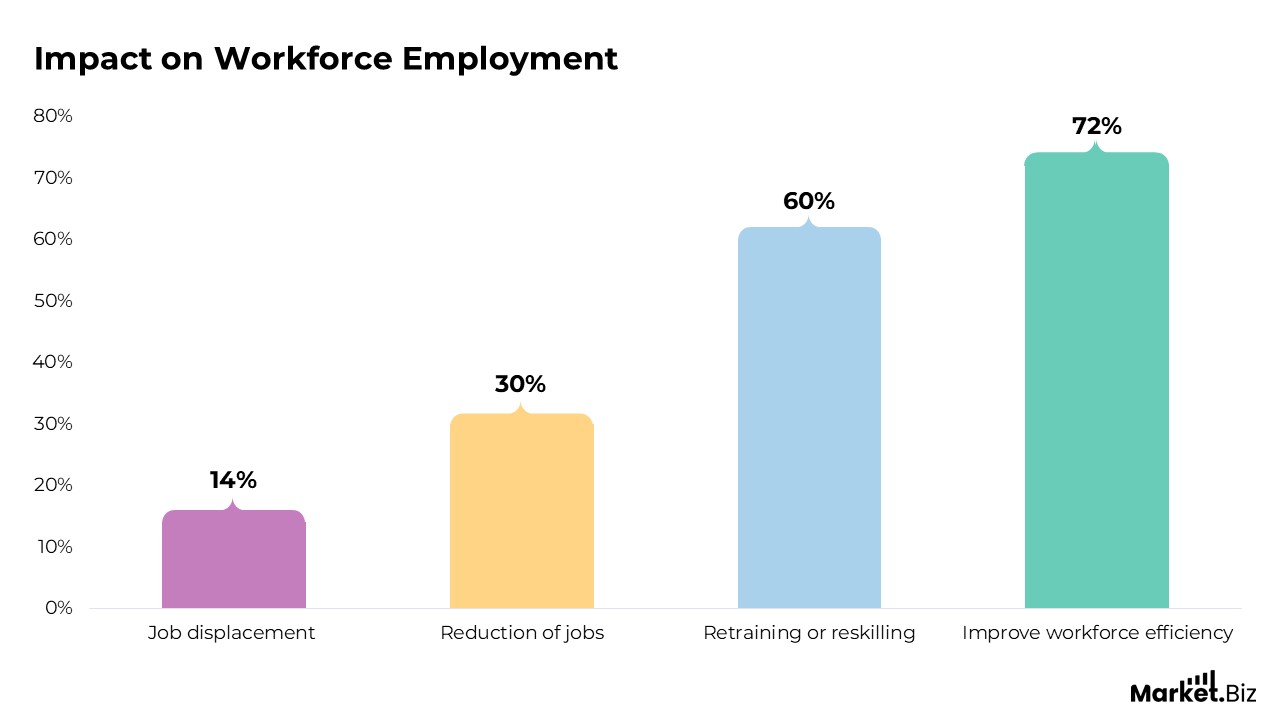
Impact on Workforce Employment
- Automation is expected to displace 85 million jobs globally in 2025, but at the same time, it will create 97 million new roles, many of which will require advanced skills in technology and digital tools.
- Around 14% of the global workforce could experience job displacement due to automation, especially in roles that involve routine tasks such as data entry and basic customer service.
- In industries like manufacturing and logistics, automation could lead to a reduction of up to 30% of jobs, while sectors such as AI programming, data analysis, and robotics engineering will see growth.
- By 2030, over 400 million workers worldwide may need to switch occupations due to automation, with a significant portion requiring reskilling and upskilling to stay competitive in the job market.
- Despite job displacement, 72% of companies believe that automation will improve workforce efficiency, leading to more specialized positions and higher-value tasks for employees.
- The World Economic Forum predicts that 60% of employees will need retraining or reskilling within the next 5 years to adapt to the changing demands of automated workplaces.
- While automation reduces repetitive tasks, it can increase job satisfaction by allowing employees to focus on more strategic, creative, and decision-making roles, driving innovation in the workplace.
- In sectors like healthcare, automation is enhancing job roles rather than replacing them, with tools like robotic surgery and AI-driven diagnostics providing professionals with more precision and efficiency.
Customer Service and Chabot’s
- In 2025, it’s expected that 80% of customer service inquiries will be handled by catboats, reducing the need for human intervention in basic support tasks.
- 67% of consumers globally prefer self-service options, with catboats being one of the most favoured tools for resolving customer issues quickly.
- AI-driven catboats can resolve customer queries 24/7, resulting in a 40% reduction in response time and enhancing overall customer satisfaction.
- Over 70% of businesses report increased customer satisfaction after implementing chatbot solutions in their customer service strategies.
- In 2023, the global Chatbot market was valued at $2.6 billion, and it is projected to grow at a compound annual growth rate (CAGR) of 24.3% through 2030.
- 54% of consumers expect businesses to provide a Chatbot experience, showing how important this technology has become in modern customer service.
- Chatbots have helped companies reduce costs by as much as 30% by automating repetitive customer service tasks such as FAQs, order tracking, and basic troubleshooting.
- According to a recent survey, 58% of consumers are more likely to engage with a business that offers a chatbot on its website or app.
- Chatbots equipped with AI and machine learning can understand context and nuances, providing more personalized responses, which enhances customer loyalty and retention.
- 37% of customers prefer to use a chatbot for troubleshooting technical issues, citing speed and convenience as their main reasons for preference.
- The use of chatbots in customer service has led to a 25% increase in customer engagement, as they allow businesses to address inquiries instantly without long wait times.
- 61% of businesses using chatbots have seen a boost in their operational efficiency, as chatbots can handle a large volume of inquiries simultaneously without affecting quality.
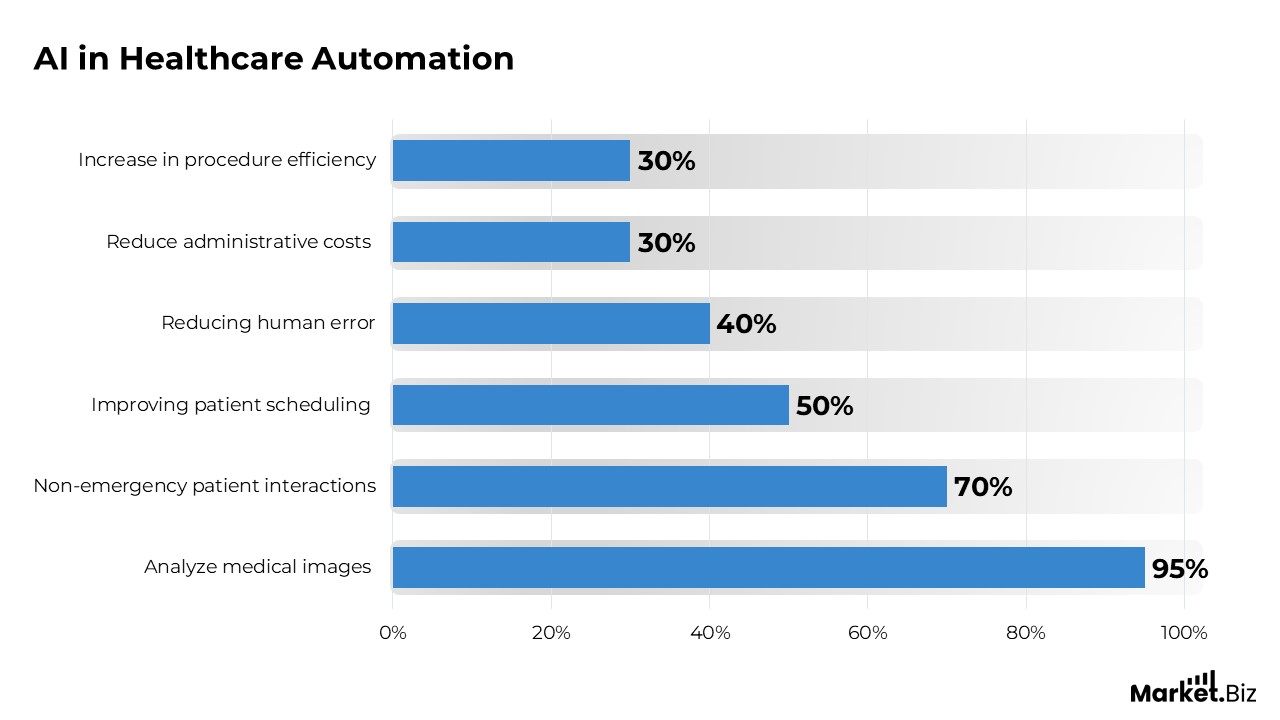
AI in Healthcare Automation
- The AI healthcare market is projected to reach $120 billion by 2028, growing at a compound annual growth rate (CAGR) of 37.3%, driven by advancements in automation technologies.
- AI-driven automation in healthcare can reduce administrative costs by up to 30%, allowing healthcare professionals to focus more on patient care.
- Approximately 40% of hospitals globally are expected to implement AI-powered automation in diagnostics, improving accuracy and reducing human error.
- AI in healthcare is predicted to improve patient outcomes by automating routine tasks, with tools like robotic surgeries showing a 30% increase in procedure efficiency.
- In 2025, 50% of healthcare organizations will have integrated AI tools into their patient management systems, improving patient scheduling and resource allocation.
- AI chatbots in healthcare can handle up to 70% of non-emergency patient interactions, streamlining appointment bookings, symptom checking, and follow-up care.
- Automated AI systems can analyze medical images with up to 95% accuracy, offering faster and more reliable diagnostics in areas like radiology and dermatology.
- AI-powered virtual health assistants are expected to reduce healthcare costs by $5 billion annually by improving the efficiency of chronic disease management and preventive care.
Automation in Human Resources
- By 2027, the HR automation market is expected to reach $34 billion, growing at a CAGR of 11.5%.
- 60% of HR tasks, such as payroll processing and benefits administration, are already automated in large enterprises.
- 45% of organizations are investing in AI-driven recruitment tools to streamline candidate screening and improve hiring efficiency.
- Automation in HR can reduce time-to-hire by up to 40%, allowing recruiters to focus on higher-value tasks.
- 70% of HR professionals report that automation has improved employee engagement by providing timely feedback and reducing administrative workload.
- HR chatbots are expected to handle 30% of employee inquiries in 2025, improving response times and reducing HR team workload.
- Automated employee onboarding systems can reduce onboarding time by 50%, increasing new hire productivity.
- 55% of businesses use automation for performance management, providing real-time insights into employee progress and development needs.
- Automation tools have been shown to reduce HR costs by up to 30% by eliminating manual processes and improving operational efficiency.
- 40% of HR departments plan to adopt AI-driven analytics tools by 2026 to enhance workforce planning and decision-making.
Challenges in Workforce Automation
- At 49%, workers in the US between the ages of 16 and 24 are most significantly exposed to the risk of automation.
- Junior employees are greatly impacted by the 14% annual growth in automated occupations.
- 69% of all managerial jobs are expected to be automated by the end of 2024.
- With 28% of employed men and 24% of women at risk of losing their jobs by the end of 2023, automation is anticipated to have a greater impact on men than women.
- In the US, 38% of occupations could be affected by automation, compared to 35% in Germany, 30% in the UK, and 21% in Japan.
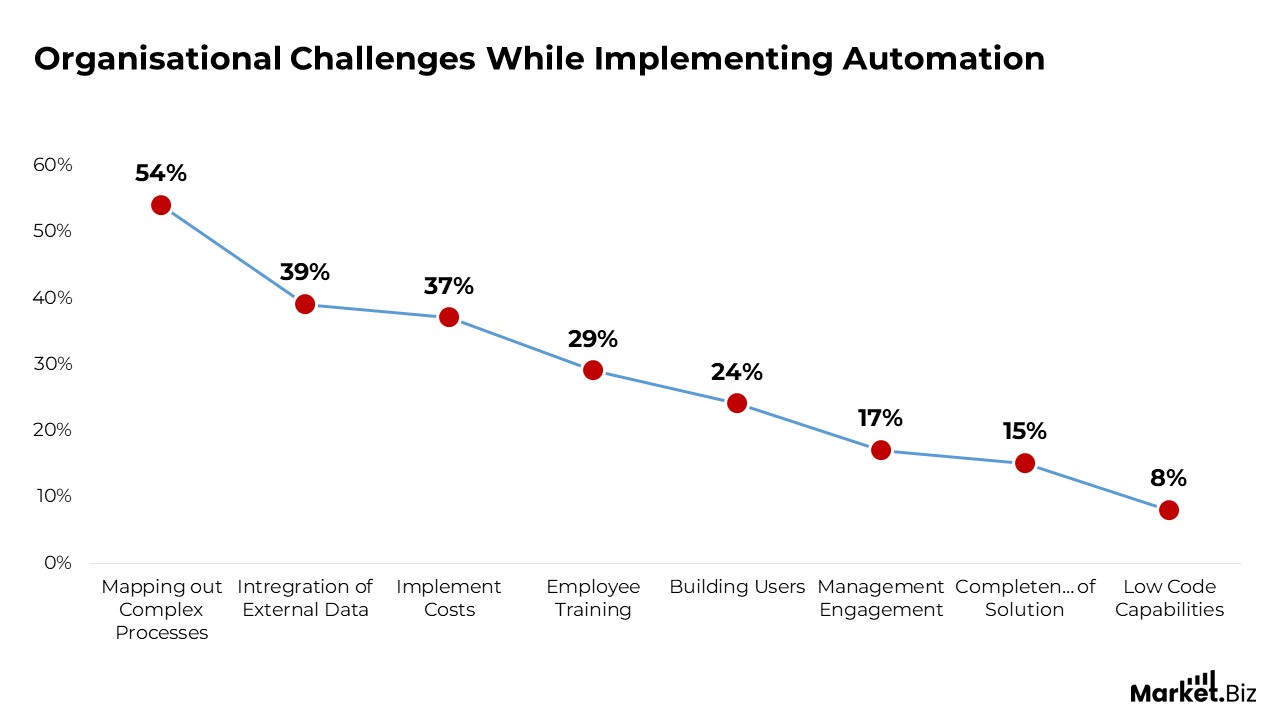
- Automation projects fail 90% of the time due to technical issues. By contrast, 37% fail because of high implementation costs, and 25% fail because of a lack of a clear vision or plan.
- When it comes to automation, resistance to change ranks as the third most obstacle.
Moreover
- Problems with deployment and integration affect 45% of businesses that use robotics and AI.
- According to 31% of respondents, automation and artificial intelligence will result in job loss and worker relocation.
- Forty-seven percent of American occupations are at high danger of being replaced by technology by 2030.
- The biggest obstacle to adoption is a lack of automation knowledge and training, which affects 39% of marketers.
- Every year, companies lose 20 to 30 percent of their revenue due to inefficient operations.
- Between 2019 and 2029, it is anticipated that the employment of surgeons would decline by 2% as a result of the deployment of surgical robots.
- Between 2019 and 2029, it is projected that AI-powered translation software would fuel a 20% growth in translation and interpretation positions.
- Lab-grown meat may account for one-third of US meat consumption by 2040, which would have an impact on the cattle and plant-based substitute businesses.
(Source: Flair)
Benefits of Workplace Automation
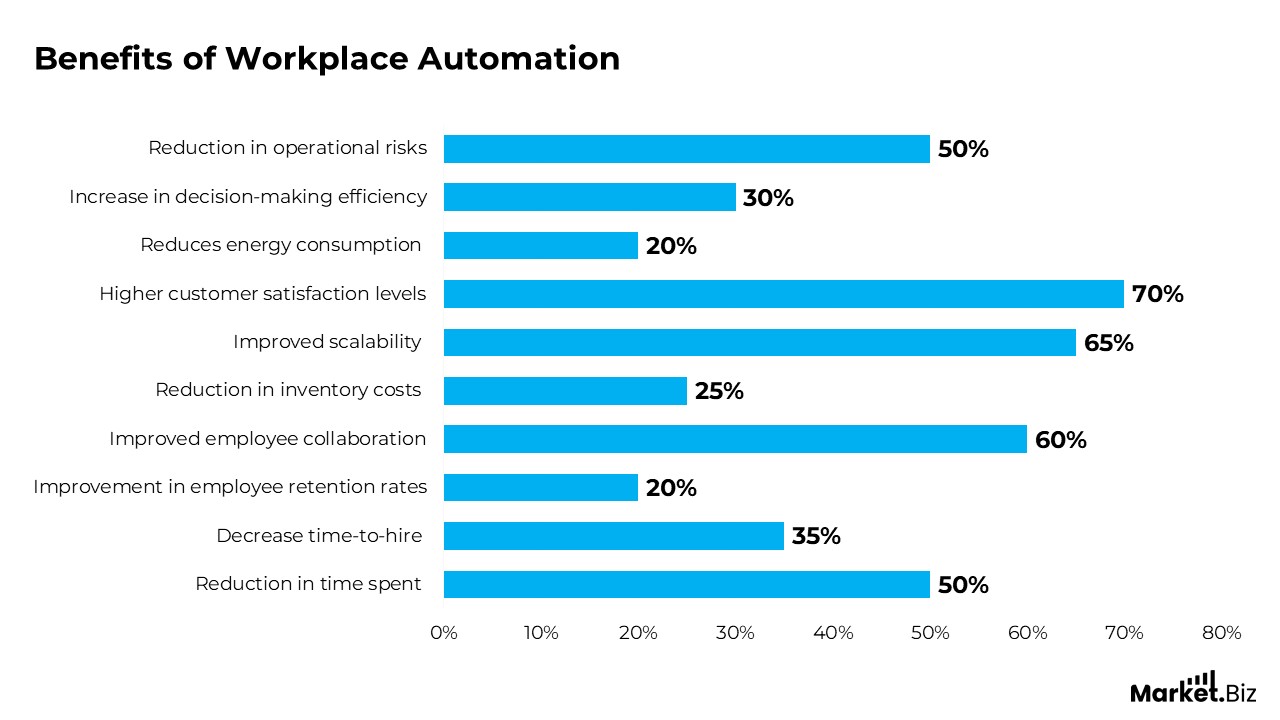
- Workplace automation can lead to up to a 50% reduction in time spent on administrative tasks, allowing employees to focus on more strategic initiatives.
- Automation in HR processes such as recruitment can decrease time-to-hire by 35%, enhancing talent acquisition and improving overall hiring efficiency.
- With the implementation of automation, companies can expect a 15-20% improvement in employee retention rates, as automation reduces burnout from repetitive tasks.
- 60% of businesses that implemented automation report improved employee collaboration, as teams can now focus on creative problem-solving rather than manual processes.
- Automation of supply chain management has resulted in a 25% reduction in inventory costs and a 20% improvement in on-time deliveries for businesses in logistics.
- Automation has allowed businesses to scale rapidly, with 65% of companies citing improved scalability as a key benefit of implementing automated solutions.
- 70% of businesses that use automation technologies report higher customer satisfaction levels, as customers experience faster response times and more accurate services.
- Automation reduces energy consumption in manufacturing processes, with automated systems optimizing energy usage and cutting costs by up to 20%.
- With automated systems handling complex data analysis, businesses can make more informed decisions, leading to a 30% increase in decision-making efficiency.
- 50% of companies that adopted automation tools reported a noticeable reduction in operational risks, as automation minimizes human errors and enhances consistency.
Impact of Automation on Job Roles
- Automation is expected to displace 85 million jobs globally in 2025, primarily in manufacturing, retail, and administrative sectors.
- While automation will eliminate some roles, it will create 97 million new roles focused on technology, AI management, and data analysis in 2025.
- 50% of all employees will need reskilling in 2025 to adapt to new technologies, with a focus on higher-level cognitive skills.
- Automation boosts productivity by up to 40% in industries like automotive manufacturing, allowing companies to scale up operations efficiently.
- 72% of companies are adopting AI to augment human roles rather than replace them, focusing on enhancing decision-making and reducing routine work.
- Automation contributes to wage polarization, increasing demand for high-skilled workers while reducing opportunities for low-skilled, low-wage jobs.
- Manufacturing, logistics, and transportation are the most affected sectors, with job losses of up to 25% in certain roles due to automation.
- The automation of administrative tasks is pushing more companies toward remote work models, where employees focus on higher-value tasks.
- AI and automation are transforming healthcare by streamlining administrative tasks, but they also demand new roles for AI specialists and data scientists.
- Automation frees employees from mundane tasks, allowing them to focus on more creative, strategic roles that drive innovation and business growth.
Employee Productivity and Automation
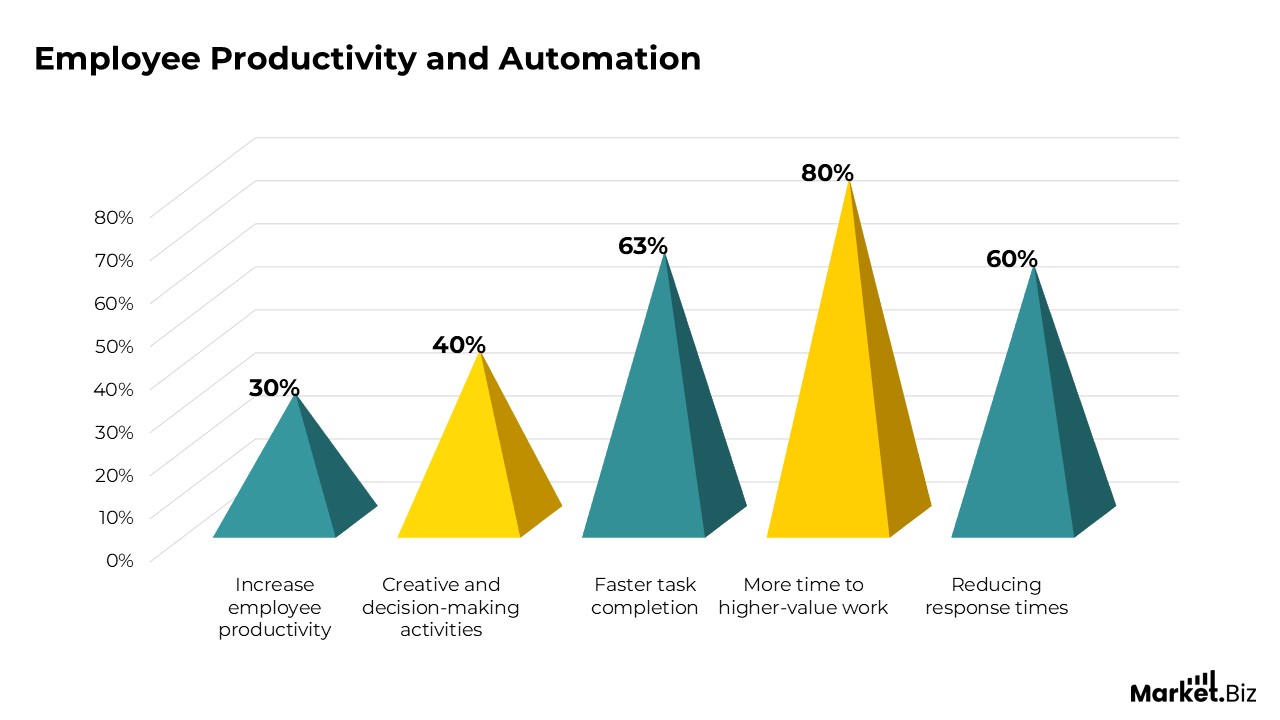
- Automation has been shown to increase employee productivity by up to 30%, particularly in industries like manufacturing and logistics, where repetitive tasks are common.
- Employees who use automation tools spend 40% less time on routine tasks, allowing them to focus more on creative and decision-making activities.
- 63% of businesses report improved employee productivity due to the adoption of robotic process automation (RPA), leading to faster task completion and fewer errors.
- Automation enables 80% of employees to dedicate more time to higher-value work, such as problem-solving and strategic planning, which contributes to business growth.
- In customer service, chatbots and AI-driven tools have increased employee productivity by reducing response times by up to 60%, allowing agents to handle more inquiries.
- A study found that automation of administrative tasks boosts employee productivity by 15% by reducing paperwork and manual data entry.
- 55% of businesses that integrated automation into their operations saw a significant improvement in workforce efficiency and output within the first year.
- Employees working alongside automated systems report a 20% increase in job satisfaction, as they are able to focus on more impactful tasks.
- Automation allows for better resource allocation, increasing team productivity by 25% as employees can focus on tasks that require critical thinking and creativity.
- The use of automation tools in project management has reduced project timelines by 20%, boosting team productivity and improving delivery times for clients.
Automation and Remote Work
- 74% of companies say automation improves remote work by streamlining tasks and communication.
- Remote workers using automation tools see a 25% boost in productivity.
- 65% of remote workers manage time better thanks to automation of routine tasks.
- 72% of businesses report improved remote team collaboration with automated workflows.
- Automation reduces work-related stress by 30% for remote employees.
Automation and Workforce Skill Gaps
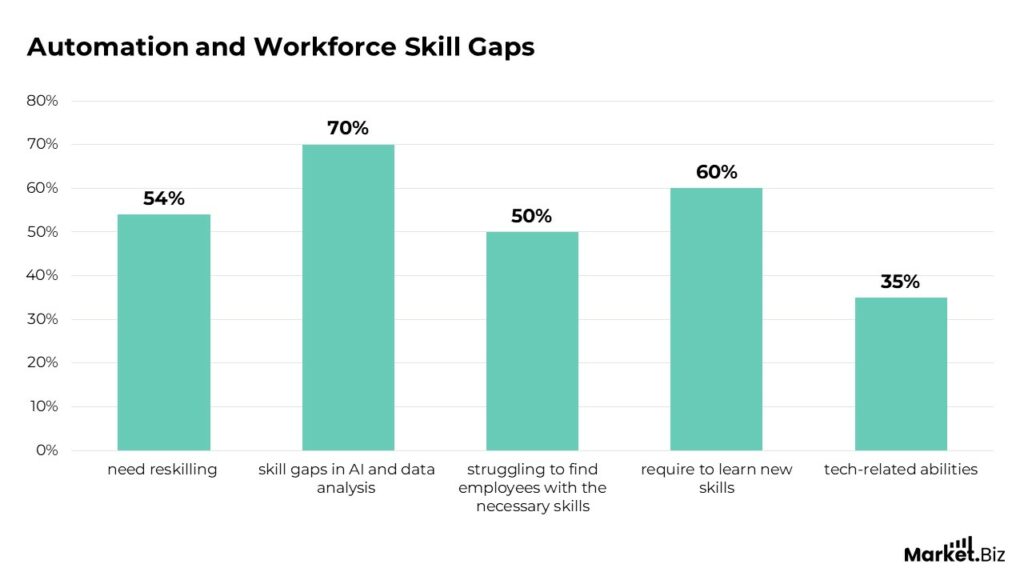
- 54% of workers need reskilling due to automation, with a focus on digital and technical skills.
- 70% of companies face skill gaps in AI and data analysis as automation demands specialized knowledge.
- 45% of global employees will need significant reskilling in 2025 due to the rise of automation technologies.
- 50% of businesses report struggling to find employees with the necessary skills to work with advanced automation tools.
- 60% of employees believe automation will require them to learn new skills, with 35% focused on tech-related abilities.
- Automation is expected to create a demand for 133 million new roles in 2022, primarily requiring soft and technical skills.
- 37% of employees feel unprepared for automation-driven changes, highlighting a growing skill gap in the workforce.
- Automation adoption has led 48% of companies to invest more in employee training to close emerging skill gaps.
The Future of Workplace Automation
- By 2030, automation could replace 20 million manufacturing jobs globally, but create 12 million new roles in tech and service sectors.
- 47% of jobs in the U.S. are at risk of automation, particularly in transport, logistics, and office administration.
- 83% of business leaders believe automation will play a critical role in their company’s future productivity and efficiency.
- The global market for workplace automation is expected to reach $18.6 billion in 2025, driven by advancements in AI and robotics.
- 52% of employees believe workplace automation will enhance their roles by handling repetitive tasks, allowing more focus on innovation.
- In the next 5 years, 75% of businesses will implement some form of AI-driven automation to streamline processes and reduce costs.
- 60% of global CEOs plan to invest in automation technologies to improve workforce agility and reduce operational costs.
- The integration of automation in the workplace is expected to increase employee satisfaction by 20%, as it reduces mundane tasks.
Conclusion
Workplace automation is rapidly transforming industries, with a significant portion of global work activities expected to be automated in the coming years, affecting billions of workers. While automation will lead to job displacement, it will also create new roles in advanced technology sectors, emphasizing the need for reskilling.
The automation market is set to grow substantially, driven by advancements in AI, machine learning, and robotics. Industries like healthcare and HR are already seeing improvements in efficiency and cost reduction, with automation boosting productivity.
However, businesses must focus on addressing emerging skill gaps, as many workers will need to adapt to new technologies. The future of automation promises increased efficiency, innovation, and new job opportunities, reshaping the workforce for years to come.
FAQ’s
In 2025, automation is expected to displace 85 million jobs globally, primarily in sectors like manufacturing, retail, and administrative roles, although new jobs will also be created in tech and advanced industries.
Manufacturing, retail, and logistics are among the industries with the highest rates of automation adoption, with some sectors surpassing 50% in automation implementation to improve efficiency and reduce costs.
Automation can boost employee productivity by up to 30%, particularly in sectors with repetitive tasks like manufacturing and logistics, allowing workers to focus on higher-value activities such as innovation and strategic decision-making.
AI and machine learning are expected to drive the majority of workplace automation by 2027, contributing to increased operational efficiency, improved decision-making, and enhanced customer service through technologies like chatbots and predictive analytics.
With automation’s rise, a significant portion of the workforce will need reskilling, particularly in digital and technical skills, as many workers adapt to new technologies and take on roles in fields like AI, data analysis, and robotics.