Trishita has more than 8+ years of experience in market research and consulting industry. She has worked in various domains including healthcare, consumer goods, and materials. Her expertise lies majorly in healthcare and has worked on more than 400 healthcare reports throughout her career.
Tajammul Pangarkar is a CMO at Prudour Pvt Ltd. Tajammul longstanding experience in the fields of mobile technology and industry research is often reflected in his insightful body of work. His interest lies in understanding tech trends, dissecting mobile applications, and raising general awareness of technical know-how. He frequently contributes to numerous industry-specific magazines and forums. When he’s not ruminating about various happenings in the tech world, he can usually be found indulging in his next favorite interest - table tennis.
India remains the second‑largest tobacco consumer globally, with nearly 267 million adults (15 years and above)—approximately 29 % of all adults—reporting current tobacco use according to the Global Adult Tobacco Survey (GATS) 2016–17. More recent data indicate approximately 253 million adult tobacco users in 2022—comprising 200 million males and 53 million females.
In India, the overall prevalence of tobacco use among adults aged 15 years and older is 28.6%, with men reporting a significantly higher rate at 42.4% compared to 14.2% among women. When broken down by type, 21.4% of adults consume smokeless tobacco, which is more common among men at 29.6%, while 12.8% of women also use it. In terms of smoking in any form, 10.7% of adults are current users, with the burden much higher in men at 19.0%, while only 2.0% of women smoke. Among adolescents aged 13 to 15 years, the prevalence of tobacco use stands at 8.5%, with 9.6% of boys and 7.4% of girls reported as current users.
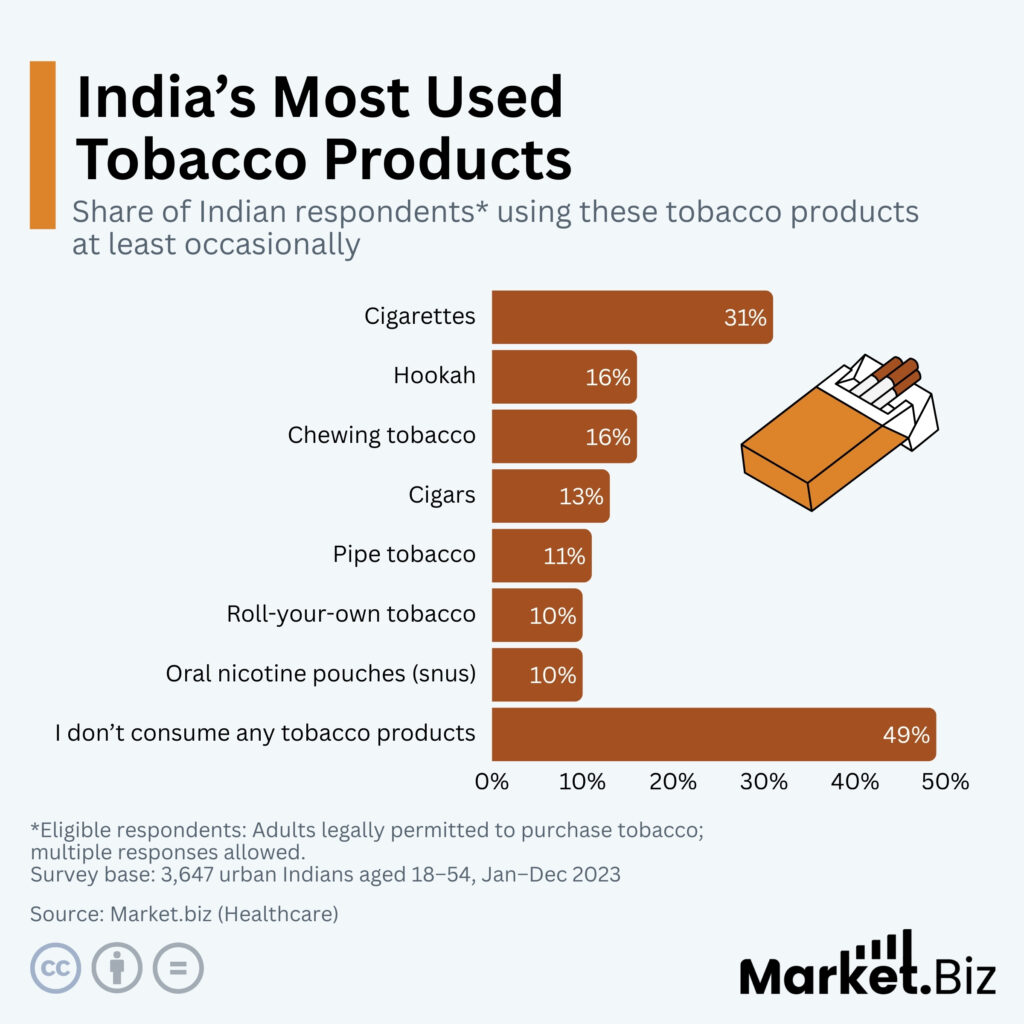
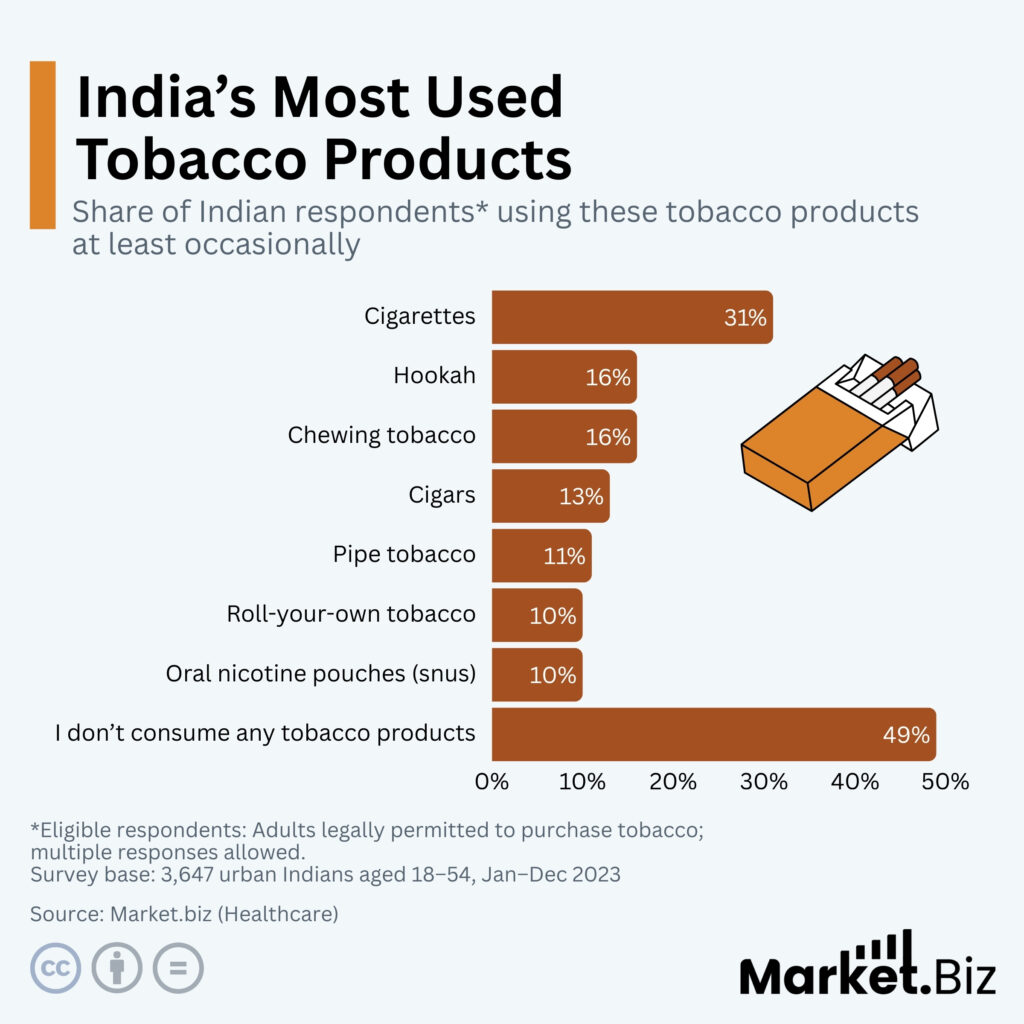
Most Used Tobacco Products in India
Cigarettes are the most used tobacco product in India, with 31% of respondents reporting occasional use.
Hookah and chewing tobacco are equally popular, each used by 16% of respondents.
Cigars are consumed by 13% of respondents.
Pipe tobacco follows with 11% usage.
Roll-your-own tobacco is used by 10% of respondents.
Oral nicotine pouches (snus) also report 10% usage.
A significant proportion, 49%, stated they do not consume any tobacco products.
The survey was based on 3,647 urban Indians aged 18–54, conducted from January to December 2023.
Pin
Summary Table (Estimated Prevalence, Adults 15+)
Product Type
Approximate Adult Prevalence (%)
Khaini (SLT)
11.2
Gutkha (SLT)
6.8
Betel quid with tobacco
5.8
All SLT (combined)
>21 percent
Bidi (smoking)
7.7
Cigarettes (smoking)
~4 percent
Note: Percentages are drawn from various studies and may not sum precisely due to overlapping use and reporting periods.
Additional Data About Popular Tobacco Products in India
The second most used tobacco product among adults is bidi smoking, practiced by around 7.7 %.
Gutkha (a mixture of tobacco, lime, and areca nut) follows at 6.8 % prevalence.
Betel quid with tobacco registers at 5.8 %.
Additional national-level data indicates Khaini use stands near 12 %, gutkha around 8 %, betel quid with tobacco at 6 %, and bidi smoking at 9 %, with cigarettes used by 6 % and hookah by 1 %, according to Press Information Bureau.
According to WHO data, smokeless tobacco (SLT) is the most prevalent form of tobacco consumption in India, with products such as khaini, gutkha, betel quid with tobacco, and zarda being particularly widespread; smoking forms include bidi, cigarette, and hookah.
Current figures show that nearly 267 million Indian adults (aged 15+)—about 29 % of all adults—use some form of tobacco.
Conclusion
A formal assessment reveals that smokeless tobacco remains the dominant tobacco product category in India, with Khaini, Gutkha, and Betel Quid with tobacco being the most prevalent forms. Among smoking products, Bidis significantly outpace cigarettes.
The scope of tobacco use remains considerable: over 250 million adult consumers, with persistent usage across gender, age, and socioeconomic groups. The economic burden—both in direct medical costs and indirect losses—far exceeds excise revenue and continues to challenge public health, despite ongoing regulatory efforts.
Market projections anticipate moderate growth in volume (CAGR ~2.1%) and significant expansion in the high-value cigarette segment (CAGR ~10.4%) by 2030. Such trends may indicate gradual shifts in consumption patterns, influenced by increasing urbanization, rising incomes, and evolving market strategies
Trishita has more than 8+ years of experience in market research and consulting industry. She has worked in various domains including healthcare, consumer goods, and materials. Her expertise lies majorly in healthcare and has worked on more than 400 healthcare reports throughout her career.