









Introduction
Retail Analytics Statistics: Retail analytics refers to the systematic collection and examination of data derived from all retail activities to derive insights regarding customer behaviour, sales patterns, and overall performance.
This process aids businesses in making informed, data-driven decisions aimed at optimising marketing strategies, inventory management, pricing structures, and enhancing the overall customer experience. Which ultimately leads to increased sales and profitability.
It employs methodologies such as artificial intelligence and machine learning to transcend basic reporting capabilities, enabling the prediction of trends. The personalisation of offers and the streamlining of operations to achieve greater efficiency and customer satisfaction.
Retail analytics encompasses the gathering and analysis of data to facilitate informed decision-making within the retail industry. It empowers retailers to improve the customer experience, optimise inventory levels, and refine pricing strategies.
The fundamental elements include data collection, as well as descriptive, predictive, and prescriptive analytics, alongside customer and store analytics. Challenges faced in this domain include ensuring data quality and addressing privacy concerns.
Future trends indicate a growing reliance on artificial intelligence, integration of the Internet of Things (IoT), enhanced personalization, and a focus on sustainability initiatives. Retail analytics is crucial for retailers, enhancing operational efficiency and profitability while influencing the future trajectory of the industry.
Editor’s Choice
- The retail analytics market is witnessing significant growth, with a compound annual growth rate (CAGR) of 22%.
- Demographic data is paramount, accounting for a significant 71% of the collected information.
- A considerable segment, roughly 69%, of consumers dedicate the majority of their disposable income each month to in-store shopping.
- Indeed, a significant portion, specifically 65%, of visits to e-commerce websites come from mobile devices.
- With the swift growth of global internet access, which now encompasses over 5 billion users worldwide, there is a persistent increase in online shopping.
General Retail Analytics Statistics
- The retail analytics market is witnessing significant growth, with a compound annual growth rate (CAGR) of 22%.
- In 2022, this market generated around USD 5.7 billion in revenue.
- The total revenue for the market in 2022 was USD 5.7 billion. With an equal distribution between services and software, each contributing USD 3.0 billion.
- Cloud-based solutions are prevalent in this sector, holding a commanding 63% share of the market. This underscores the increasing trend of businesses embracing cloud technology for their retail analytics requirements.
- In the retail sector, demographic data is paramount, accounting for a significant 71% of the data collected.
- A notable 69% of consumers dedicate the majority of their disposable income each month to in-store shopping.
- A study by Javelin Strategy & Research in 2016 revealed the considerable financial strain that fraud places on retailers, amounting to over 7.5% of their annual profits.
Retail Analytics Market Revenue Statistics
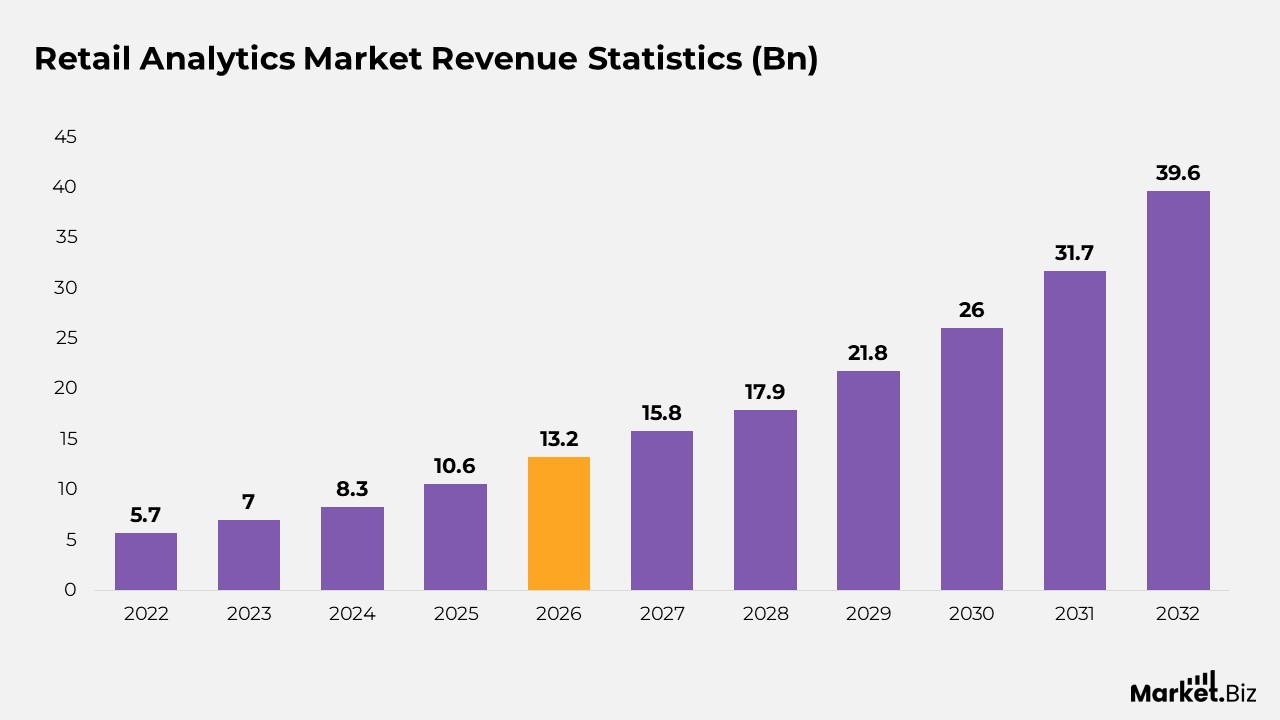
- The retail analytics market is witnessing significant growth, with a compound annual growth rate (CAGR) of 22%.
- In 2022, the market achieved an estimated revenue of around USD 5.7 billion.
- This amount is projected to increase steadily, reaching USD 7.0 billion in 2023 and further climbing to USD 8.3 billion in 2024.
- The growth momentum persists, with anticipated revenues of USD 10.6 billion in 2025 and USD 13.2 billion in 2026.
- By 2027, the retail analytics market is expected to exceed USD 15.8 billion, reflecting consistent growth.
- The upward trend is expected to continue in subsequent years, with projected revenues of USD 17.9 billion in 2028 and a notable increase to USD 21.8 billion in 2029.
- The market’s expansion becomes even more evident as we look further ahead. With estimates indicating revenues of USD 26.0 billion in 2030, USD 31.7 billion in 2031, and a remarkable USD 39.6 billion in 2032.
Types of Data Collected in Retail
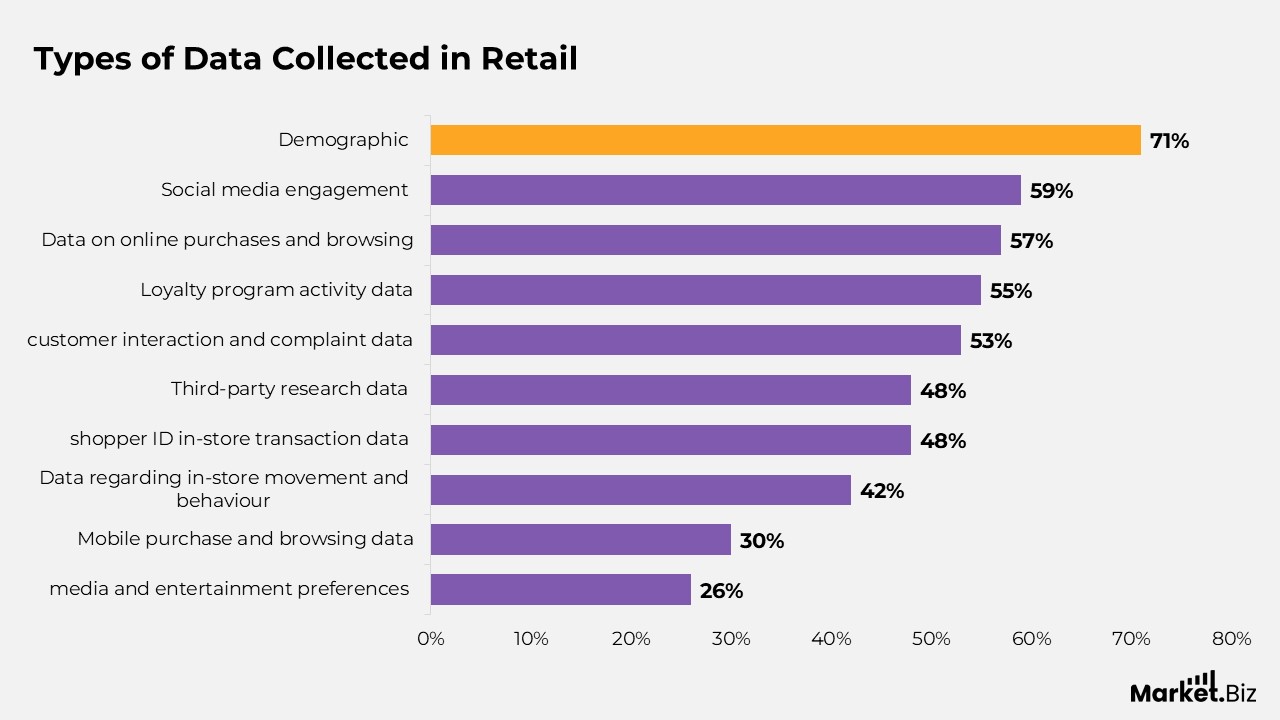
- Demographic data is paramount, accounting for a significant 71% of the collected information.
- Social media engagement follows closely with 59%, highlighting the increasing importance of online presence and sentiment analysis in the development of marketing strategies.
- Data on online purchases and browsing, at 57%, provides essential insights into customers’ online shopping behaviours. Facilitating personalised recommendations and targeted marketing initiatives.
- Loyalty program activity data, which stands at 55%, enables retailers to effectively reward and retain their loyal clientele.
- Moreover, customer interaction and complaint data, at 53%, offer crucial feedback for enhancing customer service and overall satisfaction.
- Third-party research data (48%) and shopper ID in-store transaction data (48%) present a comprehensive perspective on consumer preferences and shopping behaviours.
- Data regarding in-store movement and behaviour (42%) assists in optimising store layouts and product placements.
- Mobile purchase and browsing data (30%) yield insights into the mobile shopping experience. While media and entertainment preferences (26%) aid retailers in aligning their offerings with the broader interests of customers.
Customer Retail Preferences Statistics
- A considerable segment, roughly 69%, of consumers dedicate the majority of their disposable income each month to in-store shopping.
- However, in the wake of the pandemic, about 40% of US shoppers reduced their total retail spending.
- Prior to the pandemic, customers highlighted that the opportunity to physically try products in a store had three times the impact compared to other factors when making purchasing decisions.
- Moreover, an impressive 87% of customers conveyed their desire to gain exclusive access to products or sales events held in physical retail locations.
- A similarly high figure, 81%, expressed their eagerness to attend events organised by these stores. Meanwhile, 80% indicated their willingness to take part in product demonstrations or tutorials conducted by physical retailers.
- In addition, 71% of customers mentioned their interest in participating in games or competitions arranged by brick-and-mortar establishments.
- It is noteworthy that a significant 82% of shoppers attended a retail-related event in 2018.
- Undoubtedly, the pandemic has led to changes in consumer behaviour. In the United States, there was a remarkable 60.4% rise in Click-and-Collect sales in 2020 compared to the previous year, 2019.
- Furthermore, a significant 89% of US shoppers are inclined to prefer retail brands that make a positive contribution to society.
Mobile Retail Analytics Statistics
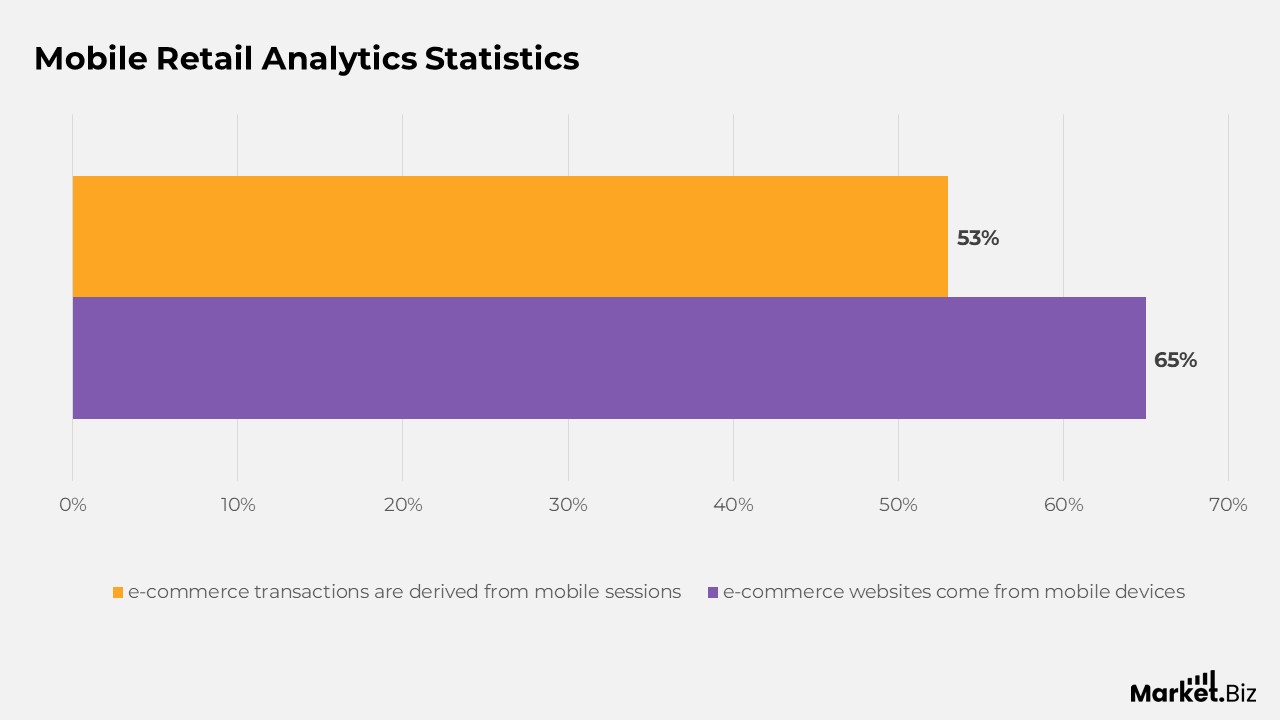
- Indeed, a significant portion, specifically 65%, of visits to e-commerce websites come from mobile devices.
- In terms of actual sales figures, 53% of e-commerce transactions are derived from these mobile sessions.
- It is noteworthy that fashion retailers experience a remarkable conversion rate of 89.3% in converting mobile website traffic into successful sales.
- Moreover, a considerable 79% of smartphone users have made an online purchase via their mobile devices in the last six months.
- Additionally, around 37% of smartphone users participate in in-store mobile payments at least once every six months.
- Projections suggest a significant increase of 33% in the global mobile payments market by the year 2022.
- Furthermore, it is anticipated that mobile payment applications will facilitate approximately $14 trillion in transactions each year by 2022.
E-commerce Retail Analytics Statistics
- With the swift growth of global internet access, which now encompasses over five billion users worldwide, there is a persistent increase in online shopping.
- In 2022, the estimated value of e-commerce sales within the retail sector exceeded an impressive 5.7 trillion U.S. dollars globally, and these figures are expected to continue rising in the coming years.
- As of 2022, the majority of online purchases around the world are conducted through online marketplaces.
- In the domain of online retail traffic, Amazon emerges as the leading player, maintaining its top position. This e-commerce giant based in Seattle provides a wide range of services that include e-retail, computing solutions, consumer electronics, and digital content.
- Significantly, in April 2023, Amazon.com’s site recorded an astounding 5.9 billion direct visits.
- However, when assessed by gross merchandise value (GMV), Amazon ranks third, falling behind its Chinese rivals, Taobao and Tmall.
- These two platforms are operated by Alibaba Group, a leading e-commerce entity in Asia and a significant online commerce provider.
- A striking trend in the e-commerce sector is the notable increase in mobile device usage. By 2023, smartphones emerged as the dominant force, accounting for over 70% of all global retail website visits.
Retail Analytics Fraud Detection Statistics
- In 2016, a study by Javelin Strategy & Research revealed the significant financial impact that fraud has on retailers, amounting to over 7.5% of their annual profits.
- The management of card-related fraud and the handling of disputed credit card transactions, referred to as chargeback management, exerts considerable pressure on their operational budgets. Representing between 14% and 23% of their expenses.
- Additionally, another element that contributes to revenue loss is the incidence of false positives, which accounts for 2.8% of lost income.
- According to predictions from Juniper in 2021, Card Not Present (CNP) fraud cases are expected to primarily arise from the United States and Asia, together making up 80% of the total.
- In the United States, Aite Group, a financial research organisation, anticipates that the implementation of EMV chip technology could lead to an increase in online fraud, akin to the 79% surge observed in the United Kingdom during the first three years following the introduction of chip cards nearly a decade ago.
- The retail sector’s hesitation to modernise outdated payment security systems worsens the issue. Especially regarding the postponed rollout of 3-D Secure 2.0 anti-fraud technology, which many retailers have delayed for a considerable time.
Recent Developments
- In 2023, Microsoft finalised its acquisition of Nuance Communications for $19.7 billion. A prominent entity in AI and speech recognition technology.
- In 2023, IBM purchased Turbonomic, an AI-driven application resource management (ARM) platform, for $1.5 billion.
- In 2023, Trax, a frontrunner in retail computer vision solutions, obtained $640 million in funding to improve its AI-enhanced retail analytics tools.
- In early 2024, SoundCommerce, a platform specialising in data integration and retail analytics. Secured $15 million to broaden its data-centric solutions.
Retail Analytics Future Predictions
- A significant transformation in the industry by early 2027 will require all point-of-sale (POS) systems to possess the capability to scan 2D barcodes in the GS1 Digital Link format. This transition will enhance product traceability, provide more comprehensive consumer data, and prepare for forthcoming innovations such as Digital Product Passports.
- By 2028, it is anticipated that the retail analytics market will surpass an estimated value of $25 billion, primarily fueled by the incorporation of Artificial Intelligence (AI), Machine Learning (ML), and the ongoing expansion of e-commerce and omnichannel retailing.
Conclusion
In summary, retail analytics serves as an essential tool for contemporary retailers. It enables them to enhance customer experiences, streamline operations, and increase profitability. Retail analytics is indispensable in today’s retail landscape, transitioning businesses from reliance on intuition to making informed, data-driven decisions.
This approach facilitates personalisation, optimises various operations such as inventory management, staffing, and pricing, and enhances profitability by analysing customer behaviour, forecasting trends, and developing cohesive omnichannel experiences. The integration of AI and machine learning is poised to further revolutionise this domain, providing a competitive edge.
FAQ’s
Over the next ten years, consumers will increasingly desire more immersive shopping experiences. Fueled by dynamic and personalised digital content that reinforces the messages and information they have previously encountered online and through social media.
Retail data analytics refers to the method of gathering and analysing retail data (such as sales, pricing, inventory, etc.) to identify trends, forecast outcomes, and enhance business decisions for greater profitability.
Pursuing a retail management course will equip you with all the necessary skills to effectively operate and manage a retail store. This will open up numerous career opportunities. As you will become a proficient problem solver and acquire essential sales and management skills.