









Introduction
LLM Agent Statistics provide a structured framework to measure, analyse, and monitor how large language model agents perform across real-world tasks and operational workflows. These statistics capture key quantitative indicators, including task success rates, response accuracy, latency, tool usage frequency, error patterns, and behavioural consistency, enabling organisations to evaluate reliability and efficiency at scale.
As LLM agents are increasingly deployed across enterprise functions, including research, customer support, software development, and autonomous decision systems, statistical visibility becomes critical for performance benchmarking, optimisation, and governance.
By tracking reasoning quality, multi-step task completion, and interaction with external tools and data sources, LLM Agent Statistics help identify operational gaps, reduce risk from hallucinations or failures, and support continuous improvement, ultimately enabling the transition from experimental use to production-ready, accountable AI deployments.
Editor’s Choice
- By 2025, nearly 67% of organizations worldwide are expected to integrate LLMs into operational workflows to enable generative AI capabilities.
- Retail and e-commerce remain the leading adopters, accounting for 27.5% of total LLM market usage across industries.
- Around 88% of working professionals say LLM adoption has directly improved the quality and efficiency of their output.
- The global ecosystem of LLM-enabled applications is expected to grow to approximately 750 million by 2025.
- Worldwide expenditure on generative AI technologies is forecast to reach $644 billion in 2025, underscoring strong commercial momentum.
- The top five LLM vendors together control 88.22% of global market revenue, indicating high market concentration.
- Reliability issues remain a challenge, with 35% of users citing inaccurate or inconsistent outputs as their main concern.
- By 2026, about 30% of enterprises are expected to automate more than half of their network operations using AI and LLM-driven systems.
- Despite concerns about automation, 80% of professionals believe LLMs will have a positive impact on long-term career growth.
- As of March 2024, a model developed by OpenAI achieved a leading score of 94.8% on a math problem-solving benchmark, demonstrating advanced reasoning performance.
- In 2023, Claude 3 Opus from Anthropic recorded the highest average global performance score at 84.83%, highlighting strong cross-task accuracy.
- Gemini 1.5 Pro, developed by Google, ranked second globally with an average score of 79%, reinforcing its competitive positioning in the LLM landscape.
Adoption of Large Language Model Use Cases Across US Healthcare Organizations
- Around 21% of US healthcare organisations use LLMs to respond to patient inquiries, making this the most common application.
- Medical chatbots are adopted by nearly 20% of organisations, supporting appointment guidance, symptom checks, and basic care interactions.
- About 19% of healthcare providers implement information extraction tasks, including extracting insights from clinical documents and records.
- LLMs support biomedical research activities in approximately 18% of organizations, aiding data analysis, literature review, and hypothesis generation.
- Clinical coding applications leverage LLM capabilities in close to 17% of healthcare settings to improve accuracy and reduce administrative burden.
- Medical text summarisation, such as condensing clinical notes and reports, is used by roughly 16% of US healthcare organisations, reflecting growing interest in improving documentation efficiency.
- In US healthcare, about 21% of organisations rely on LLMs to handle patient queries, while nearly 20% deploy medical chatbots, indicating the growing integration of conversational AI into patient engagement workflows.
- Approximately 18% of healthcare providers use LLMs in biomedical research, where they assist with drug discovery efforts and large-scale medical data analysis.
- Backend healthcare operations also benefit from LLM adoption, with information extraction used by 19% of organisations, clinical coding by 17%, and medical text summarisation by 16%, thereby improving documentation speed and administrative efficiency.
Moreover
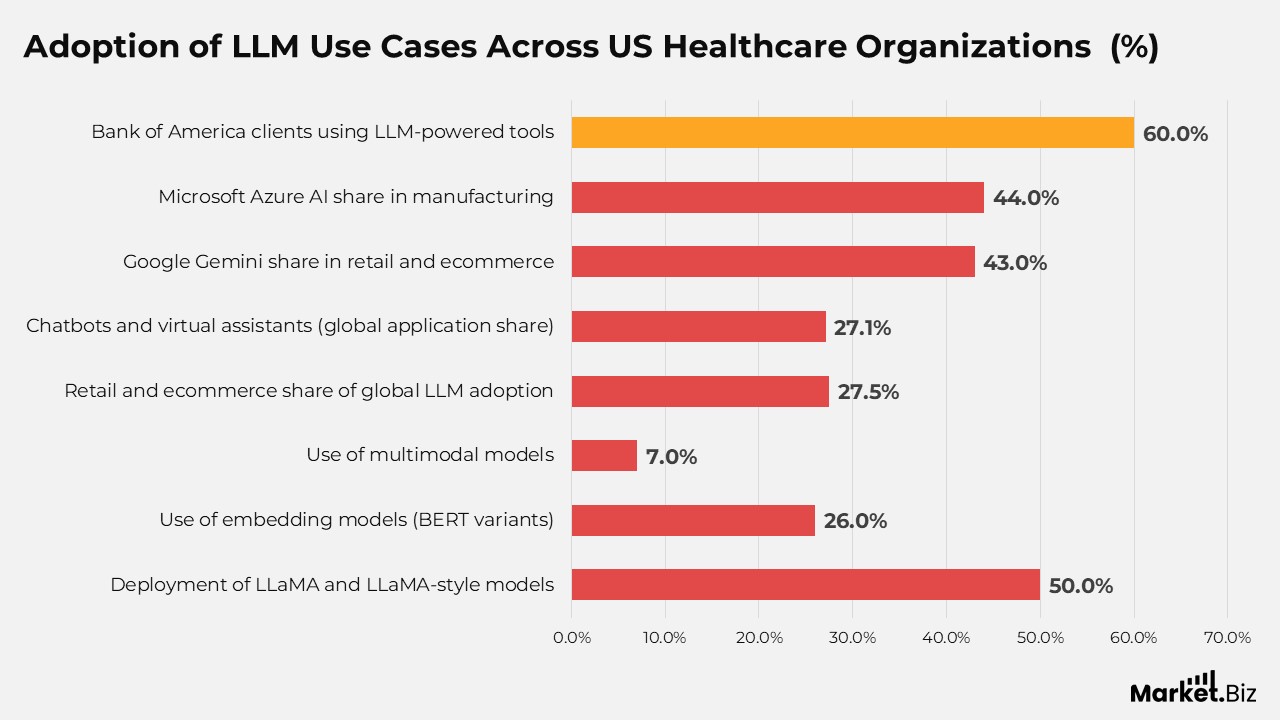
- On a global commercial scale, more than 50% of enterprises plan to deploy LLaMA and LLaMA-style models, making them the preferred choice for large-scale business applications.
- Roughly 26% of firms intend to use embedding-based models such as BERT variants, mainly for enterprise search, semantic analysis, and classification tasks.
- Only 7% of companies currently plan to implement multimodal models, showing that text-centric LLMs still dominate enterprise adoption strategies.
- Retail and e-commerce account for the largest share of global LLM adoption at 27.5%, driven by personalisation engines, recommendation systems, and automated customer support.
- Chatbots and virtual assistants lead LLM applications globally, accounting for over 27.1% of market share in 2024, reinforcing conversational AI as the primary use case.
- Vendor dominance varies by industry: Google’s Gemini captures around 43% share in retail and ecommerce, while Microsoft Azure AI leads manufacturing deployments with roughly 44% share.
- In financial services, LLM usage is already mainstream, with close to 60% of Bank of America clients using AI-powered tools for investment guidance, insurance insights, and retirement planning.
(Sources: Weartenet, Statista)
Professional Perceptions of LLM Impact on Work Quality and Productivity
- A strong majority of professionals, about 88%, believe that large language models meaningfully enhance the overall quality of their work.
- Many users report improvements in clarity, consistency, and execution speed when integrating LLMs into daily tasks.
- Nearly 87.9% of professionals rate the influence of AI on work quality at six or higher on a 10-point scale, indicating broad satisfaction with its performance.
- Within this group, 26.3% assign a top score of 10, reflecting very high confidence in the value delivered by LLM tools.
- In the US workforce, around 57% of professionals use LLMs primarily to increase productivity and reduce manual effort.
- Beyond efficiency gains, 56.7% of users adopt AI to experiment with new ideas and workflows, while 54.3% apply it specifically to elevate the quality of their outputs.
- A clear majority of professionals, around 69.6%, rate AI’s impact on work quality at 6 or higher, indicating broadly positive perceptions of its effectiveness.
- A notable share of respondents, about 20.8%, give AI a perfect score of 10, reflecting very strong confidence in its contribution to work outcomes.
- Only a small portion of professionals, roughly 9.6%, rate AI below 6, suggesting limited dissatisfaction with its influence on work quality.
(Sources: Weartenet, Statista)
Key Workplace Advantages Driving Large Language Model Adoption
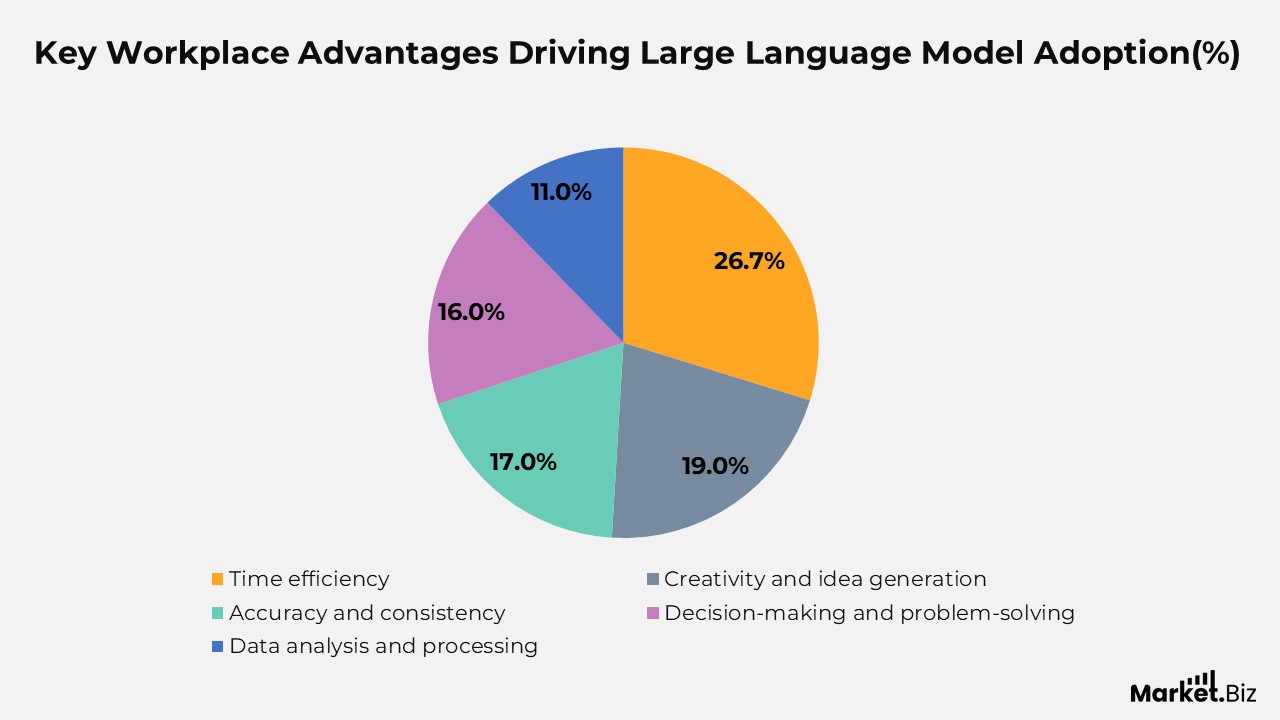
- Time efficiency is the leading benefit, with 26.7% of professionals reporting significant time savings from using LLMs in daily work activities.
- Creativity and idea generation rank as the second-most-cited advantage, cited by 19% of users who leverage LLMs for brainstorming and content development.
- Improvements in accuracy and consistency are recognized by 17% of professionals, reflecting LLMs’ role in reducing errors and standardizing outputs.
- Users’ decision-making and problem-solving capabilities are enhanced by 16%, as LLMs enable faster analysis and more informed judgments.
- Data analysis and processing benefits are noted by 11% of professionals, indicating the growing use of LLMs to handle and interpret structured and unstructured data.
Workplace Benefits and Usage Patterns of Large Language Models
- Time efficiency ranks as the leading workplace benefit, with 26.7% of professionals identifying time savings as the most important advantage, followed by creativity and idea generation at 19%.
- Perceived creative value varies by gender: 22.3% of women highlight creativity as a key benefit, compared with 16.2% of men.
- Other notable benefits include improved accuracy and consistency (17%), stronger decision-making and problem-solving (16%), and enhanced data analysis and processing (11%), demonstrating both efficiency and support for critical thinking.
- LLM adoption spans diverse tasks: 51.7% of professionals use them for research and information gathering, 47% for creative writing, and 45% for emails and workplace communication.
- Usage frequency is high: 37.3% of professionals interact with AI chatbots daily, 46% several times per week, and only 16.7% report infrequent use.
- Adoption intensity differs across demographics: 52% of US professionals earning over $125,000 use LLMs daily, compared with 20.8% among professionals aged 18–24.
- Self-rated proficiency levels show that 48.3% of users consider themselves intermediate, while 18.3% identify as experts, indicating rising confidence alongside ongoing learning.
- Despite concerns about job displacement, 80% of professionals believe LLMs will positively influence their long-term career prospects.
(Sources: Weartenet, Statista)
User Preferences and Platform Choices in the LLM Ecosystem
- OpenAI tools are the most widely used overall, with 53% of IT and engineering teams adopting them, reflecting strong uptake in developer-centric environments.
- Google Cloud AI shows strong sector-specific adoption, with 42% in healthcare and 38% across finance, operations, and HR.
- In retail and e-commerce, Google’s Gemini leads with a 43% market share, driven by applications in personalization, recommendations, and customer engagement.
- Manufacturing organisations favour Microsoft Azure AI, which holds a 44% market share due to its strengths in automation, efficiency improvements, and quality control.
- Most professionals prefer simplicity and stability, as 61.3% of AI users rely on a single platform rather than multiple providers.
- Among single-platform users, ChatGPT leads with a 38% share, maintaining its position as the most popular standalone AI option.
- The ChatGPT ecosystem reaches approximately 501 million monthly users and commands a 74.2% global market share, confirming its dominance in the AI platform landscape.
(Sources: Weartenet, Statista)
Global Adoption, Investment, and Workforce Impact of Generative AI and LLMs
- Around 75% of workers now rely on generative AI for everyday tasks, indicating broad adoption across job roles and functions.
- Recent uptake remains strong, with 46% of users beginning to use AI tools within the last six months, signalling accelerating momentum.
- LLM-powered solutions are embedded across operations in 67% of organisations, making them a core component of modern workflows.
- Generative AI is active in at least one business function at 65% of companies, spanning marketing, engineering, and operations.
- Competitive pressure is a major driver, with 71% of enterprises concerned about falling behind if they delay AI adoption.
- Among developers, 82% report that AI enhances their productivity and output quality, while only 10% express concerns about potential job displacement.
- Public sentiment toward AI remains positive in key markets, as 83% of respondents in China and 80% in Indonesia view AI as more beneficial than harmful.
- Enterprise investment is rising sharply, with API spending increasing from USD 500 million to USD 8.4 billion within 18 months, reflecting the rapid scaling of AI deployments.
- Generative AI has become mainstream in education, with 88% of students using these tools to support learning activities.
- LLMs now account for roughly 40% of global working hours, underscoring their growing role in shaping productivity and daily work processes.
(Sources: Weartenet, SecondTalent)
Rapid Expansion of Generative AI Adoption Across Workforce, Enterprises, and Education
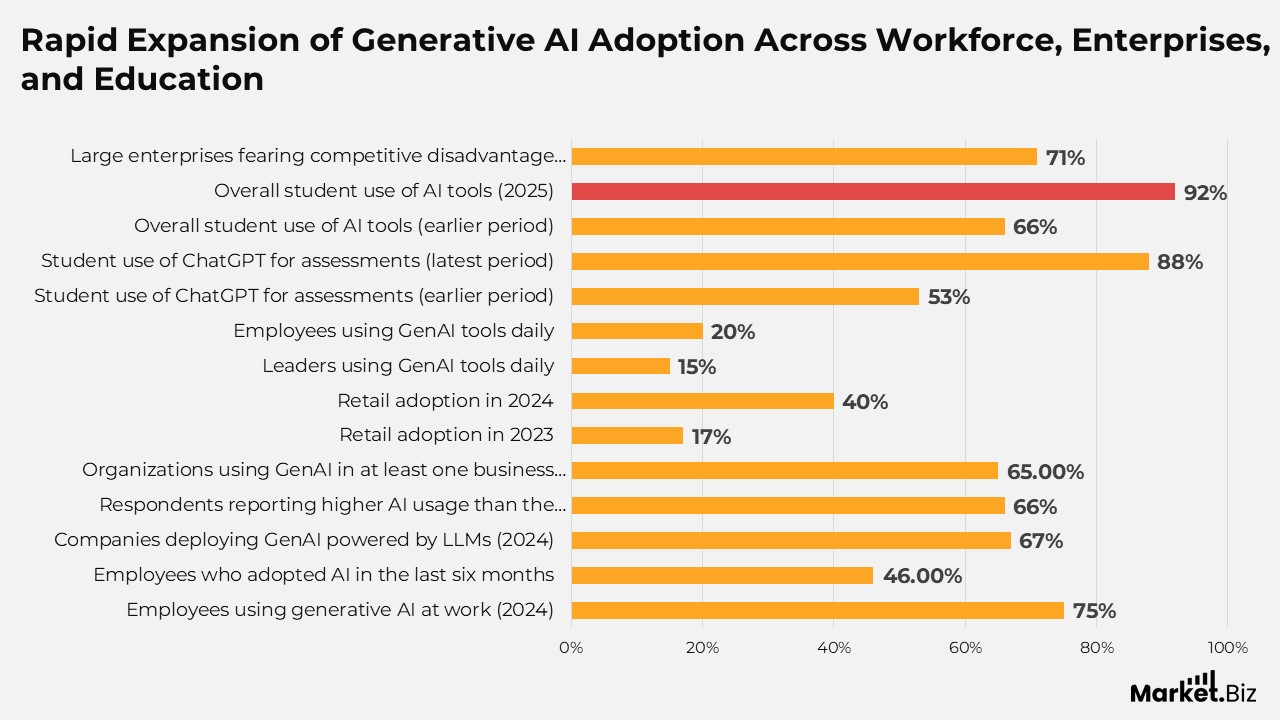
- By 2024, generative AI had become a mainstream workplace tool, with about 75% of employees reporting regular usage in their roles.
- Adoption momentum remains strong, as 46% of employees indicated they began using AI tools within the previous six months, highlighting a large base of new users.
- At the organizational level, 67% of companies were already deploying GenAI solutions powered by LLMs in 2024, signalling a shift from experimentation to practical business use.
- More than two-thirds of respondents across global regions reported higher AI usage in 2024 than in the prior year, indicating broad geographic diffusion of AI adoption.
- Generative AI is embedded in daily operations at 65% of organisations, with at least one business function actively using AI-supported workflows.
- Retail adoption accelerated sharply, rising from 17% in 2023 to 40% in 2024, as retailers increasingly deployed AI for customer engagement and product optimisation.
- Despite high overall adoption, intensive daily use remains limited: only 15% of leaders and 20% of employees use GenAI tools daily.
- In education, student reliance on ChatGPT for assessments surged from 53% to 88%, reflecting the rapid normalization of AI-supported learning.
- Overall, student use of AI tools increased from 66% to 92% by 2025, indicating near-universal adoption for study and research.
- ChatGPT’s rapid rise, reaching 100 million users within just two months of its 2022 launch, significantly accelerated global awareness and adoption of AI tools.
- Competitive urgency is high, as 71% of large enterprises believe they risk falling behind peers if they do not adopt generative AI solutions.
(Sources: Weartenet, SecondTalent)
Enterprise Spending Trends and Return on Investment in Large Language Models
- A large majority of organizations, around 72%, expect their spending on LLM technologies to increase this year, signaling continued budget expansion.
- Nearly 40% of enterprises now invest more than USD 250,000 annually in LLMs, indicating that AI is increasingly treated as a strategic, high-value asset.
- Long-term confidence remains strong, with 67% of organizations anticipating higher AI investment over the next 3 years.
- Across multiple industries, generative AI already accounts for more than 5% of total digital technology budgets, reflecting its growing share of enterprise IT spend.
- Analytical AI continues to play a major role, still capturing over 20% of digital budgets as organizations balance generative and analytics-driven capabilities.
- On a value basis, generative AI initiatives deliver approximately 3.7x return on investment for every dollar spent, reinforcing their financial attractiveness.
- Spending on foundation models increased sharply from USD 500 million in 2023 to USD 3.5 billion in 2024, representing 7.0x year-over-year growth.
- Investment in model training rose from USD 500 million to USD 3.0 billion over the same period, reflecting 6.0x growth as firms scale custom models.
- Deployment and inference spending expanded from USD 600 million in 2023 to USD 2.3 billion in 2024, marking 3.8x growth driven by production rollouts.
- Data and infrastructure spending grew from USD 50 million to USD 400 million, achieving the highest year-over-year expansion rate of 8.0x.
- Vertical AI solutions saw spending rise from USD 100 million to USD 1.2 billion, delivering the strongest category growth at 12.0x.
- Departmental AI investments increased from USD 200 million to USD 1.8 billion, reflecting 9.0x growth as AI adoption deepened across functions.
- Horizontal AI platforms expanded from USD 300 million to USD 1.6 billion, posting 5.3x growth as cross-enterprise use cases scaled.
(Sources: Weartenet, SecondTalent)
Conclusion
LLM Agent Statistics highlight how rapidly intelligent agents are moving from experimental tools to core digital infrastructure across industries. The data shows strong adoption driven by productivity gains, automation of language-intensive work, and expanding use cases in enterprise operations, education, healthcare, and consumer applications.
At the same time, statistics around reliability concerns, bias, and uneven adoption across demographics underscore the need for continued governance, evaluation, and model improvement.
As LLM agents scale across hundreds of millions of applications and automate a growing share of digital work, statistical monitoring becomes critical to ensure performance, trust, and responsible deployment. Overall, LLM Agent Statistics serve as a foundational layer for measuring impact, guiding optimisation, and enabling organisations to integrate AI agents into long-term operational and strategic workflows confidently.
FAQ’s
LLM Agent Statistics refer to quantitative and qualitative metrics used to measure how large language model agents perform in real-world environments. These include adoption rates, usage frequency, task success, automation impact, reliability concerns, bias indicators, and return on investment.
They help organisations evaluate performance, justify investments, manage risks, and optimise deployments. Statistics provide evidence on productivity gains, cost efficiency, scalability, and areas where governance or human oversight is still required.
Adoption is already mainstream, with a majority of organizations using LLM-powered tools across workflows and many employees relying on them for daily tasks such as research, communication, and content creation.
LLM agents are most commonly used in research and information gathering, customer support via chatbots, content creation, software development, marketing, and internal communications. Retail, ecommerce, and enterprise IT functions show especially high usage.
Most surveys show strong productivity benefits, with a large share of professionals reporting time savings, improved work quality, and faster task completion. LLM agents also support creativity, decision-making, and knowledge work.