









Introduction
Video-on-Demand statistics offer a concise, data-driven view of how on-demand streaming has transformed media consumption worldwide, capturing key indicators such as subscriber growth, viewing behavior, content preferences, revenue models, and device usage across subscription, advertising-supported, and transactional platforms.
These statistics help industry stakeholders evaluate platform performance, consumer engagement, and monetisation effectiveness, while broader shifts away from linear television toward personalised, mobile, and connected-TV viewing.
By tracking usage patterns, regional adoption, and technology-driven factors such as internet expansion and AI-based recommendations, Video-on-Demand statistics provide essential insight into the current scale of the ecosystem and its expected evolution.
Editor’s Choice
- In 2025, 84% of respondents reported using AI in at least one stage of the video production process, with 22% producing content entirely in-house and 18% depending on external partners for select production activities.
- Engagement remains the primary performance indicator for video marketing, cited by 68% of marketers, followed closely by watch time and click-through rate. In contrast, conversion rate continues to gain importance as a supporting metric.
- Confidence in AI-driven marketing is accelerating, with 96% of marketers expecting AI to play a more critical role in shaping marketing strategies in the coming years, a notable increase from 2024 sentiment.
- Video remains a core marketing format, with 87% of marketers planning to incorporate it into their future strategies, reflecting sustained demand despite a slight decline from the previous year amid rising focus on short-form and AI-enabled formats.
- Brand video content remains well received by audiences, with 81% of respondents indicating that they either strongly or moderately enjoy watching branded videos. In comparison, only 2% expressed a clear lack of interest in such content.
Moreover
- Global spending on video advertising is projected to reach approximately USD 191.3 billion in 2024, reflecting the continued shift of marketing budgets toward video-led digital channels.
- The United States is expected to remain the largest video advertising market, generating more than USD 84,610 million in ad revenue, supported by strong digital media adoption and advertiser demand.
- Viewer expectations around advertising formats are evolving: 43% of users prefer shorter ad breaks, and 33% favour ads aligned with their chosen content categories.
- Video advertisements on YouTube attract significantly more viewer attention, receiving 62% more attention than traditional television advertising.
- Social media remains a key distribution channel, as over 73% of marketers actively use Facebook video ads to promote products and services.
- Video remains central to marketing strategies, with 92% of marketers stating it plays an important role in their overall promotional efforts.
- In 2024, average video ad spending per user is projected to exceed USD 34, highlighting rising monetization efficiency across digital video platforms.
Video-on-Demand Platforms by Subscriber Base Statistics
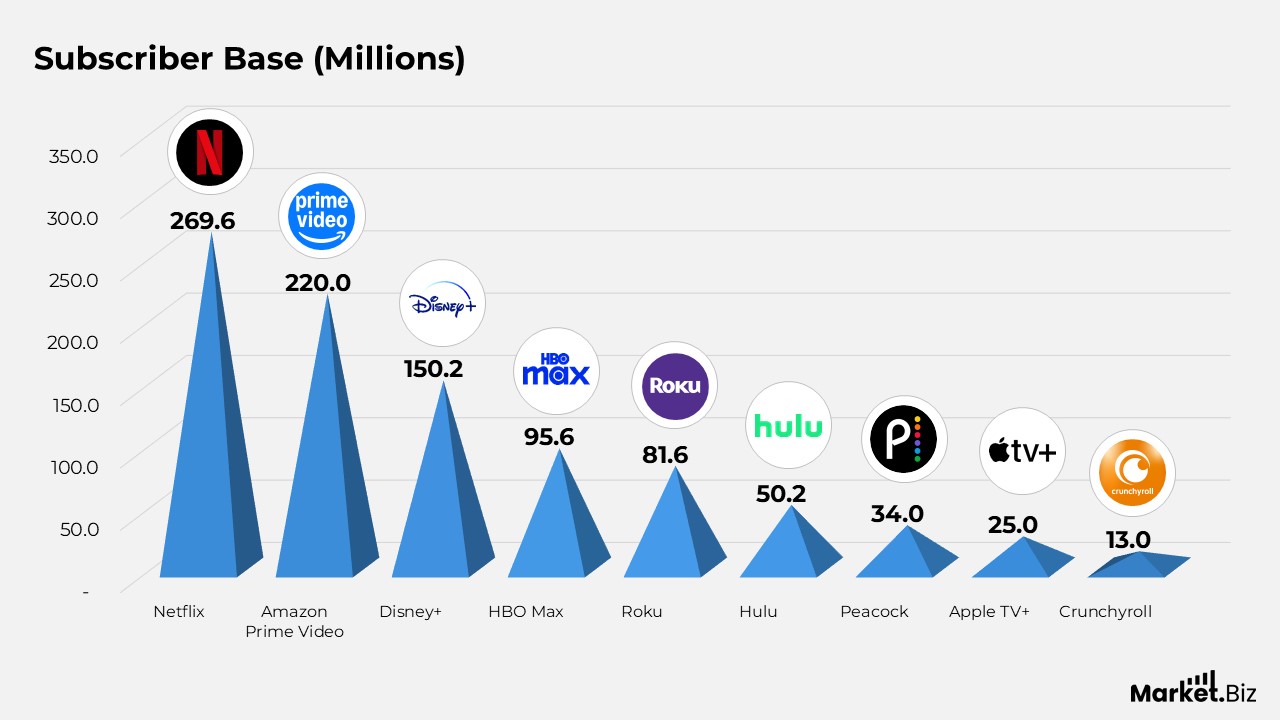
- Netflix leads the global Video-on-Demand landscape with a subscriber base of approximately 269.6 million, reflecting its strong original content pipeline and wide international presence.
- Amazon Prime Video follows closely with around 220 million subscribers, supported by its bundled Prime ecosystem and global retail integration.
- Disney+ has built a substantial audience of about 150.2 million subscribers, driven by its premium franchise content and family-focused offerings.
- HBO Max reports nearly 95.6 million subscribers, supported by high-quality scripted content and strong brand recognition in premium entertainment.
- Roku has reached approximately 81.6 million users, benefiting from its role as a streaming platform aggregator and smart TV operating system.
- Hulu maintains a subscriber base of roughly 50.2 million subscribers, supported by its hybrid on-demand and live TV content strategy.
- Peacock has expanded its subscriber base to about 34 million, leveraging a mix of free, ad-supported, and premium tiers.
- Apple TV+ has attracted close to 25 million subscribers, focusing on exclusive original programming and ecosystem-driven adoption.
- Crunchyroll serves a niche yet loyal audience of nearly 13 million subscribers, driven primarily by global demand for anime content.
(Sources: Statista, Vdocipher)
Leading Video-on-Demand Platforms and Content Depth Statistics
- Netflix continues to hold a leading position in streaming, supported by globally popular originals such as Bridgerton and Stranger Things, as well as widely viewed licensed series like Seinfeld. Its subscription plans range from $7 to $23 per month, and its content library exceeds 5,500 titles.
- Amazon Prime Video stands out for its extensive scale, offering more than 18,000 movies and nearly 2,000 TV shows, combining original productions, licensed content, and exclusive rental options.
- Disney+ remains strongly positioned through its iconic Disney catalogue, Star Wars, and Marvel franchises, featuring approximately 7,000 TV episodes and 500 films that appeal to franchise loyalists and family audiences.
- HBO Max delivers a premium viewing experience with over 10,000 hours of content, integrating assets from Warner Bros., DC, and CNN, alongside acclaimed originals such as Succession and Euphoria.
- Hulu differentiates itself by offering rapid access to current television programming, including next-day episodes, live TV, reality content, and on-demand movies across more than 68,000 hours of programming.
- Peacock leverages NBCUniversal’s portfolio with a library of roughly 15,000 hours, focusing heavily on comedy and crime genres while drawing viewers through recognizable licensed titles.
- Apple TV+ has a comparatively small catalogue but emphasises high-quality, exclusive originals such as Ted Lasso and The Morning Show to strengthen its premium positioning.
- Crunchyroll serves a dedicated global anime audience, offering access to more than 1,200 anime titles with both subtitled and dubbed viewing options.
- Paramount+ attracts fans of major franchises such as Star Trek and Yellowstone, complemented by live TV, sports content, reality programming, and premium add-on options.
Expanding Use of Digital Streaming Beyond Entertainment
- Digital platforms increasingly support religious engagement, with 30% of US adults using online services to access church live streams or search for religious information.
- Advances in live-streaming technology now enable features such as replay, pause, rewind, and live chat, enhancing viewer control and real-time interaction during broadcasts.
Streaming Device Preferences and Viewing Behavior
- Smart TVs dominate household streaming habits, used by 74.5% of households, followed by streaming sticks at 64%, while gaming consoles continue to grow in adoption at 43.5%.
- In Asia, mobile phones have become the primary streaming device, accounting for 45% of usage, surpassing big-screen TVs at 43%, while desktop usage remains limited at 7%.
- Millennials and Gen Z demonstrate flexible subscription behavior, frequently canceling and resubscribing based on specific content availability rather than long-term platform loyalty.
- Binge-watching is most prevalent among viewers aged 30 to 44, with 70% of this group engaging in extended viewing sessions that influence both platform and device preferences.
- Ad-supported streaming services are gaining momentum, with nearly 57% of consumers showing interest due to their cost-saving appeal.
(Sources: Statista, Vdocipher, SlashFlim, Entertainment Tonight, TV Guide)
E-Learning Video Course Platforms by Active User Base
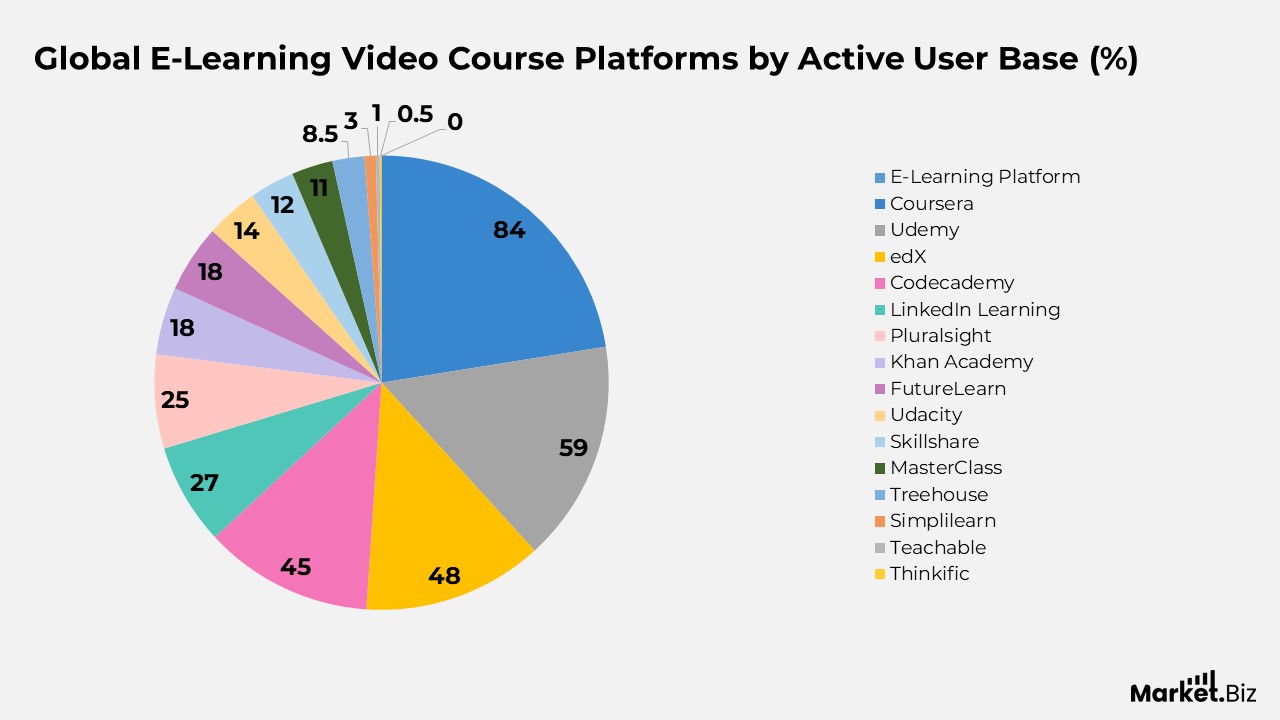
- Coursera leads the e-learning video course landscape with a user base of approximately 84 million, driven by university partnerships and professional certification programs.
- Udemy follows with around 59 million users, supported by its large marketplace of instructor-led and skill-based video courses.
- edX has built a strong global presence with nearly 48 million users, leveraging academic collaborations and structured learning paths.
- Codecademy records about 45 million users, reflecting strong demand for interactive, video-supported coding and programming education.
- LinkedIn Learning serves roughly 27 million users, benefiting from its integration with professional networking and career development tools.
- Pluralsight has nearly 25 million users, primarily focused on technology, software development, and IT skills advancement.
- Khan Academy supports around 18 million learners by emphasising free, curriculum-aligned educational video content.
- FutureLearn also engages approximately 18 million users, driven by short courses and degree-linked online programs.
- Udacity attracts about 14 million users and focuses on industry-aligned nano-degree programs in technology and data fields.
- Skillshare maintains a creative-focused audience of nearly 12 million users, centered on design, media, and lifestyle skills.
- MasterClass has reached around 11 million users, leveraging celebrity-led, high-production-value video courses.
- Treehouse serves approximately 8.5 million users, focusing on beginner-to-intermediate technology and coding education.
- Simplilearn engages close to 3 million users, targeting professional certification and enterprise training markets.
- Teachable supports about 1 million users, enabling creators and educators to host and monetize their own video courses.
- Thinkific serves roughly 0.5 million users, focused on white-label course creation and learning management tools.
(Sources: Statista, Vdocipher)
E-Learning Video Content Consumption Patterns and Emerging Trends
- Coursera sees strong demand for technology and business-focused learning, with data science, computer science, and business courses accounting for 56% of total enrollments. In comparison, 77% of users rely on the platform to build career-oriented skills.
- Udemy’s content consumption is led by web development, IT certification preparation, and marketing, supported by a catalogue exceeding 200,000 courses, with business-related learning recording a 70% surge during the pandemic.
- edX continues to benefit from rising interest in STEM education, as computer science, business management, and engineering dominate enrollments, supported by a 28% increase in STEM participation linked to professional certificate programs.
- Khan Academy’s usage is heavily centred on mathematics, which accounts for 55% of total views for K–12 and test preparation. In comparison, mobile learners account for 40% of overall traffic, reflecting a 60% increase in platform usage during the pandemic.
- LinkedIn Learning focuses strongly on professional development, with business analytics and leadership courses leading engagement among its 16,000+ courses, and 80% of learners use the platform for career advancement.
- MasterClass attracts viewers primarily through creative arts, business leadership, and culinary content, while interest in self-care and wellness courses has risen sharply, with consumption up 80%.
- Skillshare remains popular for creative education, with photography, graphic design, and writing courses driving engagement, and user-generated creative content accounting for 40% of total enrollments.
Moreover
- Enterprise needs to shape Pluralsight’s consumption trends, as cloud computing, cybersecurity, and software development dominate usage, with 55% of businesses leveraging the platform to address technology skill gaps.
- Future Learn shows strong uptake in healthcare, language, and digital skills education, alongside a 30% increase in business and management course enrollments driven by workforce upskilling initiatives.
- Treehouse continues to see high demand for web development and programming, while short-format courses under 30 minutes have seen a 45% increase in consumption, reflecting a preference for concise learning.
- Teachable supports creator-led education, with content marketing, branding, and freelancing courses leading engagement, and 68% of content creation and consumption is driven by solo entrepreneurs.
- Thinkific’s enrollments are dominated by business skills, fitness, and health education, with fitness coaching courses experiencing a 50% increase in demand since 2020.
- Codecademy’s most consumed content includes Python, web development, and data science, while interest in backend programming languages has grown by 30%, reflecting a deeper demand for technical learning.
- Simplilearn’s learning activities are centred on data science, project management, and IT security, with certification-focused programs accounting for 60% of new enrollments.
- OpenLearn attracts learners primarily to language, health, and social science courses, with enrollments in social science courses increasing by 50% as demand for academic and lifelong learning rises.
- Udacity continues to see strong engagement in machine learning, data science, and robotics, with its industry-aligned nanodegree programs achieving retention rates of up to 80%.
(Sources: Statista, Vdocipher, Thinkific, Online Courseing, Skillfrontier.io, BitDegree)
Conclusion
Video-on-Demand statistics clearly demonstrate how on-demand streaming has become central to digital content consumption across entertainment, education, and live engagement formats. Data on subscriber bases, content libraries, and viewing behaviour highlights the strong position of large, multi-category platforms while also emphasising the steady growth of specialised services focused on anime, professional learning, and creator-driven content.
Shifts in device usage, led by smart TVs globally and mobile-first viewing in emerging markets, further reflect evolving consumer access patterns. At the same time, behavioural trends, including binge consumption, flexible subscribe–cancel cycles among younger users, and rising preference for ad-supported options, point to changing expectations around cost, convenience, and personalisation.
The expansion of streaming beyond entertainment into education, workforce training, and religious content reinforces the role of Video-on-Demand as a foundational digital service. Overall, these statistics suggest a mature and competitive ecosystem where long-term success increasingly depends on content relevance, platform adaptability, and user-centric delivery models.
FAQ’s
Video-on-Demand statistics show that streaming has become a core way to access digital content across entertainment, education, and live experiences. Trends in subscriber numbers, content availability, and viewing habits highlight how audiences increasingly rely on on-demand platforms for flexible, personalised consumption.
Data on subscriber scale and content libraries indicates that large, multi-category platforms continue to dominate overall usage, while specialised services focused on anime, professional education, and creator-led content are steadily expanding their user bases.
Shifts in device preferences reveal changing access patterns: smart TVs drive global viewing, while mobile devices lead consumption in emerging markets, reflecting differences in infrastructure, affordability, and user behaviour.
Viewing patterns such as binge-watching, frequent subscription switching among younger audiences, and increasing interest in ad-supported models highlight evolving expectations around pricing flexibility, convenience, and personalized content access.
Yes. Video-on-Demand platforms increasingly support education, workforce training, and religious streaming, reinforcing their role as essential digital services rather than purely entertainment-focused platforms.