









Introduction
Virtual Influencers Statistics: Virtual influencers are digitally created personalities that mimic human traits and engage audiences through realistic appearances and carefully designed personas, transforming the way brands connect with consumers online. Using advanced artificial intelligence and 3D modeling, they enable companies to deliver consistent messaging, maintain full control over images, and ensure constant engagement without physical boundaries.
Their rising presence on platforms such as Instagram, TikTok, and YouTube shows how audiences increasingly treat them like real-life influencers. Leading brands in fashion, beauty, gaming, and entertainment are adopting these digital figures to reach younger, tech-driven audiences, enhancing visibility and customer loyalty.
Insights from engagement metrics, follower growth, and consumer sentiment highlight their growing impact on purchasing decisions, establishing virtual influencers as a key force in the future of digital marketing.
Editor’s Choice
- 58% of users follow at least one virtual influencer, highlighting their growing popularity in the digital space.
- 24% of users who do not follow virtual influencers were unaware of their existence, indicating room for increased awareness.
- 27% of followers are drawn to virtual influencers for their content, 19% appreciate their storytelling, and 15% find inspiration in these digital personas.
- The 35-44 age group stands out for being the most trusting and relatable towards virtual influencers, scoring 6.5/10 for trust and 6.2/10 for relatability.
- 35% of respondents have purchased a product or service promoted by a virtual influencer, demonstrating their influence on consumer behavior.
- 83% of brands believe that influencer marketing remains an effective strategy.
- 82% of marketers consider influencer marketing to be the most effective in generating high-quality leads.
- On average, brands allocate a quarter of their total marketing budget to influencer marketing.
- The typical cost per collaboration with an influencer is $257.
- 77% of influencers are women, reflecting the gender dominance in the influencer space.
- TikTok and Instagram remain the most popular social media platforms for influencer marketing, while Snapchat ranks as the least favored.
- 63% of influencer marketers are planning to incorporate AI into their strategies this year.
- More than 60% of brands have collaborated with virtual influencers, showcasing their growing presence in marketing strategies.
(Source: Aspire, Collabstr, Influencer Marketing Hub, Adam Connell, Influencer Talent Agency)
Motivations Behind Following Virtual Influencers
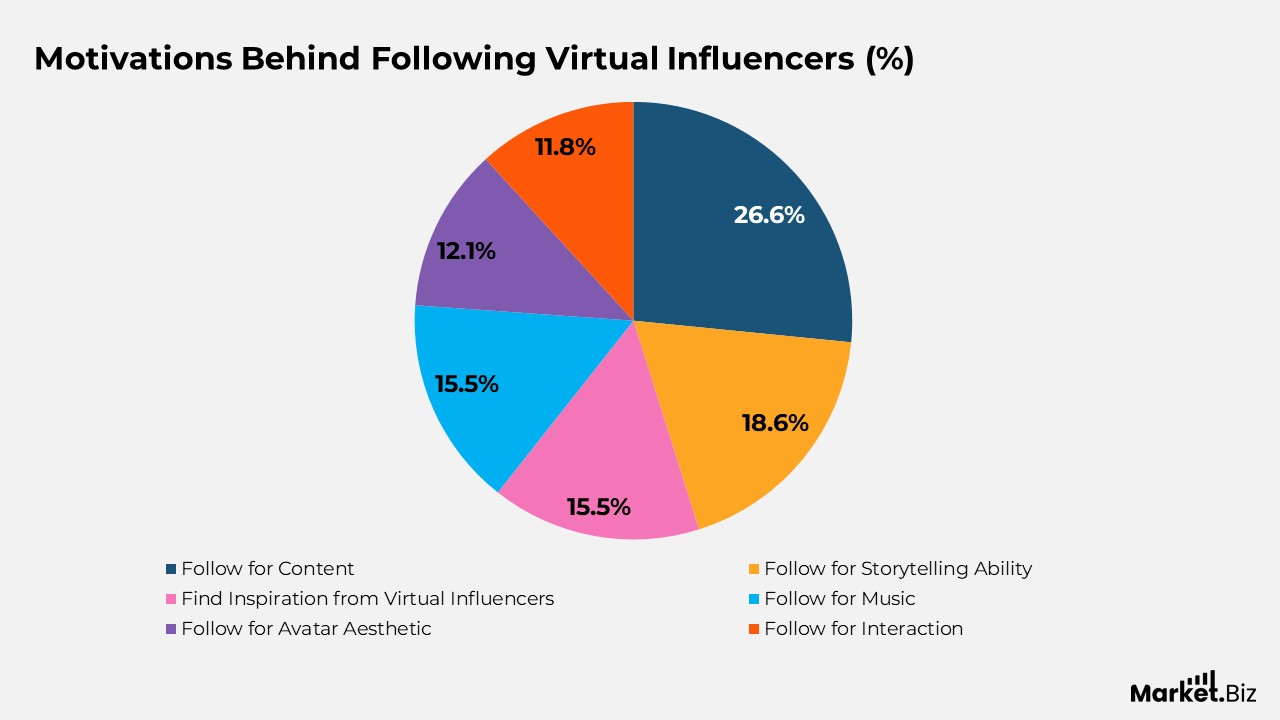
- 26.6% of users follow virtual influencers for their content.
- 18.6% follow them due to their storytelling ability.
- 15.5% find inspiration from virtual influencers.
- 15.5% of users follow virtual influencers for their music.
- 12.1% of users follow virtual influencers for their avatar aesthetic.
- 11.8% of users follow virtual influencers for their interaction.
(Source: Influencer Talent Agency, Statista)
Factors Behind Not Following Virtual Influencers
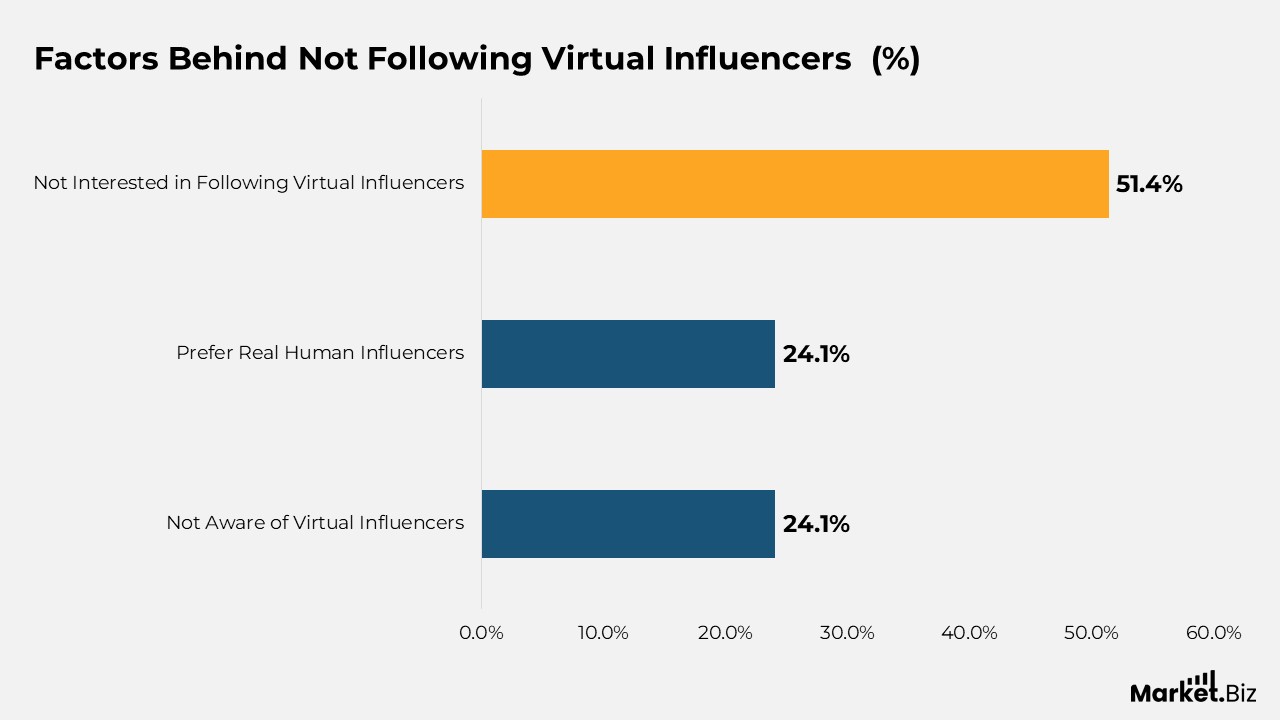
- 24.1% of users are not aware of virtual influencers’ existence.
- 24.1% prefer real human influencers over virtual ones.
- 51.4% are not interested in following virtual influencers.
(Source: Influencer Talent Agency, Statista)
Virtual Influencers Market Size
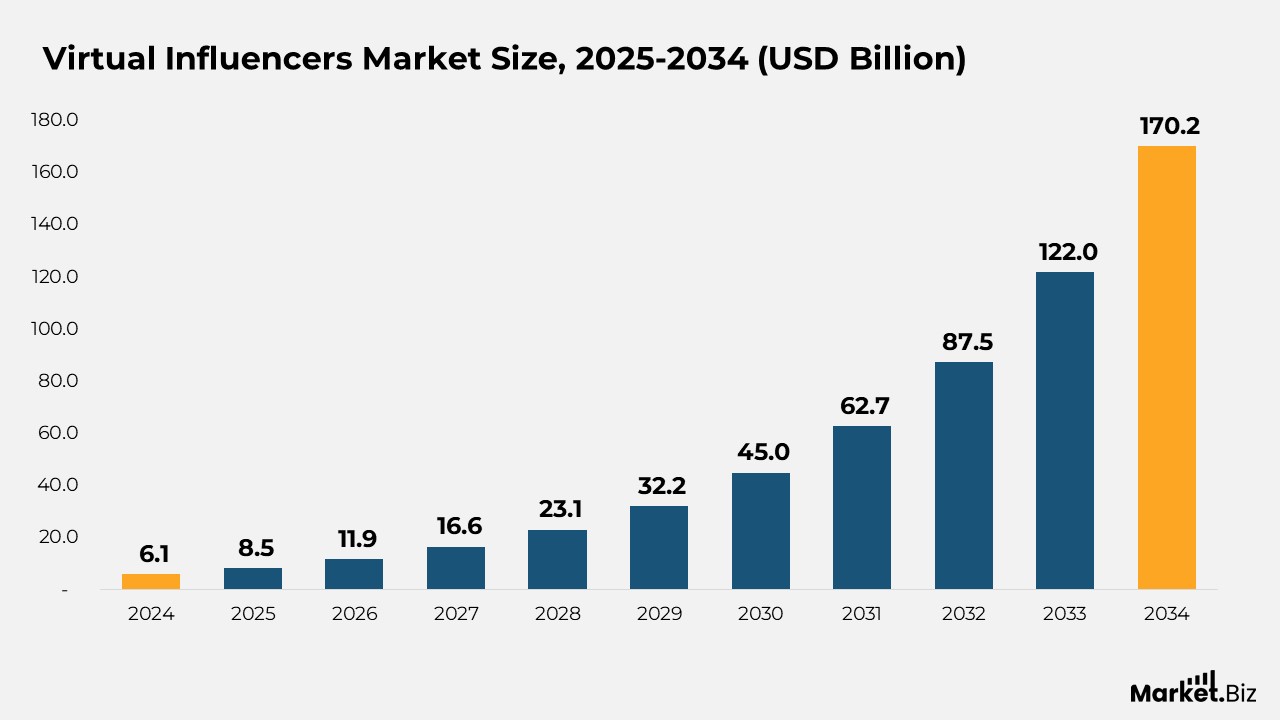
- According to Market.us, the virtual influencers market is expected to rise from $8.5 billion in 2025 to $170.2 billion by 2034, representing a compound annual growth rate (CAGR) of 39.5% from 2025 to 2034.
- The virtual influencers market is growing rapidly, driven by the increasing reliance on social media for marketing, offering brands advantages in consistency, control, and reduced risk of controversies.
- In 2024, the Human Avatar segment dominated the market, accounting for over 65% of the share, driven by the demand for more accurate and relatable virtual influencers.
- The Solutions segment led the global virtual influencers market in 2024, capturing more than 57% of the market share, fueled by the need for integrated and innovative marketing solutions.
- In 2024, the Fashion & Lifestyle segment held over 30% of the virtual influencer market, reflecting its quick adoption of virtual influencers as trendsetters and brand ambassadors.
Moreover
- North America dominated the global virtual influencers market in 2024, securing more than 40% of the share, with strong consumer engagement and substantial marketing investments.
- The US virtual influencers market was valued at USD 2.3 billion in 2024, growing at a 31.58% CAGR, driven by a focus on authenticity and sustainability in marketing.
- According to Forbes, 58% of respondents follow at least one virtual influencer, with 75% of Gen Z particularly engaged with them.
- 35% of consumers have purchased a product promoted by a virtual influencer, reflecting their growing impact on consumer behavior.
- 28% of US consumers follow virtual influencers on YouTube, where influencer-driven content accounts for 91% of video views.
- 24% of users were unaware of virtual influencers’ existence, indicating significant room for awareness growth, with 27% of users following for content, 19% for storytelling, and 15% for inspiration.
- The 35-44 age group shows higher trust and relatability with virtual influencers, scoring 6.2/10 and 6.5/10, respectively, with YouTube being the most preferred platform at 28.7%.
(Source: Market.us)
Synthetic Influencers Market Size
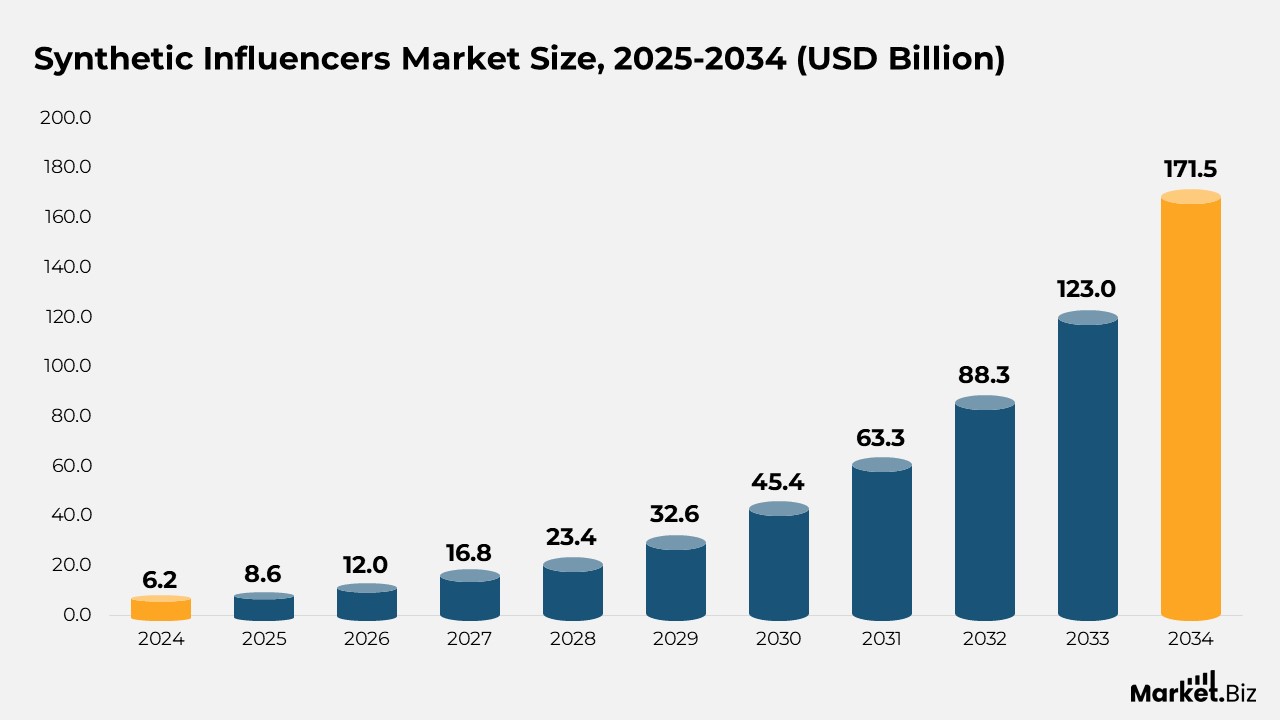
- According to Market.us, the synthetic influencers market is expected to rise from $8.6 billion in 2025 to $171.5 billion by 2034, representing a compound annual growth rate (CAGR) of 39.4% from 2025 to 2034.
- The synthetic influencers market is increasing due to advancements in AI technology and the growing popularity of social media platforms for digital marketing.
- In 2024, the AI-Generated Avatars segment leads the Synthetic Influencers Market with a share of 45.3%, driven by AI’s ability to create highly realistic, customizable, and interactive virtual personas.
- Social Media platforms remain the dominant channels for synthetic influencer activities in 2024, capturing 62% of the market share, offering unmatched reach and engagement with diverse audiences.
- North America holds a dominant position in the synthetic influencers market with more than 40% market share, generating nearly USD 2.47 billion in revenue, due to early adoption of digital technologies, a strong entertainment and fashion industry presence, and the headquarters of major social media platforms.
- The US synthetic influencers market was valued at approximately USD 2.37 billion in 2024, growing at a 37.1% CAGR, driven by its role as a hub for digital marketing innovation.
(Source: Market.us)
Consumer Behavior and Perception Towards AI and Virtual Influencers
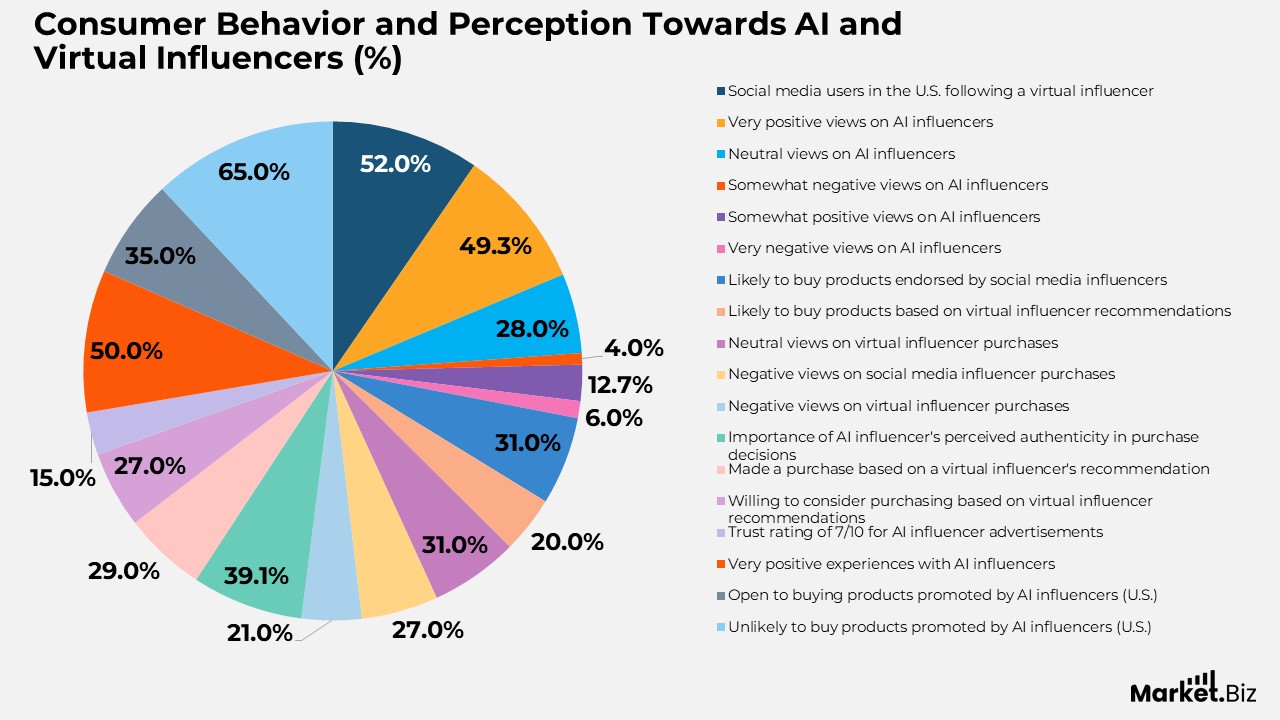
- A survey found that 52% of social media users in the United States already follow a virtual influencer, with global figures surpassing this percentage.
- Views on the effectiveness of AI influencers vary. Nearly 49.3% of respondents hold a very positive view, while 28% are neutral. Smaller percentages see them somewhat negatively (4%), somewhat positively (12.7%), or very negatively (6%).
- When it comes to purchasing behavior, a study by Rudeloff showed that 31% of participants were likely to buy products endorsed by social media influencers, while 20% would consider buying based on virtual influencer recommendations. Interestingly, 31% of virtual influencer followers were neutral, whereas 27% of social media influencer followers rated them negatively, compared to 21% for virtual influencers.
- Authenticity plays a key role in shaping purchasing decisions, with 39.1% of respondents indicating that an AI influencer’s perceived authenticity significantly affects their buying intentions.
- In terms of actual purchases, 29% of respondents have already made a purchase based on a virtual influencer’s recommendation, while 27% are willing to consider purchasing in the future.
- Trust in AI influencers is moderate, with 15% of respondents giving a trust rating of 7/10 for products advertised by virtual influencers.
- Positive experiences with AI influencers are reported by 50% of individuals who worked with them, describing their experience as “very positive.”
- Despite positive experiences, skepticism persists. A March 2022 Statista survey showed that while 35% of US consumers are open to buying products promoted by AI influencers, 65% are unlikely to do so.
(Source: Influencer Marketing Hub, Statista, The Influencer Marketing Factory)
Financial Impact of AI Virtual Influencer Campaigns
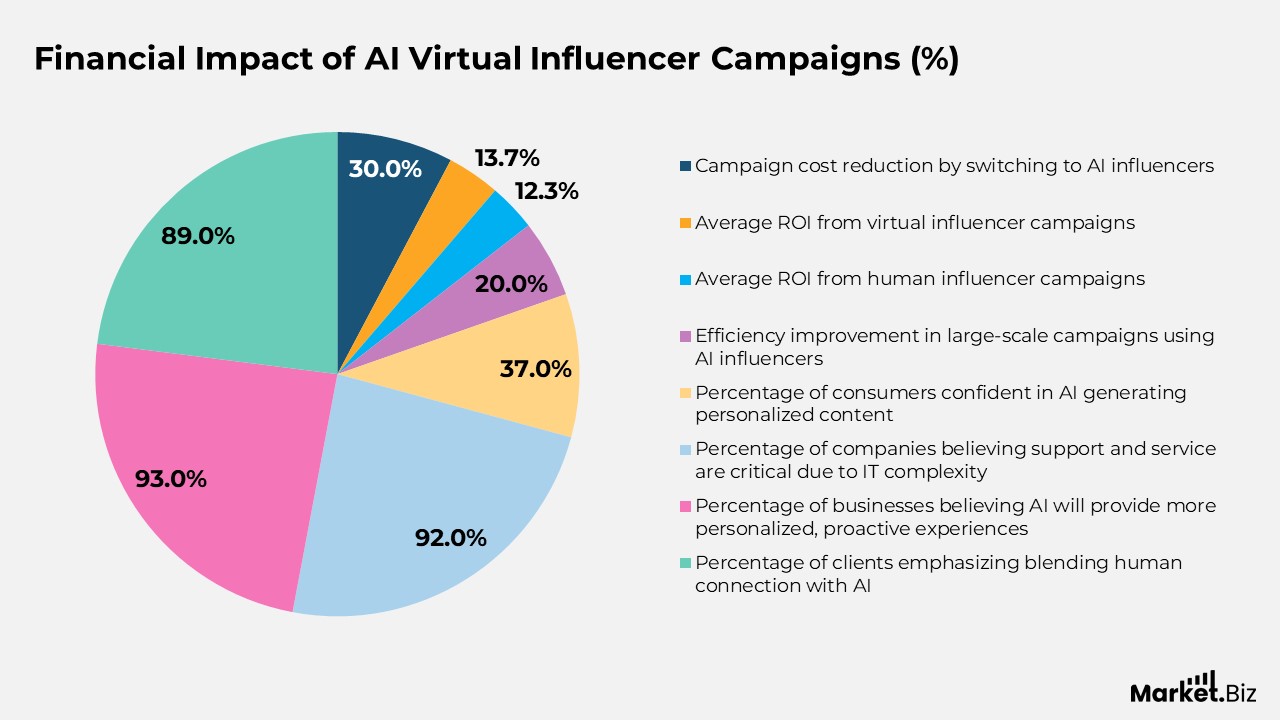
- A Gartner survey found that switching from human influencers to AI influencers can reduce campaign costs by 30%, eliminating expenses related to fees, travel, and logistics.
- Virtual influencer campaigns are yielding solid financial results, with an average ROI of 13.7%, surpassing the 12.3% ROI from campaigns using human influencers.
- In 2023, brands allocated between $18,000 and $30,000 on average for each virtual influencer campaign.
- According to Gartner, AI influencers can enhance the efficiency of large-scale campaigns by 20% when compared to traditional influencer marketing strategies.
(Source: Influencer Marketing Hub, Gartner, Statista, The Influencer Marketing Factory)
Engagement Performance of Virtual vs. Human Influencers
- Data from HypeAuditor indicates that virtual influencers can contribute to a 3% increase in engagement on platforms like Instagram.
- However, sponsored posts by human influencers generate 2.7 times more engagement compared to those from AI influencers.
- Despite this, virtual influencers still outperform human influencers in terms of average engagement, with a rate of 2.84% versus 1.72%.
- In 2023, virtual influencer campaigns achieved a remarkable 5.9% average engagement rate, which is 3 times higher than the 1.9% engagement rate from campaigns with real influencers.
(Source: HypeAuditor, Influencer Marketing Hub, Statista, The Influencer Marketing Factory)
Platform Popularity of Virtual Influencers
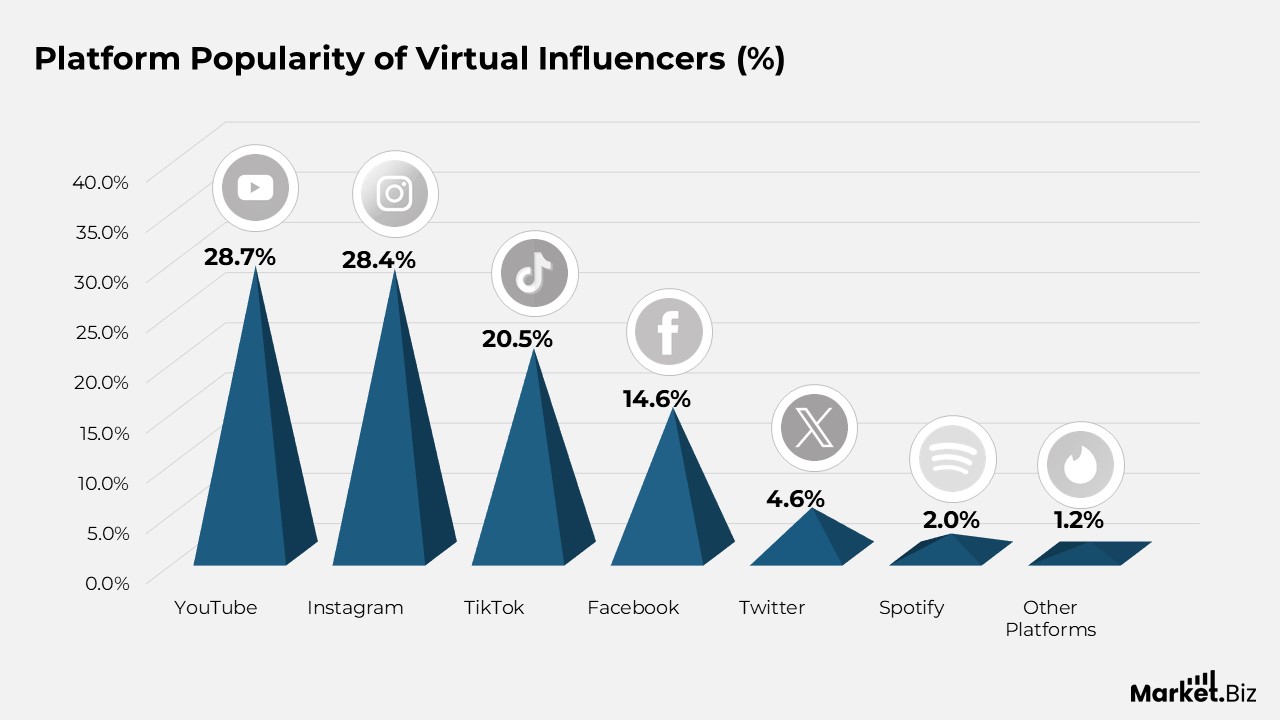
- Virtual influencers are gaining power across several social media platforms, as revealed by a Statista survey from March 2022:
- 28.7% of US consumers follow virtual influencers on YouTube.
- 28.4% engage with virtual influencers on Instagram.
- 20.5% follow virtual influencers on TikTok.
- 14.6% engage with virtual influencers on Facebook.
- 4.6% follow virtual influencers on Twitter.
- 2.0% interact with virtual influencers on Spotify.
- 1.2% of users follow virtual influencers on other platforms.
(Source: Statista, The Influencer Marketing Factory, inbeat)
Virtual Influencers in High-Profile Marketing Campaigns
- Leading brands like Nike and Samsung have invested over $1 million in virtual influencer campaigns, demonstrating their growing commitment to this marketing approach.
- Virtual influencers, such as Shudu Gram for Gucci and Gal Gadot’s collaboration with Dior, emphasize the increasing impact of virtual personas in fashion (51%) and beauty (47%), with their influence expanding into food and lifestyle sectors as well.
- Calvin Klein’s campaign featuring AI influencer Lil Miquela saw a remarkable 60% increase in social media engagement, showcasing the power of virtual influencers in prominent marketing efforts.
- However, Lil Miquela’s campaign for BMW achieved an engagement rate of 0.6%, which was notably lower than the 3.6% engagement rate from human influencers for the same brand.
- Similarly, Aitana Lopez, a Spanish AI model, worked with brands like Fortnite, Nike, and Patagonia, achieving an average engagement rate of 2.9%, which was 1.03% below the typical engagement benchmarks for these companies.
(Source: Communicate Online, Digital Delane, LLC., Disrupt Marketing Ltd., The Influencer Marketing Factory)
Content Distribution of Virtual Influencers
- In content distribution, Reels short-form videos on the Instagram account are the largest share of content used by AI influencers to engage with their audience.
- Reels: 43.3%, Traditional posts: 42.8%
- Carousels: 13.9%
- A survey revealed the following industries where virtual influencers are most effective:
- Gaming: 36%
- Technology & Gadgets: 33.5%
- Beauty & Cosmetics: 32.7%
- Fashion: 28.8%
- Entertainment: 21.5%
- 52.8% of respondents believe the adaptability of AI influencers will play a major role in shaping the future of marketing and entertainment.
(Source: Communicate Online, Digital Delane, LLC., Statista, The Influencer Marketing Factory)
Worldwide Providers of Virtual Influencer Services
| Category | Company | Country/Region | Key Influencers/Focus | Services Provided |
|---|---|---|---|---|
| Service Providers | Aww Inc. | Japan | Imma, Plusticboy (Zinn). | Virtual influencer development and management |
| Sidus Studio X | South Korea | Rozy (South Korea’s first virtual influencer), Rui. | Campaign strategies for fashion & advertising | |
| Luminary (Tencent) | China | Ayayi, Ling (virtual influencers for high-end brands). | Managing luxury brand campaigns | |
| Activ8 | China, Japan | Kizuna AI, Kiryu Coco. | VTuber creation and campaign management | |
| Xmov | Southeast Asia, China | Luo Tianyi (singer). | Creation of digital influencers for live commerce | |
| Virtual Humanoids | India, Southeast Asia | Naina Avtr (Indian virtual influencer). | Localized campaigns featuring virtual influencers | |
| Zepeto (Naver) | Global, South Korea | K-pop integrations, customizable avatars (collaborations with BTS, Blackpink). | Customizable avatar experiences | |
| Bauhaus Movement | USA | Lil Miquela. | Promoting diversity through fashion and art | |
| Meitu | China | Ling (promoting Meitu apps and AI). | Fashion and beauty promotional campaigns | |
| SuperPlastic | Global, USA | John Pork (meme-based human-pig influencer). | Pop culture-driven influencer campaigns | |
| Diigitals | Global, UK | Shudu Gram (first digital supermodel). | Luxury fashion promotion campaigns | |
| Li Jiaqi & Austin Li | China | Famous live-stream influencers for the Chinese e-commerce markets. | Live-streaming and product promotion campaigns |
(Source: Tuimbit, State of Virtual Influencers)
Conclusion
Virtual influencers are transforming the digital marketing world, providing brands with a unique and innovative approach to consumer engagement. With advancements in AI and 3D modeling, these digital personas are becoming more realistic and relatable, enabling companies to maintain consistent, controlled, and flawless marketing campaigns.
Social media platforms, especially TikTok, Instagram, and YouTube, remain the key channels for virtual influencer interactions, fueling their growth and influence.As observed in major markets such as North America and the US, the adoption of virtual influencers is rapidly increasing, with more consumers engaging with these digital figures.
Looking ahead, the role of virtual influencers in marketing is set to expand, driven by technological progress and the increasing demand for authenticity and sustainability in branding. The virtual influencer market is on track for continued growth, offering new opportunities for brands to connect with younger, tech-savvy audiences and shape purchasing decisions.
FAQ’s
The rise of virtual influencers is largely fueled by the increasing use of social media for marketing, advancements in AI and 3D modeling technologies, and the desire for consistent, controlled branding without the risk of human error or controversies. Additionally, the ability to craft highly realistic and relatable digital personas has boosted their popularity.
Advancements in AI are crucial to the evolution of virtual influencers, enabling the creation of lifelike, interactive, and customizable digital characters. AI allows for the development of personas that engage with audiences in a more human-like way, enhancing their relatability and appeal.
Social media platforms dominate virtual influencer activities due to their vast reach and high engagement potential. These platforms provide an ideal environment for virtual influencers to connect with a broad audience, making them a critical tool for brands aiming to engage with consumers effectively.