








Introduction
Sexual Health Statistics: Sexual health is a key component of overall well-being, influencing physical, emotional health, and social aspects of life. Collecting precise and comprehensive sexual health statistics is essential for understanding the prevalence of various conditions, monitoring emerging trends, and informing the development of effective public health policies and interventions.
These statistics provide valuable insights into the frequency and distribution of sexually transmitted infections (STIs), sexual behaviour patterns, contraceptive use, reproductive health outcomes, and the specific challenges experienced by different demographic groups. Analysing these statistics allows for a broader understanding of sexual health trends and identifies areas that require targeted intervention.
Editor’s Choice
- Recent data from the World Health Organisation (WHO) reveals a concerning rise in the global prevalence of sexually transmitted infections (STIs), with over 1 million new cases reported. The sharp increase in syphilis, chlamydia, and gonorrhea highlights the urgent need for enhanced prevention efforts and widespread sexual health education.
- An estimated 39.9 million people were living with HIV worldwide in 2023, with figures ranging from 36.1 million to 44.6 million. This reflects the enduring global burden of HIV across diverse populations and underscores the continued need for comprehensive treatment and support.
- Roughly 1.3 million new HIV cases were reported in 2023, based on estimates ranging between 1 million and 1.7 million. This highlights persistent global transmission rates and reinforces the urgency for more impactful prevention strategies and public health initiatives.
- Each year, about 376 million new cases of curable sexually transmitted infections (STIs) are recorded globally, involving conditions such as chlamydia, gonorrhea, syphilis, and trichomoniasis—underscoring the scale of global STI transmission and the need for regular testing and education.
- The average global age for initiating sexual activity falls between 17 and 19 years, though this varies significantly by region and cultural context, reflecting different norms, education levels, and societal influences.
- The Western Pacific Region faces the highest burden of lifetime infertility, with a prevalence rate of 23.2%, marking it as a key area of concern for reproductive health and access to fertility care.
Sexually Transmitted Disease Market Size
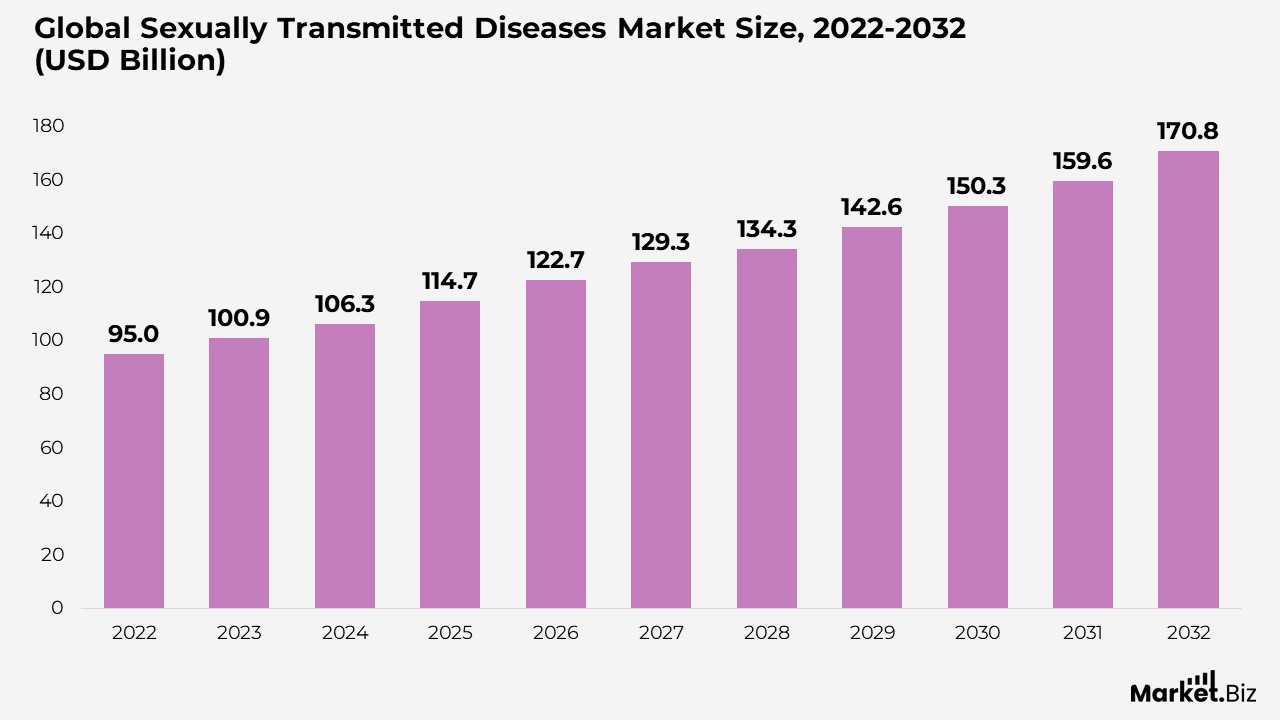
- According to Market.us, the global market for sexually transmitted diseases (STDs) is projected to grow from $114.7 billion in 2025 to $170.8 billion by 2032, reflecting a compound annual growth rate (CAGR) of 6.2% from 2022 to 2032.
- The expansion of the STD diagnostics market is primarily driven by factors such as the increase in unprotected sexual activity, growing public awareness, educational initiatives, government actions, and the rising prevalence of STDs.
- In 2022, chlamydia accounted for the largest testing volume, largely due to a lack of barrier protection and insufficient public awareness. However, syphilis is expected to experience significant growth, with a robust compound annual growth rate, and is projected to account for more than 20% of the market by 2022.
- Laboratory-based testing is expected to dominate the global STD testing market, as most diagnostic procedures are performed in clinical laboratories.
- North America, particularly the United States, is expected to account for a significant share of the global diagnostics market, capturing 52.2% of revenue. Driven by the increasing demand for STD diagnostic services,
- The United States is also expected to experience a rise in regional demand for STD diagnostic services, contributing to a projected 7.7% CAGR in the sexually transmitted disease diagnostics market between 2022 and 2032.
- Key players in the global sexually transmitted disease diagnostics market that are fueling growth include Bio-Rad Laboratories, Qiagen NV, Hologic Inc., Becton Dickinson and Company, F. Hoffmann-La Roche Ltd., and Thermo Fisher Scientific Inc.
(Source: Market.us)
Sexually Transmitted Infection Statistics
- Each year, around 376 million new cases of curable STDs are reported globally, including infections such as chlamydia, gonorrhea, syphilis, and trichomoniasis.
- Trichomoniasis leads the pack with 156 million new cases annually, followed by gonorrhea at 87 million, chlamydia at 127 million, and syphilis at 6.3 million.
- Gonorrhea continues to be a significant public health challenge, with approximately 82.4 million new cases recorded each year.
- In 2022, there were 700,000 cases of congenital syphilis worldwide. These maternal syphilis infections contributed to an estimated 70,000 neonatal deaths, 150,000 early fetal deaths and stillbirths, 55,000 cases of preterm or low-birth-weight births, and 115,000 infants diagnosed with congenital syphilis.
- By 2023, an estimated 3.8 billion people under the age of 50 (about 64% of the global population) live with herpes simplex virus type 1 (HSV-1) infection, which is the primary cause of oral herpes.
(Source: World Health Organization (WHO), National Institute of Health (NIH), American Sexual Health Association (ASHA), Guttmacher Institute, Centers for Disease Control and Prevention (CDC))
Global AIDS/HIV Statistics
- In 2023, approximately 39.9 million people globally lived with HIV, with estimates ranging from 36.1 million to 44.6 million, highlighting the persistent global impact of HIV, affecting millions of individuals across diverse regions.
- An estimated 1.3 million people, ranging from 1 million to 1.7 million, were newly diagnosed with HIV in 2023. This underscored the ongoing transmission of HIV globally and emphasized the need for more effective prevention strategies and awareness campaigns.
- In 2023, 630,000 individuals, within a range of 500,000 to 820,000, tragically succumbed to AIDS-related illnesses. This highlighted the urgent need for timely treatment and comprehensive prevention efforts to mitigate the impact of AIDS-related health complications.
- By 2023, 30.7 million people, with a range between 27 million and 31.9 million, were receiving antiretroviral therapy (ART). The widespread availability of ART marked a significant milestone in the global response to HIV, enhancing the quality of life and life expectancy for those living with the virus.
(Source: Joint United Nations Programme on HIV/AIDS (UNAIDS))
Sexually Transmitted Diseases Kits Statistics
STD testing kits have emerged as a critical tool for the prevention, early identification, and management of sexually transmitted infections. These kits enable people to test for multiple STDs privately at home and in clinical environments, offering a confidential and practical solution to a sensitive and often stigmatized health concern. The convenience and accessibility of these kits have made them an integral part of modern sexual health strategies, empowering individuals to take proactive steps toward managing their sexual health.
- The January 2025 report revealed a consistent rise in the demand for free STI home test kits, with orders increasing from 91,000 in 2022 to 126,090 in 2024.
- A 2022 survey conducted across 143 countries and territories revealed that 18% of women in the U.S. and Canada had undergone STD/STI testing in the past year.
(Source: Government of Ireland, Statista)
Reliability of Rapid Sexually Transmitted Diseases Tests
Not all rapid STI tests offer the same level of performance. The specificity and sensitivity of these tests can vary significantly. Below are the average sensitivities and specificities when testing during an acute infection:
- Chlamydia: 97% specificity, 86% sensitivity
- Hepatitis B: 99% specificity, 97% sensitivity
- HIV (oral swab, at-home): 99% specificity, 92% sensitivity
- Gonorrhea: 97% specificity, 86% sensitivity
- Human papillomavirus (HPV): 94% specificity, 87% sensitivity
- Herpes simplex: 99.9% specificity, 93% sensitivity
- Syphilis: 91% specificity, 85% sensitivity
(Source: Verywell Health)
How Do Rapid STI Tests Differ from Regular Tests?
| Types of Tests | Accuracy of Instant Test | Accuracy of Regular Test |
|---|---|---|
| Chlamydia & Gonorrhoea Tests | Specificity: 99.9%, Sensitivity: 93% | Positive Test: 90%, Negative Test: 99% |
| Herpes | Specificity: 99.9%, Sensitivity: 93% | 96% accuracy when using a PCR test. |
| Syphilis | Specificity: 91% Sensitivity: 85% | 85% accurate when using a blood test |
| HIV | Specificity: 99%, Sensitivity: 92% | 99.5% accurate when using a blood test |
(Source: Your Sexual Health)
Demographics of Sexual Health By Age
15-19 Years (Adolescents)
- Approximately 12% of individuals in the 15-19 age group have engaged in sexual activity.
- Youths aged 15-19 contribute to approximately 25% of the global novel HIV infections.
20-24 Years (Young Adults)
- More than 60% of young children have experienced sexual contact by the age of 24.
- Around 30% of all new STI diagnoses are reported in young children aged 20-24.
25-49 Years (Adults)
- In the 25-49 age range, around 60% of women and 70% of men have engaged in sexual intercourse.
- A significant proportion of new HIV infections are reported in adults aged 25-49.
50-64 Years (Middle-Aged Adults)
- More than 40% of women and 50% of men in the 50-64 age group continue to be sexually active.
- A notable proportion of new STI cases are identified in middle adulthood.
65+ Years (Older People)
- Approximately 40% of elders aged 65-80 report maintaining sexual activity.
- The incidence of STIs is increasing among older adults, driven by evolving societal attitudes and advancements in healthcare.
(Source: World Health Organization (WHO), The Joint United Nations Programme on HIV/AIDS (UNAIDS), Guttmacher Institute, Centers for Disease Control and Prevention (CDC), Kinsey Institute, American Association of Retired Persons (AARP), National Poll on Healthy, Market.us)
Sexual Practices and Behavior Statistics
- Globally, individuals typically begin engaging in sexual intercourse between the ages of 17 and 19, with variations influenced by cultural and regional factors.
- Condom utilization during sexual intercourse differs widely across regions, although some countries report over 70% usage among sexually active people.
- Research suggests that adults have an average of 4 to 10 lifetime sexual partners, with this number shaped by cultural norms and regional differences.
- On average, adults engage in sexual activity one to two times per week, although this can fluctuate based on factors like relationship status, age, and other personal circumstances.
- Evolving societal attitudes have contributed to a reduction in the stigma surrounding premarital sex and non-heteronormative sexual behavior in many parts of the world, reflecting a shift in perceptions of sexual practices and identities.
- As technology continues to evolve, studies show that 60% to 40% of people engage in some form of online sexual behavior, including consuming and sexting explicit content.
- Around 15% to 30% of teenagers worldwide report having had sexual activity before the age of 18, with educational, cultural, and socio-economic factors significantly influencing this trend.
- There is a clear connection between sexual satisfaction and general relationship happiness, highlighting the role of intimacy and communication in fostering long-term relationship fulfillment.
(Source: World Health Organization (WHO), NCBI, United Nations Population Fund, Journal of Sexual Medicine, Kinsey Institute, Archives of Sexual Behavior, Pew Research Center, Market.us)
Statistics on Infertility and Fertility
- In 2023, approximately 17.5% of the adult population, or roughly 1 in 6 people worldwide, faced infertility, highlighting the critical need for improved access to affordable and high-quality fertility care for those affected.
- Infertility causes are divided as follows: 50% are attributable to female aspects, 30% to male aspects, and 20% result from a combination of male and female factors.
- Female fertility declines significantly after age 35, with a more pronounced decline after age 40.
- The Western Pacific Region has the highest estimated lifetime infertility prevalence at 23.2%, indicating a significant regional challenge in fertility issues.
- In contrast, the Eastern Mediterranean Region reports the lowest estimated lifetime prevalence of infertility at 10.7%, reflecting different demographic and healthcare factors.
- In 2023, the lifetime infertility prevalence in high-income countries was 17.8%, whereas in low- and middle-income countries it was slightly lower at 16.5%.
- Success rates for in vitro fertilisation (IVF) are influenced by age, with women under 35 experiencing success rates ranging from 40-50%, while women over 40 face success rates of around 10%. This variance underscores the importance of age in fertility treatment outcomes.
(Source: World Health Organization (WHO), United Nations, National Institute of Health, Society for Assisted Reproductive Technology, Market.us)
Gender Violence and Sexual Health
- Globally, an estimated 1 million new STIs are developed every day, with gonorrhea, chlamydia, syphilis, and trichomoniasis existence the most prevalent infections.
- Around 45% of pregnancies globally are chance, highlighting the urgent essential for family planning services and accessible contraception.
- One in three women globally has experienced sexual intimate partner violence, or non-partner sexual violence, at some point in their lives.
- Almost 12 million girls below the age of 18 are married every year, exposing them to significant sexual health hazards and the potential for early pregnancies.
- Every year, about 15 million girls aged 15 to 19, and 777,000 girls under the age of 15, give birth, facing higher risks of pregnancy-related complications.
- More than 200 million women and girls alive today have experienced female genital mutilation (FGM), resulting in severe health complications and long-term consequences.
(Source: World Health Organization (WHO), Guttmacher Institute, UNICEF Girls Not Brides, Market.us)
Recent Developments
New Product Launches
- In September 2024, Haleon, a U.S.-based consumer health company, introduced Eroxon, an FDA-approved erectile dysfunction gel designed to help men achieve an erection within 10 minutes, promoting physical intimacy.
- In July 2024, Grindr Inc. rolled out in-app access to sexual health and safety resources, making them available globally to users across 30 countries.
- In July 2024, Morari Medical launched a Wefunder Campaign to improve sexual health through an innovative wearable patch.
Partnerships and Collaborations
- In March 2024, a sexual health nonprofit organization collaborated with a social media platform to launch targeted educational campaigns aimed at enhancing sexual health awareness and reaching young adults with crucial information.
- In November 2023, a sexual health clinic formed a partnership with a telemedicine platform to offer remote consultations and prescriptions for sexually transmitted infection (STI) testing and treatment, expanding access to care through digital channels.
Fundings Rounds
- In January 2025, the Government of Sweden allocated USD 0.41 billion (SEK 4.3 billion) towards enhancing sexual and reproductive health and rights. This initiative aims to reduce the incidence of female genital mutilation, child marriage, unintended pregnancies, unsafe childbirth, and unsafe abortions.
- In November 2024, the Australian Government raised USD 56.8 million to support sexual and reproductive health and rights initiatives in Southeast Asia, with a focus on eliminating all forms of violence against women and girls.
- In September 2024, a coalition of governments and philanthropic organizations secured USD 350 million in funding to expand access to family planning and sexual and reproductive health services, improving global health outcomes.
Mergers and Acquisitions
- In September 2023, a prominent healthcare conglomerate acquired a sexual health clinic sequence, significantly expanding its presence in the sexual health services market.
- In December 2023, two major sexual wellness product manufacturers merged, combining their capabilities to offer an enhanced product portfolio and extend their reach to a broader customer base.
Regulatory Advancements
- The introduction of regulations for the marketing and sale of sexual wellness products aimed at ensuring product safety, effectiveness, and accurate labelling.
- The establishment of guidelines by government health agencies for sexual health education in schools and communities is designed to encourage healthy sexual behaviors and reduce the risk of STIs and unintended pregnancies.
Investment Environment
- In 2023, venture capital investments in sexual health startups reached $2.5 billion, primarily directed towards companies developing innovative solutions for STI prevention, contraception, and overall sexual wellness.
- In 2023, half of the total investment activity in the sexual health sector was driven by strategic acquisitions and partnerships among healthcare providers, technology firms, and sexual wellness brands, highlighting a collaborative industry approach to addressing comprehensive sexual health needs.
Conclusion
Sexual Health Statistics: Sexual health continues to be a major global issue, as evidenced by the rising incidence of sexually transmitted infections and their significant effects on individuals’ physical, emotional, and social health. These statistics highlight the urgent need for ongoing efforts in prevention, sexual health education, and better healthcare accessibility.
With millions of new STI cases recorded annually and a concerning rise in infections among adolescents, young adults, and older adults, it is clear that more comprehensive sexual health programs are essential across all age groups and demographics. The increased adoption of at-home STI testing kits, advancements in diagnostic technologies, and growing public awareness offer positive signs of progress.
However, challenges remain, particularly regarding disparities in access to sexual health services, which emphasize the need for targeted interventions for high-risk groups and underserved areas.
FAQ’s
The most common STIs globally include gonorrhea, chlamydia, syphilis, and human papillomavirus (HPV). According to global health reports, chlamydia and gonorrhea are among the most frequently reported, while HPV is the leading cause of cervical cancer worldwide.
Adolescents and young adults, particularly those aged 15-24, are the most affected by STIs. This age group accounts for a significant percentage of new infections globally, particularly for chlamydia and gonorrhea.
At-home STI testing kits are becoming more popular due to their convenience and privacy. These tests are generally reliable, with certain tests (such as for HIV and chlamydia) offering high sensitivity and specificity. However, laboratory tests are still recommended for more accurate results, particularly for complex or multiple infections.
Common symptoms of STIs may include:
– Fever, chills, and general fatigue
– Abnormal vaginal discharge or bleeding
– Pain or burning sensation during urination
– Painful sores or blisters in the genital region
– Genital warts
– Unusual discharge from the penis
Here are several resources for sexual health assistance:
– Planned Parenthood Hotline: 1-800-230-PLAN
– National Sexual Assault Hotline: 1-800-656-HOPE
– CDC Sexually Transmitted Disease Hotline: 1-800-232-4636