









Introduction
Food Waste Statistics: Food waste represents a substantial global challenge, with approximately one-third of all food intended for human consumption lost or wasted each year (around 1.3 billion tons). This issue adversely affects hunger, resources, and the climate, contributing to 8-10% of greenhouse gas emissions. The waste is prevalent throughout the entire supply chain, from agricultural production to households, where families are significant contributors (61%).
This situation results in the wastage of precious land, water, and energy, even as hundreds of millions of individuals face hunger. Addressing food waste is a crucial objective for the United Nations, necessitating comprehensive efforts from consumers, businesses, and policymakers to enhance food security and promote sustainability. Food waste is a critical global concern that impacts both developed and developing nations.
It encompasses the loss or disposal of edible food throughout the entire food supply chain, including production, processing, distribution, retail, and consumption. Food waste arises when edible food that is safe for human consumption is discarded, whether as a result of spoilage, excessive production, or consumer behaviours.
Editor’s Choice
- Approximately 1.3 billion metric tons of food are wasted each year globally.
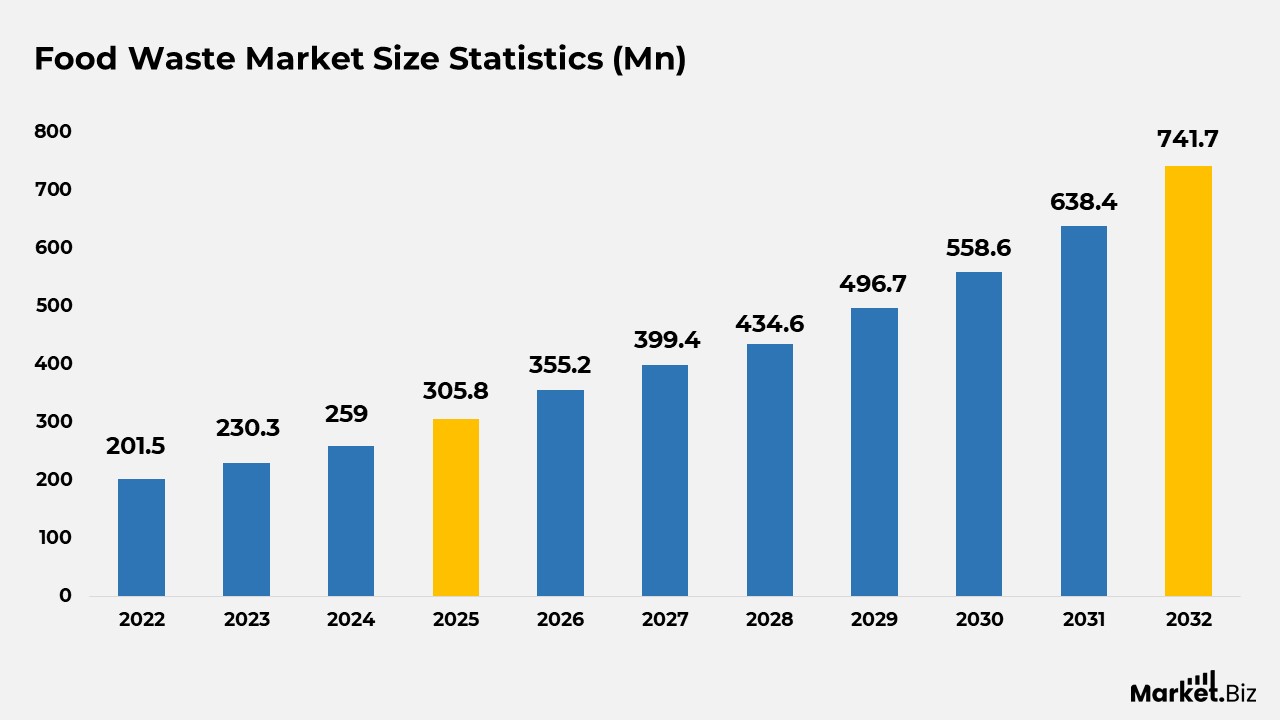
- In 2022, the global Smart Food Bin Market was assessed at a value of US$201.5 million and is projected to reach US$741.7 million by the year 2032. From 2023 to 2032.
- Food production accounts for 26% of the total greenhouse gas emissions globally.
- Approximately 40% of the food generated in sub-Saharan Africa is lost or wasted each year.
- It is estimated that restaurants and food service establishments in the United Kingdom produce approximately 1 million tonnes of food waste each year.
- It is estimated that food waste incurs a cost of approximately £1 billion annually for supermarkets in the UK.
General Food Waste Statistics
- Approximately 1.3 billion metric tons of food are wasted each year globally.
- This amount is equivalent to about one-third of all food produced for human consumption.
- High-income regions, such as North America and Europe, tend to have higher levels of food waste per capita compared to low-income regions.
- Industrialised countries waste about 222 million tons of food annually, which is nearly as much as the entire net food production of sub-Saharan Africa (230 million tons).
- Food waste contributes to approximately 8% of global greenhouse gas emissions. If food waste were a country, it would be the third-largest emitter after the United States and China.
- Wasted food occupies around 1.4 billion hectares of land, which accounts for about 30% of the world’s agricultural land area.
- The water footprint of food waste is approximately 250 km³ per year, equivalent to the annual flow of Russia’s Volga River, the largest river in Europe.
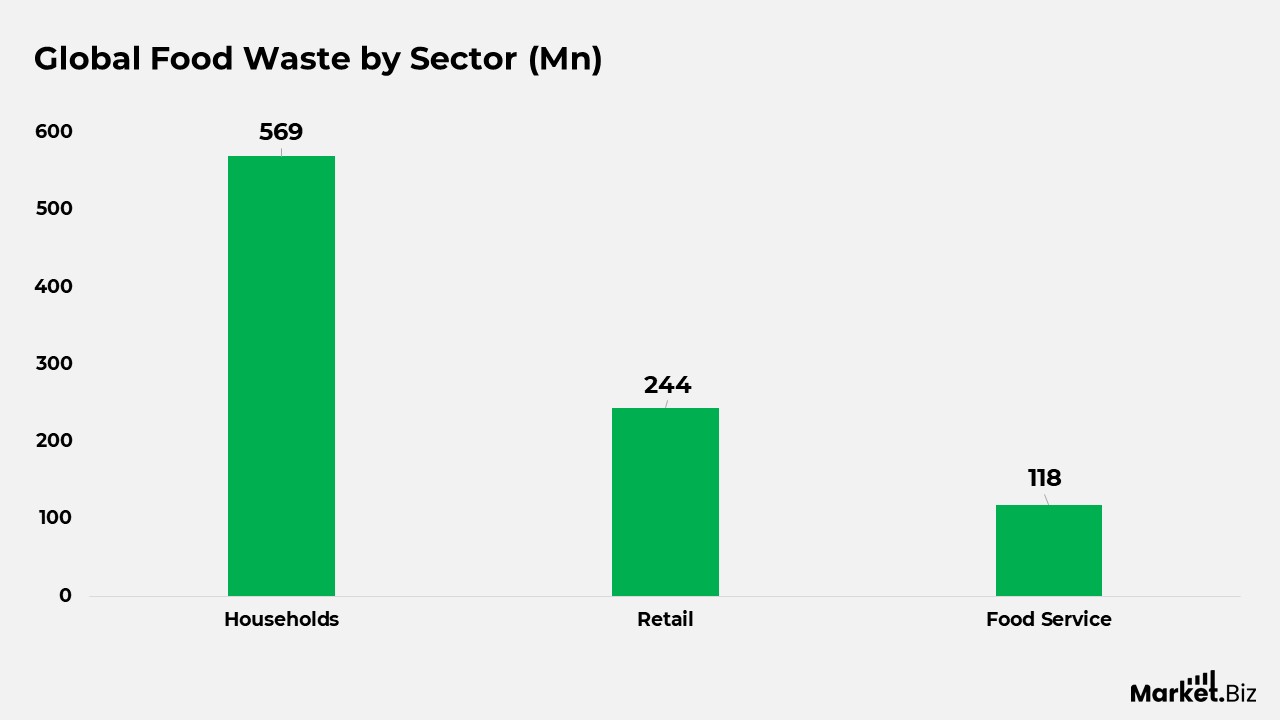
- The household sector accounts for approximately 569 million tonnes of food waste globally.
- The retail sector contributes around 244 million tonnes of food waste to the global total.
- Within the food service industry, approximately 118 million tonnes of food are wasted worldwide.
Market Size Statistics in Food Waste
- In 2022, the global Smart Food Bin Market was assessed at a value of US$201.5 million and is projected to reach US$741.7 million by the year 2032. From 2023 to 2032, this market is anticipated to experience the highest compound annual growth rate (CAGR) of 14.3%.
- Globally, around 1.3 billion tonnes of food are wasted each year.
- Approximately 690 million individuals are affected by chronic hunger across the globe. It is estimated that 1.3 billion tons of food are discarded annually.
- The financial impact of global food waste is estimated to be approximately $1 trillion each year.
- In the United States, around 30-40% of the food supply is wasted, which translates to about 133 billion pounds and a monetary value of $161 billion in food wasted annually.
Food Waste in the Retail Sector
Food waste generated by the retail sector remains a significant contributor to overall food loss in many countries, reflecting inefficiencies in supply chain management and consumer demand forecasting. Retailers, including supermarkets and grocery stores, play a vital role in reducing food waste worldwide.
- In the United States, the retail industry is responsible for discarding roughly 43 billion pounds (approximately 19.5 million metric tons) of food annually.
- Supermarkets and grocery stores in the United Kingdom produce around 200,000 tons of food waste every year.
- Australian supermarkets contribute an estimated 7.3 million tonnes of food waste annually, incurring costs of about AUD 36.6 billion per year.
- Retailers in Canada account for approximately 10% of the nation’s total food waste, according to recent surveys.
- In South Africa, food waste from retailers amounts to approximately 2.8 million tons annually.
- China experiences the loss or waste of more than 35 million tonnes of food annually, representing roughly six per cent of the country’s total food production, enough to nourish between 30 and 50 million people.
Food Waste in Households
- The household segment accounts for about 62% of total global food waste.
- In high-income countries, households leave about 95 to 115 kg of food per capita per year.
- The per capita household food surplus in middle- and low-income countries ranges from 6 to 11 kg annually.
- Approximately 40% of food unused by homes is vegetables and fruits.
- Cereals and bread contribute to about 20% of household food leftover.
- Dairy products, such as cheese and milk, account for roughly 17% of household food waste.
- Fish and meat waste make up approximately 8-10% of household food waste.
- Leftover and prepared meals account for roughly 8% of food waste in households.
- In high-income countries, consumers dispose of about 10 to 15% of their food consumption.
- Improper meal planning and a lack of awareness are significant contributors to household food waste.
Food Waste in the Food Service Industry
- The food service industry is responsible for about 10% of the world’s total food waste.
- Approximately 5% of the global food production is lost within this sector.
- In restaurants and catering businesses, food waste can represent nearly 14% of their overall operating costs.
- In the United States alone, the food service sector generates more than 11 million tons of food waste annually.
- On average, restaurants and food service establishments discard between 4% and 10% of the food they purchase.
- Buffet-style dining operations tend to generate more food waste compared to other food service formats.
- Key causes of food waste in this sector include excess food production, spoilage, and uneaten portions left on plates.
- Nearly 40% to 50% of fruits and vegetables served in the food service industry end up being wasted.
- In Europe, the food service sector accounts for approximately 14% of the total food waste generated throughout the entire supply chain.
- Adopting food waste reduction measures within the U.S. food service sector has the potential to save businesses up to $1.6 billion annually.
Cost Savings through Reducing Food Waste
According to ReFED, a sustained annual investment of $14 billion in food waste reduction initiatives over the next decade in the United States could yield significant benefits:
- Decrease food waste by 45 million tons each year
- Generate a net financial gain of $73 billion annually for the nation
- Cut greenhouse gas emissions by 75 million metric tons and provide the equivalent of four billion meals annually to those facing food insecurity.
- Support the creation of 51,000 new jobs over ten years
- Meet the 2030 national target of halving the volume of wasted food
Financial Impact of Food Waste
- Globally, food waste results in an estimated economic loss of nearly $ 1 trillion per year.
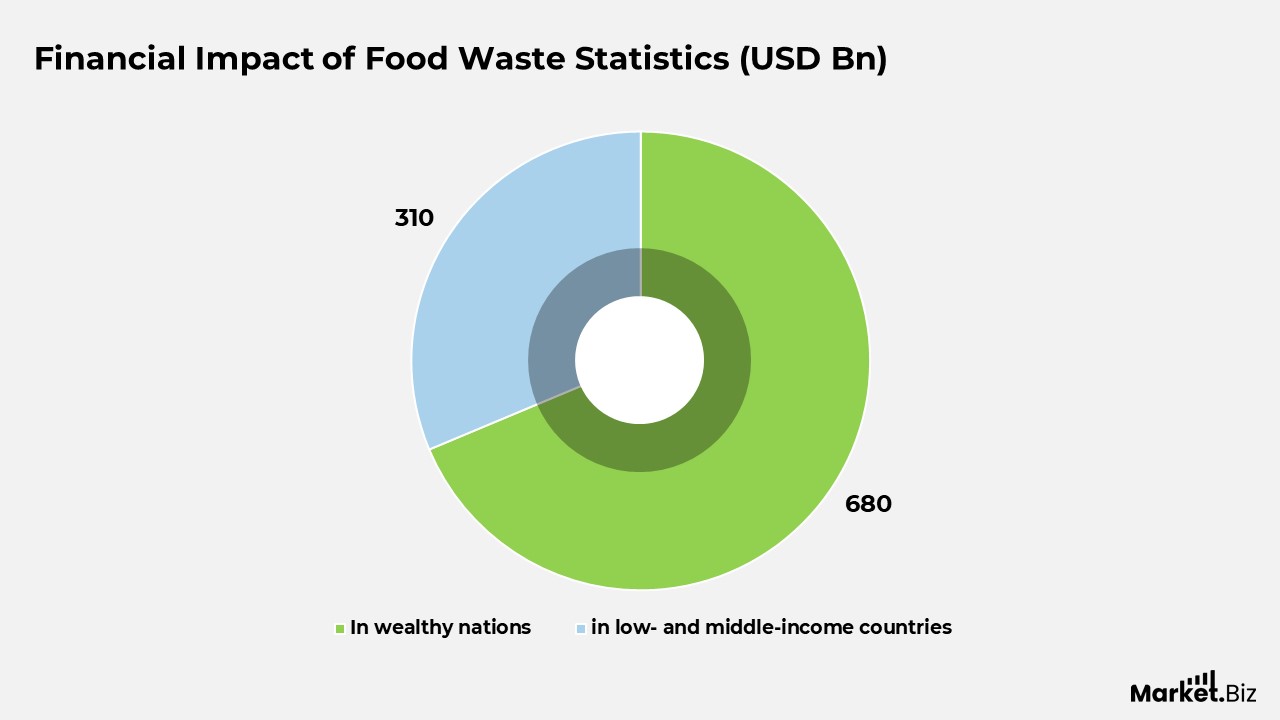
- In wealthy nations, the annual financial burden of food waste reaches around US$680 billion, whereas in low- and middle-income countries, the cost is approximately US$310 billion.
- Throughout the supply chain, food waste results in considerable monetary losses for farmers, manufacturers, and retailers, with estimates indicating that 15% to 30% of the total production value is lost.
- The hospitality industry faces notable economic setbacks due to food wastage, with restaurants and catering businesses losing up to 4% of their profits because of discarded food.
- Investing in effective food waste reduction strategies yields significant financial returns; on average, every dollar spent on such initiatives results in approximately $14 in cost savings.
Environmental Impacts of Food Waste Statistics
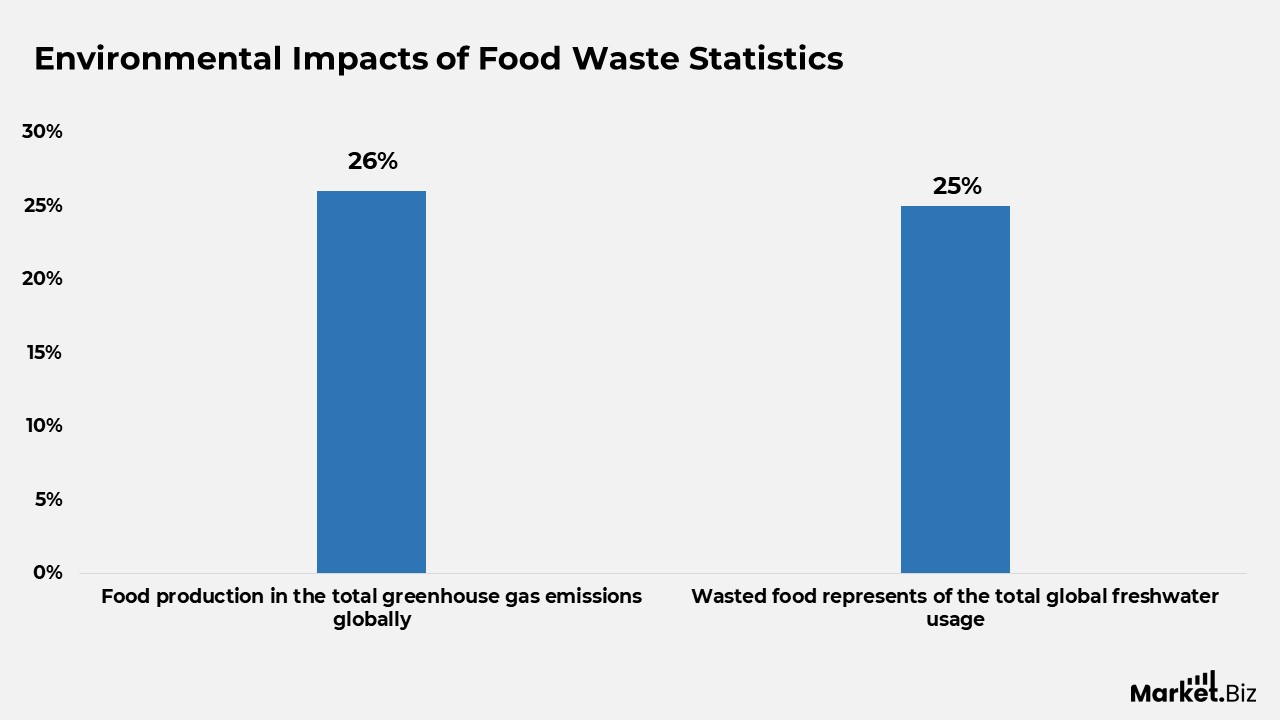
- Food production accounts for 26% of the total greenhouse gas emissions globally.
- Agriculture occupies 50% of the Earth’s habitable land, excluding areas covered by ice and deserts.
- 70% of the world’s freshwater withdrawals are designated for agricultural purposes.
- Agriculture is responsible for 78% of the eutrophication in both marine and freshwater environments, which is characterised as water pollution caused by nutrient-rich runoff.
- Livestock constitutes 94% of the total biomass of non-human mammals, signifying that livestock surpasses wild mammals by a ratio of 15 to 1.
- Poultry livestock makes up 71% of the overall bird biomass, surpassing the biomass of wild birds by a ratio exceeding 3 to 1.
- The carbon footprint linked to food waste is projected to reach 3.3 billion metric tons of CO2 equivalent annually.
- Wasted food represents approximately 25% of the total global freshwater usage.
- Approximately 1.4 billion hectares of land, which equates to about 28% of the world’s agricultural land, is used to grow food that is ultimately discarded.
Food Waste in Countries
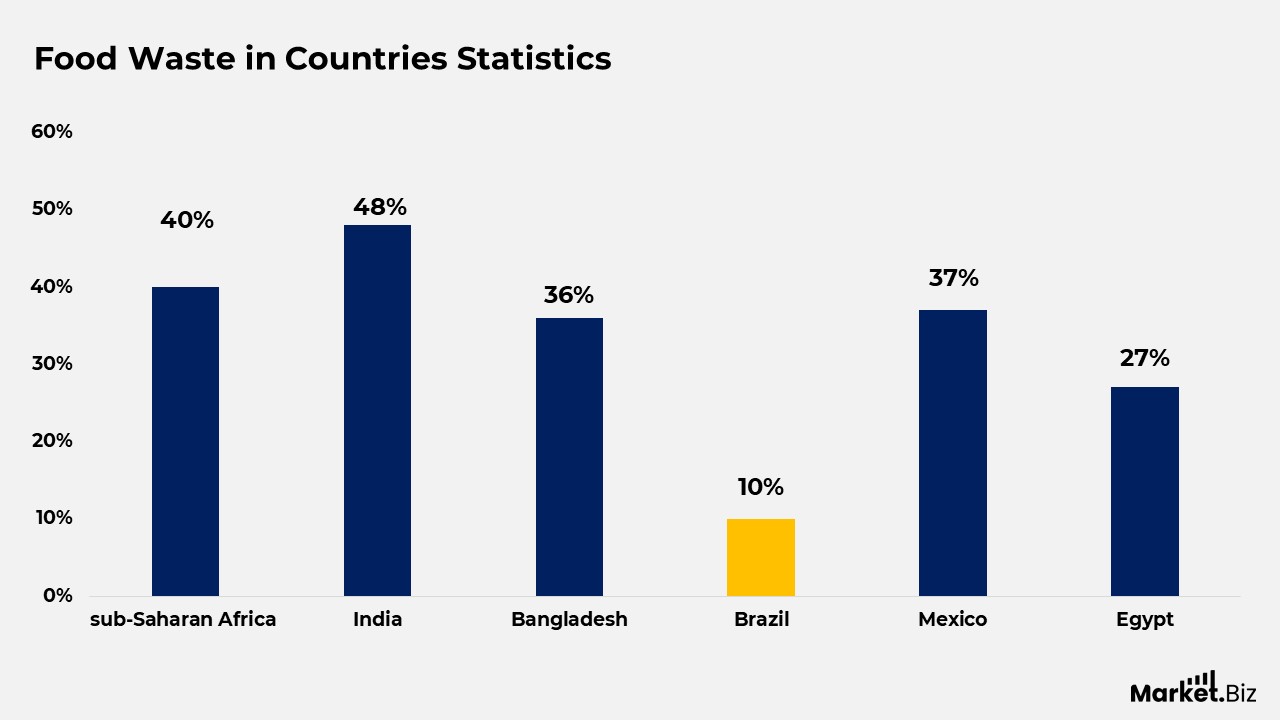
- Approximately 40% of the food generated in sub-Saharan Africa is lost or wasted each year.
- In sub-Saharan Africa, post-harvest losses for cereals, roots, and tubers can vary between 15% and 50%.
- On a per capita basis, food waste in sub-Saharan Africa is projected to be between 6 and 11 kg annually.
- Countries in South Asia waste an estimated 9% of their food production each year.
- In India, it is estimated that around 48% of the food produced is wasted, which amounts to approximately $14 billion each year.
- In Bangladesh, post-harvest losses for perishable crops can reach as high as 36%.
- Food losses and waste in Latin America and the Caribbean constitute about 15% of the total food production.
- In Brazil, food waste accounts for roughly 10% of the total food production.
- In Mexico, it is estimated that around 37% of food available for human consumption is lost or wasted.
- In the Middle East and North Africa region, food losses and waste range from 250 to 450 kg per capita each year.
- In Egypt, food waste is estimated to be around 27% of the total food production.
- In Saudi Arabia, the annual cost of food waste is estimated to be $13.3 billion.
Restaurant Food Waste Statistics
- It is estimated that restaurants and food service establishments in the United Kingdom produce approximately 1 million tonnes of food waste each year.
- The hospitality industry, which includes restaurants, hotels, and catering services, is responsible for about 10% of the total food waste generated in the UK.
- Food waste poses a significant financial challenge for the restaurant sector in the UK. It is estimated that restaurants across the UK incur losses of around £682 million annually due to food waste.
- Plate waste is a major factor contributing to food waste in UK restaurants.
- Research indicates that roughly 39% of meals served in restaurants go to waste, with a considerable amount being left uneaten on plates.
- Numerous initiatives and organisations in the UK, including the Sustainable Restaurant Association (SRA) and the Guardians of Grub campaign, are dedicated to raising awareness and assisting restaurants in their efforts to minimise food waste.
UK Supermarket Food Waste Statistics
- It is estimated that food waste incurs a cost of approximately £1 billion annually for supermarkets in the UK.
- According to a study conducted in 2022, 61% of consumers believe that brands, stores, and supermarkets should take greater action to mitigate waste, while 57% express disappointment regarding the current initiatives.
- The largest supermarket chains in the UK, such as Tesco, Asda, Sainsbury’s, and Morrisons, have pledged to meet the Sustainable Development Goal 12.3 objective of reducing food waste by 50% by the year 2030.
- It is estimated that UK supermarkets wasted about 200,000 tonnes of food, which is equivalent to more than 350 million meals.
- In 2019, UK supermarkets donated over 50,000 tonnes of food to charities and community organisations.
Food Market by Region Statistics
- The global food market is presently valued at $10.07 trillion.
- It is projected that from 2024 to 2028, it will experience a compound annual growth rate (CAGR) of 6.53%.
- In international markets, it is anticipated that a significant portion of the revenue will be generated from China, amounting to $1,630 billion in 2024.
- By the year 2028, the volume of the food market is expected to reach 3,118 billion kg.
- In 2024, the estimated average volume per capita in the global food market is 352.30 kg.
- Moreover, in the global market, it is expected that the majority of sales will come from online transactions in the current year.
- As of 2024, the anticipated revenue per person is projected to be $1,299.
- Within the global food market, the Confectionery and Snacks segment is expected to be the largest food category by market volume, with an estimated value of $1.77 trillion in 2024.
Recent Development
- The UNEP Food Waste Index Report 2024 revealed that 1.05 billion tonnes of food were wasted in 2022, which accounts for nearly 20% of the food available, with households contributing 631 million tonnes to this total.
- India ranks as the second-largest producer of food waste, following China, with a per capita waste of 55 kg.
- The UN Environment Programme (UNEP) has published its Food Waste Index Report 2024, which builds upon the findings from 2021 to provide improved global measurement guidance for households, retail, and food service sectors in order to achieve Sustainable Development Goals (SDG 12.3).
Food Waste Future Predictions
- By the year 2026, the emphasis on reducing food waste will centre on technology-driven prevention methods (such as AI and sensors), circular economy frameworks (including upcycling and renewable energy), more stringent policies and incentives, as well as a cohesive operational discipline within the hospitality sector.
- Government initiatives, along with public awareness campaigns, play a vital role in reaching objectives such as the United States’ aim to reduce food loss and waste by 50% by the year 2030.
Conclusion
Food Waste Statistics: Food waste represents a major global challenge that impacts both developed and developing nations. The data illustrates the magnitude of the issue and its effects on different areas.
Nevertheless, there are approaches and solutions that can be implemented to address food waste, such as food recovery and redistribution, enhanced storage and transportation methods, consumer education and awareness initiatives, as well as policy and regulatory actions.
It is essential for individuals, organisations, and governments to collaborate in creating a more sustainable and efficient food system that reduces waste and guarantees food security for everyone.
FAQ’s
Approximately one-third of all food produced globally goes uneaten, this is the traditional estimate. Nevertheless, the problem is probably far more serious than this. Recent statistics suggest that up to 40% of food is either lost or wasted along the value chain, underscoring a considerable flaw in worldwide food systems.
Loss and waste occur at every stage of the supply chain, with the majority taking place in consumer-facing businesses, including grocery stores, restaurants, and other establishments that sell and serve food, as well as in households.
China. China leads the rankings, with over 108 million tons of food wasted each year. As the most populous nation globally, its large population naturally contributes to this staggering total. However, on a per capita basis, the waste is lower than in some other countries, approximately 76 kg per person annually.

