









Introduction
Platform as a Service Statistics offers a clear, data-driven perspective on how enterprises are using cloud-based platforms to build, deploy, and manage applications more efficiently.
These statistics highlight adoption levels, investment patterns, and key use cases across industries. Underscoring the expanding role of PaaS in application development, integration, data services, and analytics.
They also illustrate how PaaS enables cloud-native architectures, DevOps practices, microservices, and automated workflows, offering insight into how organisations are leveraging platform services to enhance flexibility, scalability, and speed in their digital initiatives.
Editor’s Choice
- Data and analytics are the strongest catalysts for change, with 72% of respondents identifying them as the top priority driving technology and platform investments.
- Business alignment is a critical driver of platform adoption, as 66% of organizations prioritize aligning technology initiatives with business and marketing objectives.
- Platform-as-a-Service is gaining rapid momentum, with current adoption at 33% and 72% of respondents expecting to use PaaS within their organisations over the next five years.
- Hybrid cloud adoption is accelerating, reaching 38% of organisations, while public cloud usage has stabilised at 50% year over year.
- Cost savings are no longer the dominant cloud motivator, dropping from 73% two years ago to 29%, as business needs now lead adoption decisions at 45%.
- Decentralised IT spending is reshaping platform demand: 37% of organisations are increasing technology spend outside central IT, and 39% of that spend is directed toward cloud and SaaS solutions.
- Private cloud continues to play a strategic role, with 39% of organisations using it and 44% deploying mission-critical workloads in private environments.
- Investment momentum remains strong across cloud models, as 28% of respondents plan to increase private cloud spending by more than 20%. While 29.7% expect similar increases in public cloud spending.
- Software as a Service remains the most widely adopted cloud model. With 63% of organisations use SaaS, up from 52% in 2012.
- Enterprises are prioritizing faster time-to-value, scalability, and agility, cited by 54.5%, 54.3%, and 48% of respondents. Respectively, reinforcing the long-term role of PaaS in cloud strategies.
Business Alignment and Data Capabilities Drive Change Initiatives
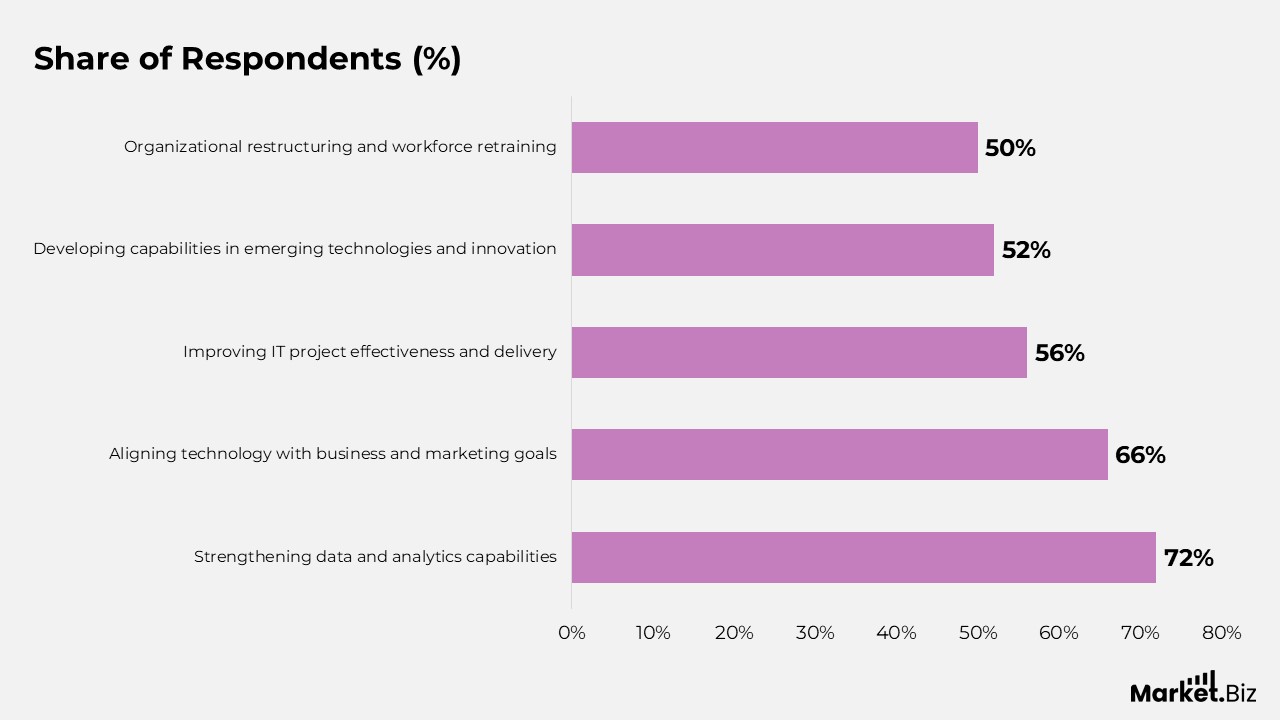
- Strengthening the use of data and analytics stands as the top priority. Cited by 72% of respondents as a key focus area.
- Aligning technology initiatives with business and marketing objectives is a major driver, highlighted by 66% of respondents.
- Improving the effectiveness and delivery of IT projects is emphasized by 56% of participants.
- Building capabilities in emerging technologies and innovation is a growing priority, with 52% of respondents calling it essential.
- Organizational restructuring and workforce retraining to support business outcomes and innovation are noted by 50% of respondents.
(Sources: Saasworthy, Statista)
Distribution of Technology Investment and Development Approaches
- Investment in cloud spending and SaaS solutions accounts for the largest share, at 38% of responses.
- Outsourced web or mobile application development forms a significant portion of technology activity, cited by 29% of respondents.
- Application development teams within business units contribute a notable share, representing 21% of responses.
- A smaller but meaningful group, 19%, identifies spending focused on cloud infrastructure services such as IaaS or PaaS.
(Sources: Saasworthy, Statista)
Shifting Priorities and Adoption Patterns Across Cloud Deployment Models
- Business requirements have overtaken cost savings as the primary driver of public cloud adoption, cited by 45% of respondents, up from 29% this year and 73% two years ago.
- Concerns around security, control, and existing IT investments continue to slow cloud adoption for some organizations.
- Hybrid cloud usage is increasing, with 38% of respondents now using hybrid environments, up from 29% in the previous year.
- Private cloud adoption has declined from 31% last year to 21% today.
- Public cloud usage has remained stable over time, holding steady at 50% year over year.
- Improved business agility (54%), scalability (54.3%), and cost efficiency (48%) are the leading factors driving cloud adoption today.
- Over the period from 2012 to 2016, public cloud usage declined from 39% to 32%, while private cloud use fell from 34% to 25%. As hybrid cloud adoption rose from 27% to 43%, emerging as the most widely used model.
- Platform-as-a-Service adoption currently stands at 33%, with strong future momentum: 72% of respondents expect PaaS usage within their organisations over the next five years.
- Infrastructure as a Service is used by 45% of organisations today, up 29% from the previous year.
- Software as a Service remains the most widely adopted model, with 63% of respondents reporting SaaS usage, representing growth of more than 15% since 2012.
(Sources: Saasworthy, Statista, North Bridge report, GigaOm Research)
Private Cloud Momentum and Enterprise Cloud Investment Trends
- Cost efficiency, operational flexibility, scalability, and faster time-to-value are identified as the most important benefits driving cloud adoption.
- Cloud usage remains distributed across models: 39% of organisations use private cloud, 31% rely on public cloud, and 28% operate hybrid environments.
- Planned cloud investment is firmly positive, as 28% of respondents expect private cloud spending to increase by more than 20%. While 29% plan similar increases in public cloud spending, with no organizations indicating spending reductions.
- Mission-critical workloads are more commonly deployed in private environments. With 44% hosted on private cloud compared with 20% on public cloud platforms.
- Current enterprise cloud initiatives are centred on Internal Private Cloud (35%), Infrastructure as a Service (31%), and Software as a Service (30%). Alongside a rising focus on cloud-provider assessment and planning to support more agile IT strategies.
- Enterprise cloud budgets vary widely, with a median of 675,000, an average of 8,234,438, and a maximum of 125 million, reflecting differing levels of cloud maturity.
- Private cloud environments are expected to see continued workload growth, with organisations anticipating a 29% increase.
- Research released by Technology Business Research in November 2013 found that private cloud adoption was driven by the need to address limitations in public cloud offerings, particularly for customers with maturing and complex requirements.
- The same study projected that private cloud workload volumes would grow by 29% year over year. Increasing from an average of 4 workloads in 2013 to 10 workloads in 2014.
- As private cloud adoption accelerates toward 50%, hybrid cloud models are emerging as the dominant architecture. Combining the strengths of private, public, and on-premises infrastructure.
(Sources: Saasworthy, Statista, North Bridge report, GigaOm Research)
Public Cloud Usage Patterns Across Enterprises
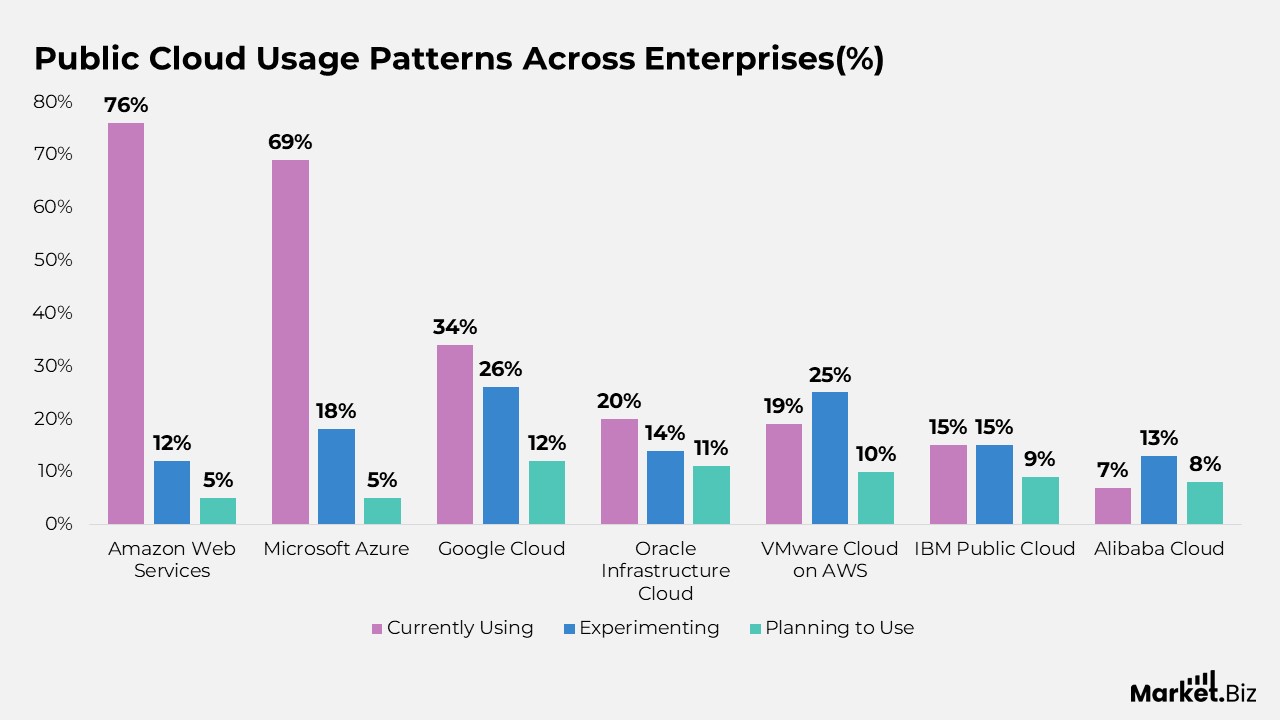
- Amazon Web Services leads enterprise public cloud adoption, with 76% of organisations currently using the Platform. While an additional 12% are experimenting and 5% plan to use it in the future.
- Microsoft Azure follows closely, with 69% of enterprises actively using the Platform, 18% in the experimentation phase, and 5% planning adoption.
- Google Cloud has moderate penetration: 34% of enterprises currently use it, 26% experiment with it, and 12% plan to adopt it.
- Oracle Infrastructure Cloud is used by 20% of respondents, 14% are experimenting, and 11% have future adoption plans.
- VMware Cloud on AWS shows strong exploratory interest: 19% currently use the service, 25% are experimenting, and 10% plan to use it.
- IBM Public Cloud records lower active usage at 15%, with a similar 15% experimenting and 9% planning future adoption.
- Alibaba Cloud shows emerging adoption: 7% of enterprises currently use the Platform, 13% are experimenting, and 8% are planning to adopt.
(Sources: Saasworthy, Statista, North Bridge report, GigaOm Research)
Shift Toward Decentralized IT Spending and Cloud-Led Purchases
- A growing share of organizations reported increased technology spending outside central IT. With 37% indicating higher decentralized spend in 2014, up from 22% in 2013.
- In contrast, centralised IT budgeting declined sharply, from 38% of organisations in 2013 to 21% in 2014.
- Cloud-related purchases dominate non-central IT spending, with 39% of respondents citing cloud services and SaaS as key areas of investment.
- Outsourced web and mobile application development accounted for a significant portion of decentralised spending, with 29% of respondents reporting it.
- Staffing for application development within individual business units accounts for 21% of technology purchases made outside centralized IT control.
- A further 19% of respondents identified spending on cloud infrastructure services. Such as IaaS or PaaS, as part of their decentralised technology investments.
(Sources: Saasworthy, Statista)
Evolving Drivers and Adoption Trends Across Cloud Deployment Models
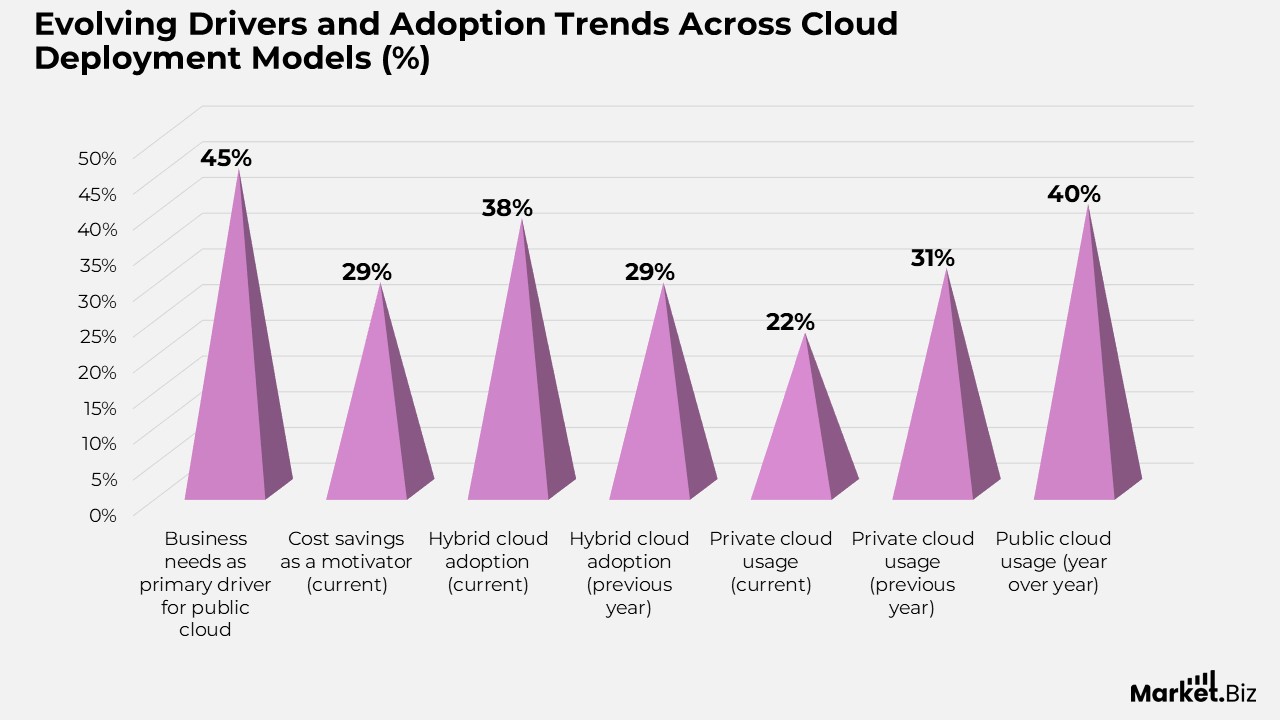
- Business requirements have emerged as the leading driver of public cloud adoption. With 45% of respondents citing business needs as their primary reason.
- Cost savings have become a much weaker motivator, falling from 73% two years ago to just 29% in the most recent survey.
- Security, operational control, and prior investment in internal IT infrastructure remain the main factors slowing cloud adoption.
- Hybrid cloud adoption has increased significantly, rising to 38% of respondents from 29% the previous year.
- Private cloud usage has declined year over year, decreasing from 31% to 22%.
- Public cloud usage has remained stable, holding steady at 40% year over year.
(Sources: Saasworthy, Statista)
Cloud Adoption Drivers, Deployment Shifts, and Enterprise Investment Trends
- The leading motivations for cloud adoption today are improved business agility (54.5%), enhanced scalability (54.3%), and cost efficiency (48%).
- Deployment preferences are shifting toward hybrid models, with public cloud usage expected to decline from 39% to 32% and private cloud from 34% to 25% between 2012 and 2016. While hybrid cloud adoption is projected to rise from 27% to 43%, becoming the dominant approach.
- Platform-as-a-Service adoption currently stands at 33%, and it is expected to be the fastest-growing model, with 72% of respondents indicating plans to use PaaS within the next five years.
- Infrastructure as a Service is already in use by 45% of organisations, a 29% increase from the previous year.
- Software as a Service remains the most widely adopted cloud model. With 63% of respondents reporting SaaS usage, representing 15% growth since 2012.
- Faster time-to-value, alongside cost savings, flexibility, and scalability, is identified as a key benefit driving cloud and PaaS adoption.
- Cloud usage remains diversified, with 39% of organizations operating private clouds, 31% using public clouds, and 28% relying on hybrid environments.
- Investment momentum remains strong, as 28% of respondents plan to increase private cloud spending by more than 20%. In comparison, 29.7% intend to raise public cloud spending by a similar margin, with no respondents planning to reduce spending.
- Mission-critical workloads are increasingly deployed in private environments, with 44% on private clouds compared with 20% on public clouds.
- Internal Private Cloud initiatives represent the top current investment focus, cited by 35% of enterprises. Followed by Cloud Provider Assessment and Strategy Planning (33%), IaaS (31%), and SaaS (30%).
- Enterprise cloud budgets vary widely, with a median budget of 675,000, an average budget of 8,234,438, and the largest reported budget reaching 125 million, highlighting differing levels of cloud maturity and scale.
(Sources: Saasworthy, Statista)
Conclusion
Platform as a Service Statistics indicate that PaaS has moved from a niche development tool to a core component of enterprise cloud strategies. The data shows steady growth in PaaS adoption, driven by the need for faster application development, improved scalability, and reduced time-to-value.
Organizations increasingly view PaaS as a foundation for modern software practices such as cloud-native development, DevOps automation, and API-driven integration, while also using it to support digital transformation initiatives. At the same time, rising adoption alongside IaaS and SaaS highlights PaaS’s role within broader hybrid and multi-cloud environments.
Overall, the statistics suggest that PaaS will remain one of the fastest-growing cloud models, with future focus shifting toward optimization, governance, and alignment with business outcomes as platforms mature.
FAQ’s
Platform as a Service Statistics track how organisations adopt and use cloud-based platforms for application development, deployment, and management. They provide insight into adoption rates, spending trends, use cases, and the role of PaaS within broader cloud strategies.
Platform as a Service helps enterprises accelerate application development by providing ready-to-use development frameworks, tools, and infrastructure. It reduces complexity, shortens time-to-market, and enables teams to focus more on innovation rather than infrastructure management.
Platform as a Service sits between IaaS and SaaS in the cloud service stack. While IaaS provides raw infrastructure, SaaS delivers complete applications, and PaaS offers a managed environment for building, testing, and deploying custom applications.
Key drivers include faster development cycles, improved scalability. Support for cloud-native architectures, DevOps automation, and easier integration of applications and data services.
PaaS adoption is strongest in industries with high software development needs, such as telecommunications, banking, technology, healthcare, and retail, where rapid innovation and digital services are critical.