








Introduction
For the average worker, the prevailing anxiety about Artificial Intelligence (AI) is economic: Will a chatbot take my job? It is a valid fear, fueled by headlines about automated coding, copywriting, and customer service. However, if you speak to the architects of this technology—the researchers, engineers, and CEOs building these models—the narrative shifts drastically.
While the public braces for a recession of relevance, the experts are bracing for a recession of reality.
According to recent data from the World Economic Forum and the Pew Research Center, the consensus among the AI elite is clear: the immediate, existential danger of AI is not that it will replace us, but that it will deceive us.
The Great Divergence: Public vs. Expert Opinion
The divide between public perception and expert reality is stark. A 2025 report by the Pew Research Center highlighted this discrepancy with precision.
- The Public View: Approximately 64% of U.S. adults believe AI will lead to fewer jobs over the next two years.
- The Expert View: Only 39% of AI researchers share this economic pessimism.
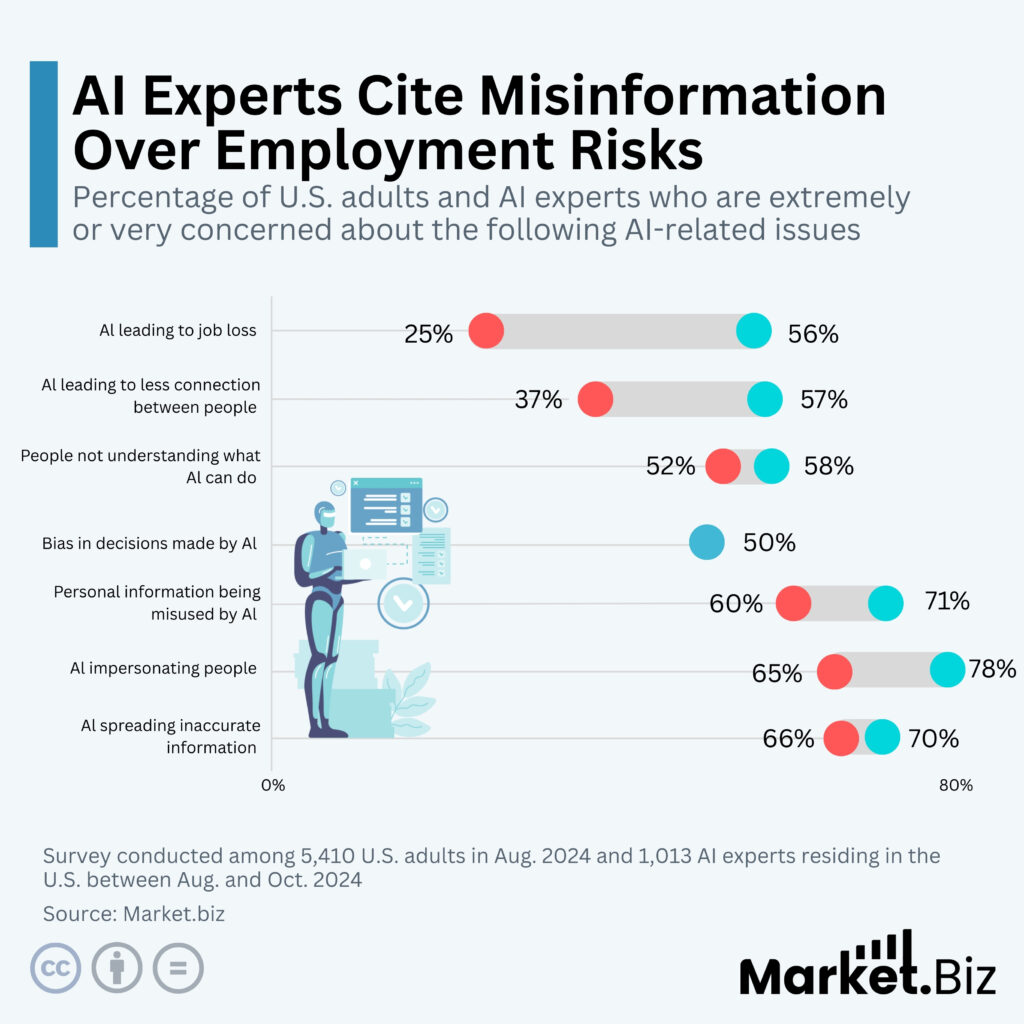
- The Shared Reality: Conversely, 70% of AI experts are “highly concerned” about the spread of inaccurate information, identifying it as a more pressing crisis than labor displacement.
This data suggests that while the economy might adapt to AI (as it did with the steam engine and the internet), our information ecosystem may break under the strain of infinite, zero-cost fabrication.
Key Takeaways
- Pew Research Center survey data shows that 47% of AI experts said they feel more excited than concerned about AI in daily life.
- The same survey indicates that 51% of U.S. adults said they feel more concerned than excited about the rise of AI-powered services.
- Concern about AI spreading inaccurate information is widely shared by both AI experts and the general public.
- The risk of AI being used to impersonate people, including through deepfakes, is also a shared concern across both groups.
- AI handling of personal information is reported as a common worry, reflecting ongoing concern about privacy and potential misuse.
- Bias in AI-driven decisions is presented as another area where both experts and the public express concern.
- Job displacement risk shows the largest gap, with 56% of U.S. adults being extremely or very concerned about job losses, compared with 25% of AI experts.
- Concern about a weaker human connection is also higher among adults because 57% of U.S. adults are extremely or very worried, versus 37% of experts.
- Long-range optimism is higher among experts because 56% of AI experts expect a net positive U.S. impact over the next 20 years, compared with 17% of the general public.
The Data: A Stark Divide in Perception
Recent data highlights a fascinating disconnect between public anxieties and expert warnings. While the everyday citizen worries about their livelihood, data scientists worry about the fabric of reality.
- The Job Loss Gap: According to surveys by the Pew Research Center, while 56% of the general public is extremely concerned about AI leading to job loss, only 25% of AI experts share that same level of fear.
- The Disinformation Threat: Conversely, 70% of AI experts are highly concerned about AI spreading inaccurate information, and an overwhelming 78% worry about AI impersonating people via deepfakes.
- Global Consensus: The World Economic Forum’s (WEF) 2024 Global Risks Report officially ranked AI-driven misinformation and disinformation as the number one most severe global risk over the next two years—outranking climate change, armed conflict, and economic downturn in the short term.
Why Misinformation Is the “Tier 1” Threat
Why does the “fake news” of the past pale in comparison to the AI misinformation of today? Experts point to three escalating factors:
- Velocity and Volume: In the past, creating a convincing propaganda campaign required a team of humans, a budget, and time. Today, a single bad actor using an open-source Large Language Model (LLM) can generate millions of unique, persuasive, and personalized articles in minutes.
- The “Liar’s Dividend”: This concept, often cited by researchers, describes a world where the mere existence of deepfakes allows politicians and leaders to dismiss real evidence as “AI-generated.” When nothing can be trusted, the truth loses its power to hold power accountable.
- Hyper-Personalized Persuasion: Unlike broadcast propaganda, AI can tailor lies to individual psychological profiles. It doesn’t just broadcast a lie; it whispers the specific lie you are most likely to believe.
The “Davos” Consensus: Misinformation as a Global Risk
The World Economic Forum’s (WEF) Global Risks Report 2024 solidified this hierarchy of fears. For the first time, “Misinformation and Disinformation” was ranked as the number one global risk over a two-year horizon, outranking extreme weather, war, and—crucially—economic downturns.
The report warned that the nexus of AI and social media could “radically disrupt electoral processes,” leading to civil unrest that is far harder to fix than a fluctuating job market.
Voices from the Top: What the CEOs Are Saying
The leaders of the world’s most powerful tech companies have been vocal about this shift. They view job displacement as a manageable transition—a “co-pilot” era where humans become more productive—but view the erosion of truth as a systemic failure mode for democracy.
1. Satya Nadella (CEO, Microsoft)
Nadella has frequently argued that while AI will create “unintended consequences,” the most critical guardrails must be built around information integrity. He views the “unintended consequences” of deepfakes as a primary safety challenge.3. Elon Musk (CEO, Tesla/xAI)
Musk has historically been a catastrophic warner of AI risks. While he often discusses “civilizational destruction” (the Terminator scenario), his immediate actions with his own AI (Grok) and platform (X) focus heavily on the concept of “anti-woke” truth. He argues that if AI is trained to lie (or be “politically correct” at the expense of truth), it becomes a deadly tool.
2. Elon Musk (CEO, Tesla/xAI)
Musk has historically been a catastrophic warner of AI risks. While he often discusses “civilizational destruction” (the Terminator scenario), his immediate actions with his own AI (Grok) and platform (X) focus heavily on the concept of “anti-woke” truth. He argues that if AI is trained to lie (or be “politically correct” at the expense of truth), it becomes a deadly tool.
3. Sam Altman (CEO, OpenAI)
During his testimony before the U.S. Senate, Altman was explicitly asked about his greatest fears. He did not say “mass unemployment.” He said his “worst nightmare” was the technology causing “significant harm to the world” through persuasion and election interference.
Why Jobs Are a “Tier 2” Concern
It is not that experts are heartless about employment. Rather, they rely on historical economic data which suggests technology generally expands labor demand (Jevons paradox).
- The Co-Pilot Theory: Most experts see AI not as a replacement for the worker, but a replacement for the task. A lawyer using AI is still a lawyer, but one who spends less time summarizing case files and more time arguing in court.
- Demographics: With aging populations in the West and China, many economists argue we will actually face a labor shortage, making AI automation necessary to maintain living standards.
Conclusion
The job market is resilient; it bends, breaks, and rebuilds. The concept of “truth,” however, is fragile. Once a society loses the ability to agree on basic facts—such as who won an election, or whether a video of a crime is real—the foundation of that society crumbles.
As we move forward, the “robots coming for your paycheck” headline serves as a distraction. The real wolf at the door is the bot in your newsfeed, quietly rewriting history one token at a time.