









Introduction
Computing power statistics provide insight into a system’s capability to process data, quantified by metrics such as FLOPS (Floating-Point Operations Per Second) or MIPS (Millions of Instructions Per Second). These metrics reflect hardware components, including CPUs/GPUs, cores, and clock speeds, and are essential for applications in AI, data analysis, and scientific computing.
A thorough understanding of these statistics is vital for evaluating performance, monitoring technological advancements (as per Moore’s Law), and comparing different systems, although it is important to consider additional factors such as software and memory.
Computing capability denotes a computer system’s ability to perform tasks quickly and efficiently, which depends on hardware components like the GPU, CPU, memory, and storage devices. This capability is assessed using criteria such as core count, clock speed, and FLOPS.
Influential factors affecting computing capability include Moore’s Law, cooling solutions, energy efficiency, overclocking, and thermal design power. Enhanced computing power finds applications in various fields, including scientific research, AI, cryptocurrency mining, gaming, and data analysis.
Emerging trends in this domain include quantum computing, neuromorphic computing, edge computing, specialised AI hardware, and energy-efficient computing. The challenges faced in this area involve physical constraints, energy consumption, safety issues, and accessibility concerns.
Editor’s Choice
- In December 1945, ENIAC became the first electronic general-purpose computer.
- As of 2022, the market revenue is recorded at 42.8 billion USD.
- Megahertz (MHz) and Gigahertz (GHz) denote the speed at which the CPU alternates between 1 and 0, thereby affecting its processing capability when all other factors are constant.
- The majority of computers today utilise standard PC100 RAM, which functions at 100MHz and is adequate for most applications.
- Apple employs PowerPC chips, which can be either 64-bit or 128-bit, granting them a performance advantage despite having lower clock speeds.
Historical Facts about Computing Power
- In December 1945, ENIAC became the first electronic general-purpose computer.
- In March 1951, the U.S. Census Bureau obtained the Univac computer from Eckert-Mauchly, marking the inception of the commercial computer market in the United States.
- By 1954, 20 Univac computers had been sold at a price of approximately one million dollars each.
- In 1961, Kristen Nygaard and Ole-Johan Dahl initiated the creation of SIMULA, a programming language intended for computer simulations, at the Norwegian Computer Center.
- In April 1964, IBM launched the System 360 computer family, facilitating upgrades through a common instruction set.
- In 1971, Bob Thomas at BBN developed the first computer virus, known as Creeper.
- In 1981, Apollo Computer unveiled the first graphics workstation utilising the Motorola 68000 microprocessor.
- In May 1995, Sun released Java, a programming language intended to promote cross-platform compatibility.
- In July 2020, OpenAI unveiled GPT-3, which, supported by 175 billion machine learning parameters, produces text that mimics human language.
General Computing Power Statistics
- In the forthcoming decade, the computing power market is anticipated to experience substantial growth, with a compound annual growth rate (CAGR) of 6.8%.
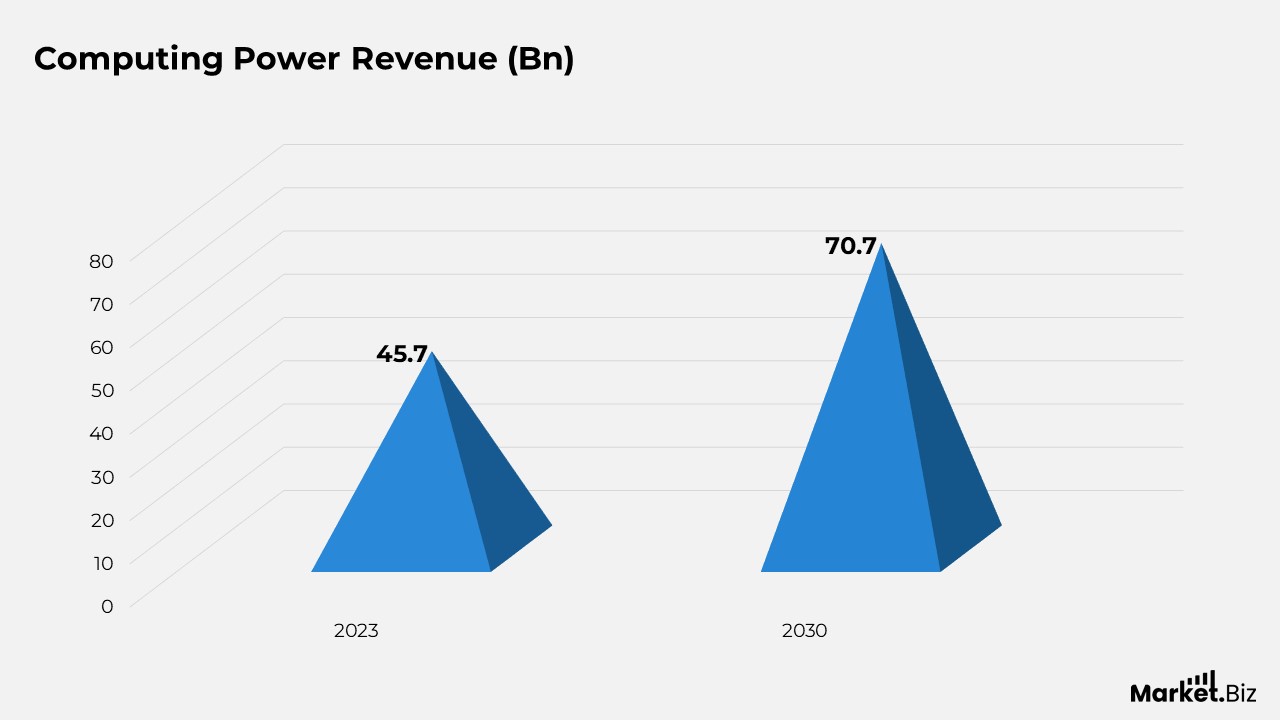
- As of 2022, the market revenue is recorded at 42.8 billion USD. This amount is projected to progressively increase to 81.3 billion USD by 2032.
- Revenue from servers is forecasted to grow from USD 15.1 billion in 2022 to USD 28.6 billion by 2032. Concurrently, revenue from services is expected to rise from USD 13.8 billion to USD 26.2 billion over the same timeframe.
- The global computing power market demonstrates a notable distribution of deployment modes, with on-premise solutions leading the market, holding a significant share of 65%.
- Typically, Windows PCs utilise the 32-bit x86 architecture, while Apple employs PowerPC chips, which can be either 64-bit or 128-bit, granting them a performance advantage despite having lower clock speeds.
- Currently, the majority of computers are equipped with standard PC100 RAM, operating at 100MHz, which is adequate for most applications.
- In contemporary settings, most hard drives operate at 7,200 RPM, whereas older models and laptops generally function at 5,200 RPM.
Computing Power Market Statistics
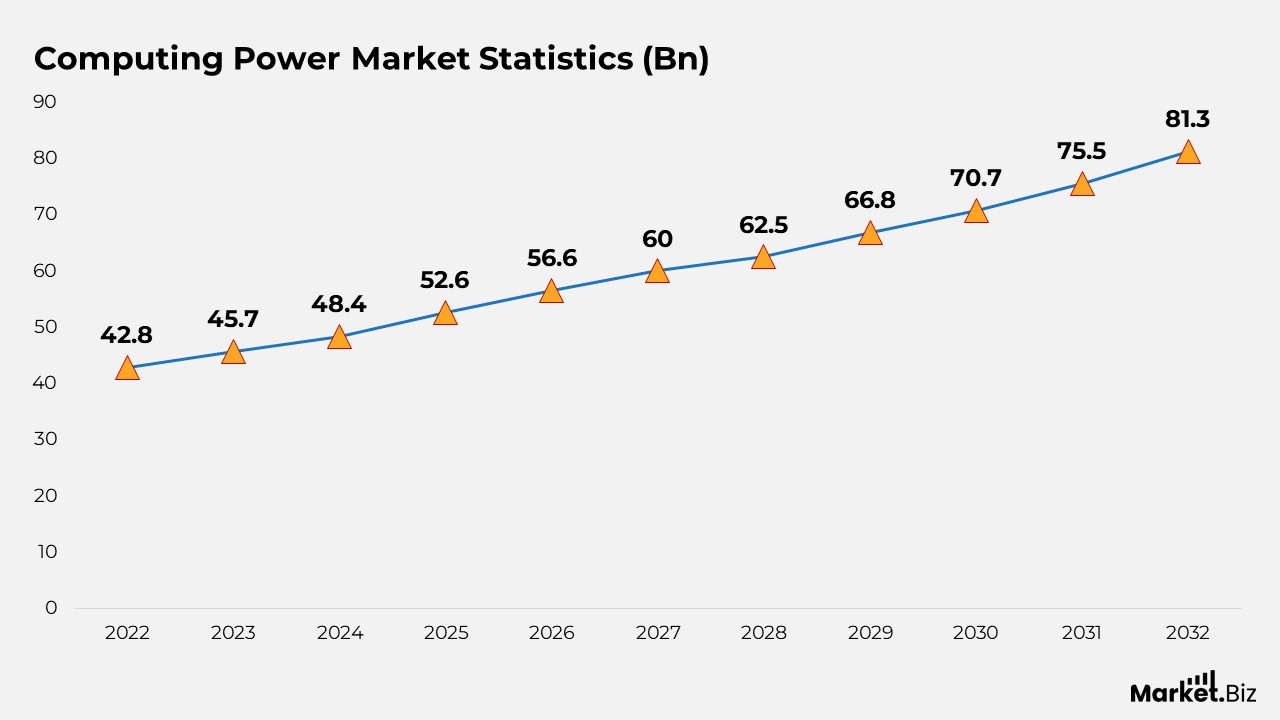
- Over the next ten years, the computing power market is anticipated to experience considerable growth, with a compound annual growth rate (CAGR) of 6.8%, as evidenced by the projected revenues in billions of USD.
- In 2022, the market revenue is recorded at 42.8 billion USD. In the subsequent years, this amount is expected to progressively increase.
- By 2023, it is forecasted to attain 45.7 billion USD, followed by 48.4 billion USD in 2024 and 52.6 billion USD in 2025.
- This growth trend persists with revenues of 56.6 billion USD in 2026 and 60.0 billion USD in 2027.
- As we approach the end of the decade, the market is anticipated to witness even more significant advancements, reaching 62.5 billion USD in 2028 and 66.8 billion USD in 2029.
- By 2030, the computing power market is expected to generate 70.7 billion USD in revenue. This upward trajectory continues into 2031, with an estimated revenue of 75.5 billion USD.
- Ultimately, in 2032, the market is projected to achieve an impressive revenue of 81.3 billion USD.
Statistics By Computing Power Components
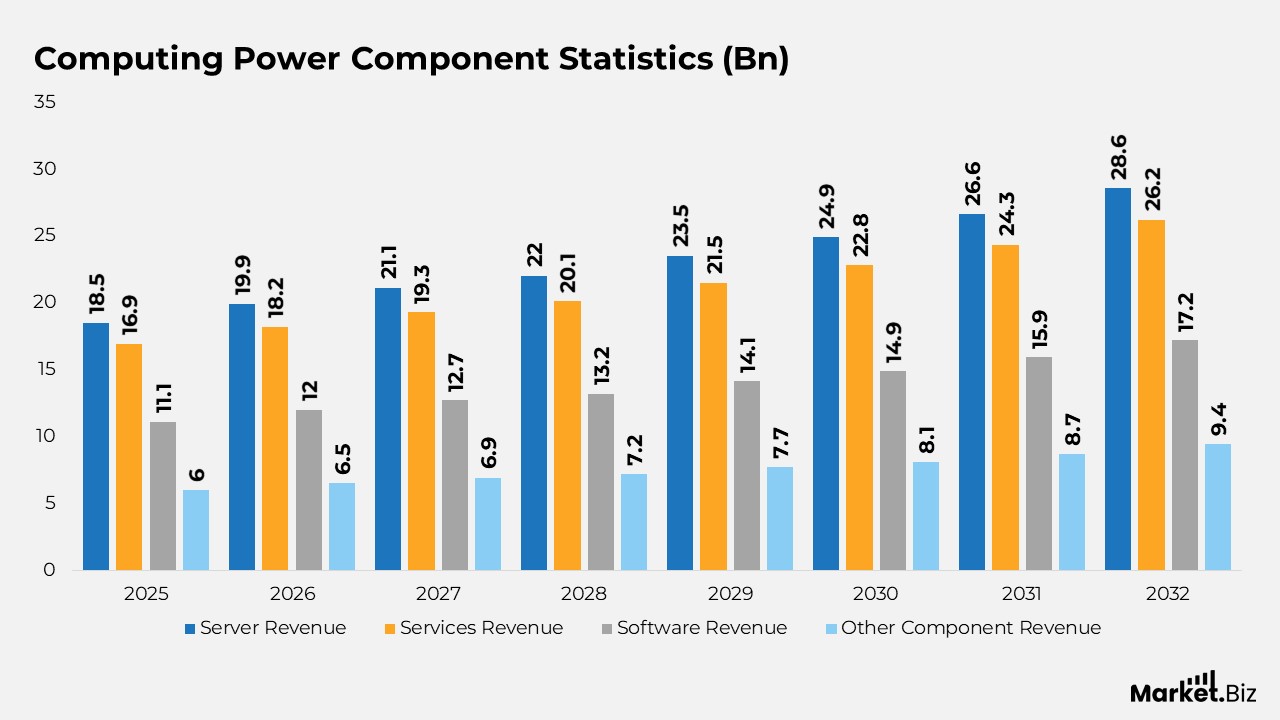
- In 2022, the overall market revenue amounted to USD 42.8 billion, with servers contributing USD 15.1 billion. Services generated USD 13.8 billion, software represented USD 9.0 billion, and other components added USD 4.9 billion to the market.
- Looking forward, the market is anticipated to grow. It is expected to reach USD 45.7 billion in 2023 and continue to expand to USD 81.3 billion by 2032.
- This growth will be fueled by the rising demand for computing power across various sectors.
- Server revenue is projected to increase from USD 15.1 billion in 2022 to USD 28.6 billion by 2032.
- Meanwhile, services revenue is forecasted to rise from USD 13.8 billion to USD 26.2 billion over the same timeframe.
- Software revenue is also expected to experience substantial growth, reaching USD 17.2 billion by 2032, while revenue from other components is anticipated to hit USD 9.4 billion.
Computing Power Processor Speed Statistics
- Megahertz (MHz) and Gigahertz (GHz) denote the speed at which the CPU alternates between 1 and 0, thereby affecting its processing capability when all other factors are constant.
- Chips with higher MHz ratings tend to consume more energy and produce increased heat. Level 1 (L1) and Level 2 (L2) caches serve as fast on-chip memory utilised for temporarily storing data before and after it is processed.
- Static Random Access Memory (SRAM), which is specific to processors, is expensive; currently, most chips are equipped with 128KB of L1 cache and between 256KB to 512KB of L2 cache.
- While Windows PCs typically operate on the 32-bit x86 architecture, Apple employs PowerPC chips, which can be either 64-bit or 128-bit, granting them a performance advantage despite having lower clock speeds.
- Intel and AMD are in the process of developing 64-bit x86 chips; however, transitioning to a higher-bit architecture requires modifications to software, leading to compatibility challenges between platforms such as Mac and PC.
System RAM Speed and Size Statistics
- The amount and speed of your computer’s RAM significantly influence its performance. Attempting to run Windows XP with only 64 MB of RAM will likely result in difficulties or even failure.
- There are primarily two types of RAM, with dynamic RAM being the more prevalent option. Dynamic RAM necessitates frequent refreshing thousands of times each second.
- Moreover, the speed of the RAM can also play a crucial role. The majority of computers today utilise standard PC100 RAM, which functions at 100MHz and is adequate for most applications.
- Nevertheless, gamers and high-performance systems frequently choose DDR (double data rate) RAM, which is newer and operates at 266MHz, although not all computers are compatible with DDR RAM.
Recent Developments
- In 2024, Nvidia successfully concluded its acquisition of Arm Holdings for $40 billion.
- In late 2023, AMD completed its acquisition of Xilinx for $35 billion.
- In 2023, Nvidia launched the H100 Tensor Core GPU, engineered to provide exceptional performance for AI, data analytics, and scientific computing tasks.
- In 2023, the US government declared a $1 billion investment aimed at advancing the development of the next generation of supercomputers.
Conclusion
Computing Power Statistics: In conclusion, computational power serves as a crucial component in the field of contemporary technology, impacting a diverse range of applications and sectors.
It relies on hardware elements such as CPUs, GPUs, memory, and storage devices, with important metrics including clock speed, core count, and FLOPS. Numerous factors, such as Moore’s Law, cooling techniques, power efficiency, and overclocking, play a role in determining computing power.
Its importance is apparent in areas such as scientific research, gaming, artificial intelligence, cryptocurrency mining, data analysis, and beyond. The future presents encouraging trends like quantum computing, neuromorphic computing, AI hardware accelerators, and energy-efficient computing. However, challenges related to physical limitations, power consumption, security, and accessibility continue to exist.
FAQ’s
Power Computing Corporation, commonly known as Power Computing, was the inaugural company chosen by Apple Inc. to manufacture Macintosh-compatible computers, often referred to as “Mac clones.”
The significance of computing power lies in its direct influence on the performance of a computer or device. A device with greater computing power can execute calculations, process data, and carry out instructions more swiftly.
Furthermore, the quantity of cores within a CPU influences both the parallel processing capabilities and the overall computing power. To determine the total computing power of a system, one must multiply the clock speed by the number of cores and the number of instructions executed per clock cycle.