









Introduction
AI in marketing statistics provides a concise, data-driven view of how artificial intelligence is transforming modern marketing practices by measuring adoption levels, performance impacts, and investment trends across key functions such as personalisation, predictive analytics, customer targeting, content optimisation, and automated campaign management.
These statistics quantify improvements in engagement, conversion rates, operational efficiency, and return on marketing investment, while also reflecting the broader shift toward real-time, machine-learning-powered decision-making.
As marketers respond to rising data volumes, stricter privacy regulations, and growing demand for personalized experiences, AI in marketing statistics serves as a critical benchmark for assessing technology maturity, competitive positioning, and the strategic value of AI-enabled marketing initiatives.
Editor’s Choice
- 92% of businesses indicate a strong intention to invest in generative AI, signalling sustained confidence in its long-term marketing value.
- Around 79% of organizations report adopting AI agents, with nearly two-thirds confirming that these tools are already delivering measurable business value.
- Nearly 75% of companies using AI in marketing expect teams to transition toward higher-value, strategy-driven roles.
- About 69% of marketing professionals express optimism about AI’s influence on future job roles and career growth.
- More than half of marketing teams now apply AI to enhance and optimize content performance across channels.
- Close to 90% of businesses express concern about how AI and large language models may reshape the future of SEO strategies.
- AI-driven marketing platforms reduce campaign launch timelines by 75%, increase click-through rates by 47%, and improve ROI by up to 30%.
- AI adoption is nearly universal, with 94% of marketers already integrating AI into daily workflows.
- Nearly two-thirds of organizations using generative AI report tangible gains in productivity and operational efficiency.
- AI is reshaping sales performance, driving productivity improvements of up to 40% and shortening sales cycles by 25%.
- AI investments deliver fast returns: 86% of sales teams report positive ROI within the first year.
- Companies using AI-based pricing optimisation achieve an average increase in profit margins of 12%.
Moreover
- Sales and marketing represent the largest focus of AI investment, accounting for over 50% of total corporate AI budgets.
- Predictive AI technologies improve conversion rates by approximately 20–30%, strengthening revenue outcomes.
- Nearly 79% of marketers identify efficiency improvement as the most valuable benefit of AI adoption.
- Automation momentum continues to rise, with 42% of business tasks expected to be automated within the next three years.
- Marketing roles that reference AI skills earn salaries that are, on average, 20.26% higher than those without AI requirements, reflecting growing demand for AI expertise.
- About 64.5% of marketers report that AI has the strongest impact on content creation and copywriting, outperforming the next most affected task by 20 percentage points.
- Only 5.2% of marketers state that they see no value in AI or have not experimented with AI tools, indicating near-universal exposure.
- Roughly 82% of marketers prioritize using AI to reduce time spent on repetitive, data-intensive activities.
- More than 54.2% identify inaccurate or inconsistent AI outputs as the primary limitation, highlighting persistent quality challenges.
- Around 41% cite data privacy concerns as the leading barrier to adopting new AI solutions.
- While 53% of marketing professionals believe AI may eliminate more jobs than it creates within three years, only 4.5% of teams report actual downsizing to date.
Further
- Over 77% of ChatGPT users now rely on it as a search tool, while 88% of marketers use AI daily, and 92% of businesses plan near-term AI investments.
- AI delivers measurable performance benefits, with 93% of marketers producing content faster and 81% reporting improvements in brand awareness and sales.
- AI adoption is shifting workforce focus, with 75% of marketing work moving toward strategy, while sales teams using AI report 83% revenue growth compared to 66% among non-users.
- Approximately 63% of marketers actively use generative AI, while AI Overviews reach 1.5 billion monthly users and have expanded by 116% since recent core updates.
- AI Overviews now appear in 9.46% of desktop keyword results globally and 16% in the US, covering 12.8% or more of total search volume.
- These AI-driven results are more common for informational, longer, and high-volume queries, but appear less frequently for branded, local, and short searches.
- AI Overviews are predominantly shown on non-monetized searches and reduce click-through rates by 34.5%, with 43% of references pointing back to Google.
- The generative AI in marketing market is projected to reach USD 22 billion by 2032, underscoring strong long-term growth expectations.
- Nearly 49% of US generative AI decision-makers anticipate returns on AI investments within 1–3 years.
- Generative AI is expected to displace around 100,000 frontline agents at major global outsourcing firms by 2025.
- Around 75% of PPC professionals report using generative AI at least occasionally for ad copy development.
- Customer trust in companies using AI ethically stands at 42%, down from 58% in 2023, signalling rising concerns about trust.
- About 85% of retailers agree that AI advancements are fundamentally transforming the retail sector.
(Sources: Reboot, Forrester, Statista, Global State of PPC 2024, State of the Connected Customer, Connected Shoppers Report (6th Edition), State of Sales, State of Marketing, Google, Ahrefs, SERanking)
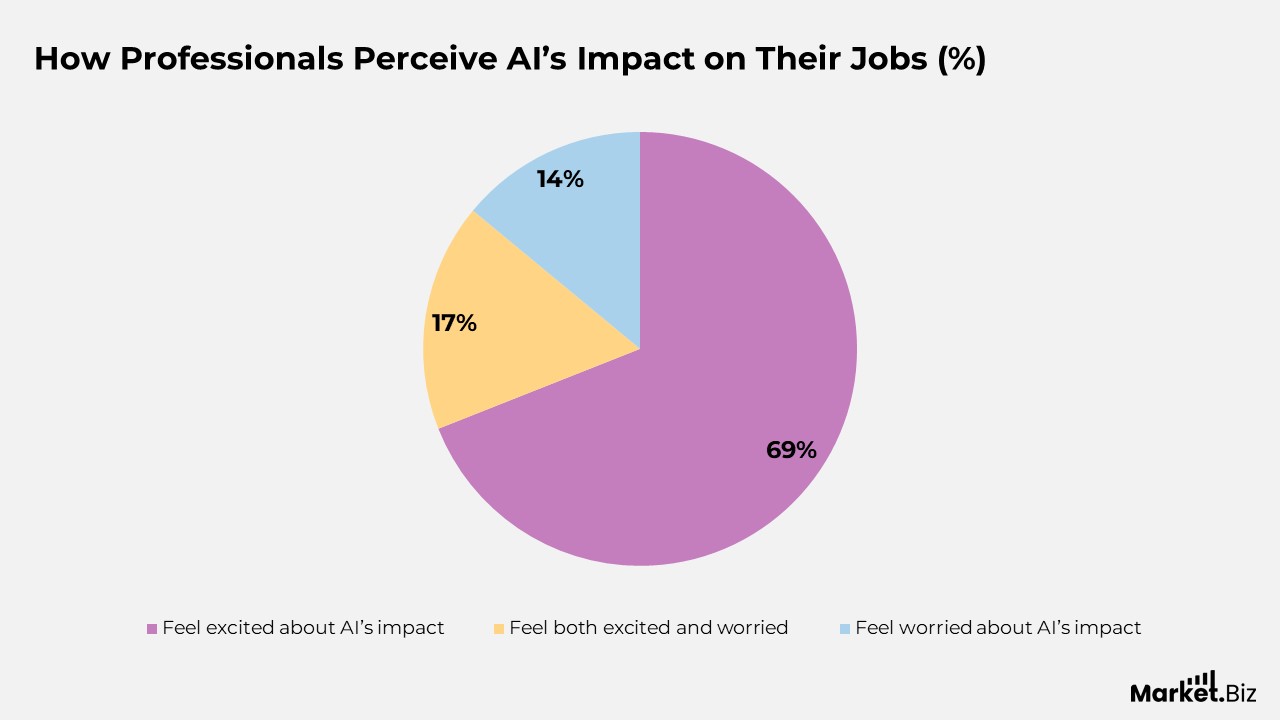
How Professionals Perceive AI’s Impact on Their Jobs
- A strong majority of respondents, 69%, say they feel excited about the influence of AI on their work, reflecting broad optimism toward AI-driven change.
- Around 17% of professionals report mixed emotions, indicating they are both excited about AI’s potential and concerned about its implications.
- A smaller segment, 14%, expresses concern about AI’s impact on their jobs, highlighting ongoing uncertainty and risk perceptions among some workers.
(Sources: Statista, SurveyMonkey)
AI Adoption and Integration Trends Across Marketing Teams
- As many as 94% of organizations now use AI to support marketing planning or execution, highlighting its near-universal role.
- By 2024, around 69% of marketers had already embedded AI into day-to-day marketing operations, indicating early maturity.
- Nearly 88% of marketing professionals rely on AI tools in their roles, underscoring the strong reliance on automation and intelligence.
- About 85% of marketers actively use AI-powered writing or content creation tools to improve speed and scale.
- Roughly 63% of marketing teams use generative AI, and 78% report a positive impact on performance.
- Adoption momentum accelerated recently, with 78% of teams adopting generative AI in 2024.
- Frequent use is becoming the norm, with 71% of marketers using generative AI weekly or more, and nearly 20% engaging with it daily.
- Among go-to-market professionals, 20% use AI every day, while another 29% rely on it weekly.
- About 56% of marketers say their organizations are actively driving AI implementation rather than leaving it to individuals.
Moreover
- Full-scale deployment is still evolving, with 32% of marketing organizations reporting complete AI implementation and 38% of marketers feeling fully integrated.
- Experimentation remains common, with 43% of marketing organisations continuing to test AI capabilities before full rollout.
- Strategic integration is widespread, with 96% of marketers having partially or fully incorporated AI into marketing strategies.
- Forward-looking investment is strong, with 85.8% of marketing professionals planning to increase AI usage over the next 36 months.
- Nearly 90% of marketers expect to expand AI integration in 2025, further reinforcing their long-term commitment.
- At the enterprise level, 79% of companies plan to broaden AI adoption in 2025.
- Agencies are also embracing AI, with 91% already using AI technologies and 63% reporting extensive usage.
- Generative AI penetration continues to rise, with 73% of marketing teams currently using GenAI solutions.
- Among non-users, 75% plan to adopt AI within the next year, leaving only 3.9% of companies unwilling to integrate AI.
(Sources: Epsilon, Influencer Hub, SurveyMonkey, CoSchedule, Jasper, AMA, ZoomInfo, NinjaCat, Demand Gen Report)
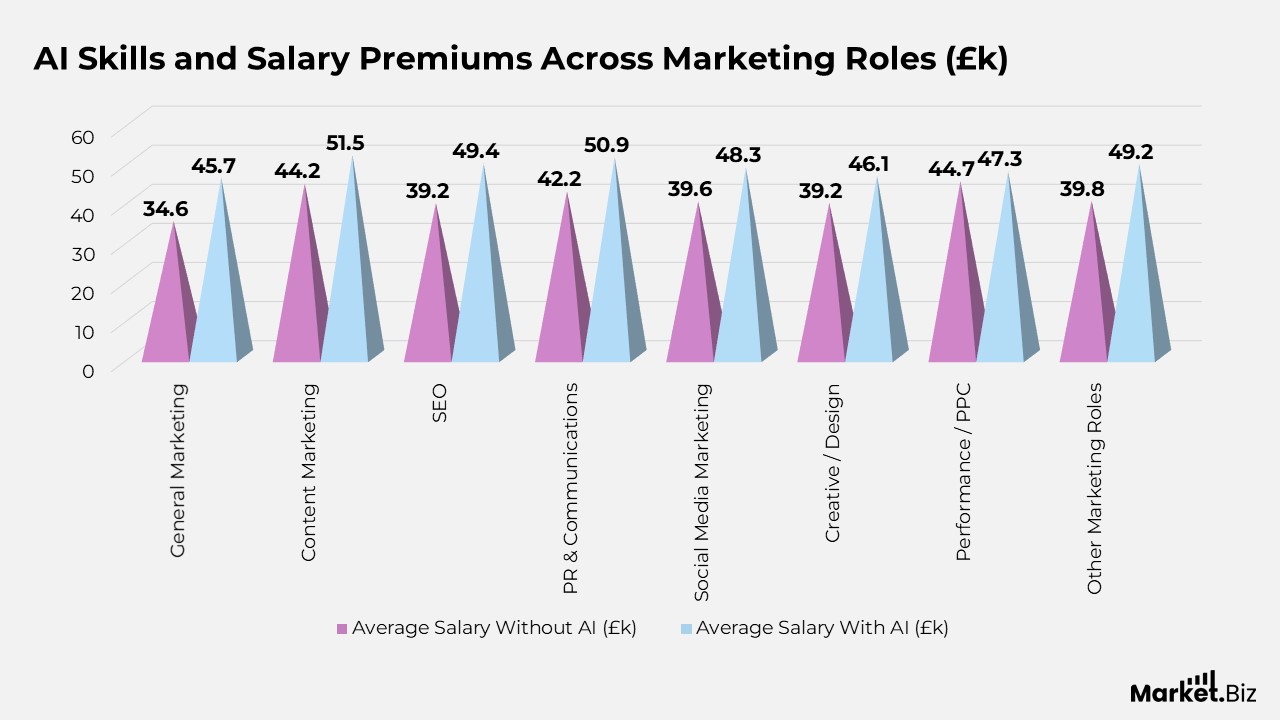
AI Skills and Salary Premiums Across Marketing Roles
- In general marketing positions, salaries rise from about £34.6k without AI to nearly £45.7k when AI expertise is mentioned, showing a clear skills premium.
- Content-focused roles see a strong uplift, increasing from roughly £44.2k to £51.5k when AI capabilities are included.
- SEO professionals experience one of the largest gaps, with average pay moving from around £39.2k without AI to about £49.4k with AI-linked responsibilities.
- PR and communications roles also benefit significantly, with AI-related positions averaging £50.9k compared to £42.2k for non-AI roles.
- Social media marketing salaries increase notably, from approximately £39.6k to £48.3k when AI skills are part of the role.
- Creative and design roles show a notable increase, rising from approximately £39.2k to nearly £46.1k, with AI being mentioned.
- Performance and PPC roles exhibit a smaller but still positive difference, increasing from approximately £44.7k to £47.3k with AI exposure.
- Across other marketing functions, AI-linked roles average around £49.2k, compared with £39.8k for roles that do not reference AI.
(Sources: Rebootonline, Statista)
How Marketers Are Using AI Across Key Marketing Tasks
- Content creation and copywriting stand out as the leading AI use cases, with 64.5% of marketers relying on AI to support writing and content development.
- SEO and content optimisation rank second, with 43.9% of respondents using AI to improve search visibility and content performance.
- Brainstorming and idea generation are equally impacted, with 43.9% of marketers using AI to accelerate creative thinking and campaign concepts.
- Research activities benefit significantly from AI adoption, with 33.5% of marketers applying AI tools to gather and synthesize insights.
- Around 23.2% of respondents associate AI usage with improvements in overall productivity and operational efficiency.
- Analytics, insights, and attribution tasks are supported by AI for 14.8% of marketers, indicating growing but selective adoption.
- AI enhances email marketing and automation workflows for 12.9% of respondents.
- PPC and paid media campaign optimization account for 9.7% of AI usage, reflecting targeted application in performance marketing.
- 5.2% of marketers say CRM-related functions, such as customer segmentation, lead scoring, and AI influences nurturing.
- Customer experience tools, including chatbots, are used by 3.9%, showing early-stage adoption.
- Video content creation and personalisation at scale each account for 3.2% of AI usage, suggesting emerging opportunities.
- Social listening and sentiment analysis remain niche use cases, cited by just 1.9% of respondents.
- Overall, AI adoption in marketing is most concentrated in content-driven and creative tasks, with broader operational use cases still developing.
(Sources: Rebootonline, Search Engine Journal)
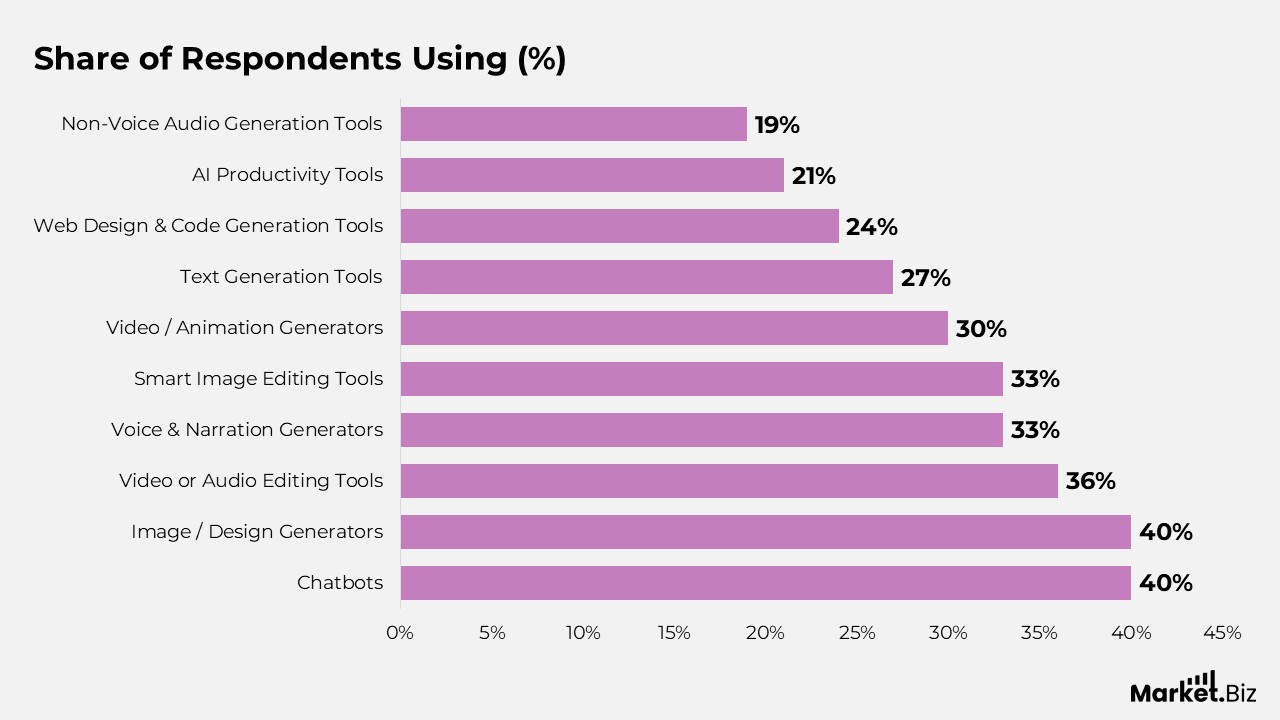
Most Common AI Tools Used by Marketers
- General-purpose chatbots and image or design generators lead AI tool usage, each adopted by 40% of respondents.
- Smart AI tools for video or audio editing are used by 36% of marketers, reflecting strong demand for automated media production.
- Voice and narration generators, along with smart image editing features, are each used by 33%, showing balanced adoption across creative formats.
- Video or animation generation tools are utilized by 30% of respondents, highlighting growing interest in dynamic visual content.
- General-purpose text generation tools are used by 27%, supporting copywriting and written communication needs.
- AI-powered web design and code-generation tools have 24% adoption, indicating moderate use for technical and development tasks.
- AI-enhanced productivity tools are used by 21%, helping streamline workflows and task management.
- Non-voice audio generation tools remain more niche, with 19% of respondents using them.
(Sources: Rebootonline, Hubspot))
Leading AI Assistants Used by Marketing Professionals
- ChatGPT leads AI assistant adoption, with 88% of respondents actively using it, making it the most dominant platform.
- Google Gemini ranks second, with 52% of respondents reporting it as part of their regular AI usage.
- Microsoft Copilot is used by 44% of respondents, reflecting strong adoption within productivity and enterprise workflows.
- Meta AI Assistant is used by 28% of respondents, indicating moderate penetration in conversational and social-focused use cases.
- Deepseek records adoption among 17% of respondents, showing an emerging but limited market presence.
- Claude is used by 11% of respondents, suggesting niche adoption for advanced reasoning and structured tasks.
- Perplexity closely trails 10% usage, highlighting early-stage adoption of AI-powered search and research.
(Sources: Rebootonline, Hubspot)
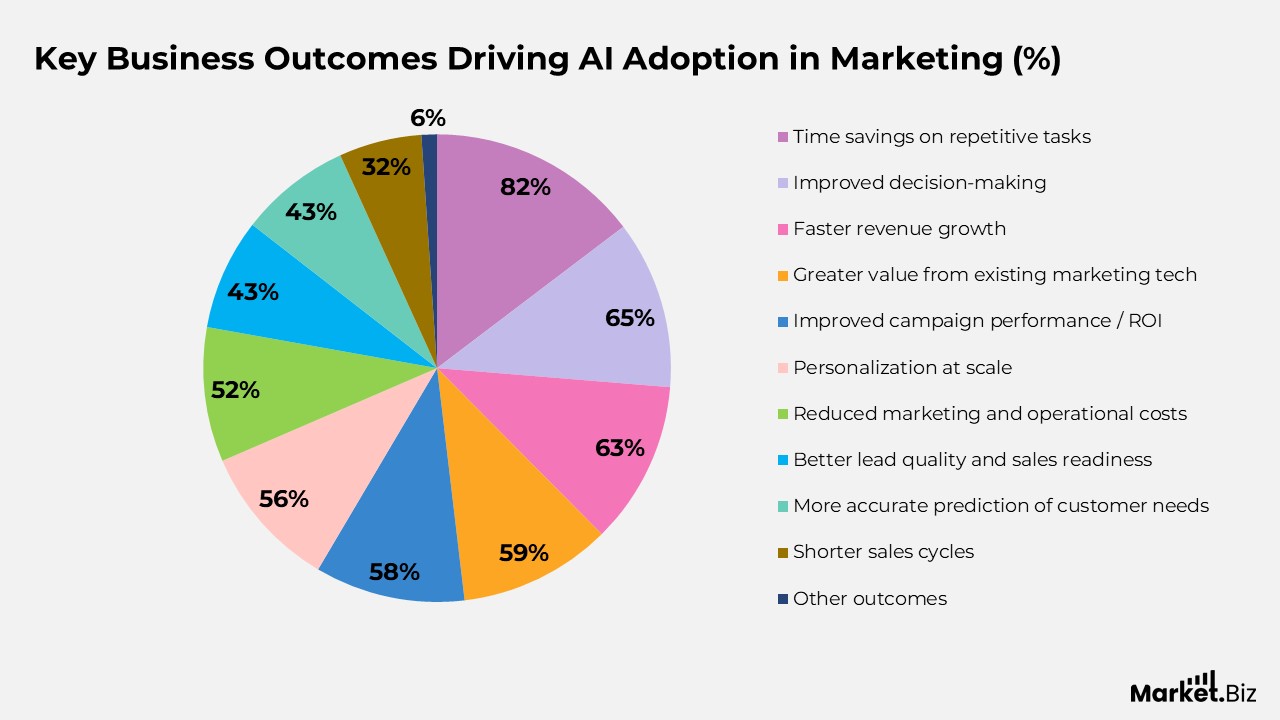
Key Business Outcomes Driving AI Adoption in Marketing
- The most cited outcome of AI adoption is time savings, with 82% of respondents using AI to reduce effort spent on repetitive and data-intensive tasks.
- Improved decision-making is a major benefit, as 65% of marketers rely on AI to extract more actionable insights from marketing data.
- Revenue acceleration ranks high, with 63% of respondents linking AI use to faster revenue growth.
- Nearly 59% of marketers use AI to unlock greater value from existing marketing technologies and platforms.
- Campaign performance improvement is a priority, with 58% of respondents aiming to generate higher returns on marketing investments through AI.
- 56% of marketers enable personalisation at scale with AI, supporting tailored customer experiences across channels.
- Cost efficiency is another key driver, as 52% of respondents adopt AI to reduce overall marketing and operational costs.
- Pipeline quality benefits from AI adoption, with 43% reporting improvements in lead qualification and sales readiness.
- The same share, 43%, uses AI to predict customer needs and behaviors with greater accuracy.
- 32% of respondents report enhanced sales cycle efficiency by using AI to shorten the time from lead to conversion.
- A small minority cite alternative outcomes (6%) or see no relevant benefit (1%), indicating broad alignment on AI’s value.
(Sources: Rebootonline, Marketing AI Index, SmarterX)
Key Limitations and Challenges of AI in Marketing
- The most common limitation cited is inconsistent or unreliable output quality, reported by 54.2% of respondents.
- Contextual understanding remains a challenge, with 32.3% indicating that AI struggles to grasp nuance and intent.
- Around 22.6% of marketers say AI outputs require significant manual review or editing before use.
- Integration complexity affects adoption, as 18.1% report difficulty aligning AI tools with existing systems and workflows.
- Legal, privacy, and data compliance concerns are highlighted by 16.1% of respondents.
- The same share, 16.1%, points to difficulties in maintaining a consistent brand voice when using AI-generated content.
- A lack of proper citations and source attribution is a concern for 14.8% of marketers.
- Unrealistic expectations around AI capabilities lead to dissatisfaction for 13.5% of respondents.
- Skills gaps remain an issue, with 12.9% citing steep learning curves or the need for upskilling.
- Only 3.9% report wasted time or budget due to ineffective AI tools, indicating that most challenges are operational rather than financial.
(Sources: Rebootonline, Search Engine General)
Organizational Barriers to AI Adoption in Marketing
- Data privacy remains the leading concern, cited by 41% of respondents as a key obstacle to wider AI adoption.
- Training requirements and time investment are significant challenges, with 39% highlighting the effort needed to upskill teams.
- Tool fragmentation is a common issue, as 34% report dealing with too many disconnected AI tools that fail to integrate.
- Legacy system compatibility limits progress for 34% of respondents, who face integration challenges with existing technologies.
- Internal preference mismatches slow adoption: 27% report that team members favour tools different from those selected by the organisation.
- 27% of respondents identify resistance to change within the organisation as a barrier to implementing AI at scale.
- Concerns around job security affect 26% of respondents, reflecting uncertainty about AI’s impact on roles and responsibilities.
- Ethical and legal compliance considerations are cited by 22%, underscoring the need for stronger governance frameworks when deploying AI solutions.
(Sources: Rebootonline, Search Engine General)
Conclusion
AI in marketing statistics demonstrate that artificial intelligence has firmly transitioned from a pilot technology to a foundational element of modern marketing. Widespread adoption, rising usage frequency, and sustained investment plans signal strong belief in AI’s ability to drive efficiency, speed, and measurable business outcomes. The data highlights AI’s growing role in automating repetitive tasks, unlocking deeper insights from data, enabling large-scale personalization, and strengthening campaign effectiveness and returns.
At the same time, trends in higher pay for AI-skilled roles, evolving job responsibilities, and changing search behaviors reveal the broader impact of AI on marketing careers and operating models. Although challenges related to data privacy, content quality, and workforce disruption persist, organizations continue to scale AI use. Overall, these statistics point to a lasting shift toward intelligent, data-led, and strategically driven marketing, with AI increasingly defining competitive differentiation.
FAQ’s
AI in marketing statistics refers to the systematic measurement and analysis of how artificial intelligence technologies are applied within marketing. It focuses on understanding adoption patterns, usage intensity, performance outcomes, and the broader influence of AI on marketing strategies, processes, and decision-making models.
These statistics are important because they provide evidence-based insights into how AI is transforming marketing operations. They help organizations evaluate effectiveness, justify technology investments, benchmark performance, and understand long-term structural changes in the marketing ecosystem.
AI in marketing statistics offers insights into efficiency gains, productivity improvements, customer engagement outcomes, revenue impact, workforce transformation, and shifts in consumer behaviour driven by AI-enabled tools and platforms.
By quantifying outcomes and adoption trends, these statistics enable marketers and business leaders to assess maturity levels, prioritize use cases, allocate budgets, manage risks, and align AI initiatives with broader business and growth objectives.
They illustrate the transition from manual, intuition-led marketing toward automated, data-driven, and predictive models. The statistics capture how AI is reshaping workflows, redefining skill requirements, and embedding intelligence into everyday marketing activities.