









Introduction
AI writing statistics offer a clear, quantitative view of how artificial intelligence is transforming the creation, management, and distribution of written content across industries such as marketing, media, education, and business communications. These metrics capture adoption trends, usage frequency, productivity improvements, quality outcomes, and the financial impact of AI-powered writing tools, including generative text engines and content assistants.
They also illustrate how organisations are using AI to speed up writing processes, expand content output, reduce operational costs, and enable personalisation at scale. At the same time, AI writing statistics highlight ongoing concerns around accuracy, originality, ethical considerations, and the need for human review, making them a valuable reference for assessing the evolution and effectiveness of AI-driven writing solutions.
Editor’s Choice
- ChatGPT records around 700 million weekly active users, collectively generating nearly 18 billion messages every week.
- AI writing tools enable up to 40% faster writing, saving users an average of 2.2 hours per week.
- Business adoption of AI has accelerated to 78% of organizations, up sharply from 55% just one year earlier.
- About 90% of content marketers now rely on AI, reflecting one of the highest adoption rates across professional functions.
- AI tools save roughly 5.4% of total work hours, translating into an overall productivity uplift of about 1.1%.
- AI writing has entered the mainstream, with 82% of businesses using AI for content creation, and the global AI market is projected to reach USD 1.8 trillion by 2030.
- Organizations using AI writing tools report 59% faster content creation and 77% higher output volumes, allowing teams to focus more on strategy than production.
- Content quality has improved substantially, with 84% of readers unable to distinguish AI-generated writing from human-written content in blind tests.
- High-performing teams favour a hybrid approach, with 62% combining AI efficiency and human creativity rather than relying solely on automation.
- AI-optimised content delivers stronger results, achieving 32% higher engagement rates and 47% better conversion rates than non-optimised content.
- As AI writing capabilities mature, 73% of content-related roles are being redefined around collaboration with AI rather than job replacement.
- Around 77% of devices currently in use incorporate some form of AI functionality.
- Nearly 90% of organizations support AI adoption as a source of competitive advantage.
- AI is expected to contribute approximately USD 15.7 trillion to the global economy by 2030.
Moreover
- By 2025, AI may displace 85 million jobs while creating 97 million new roles, resulting in a net gain of 12 million jobs.
- About 63% of organisations plan to adopt AI globally over the next 3 years.
- The AI market is forecast to grow by at least 120% year over year, with 33% growth projected for 2024 alone.
- Among non-users, 88% remain uncertain about how generative AI will affect their lives.
- While only about one-third of consumers believe they use AI platforms, actual usage stands at 77%.
- By 2026, roughly 90% of content marketers are expected to regularly use AI writing tools.
- Around 71% of content marketers apply AI specifically for content ideation and topic generation.
- ChatGPT is the most widely used tool in content marketing workflows, accounting for 78% of usage.
- Approximately 41% of users report a significant improvement in content creation productivity after adopting AI writing tools.
- About 44% of respondents believe the overall quality of AI-generated content is good.
AI Writing, Content Marketing, and Adoption Trends
- AI use in content marketing continues to rise sharply, with 90% of marketers planning to use AI in 2025, up from 83.2% in 2024 and 64.7% in 2023, signalling rapid mainstream adoption.
- Only 21.5% of AI-using marketers report underperforming strategies, versus 36.2% among non-users, suggesting stronger outcomes from AI-enabled approaches.
- AI is widely used across creative workflows, with 47% applying it to content generation and 28% to design tasks.
- Public perception remains favourable toward efficiency gains, with 72% of adults believing AI helps manage repetitive tasks more effectively.
- Acceptance of AI varies by use case, with higher trust for analytical tasks such as fraud detection (43%) and lower trust for sensitive areas like medical tasks (14%) and news writing (11%).
(Sources: Siege Media, Wynter, Statista, Stanford, The Verge)
AI Content Marketing and Blogging Insights
- In 2025, AI is most frequently used for outlining (71.7%), ideation (68%), and drafting (57.4%), making these the top AI-driven content activities.
- About 62.8% of content marketers report year-over-year traffic growth, while 36.4% report declines, with most changes remaining moderate.
- Interactive content performs better: 44.4% of marketers using interactive formats report successful strategies, compared with 39.9% among non-users.
- Despite AI search changes, only 36.4% saw traffic declines, while homepage clicks increased by 29.6% in multi-site studies.
- AI-generated content delivers strong performance, including 36% higher landing page conversions, 38% higher ad CTRs, 32% lower CPC, and up to 120% growth in organic traffic within six months.
- AI is now standard for core writing tasks, with 76% of marketers using it for basic content creation and copywriting.
(Sources: Siege Media, Wynter, Zebracat, Salesforce, Google Search Central, The Washington Post)
Global AI and Regulatory Landscape
- AI-capable PCs are forecast to account for 40% of global PC shipments by 2025, reflecting deeper hardware-level AI integration.
- Governments and institutions are strengthening AI governance, emphasizing ethical use, human rights, and democratic values.
(Sources: Canalys, European Commission, OECD)
AI Writing Software, Assistants, and Workforce Impact
- Advanced language models now rival or exceed human performance on complex benchmarks, reflecting rapid technical progress.
- ChatGPT has grown to around 800 million weekly active users by mid-2025, including enterprise and premium subscribers.
- The US accounts for roughly 19% of global ChatGPT monthly users, making it the largest single market.
- AI assistants are nearly universal, with 97% of mobile users engaging with them.
- AI’s labor impact remains balanced, with projections showing 85 million jobs displaced but 97 million created, resulting in net job growth.
(Sources: NerdyNav, Creative Strategies, World Economic Forum, Deloitte, Statista)
Workforce Perceptions and Employment Impact of AI
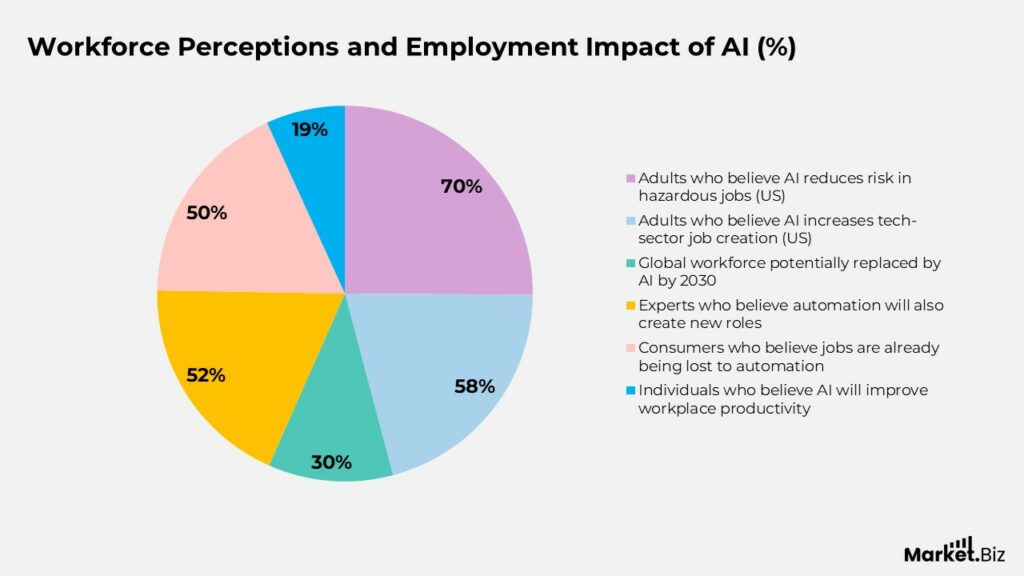
- About 70% of adults in the US believe AI helps lower risk in hazardous and physically demanding jobs by taking on dangerous tasks.
- Around 58% of US adults feel that AI has contributed to increased job creation within the technology sector.
- Intelligent automation and robotics are projected to replace up to 30% of the global human workforce by 2030.
- As a result of this shift, nearly 375 million workers worldwide may need to transition into new career paths by 2030.
- According to global employment outlooks, AI-powered technologies are expected to displace 85 million jobs by 2025.
- Over the same period, AI is projected to create 97 million new jobs, resulting in a net gain.
- Despite concerns about displacement, 52% of experts believe automation will ultimately stimulate innovation and create new roles.
- Public sentiment remains divided, with about 50% of consumers believing job losses due to computer-driven automation are already occurring.
- Productivity perceptions lag behind adoption, as only 19% of individuals believe AI will improve productivity in their own workplace.
(Sources: ddiy.co, Statista))
AI, Machine Learning, and Intelligent Automation: Adoption, Impact, and Scale
- Google’s deep learning systems have achieved 89% accuracy across a wide range of tasks, demonstrating strong model maturity.
- Jasper AI has emerged as a major AI writing platform, achieving a valuation of USD 1.5 billion, reflecting investor confidence in AI-driven content tools.
- Grammarly’s AI-powered writing technology reached a valuation of USD 13 billion following a USD 200 million investment, underscoring large-scale adoption of AI writing assistants.
- Inscribe AI applies machine learning to fraud prevention, detecting approximately USD 80 million in fraudulent activity every month.
- Voice-enabled smart speakers are projected to be in 70 million US households, highlighting widespread consumer adoption.
- Netflix leveraged machine learning in recommendation systems to save an estimated USD 1 billion, demonstrating tangible financial returns from AI.
- The global machine learning market is expected to expand from USD 19.2 billion in 2022 to USD 225.9 billion by 2030, signaling rapid market acceleration.
- More than 8 billion devices are projected to use AI-powered virtual assistants by 2024, reflecting mass-scale integration.
- Google’s Gemini model, released in 2024, became the first AI system to outperform human experts on the Massive Multitask Language Understanding benchmark.
Further
- GPT-4 can generate up to 25,000 words and understand more than 26 languages, highlighting advanced generative and multilingual capabilities.
- GPT-3 runs on large-scale AI infrastructure, powered by 10,000 GPUs, 285,000 CPUs, and 400 Gbps of network connectivity.
- Around 30% of IT professionals report colleagues using AI and automation tools primarily to save time.
- Currently, 34% of companies actively use AI, while another 42% are exploring potential AI applications.
- About 35% of organisations are investing in employee training and reskilling to adopt AI and automation tools effectively.
- Grammarly’s AI tools are used by over 30 million individuals daily and more than 50,000 teams, reflecting AI’s integration into everyday work.
- AI-powered voice assistants are used by 97% of mobile users, with over 4 billion devices already enabled.
- Approximately 40% of people use voice search at least once per day.
- By 2025, an estimated 50% of knowledge workers are expected to rely on virtual assistants in their roles.
- Around 54% of users agree that virtual personal assistants simplify daily tasks and improve convenience.
- AI spending in the retail sector is projected to reach USD 20.05 billion by 2026, growing at a 39% CAGR since 2019.
Moreover
- Nearly 80% of retail executives expect to adopt AI-driven intelligent automation by 2027.
- Global spending on machine learning increased by 230% between 2019 and 2023, reflecting accelerated enterprise investment.
- Around 80% of marketers have integrated chatbots into customer experience strategies to improve responsiveness and engagement.
- About 40% of businesses identify customer experience as the primary reason for adopting AI technologies.
- Chatbots now handle roughly 85% of customer service interactions, significantly reducing manual workloads.
- While only 23% of customer service companies currently use AI, chatbot adoption can reduce service costs by up to 30%.
- Approximately 68% of users value chatbots for their fast response times.
- Nearly 48% of marketing leaders believe AI has a significant influence on customer interactions.
- Around 51% of eCommerce companies use AI to deliver smoother, more personalised shopping experiences.
- About 64% of B2B marketers consider AI a valuable component of their marketing strategies.
(Sources:pdfreader, Statista)
AI Content Generation Adoption and Impact in Content Marketing
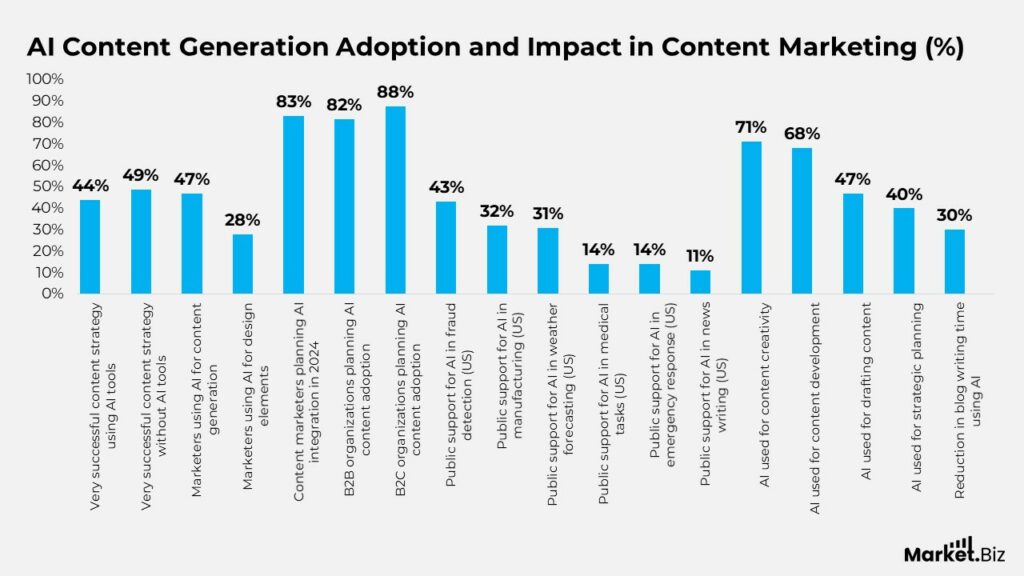
- Among businesses using AI content generation tools, 43.8% report having a very successful content strategy, compared with 48.6% of businesses not yet using these tools, indicating comparable performance outcomes at this stage.
- AI adoption in creative workflows is widespread, with 47% of marketers using AI for content generation and 28% applying it to design-related elements.
- In 2024, around 83.2% of content marketers plan to integrate AI content generation tools into their marketing activities.
- Adoption spans both business models, with 81.5% of B2B organisations and 87.7% of B2C companies intending to use AI content generation tools to support content marketing strategies.
- Public perception in the US is more positive toward AI applications in analytical and operational tasks, including fraud detection (43%), manufacturing (32%), and weather forecasting (31%).
- Trust is lower for sensitive use cases, with only 14% supporting AI in medical tasks, 14% in emergency response operations, and 11% in news writing.
- AI writing tools generally fall into three categories: text prediction systems, AI-powered text editors, and full-scale text generation platforms.
- In content marketing, AI is most commonly used for content creativity (71%), content development (68%), drafting (47%), and strategic planning (40%).
- Bloggers using AI content creation tools spend about 30% less time writing individual blog posts, improving overall productivity.
- AI has demonstrated scalability in journalism, with major publishers producing over 850 data-driven stories with AI assistance during large global events.
(Sources: PDF Technologies, Inc., Statista)
Enterprise AI Adoption, Workforce Impact, and Content Performance Gains
- Nearly 90% of leading businesses have invested in AI technologies, yet only 14.6% have fully embedded AI capabilities into day-to-day operations, highlighting an execution gap.
- Among large enterprises, about 42% actively use AI within core business functions, indicating uneven adoption maturity across organizations.
- Public perception remains positive for safety-related use cases, with 70% of US adults believing AI helps reduce risks in dangerous jobs.
- Around 58% of US adults feel AI has contributed to job creation in the technology sector, reflecting cautious optimism about employment impact.
- AI is projected to generate approximately 97 million new jobs globally by 2025, reinforcing its role as a net job creator.
- Despite growing adoption, workplace confidence remains limited, with only 19% of people believing AI will directly improve productivity in their own jobs.
- The AI startup ecosystem has expanded rapidly, with the number of AI-focused startups increasing by nearly 14 times over the past two decades.
- From a commercial standpoint, AI integration can boost sales lead generation by up to 50% while cutting marketing costs by up to 60%.
- AI-powered SEO platforms have demonstrated strong scalability, with some tools driving more than 1 million monthly organic visitors through algorithmic content optimization.
- AI writing technologies significantly enhance output capacity, enabling organisations to produce up to 10 times more content than traditional workflows.
(Sources: PDF Technologies, Inc., Statista)
AI Writing Capabilities, Adoption, and Impact on Education
- Some advanced AI writing tools can produce up to 1,500 words in just 30 seconds, demonstrating dramatic gains in writing speed.
- More than 60% of enterprise executives expect their organizations to appoint a dedicated Chief AI Officer, signaling AI’s growing strategic importance.
- AI-powered services have become mainstream, with 77% of individuals already using at least one AI-enabled device or application.
- Human ability to identify AI-generated content remains limited, as accuracy in spotting ChatGPT-generated articles was only 52%, barely above random chance.
- On average tasks, humans outperform AI by a narrow margin of just 1%, highlighting how closely AI performance now mirrors human output.
- Early forms of AI writing date back to the 1980s, when spell checkers became standard features in personal computers.
- In 2023, AI writing tools saw widespread academic use, with 89% of students reporting using ChatGPT for homework-related tasks.
- The rapid adoption of AI writing in education exposed gaps in attribution practices, with no consistent standards for citing or crediting original authors in 2023.
- Educators primarily used AI writing tools for research support, lesson planning, information gathering, and preparing assessments and classroom materials.
- Resistance remains within academia, as 72% of college students and 34% of educators supported banning AI writing tools from college networks.
- At the same time, nearly 50% of teachers felt that AI writing tools helped reduce their workload and administrative burden.
- Faculty sentiment is divided, with 47% of Harvard instructors believing AI could negatively affect higher education outcomes.
- Policy development has lagged behind adoption, with fewer than 10% of schools having formal guidelines governing AI writing use as of September 2023.
(Sources: PDF Technologies, Inc., Statista)
AI Workforce Disruption and Gaps in Ethical Governance
- Intelligent robotics and automation are projected to replace up to 30% of the global workforce by 2030, potentially requiring around 375 million people to transition into new careers.
- In the near term, AI-powered systems are expected to displace approximately 85 million jobs worldwide by 2025, underscoring the scale of labor market disruption.
- Despite concerns about displacement, 52% of experts believe automation will simultaneously eliminate existing roles and create new job opportunities.
- Public perception reflects growing anxiety, with about 50% of consumers believing that computers and automated systems are already replacing workers.
- Within AI ethics frameworks, certain principles receive limited attention, including labor rights (19.5%), truthfulness (8.5%), intellectual property protection (7%), and the rights of children and adolescents (6%).
- The vast majority of AI ethics guidelines remain theoretical, as 96% focus on high-level norms rather than actionable implementation steps.
- Regulatory strength is limited, with only 4.5% of AI ethics guidelines proposing legally binding or enforceable forms of regulation.
(Sources: PDF Technologies, Inc., Statista)
Conclusion
AI writing statistics indicate that artificial intelligence has evolved from a supplementary writing tool into a foundational element of content creation across marketing, education, media, and business communication. Widespread adoption, faster writing speeds, and higher content output demonstrate AI’s effectiveness in improving productivity and scaling written work.
At the same time, the data underscores a growing preference for hybrid approaches, where AI assists with ideation, drafting, and optimization while human input safeguards quality, creativity, and ethical responsibility. Ongoing challenges related to attribution, transparency, academic integrity, workforce impact, and limited regulatory frameworks remain unresolved. Taken together, these statistics highlight a lasting shift in writing practices, with AI reshaping workflows and standards rather than fully replacing human writers.
FAQ’s
AI writing statistics refer to the systematic collection and analysis of data that explains how artificial intelligence technologies are applied to writing and content creation. They focus on adoption patterns, usage intensity, performance outcomes, and the broader influence of AI on writing practices, workflows, and communication models.
AI writing statistics matter because they provide empirical evidence of how writing is evolving in response to automation and machine learning. They help organizations, educators, and policymakers understand structural shifts in content production, skill requirements, and value creation.
These statistics capture trends related to productivity gains, content scalability, quality perception, workforce transformation, tool adoption maturity, and the balance between human creativity and automated writing assistance.
By quantifying outcomes and adoption levels, AI writing statistics inform strategic planning, technology investment decisions, governance frameworks, ethical guidelines, and workforce development initiatives.
They illustrate the transition from manual, human-only writing processes to hybrid, AI-assisted models, where automation supports ideation, drafting, and optimisation. At the same time, human oversight ensures quality, originality, and ethical compliance.