









Introduction
Content Creator Economy Statistics: The content creator economy has quickly become a vibrant and ever-changing field, transforming how digital content is created, shared, and monetized. The growth of social media platforms, streaming services, and independent publishing outlets has given creators unique opportunities to engage with global audiences and earn revenue directly from their followers.
This shift has sparked the emergence of innovative business models such as subscription services, brand collaborations, and crowdfunding, enabling creators to turn their hobbies into professional careers.
With continuous advancements in digital tools for content production and interaction, the creator economy is expected to expand even further, influencing not just the entertainment and media industries but also shaping advertising, marketing, and consumer habits worldwide.
Editor’s Choice
- Currently, more than 64 million individuals create content on YouTube worldwide.
- Since 2020, over 165 million new content creators have emerged across various social media platforms.
- 60% of content creators maintain full-time employment outside their content creation activities.
- Around 20% of content creators operate their businesses centered around their content.
- Globally, TikTok is home to over 1 million content creators.
- Approximately 35% of content creators have been active for a period ranging from 3 to 5 years.
- Only 4% of content creators earn more than $100,000 annually, indicating that high-income creators are outliers in the industry.
- Platforms like YouTube and Instagram are the top drivers of brand ROI in creator-led campaigns.
- Over 91% of content creators are leveraging generative AI to streamline and scale their content production.
- The creator economy now includes over 207 million content creators globally.
- There are 200 million active content creators in the global creator economy.
- The creator economy also boasts over 2 million expert-level content creators.
- Shopify plays a significant role in supporting the creator economy, generating an impressive annual revenue of $5.2 billion.
(Source: WPBeginner LLC, Statista, Spiralytics, inBeat Agency, Deloitte, DemandSage)
General Content Creator Economy Statistics
- Over 200 million content creators exist worldwide.
- Around 2% (approximately 4 million) creators have more than 100,000 followers.
- The majority, about 140 million creators, have between 1,000 and 10,000 followers.
- The global number of social media users is around 4.2 billion.
- Approximately 500 million people participate in the passion economy.
- American creator economy startups raised 79% less money at the end of 2022 compared to the previous year.
- 52% of content creators are men, 47% are women, and 1% identify outside of these categories.
- Only 13% of content creators belong to Gen Z.
- 67% of creators have between 1,000 and 10,000 followers.
- Nearly 25% of the global population is content creators.
- Only 20% of creators run a content-related business.
- 58% of content creators hold a full-time job in addition to their creator activities.
(Source: Linktree, The Information, Adobe, The Leap)
Creator Profile Statistics
- The creator economy is home to over 45 million professional content creators.
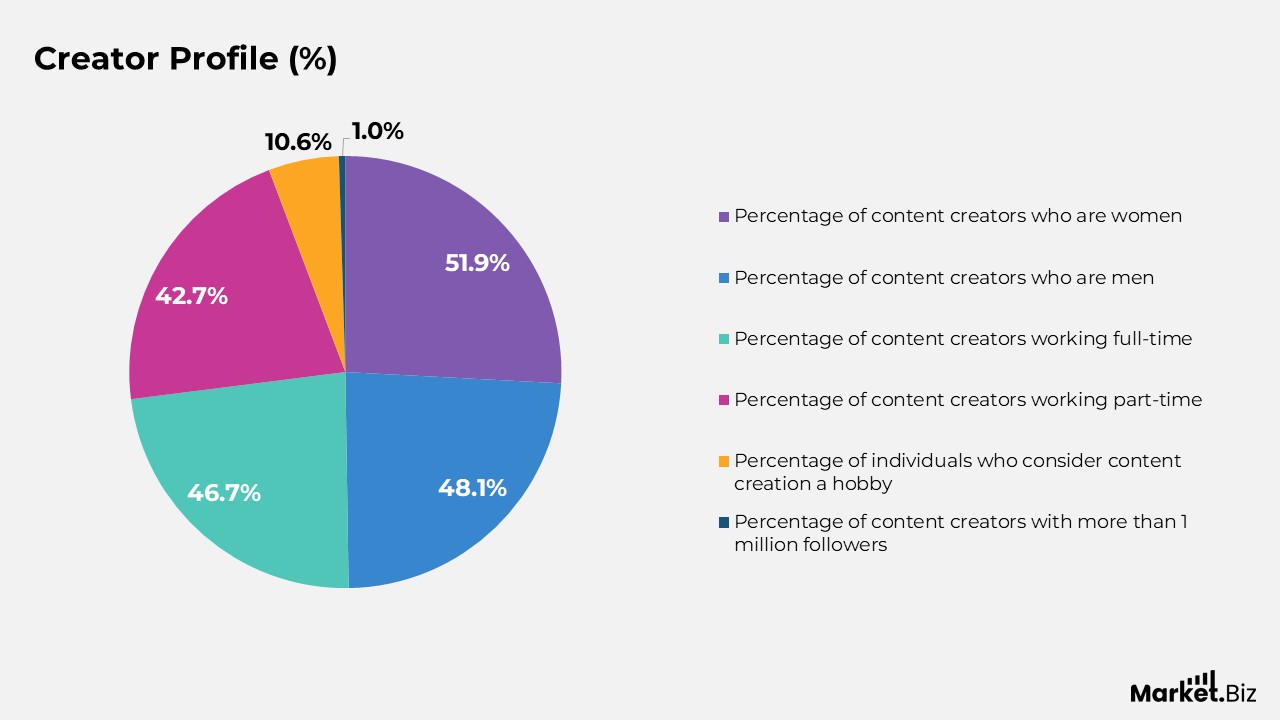
- 51.9% of content creators in the industry are women, while 48.1% are men.
- There are more than 162 million amateur content creators in the creator economy.
- 46.7% of content creators work full-time, followed by 42.7% who are part-timers.
- 10.6% of individuals consider content creation to be a hobby.
- Only 0.96% of content creators have more than 1 million followers.
(Source: WPBeginner LLC, Statista)
Influencer Statistics
- The influencer industry is currently valued at $24 billion.
- The industry is projected to grow at a rate of 14.47%.
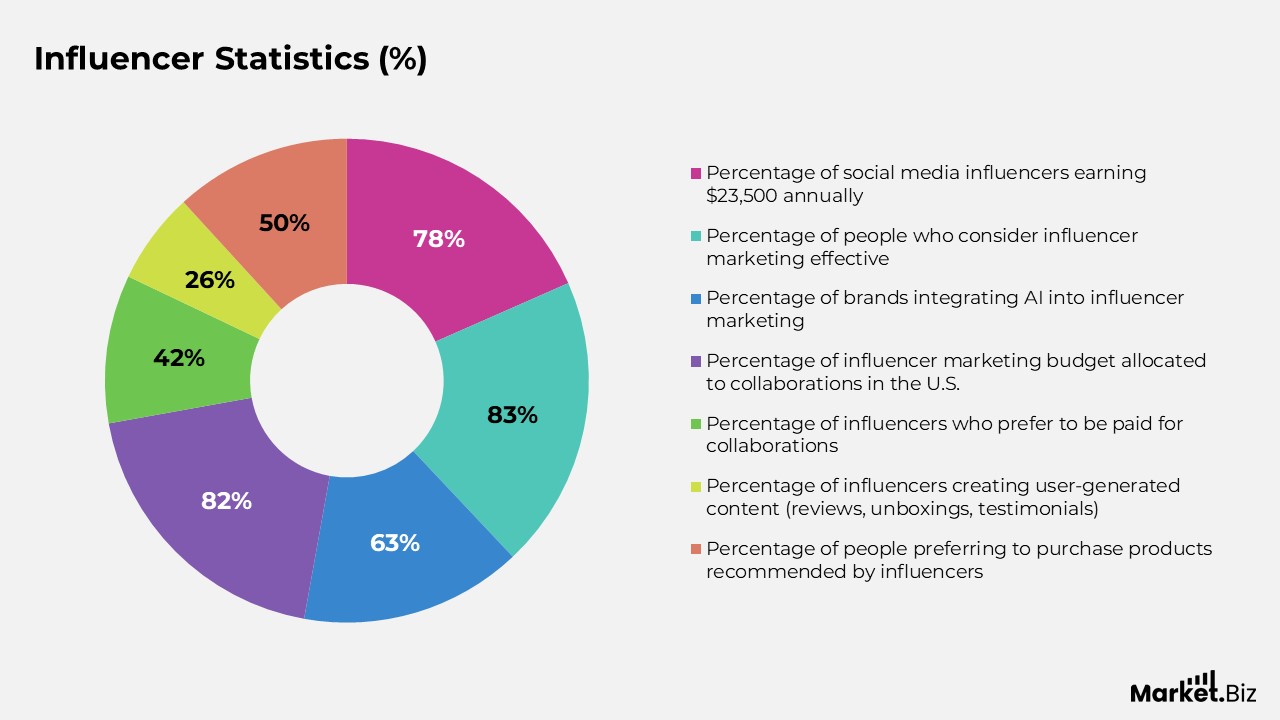
- Around 78% of social media influencers earn approximately $23,500 annually.
- The average hourly wage for an influencer is $76.
- 83% of people consider influencer marketing to be an effective strategy.
- 63% of brands integrate artificial intelligence (AI) into their influencer marketing efforts.
- Brands invest a total of $6 billion in influencer collaborations.
- In the United States, 82% of the influencer marketing budget is allocated to influencer collaborations.
- On average, lifestyle influencers request $994 for a collaboration, while fashion influencers ask for around $912.
- Brands spend an average of $257 per collaboration with an influencer.
- Influencers typically take an average of 14 hours to respond to collaboration inquiries.
- The average duration to complete a collaboration is 16 days.
- 42% of influencers prefer to be paid for collaborations.
- 26% of influencers create user-generated content, such as reviews, unboxings, and testimonials.
- 50% of people prefer purchasing products recommended by their favourite influencers.
- Influencers are typically active on at least 2 social media platforms.
(Source: WPBeginner LLC, Statista)
Number of Content Creators
- 26% of content creators prefer TikTok as their primary social media platform.
- TikTok has surpassed 1 billion monthly active users.
- 53% of TikTok users are women, with 46% being men.
- On TikTok, 76% of influencers are women, while 24% are men.
- 80 million monthly active TikTok users are based in the United States.
- 37.3 million active TikTok users are from Generation Z.
- TikTok users spend an average of 95 minutes on the platform daily.
- 56% of brands prefer collaborating with influencers on TikTok.
- The top-earning TikTok content creator is Charli D’Amelio.
(Source: WPBeginner LLC, Nealschaffer, Linktree)
Content Creator Economy Market Size
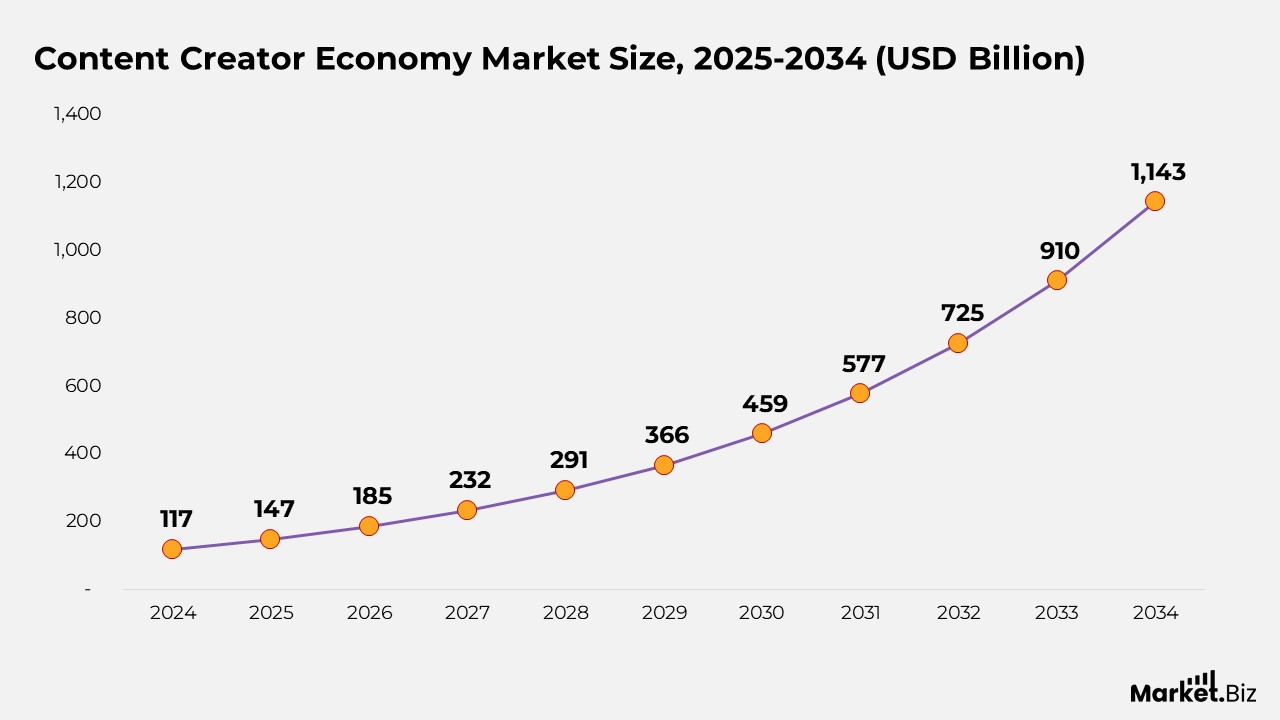
- According to Market.us, the content creator economy market is expected to rise from $147 billion in 2025 to $1,143 billion by 2034, representing a compound annual growth rate (CAGR) of 25.6% from 2025 to 2034.
- The content creator economy is experiencing rapid growth, fueled by various platforms that support the production and distribution of creative content. This has attracted a wide range of creators, extending beyond traditional influencers to include educators, entertainers, and artisans. Key factors driving this growth include the availability of intuitive tools and the widespread adoption of mobile technology, which simplifies content creation and sharing.
- In 2024, the Entertainment Content segment led the Creator Economy, holding more than 34.7% of the market share. This dominance is driven by the growing demand for streaming services and digital entertainment, as well as shifting societal trends that emphasize online leisure activities.
Moreover
- Video-based platforms also held a strong position in 2024, capturing over 29.5% of the market share. This growth is attributed to the increasing popularity of short-form video content on platforms like TikTok and Instagram, as well as ongoing advancements in video streaming technologies that have enhanced viewer engagement.
- The Influencers & Social Media Personalities segment maintained its market leadership in 2024, securing more than 38.8% of the market. Their significant engagement levels, supported by social media algorithms that amplify visibility, have driven numerous brand collaborations and sponsorships.
- The US content creator economy was valued at US$ 35.31 billion in 2024, growing at a 24.2% CAGR. Key contributors to this strong market performance include a digitally advanced population, substantial investments in technological innovations, and a culture that encourages online entrepreneurship and content creation.
- North America maintained its dominant position in the creator economy in 2024, holding 37.5% of the market with US$ 43.8 billion in revenue. This leadership can be attributed to the region’s superior digital infrastructure, widespread internet access, high smartphone penetration, and a well-established ecosystem of content distribution platforms, allowing creators to engage with a global audience easily.
(Source: Market.us)
Consumer Engagement with Content Creators
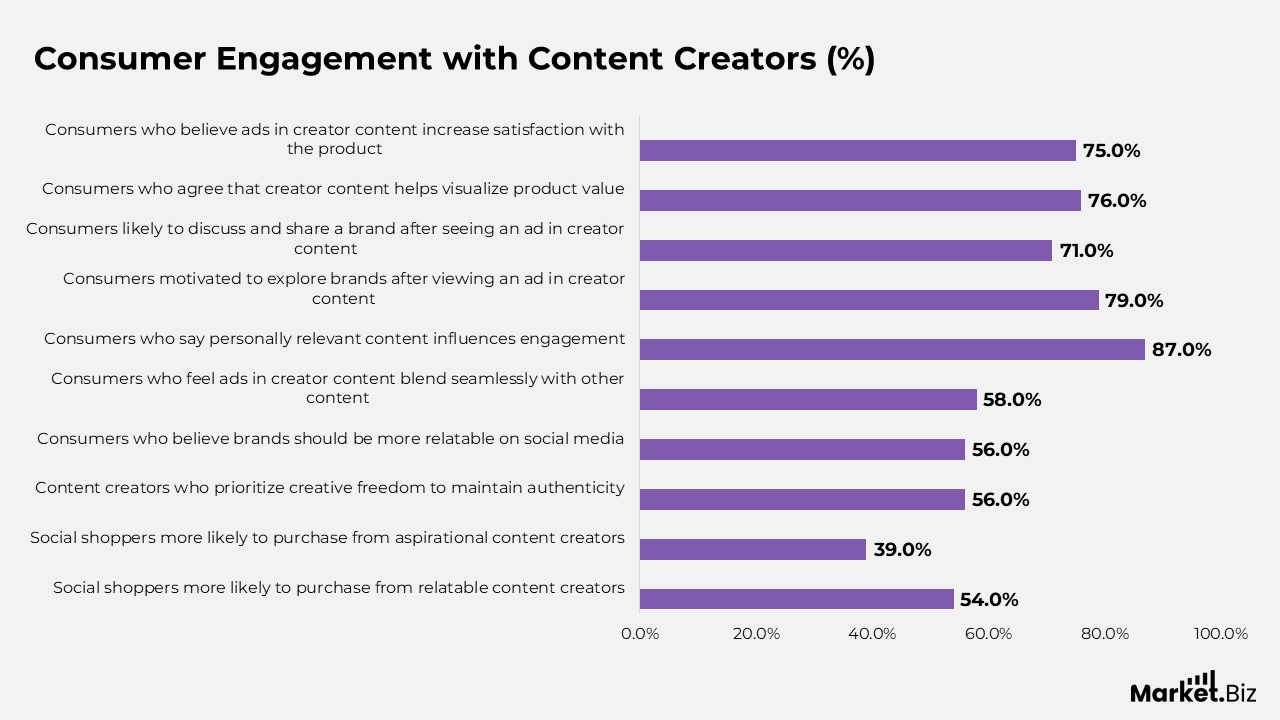
- Social shoppers are 54% more inclined to purchase from content creators they find relatable compared to 39% who prefer aspirational creators.
- Over 56% of content creators prioritize creative freedom to preserve their authenticity.
- A similar 56% of consumers believe that brands should present themselves as more relatable on social media.
- 58% of consumers feel that advertisements embedded in creator content blend seamlessly with the rest of the content.
- 87% of consumers state that content featuring personally relevant topics is a major factor in their engagement.
- Nearly 79% of consumers are motivated to explore brands after viewing an ad within creator content, and almost 70% are likely to discuss and share that brand with others.
- 76% of consumers agree that creator content makes it easier to visualize how a product works and its potential value in their lives.
- According to 75% of consumers, ads within creator content enhance their satisfaction with the product.
(Source: DemandSage, Statista, Spiralytics)
Earnings Statistics
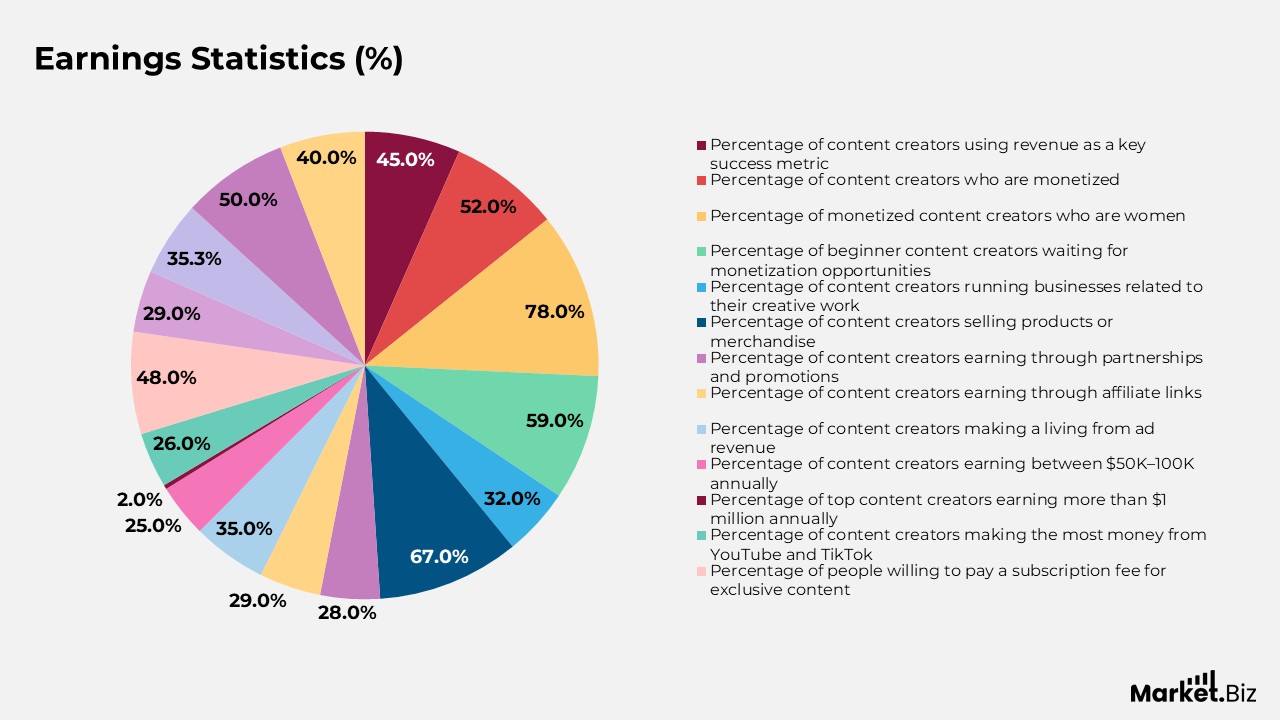
- Over 45% of content creators use revenue as a key metric to track their success.
- 52% of content creators are monetized, earning money from their content.
- 78% of monetized content makers are women.
- 59% of learner content creators are quite eager for monetization opportunities.
- Monetized content creators typically earn an average of $51 per hour.
- 32% of content creators run businesses related to their creative work.
- The average income for content creators who own a business is $75 per hour.
- 67% of content creators sell products or merchandise to boost their income.
- 28% of content creators generate revenue through partnerships and promotions.
- 29% of content creators earn through affiliate links.
- 35% of content creators make a living from ad revenue.
- 25% of content creators earn between $50K–100K annually.
- Only 2% of top content creators earn more than $1 million per year.
- To surpass $1 million in annual earnings, content creators typically need more than 5 million followers.
- 26% of content creators make the most money from YouTube and TikTok.
- 48% of people are willing to pay a subscription fee for exclusive content.
- 29% of people support their favourite content creators because they find them inspiring.
- 35.3% of people tip their favourite content creators as a form of support.
- 50% of people have tipped their favourite content creators at least once.
- Over 40% of people tip between $5 and $10 on average to their favourite content creators.
(Source: WPBeginner LLC, Statista, DemandSage)
Independent Creator Statistics
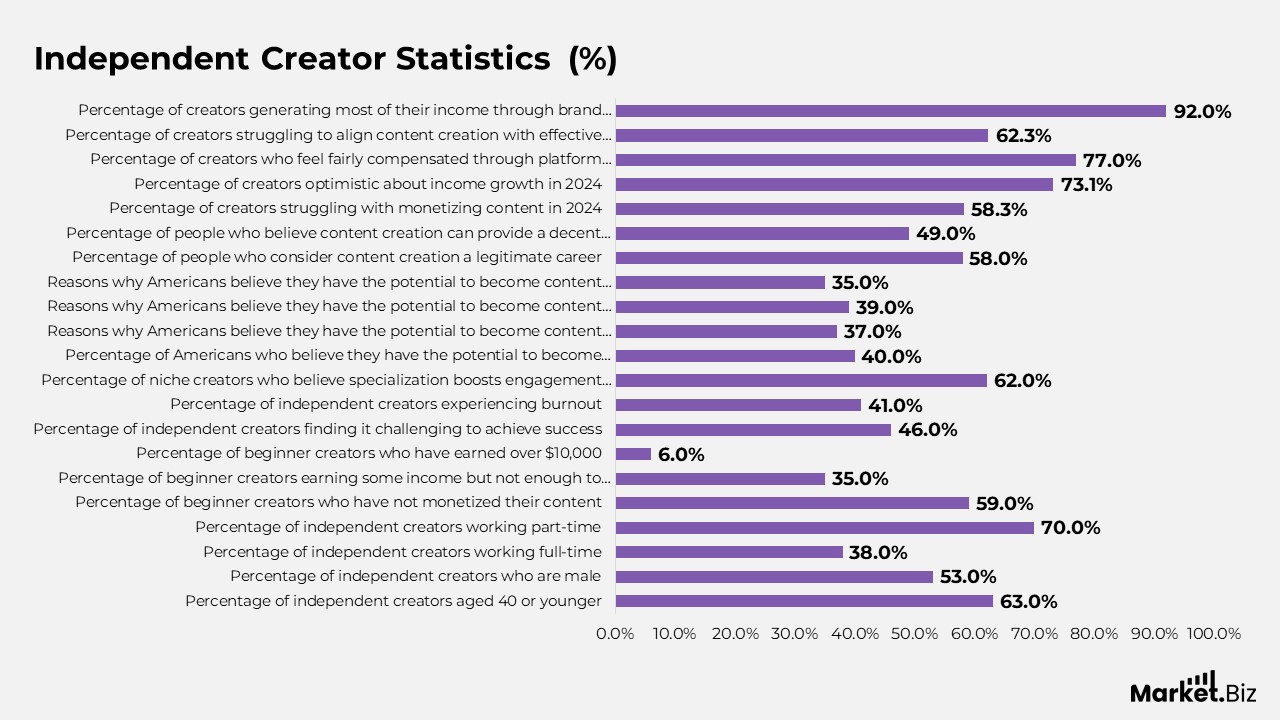
- Independent creators are predominantly young and male, with 63% being aged 40 or younger and 53% male. However, older generations (Gen X and Baby Boomers) are increasingly represented, growing from 27% to 35% between 2022 and 2023.
- 38% of independent creators work full-time in the creator economy, while 70% work part-time as independent digital content creators.
- 59% of beginner creators have not monetized their content, 35% have earned some income but not enough to support themselves, and only 6% have achieved significant success, earning over $10,000.
- Lockdown measures and the transition to remote work have boosted online engagement, leading to increased demand for content on platforms like YouTube, TikTok, and others created by independent creators.
- The number of independent creators earning money through creating and distributing digital content slightly decreased, from 8.2 million in 2022 to 8.1 million in 2023.
- Nearly half (46%) of independent creators find it challenging to achieve success, and a significant proportion (41%) experience burnout, highlighting the difficulties and pressures in the creator economy.
Moreover
- 62% of niche creators believe that specialization boosts engagement and reach. They are also more likely to collaborate with brands (37% vs 26%) and earn over $100K annually (5% vs7%) compared to non-niche creators.
- 40% of Americans believe they have the potential to become successful content creators, driven by passion for sharing (37%), financial goals (39%), and independence (35%). Most (58%) consider content creation a legitimate career, and 49% believe it can provide a decent living.
- 58.3% of creators reported struggling with monetizing their content in 2024, a slight improvement from 61.5% who faced similar challenges in 2023, indicating a gradual easing of monetization difficulties.
- 73.1% of creators are optimistic about their income growth in 2024, expecting improvements due to new monetization opportunities and diversifying content across platforms, a slight increase from last year’s outlook.
- A significant majority (77%) of creators who monetize their content feel fairly compensated through platform programs. However, 62.3% still struggle to align their content creation with effective monetization strategies, indicating a persistent challenge in the creator economy.
- Most creators (92%) generate most of their income through partnerships with brands, with the tech and business niches being the most lucrative, earning over $150,000 annually for top creators in these fields.
(Source: Passive Secrets, LLC, Influencer Marketing Hub, Epidemic Sound)
YouTube Statistics
- With 2.2 billion monthly active users, YouTube ranks as one of the leading social media platforms.
- YouTube channels experience an annual growth rate of 36%.
- 69% of influencers on YouTube are women, while 31% are men.
- The platform supports a wide array of languages, reaching 95% of internet users globally.
- 197 million YouTube users are based in the United States.
- 29% of children in the US aspire to become YouTubers or vloggers in the future.
- Just 3% of YouTubers generate 90% of the platform’s total revenue.
- The average YouTube creator has a 1/57 chance of reaching the 10,000 subscriber milestone.
- 10% of the content posted by the most popular YouTube channel accounts for 79% of all views.
- 70% of YouTubers desire to create long-form videos.
- On average, brands allocate $418 for collaborations with YouTubers.
- 25% of viewers prefer watching live streams on YouTube.
- Nearly 1.7 million YouTube streamers have an average of 5+ viewers.
- 25.9% of people prefer tipping or subscribing to their favourite content creators on YouTube.
- The top YouTube channels by subscriber count include MrBeast, T-Series, CocoMelon, and SET India.
(Source: WPBeginner LLC, Statista, DemandSage)
Instagram Statistics
- 25% of people believe that Instagram offers the highest potential for return on investment (ROI).
- 29% of brands intend to allocate the most resources to Instagram due to its ability to grow their audience base.
- Instagram boasts 2 billion monthly active users, making it one of the most widely used platforms.
- 79% of influencers on Instagram are women, with 21% being men.
- 9 out of 10 Instagram users engage with video content every week.
- A significant 89% of Instagram users are based outside of the United States.
- 11% of American Instagram users rely on the platform as their primary source of news.
(Source: WPBeginner LLC, DemandSage, Statista)
TikTok Statistics
- 26% of content creators prefer TikTok as their primary social media platform.
- TikTok has surpassed 1 billion monthly active users.
- 53% of TikTok users are women, with 46% being men.
- On TikTok, 76% of influencers are women, while 24% are men.
- 80 million monthly active TikTok users are based in the United States.
- 37.3 million active TikTok users are from Generation Z.
- TikTok users spend an average of 95 minutes on the platform daily.
- 56% of brands prefer collaborating with influencers on TikTok.
- The top-earning TikTok content creator is Charli D’Amelio.
(Source: WPBeginner LLC, DemandSage, Statista)
Content Creator Economy Challenges
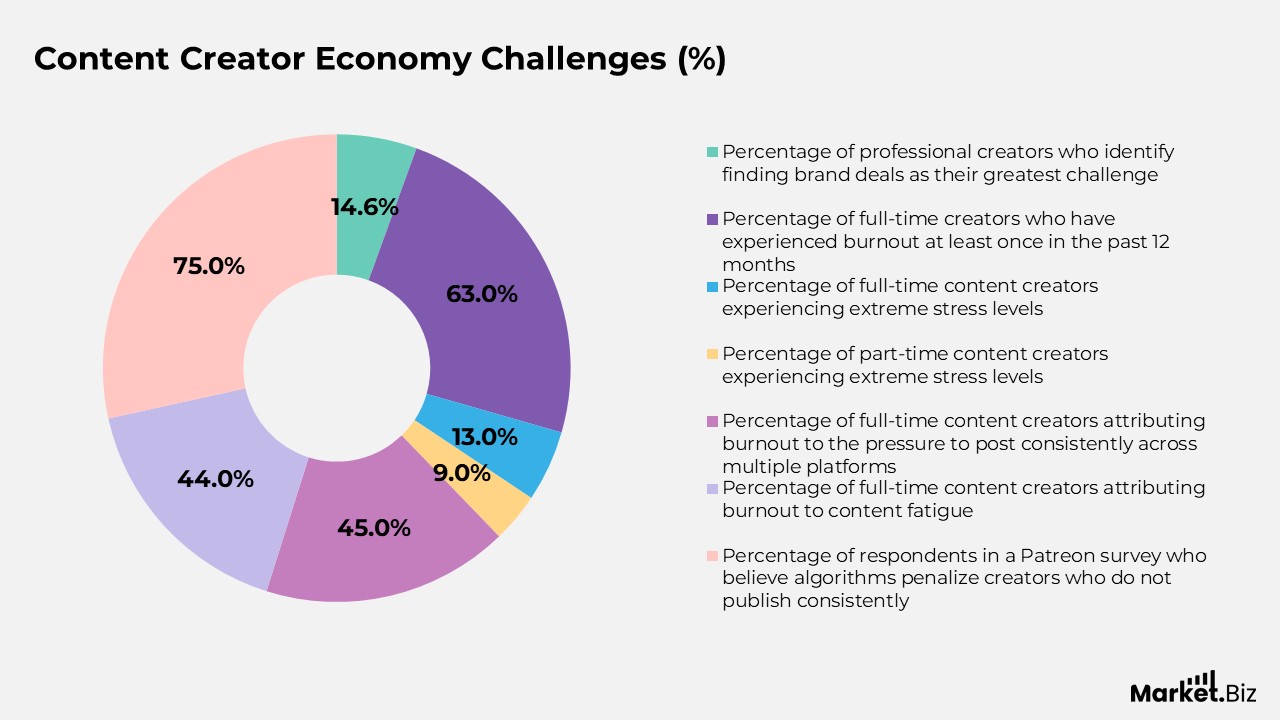
- 14.6% of professional creators identify finding brand deals as their greatest challenge.
- 63% of full-time creators have experienced stress at least once in the past 12 months.
- 13% of full-time content creators report consistently experiencing extreme stress levels, with 9% of part-time creators facing the same.
- Over 45% of full-time content creators attribute burnout to the pressure to post consistently across multiple platforms, followed closely by content fatigue at around 44%.
- A Patreon survey revealed that 75% of respondents believe algorithms penalize creators who do not publish consistently.
(Source: WPBeginner LLC, Statista, DemandSage)
Conclusion
Content Creator Economy Statistics: The content creator economy is a rapidly growing and impactful sector that is transforming the digital landscape. It has opened up new opportunities for a wide variety of creators, ranging from influencers to educators and artisans, to connect with global audiences and monetize their content.
The notable growth of entertainment content, the dominance of video-based platforms, and the rise of social media personalities are key factors driving this market. North America remains at the forefront due to its advanced infrastructure and high levels of connectivity.
As platforms evolve to meet the needs of creators, new opportunities and business models are expected to emerge, solidifying the content creator economy as a powerful force in the global digital ecosystem.
FAQ’s
The content creator economy refers to the rapidly expanding sector where individuals generate, share, and monetize content on digital platforms like YouTube, Instagram, TikTok, and other social media sites. Creators typically earn revenue through advertising, sponsorships, donations, paid subscriptions, and partnerships with brands.
The most widely used platforms by content creators include:Instagram: Boasting 2 billion active users, with 79% of influencers being women.
TikTok: With over 1 billion monthly active users, 53% of whom are women.
YouTube: The largest platform for video content, hosting billions of users globally.
Gender: 79% of influencers on Instagram are women, while 76% of influencers on TikTok are women.
Age: Younger generations, especially those in Generation Z (born 1997–2012), are most active on TikTok and YouTube.
Geography: A large portion of TikTok’s users (80 million) are from the United States, while 89% of Instagram’s users are located outside of the US.
Brands partner with content creators to promote products, run sponsored campaigns, place ads, and implement influencer marketing strategies. 56% of brands prefer working with influencers on TikTok, while Instagram continues to be the platform with the highest return on investment (ROI) for 25% of brands.