









Introduction
Underwater Drone Statistics: Underwater drones, which encompass Remotely Operated Vehicles (ROVs) and Autonomous Underwater Vehicles (AUVs), serve as advanced instruments utilised for a variety of tasks beneath the surface of the water. ROVs are connected to a surface vessel and are utilised for real-time inspections and operations. In contrast, AUVs function autonomously for missions that are pre-programmed.
The essential components of these drones consist of a sturdy hull, sensors and cameras, a propulsion system, communication systems, and a power supply. These drones find applications in scientific research, industrial inspections, environmental monitoring, and defence. Challenges such as pressure at depth, battery longevity, limitations in communication, and navigation are tackled through cutting-edge engineering and technology.
Editor’s Choice
- The worldwide market for underwater drones is anticipated to witness consistent growth from 2022 to 2032, with a compound annual growth rate (CAGR) of 12.4%.
- In 2021, the market generated $1.26 billion, reflecting the growing interest and initial adoption of drone delivery services.
- In 2023, it is anticipated that the Asia Pacific region will lead the global drone delivery market share, capturing a significant 39% of the total market.
- The CHASING M2 is an advanced underwater drone that boasts a maximum operational depth of 330 feet (100 meters) and can reach speeds of up to 3 knots.
- Geneinno Titan underwater ROV features an ultra-wide 160° field of view camera that includes an 8MP 1/2.5” CMOS sensor, which is capable of streaming 1080p live views to the controller and capturing 4K video.
General Underwater Drone Statistics
- The evolution of underwater drones, also known as unmanned underwater vehicles (UUVs), dates back to the 1950s when the Office of Naval Research sponsored the creation of one of the earliest UUVs, the Special Purpose Underwater Research Vehicle (SPURV).
- In 2023, the global underwater drone market generated revenue of $4.4 billion.
- By the year 2032, the market is anticipated to reach a peak of $12.2 billion, with remotely operated vehicles (ROVs) accounting for $5.19 billion, autonomous underwater vehicles (AUVs) for $4.49 billion, and hybrid vehicles for $2.53 billion.
- The allocation of market share by product type within a particular category illustrates a wide array of consumer preferences.
- The “Heavy Work-Class” products dominate with a 38% market share, reflecting a strong demand for robust and high-capacity products.
- The revenue for the Global Remote Drone Identification System market is expected to rise to around $1,251.9 million by 2029.
- In 2023, it is projected that the Asia Pacific region will lead the global drone delivery market share, holding a significant 39% of the market.
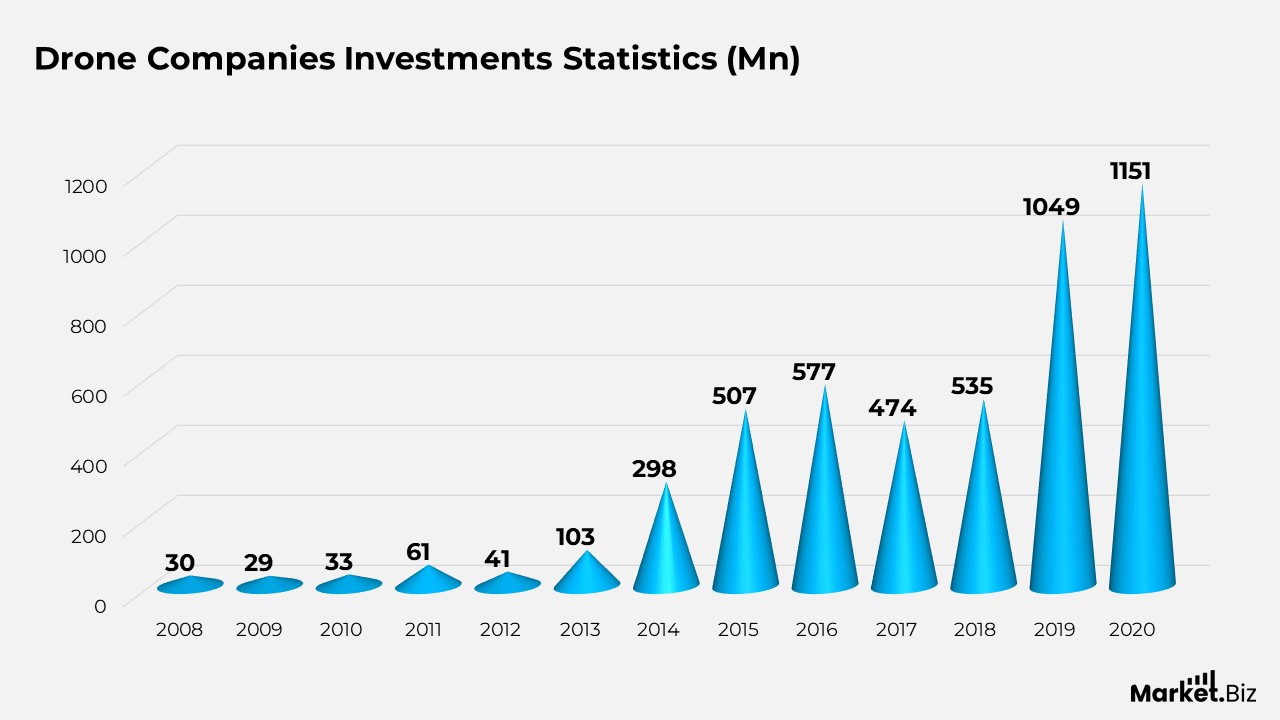
- Global investments in drone enterprises amounted to $1,151 million in 2020.
- In the United States, there is a requirement for the registration of drones that weigh more than 250 grams, along with additional stipulations for commercial operations under the FAA’s Part 107, which includes obtaining a Remote Pilot Certificate and adhering to specific flying conditions such as operating at night and flying over people.
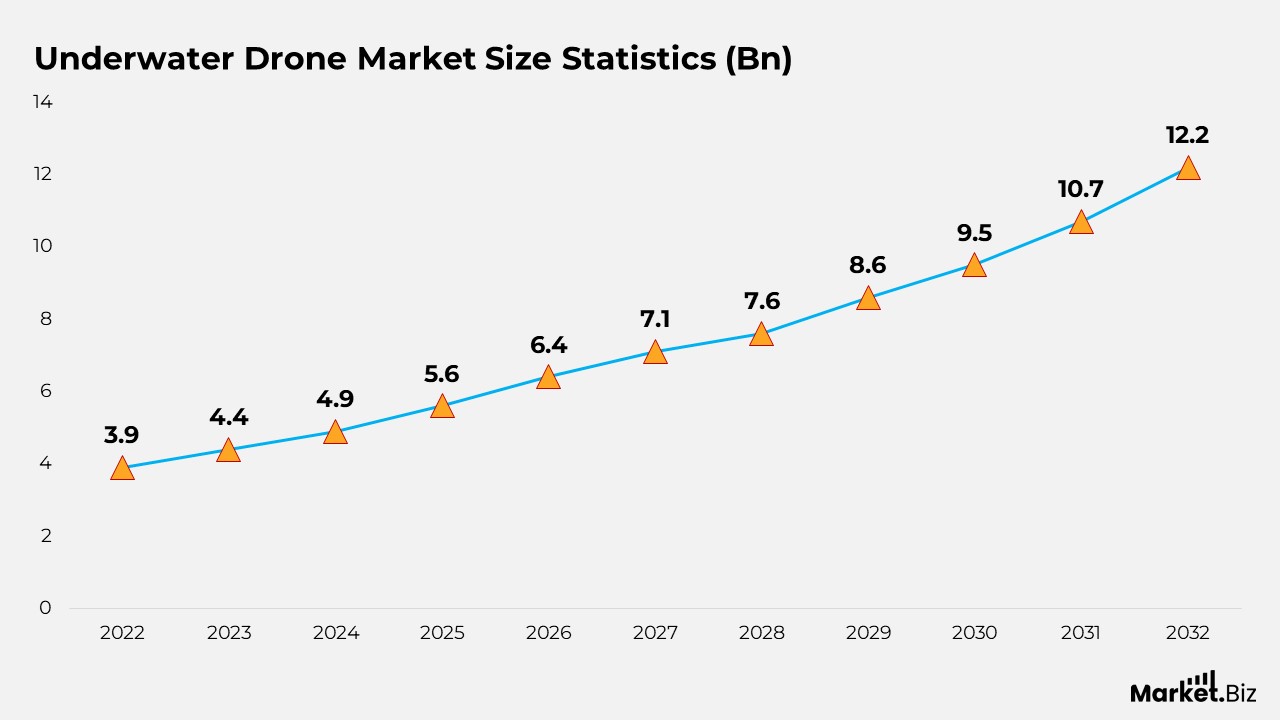
Underwater Drone Market Size Statistics
- The worldwide market for underwater drones is anticipated to witness consistent growth from 2022 to 2032, with a compound annual growth rate (CAGR) of 12.4%.
- In 2022, the market’s revenue was recorded at $3.9 billion.
- The following year, 2023, experienced an increase to $4.4 billion.
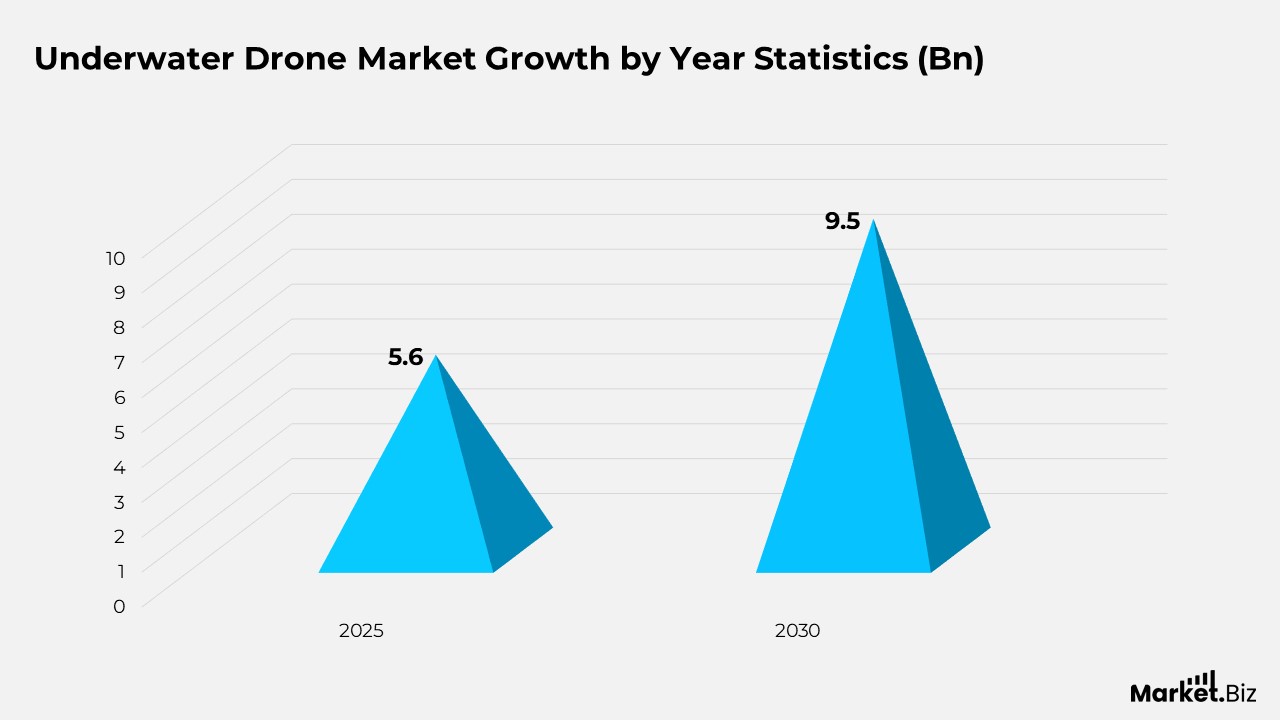
- This upward trend persists, with the market size projected to reach $4.9 billion in 2024 and further expand to $5.6 billion in 2025.
- The growth trajectory is sustained in the subsequent years, with revenues expected to be $6.4 billion in 2026, $7.1 billion in 2027, and $7.6 billion in 2028.
- The market is predicted to accelerate slightly, reaching $8.6 billion in 2029 before advancing to $9.5 billion in 2030.
- The growth remains strong into the early 2030s, with market revenues anticipated to hit $10.7 billion in 2031 and $12.2 billion in 2032.
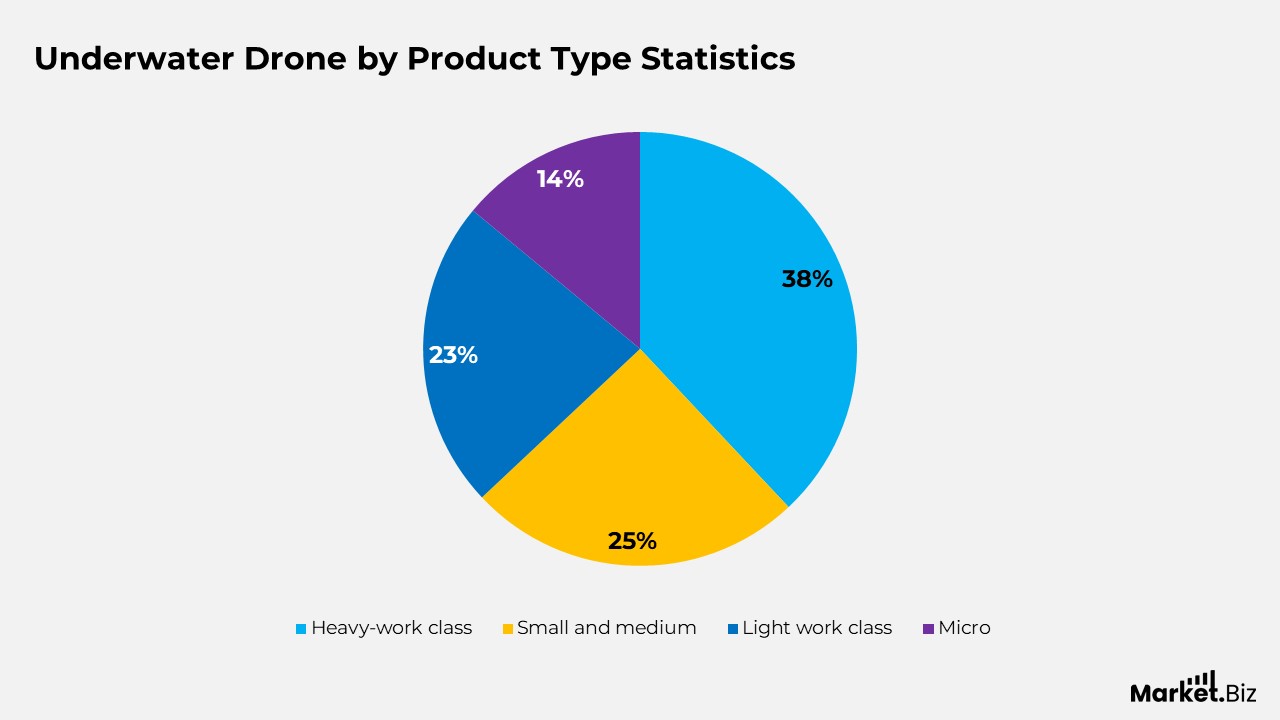
Underwater Drone by Product Type Statistics
- The allocation of market share by product type within a particular category illustrates a wide array of consumer preferences.
- The “Heavy Work-Class” products dominate with a 38% market share, indicating a strong demand for durable and high-capacity items.
- Next are the “Small and Medium” products, which possess a 25% share, suggesting a considerable interest in versatile solutions that are appropriate for various tasks.
- The “Light Work-Class” products represent 23% of the market, underscoring their importance in more specialised or less intensive operations.
- Finally, the “Micro” products, despite being the smallest category, still secure a 14% market share.
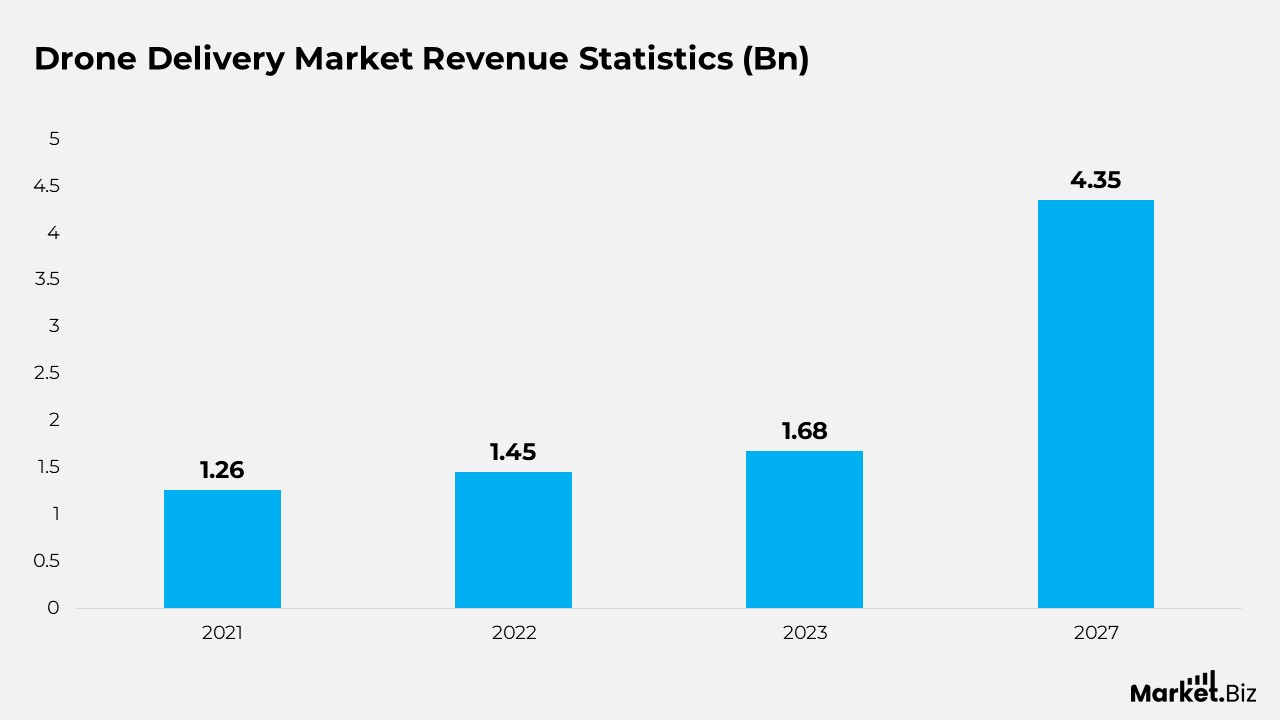
Drone Delivery Market Revenue Statistics
- In 2021, the market generated $1.26 billion, reflecting the growing interest and initial adoption of drone delivery services.
- The following year, 2022, saw an increase in market revenue to $1.45 billion, signifying continued growth and acceptance of drone technologies in commercial delivery environments.
- The positive trend persisted into 2023, with revenue rising further to $1.68 billion.
- This growth pattern is expected to accelerate considerably by 2027, with revenue forecasted to reach $4.35 billion.
Drone Delivery by Region Statistics
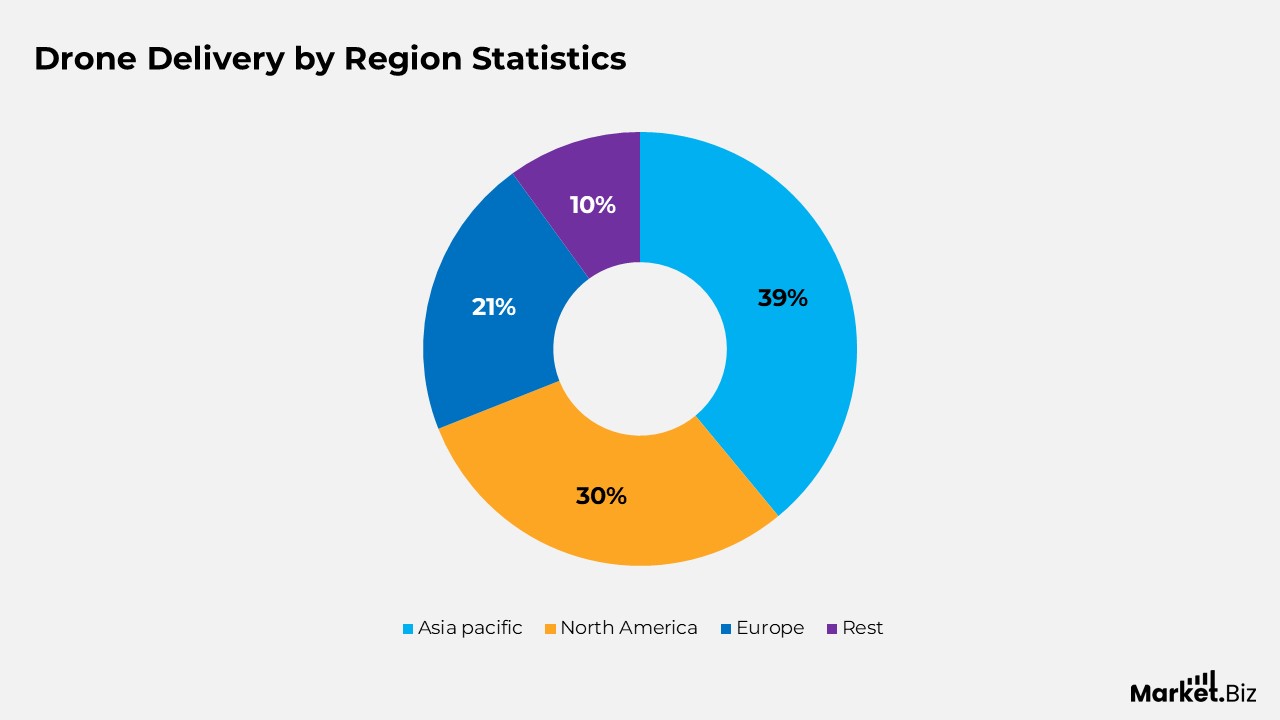
- In 2023, it is anticipated that the Asia Pacific region will lead the global drone delivery market share, capturing a significant 39% of the total market.
- This leadership is a result of the region’s swift technological progress and extensive incorporation of drone delivery into commercial and logistical systems.
- North America ranks second with a 30% market share, reflecting strong investments and regulatory frameworks that foster the growth of drone technology.
- Europe possesses a 21% share, gaining from the rising adoption of drones in various industries, such as healthcare and retail.
- The remaining 10% of the market is attributed to other regions of the world.
Chasing M2 Underwater Drone Statistics
- The CHASING M2 is an advanced underwater drone that boasts a maximum operational depth of 330 feet (100 meters) and can reach speeds of up to 3 knots.
- It provides a runtime of 3 hours under ideal conditions, powered by a 97.68 Wh battery.
- This drone is adept at capturing ultra-high definition video with resolutions reaching 3840 x 2160 (4K) at 30 fps, as well as taking 12-megapixel photographs.
- The remote controller, which features Wi-Fi and HDMI output, is equipped with a 2500 mAh battery, allowing for a runtime exceeding 6 hours.
- The camera system is fitted with a 1/2.3 inch CMOS sensor paired with an F1.8 lens, providing a broad field of view of 152 degrees and an adjustable ISO range from 100 to 6400.
- The drone can support a tether length of up to 656 feet (200 meters), utilizes a 64 GB SD card for data storage, and is outfitted with dual 2000 lumens LEDs that have dimming capabilities.
- Its advanced sensor suite comprises a 3-axis gyro, accelerometer, compass, depth sensor, and temperature sensor, which together ensure accurate navigation and data collection.
Blueye Pioneer Underwater Drone Statistics
- The Blueye Pioneer underwater drone is designed for exceptional performance across various conditions. It boasts IPX8 ingress protection and is made from ABS, aluminium, and polycarbonate materials.
- It has dimensions of 485 x 257 x 354 mm and a weight of 8.6 kg when using saltwater ballast, supported by HCP 30 Polymer Foam, and can dive to depths of 150 meters.
- Powered by four 350 W thrusters, it achieves a speed of 1.5 m/s (3 knots) with a runtime of 2 hours and operates within a temperature range of –5 to +35°C.
- Its imaging system features a 1/3 inch CMOS sensor that records Full HD video at 25/30 fps, with storage on a 64 GB SD card.
- The drone is fitted with 3300-lumen LED lights that have adjustable brightness and a smart battery pack with a capacity of 14.8 V and 6500 mAh.
- Additionally, it includes a variety of sensors such as a 3-axis IMU, depth sensor, and temperature sensor, along with a durable tether that can extend up to 300 meters.
Geneinno Titan Underwater Drone Statistics
- Geneinno Titan underwater ROV features an ultra-wide 160° field of view camera that includes an 8MP 1/2.5” CMOS sensor, which is capable of streaming 1080p live views to the controller and capturing 4K video.
- The ROV is equipped with six thrusters, four for vertical movement and two for horizontal movement, enabling precise navigation and hovering abilities.
- It provides both high and low-speed modes, achieving a maximum speed of 6.6 feet per minute, and is fitted with two 1500-lumen lights to ensure clear visibility underwater.
- The ROV is powered by a 9000mAh, 10.8 VDC, 97.2Wh battery, offering a runtime of four hours, while the wireless transmitter operates for six hours on its 3200mAh, 10.8 VDC, 34.6Wh battery.
- Included in the package are the Geneinno Titan ROV, a controller, and the 492-foot tether.
Drone Companies Investments Statistics
Underwater Drone Recent Development
- In the year 2023, Teledyne Technologies finalised the purchase of SeaBotix, a firm focused on underwater drones, for a sum of $150 million.
- In 2023, Aquabotix, a company engaged in underwater robotics, secured $20 million to enhance its research and development initiatives concerning autonomous underwater drones.
- Underwater drones are increasingly significant in defence, with projections indicating that 40% of newly developed underwater drones will be utilised for military and surveillance applications by 2025.
Underwater Drone Future Predictions
- By the end of 2026, it is anticipated that drones equipped with wireless technology will represent 40% of the market, propelled by progress in underwater communication and sensor technologies.
- Drones play a crucial role in the worldwide initiative to chart 80% of the seabed by 2030, examining the effects of climate change, and overseeing marine resources.
Conclusion
Underwater Drone Statistics: The market for underwater drones has experienced substantial growth, propelled by technological advancements and a variety of applications across fields such as scientific research, environmental monitoring, and military operations.
These drones offer essential insights into difficult-to-access aquatic environments through sophisticated cameras and sensors, thereby improving our comprehension of marine biology, archaeology, and geology.
With continuous innovations in autonomy, energy efficiency, and the integration of artificial intelligence, underwater drones are poised to transform marine exploration and resource management. This progression indicates a future in which underwater drones play a vital role in sustainable marine practices and the protection of ecosystems.
FAQ’s
In March 1995, the Kaikō became the 2nd vessel ever to reach the depths of the Challenger Deep, marking the first exploration of this site since the Trieste mission. The maximum depth achieved during that dive was 10,911.4 meters, setting the record for the deepest dive performed by an unmanned submersible to date.
The maximum operational depth ranges from 100 to 350 meters, depending on the specific model. Maximum underwater drones are capable of travelling at a speed of 3 knots, allowing them to navigate through currents of up to 2 knots. The QYSEA FIFISH W6 ROV can achieve a speed of 4 knots, enabling its operation in currents reaching 3 knots.
A 20-minute drone show can cost anywhere from $15,000 for smaller, simpler events to well over $100,000 for large, complex productions, with costs primarily driven by the number of drones (often $200-$300+ per drone), show complexity, customisation (music, graphics), and logistics like travel and permits. A typical 10-minute show with 100 drones might cost around $20,000-$25,000, so a 20-minute show with more drones would be significantly more expensive.