









Introduction
eSports viewership statistics illustrate the transformation of competitive gaming from a niche pastime into a global entertainment phenomenon. Growth in live streaming platforms, professional leagues, and international tournaments has attracted millions of viewers worldwide, particularly among younger, digitally native audiences.
Improved internet connectivity, widespread adoption of mobile gaming, and interactive streaming features such as live chat and co-streaming have further strengthened audience engagement.
At the same time, rising prize pools, franchised competitions, and increased brand and sponsor involvement have positioned eSports as a commercially sustainable segment within the broader media and entertainment industry. Together, these statistics offer insight into audience scale, viewing behavior, and the long-term growth potential of competitive gaming.
Editor’s Choice
- The global eSports audience is nearly evenly divided, with occasional viewers estimated at 322.7 million and dedicated fans reaching around 318.1 million.
- Competitive gaming sharing in the US remains active, with approximately 3,530 registered eSports players nationwide.
- Asia Pacific dominates the global eSports viewing landscape, accounting for over 57% of total viewers.
- China and the Philippines play a central role in audience concentration, together representing about 40% of the worldwide eSports fanbase.
- The global eSports market has expanded into a multi-billion-dollar industry, with an estimated valuation of USD 2.89 billion.
- The US remains a key commercial hub, with its eSports market valued at approximately USD 1.07 billion.
- Regular engagement with competitive gaming was already substantial in 2021, with around 234 million people regularly watching esports events.
- In Europe, esports viewership skews male, with men watching more frequently, while women tend to spend more on esports-related merchandise.
- Esports remains a niche interest in the US, where nearly 80% of the total audience does not actively follow esports content.
- The pandemic accelerated esports adoption in Spain, where about 70% of people reported watching esports more than usual during the first year compared with traditional sports.
- Audience peaks were led by the Free Fire World Series Singapore 2021, which emerged as the most-watched esports tournament, with 5.41 million viewers.
(Sources: Statista, DemandSage)
Dedicated vs Occasional eSports Audiences
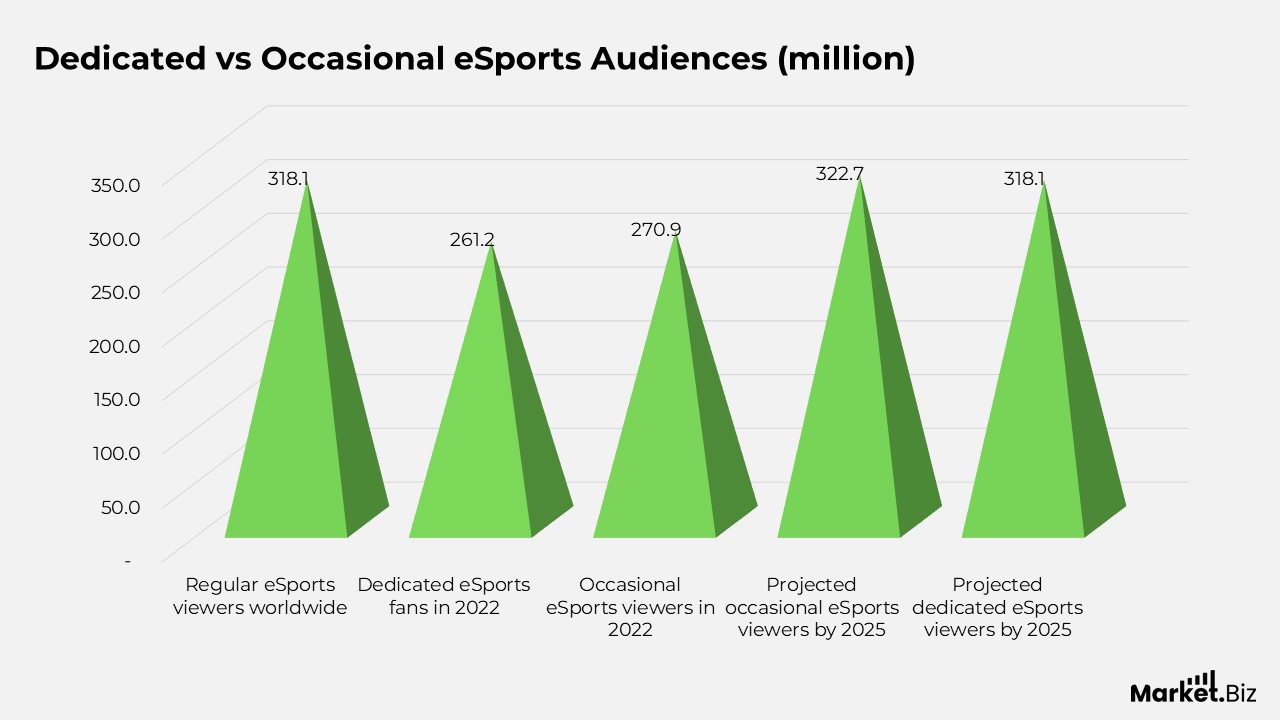
- Regular eSports viewers are estimated at 318.1 million, reflecting the growing loyalty of competitive gaming audiences.
- In 2022, eSports attracted 261.2 million dedicated fans and 270.9 million occasional viewers, confirming its transition into mainstream entertainment.
- By 2025, occasional viewership is expected to reach 322.7 million, while dedicated fans are projected to remain close to 318.1 million.
(Sources: Statista, DemandSage)
Regional Distribution of eSports Viewers
- Asia Pacific dominates global eSports viewership, accounting for over 57% of the total audience, supported by a gamer base of over 1.5 billion.
- China and the Philippines together represent approximately 40% of the global eSports fanbase.
- Europe contributes around 16% of worldwide eSports viewers, while North America accounts for 12%.
- The United States recorded nearly 45 million eSports viewers in 2023, with expectations to reach 65 million by 2028.
(Sources: Statista, DemandSage)
Record-Breaking eSports Tournament Viewership
- The League of Legends World Championship 2024 set a new benchmark with a peak viewership of 6.86 million, the highest recorded to date.
- Previous records include 6.4 million peak viewers in 2023 and 5.41 million during the Free Fire World Series 2021, highlighting consistent growth in marquee events.
(Sources: Statista, DemandSage)
eSports Market Size and Betting Trends
- The global eSports market reached a valuation of USD 2.89 billion, up from USD 1.98 billion in 2023, reflecting a 20.9% CAGR.
- Long-term projections suggest the market could reach USD 10.9 billion by 2032.
- The global eSports betting market was valued at USD 12.67 billion in 2024 and is expected to surpass USD 20 billion by 2027.
- Parallel growth in online cricket betting generated over USD 3.6 billion in 2024, supporting convergence between traditional sports fandom and eSports-style betting models.
(Sources: Statista, DemandSage)
United States eSports Market Performance
- The US eSports market surpassed USD 1.07 billion, up from approximately USD 871 million in 2023.
- With an expected CAGR of 18.7%, the market is projected to reach USD 1.51 billion by 2028.
- The US eSports user penetration rate stood at 18.7% in 2024 and is forecast to reach 23.4% by 2028, surpassing China’s penetration rate.
(Sources: Statista, DemandSage)
Revenue Streams Powering the eSports Ecosystem
- Sponsorships remain the largest revenue contributor, generating over USD 837.2 million in 2022.
- Media rights and publisher fees contributed approximately USD 338.5 million, while merchandise, tickets, digital content, and streaming further diversified revenue.
(Sources: Statista, DemandSage)
eSports Players and Professional Teams Landscape
- The United States leads globally with 3,530 energetic eSports players, followed by Brazil (1,356) and China (2,024).
- Denmark’s N0tail is the maximum-receiving male eSports player, with career earnings of approximately USD 7.18 million.
- Scarlett from Canada is the top-earning female eSports player, having earned around USD 472,110.
- Team Liquid ranks as the highest-earning professional team, with total prize winnings of USD 53.42 million.
- Among organizations, TSM leads in revenue generation, reporting USD 540 million, followed by 100 Thieves at USD 460 million.
(Sources: Statista, DemandSage)
Popular Games, Streaming, and Prize Pools
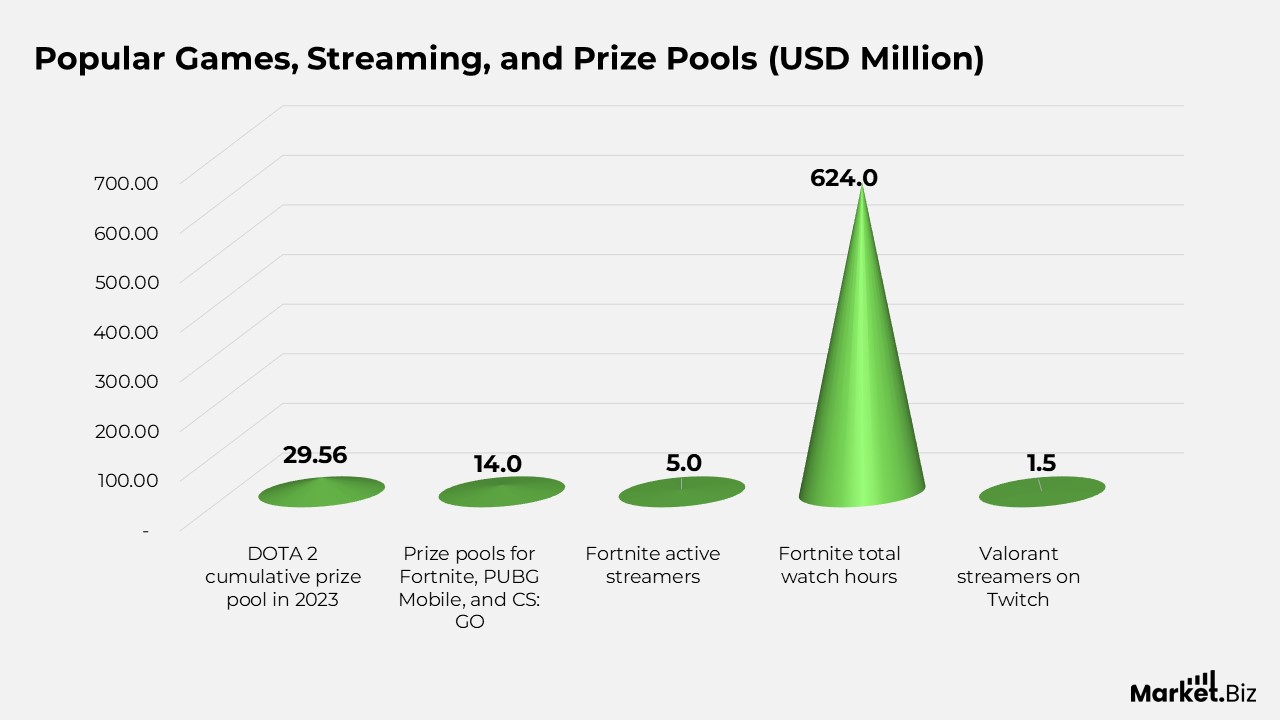
- DOTA 2 recorded the largest cumulative prize pool in 2023, totalling approximately USD 29.56 million.
- Fortnite, PUBG Mobile, and CS: GO also featured prize pools exceeding USD 14 million.
- Fortnite dominates streaming engagement, with more than 5 million active streamers and over 624 million watch hours.
- Valorant ranks second among Twitch’s most-streamed titles, with around 1.5 million streamers.
(Sources: Statista, DemandSage)
Key Demographics and Behavioral Insights
- Around 70% of eSports fans in the US are male, while approximately 28% are female.
- The average age of a US eSports viewer is 29, with an estimated ARPU of USD 16.73.
- Roughly 76% of eSports fans spend more time watching eSports than traditional sports.
- Global eSports viewership is expected to reach 1 billion users by 2025, signaling mass adoption of competitive gaming.
(Sources: Statista, DemandSage)
Growth Trend of Dedicated and Casual eSports Viewers
- In 2019, the global eSports audience included 197 million dedicated fans, alongside 200.8 million casual viewers, indicating a fairly balanced viewer base.
- Viewership expanded in 2020, with dedicated eSports fans increasing to 215.4 million and casual watchers rising to 220.5 million, reflecting broader engagement during that period.
- By 2021, regular eSports viewership reached 234 million fans, while casual audiences grew to 240 million, highlighting steady growth across both committed and occasional viewer segments.
(Sources: Statista, Play Today)
Age-wise Distribution of Regular eSports Viewers
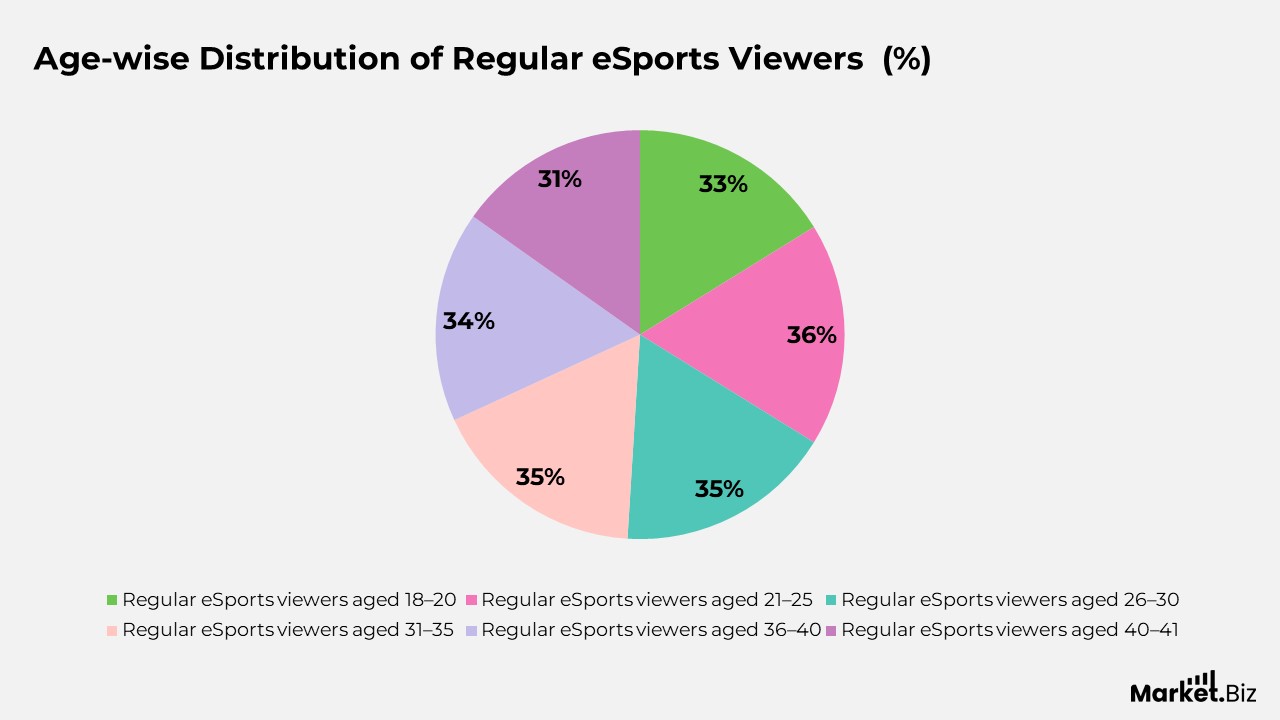
- Young adults aged 18–20 show strong engagement, with 33% identified as regular eSports viewers.
- The highest concentration of regular viewers appears in the 21–25 age group, where 36% actively follow eSports content.
- Viewership remains consistently high among individuals aged 26–30, with 35% regularly engaging with eSports.
- The 31–35 age group mirrors this trend, as 35% are regular viewers, indicating sustained interest beyond early adulthood.
- Engagement slightly tapers among viewers aged 36–40, where 34% continue to watch eSports regularly.
- Participation declines further in the 40–41 age group, though 31% remain consistent eSports viewers.
(Sources: Statista, Play Today)
Conclusion
eSports viewership statistics confirm that competitive gaming has firmly established itself as a mainstream global entertainment category. Consistent growth in both dedicated and occasional audiences, rising peak viewership for major tournaments, and strong regional dominance from Asia Pacific highlight the scale and momentum of the ecosystem. Expanding access through mobile devices, streaming platforms, and social media has further strengthened audience engagement across age groups and geographies.
At the same time, the data shows that viewership growth is closely tied to commercialization opportunities. Increasing market valuations, expanding sponsorship revenues, and the integration of betting and interactive viewing models are reshaping how audiences engage with eSports content. The United States remains a key revenue market, while Asia continues to drive audience volume, creating a balanced global growth dynamic.
Overall, eSports viewership statistics indicate a long-term shift in how digital audiences consume competitive entertainment. As production quality improves, new games enter the competitive scene, and platforms innovate around engagement, eSports is expected to continue attracting larger, more diverse audiences and strengthening its position within the global media and entertainment landscape.
FAQ’s
eSports viewership statistics show consistent year-over-year growth, with both dedicated and occasional audiences expanding across regions. Rising tournament popularity, improved streaming access, and growing interest among younger audiences continue to drive global viewership momentum.
Asia Pacific leads global eSports viewership, accounting for more than half of total viewers. High gamer populations, mobile gaming adoption, and strong esports ecosystems in countries such as China and Southeast Asian nations contribute to this dominance.
Dedicated viewers regularly watch esports events, follow teams or players, and engage deeply with competitive gaming content. Occasional viewers tune in less frequently, often for major tournaments or popular titles, but still contribute significantly to total viewership numbers.
Record-breaking peak viewership is driven by high production quality, global accessibility via streaming platforms, popular game titles, and strong community engagement. Flagship events such as world championships attract large audiences due to prestige and competitive intensity.
Growing viewership directly supports revenue expansion through sponsorships, advertising, media rights, and related digital services. Higher audience engagement increases brand interest and accelerates investment across the esports ecosystem.