









Introduction
Recipe app statistics highlight how digital cooking platforms have become an integral part of everyday meal planning and food discovery. Consumers increasingly seek convenience, healthier eating options, and personalised culinary experiences. Recipe apps have evolved from simple digital cookbooks into feature-rich platforms that offer step-by-step guidance, nutritional insights, shopping list integration, and AI-driven recommendations.
Growing smartphone penetration, busy lifestyles, and rising interest in home cooking have further accelerated adoption across age groups and regions. Overall, recipe app statistics provide valuable insight into user behavior, engagement trends, and the expanding role of technology in shaping modern cooking habits.
Editor’s Choice
- North America is projected to generate approximately USD 288.3 million in recipe app revenue by 2025. Reflecting strong regional adoption and monetization.
- The United States is expected to lead market sales, contributing around USD 209.6 million in revenue by 2025.
- Free-to-use platforms continue to dominate, with free recipe apps expected to capture nearly 60% of the market in 2025.
- User demographics skew younger: about 40% of recipe app users are in the 18–34 age group. Followed by 35% aged 35–54, and 25% aged 55 or older.
- The US market is highly saturated and diverse, with more than 500 recipe apps currently available to consumers.
- Product innovation remains strong, with roughly 40% of companies launching updated versions that include AI-powered recipe recommendation features.
- Personalised recipe app businesses offer attractive income potential, with annual earnings typically ranging from USD 50,000 to USD 150,000.
- Recipe apps continue to gain popularity by simplifying meal preparation, improving organization, and reducing cooking time.
- Mobile device dependency during cooking is high. With nearly 60% of adults keeping a smartphone or tablet nearby while preparing meals.
- Health-focused functionality influences adoption: about 50% of users prefer apps that provide detailed nutritional information.
(Sources: Statista, Eletroiq)
Recipe App Usage and Engagement Trends Shaping the Digital Cooking Ecosystem
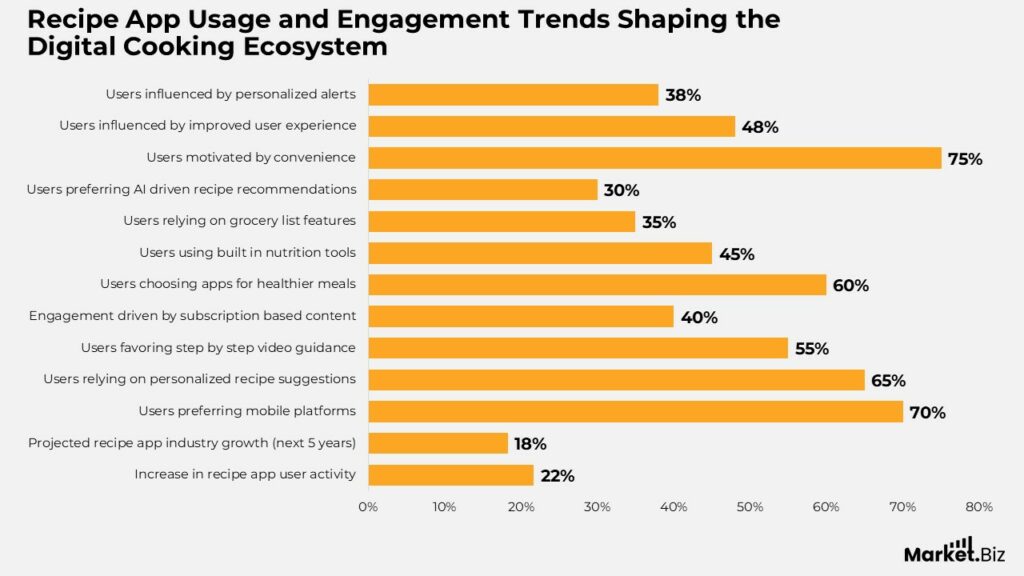
- Recipe app usage has accelerated sharply, with overall user activity increasing by 21.7% over the past year, indicating rising reliance on digital cooking tools.
- Long-term momentum remains strong, as the recipe app industry is projected to grow by 18.3% over the next five years.
- In the US app ecosystem, recipe platforms dominate free downloads. Accounting for 91 of the top 100 free apps, while only 9 fall under fully paid categories.
- User engagement is consistent, with US consumers spending an average of 25 minutes per day using recipe applications.
- Mobile-first behaviour shapes the market, with more than 70% of users preferring smartphones for meal planning and ingredient tracking.
- Personalization features are widely adopted, with over 65% of users relying on tailored recipe suggestions and nearly 55% favouring step-by-step video guidance.
- Subscription-based content plays a major role, driving around 40% of overall engagement across recipe platforms.
- Health and wellness use cases are prominent, with more than 60% of users turning to recipe apps for healthier meal choices and 45% using built-in nutrition tools.
- Social features significantly influence usage, with nearly 50% of interactions tied to sharing recipes or content with others.
- Practical utilities continue to attract users, as 35% rely on grocery list features and 30% prefer AI-driven recipe recommendations.
- New user adoption is largely convenience-driven, with 75% citing ease of use as the primary motivation, followed by 48% influenced by improved user experience and 38% by personalized alerts.
(Sources: Statista, Eletroiq)
Personalization and Feature Innovation Driving Recipe App Adoption
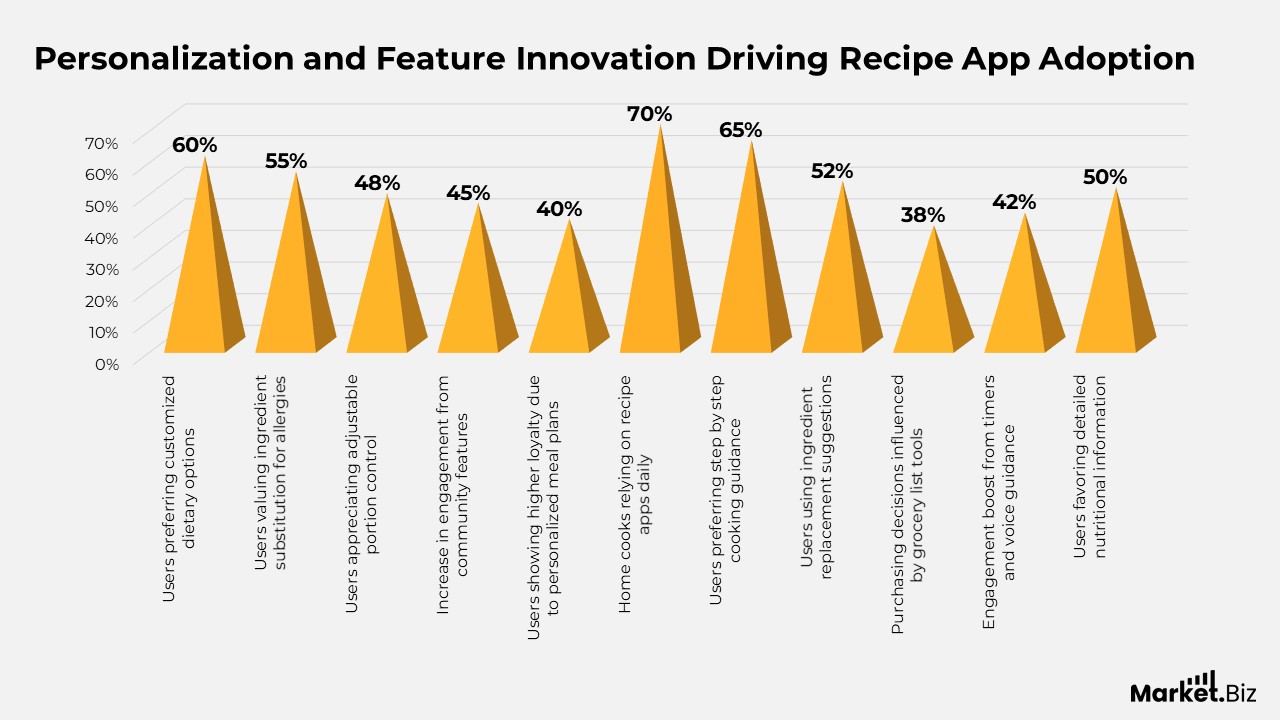
- Personalised dietary support is a key differentiator, with over 60% of users preferring recipe apps that offer customised diet options.
- Allergy-aware functionality is in demand, as around 55% of users value ingredient substitution features.
- Portion-control tools enhance usability, with 48% of users appreciating adjustable serving sizes.
- Community-driven design increases engagement, as social interaction features lift user activity by 45%.
- Personal meal planning strengthens retention: 40% of users show higher loyalty when apps offer customised meal plans.
- Digital dependency is growing among home cooks, with more than 70% now relying on recipe apps for daily meal preparation.
- Guided cooking experiences remain essential, as 65% of users prefer step-by-step instructions.
- Ingredient flexibility supports adoption, with 52% of users using replacement suggestions.
- Shopping behaviour is influenced by in-app tools, with grocery list integration affecting nearly 38% of purchasing decisions.
- Interactive features such as timers and voice guidance boost engagement levels by 42%.
- Nutritional transparency continues to matter, with 50% of users favouring apps that provide detailed nutritional information.
(Sources: Statista, Eletroiq)
Recipe App Revenue Trends by Monetization Model
- Revenue from free recipe apps is projected to grow steadily from USD 567.5 million in 2025 to approximately USD 1,306.4 million by 2032, driven by strong user adoption of ad-supported and freemium models.
- Paid recipe apps are also expected to show consistent growth, increasing from USD 276.5 million in 2025 to around USD 973.6 million by 2032, driven by premium features, subscriptions, and personalised content offerings.
- The widening revenue gap between free and paid apps highlights the continued dominance of free platforms, while paid apps gain traction through value-added services and advanced functionality.
(Sources: Statista, Eletroiq)
Recipe App Market Sales by Region
- North America is projected to generate USD 288.315 million in recipe app revenue by 2025, with the market size expected to reach about USD 732.192 million by 2033, supported by a CAGR of 12.356% driven by advanced digital adoption in the US and Canada.
- Europe is estimated to record USD 207.855 million in 2025, growing to nearly USD 546.382 million by 2033 at a CAGR of 12.84%, supported by digital modernization initiatives and strong uptake in Germany, France, and the UK.
- Asia Pacific is forecast to expand from USD 160.92 million in 2025 to around USD 488.128 million by 2033, posting the fastest CAGR of 14.88% due to rapid digital transformation across China, Japan, and India.
- South America is expected to grow from USD 38.74 million in 2025 to approximately USD 108.473 million by 2033, reflecting a CAGR of 13.74% supported by rising technology investments, particularly in Brazil.
- The Middle East market is projected to increase from USD 29.055 million in 2025 to about USD 82.359 million by 2033, with a CAGR of 13.91%, driven by government-led digital infrastructure programs in the Gulf region.
- Africa is anticipated to expand from USD 20.115 million in 2025 to nearly USD 51.223 million by 2033, registering a CAGR of 12.39% as digital adoption improves in countries such as South Africa, Nigeria, and Kenya.
(Sources: Statista, Eletroiq)
Conclusion
Recipe app statistics underscore a clear shift toward digital solutions in everyday cooking and meal planning. Growing usage across both free and paid platforms reflects strong consumer demand for convenience, personalisation, and mobile-friendly experiences. Steady revenue growth projections indicate that recipe apps are evolving from basic content libraries into dynamic platforms supported by subscriptions, advertising, and advanced features.
Regional trends reveal balanced global expansion, with North America and Europe providing stable revenue foundations. At the same time, Asia Pacific leads in growth momentum, driven by rapid digital adoption and changing dietary habits.
The increasing use of AI-driven recommendations, nutritional tracking, and interactive cooking tools continues to strengthen user engagement and long-term retention.
Taken together, recipe app statistics point to a resilient and innovative market. As users place greater emphasis on healthier choices, efficiency, and personalized guidance, recipe apps are expected to play an increasingly important role in shaping modern food consumption and lifestyle behavior worldwide.
FAQ’s
Recipe app statistics show consistent growth driven by rising smartphone usage. Increased interest in home cooking, and demand for convenient, personalised meal-planning tools. Expanding revenue from both free and paid apps reflects strong long-term market potential.
Free recipe apps attract a larger user base due to their easy accessibility and ad-supported models. Many users prefer to try features at no cost, while paid versions gain adoption through premium content, personalisation, and advanced tools.
Personalisation plays a major role in user engagement, as features such as tailored recipes, dietary preferences, allergy filters, and portion control improve relevance and retention. Statistics show higher loyalty and interaction when personalized options are available.
North America and Europe maintain strong revenue positions, while Asia Pacific demonstrates the fastest growth due to rapid digital adoption, changing lifestyles, and increasing mobile usage across emerging markets.
Step-by-step cooking guidance, nutritional information, grocery list integration, AI-powered recommendations, and interactive tools such as timers and voice instructions are among the most valued features influencing user engagement.