









Introduction
Heat Exchanger Statistics: Heat exchangers are essential components in numerous industries, facilitating the efficient transfer of heat between fluids without any direct contact. They serve various applications such as heating, cooling, and temperature regulation, which include HVAC systems, power generation, and chemical processing. These devices enable heat to pass through solid barriers or plates, effectively separating hot and cold fluids.
Common varieties consist of shell, plate, tube, and finned tube heat exchangers. It is crucial to perform regular maintenance to maintain their efficiency. Issues like fouling and corrosion can significantly impact their performance. Heat exchangers are integral to a wide range of industrial processes. Making it imperative for professionals in related fields to grasp their fundamental principles.
Editor’s Choice
- The heat exchanger market is expected to experience consistent growth over the next decade, with a compound annual growth rate (CAGR) of 6%.
- Aluminium, possessing an 18% market share, is also a significant player, celebrated for its lightweight characteristics and affordability.
- In 2022, Europe is positioned to assume a leading role in the global market, capturing a significant 31.9% share.
- The use of shell-and-tube heat exchangers can significantly reduce temperatures, typically by 30% to 40%.
- The outer diameter (OD) of the tubes ranges from 0.031 to 0.052 feet or 0.375 to 0.625 inches.
- Chilled water functions efficiently within the temperature range of 5 to 12°C. Rendering it appropriate for cooling applications below ambient temperatures.
General Heat Exchanger Statistics
- The heat exchanger market is expected to experience consistent growth over the next decade, with a compound annual growth rate (CAGR) of 6%.
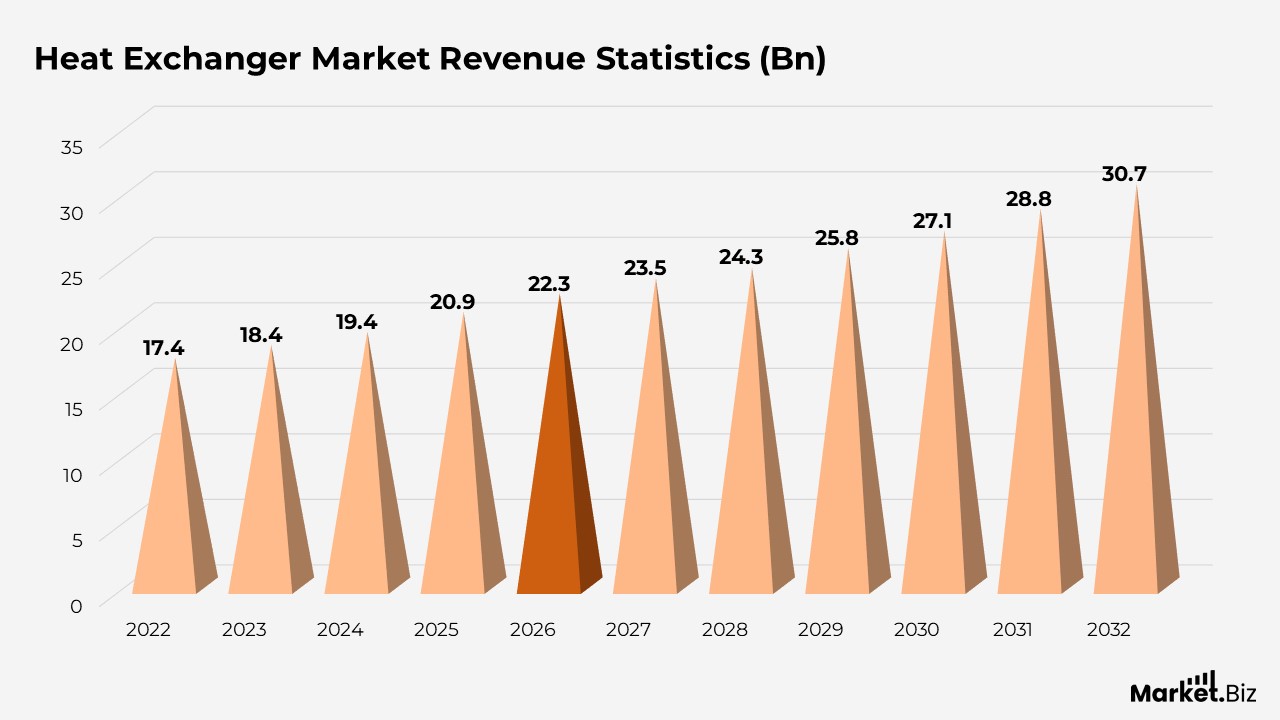
- In 2022, the heat exchanger market generated revenue amounting to $17.4 billion, which is projected to rise to $30.7 billion by 2032.
- Among the different product categories, in 2022, Shell and Tube Heat Exchangers represented USD 6.2 billion. Plate and Frame Heat Exchangers accounted for USD 4.9 billion. Air-Cooled Heat Exchangers generated USD 3.4 billion, and Other Products totalled USD 2.8 billion.
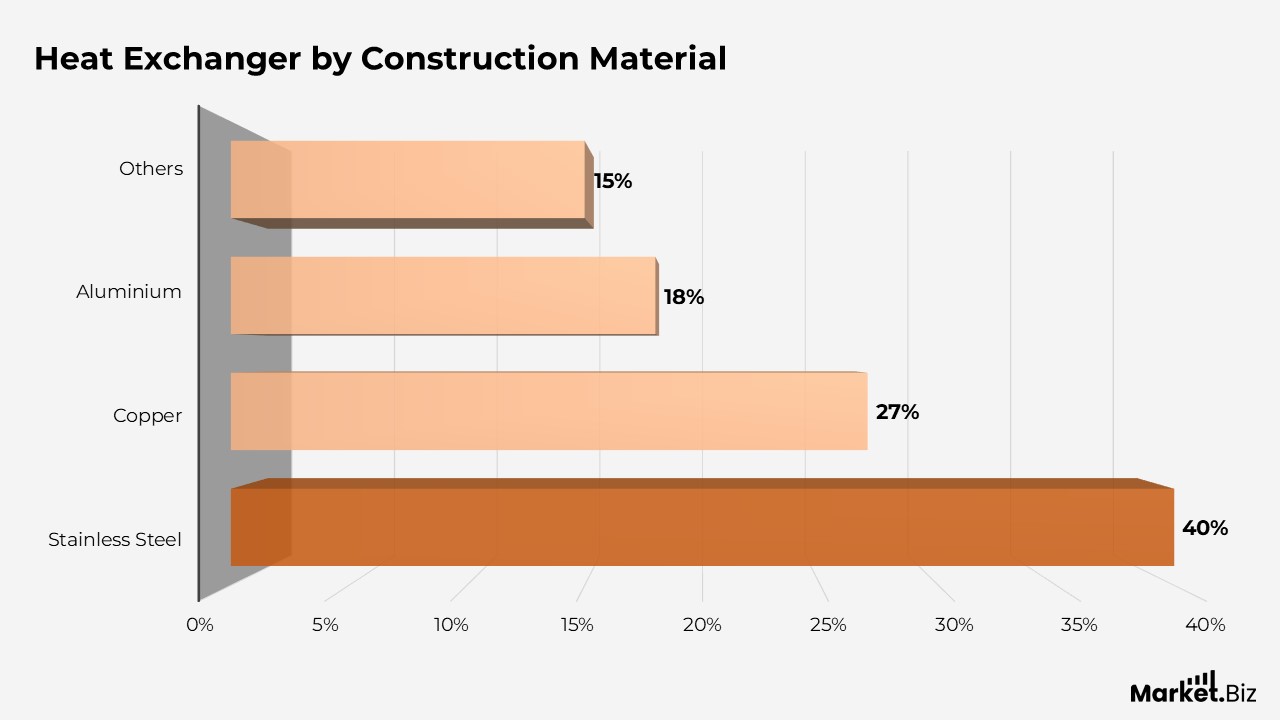
- Stainless steel stands out as the leading material in this industry, holding a substantial 40% market share. Its popularity can be attributed to its durability, corrosion resistance, and versatility for various applications.
- In 2022, Europe is expected to lead the global market, capturing a significant 31.9% share.
- The use of shell-and-tube heat exchangers can effectively reduce temperatures by a considerable margin, typically between 30% and 40%.
- Thrust plates utilised in heat exchangers are required to have a minimum thickness of 18 millimetres.
Statistics of the Heat Exchanger Market Size
- In 2022, the market achieved a revenue of $17.4 billion, which is expected to show steady growth in the coming years.
- In 2023, the revenue is projected to rise to $18.4 billion, reflecting a slight but encouraging growth trend.
- This pattern persists with revenues of $19.4 billion in 2024 and $20.9 billion in 2025, indicating a gradual increase in market development.
- As we move further into the future, the heat exchanger market is anticipated to experience more substantial growth, with revenues of $22.3 billion in 2026, $23.5 billion in 2027, and $24.3 billion in 2028.
- By 2029, the market is expected to surpass the $25 billion mark, reaching $25.8 billion in revenue.
Heat Exchanger by Product Statistics
- In 2022, the overall market revenue was recorded at USD 17.4 billion.
- Among the different product categories, Shell & Tube Heat Exchangers contributed USD 6.2 billion. Plate & Frame Heat Exchangers contributed USD 4.9 billion. Air-Cooled Heat Exchangers contributed USD 3.4 billion, and Other Products contributed USD 2.8 billion.
- In the coming decade, the market is anticipated to experience significant growth. By 2032, the total market revenue is projected to reach USD 30.7 billion, indicating considerable expansion.
- Shell and Tube Heat Exchangers are expected to retain their leading position. With revenues projected to hit USD 11.0 billion, followed by Plate and Frame Heat Exchangers at USD 8.7 billion, Air-Cooled Heat Exchangers at USD 6.1 billion, and Other Products at USD 4.9 billion.
Construction Material By Heat Exchanger
- Stainless steel stands out as the leading material in this industry, holding a substantial 40% market share. This preference is due to its strength, resistance to corrosion, and versatility across multiple applications.
- Copper closely trails with a 27% share of the market, recognized for its superior thermal conductivity and efficiency.
- Aluminium, possessing an 18% market share, is also a significant player, celebrated for its lightweight characteristics and affordability.
- The remaining 15% is comprised of other materials, highlighting the market’s flexibility in meeting diverse industry needs.
Heat Exchanger by Regional Statistics
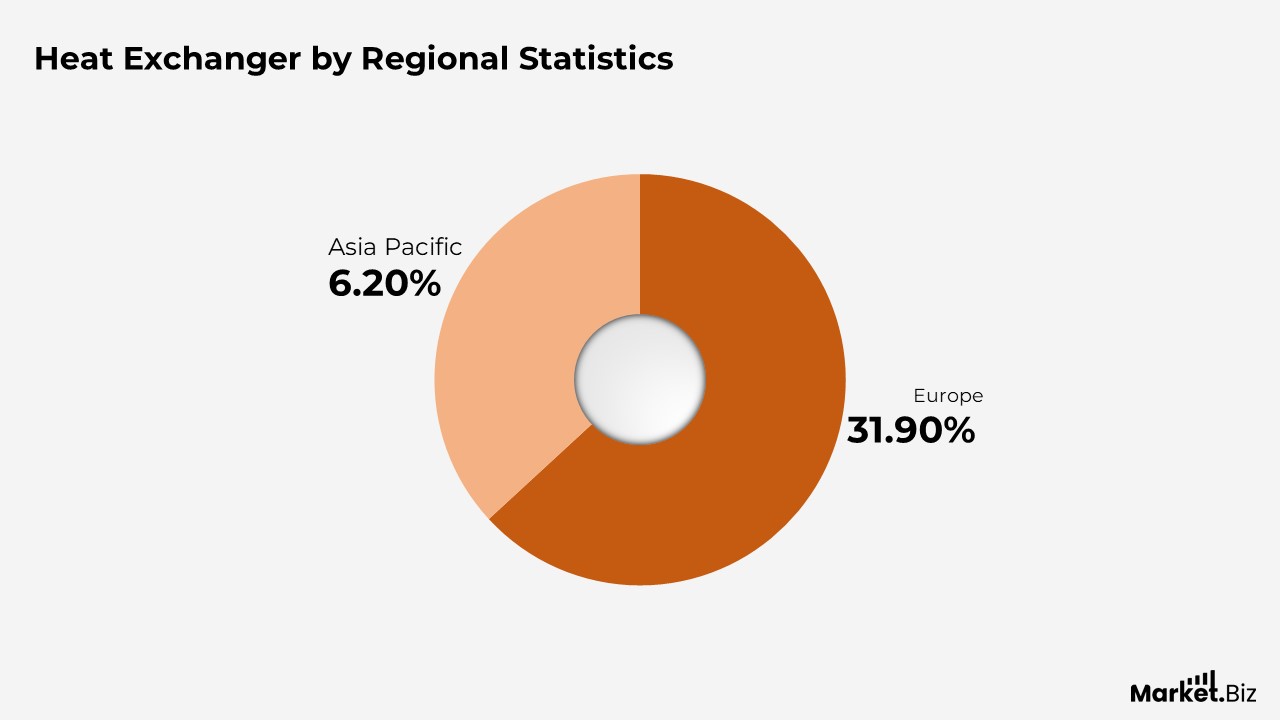
- In 2022, Europe is positioned to assume a leading role in the global market, capturing a significant 31.9% share.
- This leadership is a result of continuous investments in infrastructure from both public and private sectors, which are driving an increasing demand for these products.
- At the same time, North America, especially the United States and Canada, is anticipated to see a marked increase in product demand, primarily due to heightened oil and natural gas exploration activities.
- In the Asia Pacific region, the heat exchanger market is projected to experience a strong growth of 6.2% during the forecast period.
Shell and Tube Heat Exchanger Statistics
- The use of shell-and-tube heat exchangers can significantly reduce temperatures, typically by 30% to 40%.
- The inner diameter of the shell is 66 millimetres, whereas the outer diameter is slightly larger at 70 millimetres. In comparison, the tubes have an inner diameter of 12 millimetres and an outer diameter of 13 millimetres.
- These geometric dimensions are essential for assessing the efficiency of heat exchange and the overall performance of the heat exchanger.
- Furthermore, it is important to highlight that the construction materials consist of steel for the shell and copper for the tubes, which can affect the heat transfer properties and the durability of the heat exchanger.
- On the shell side, the fluid utilised is oil, entering at an inlet temperature of 60 degrees Celsius. Conversely, the tube side features water as the fluid, which enters the heat exchanger at a lower temperature of 27 degrees Celsius.
- Moreover, the flow rates vary considerably, with the oil on the shell side flowing at rates of 300, 420, and 540 litres per hour, while the water on the tube side maintains a steady flow rate of 180 litres per hour.
Finned Tube Heat Exchanger Statistics
- The specifications for finned tube heat exchangers featuring a plain fin pattern include a variety of parameters.
- These heat exchangers may consist of one to four rows of fins.
- The outer diameter (OD) of the tubes ranges from 0.031 to 0.052 feet or 0.375 to 0.625 inches.
- The fin pitch, which denotes the number of fins per foot or inch, is between 96 and 168, equivalent to 8 to 14 fins per inch.
- The spacing between the tubes, measured in feet or inches, ranges from 0.083 to 0.125 feet or 1 to 1.5 inches.
- These specifications are essential for the design and selection of finned tube heat exchangers that are customised to meet specific heat transfer needs and applications.
- The finned tube heat exchanger coil possesses defined parameters that determine its design and operational capabilities.
- It has a frontal height of 18 inches and a frontal width of 18 inches. The coil comprises six circuits, with each row in every circuit containing three tubes.
- The coil is positioned with a vertical face orientation, and the outer diameter of the tubes is 0.375 inches. The tubes are arranged vertically, and their configuration is staggered.
- The transverse spacing between the tubes is 1 inch, while the longitudinal spacing measures 0.77 inches.
Common Cooling-Media Applications
- Chilled water functions efficiently within the temperature range of 5 to 12°C, rendering it appropriate for cooling applications below ambient temperatures.
- Cooling water, conversely, operates within a wider spectrum of 32 to 60°C, encompassing ambient temperatures and reaching up to 100°C.
- Air cooling, at atmospheric conditions, is mainly effective for temperatures exceeding 60°C.
Heat Exchanger Recent Development
- Moreover, Danfoss finalised its acquisition of BOCK GmbH, a prominent producer of natural refrigerant compressors, for $200 million in late 2023.
- Further, in mid-2023, SWEP introduced the B5T heat exchanger, intended for refrigeration and HVAC applications.
- In early 2024, Thermofin, a manufacturer of heat exchangers and refrigeration equipment, obtained $100 million to invest in research and development as well as to enhance its production facilities.
Conclusion
Heat exchangers play a crucial role in numerous industries by facilitating efficient heat transfer between different fluids. They are available in a variety of types and designs, customized to meet specific requirements dictated by temperature, fluid properties, and available space. Moreover, properly designed and maintained heat exchangers can greatly enhance energy efficiency, reduce operational costs, and promote environmental sustainability.
However, issues such as fouling, corrosion, and maintenance require careful consideration. In a time of rapid technological progress and changing industry demands, heat exchangers continue to be essential in thermal engineering, ensuring effective heat utilization across various processes.
FAQ’s
Heat exchangers are engineered to endure considerable thermal stress; however, they are not everlasting. Various factors can lead to the formation of cracks over time: Age and Normal Wear. The typical lifespan of a heat exchanger ranges from 10 to 20 years, contingent upon usage patterns and maintenance practices.
Shell-and-tube heat exchangers are commonly utilized due to their durability. They facilitate heat transfer between process fluids and cooling media such as water or air. Additionally, shell-and-tube heat exchangers play a crucial role in gas processing, condensing, or vaporizing gases at various stages.
The fluids within heat exchangers generally flow swiftly to enhance the transfer of heat through forced convection. This swift flow leads to pressure losses in the fluids. The efficiency of heat exchangers is defined by their ability to transfer heat in relation to the pressure loss experienced.