









Introduction
Influencer Marketing Statistics: Influencer marketing has become a vital component of modern advertising strategies, largely due to the rapid growth of social media platforms and the shift toward digital content consumption. Brands are increasingly partnering with influencers to reach their target audiences more authentically, as influencers are seen as trusted voices within their communities.
This form of marketing is particularly effective in driving brand awareness, engagement, and consumer loyalty. With influencers leveraging their credibility and direct connections with followers, they can influence purchasing decisions, shape perceptions, and foster stronger relationships between brands and their audiences.
The growing popularity of micro and nano influencers, who engage with niche communities, has further amplified the impact of influencer marketing. As the landscape continues to evolve, influencer marketing is poised to remain a vital tool for brands aiming to connect with consumers in a more personal and engaging way.
Editor’s Choice
- The influencer marketing industry is projected to reach US$24 billion in the coming years.
- Over 69% of consumers trust recommendations made by influencers.
- For every $1 invested in influencer marketing, businesses see a return of $6.50.
- The AI influencer market is anticipated to reach US$1.5 billion by 2025.
- Global spending on influencer marketing ads is expected to hit US$35.09 billion.
- 19% of brands collaborate with 10 to 50 influencers, while 15.2% engage 50 to 100 influencers for their campaigns.
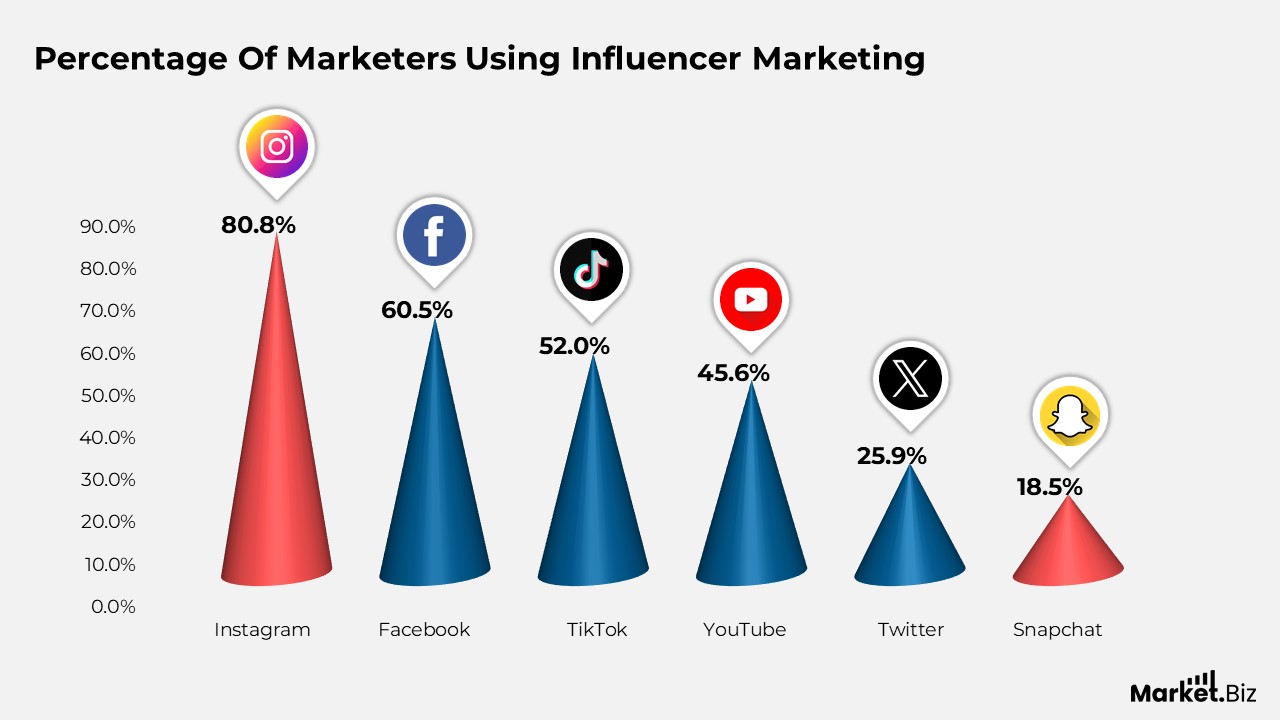
- 80.8% of marketers leverage Instagram for their influencer marketing campaigns.
- The cost of influencer marketing campaigns can range from $10,000 to $500,000.
- Influencer content is perceived as more authentic and persuasive, with 46.7% of marketers finding it more effective than brand-generated content.
- 83% of influencers are willing to collaborate for free products, though this is not the most preferred form of compensation.
- The use of free products as influencer payment has increased 5 times from 2022 to the previous year.
- Brands prefer micro-influencers over mega-influencers 10 times more often.
- Facebook is the least favored platform by Gen Z, with only 3% selecting it as their preferred choice.
- 49.6% of influencer payments are made through a percentage of sales, despite only 4% of influencers preferring this payment method.
- Gen Z is the most receptive age group to influencer marketing.
- Nanoinfluencers have the highest engagement rates among influencers with various follower counts.
- Nearly half of internet users globally are utilizing ad-blocking software.
- Women are more likely than men to make a purchase based on an influencer’s recommendation.
- Trust in influencers decreases with age, with older internet users showing less confidence in them.
Types of Influencers
- Nano influencers normally have between 1,000 and 10,000 followers.
- Micro-influencers usually have a follower count ranging from 10,000 to 100,000.
- Macro influencers are individuals with followers ranging from 100,000 to 1 million.
- Mega influencers boast follower counts of over 1 million.
- All-Star influencers (celebrities) have followers exceeding 2 million.
(Source: DemandSage, Statista)
General Influencer Marketing Statistics
- Influencer marketing is expected to reach a US$24 billion industry by the end of 2024.
- 56% of businesses invest in influencer campaigns to generate user-generated content (UGC), with 23% focused on generating sales.
- Businesses prefer working with nano (44%) and micro (26%) influencers over celebrities and macro influencers.
- Approximately 25% of influencers purchase fake followers.
- 93% of influencers are willing to collaborate for free products if they love the brand.
- By 2025, influencer marketing spending is projected to reach $ 9.29 billion.
- 60% of brands work with more than 10 influencers in their campaigns.
- Paying influencers is now the norm for 41% of businesses, while 31% offer free products as compensation.
- 59.4% of businesses that budget for influencer marketing plan to increase their budgets over the next 12 months.
- 56% of businesses use influencer campaigns primarily for creating User-Generated Content.
- In 2024, 84.8% of marketers consider influencer marketing effective, a slight increase from 83% in 2023, but a drop from 90% in 2022.
- In 2024, 63.2% of brands utilized the same influencers across different campaigns, indicating an increased preference for maintaining ongoing relationships with influencers.
Moreover
- 53% of Gen Z and Millennial consumers are likely to purchase products based on recommendations from their favourite influencers.
- Brands are collaborating with 33% more micro-influencers each year.
- The primary goals for influencer campaigns are to generate user-generated content (56%) and drive sales (23%).
- In 2024, 37.6% of brands collaborated with up to 10 influencers, while 14.7% worked with more than 1,000.
- Over the past year, 87% of the content requested from micro-influencers was in the form of short videos, such as TikTok and Instagram Reels.
- For micro-influencers, the primary campaign goals are repurposing content for ads (22%), brand awareness (65%), and increasing in-store sales (13%).
- 63% of marketers plan to incorporate AI into their influencer campaigns.
- The most effective micro-influencer videos on TikTok and Instagram Reels typically last between 20 and 40 seconds.
- In the US, 52% of social media users follow a virtual influencer.
- Of those marketers using AI, 55.8% will use it for influencer identification, 18.6% for content distribution, and 5.7% to detect fake influencers.
- Videos with voiceovers on Instagram and TikTok Reels tend to receive more views than those without voiceovers.
- 22% of marketers consider influencer marketing the most cost-effective customer acquisition channel.
- In 2024, 62.2% of marketers have used virtual influencers, up from 60.4% in 2023.
- Over half of influencers report facing discrimination online, with TikTok being the most problematic platform, accounting for nearly 60% of incidents.
- 23.8% of social media users aged 16-64 watch influencer videos and vlogs on a weekly basis.
(Source: Influencer Marketing Hub, Dash App, Shopify, Statista, Traackr, Statusphere, Meltwater, Convince & Convert, Harvard Business Review)
Aims of Influencer Marketing Campaigns
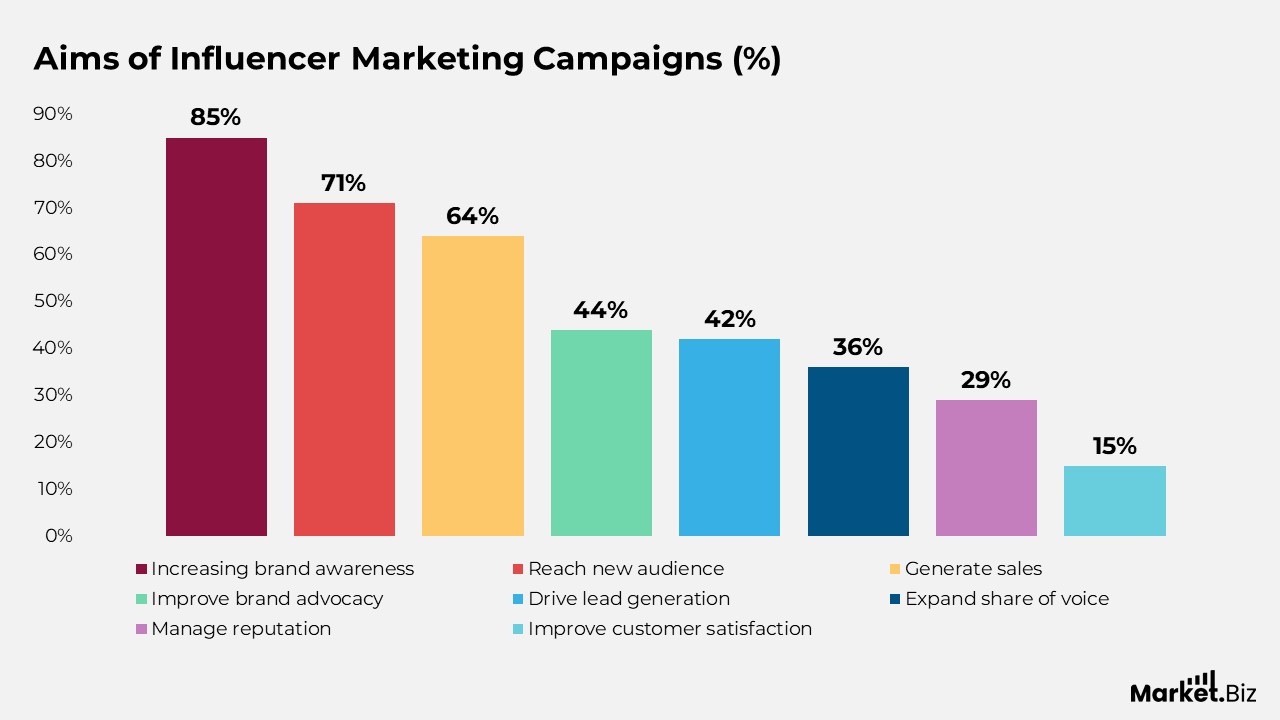
- 85% of marketers prioritize increasing brand awareness, enabling them to connect with a broader audience and strengthen brand recall.
- 71% of marketers seek to expand their audience base by collaborating with influencers who have built trust within specific niche communities.
- 64% of campaigns are designed to boost sales, leveraging influencer recommendations to drive conversions and increase revenue.
- 44% of marketers aim to enhance brand advocacy by motivating influencers to represent their products, turning them into credible advocates for the brand.
- 42% of influencers are used for lead generation, employing creative calls-to-action and exclusive deals to attract qualified prospects for future sales.
- 36% of campaigns focus on amplifying share of voice, positioning influencers as vital players in strengthening the brand’s presence in a competitive market.
- 29% of influencer marketing initiatives aim to manage a brand’s reputation, with influencers playing a role in protecting or improving the brand image during a crisis or rebranding phase.
- 15% of brands collaborate with influencers to enhance customer satisfaction, offering valuable insights and reinforcing positive experiences to foster customer loyalty.
(Source: BloggingX, Shopify, Statista)
Cost of Influencers
- Nano-influencers typically charge between $2 and $250 per social media post. For sponsored content, the rates are approximately:
- US$10 to US$100 for an Instagram postUS$20 to US$200 for a YouTube videoUS$5 to US$25 for a TikTok videoUS$2 to US$20 for an X post
- US$25 to US$250 for a Facebook post
- Micro-influencers with up to 100,000 followers charge higher rates, typically ranging from US$25 to US$1,250 per post. Expected rates include:
- US$100 toUS$500 for an Instagram postUS$200 toUS$1,000 for a YouTube videoUS$25 toUS$125 for a TikTok videoUS$20 toUS$100 for an X post
- US$250 to US$1,250 for a Facebook post
- Mega-influencers, including celebrities with more than 1 million followers, command premium rates for sponsored content, with charges typically above US$1,000. Estimated fees include:
- US$10,000+ for an Instagram post
- US$20,000+ for a YouTube video
- US$2,500+ for a TikTok video
- US$2,000 for an X post
- US$25,000 for a Facebook post
(Source: Influencer Marketing Hub, Shopify)
Virtual Influencers Market Size
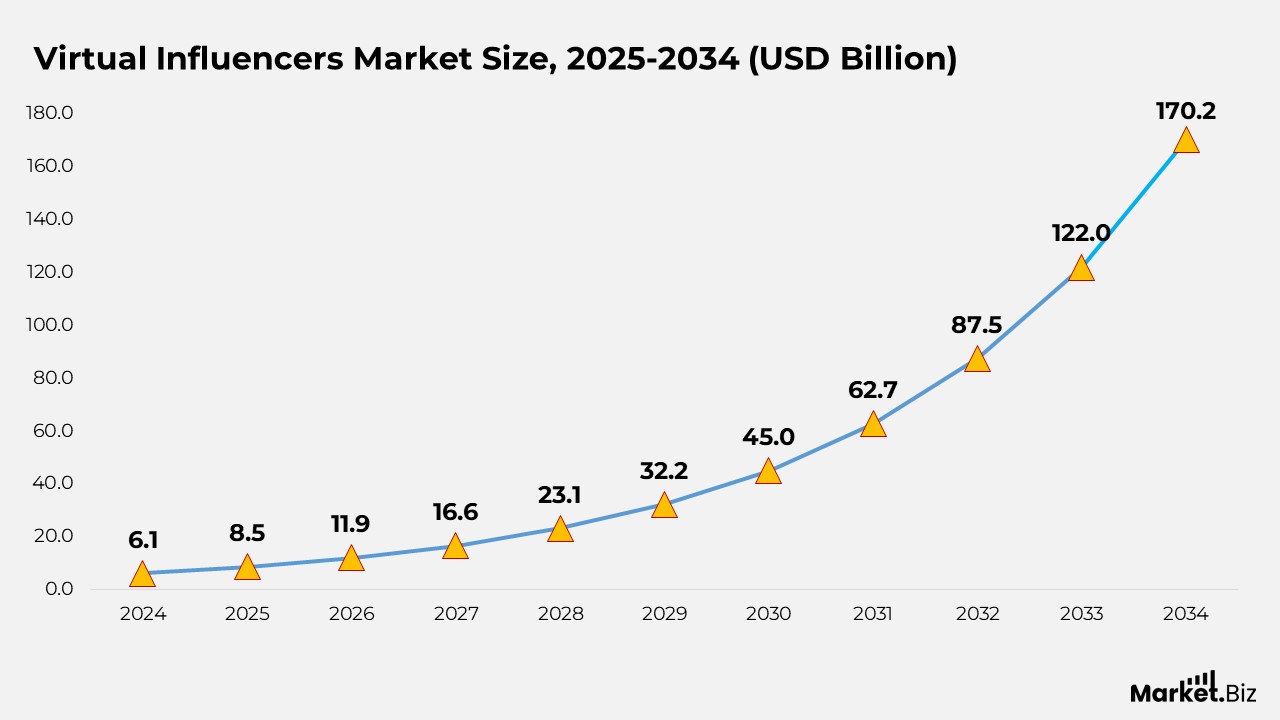
- According to Market.us, the global virtual influencers market is projected to grow from $8.5 billion in 2025 to $170.2 billion by 2034, representing a compound annual growth rate (CAGR) of 39.5% from 2025 to 2034.
- The rapid expansion of the virtual influencer market is driven by the increasing use of social media platforms for marketing purposes.
- In 2024, the human avatar segment dominated the virtual influencer market, capturing over 65% of the market share due to demand for realistic and relatable digital personalities.
- The solutions segment led the global virtual influencers market in 2024, holding more than 57% of the market share, driven by demand for innovative, integrated marketing solutions.
- Fashion & lifestyle held a significant position in the virtual influencer market in 2024, accounting for over 30% of the market share due to its quick adoption of virtual influencers as trendsetters and brand ambassadors.
- North America captured more than 40% of the global virtual influencer market in 2024, driven by high consumer engagement and a strong focus on innovative marketing strategies.
- The US virtual influencers market was valued at USD 2.3 billion in 2024, with a CAGR of 31.58%, driven by a focus on authenticity and sustainability in marketing.
- 58% of individuals follow at least one virtual influencer, highlighting the growing popularity of this digital trend, with content, storytelling, and inspiration as key reasons for following.
- A study by the UK government revealed that 10% of female consumers purchase counterfeit goods endorsed by social media influencers, raising concerns about the influence of online personalities.
- 75% of Gen Z consumers are particularly engaged with virtual influencers, with 35% having purchased products promoted by them.
- 24% of users were unaware of the existence of virtual influencers, presenting an opportunity for increased awareness in the market.
(Source: Market.us)
Digital Marketing Software Market Size
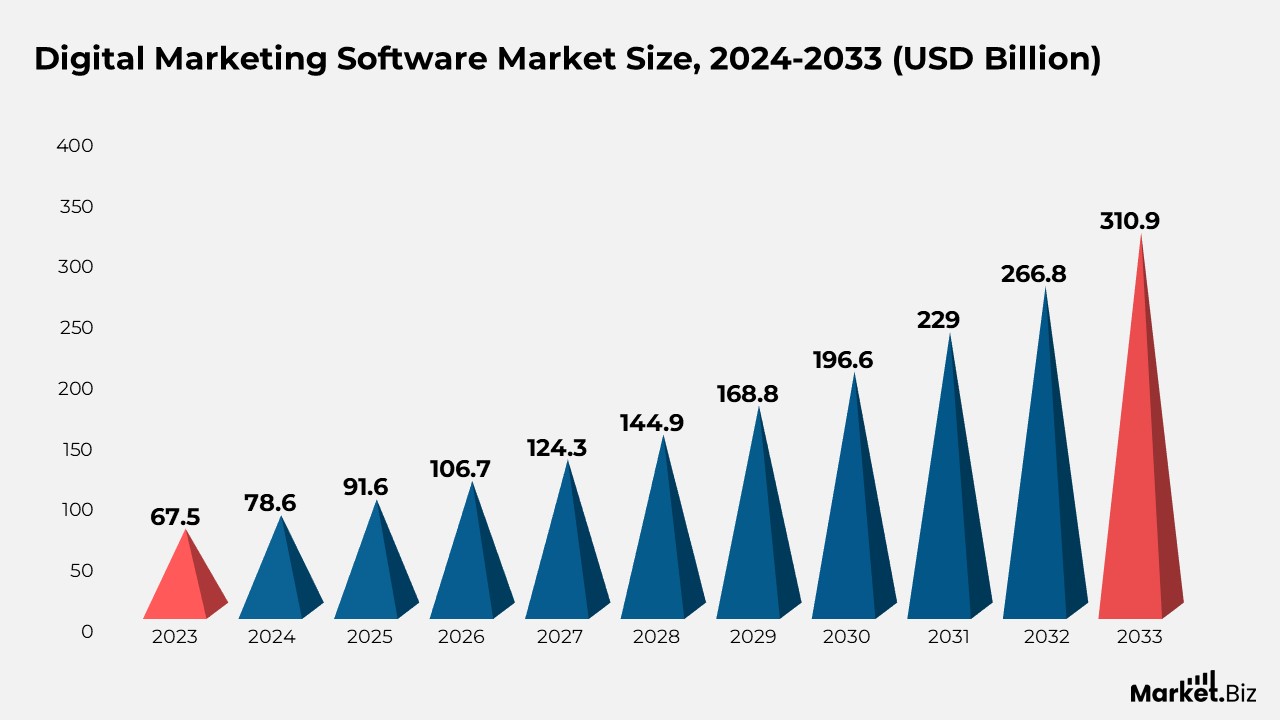
- According to Market.us, the global digital marketing software market is projected to grow from $78.6 billion in 2024 to $310.9 billion by 2033, representing a compound annual growth rate (CAGR) of 16.5% from 2024 to 2033.
- The increasing adoption of digital marketing strategies across various industries drives the growth of the digital marketing software market.
- In 2023, the cloud segment dominated the digital marketing software market, capturing more than 58.4% of the market share due to the flexibility, scalability, and cost-effectiveness of cloud solutions.
- In 2023, the email marketing segment held a dominant market position, capturing more than 31.2% of the market share, largely due to its effectiveness in personalized direct communication.
- In 2023, the large enterprises segment led the market, holding more than 52.4% of the share due to extensive resources and budgets for comprehensive digital marketing solutions.
- In 2023, the BFSI (Banking, Financial Services, and Insurance) sector dominated the digital marketing software market, capturing more than 21.4% of the market share, driven by the need for personalized customer engagement.
Moreover
- Digital display advertising is projected to grow at a CAGR of 15.5%, outpacing search advertising at 12.2%, though search still leads with 40.9% of the global digital advertising market.
- 63% of businesses have improved their digital marketing budgets in recent years, representing a surge in investment in this area.
- 94% of small businesses plan to increase their marketing expenditures in 2024, part of a broader trend of digital marketing budget growth by 10% from 2023 to 2024.
- 72% of overall marketing budgets are allocated to digital marketing, with an estimated 60% of all marketing spending expected to be digital by the end of 2024, indicating a shift away from offline media.
- The demand for marketing professionals, particularly in digital marketing, is on the rise, with a projected 10% increase in marketing job demand by 2026 and a 6% increase in digital marketing job opportunities by 2032.
(Source: Market.us)
Instagram Influencer Marketing Statistics
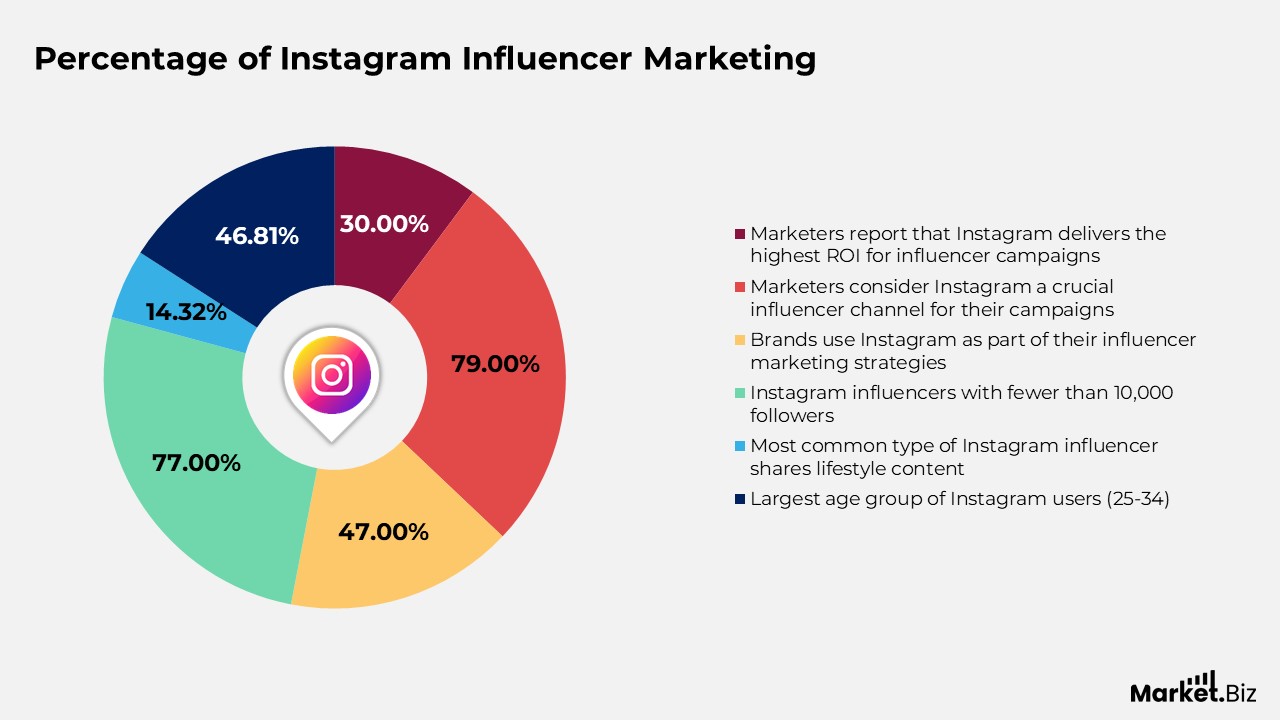
- 30% of marketers report that Instagram delivers the highest ROI for influencer campaigns.
- 79% of marketers consider Instagram a crucial influencer channel for their campaigns.
- 47% of brands use Instagram as part of their influencer marketing strategies.
- Nearly 77% of Instagram influencers have fewer than 10,000 followers.
- The most frequent niche for Instagram influencers from 2020 to 2022 was lifestyle.
- The majority of influencers on Instagram are nano-influencers.
- The most common type of Instagram influencer shares lifestyle content, making up 14.32% of the platform’s influencers.
- For every US$1 spent on Instagram influencer campaigns, companies are estimated to generate around US$4 in sales.
- The largest group of Instagram users is aged 25-34, comprising 46.81% of the platform’s user base.
- Instagram’s brand value is currently estimated at US$47.4 billion.
- Instagram influencers worldwide charge between $20 and $ 7,000 or more per post.
- On average, brands publish around 4.7 posts per week on Instagram.
(Source: HypeAuditor, Sixth City Marketing, Influencer Marketing Hub, HubSpot, Dash App, Statista, Sprout Social, WebFX)
TikTok Influencer Marketing Statistics
- 1 in 4 small businesses on TikTok collaborate with influencers.
- 67% of brands prefer working with micro-influencers, while only 17% opt for mega influencers.
- TikTok macro-influencers charge between $150 and $3,500 per post.
- 69% of brands utilize TikTok for their influencer marketing strategies.
- 14% of marketers believe TikTok is the best platform for influencer collaborations.
- TikTok boasts an impressive 18% engagement rate.
- Over 71% of TikTok users make purchases based on paid influencer recommendations in their feed.
- 76% of engagement on TikTok goes to influencers with fewer than 10,000 followers.
- When users weren’t watching Netflix, they were discussing and creating videos about it on TikTok.
- Males are more engaged on TikTok in the 25-34 age group, with 15.74% of males liking it compared to 11.77% of females in the same age group.
- TikTok accounts with over 1 million followers experience an engagement rate of about 10.53%.
(Source: Hootsuite, Statista, HubSpot, Sixth City Marketing, Influencer Marketing Hub, Sprout Social, Shopify)
YouTube Influencer Marketing Statistics
- 80% of YouTube influencers prioritize engagement rate over view count when collaborating with brands.
- In the US, there are approximately 385,000 influencers on YouTube.
- 90% of people admit they’ve discovered new products and brands through YouTube.
- The majority of YouTube influencers have between 10,000 and 50,000 subscribers.
- 33% of brands use YouTube for their influencer marketing campaigns.
- The most popular content type posted by YouTube influencers is product reviews.
- 60% of YouTube subscribers would trust product recommendations from their favourite influencers over celebrities.
- YouTube influencers with over 1 million subscribers can earn nearly US$60,000 annually from ad revenue.
- In February 2024, YouTube videos appeared in over 791.3 million search queries in the US.
- More females than males look up YouTube videos, with 26% of females aged 13-24 compared to 22% of males in the same age group.
- 59% of people find YouTube ads more relevant than ads on network TV or other streaming platforms.
- Channels with 100K-1M subscribers have the highest engagement rate of 3.47%, with influencers above 1M subscribers close behind at 3.40%.
- In 2024, users spent approximately 29 hours per month using the YouTube mobile app.
- Over 169 billion YouTube views on influencer channels come from the beauty sector.
(Source: Statista, Sixth City Marketing, WifiTalents, Influencer Marketing Hub, Sprout Social, G2, DemandSage)
Consumer Behavior Statistics on Influencers
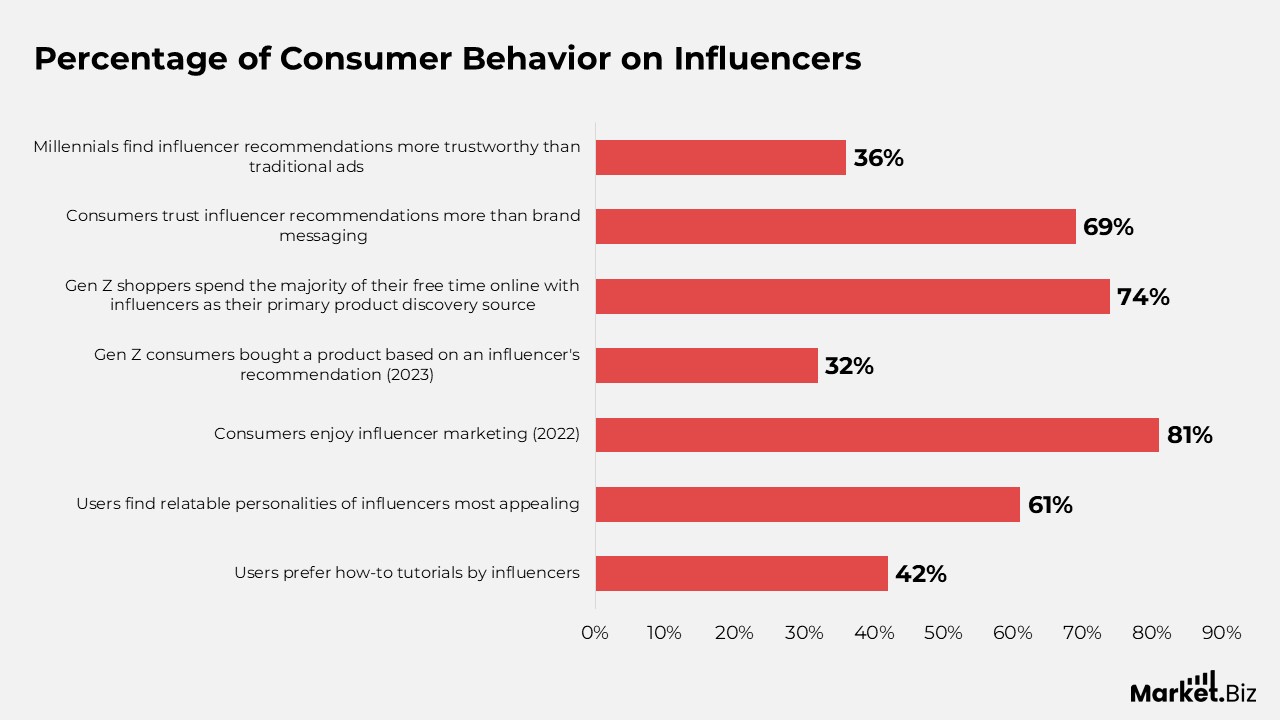
- 42% of users prefer to watch how-to tutorials created by influencers.
- 61% of users find influencers with relatable personalities the most appealing.
- In 2022, 81% of consumers reported enjoying influencer marketing.
- Gen Z tends to trust influencers more than traditional celebrities due to the digital nature of their environment.
- In 2023, 32% of Gen Z consumers purchased a product based on an influencer’s recommendation.
- 74% of Gen Z shoppers spend the majority of their free time online, with influencers serving as their primary source for product discovery.
- Ninety-five per cent of men follow influencers, slightly more than 93% of women.
- 95% of men follow influencers, compared to 93% of women.
- 69% of consumers trust influencer recommendations more than brand messaging.
- 36% of millennials worldwide find influencer recommendations more trustworthy than traditional advertisements.
(Source: Statista, Influencer Marketing Hub, Industry Dive, Sixth City Marketing, HubSpot, Digital Marketing Institute, Marketing Dive, Shopify, WebFX)
The Role of Influencers in Marketers’ Strategies
- 85% of marketers consider influencer marketing an effective strategy for driving results.
- 80% of marketers have allocated a specific budget for influencer marketing in their plans.
- 44% of companies believe the key benefit of collaborating with smaller influencers is cost-effectiveness and the ease of fostering long-term relationships.
- In 2024, 14.5% of brands are projected to spend more than US$500,000 on influencer marketing.
- Approximately 58% of marketers utilize artificial intelligence (AI) to identify the most suitable influencers for their campaigns.
- 60% of brands typically collaborate with at least 10 influencers in their marketing efforts.
- 36% of brands claim that influencer-generated content outperforms content created by the brand itself.
- Just under 56% of marketers find selecting the right influencer to be the biggest challenge in influencer marketing.
- Celebrities can charge up to US$1 million for a single social media post.
- 57.66% of brands working with influencers operate ecommerce stores.
- 71% of marketers will turn to AI to help them find the best influencers for their brand.
- For every US$1 spent on influencer marketing, businesses earn approximately US$5.78 in return.
- 7% of marketers report that influencer marketing provides the highest ROI for their campaigns.
- Hiring a nano-influencer typically costs between $20 and $100 per post.
- 38% of marketers view macro-influencers as the most successful for their brand.
- The number of followers an influencer has impacts ROI by 9.2%.
- 94% of small businesses plan to increase their influencer marketing budgets over the next year.
- If marketers increased their influencer marketing budget by 1%, they could see a 0.5% boost in engagement.
- Most companies spend less than US$50,000 on influencer marketing.
(Source: Influencer Marketing Hub, HubSpot, Sixth City Marketing, Digital Marketing Institute, Shopify, Linqia, Sprout Social, Sage Journals, Taradel Survey)
Trends in Influencer Marketing
- 63% of businesses report using artificial intelligence (AI) to optimize and streamline their influencer marketing strategies.
- A survey revealed that over 60% of respondents plan to incorporate AI or machine learning (ML) into their influencer marketing campaigns.
- More than 50% of influencers believe that natural language processing (NLP) will simplify their tasks in the future.
- 5.7% of respondents aim to use AI to detect fraudulent influencers and fake engagements.
- In a 2023 study, 60.4% of respondents reported using virtual influencers, with the percentage increasing to 62.2% in 2024.
- The most common use of AI/ML (55.8%) is leveraging social media data analytics to identify the most effective influencers for specific brands or campaigns.
- A study conducted in the US found that 58% of respondents followed a virtual influencer.
(Source: The Mission, Influencer Marketing Hub, WP Beginner, The Influencer Marketing Factory)
Advantages of Influencer Marketing for Businesses
- In 2023, 80% of online business owners who experimented with influencer marketing chose to allocate a dedicated budget for this strategy.
- 75% of businesses track influencer sales on an individual basis to identify those who deliver the highest ROI.
- Influencer-generated content achieves an engagement rate 8 times higher than traditional social media posts, making it a compelling choice for brands.
- More than half of marketers report that influencer collaborations have helped them identify individuals who are genuinely interested in their products or services.
- Influencer marketing success can be measured in various ways, with views, reach, and impressions being the three most common metrics used to evaluate it.
- The primary motivations for brands to partner with influencers are to expand their reach and drive more sales.
- 68% of marketers prefer working with influencers for brand partnerships.
- According to HypeAuditor, brands can expect to receive $4.12 of earned media value for every $1 spent on Instagram influencer marketing.
- Successful businesses that leverage influencer marketing generate $5.78 in revenue for every $1 invested.
(Source: WPBeginner LLC., Statista)
Advantages of Influencer Marketing
- Suitable for businesses of all sizes to adopt and implement.
- Particularly powerful when targeting a younger demographic.
- Bypasses ad blockers that typically target display advertisements.
- Effectively reaches niche communities with specific interests.
- Offers a valuable opportunity to enhance Search Engine Optimization (SEO).
(Source: Acumen Connections Inc.)
Challenges in Influencer Marketing
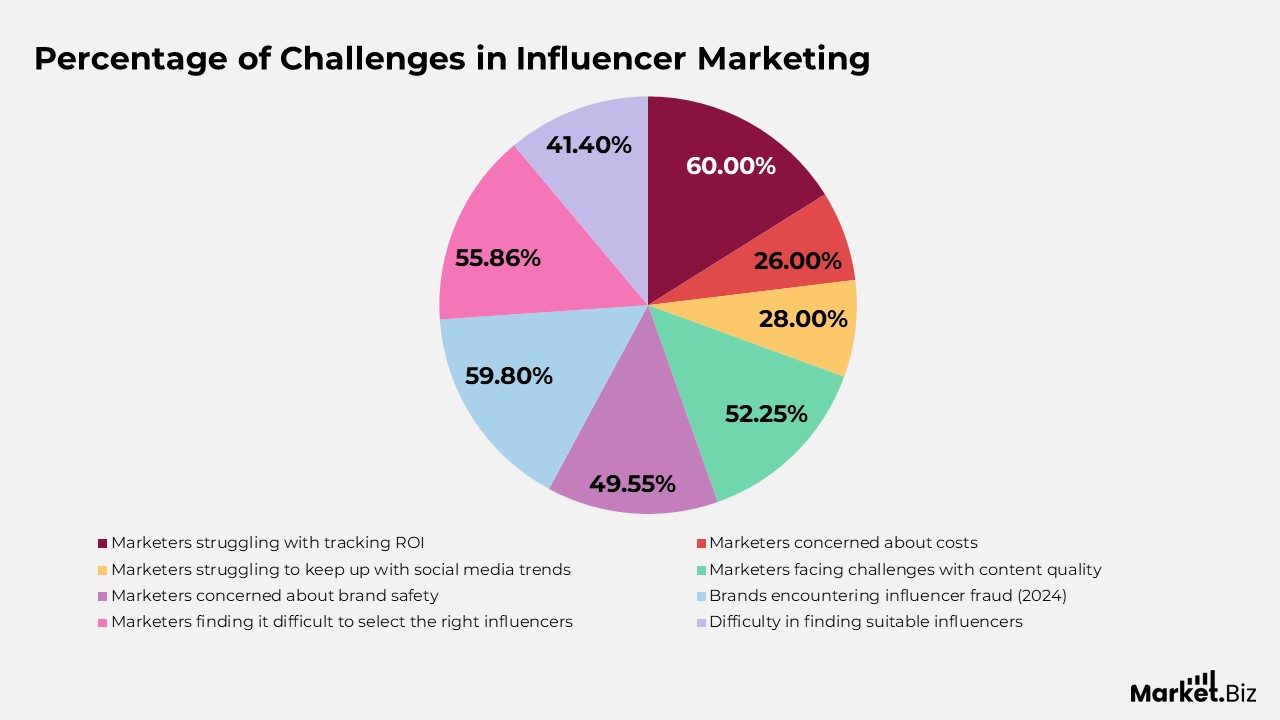
- 60% of marketers struggle with tracking the return on investment (ROI) from influencer marketing efforts.
- 26% of marketers are worried about the costs involved, and 28% struggle to stay on top of ever-evolving social media trends.
- 52.25% of marketers face challenges in maintaining high content quality, while 49.55% express concerns about brand safety.
- In 2024, 59.8% of brands encountered influencer fraud, representing an increase from 31% in 2022 and 55% in 2023.
- 55.86% of marketers find selecting the right influencers with the appropriate quality to be the most difficult aspect of their campaigns.
- Finding suitable influencers remains a significant challenge for marketers, with 41.4% stating it’s moderately difficult (a decrease from 45% in 2023), while 21% now find it very challenging, up from 18% in the previous year.
(Source: Statista, Coolest-Gadgets, Kooc Media Ltd.)
Conclusion
Influencer marketing remains a crucial strategy for brands seeking authentic and engaging connections with their target audience. Key statistics reveal that it delivers significant returns on investment, with many marketers observing improved engagement and sales through influencer collaborations.
Despite challenges in areas such as tracking ROI, influencer selection, and content quality, a significant number of marketers are incorporating influencers into their strategies, utilising AI tools for influencer selection, and capitalising on the extensive reach of platforms like Instagram and TikTok.
As consumer trust in influencer recommendations continues to grow, brands must adapt to evolving trends and prioritise building long-term relationships with influencers to capitalise on this marketing strategy fully.
FAQ’s
Marketers often encounter several hurdles, including difficulties in tracking ROI (60% struggle), selecting the right influencers (56% face challenges), maintaining high content quality (52.25%), and ensuring brand safety (49.55% are concerned). Furthermore, influencer fraud is becoming more prevalent, with 59.8% of brands reporting it in 2024.
Instagram is widely recognized as a top platform for influencer marketing, with 79% of marketers deeming it essential for their campaigns. TikTok also ranks highly, with 69% of brands utilizing it for influencer partnerships, and 95% of men and 93% of women follow influencers on this platform.
Influencers support brands by expanding reach, enhancing brand visibility (85% of marketers), driving conversions (64%), and fostering brand loyalty (44%). Their content is often seen as more genuine compared to traditional advertisements, with 36% of millennials trusting influencer recommendations over conventional ads.
Brands often opt to work with micro-influencers (67%) due to their higher engagement rates and ability to target specific audiences. Nano-influencers, with 1,000–10,000 followers, are also favored for their intimate, engaged following. Mega-influencers, who have over 1 million followers, are typically more costly but offer massive reach.
Influencer marketing is significantly influencing consumer decisions, with 60% of users trusting recommendations from influencers more than brand messaging. Notably, 71% of TikTok users make purchases based on paid influencer recommendations, and 36% of millennials trust influencer endorsements over traditional advertisements.