









Introduction
Language-learning app statistics provide a quantitative perspective on how digital platforms are transforming language acquisition across demographics and regions. These metrics track user adoption, engagement patterns, subscription growth, and learning behavior, highlighting the increasing role of mobile and AI-driven tools in education.
Driven by globalization, remote work, cross-border communication, and international education needs, demand for language learning apps continues to rise. Overall, these statistics help assess market growth, learner preferences, and the effectiveness of digital technologies in shaping modern language education.
Editor’s Choice
- English remains the most widely studied language globally, with 43% of learners on Preply choosing it as their primary language of study.
- Spanish holds the second position among the most learned languages, accounting for 13% of Preply learners, driven by its relevance across the Americas and Europe.
- Mandarin Chinese leads the world in native speaker population, with approximately 990 million people speaking it as their first language.
- According to global education estimates, more than 40% of people lack access to education in a language they understand, with this figure rising to 90% in low- and middle-income countries.
- The global online language learning market is projected to reach $115 billion by the end of 2025, driven by strong demand for digital education platforms.
- Japanese, Arabic, and Korean are among the fastest-growing languages on learning platforms, recording learner growth of 33%, 15%, and 13% respectively, over the past two years.
- A European business survey indicates that 33% of small and medium-sized exporters face challenges in foreign markets due to differences in business environments, including language and regulatory barriers.
- Economic analysis suggests that eliminating language barriers could increase the UK export value by approximately £19 billion annually.
- Research evidence indicates that bilingual individuals may experience greater cognitive resilience, potentially reducing the risk of dementia and Alzheimer’s disease.
- Of the more than 7,000 languages spoken globally, up to 1,500 are considered at risk of extinction, underscoring the importance of language preservation efforts.
How Digital Platforms and AI Are Reshaping Language Learning Trends
- In UK schools, language preferences are changing, with Spanish gaining momentum, up by 1% in A-level entries, while French and German registrations have declined by 8% and 6%, respectively.
- “Other modern languages,” including Mandarin Chinese, are recording the fastest growth in schools, increasing by 4%, reflecting broader diversification in language education.
- Parental support for language learning remains strong, with 64% willing to encourage their children to study Spanish and 68% believing that a modern foreign language should be compulsory at the secondary level.
- Around 70% of parents want their children to gain more international exposure, while 49% regret not learning a second language themselves, reinforcing long-term motivation for bilingual education.
- Digital learning continues to expand rapidly, driven by language apps, online tutoring, and self-paced courses that offer flexible, location-independent access.
Moreover
- English dominates the digital space, accounting for more than 49% of global websites, followed by Spanish and German at 6% each.
- Artificial intelligence is increasingly embedded in education, with 80% of students and recent graduates reporting current or prior use of AI tools in academic settings.
- AI-supported language learning is most common in Spanish (18%), English (57%), and French (8%), and 73% of Americans believe AI makes language learning easier.
- Tutor adoption of AI is also rising, with over 40% using it to generate grammar and vocabulary exercises and more than 33% applying it for language-training support.
- Despite digital advances, human instruction remains essential, as 71% of self-study app users feel more confident practicing with a tutor than relying solely on apps.
- More than 50% of app users believe self-learning platforms limit progress due to insufficient real-world interaction, reinforcing that AI enhances but does not replace human-led language learning.
(Source: UK Department for Education, Preply, UNESCO, Eurobarometer, RAND Europe, World Wide Web Consortium (W3C), OECD, Pew Research Center, EdTech Industry Surveys)
Language Inequality and the Role of Digital Learning
- More than 40% of the global population lacks access to education in a language they fully understand, a figure that rises sharply to 90% in low- and middle-income countries, highlighting a critical learning barrier that digital tools can help address.
- The year 2026 is expected to be a pivotal point for global language inclusion. As digital platforms are increasingly tested on their ability to close education and communication gaps.
- Language learning extends beyond skill acquisition and plays a key role in cultural continuity and identity preservation.
- Of the more than 7,000 languages spoken worldwide, up to 1,500 face the risk of extinction, as globalization strengthens dominant languages while marginalizing smaller ones.
- Current education systems rely on only 351 languages for instruction. Leaving substantial room to broaden language representation and promote inclusive, culturally diverse learning.
(Source: UNESCO, Ethnologue, Global Education Monitoring Report, World Bank, International Linguistics and Cultural Preservation Studies)
Most Widely Spoken Languages by Total Global Speakers
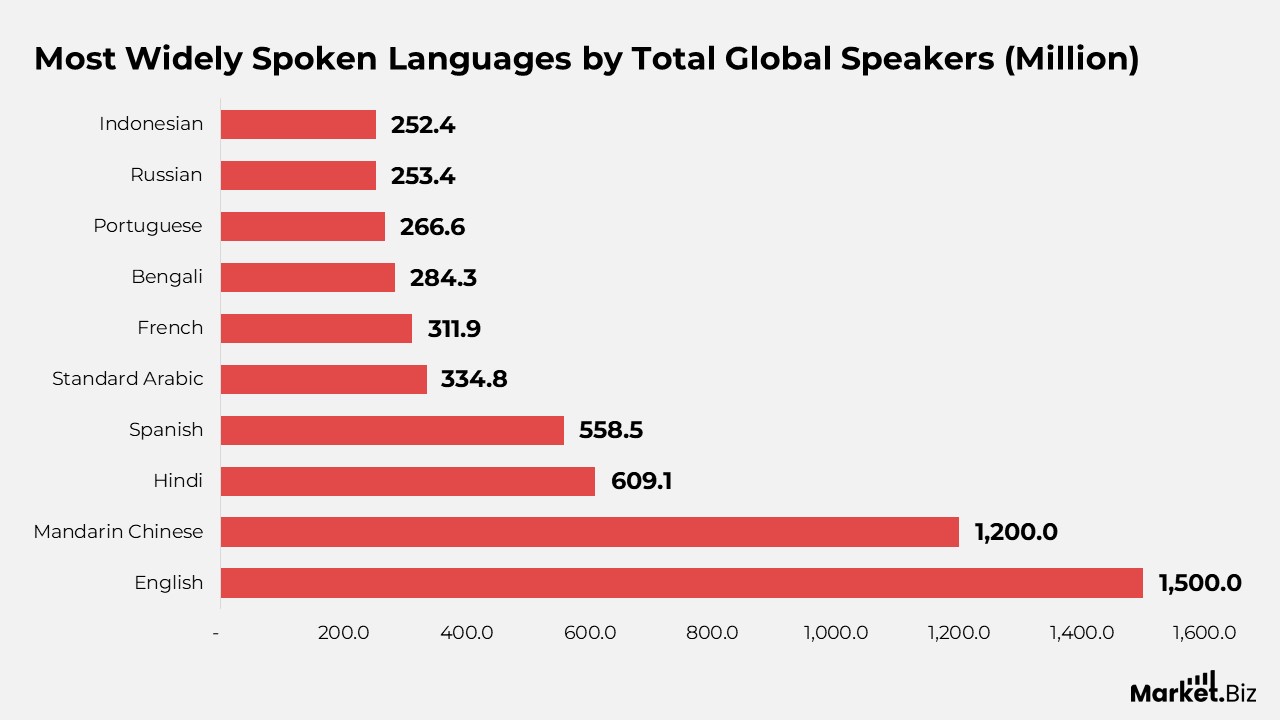
- English ranks as the most widely spoken language worldwide. With approximately 1.5 billion total speakers, including both native and non-native speakers.
- Mandarin Chinese is the second most spoken language, with around 1.2 billion speakers globally.
- Hindi ranks third, spoken by nearly 609.1 million people worldwide, reflecting its strong presence in South Asia.
- Spanish ranks fourth with about 558.5 million speakers, driven by widespread use across Europe, Latin America, and North America.
- Standard Arabic stands fifth, with approximately 334.8 million speakers across the Middle East and North Africa.
- French remains a major global language, spoken by around 311.9 million people across Europe, Africa, and parts of the Americas.
- Bengali ranks seventh, with roughly 284.3 million speakers, largely concentrated in South Asia.
- Portuguese ranks second with about 266.6 million speakers, supported by strong use in Brazil, Portugal, and parts of Africa.
- Russian is spoken by approximately 253.4 million people, maintaining a strong presence across Eastern Europe and Central Asia.
- Indonesian completes the top ten, with nearly 252.4 million speakers, reflecting its widespread national use in Southeast Asia.
(Source: Ethnologue, UNESCO Institute for Statistics, World Population Review, Preply)
Most Studied Languages Worldwide by Learner Preference
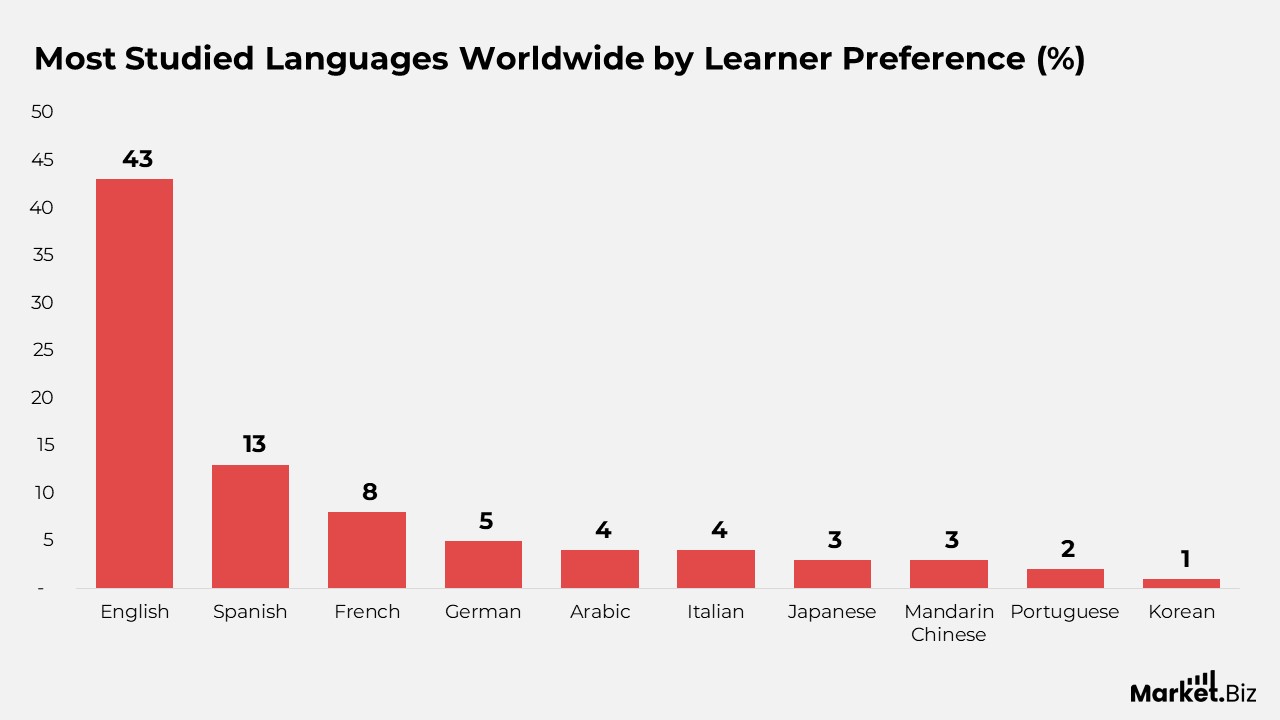
- English dominates global language learning, accounting for 43% of learners, reinforcing its role as the primary language for international communication, education, and business.
- Spanish ranks as the second most learned language globally. Chosen by 13% of learners due to its widespread use across the Americas and Europe.
- French holds the third position, with 8% of learners studying it, supported by its importance in diplomacy, education, and global institutions.
- German follows closely, representing 5% of global learners, driven by its relevance in European business, engineering, and higher education.
- Arabic and Italian are positioned next to each other, each attracting 4% of learners. Reflecting interest in both cultural heritage and regional economic opportunities.
- Japanese accounts for 3% of global learners, supported by demand linked to technology, pop culture, and business engagement with Japan.
- Mandarin Chinese also accounts for 3% of learners, reflecting its long-term strategic importance despite its higher learning complexity.
- Portuguese attracts 2% of learners globally, driven by its presence in Brazil, Portugal, and parts of Africa.
- Korean completes the top ten, with 1% of learners, influenced by cultural exports and growing global interest.
(Source: Preply Language Learning Insights, Global Language Learning Surveys, UNESCO Education Statistics)
Most Learned Languages Among North American Learners
- Spanish leads language learning preferences in North America, chosen by 25% of learners, reflecting strong regional, cultural, and economic ties.
- English follows closely as the second most learned language, accounting for 24% of learners, driven by professional advancement and academic needs.
- French ranks third, with 9% of learners studying it, supported by its relevance in Canada, diplomacy, and international organizations.
- Arabic attracts 5% of learners, indicating growing interest linked to global business, geopolitics, and cultural engagement.
- Japanese and Mandarin Chinese each account for 4% of learner interest, reflecting demand driven by technology, trade, and cultural influence.
- Italian is studied by 3% of learners, largely motivated by cultural heritage, travel, and lifestyle interests.
- Korean and Portuguese each account for 3% of learners, supported by cultural exports and regional connectivity.
- Russian completes the top ten, with 2% of learners showing interest in the language.
(Source: Preply Learner Data, North America Language Learning Trends, Global Education Insights)
Most Learned Languages Among European Learners
- English overwhelmingly dominates language learning across Europe, accounting for 49% of learners, reinforcing its role as the primary language for cross-border communication and careers.
- Spanish ranks second with 10% of learners, driven by its widespread cultural presence and relevance for travel and business.
- German and French share the third position, each attracting 8% of learners, reflecting their continued importance within European economic and institutional frameworks.
- Italian ranks 4th among languages, with 4% of learners, supported by a strong interest in culture, lifestyle, and tourism.
- Arabic accounts for 3% of language learners, highlighting growing interest linked to migration, trade, and geopolitical engagement.
- Portuguese and Dutch each represent 2% of learner interest, reflecting regional and professional learning needs.
- Polish also accounts for 2% of learners, supported by intra-European mobility and workforce integration.
- Japanese completes the top ten, with 1% of learners in Europe studying the language.
(Source: Preply Learner Data, European Language Learning Trends, Global Education Insights)
Fastest-Growing Languages by Learner Growth in 2025
- Japanese leads global language learning growth in 2025, recording a year-on-year increase of 33% and significantly outpacing average platform growth rates.
- Arabic ranks second among the fastest-growing languages, with learner demand rising by 15%, driven by expanding economic and cultural engagement.
- Korea follows closely, posting a 13% growth rate, supported by continued global interest in Korean culture, media, and technology.
- Chinese (Mandarin) shows steady expansion, with learner growth reaching 9%, reflecting sustained long-term strategic interest.
- Spanish and French record more moderate growth, each increasing by 3%, indicating stable but mature learning demand.
(Source: Preply Global Language Learning)
Motivations Behind Language Learning Worldwide
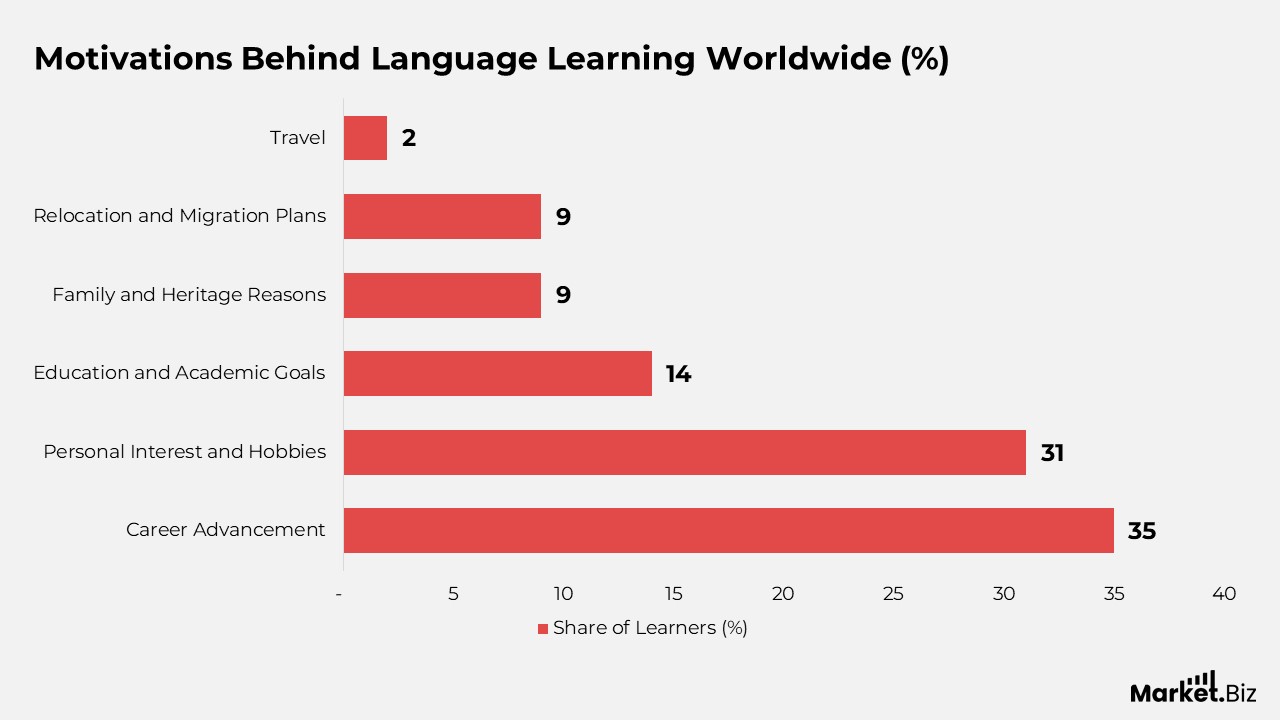
- Career advancement is the leading reason for language learning. With 35% of learners pursuing new languages to improve job prospects and professional growth.
- Personal interest and hobbies account for 31% of language learners, highlighting strong demand driven by cultural curiosity and self-enrichment.
- Education-related goals motivate 14% of learners, reflecting the importance of languages in academic studies and skill development.
- Family-related reasons, such as communicating with relatives or learning about heritage, influence 9% of individuals to study a new language.
- Relocation plans drive 9% of learners to acquire language skills to support migration, work, or long-term settlement abroad.
- Travel represents a smaller but meaningful motivation, with 2% of learners studying languages primarily to enhance travel experiences.
(Source: Preply Learner Motivation Survey, Global Language Learning Behavior Insights)
Language Learning Growth and Career Impact Statistics
- An estimated 1.5 billion people worldwide are actively learning a foreign language, reflecting steady global growth in multilingual education.
- Bilingual professionals tend to earn higher wages, with studies indicating average income premiums ranging from 5% to 20% compared to monolingual employees.
- Proficiency in high-demand languages such as Mandarin, Spanish, and Arabic significantly enhances employability and expands access to international job opportunities.
- The global e-learning market is projected to reach approximately $325 billion by 2025. With language learning emerging as one of the fastest-expanding segments.
- In the United Kingdom, 39% of employers rate language skills as a high-priority requirement. Especially across sectors such as finance, law, and hospitality.
(Source: Preply Learner Motivation Survey, Global Language Learning Behavior Insights)
Common Challenges and Motivations in Language Learning
- Grammar remains the most frequent difficulty for language learners, with 68% reporting challenges in understanding and applying grammatical rules.
- Vocabulary acquisition is another major hurdle, as 53% of learners struggle to build and retain sufficient word knowledge.
- Pronunciation is considered the most challenging aspect of language learning by 42% of learners, reflecting difficulties with accent, sounds, and fluency.
- Learning plateaus are widely experienced, with 64% of language learners reporting periods of stalled progress that often reduce motivation and engagement.
- Career advancement is a key driver of language learning. As 72% of learners are motivated by the goal of improving professional opportunities.
(Source: Preply Learner Motivation Survey, Global Language Learning Behavior Insights)
Economic, Cognitive, and Personal Benefits of Language Learning
- Language skills generate significant economic value, contributing an estimated £48 billion ($65 billion) annually to the UK economy through trade growth. Foreign investment, and expanded employment opportunities.
- In the United States, bilingual professionals earn wage premiums of 5% to 20% compared to monolingual workers. Reflecting strong labour-market demand for multilingual skills.
- Cognitive research shows that bilingual individuals demonstrate stronger attention control, greater cognitive flexibility, and enhanced problem-solving abilities than monolinguals.
- Personal development benefits are widely reported, with 89% of language learners experiencing increased self-confidence after learning a new language.
(Source: Lingomelo)
Conclusion
Language Learning App Statistics indicate a growing emphasis on multilingual abilities as an essential component of modern education, workforce readiness, and global engagement. Increasing learner interest in high-demand languages, alongside the rapid expansion of digital and AI-enabled learning platforms, reflects a strong preference for flexible and outcome-driven learning models.
At the same time, disparities in language access and the declining use of many indigenous languages highlight ongoing challenges around inclusion and cultural preservation. Collectively, these trends show that language learning has evolved into a critical enabler of economic opportunity, global connectivity, and long-term cultural resilience.
FAQ’s
Language learning statistics provide a structured way to analyze how languages operate across education systems, labor markets, and societies by tracking learning behavior, usage patterns, and demand dynamics.
They reflect changes in linguistic influence, international interaction, and the increasing reliance on common languages for global commerce, education, and digital communication.
These statistics demonstrate how digital technologies expand learning access by supporting scalable, flexible, and personalized language education beyond conventional classroom models.
They illustrate the tension between the strengthening of globally dominant languages and the gradual decline of lesser-used languages, revealing important cultural and identity implications.
They highlight inequalities in access to education conducted in familiar languages, underscoring the importance of language in enabling inclusion, equal opportunity, and upward social mobility.