









Introduction
Vegan Meat Statistics: Vegan meats made from ingredients such as soy, peas, and wheat gluten are designed to replicate the flavor and texture of animal meats. These alternatives are becoming increasingly popular due to their health advantages, including lower levels of saturated fats and the absence of cholesterol, as well as their diminished environmental footprint, which requires fewer resources like water and land while generating fewer greenhouse gas emissions.
With a wide range of options available, including sausages, burgers, and nuggets, the vegan meat market is experiencing rapid growth. This expansion is driven by advancements in food science, a rising consumer demand for sustainable and ethical food options, and substantial investments in the industry.
Consequently, plant-based meats are now readily accessible in supermarkets, restaurants, and online platforms, attracting not only vegetarians and vegans but also a wider audience seeking to decrease their meat intake for health or environmental considerations.
Editor’s Choice
- The worldwide revenue from the vegan meat market is projected to attain USD 19.1 billion by the year 2032.
- The global vegan meat market has witnessed remarkable growth, achieving a compound annual growth rate (CAGR) of 14.3%.
- In the worldwide meat market revenue, China holds the top position with a substantial USD 2,371 million, closely followed by the United States at USD 2,060 million.
- Between 2018 and 2028, the cost per unit of meat substitutes experienced a steady increase, beginning at USD 0.64 in 2018 and anticipated to rise to USD 2.09 by 2028.
- A single serving of tempeh, acknowledged as a dependable source of nutrition, offers a considerable nutritional profile, comprising 319 calories.
- Disease prevention serves as a crucial motivator, appreciated by 53% of consumers, while 52% pursue the energy advantages linked to plant-based diets.
General Vegan Meat Statistics
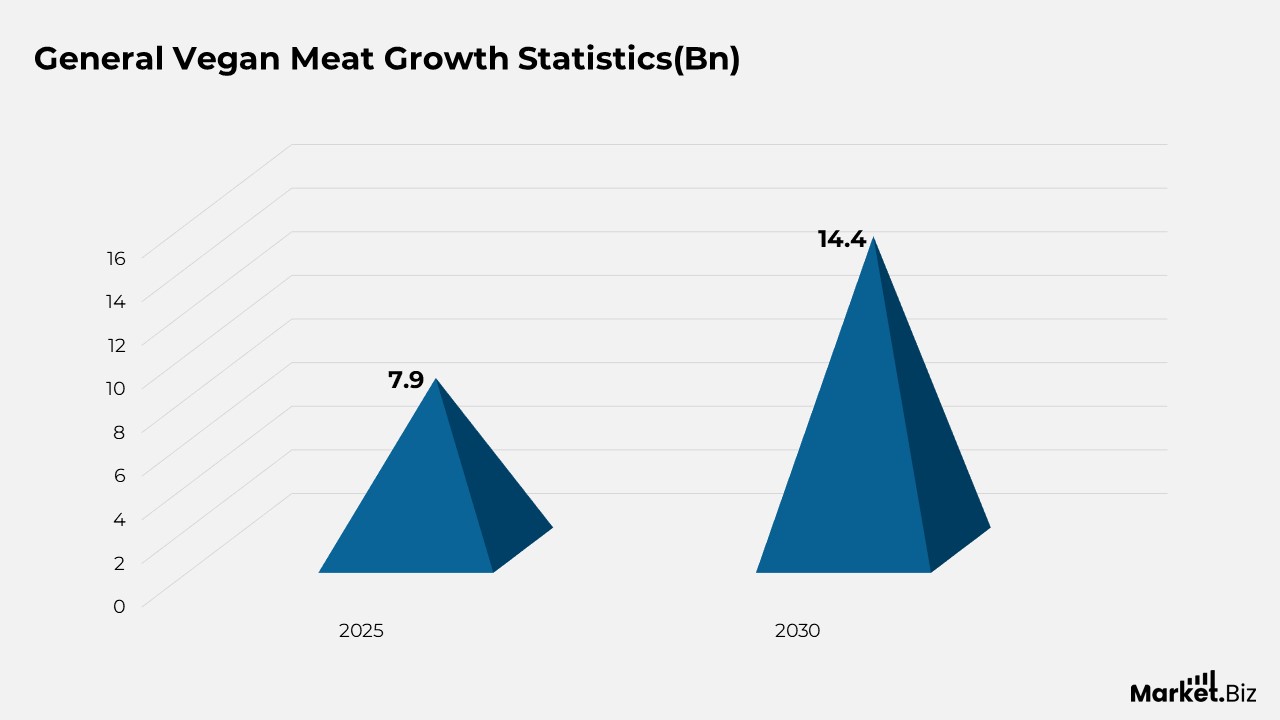
- The worldwide revenue from the vegan meat market is projected to attain USD 19.1 billion by the year 2032.
- Between 2018 and 2028, the average revenue per capita derived from meat substitutes has demonstrated a steady increase, beginning at USD 0.64 in 2018 and expected to rise to USD 2.09 by 2028.
- In the context of the meat substitute market revenue, China stands out with a notable USD 2,371 million.
- From 2018 to 2028, the unit price of meat substitutes has experienced a continuous increase, starting at USD 0.64 in 2018 and projected to reach USD 2.09 by 2028.
- A single serving of tempeh, acknowledged as a dependable source of nutrition, offers a significant nutritional profile, containing 319 calories.
- In the sector of plant-based food and beverage options, consumers emphasise health and wellness, with 57% indicating that both daily and long-term health benefits are extremely or very important considerations.
- As per a recent study, 69% of consumers believe there is a lack of variety in plant-based products or brands available, while 59% observe a deficiency in different types of plant-based alternatives, such as those for chicken or seafood.
Vegan Meat Market Size Statistics
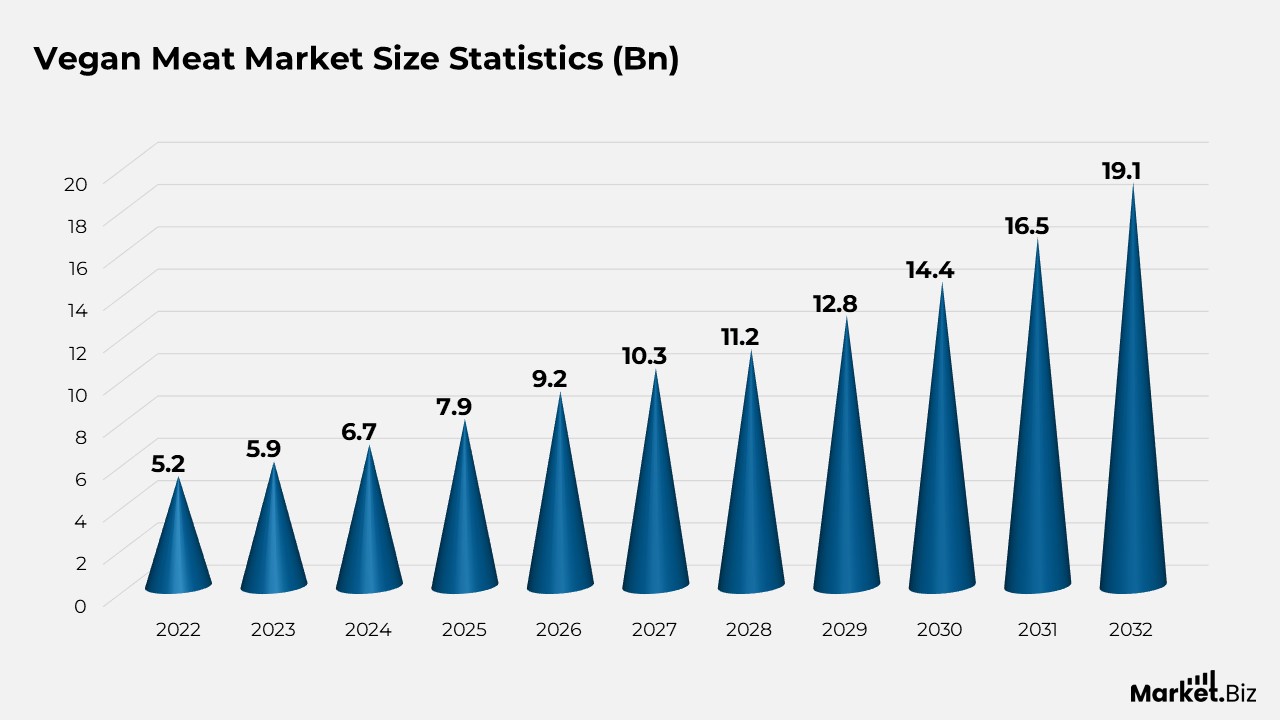
- The global vegan meat market has witnessed remarkable growth, achieving a compound annual growth rate (CAGR) of 14.3%. Revenue has risen from USD 5.2 billion in 2022 to an anticipated USD 19.1 billion by 2032.
- This upward trend commenced with a revenue of USD 5.9 billion in 2023, followed by consistent annual increases: USD 6.7 billion in 2024, USD 7.9 billion in 2025, and USD 9.2 billion in 2026.
- The market continued to grow, reaching USD 10.3 billion in 2027, USD 11.2 billion in 2028, and USD 12.8 billion in 2029.
- The expansion continued into the following decade, with revenues of USD 14.4 billion in 2030 and USD 16.5 billion in 2031, closing with an estimated USD 19.1 billion by 2032.
Vegan Meat Substitutes Market Statistics
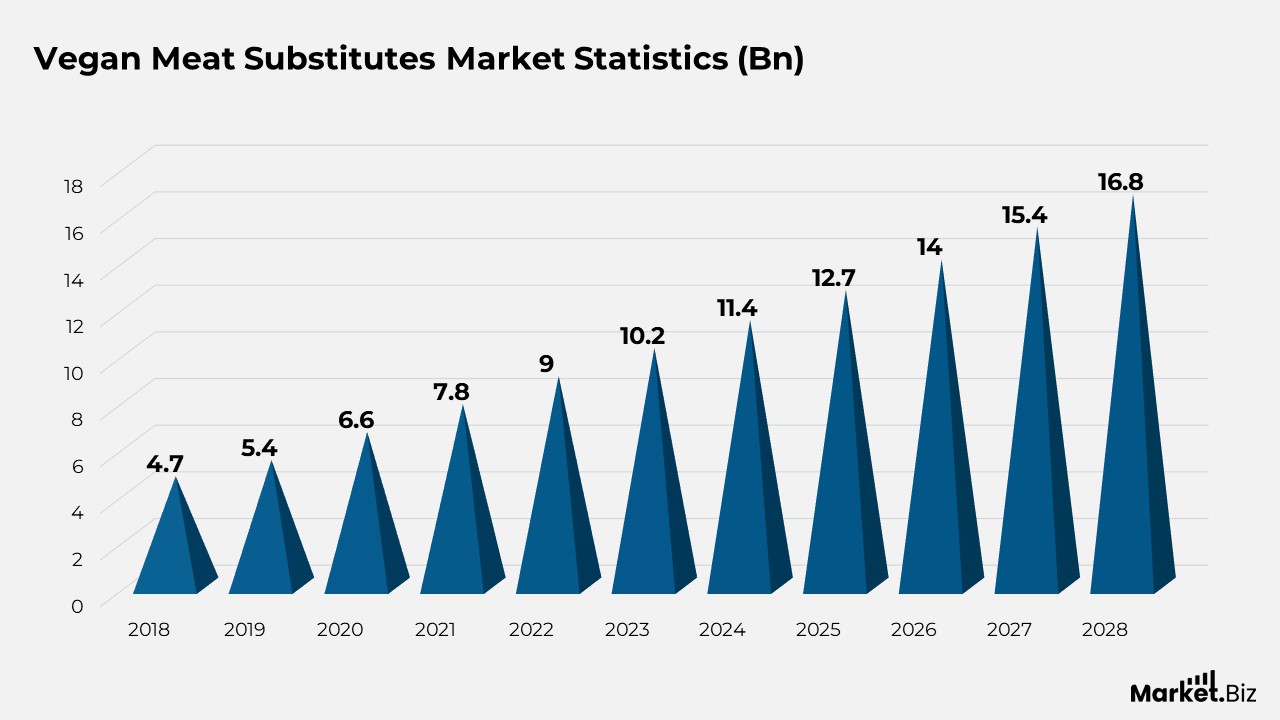
- The global market for meat substitutes has exhibited a notable growth trend, achieving a compound annual growth rate (CAGR) of 10.20%. Revenues have escalated from USD 4.66 billion in 2018 to an expected USD 16.78 billion by 2028.
- This development included an increase to USD 5.38 billion in 2019, followed by a substantial rise to USD 6.63 billion in 2020, indicating a heightened consumer interest in alternative proteins.
- The market maintained its upward momentum, reaching USD 7.79 billion in 2021 and USD 8.96 billion in 2022.
- The growth continued, with revenues reaching USD 10.15 billion in 2023, and further increases were observed, with USD 11.38 billion in 2024 and USD 12.71 billion in 2025.
- As consumer preferences for plant-based alternatives grew stronger, the market expanded to USD 13.99 billion in 2026, followed by USD 15.37 billion in 2027, and is anticipated to reach USD 16.78 billion by 2028.
Substitutes Revenue by Country Statistics
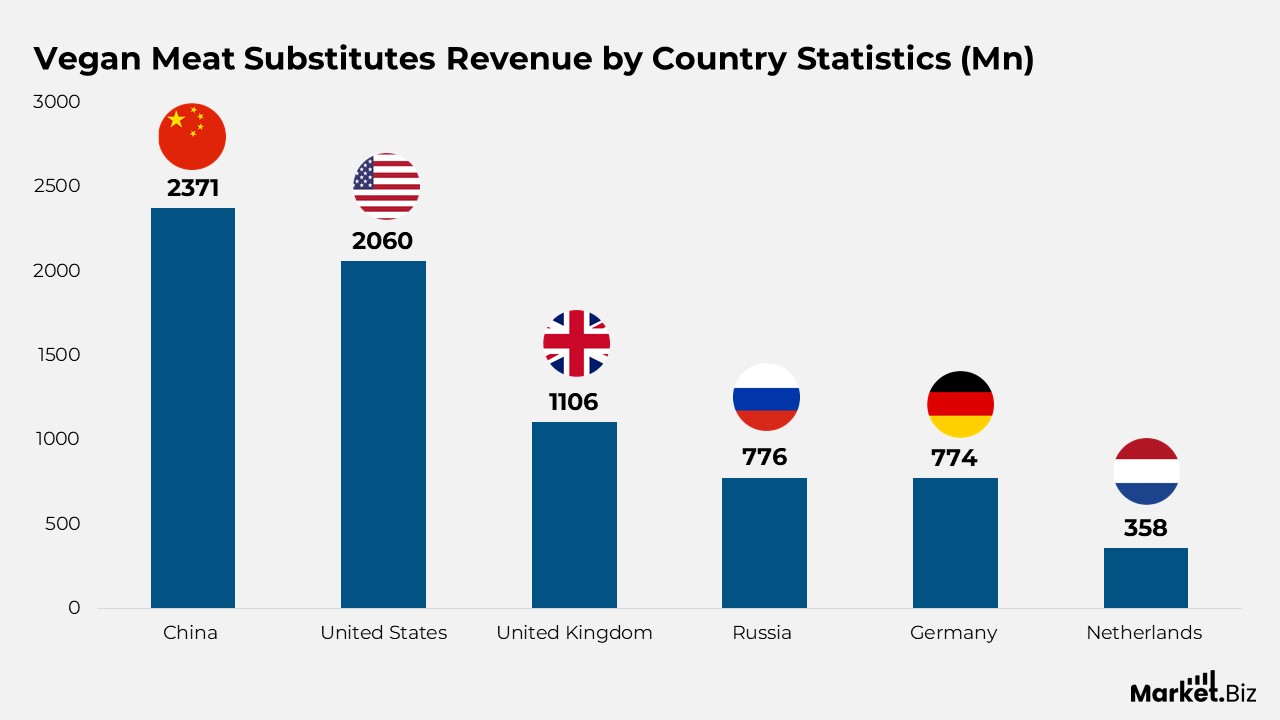
- In the worldwide meat market revenue, China holds the top position with a substantial USD 2,371 million, closely followed by the United States at USD 2,060 million.
- The United Kingdom ranks as the 3rd largest market, generating $1,106 million.
- Germany and Russia exhibit similar market sizes, with revenues of USD 774 million and USD 776 million, respectively.
- The Netherlands also showcases a significant market at USD 358 million, with Japan trailing slightly at USD 323 million.
- Canada and Indonesia add to the market with revenues of $289 million and $298 million, respectively, while Mexico completes this list with a market revenue of USD 254 million.
Vegan Meat Price Statistics
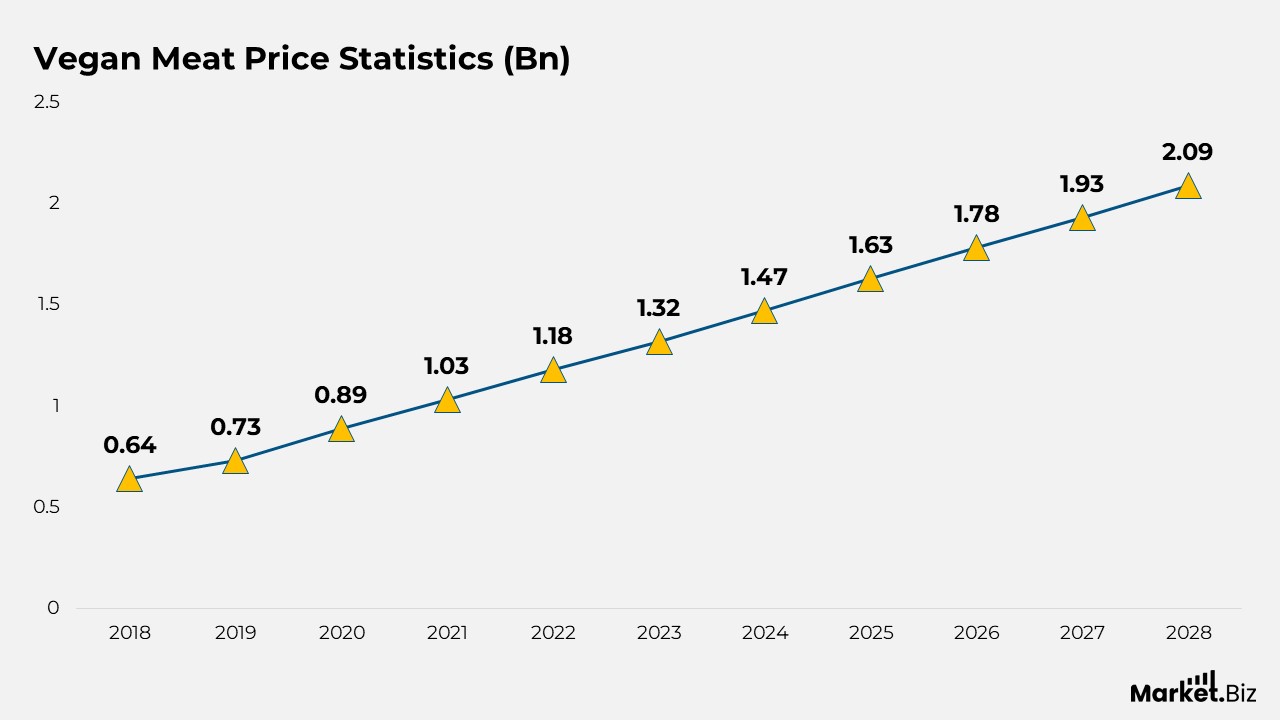
- Between 2018 and 2028, the cost per unit of meat substitutes experienced a steady increase, beginning at USD 0.64 in 2018 and anticipated to rise to USD 2.09 by 2028.
- This pattern illustrates a gradual yet consistent rise in consumer expenditure on plant-based alternatives throughout the decade.
- In 2019, the unit price rose to USD 0.73, and this upward trend persisted with a leap to USD 0.89 in 2020, indicating a growing consumer interest in these products.
- The growth trajectory continued, with the unit price reaching USD 1.03 in 2021, USD 1.18 in 2022, and further increasing to USD 1.32 in 2023.
- The subsequent years saw steady increments: USD 1.47 in 2024, USD 1.63 in 2025, progressing to USD 1.78 in 2026, and USD 1.93 in 2027, culminating in the projected USD 2.09 by 2028.
Tempeh Nutritional Statistics
- A single serving of tempeh, acknowledged as a dependable source of nutrition, offers a considerable nutritional profile, comprising 319 calories.
- It is especially abundant in protein, providing 33.7 grams, in addition to 17.9 grams of fat. Regarding minerals, this serving supplies 184 milligrams of calcium and 4.48 milligrams of iron, making a significant contribution to daily nutritional needs.
- Moreover, tempeh is praised for being a valuable source of magnesium and vitamin B-6, which further enhances its importance as a nutritious element of a well-rounded diet.
Seitan Nutritional Statistics
- A 4-ounce portion of seitan, recognised by reputable sources for its nutritional value, contains 140 calories, rendering it a low-calorie choice for various diets.
- It is remarkably rich in protein, delivering 28 grams while having only 2 grams of fat, thus establishing it as a lean protein source.
- Importantly, seitan is fortified with multiple vitamins, being particularly high in riboflavin, niacin, and vitamin B-6, which are essential for energy metabolism and overall well-being.
Hamburger vs. Plant-based Meat Alternatives
- The examination of consumer preferences regarding traditional hamburgers versus plant-based meat replacements reveals significant trends.
- While 65%, 59% and 68% of consumers prefer hamburgers for their familiar ingredients, cost, and taste, environmental and ethical considerations are beginning to narrow the gap for plant-based meats.
- Despite the fact that merely 12% of consumers favour the flavour of plant-based alternatives, and their ingredient lists and pricing are less attractive (22% and 13%), these alternatives are advancing in areas such as health (35%), animal welfare, and environmental impact (37%).
Factors Driving Plant-based Food/Beverage
- In the domain of plant-based food and beverage selections, individuals emphasize health and wellness, with 57% indicating that both daily and long-term health enhancement are extremely or very important considerations.
- Disease prevention serves as a crucial motivator, appreciated by 53% of consumers, while 52% pursue the energy advantages linked to plant-based diets.
- Taste preference emerges as a significant factor for 49% of consumers, underscoring the role of flavor in the acceptance of plant-based alternatives.
- The principles of clean eating and improved treatment of animals are closely matched in significance, at 48% and 47%, respectively.
Vegan Meat Recent Statistics
- Market research reports have shown a notable rise in consumer demand for vegan meat products, influenced by health, environmental, and ethical factors.
- Surveys and consumer studies have demonstrated an increasing interest in plant-based diets and meat alternatives, with a significant number of consumers integrating vegan meat into their daily meals.
- In addition to burgers, recent product launches are concentrating on plant-based seafood (such as tuna), chicken, and traditional local cuisines (for instance, kebab and dumplings).
Vegan Meat Future Statistics
- The worldwide market for vegan meat has seen remarkable expansion, achieving a compound annual growth rate (CAGR) of 14.3%. Revenue has risen from USD 5.2 billion in 2022 to an anticipated USD 19.1 billion by 2032.
- By the year 2040, it is projected that merely 40% of the global population will continue to consume conventional meat, as alternative proteins become increasingly favoured.
Conclusion
The vegan meat sector, in the midst of its swift expansion and transformation, is driven by health, ethical, and environmental considerations among consumers. Despite obstacles such as a limited selection of products and reluctance towards lab-cultured meats, there is a distinct trend towards greater consumer acceptance and demand for plant-based alternatives.
The industry is at a crucial juncture, presenting an opportunity for innovation, which promises a future where a wide variety of vegan meats are more broadly embraced and incorporated into mainstream diets.
This transition not only mirrors an increasing consumer inclination towards natural and diverse options but also indicates a shift towards a more sustainable and ethical global food system.
FAQs
Vegan meat, also referred to as plant-based meat, is mainly derived from ingredients such as soy, peas, wheat gluten (seitan), along with a range of other legumes and vegetables. These products frequently incorporate oils, starches, and natural flavorings to improve taste and texture.
Vegan meat products are crafted to replicate the flavor, texture, and appearance of animal meat by utilizing plant-based ingredients, seasonings, and food technology methods such as extrusion. This enables them to imitate the savory flavor profile and mouthfeel characteristic of conventional meats.
Vegan meat may be more nutritious than animal meat due to its lower levels of saturated fat and cholesterol. Nevertheless, the nutritional content can differ among products. Numerous plant-based meats are also enriched with vitamins and minerals to improve their nutritional value.