









Introduction
Robot Statistics: Robotics has become a key catalyst for technological advancement, revolutionizing industries by boosting productivity, accuracy, and safety. The integration of artificial intelligence, machine learning, and machine vision has made robots more advanced, enabling them to make smarter decisions and automate intricate tasks.
These innovations are being adopted across diverse sectors such as manufacturing, healthcare, logistics, and consumer services, minimizing human involvement in repetitive or hazardous activities. The widespread adoption of robotics is further fueled by government policies, academic research, and private sector investments, all contributing to innovation and broadening the range of robotic applications.
This dynamic shift underscores the vital role robots play in enhancing operational efficiency and transforming industries, as they are increasingly utilized to streamline processes, improve safety, and address long-standing challenges.
Editor’s Choice
- Asia accounts for more than one-third of the total global revenue generated by the robotics industry.
- Currently, more than 3.4 million work robots are operating worldwide.
- In the manufacturing sector, the global robot-to-human ratio stands at 1 robot for every 71 humans.
- Over the next 5 years, industrial companies are planning to allocate 25% of their capital towards industrial automation.
- Around 14% of the workforce has experienced job displacement due to automation and robotics.
- The medical industry is expected to represent approximately 27.03% of the global robotics market by 2025.
- In 2024, the average cost of a service robot was $11,510, compared to $21,350 for a standard industrial robot.
- The Asia Pacific region contributed nearly 46% of the global robotics market revenue in 2023.
- The United States led the world in robotics revenue generation in 2024, earning $9.4 billion.
- The Republic of Korea holds the highest robot density globally, with 1,012 robots per 10,000 employees, far surpassing the global average of 151 robots per 10,000 employees.
- By 2025, it’s projected that the US will have 161,766 job openings for robotic engineers, reflecting a growth of over 6% since 2020.
- The projected average salary for a robotics engineer in the US in 2025 is $114,789, marking a 10.3% increase from 2020.
- In the manufacturing industry, it is estimated that there is 1 robot for every 71 humans working.
- As of 2023, the global operational stock of industrial robots was approaching 4.3 million units, according to the IFR.
(Source: Robot Statistics, International Federation of Robotics, Statistics, Semrush Inc.)
General Robot Statistics
- Last year, the global count of robotic units reached 12 million, with 31,044 of those units being purchased solely by North American businesses.
- Cobots, or Collaborative robots, are expected to make up 34% of total robot sales by the end of 2025.
- In terms of regional robotics statistics, North American companies saw a growth of 3.5% in 2021.
- A significant increase of 12% was noted in global robot shipments from 2020 to 2022.
- According to data from the National Bureau of Statistics, China’s production of industrial robots has been rising steadily at a rate of 29.2% annually.
- Amazon’s cobots have collectively saved the company $22 million.
- Beyond the automotive industry, orders for robotic units have grown and are expected to increase by 11% in sectors like electrical, photonics, and semiconductors by the end of 2021.
- The robotics industry has employed over 150,000 skilled workers globally in engineering and assembly roles.
- 88% of industries worldwide are planning to incorporate robotic automation into every facet of their IT infrastructure.
Moreover
- By 2022, approximately 584,000 robotic units are projected to be shipped.
- Based on current trends, the robotics industry is expected to see at least 15% growth by 2028, making its total value approximately $20 billion.
- It might surprise you, but by 2021, there will be an estimated 1,287 robots for every 10,000 workers in the automotive industry.
- In the past year, more than 3.05 million industrial robot units were installed globally to enhance efficiency and productivity.
- A 12% increase in robotics shipments worldwide is expected between 2020 and 2022, driving annual robotics unit sales to 465,000 in 2020 and 584,000 in 2022.
- Looking ahead, the robotics industry is projected to reach a total value of approximately $20 billion by 2028.
- In the medical field, Veebot robots offer 83% accuracy in identifying the best vein for blood draws from patients.
- As reported by the World Robotics publication in September 2023, the total number of industrial robots delivered in 2022 was 553,052 units. Additionally, the report published in January 2024 confirmed that by the end of 2022, the global count of industrial robots reached 3.9 million units.
- According to estimates by Statista, 51,300 autonomous mobile robots (AMRs) were sold in 2023. This number is expected to surpass 180,000 units by 2030. The AMR market in 2023 was valued at 1.24 billion US dollars, with a projected growth to 3.13 billion US dollars by 2030.
(Source: National Bureau of Statistics, International Federation of Robotics, Next Move Strategy Consulting, Statista, Zippia, Banklesstimes, Gitnux, Techjury.net)
Robotic Prosthetics Market Size
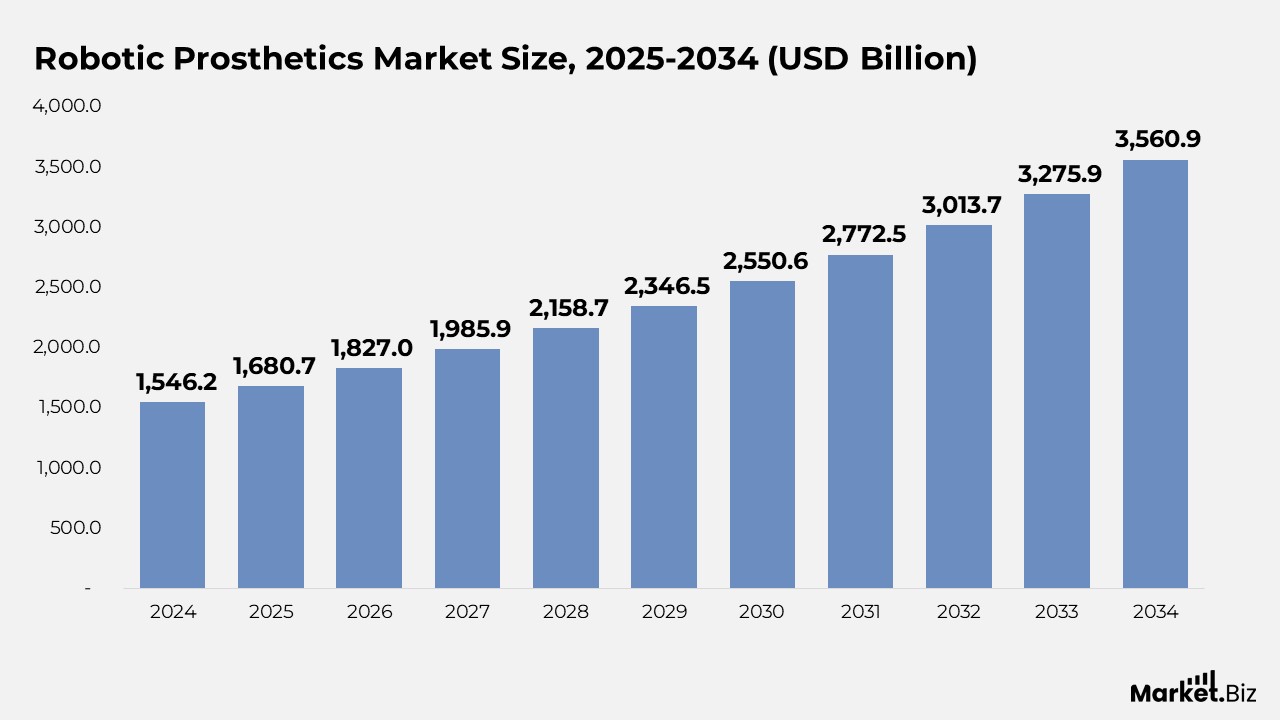
- According to Market.us, the robotic prosthetics market is expected to rise from $1,680.7 million in 2025 to $3,560.9 million by 2032, representing a compound annual growth rate (CAGR) of 8.7% from 2025 to 2034.
- Technological advancements and the rising demand for improved mobility solutions fuel the growth of the robotic prosthetics market. Innovations such as microprocessor-controlled (MPC) systems, myoelectric prosthetics, and bionic limbs have significantly enhanced the functionality and performance of prosthetic devices, allowing them to replicate natural limb movement more effectively, offering users better comfort and mobility.
- Lower Limb Prosthetics holds the largest market share in robotic prosthetics for extremities, accounting for over 58.7% of the market. This dominance is attributed to the higher frequency of lower limb amputations, commonly caused by conditions like diabetes, vascular diseases, and trauma. The prevalence of conditions such as peripheral vascular disease and diabetes, which often lead to amputations of the foot or leg, makes lower limb amputations more frequent than upper limb amputations.
- Microprocessor-Controlled (MPC) Prosthetics is the leading technology in the robotic prosthetics market, capturing 62.4% of the market share. MPC systems provide enhanced stability, comfort, and functionality by using microprocessors that automatically adjust to changes in terrain and walking patterns, enabling smoother, more natural movements compared to traditional prosthetics.
- North America commands a significant market share, holding more than 38.9%, with a market value of US$ 601.5 million for the year.
- The increasing demand for personalized and customizable prosthetic solutions offers opportunities for companies to create devices tailored to the specific needs of individual users.
- In June 2025, Axiles Bionics, a medtech and deeptech spin-off from Brubotics at Vrije Universiteit Brussel (VUB), announced the successful completion of the first €6 million tranche in its €8 million Series A funding round.
(Source: Market.us)
Cloud Robotics Market Size
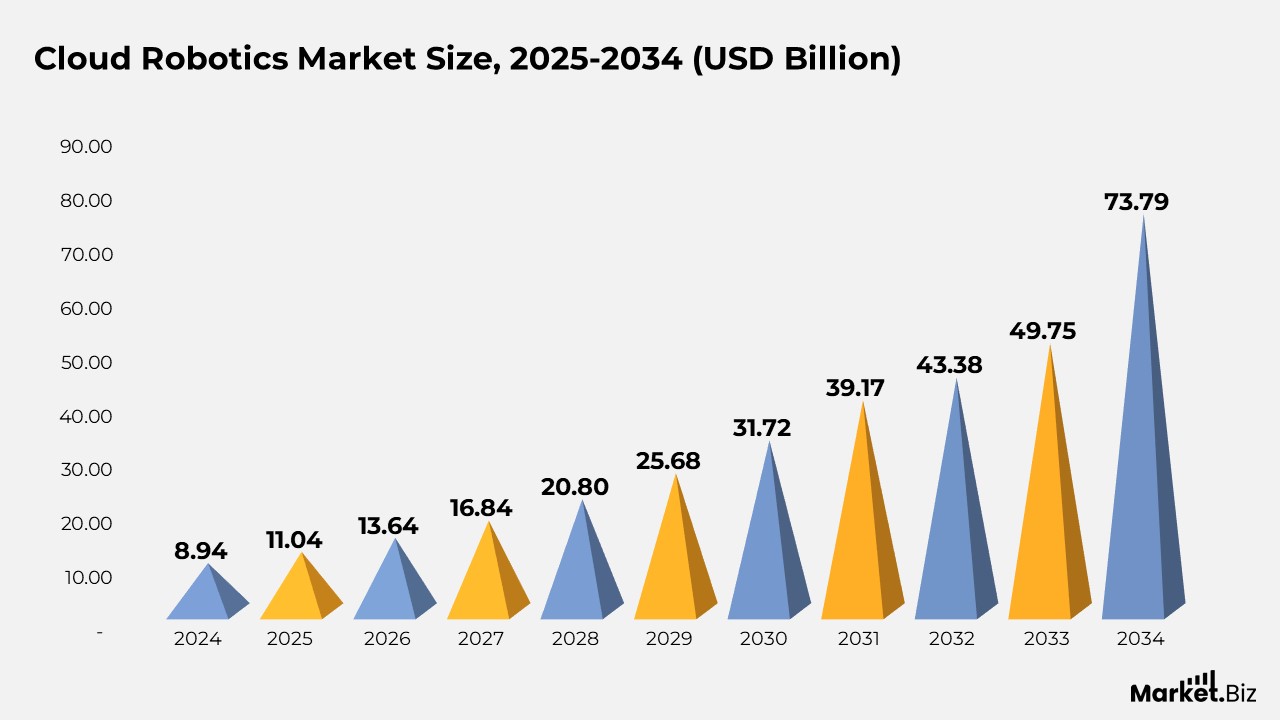
- According to Market.us, the cloud robotics market is expected to rise from $11.04 billion in 2025 to $73.79 billion by 2034, representing a compound annual growth rate (CAGR) of 23.5% from 2025 to 2034.
- The cloud robotics market is experiencing significant growth, driven by advancements in artificial intelligence, machine learning, and high-speed connectivity. Key factors contributing to this growth include the increasing demand for automation across industries, the scalability and cost-effectiveness of cloud-based solutions, and the enhanced capabilities that cloud integration provides to robots.
- In 2024, the software segment dominated the global cloud robotics market, capturing over 54% of the market share. This leadership is due to the rising demand for advanced robotic functionalities that depend heavily on software components.
Moreover
- The Software as a Service (SaaS) segment held a leading position in the cloud robotics market in 2024, accounting for more than 46% of the total market share. This is attributed to the growing need for scalable and cost-efficient solutions that enable businesses to access advanced robotic functionalities without major investments in infrastructure.
- The Industrial Robots segment maintained a dominant position in the global cloud robotics market in 2024, capturing more than 40% of the market share. This is driven by the increasing integration of cloud computing with industrial automation, allowing robots to perform complex tasks with enhanced efficiency and flexibility.
- The Verticals segment dominated the cloud robotics market in 2024, securing over 74% of the market share. This dominance is driven by the widespread adoption of cloud robotics across diverse industries, including manufacturing, healthcare, logistics, and retail.
- North America held a leading position in the global cloud robotics market in 2024, capturing more than 38% of the market share, with a revenue of USD 3.39 billion. The region’s dominance is attributed to technological advancements, high industrial adoption, and strategic initiatives, particularly in the United States.
- In the United States, the cloud robotics market reached USD 3.2 billion in 2024, growing at a strong 21.7% CAGR, reflecting increasing enterprise adoption across various sectors.
(Source: Market.us)
Global Robotics Installations by Sector
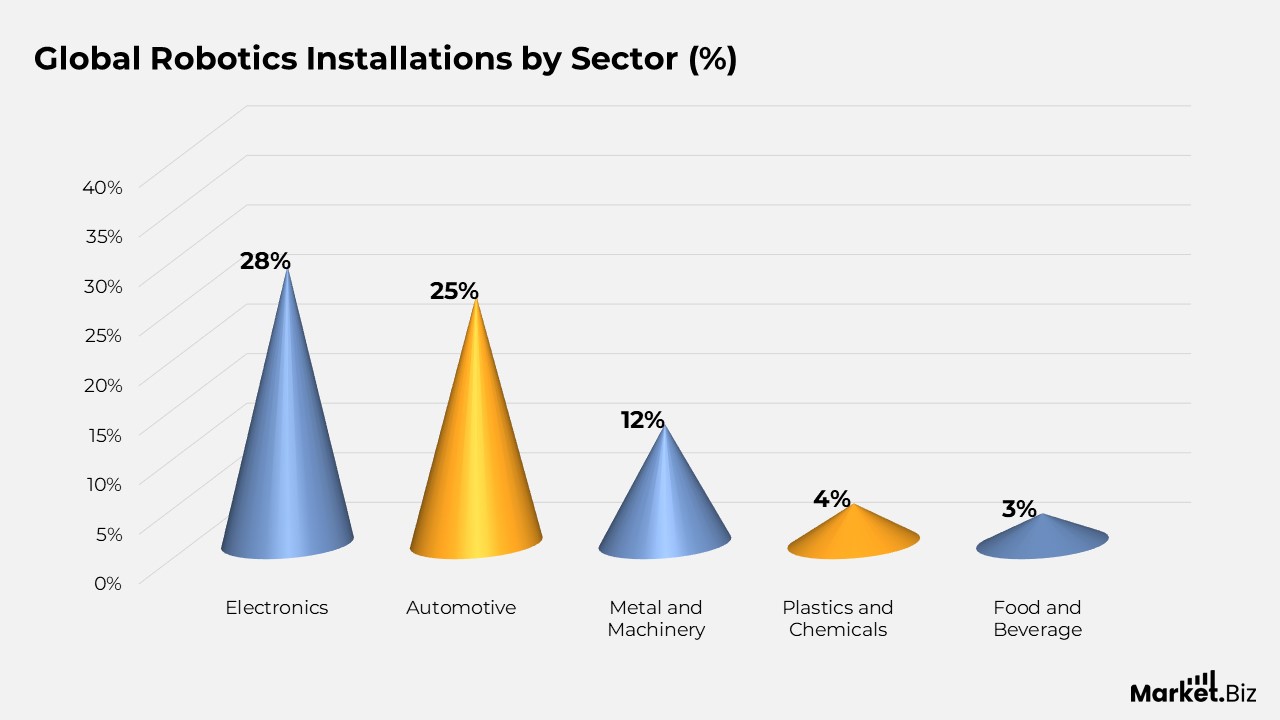
- The electronics sector takes the lead in global robotics installations, accounting for 28% of new robot deployments worldwide.
- The automotive industry follows closely, contributing 25% of the global share of new robotics installations.
- The metal and machinery sector represents 12% of the global total for new robotics installations.
- The plastics and chemicals industries together account for 4% of robotics installations globally.
- The food and beverage industry accounts for 3% of all new robotics installations around the world.
(Source: Statista, Site Selection Magazine, International Federation of Robotics)
Job Automation Trend
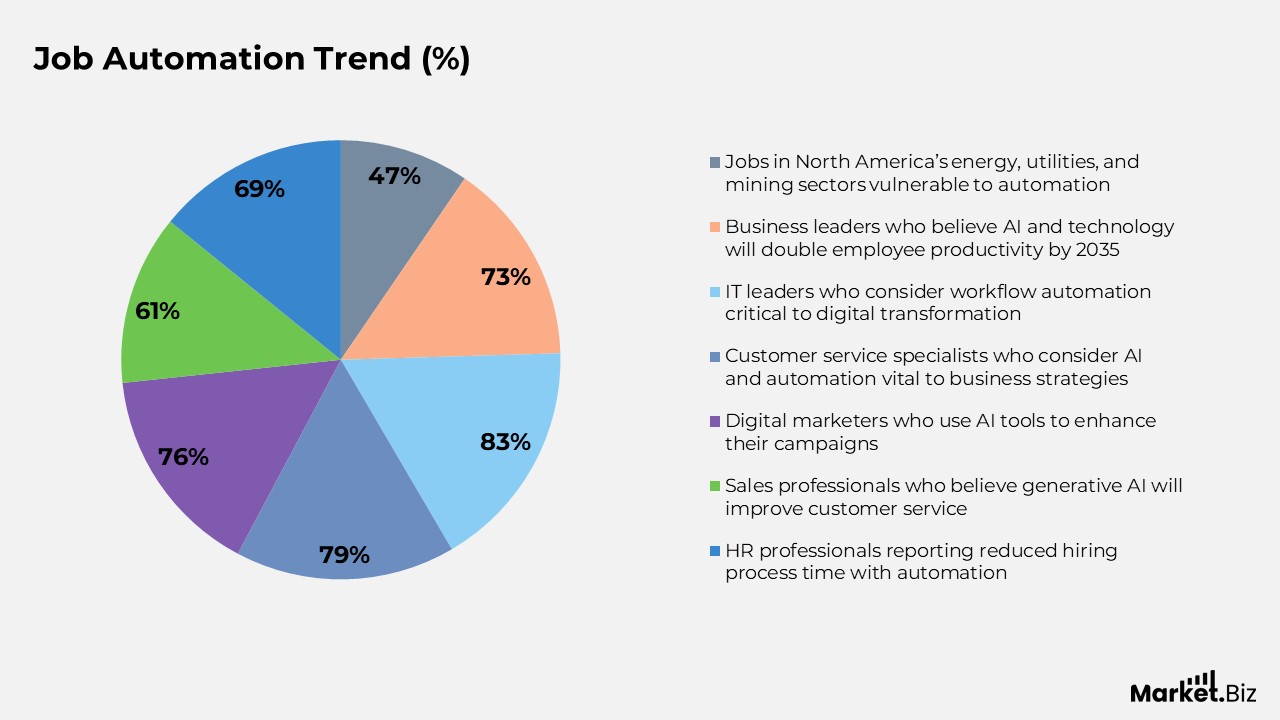
- Around 46.5% of jobs in North America’s energy, utilities, and mining sectors are highly vulnerable to automation.
- By 2040, automation may affect up to 41 million retail jobs, with roles like cashiers, stock clerks, and customer service positions being most at risk. Self-checkout systems, robotics, and AI are driving this transformation to increase efficiency and reduce costs.
- Since 1980, automation and AI have led to wage reductions of up to 70% in certain industries.
- So far, automation has resulted in the loss of 1.7 million manufacturing jobs.
- A recent survey indicates that 73% of business leaders believe technology and AI will enable employees to become at least twice as productive by 2035.
- 83% of IT leaders consider workflow automation a critical component of digital transformation strategies.
- 79% of customer service specialists regard AI and automation as vital to their business strategies.
- According to a recent survey, 75.7% of digital marketers utilize AI tools to optimize their campaigns.
- 61% of sales professionals believe that generative AI will enhance their ability to serve customers more effectively.
- 69% of HR professionals using automation in the hiring process report significant reductions in the time required to hire new talent.
(Source: Statista, edoxi, Forbes, Leftronic, AMS, Kissflow, HubSpot, Harpa AI Technologies, Salesforce, Kissflow)
Robotics Statistics – By Usage
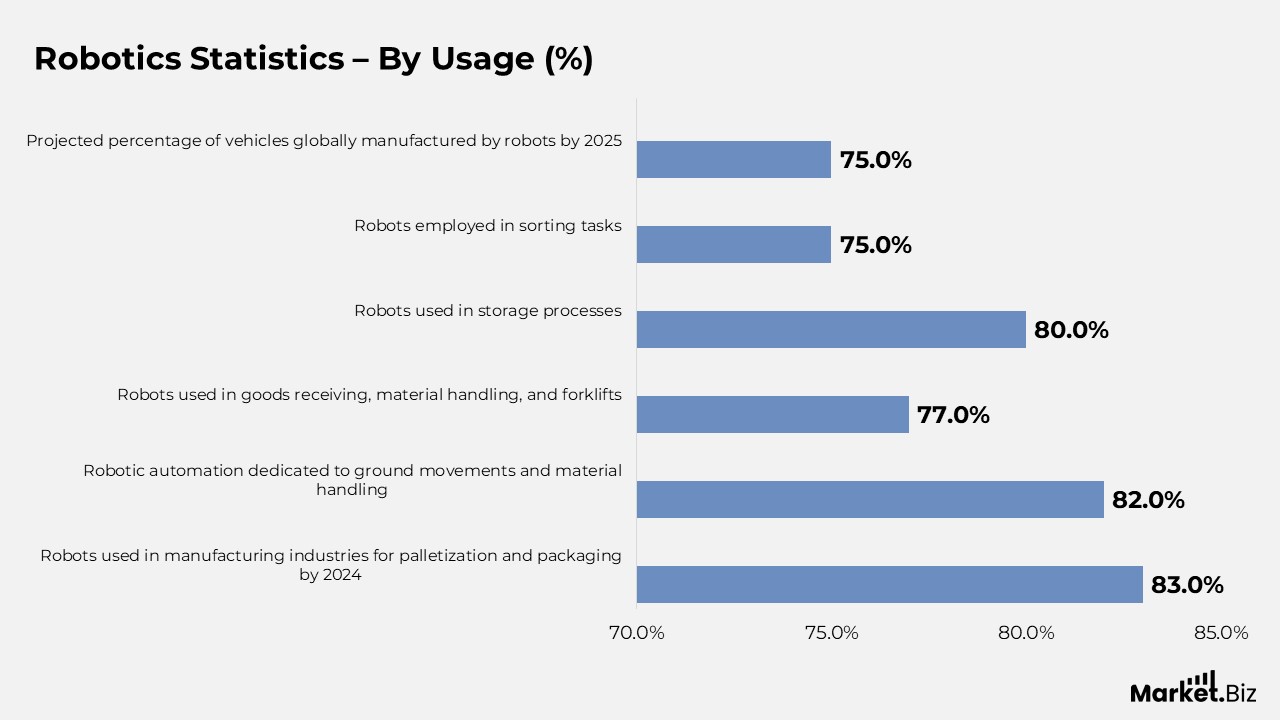
- In 2024, robots were extensively used in 83% of manufacturing industries for tasks such as palletization and packaging.
- 82% of robotic automation is dedicated to ground movements and material handling processes.
- Other notable applications of robots include goods receiving and material handling, and forklifts (77%), storage (80%), and sorting (75%).
- By 2025, robots are projected to be responsible for manufacturing 75% of all vehicles globally.
- In the first quarter of 2023, businesses in the United States placed an order for 9,169 robotic units, resulting in a total value of USD 598 billion.
- Over the past decade, more than 7.2 million robotic surgeries have been performed across 67 countries.
- 83% of robots in manufacturing are primarily used for palletization and packaging.
- 82% of robots are utilized for ground movements and material handling.
- 80% of robots are applied in goods receiving and storage processes.
- 77% of robots are used for material handling and forklift operations.
- 75% of robots are employed in sorting tasks.
(Source: Statista, Kooc Media Ltd., Coolest Gadgets)
Robot Stock Distribution by Application
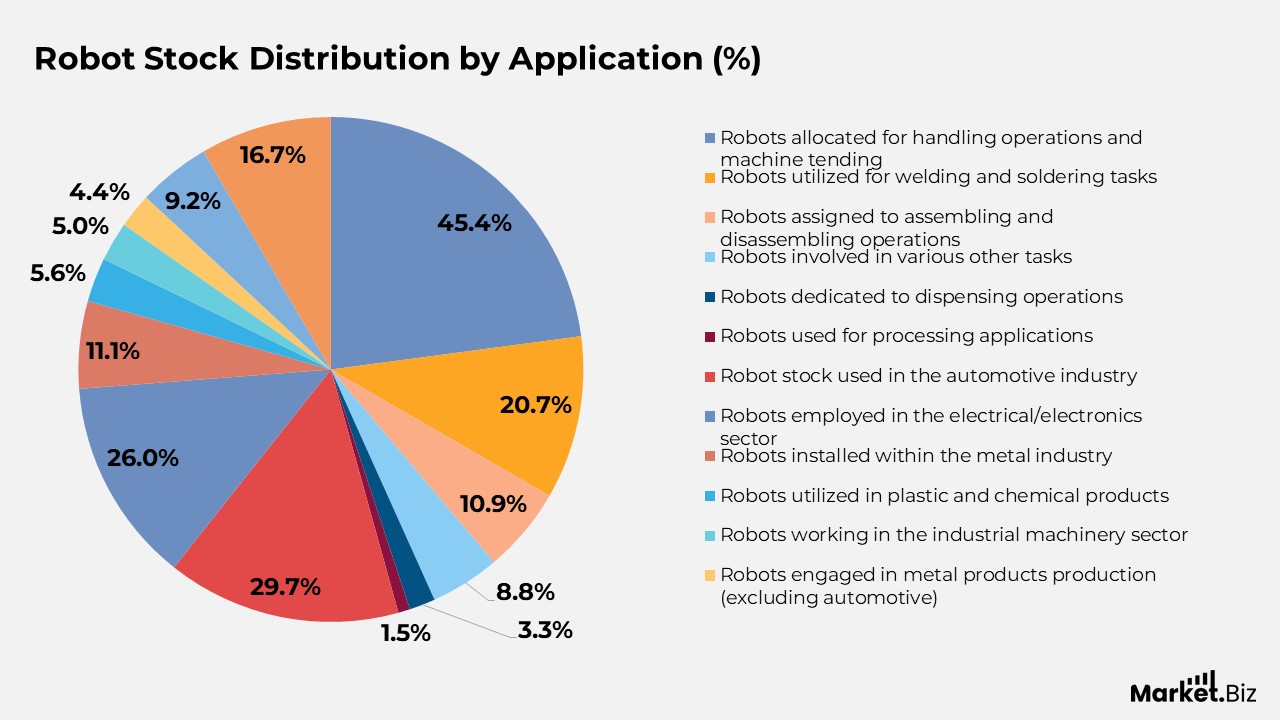
- 45.4% of robots are allocated for handling operations and machine tending.
- 20.7% of robots are utilized for tasks related to welding and soldering.
- 10.9% of robots are assigned to assembling and disassembling operations.
- 8.8% of robots are involved in various other tasks.
- 3.3% of robots are dedicated to dispensing operations.
- 1.5% of robots are used for processing applications.
- 29.7% of robot stock is used in the automotive industry.
- 26.0% of robots are employed in the electrical/electronics sector.
- 11.1% of robots are installed within the metal industry.
- 5.6% of robots are utilized in plastic and chemical products.
- 5.0% of robots are working in the industrial machinery sector.
- 4.4% of robots are engaged in metal products production (excluding automotive).
- 9.2% of robots are categorized as unspecified in terms of application.
- 16.7% of robots remain unspecified in terms of industry sector.
(Source: World Intellectual Property Organization)
Global Robotics Market Trends
- In 2023, the annual robot unit sales volume was released at 541,302 units, reflecting a decrease of 2.1% compared to 2022. However, the operational stock of robots increased to 4,281,585 units, marking a growth of 9.7%. The largest countries in terms of operational stock are South Korea (8.9%), Germany (6.3%), Japan (10.2%), China (accounting for 41%), and the United States (8.9%).
- Global robot density, defined as the number of industrial robots per 10,000 persons employed in the manufacturing industry, rose from 151 to 162. The countries with the highest robot densities are Japan (419 robots), China (470 robots), South Korea (1,012 robots), and Germany (429 robots).
- The automotive industry emerged as the largest segment, with 135,461 robot installations, followed by the electronics sector with 125,804 installations.
- On the country level, the market presented mixed results. China, the largest market, saw a decline of -4.8%, with 276,288 units installed.
- Other countries, including South Korea (-1%), Japan (-8.6%), and the USA (-5%), also experienced decreases in robot sales.
- On the other hand, positive growth was reported in several countries, such as Germany (+6.6%), Brazil (+77.6%), India (+59%), and Spain (+31%).
(Source: International Federation of Robotics)
Robotics Average Salary
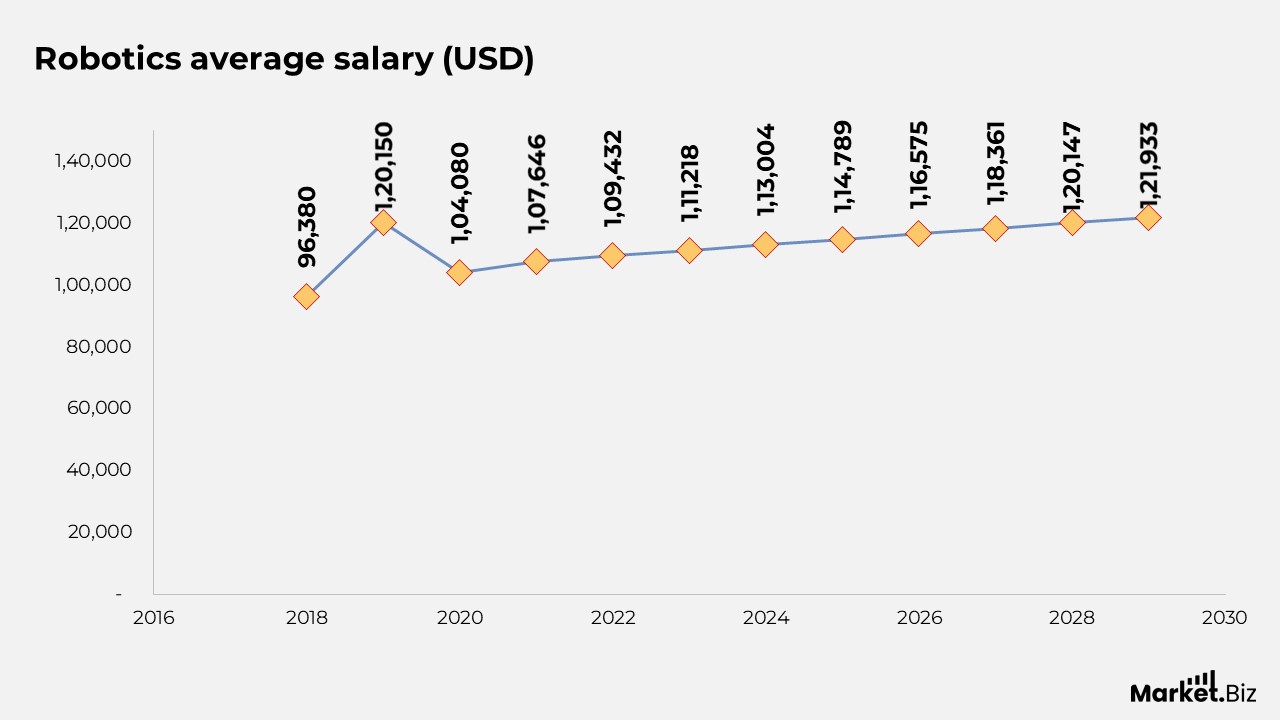
- By 2025, the average annual salary for a robotics engineer is expected to reach approximately $114,789, reflecting an increase of around 10.3% from 2020.
- The salary trends over the years are as follows:
- In 2018, the average salary was $96,380.
- In 2019, it rose to $120,150.
- In 2020, the salary dropped slightly to $104,080.
- In 2021, the salary increased to $107,646.
- By 2022, the salary reached $109,432.
- In 2023, the salary continued to rise to $111,218.
- In 2024, it further grew to $113,004.
- By 2025, it is projected to reach $114,789.
- In 2026, the salary is anticipated to increase to $116,575.
- By 2027, the average salary is expected to rise to $118,361.
- In 2028, it is forecast to reach $120,147.
- By 2029, the salary is projected to rise to $121,933.
(Source: AIPRM, Statista)
Robotics Adoption Challenges
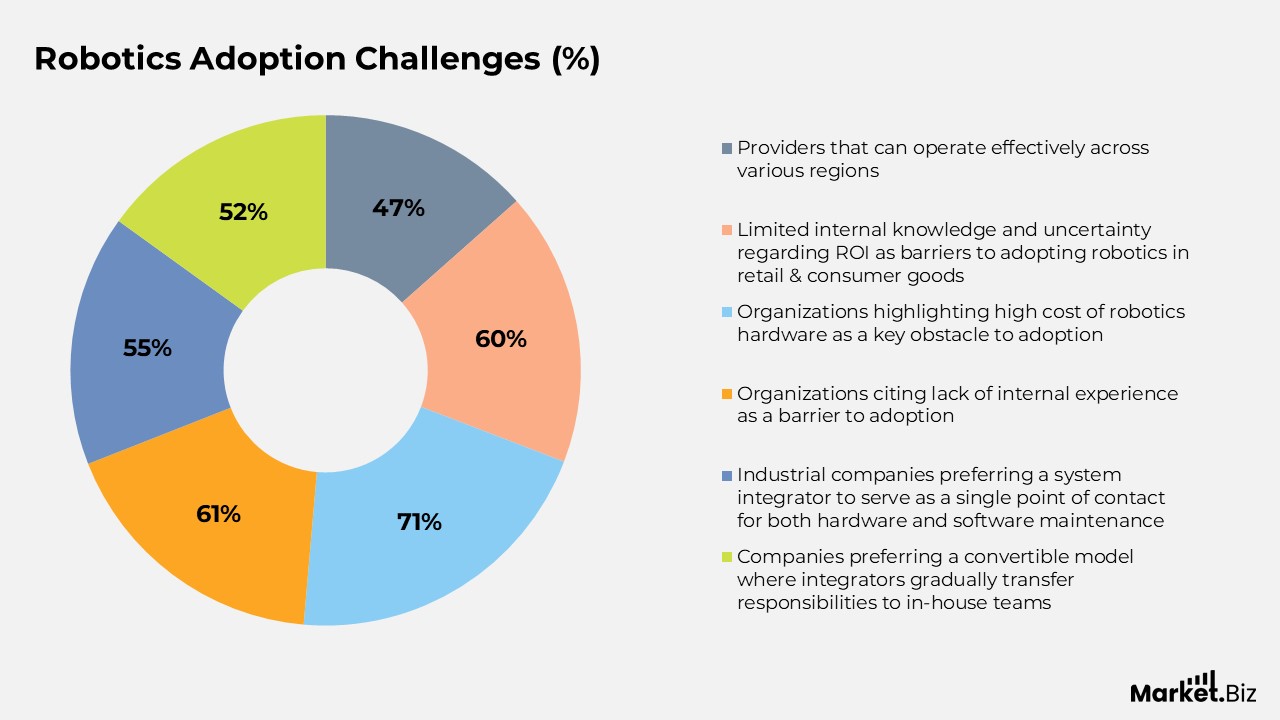
- Around 42% of companies face challenges in finding end-to-end robotics solution providers that can operate effectively across various regions.
- In the retail and consumer goods sector, approximately 60% of respondents identify limited internal knowledge and uncertainty regarding ROI as major barriers to adopting robotics.
- 71% of organizations highlight the high cost of robotics hardware as a key obstacle to adoption, while 61% point to a lack of internal experience.
- 55% of industrial companies express a desire for a system integrator to serve as a single point of contact for both hardware and software maintenance.
- 52% of companies prefer a convertible model in which integrators gradually transfer responsibilities to in-house teams.
(Source: Statista, McKinsey, StudioRed.com )
Conclusion
The robotics industry is witnessing significant growth, fueled by advancements in artificial intelligence, machine learning, and high-speed connectivity. As robots become more seamlessly integrated with cloud computing and automation systems, their applications across industries such as manufacturing, healthcare, logistics, and retail are expanding.
The shift towards microprocessor-controlled prosthetics, industrial robots, and cloud robotics is transforming the sector, enhancing functionality, efficiency, and scalability. Strong investments, government support, and widespread industrial adoption further drive this market growth.
As robotics technology continues to evolve, it is poised to deliver more intelligent and flexible solutions to meet the diverse needs of various industries. Looking ahead, robots are expected to play a crucial role in optimizing processes, enhancing safety, and tackling global challenges across multiple sectors.
FAQ’s
The robotics industry involves the design, development, and use of robots across various industries. It integrates technologies such as artificial intelligence (AI), machine learning, automation, and cloud computing, enabling robots to perform tasks autonomously or with minimal human oversight.
Key drivers of the robotics industry’s growth include advancements in AI, machine learning, and high-speed connectivity. Additionally, the increasing need for automation, cost-effective and scalable solutions, along with the rising adoption of robots in manufacturing, healthcare, logistics, and other industries, contribute significantly to its expansion.
Industrial robots are mainly used in manufacturing for tasks such as assembly, welding, painting, packaging, and material handling. Their capacity to perform repetitive tasks with high precision and speed has made them indispensable in enhancing productivity and reducing operational costs in factories.
In healthcare, robotics is transforming patient care and medical procedures. Robots are employed in minimally invasive surgeries, rehabilitation, and assisting the older and disabled. Robotic prosthetics, exoskeletons, and telemedicine robots are also enhancing mobility and improving the delivery of care.
Cloud robotics refers to the integration of robots with cloud computing, allowing them to leverage remote data and processing power. This enables robots to execute complex tasks without requiring extensive local processing, thereby enhancing their functionality, scalability, and adaptability to dynamic environments.
Industrial robots are specialized for high-precision, repetitive tasks in manufacturing environments. In contrast, service robots are designed for a wide range of applications, including healthcare, hospitality, and consumer services. They tend to be more flexible and are often designed to interact with humans in dynamic, unpredictable settings.