









Introduction
Simulation Software Statistics: Simulation software serves as a flexible instrument utilised across multiple sectors to emulate real-world systems for the purposes of analysis and decision-making. It aids in cost reduction, risk mitigation, and process optimisation.
Various types of simulation software exist, including discrete event, continuous, agent-based, and Monte Carlo simulations, each designed for particular applications. Users are able to model intricate systems, conduct experiments, visualise data, and make well-informed decisions.
Industries such as manufacturing, healthcare, finance, and aerospace depend on simulation software to enhance efficiency and manage complex systems. Continuous advancements in technology further improve its capabilities and expand its range of applications.
Editor’s Choice
- The simulation software market is witnessing consistent growth, with a compound annual growth rate (CAGR) of 12.9%, as indicated by its rising revenue.
- The worldwide simulation software market is chiefly led by software solutions, which represent a significant 70% of the market share.
- Anticipated for the year 2025, the number of users engaging in remote patient monitoring could exceed 70.6 million.
- The global demand for oil could exceed 106.5 million barrels daily by the year 2030, alongside a growing need for gas.
- As of 2018, AWS (Amazon Web Services) indicated that numerous industrial applications were either in the midst of migrating to or were being considered for migration to the public cloud.
General Simulation Software Statistics
- The simulation software market is witnessing consistent growth, with a compound annual growth rate (CAGR) of 12.9%, as indicated by its rising revenue.
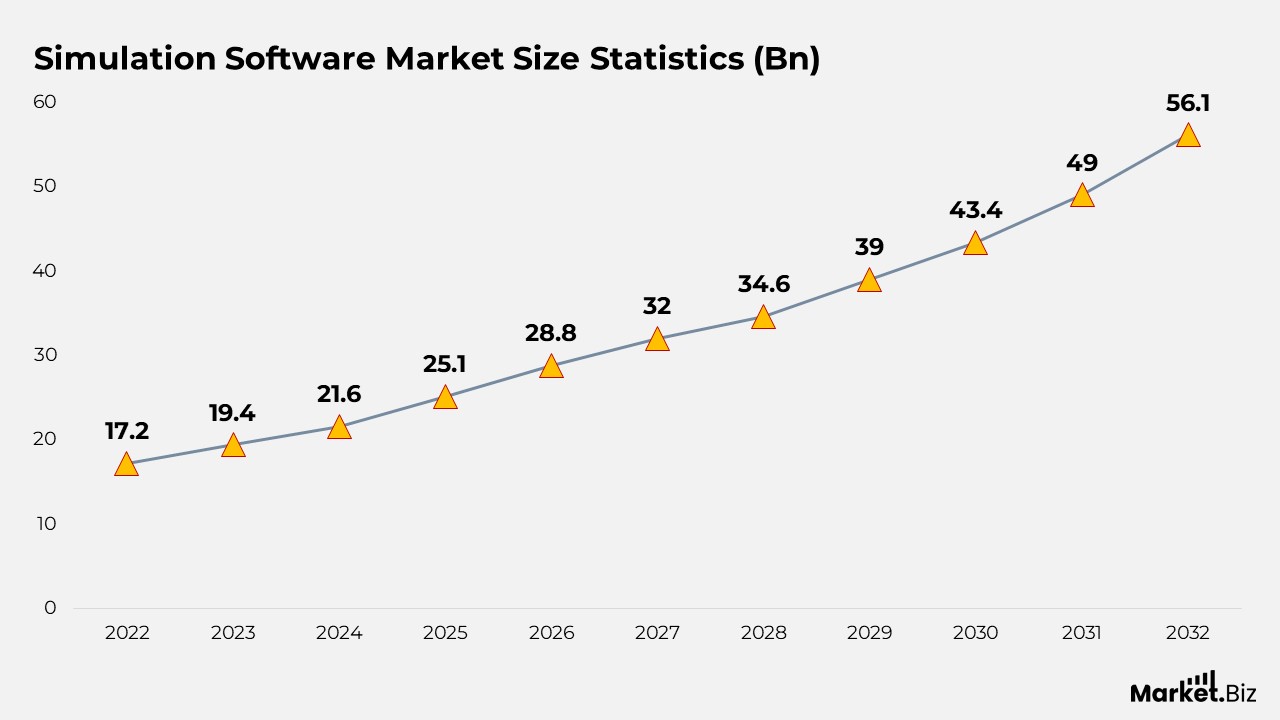
- In 2022, the market achieved a revenue of $17.2 billion and is projected to increase to $56.1 billion by 2032.
- In 2022, total market revenue was USD 17.2 billion, with on-premises deployments accounting for USD 12.1 billion and cloud-based deployments generating USD 5.1 billion in revenue.
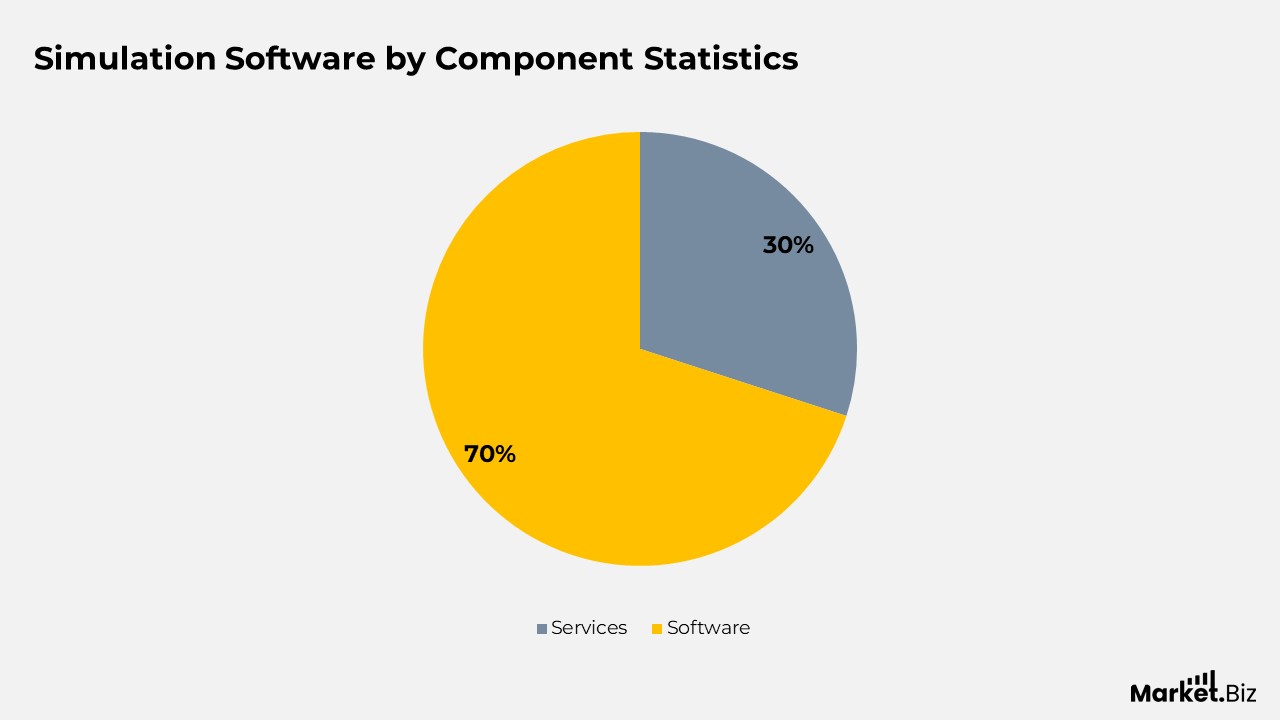
- Software solutions predominantly lead the global simulation software market, accounting for a significant 70% of the market share.
- GM Holden Australia, a division of General Motors, saw a 5% increase in throughput without additional costs by utilising simulation software.
- Stillwater, a mining company located in South Africa, successfully reduced its backfill time from 2-3 hours to merely 20 minutes through the use of simulation software.
- Terminal San Giorgio Ports in Italy realised a 20% enhancement in its overall terminal throughput by integrating simulation software with artificial intelligence.
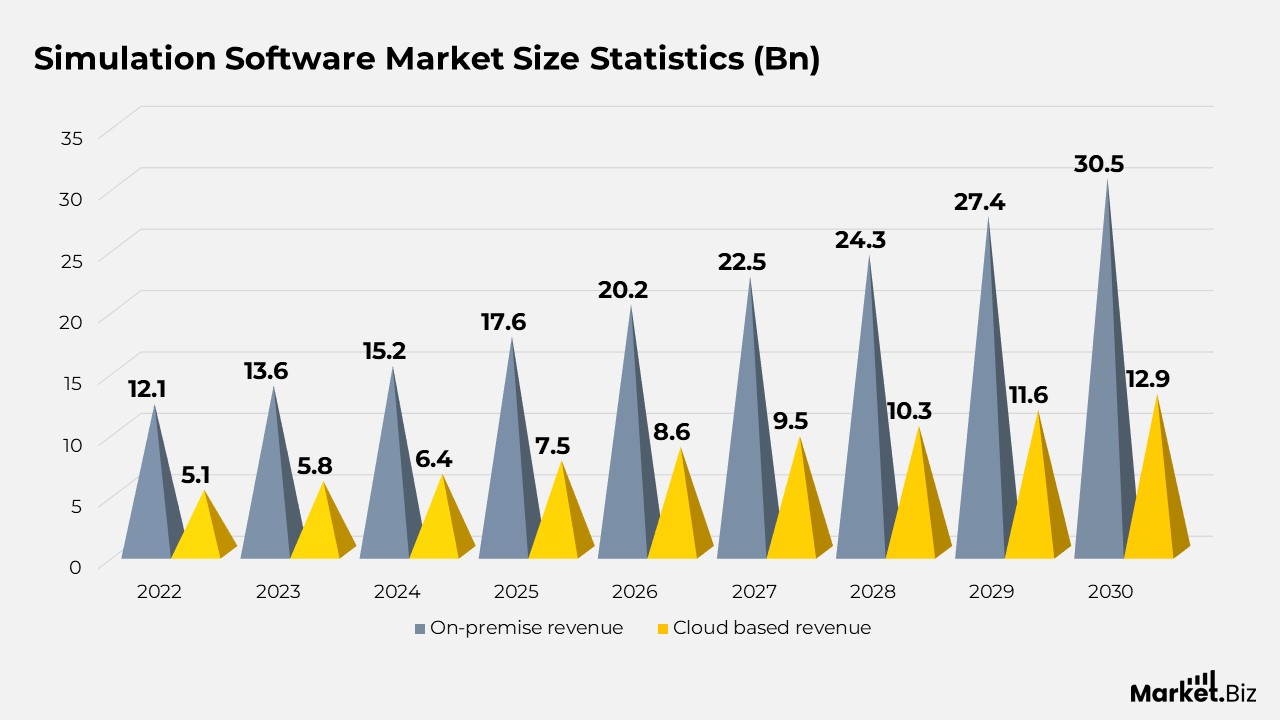
Simulation Software Market Size Statistics
- The simulation software market is witnessing consistent growth at a compound annual growth rate (CAGR) of 12.9%, as indicated by its rising revenue.
- In 2022, the market achieved a revenue of $17.2 billion, and this amount is anticipated to increase steadily in the forthcoming years.
- By 2023, the revenue is expected to hit $19.4 billion, followed by $21.6 billion in 2024, and $25.1 billion in 2025.
- The upward trend persists with projected revenues of $28.8 billion in 2026, $32 billion in 2027, and $34.6 billion in 2028.
- The market is anticipated to surpass the $39 billion threshold in 2029. Additional growth is forecasted for 2030, with revenue estimated at $43.4 billion.
- Looking further ahead, the simulation software market is expected to reach $49 billion in 2031 and achieve a remarkable milestone of $56.1 billion in 2032.
Component Statistics of Simulation Software
- The worldwide simulation software market is chiefly led by software solutions, which represent a significant 70% of the market share.
- Moreover, these software applications are crucial in multiple sectors, spanning from aerospace and automotive to healthcare and finance, providing simulation functionalities for a variety of applications.
- Supporting the software segment are services, which make up the remaining 30% of the market share.
Simulation Software Applications Statistics
Healthcare
- Anticipated for the year 2025, the number of users engaging in remote patient monitoring could exceed 70.6 million. This is likely to result in increased demands and scrutiny within the healthcare industry.
- As a result, the use of simulation in healthcare demonstrates significant advantages for both patients and healthcare professionals in maintaining high standards of care and treatment.
- Moreover, a notable example of this is the Nebraska Medical Centre, which successfully removed workflow barriers and minimised travel time for both patients and physicians by employing simulation software.
Oil & Gas
- The global demand for oil could exceed 106.5 million barrels daily by the year 2030, alongside a growing need for gas.
- As a result, the Oil and Gas industry is set to face numerous challenges related to efficiency and productivity.
- To tackle these challenges, the sector is progressively integrating simulation software into its operations.
- In this domain, simulation software utilises industry-validated accuracy and optimised processes to improve safety, profitability, and overall site throughput.
Mining
- The role of simulation has evolved from a useful tool to a vital technology within the mining industry. It is achieving remarkable progress in this field.
- For example, Stillwater, a mining firm located in South Africa, successfully reduced their backfill duration from 2-3 hours to merely 20 minutes through the adoption of simulation software.
- In addition to enhancing operational efficiency, simulation software is instrumental in formulating more effective strategies for risk management in mining activities.
Simulation Software Cloud Computing Advancements
- As of 2018, AWS (Amazon Web Services) indicated that numerous industrial applications were either in the midst of migrating to or were being considered for migration to the public cloud.
- These applications spanned a broad spectrum of functions within the industrial sector.
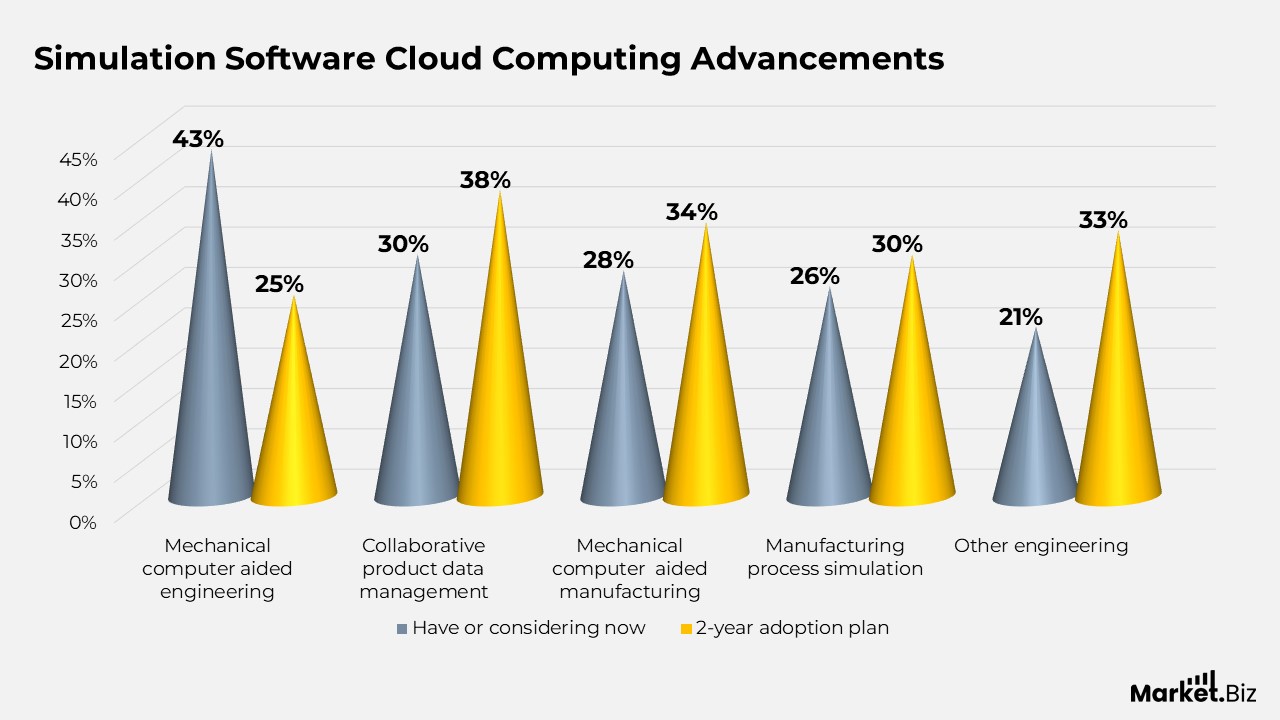
- Significantly, 43% of respondents were either actively contemplating or had already begun implementing mechanical computer-aided engineering in the cloud, while 30% found themselves in a similar situation regarding collaborative product data management.
- Further, the fields of mechanical computer-aided manufacturing and manufacturing process simulation were closely aligned, with respective figures of 28% and an undisclosed percentage.
- Moreover, other engineering functions were under exploration by 21% of respondents.
- Mechanical computer-aided design had 19% of respondents either currently migrating or planning to do so within the next two years.
- Demand planning and forecasting completed the list, with 18% considering or actively transitioning these functions to the public cloud.
Recent Developments
- In the early part of 2023, Autodesk finalized its acquisition of Innovyze, a prominent global entity in water infrastructure simulation software, for a sum of $1 billion.
- In the middle of 2023, Ansys, a frontrunner in simulation software, purchased Analytical Graphics Inc. (AGI) for $700 million.
- In 2023, Altair, a prominent company in simulation and AI, secured $250 million to expedite the advancement of simulation software that incorporates AI and machine learning technologies.
- The demand for cloud-based simulation solutions is projected to increase by 14% each year, propelled by industries aiming to enhance product development cycles.
Simulation Software Future Predictions
- The market is expected to exceed the $39.0 billion mark by 2029. Growth is anticipated in 2030, with revenues projected to hit $43.4 billion.
- In the future, the simulation software market is predicted to reach $49.0 billion in 2031, followed by a significant milestone of $56.1 billion in 2032.
Conclusion
In summary, simulation software has become an essential and versatile tool across various sectors. Furthermore, its ability to replicate real-world scenarios and analyze complex systems has made it a vital technology for improving operations, minimizing costs, and enhancing productivity in areas such as manufacturing, healthcare, transportation, and the oil and gas industry.
In addition to efficiency gains, simulation software plays a significant role in risk management, logistics assessment, and responding to disruptions, safeguarding against potential losses. It also plays a crucial role in the planning of container yards, resource distribution, and route optimization for more streamlined processes.
Moreover, as technology advances, the integration of simulation software with real-time data and artificial intelligence is poised to drive innovation and tackle intricate challenges, solidifying its position as an indispensable asset in today’s competitive landscape.
FAQ’s
Simulation software is defined as a computer application that creates a digital model of a real-world system, process, or scenario, enabling it to imitate its behavior and assess its performance under various conditions.
AnyLogic is recognised as the leading simulation modeling software for business applications, utilized worldwide by over 40% of Fortune 100 companies. The simulation models developed with AnyLogic enable analysts, engineers, and managers to gain deeper insights and improve complex systems and processes across a wide range of industries.
The statistical simulation method is described as a scientific approach that uses computer simulations to replicate complex phenomena and processes, integrating theoretical evaluations with experimental data to analyse random variations and characteristics of systems.