









Introduction
Virtual Entertainment statistics offer a clear, data-focused view of how immersive digital formats such as online gaming, virtual events, metaverse experiences, VR environments, and interactive streaming are reshaping the global entertainment landscape.
These statistics examine key measures, including user participation, engagement intensity, content consumption patterns, revenue models, and regional adoption, highlighting the ongoing shift from passive entertainment to interactive, experience-led platforms.
They also reflect the influence of technological advances in virtual and augmented reality, cloud infrastructure, and high-speed networks on both audiences and content creators. Overall, Virtual Entertainment statistics provide a solid foundation for evaluating market evolution, user behavior trends, and long term growth potential within the digital entertainment ecosystem.
Editor’s Choice
- Virtual reality adoption is gaining traction in the US, with approximately 53 million adults currently owning a VR device.
- The global audience for immersive technologies continues to expand, as the combined AR and VR user base is projected to reach 3.7 billion users by 2029.
- Enterprise adoption is accelerating, with one in two companies actively incorporating VR into their business strategies to support training, collaboration, and digital engagement.
- Consumer exposure to VR is becoming mainstream, as nearly 48% of US consumers report having experienced virtual reality at least once.
- User experience remains a key barrier to wider VR adoption, with 26% of businesses identifying usability and comfort challenges as the primary obstacle.
- Virtual reality already has a sizable global footprint, with around 171 million people using VR in some capacity today.
- The VR industry reached an estimated market value of USD 6.1 billion in 2020, reflecting its early but growing commercial presence.
- Hardware adoption was accelerating, with shipments of AR and VR devices expected to reach approximately 5.5 million units in 2020.
- China stands out as the largest investor in virtual reality, committing nearly USD 5.8 billion to VR development and deployment.
- Immersive technologies are expected to reshape employment, with VR and AR potentially influencing up to 23 million jobs by 2030.
- Combined VR and AR adoption could deliver a significant economic uplift, with projections indicating a contribution of around USD 1.9 trillion to the global economy by 2030.
Virtual Reality Adoption, User Perception, and Enterprise Impact
- Virtual reality has established a strong global presence, with approximately 171 million people actively using VR technology worldwide.
- User penetration for virtual reality is expanding steadily, projected to reach 52.8% in 2024 and increase further to 55.9% by 2028.
- The combined AR and VR ecosystem continues to scale rapidly, with total global users expected to reach 3.7 billion by 2029.
- Consumer exposure to VR is widespread in the US, with 48% of consumers reporting having experienced it at least once.
Generational Adoption and Consumer Sentiment Toward VR
- Younger audiences show stronger engagement: over 30% of Gen Z and millennials have tried VR, compared to 26% of Gen X and 13% of baby boomers.
- User satisfaction remains high, with 8 out of 10 consumers who have tried VR describing their experience as either very or somewhat positive.
- Interest in future use is growing, with more than 40% of consumers indicating they are willing to use VR under suitable conditions.
- Emotional engagement with VR is notable, as nearly 37% of US consumers say they feel excited about spending time in virtual reality environments.
- Societal perception is generally optimistic, with one-third of US adults believing VR will have a positive impact on society.
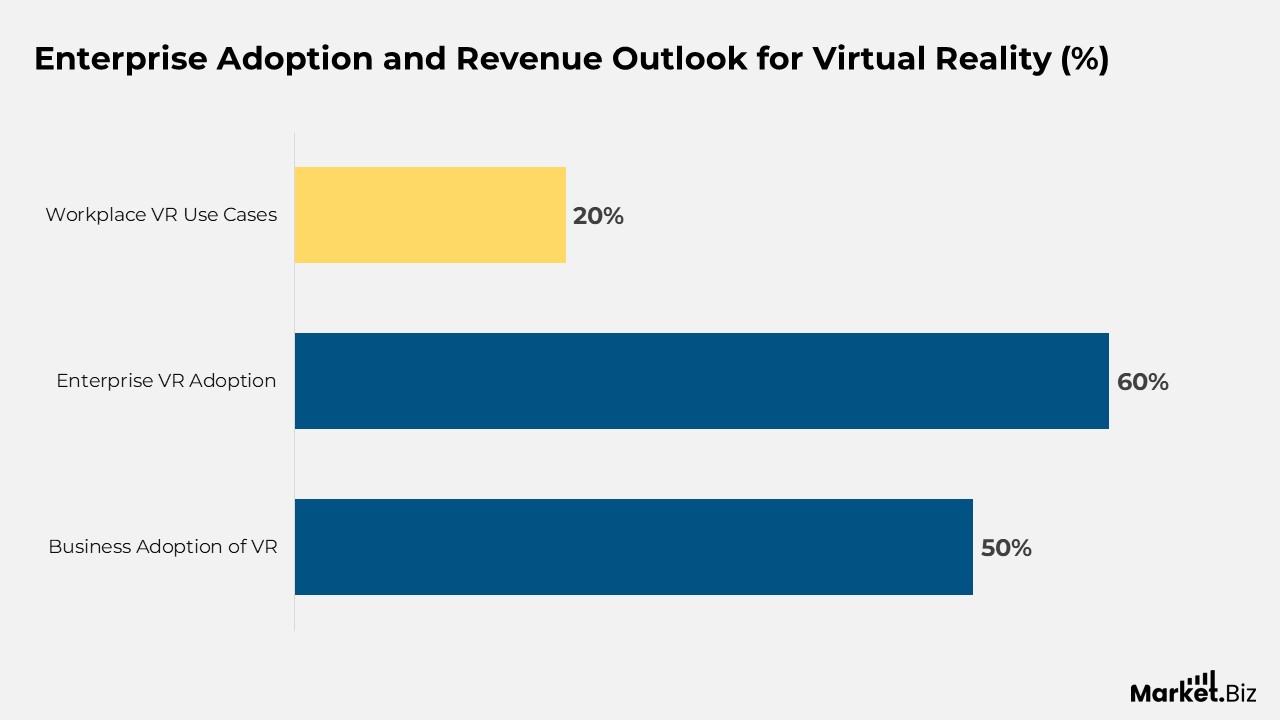
Enterprise Adoption and Revenue Outlook for Virtual Reality
- Business adoption of VR is accelerating, with 50% of companies either actively integrating VR into their strategies or already using it within at least one business function.
- Enterprise applications are expected to dominate the VR market, accounting for more than 60% of total revenue by 2030.
- Workplace use cases are emerging, as 1 in 5 Americans expresses interest in attending professional meetings within virtual reality environments.
- Monetization indicators show steady growth potential, with average revenue per VR user projected to reach USD 11.9
(Sources: Statista, g2.com)
Technology Adoption and Workforce Impact
- Deskless workers, who make up nearly 80% of the global workforce, are expected to play a central role in driving AR adoption, particularly in field operations and industrial environments.
- Network advancements are expected to support immersive experiences, with more than one-third of early adopters anticipating that 5G will enable smoother mobile AR and VR use through faster and more stable connectivity.
- Developments in edge computing are supporting the growth of AR technology, advanced head-mounted displays, and motion-based interfaces. Creating a more seamless AR ecosystem for interaction and data processing.
Retail, Shopping, and Consumer Commerce Applications
- AR is increasingly influencing online purchasing behaviour. With more than 25% of shoppers using it to buy furniture and around 20% for clothing and accessories.
- Products promoted with AR or VR content achieve significantly stronger performance. With a 94% higher conversion rate than non-immersive product listings.
- Consumer expectations are evolving, as 43% of mobile shoppers believe beauty brands should universally adopt AR experiences.
- Visual search is gaining acceptance, with over 90% of US consumers open to using AR-powered visual search for shopping.
- AR-driven retail experiences continue to grow, with the retail AR market projected to reach USD 7.95 billion by 2025, and 40% of consumers willing to pay more for enhanced AR shopping experiences.
Consumer Engagement, Entertainment, and Brand Interaction
- Brand connection through immersive experiences is strengthening. As nearly 50% of Gen Z consumers report feeling more connected to brands when using AR lenses or filters.
- Entertainment remains a key use case, with 67% of consumers expressing interest in AR experiences for concerts, sports events, and live entertainment.
- AR engagement on social platforms is extensive, with more than 250 million Snapchat users interacting with AR shopping lenses over 5 billion times.
- Interest in AR extends beyond shopping: 79% of consumers are interested in AR for entertainment, 78% for wellness or fitness activities, and 84% for learning and education.
AR Hardware, Devices, and Regional Performance
- Sales of AR head-worn devices are expected to reach 1.49 million units in 2024 and increase to 1.63 million units in 2025. With total installations projected to exceed 5.79 million by 2028.
- Hardware remains the dominant segment of the AR market, accounting for over 58% of total revenue in 2024, driven by demand for smart glasses, headsets, and display systems.
- North America leads global AR adoption, holding 36.14% of total market revenue in 2023. Supported by early technology adoption and strong enterprise investment.
Marketing, Accessibility, and Sustainability Impact
- AR is gaining traction in marketing strategies, with 14% of marketers currently using AR or VR and 49% planning to increase investment in immersive campaigns in 2024.
- AR product visualization is expanding rapidly, projected to grow from USD 2.13 billion to USD 30.2 billion within a short time frame, reflecting strong commercial interest.
- Accessibility benefits are widely recognised, with 72% of brands believing AR helps make products and events more inclusive.
- Sustainability potential is also noted, with 83% of consumers believing AR can help reduce product returns and environmental impact.
- Consumer confidence improves through AR usage, with 81% of shoppers reporting greater purchase confidence and 75% expressing interest in AR-based product instructions.
- Engagement depth remains strong, with 4 out of 5 AR ad users saying immersive advertising enables more meaningful brand interactions.
(Sources: National Research Group, Snapchat, Statista)
Virtual Reality Market Leaders and Competitive Landscape
- Major technology companies and startups are competing aggressively in the VR space. With Meta positioning itself as a leading immersive experience provider following its rebrand from Facebook.
- Meta dominates the VR headset market, holding approximately 74% share. While ByteDance’s Pico follows with around 8%.
- China-based DPVR accounts for roughly 4% of the market, with Apple and Sony each holding about 3%.
- Meta’s AR and VR division, Reality Labs, generated around USD 2 billion in revenue from Quest headsets, games, apps, and services.
- Cumulative sales of Meta’s Oculus Quest headsets have surpassed 20 million units, reinforcing its leadership position.
Workforce Impact and Virtual Reality Employment
- Demand for immersive technology skills is rising, with AR- and VR-related job postings increasing by 154% over the past five years. Despite representing only a small share of total listings.
- The US, India, and Germany are leading regions investing in AR and VR talent and innovation.
- By 2030, immersive technologies are expected to enhance up to 23 million jobs globally across industries such as manufacturing, healthcare, and education.
- VR professionals command strong compensation. With the average annual salary of a VR developer in the US reaching approximately USD 108,471.
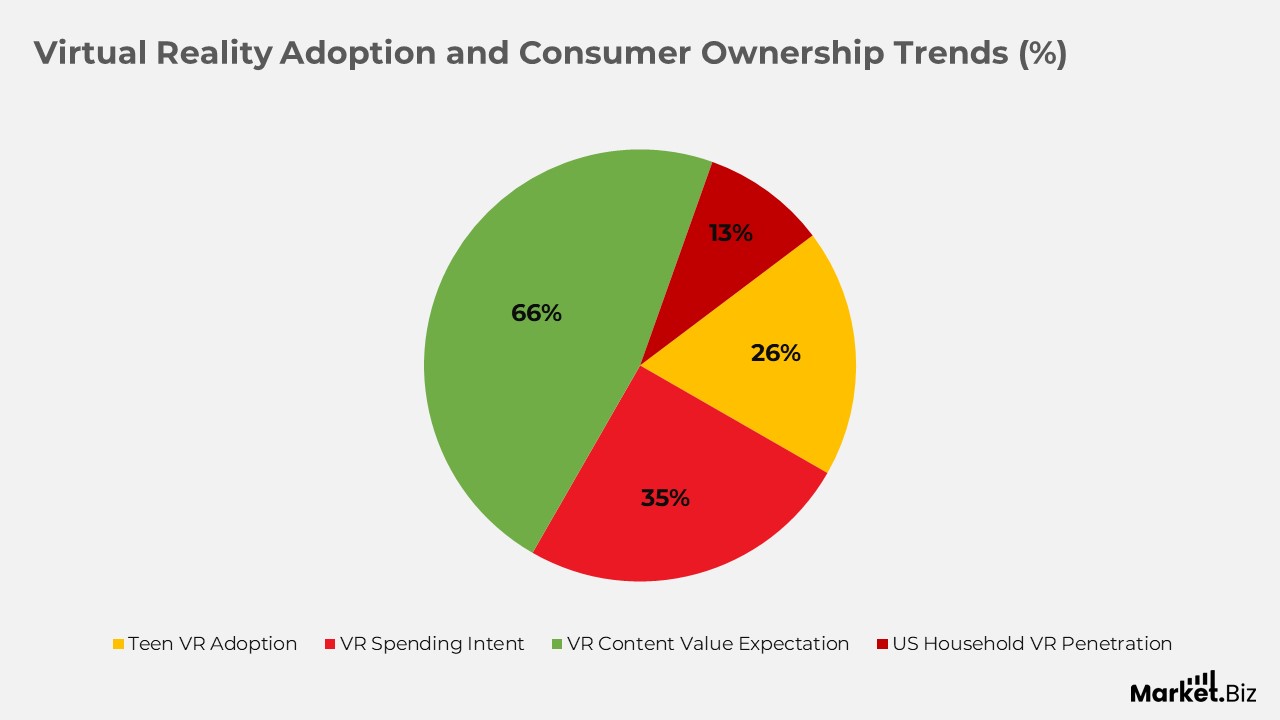
Virtual Reality Adoption and Consumer Ownership Trends
- VR adoption is progressing steadily, with an estimated 72.2 million Americans using VR systems in 2024.
- Augmented reality has an even broader reach, with around 95.5 million Americans engaging with AR experiences.
- Ownership levels continue to rise, as roughly 53 million Americans currently own a VR device.
- Teen adoption is notable, with 26% reporting ownership of a VR headset.
- Near-term demand remains strong, with an additional 14 million US adults likely to purchase a VR device within 6 months.
- Spending intent is positive, as 35% of VR users expect to increase their VR-related spending in the near future.
- Value expectations remain high, with 66% of users stating VR content must deliver experiences unavailable through traditional media.
- Household penetration remains early stage, with 13% of US households owning at least one VR headset.
VR Hardware Market Growth and Sales Momentum
- The VR headset market is projected to reach approximately USD 26.8 billion by 2027, up from USD 7.9 billion in 2021.
- VR headset users in the US are expected to exceed 32 million, supported by 13.9 million units sold in 2022.
- Market momentum accelerated sharply, with VR headset sales increasing by 241.6% in the first quarter of 2022 alone.
- By 2024, more than 34 million VR headsets are expected to be actively in use.
- Combined AR and VR headset sales are projected to reach 73.6 million units by 2026.
Consumer Expectations and Entertainment Use Cases
- Interest in immersive entertainment is rising, with 4 out of 10 consumers expressing excitement about attending VR-based concerts.
- Key purchase considerations include image resolution (52%), comfort of headsets and controllers (44%), high-quality audio (39%), and simple setup processes.
- Virtual live events appeal strongly to younger audiences, with 37% of Gen Z and 38% of millennials showing strong interest in virtual concerts.
- Beyond entertainment, consumers are interested in VR for cultural and social experiences, including virtual museums (39%), social interaction (31%), and fitness classes (32%).
- Nearly 50% of shoppers indicate willingness to pay more for products customized through immersive technologies.
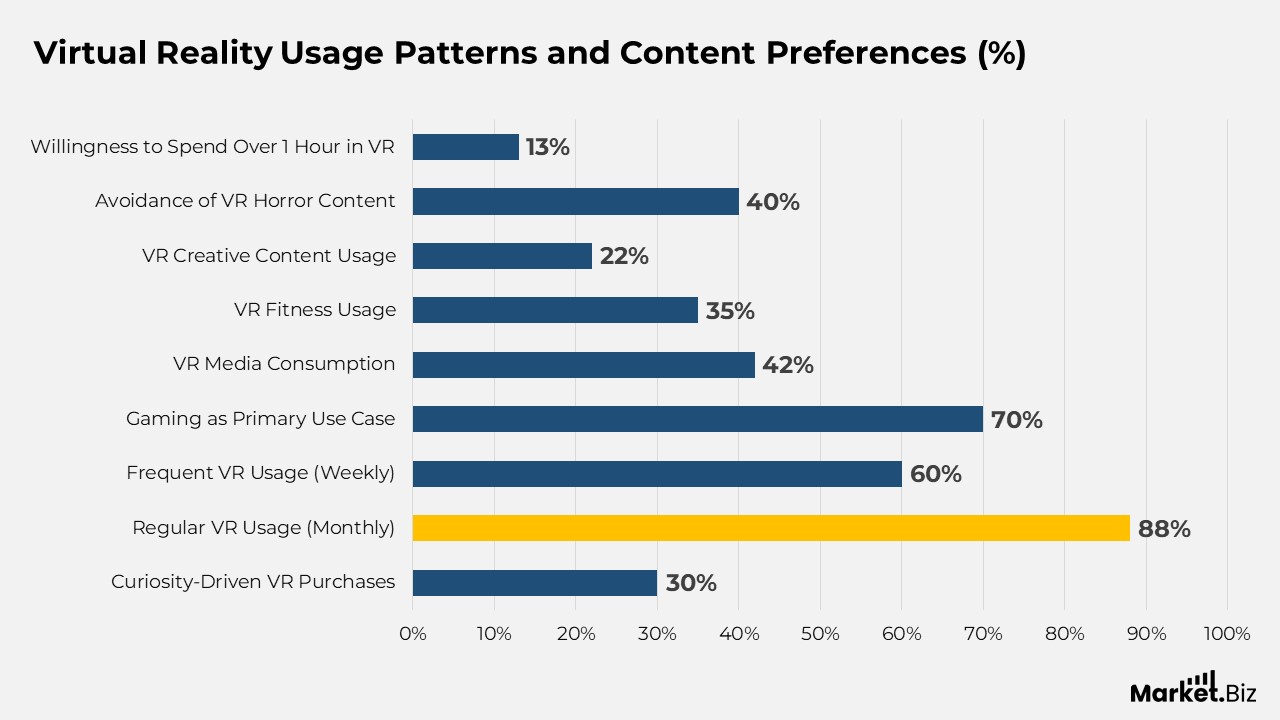
Virtual Reality Usage Patterns and Content Preferences
- Curiosity drives early adoption, as 3 out of 10 users purchased a VR device primarily to explore the technology.
- Engagement frequency is high: 88% of headset owners use VR multiple times per month, and 60% use it more than once a week.
- Gaming remains the dominant use case, with 70% of VR users playing games on their devices.
- Media consumption is also common, as 42% of users watch films or television through VR.
- Fitness and creativity are growing segments, with 35% using VR for workouts and 22% for music, video, or art creation.
- Comfort limitations persist: 40% of consumers say they would avoid VR horror experiences, and only 13% are willing to spend more than 1 hour in VR without a break.
Challenges and Barriers to Mass VR Adoption
- Cost remains the largest obstacle, cited by 65% of consumers as the reason they do not own a VR device.
- Industry assessments suggest a 50% price reduction may be necessary to unlock large-scale adoption of AR and VR.
- User comfort issues persist: 37% of VR users experienced motion sickness during their most recent session.
- Social and ethical concerns remain, as more than one-third of consumers believe VR could negatively impact children.
- Privacy and security concerns affect adoption, with 20% of users reporting moderate to great concern.
- Parental caution is evident, as 50% of parents are uncomfortable with children using VR for more than three hours per week.
- Social VR challenges include harassment, with nearly 50% of users reporting negative interactions, particularly toward female-presenting avatars.
Virtual Reality Gaming Market Dynamics
- Gaming is the primary motivation for VR purchases for more than 50% of consumers.
- Meta sold approximately 325,265 VR headsets across its Quest lineup in the third quarter of 2024.
- Sony has sold more than 600,000 PlayStation VR2 headsets.
- Global VR gaming revenue is projected to reach USD 3.2 billion in 2024.
- Gaming engagement is strong, with 73% of VR headset users listing gaming as one of their top hobbies.
- Revenue concentration is increasing, with more than one-third of Meta’s VR games generating over USD 1 million each.
- Flagship titles are performing strongly, with “The Walking Dead: Saints & Sinners” generating over USD 50 million in revenue.
- Perceptions of future impact are positive, with 52% of US gamers believing metaverse technologies will reshape the gaming industry.
Social Platforms, Virtual Reality Media, and Retail
- VR content consumption continues to grow, with approximately 3.4 million subscribers following YouTube’s 360-degree video channel.
- Social VR platforms see high engagement: Roblox records around 88.9 million daily active users, with nearly 50% of them under 13.
- User engagement on Roblox is substantial, with 20.7 billion hours spent on the platform.
- Commerce in virtual spaces is expanding, as more than one-third of VR users shopped on VR platforms after browsing products virtually.
- Digital goods purchases are rising, with 31% of users buying NFTs and 19% purchasing luxury items in VR environments.
- Immersive marketing effectiveness remains high, with AR and VR content delivering conversion rates 94% higher than traditional formats.
- Interest in virtual commerce continues to grow, with 40% of consumers open to shopping for physical products in virtual worlds.
- Younger consumers show a strong preference for immersive brand engagement, with 70% appreciating brands that interact within virtual environments and 61% more likely to purchase from them.
- VR is influencing travel decisions: nearly 20% of consumers use it to choose holiday destinations, and 25% plan to do so in the future.
Virtual Reality Training and Learning Effectiveness
- Educational acceptance is growing, with 60% of Americans believing VR and AR are effective learning tools for children.
- Training efficiency improves significantly, as employees trained in VR complete learning programs four times faster than those in classroom settings.
- Learning outcomes are stronger, with a 76% increase in effectiveness compared to traditional methods.
- Skill confidence improves dramatically, with VR training leading to a 275% increase in confidence when applying learned skills.
- Attention levels are higher: VR-trained employees are 4 times more focused than e-learning participants and 1.5 times more focused than classroom learners.
- In healthcare, VR training delivers measurable benefits: surgeons trained with VR make 40% fewer errors than those trained conventionally.
(Sources: PwC, S&P Global Market Intelligence, McKinsey, VentureBeat, Roblox, National Research Group)
Conclusion
Virtual entertainment statistics underscore a significant transformation in digital engagement, as immersive formats like virtual reality, augmented reality, interactive gaming, and virtual experiences gain widespread acceptance. Rising adoption, strong user satisfaction, and growing interest across demographics indicate that virtual entertainment is transitioning from a niche concept to a core component of modern digital consumption.
Continued improvements in immersive technology and network capabilities are further enhancing the quality and accessibility of these experiences. From an industry standpoint, the data reflects accelerating momentum fueled by expanding enterprise use, diversified applications, and improving revenue models. Virtual entertainment is increasingly being integrated into gaming, social platforms, live events, education, and professional collaboration, with business use cases expected to drive a substantial share of future growth.
Overall, the statistics point to a dynamic and scalable ecosystem, positioning virtual entertainment as a long-term driver of innovation, engagement, and value creation in the digital economy.
FAQ’s
Virtual entertainment statistics are used to examine patterns of adoption, engagement, and usage of immersive digital experiences. They help assess how technologies such as virtual and augmented reality, and interactive platforms, influence entertainment consumption, user behaviour, and the broader digital ecosystem over time.
These statistics illustrate a shift from passive content consumption to interactive, experience-driven formats. Metrics related to user participation, time spent, and engagement intensity indicate that audiences increasingly prefer immersive environments that allow active involvement rather than traditional one-way media.
User perception plays a critical role in understanding the sustainability of virtual entertainment adoption. Measures of satisfaction, interest, and emotional response help explain whether immersive experiences meet user expectations and whether initial trials translate into long-term usage.
Virtual entertainment statistics often separate consumer-driven entertainment use from enterprise applications such as training, collaboration, and virtual events. This distinction helps clarify how immersive technologies serve both leisure-oriented and functional purposes across different economic and organisational contexts.
By tracking adoption rates, engagement trends, and technological integration. Virtual entertainment statistics offer insight into how immersive experiences may shape future digital ecosystems. They help anticipate the role of virtual environments in social interaction, work, learning, and entertainment as digital convergence continues to evolve.

