









Introduction
Employee Sabbatical Statistics: Employee sabbaticals are becoming more popular as they are seen as a strategic method of improving well-being and retention. As of 2019, just 16% of companies had sabbatical programs, and only a few 5% of them offered paid versions according to the Society for Human Resource Management reports.
Research also says that 80% of salaried worker who go on sabbaticals return to their jobs feeling more committed, creative, and engaged. This is how we can see the broader movement towards realising the thousands of direct and indirect advantages that sabbaticals provide, for taking care of burnout and growing in your professional life.
Editor’s Choice
- 16 percent were offering any kind of sabbatical leave in 2019.
- 29% of organisations offered unpaid sabbatical leave in 2021.
- WorldatWork’s 2021 survey included 886 participants who shared information on paid leave programs.
- Banks including Bank of America have rolled out formal sabbatical policies, lending four-week, paid sabbaticals to 15 year employees, and increasing to six weeks for 30-year employees.
- 80 percent of employees who go on sabbaticals return to their jobs afterwards, the report said.
- Businesses that provide sabbaticals programs enjoy greater employee retention, as these hiatuses can strip off burnout and career irritability.
- Monzo offers 8 weeks of paid sabbaticals after 5 years of service.
- Collabora provides a 6-week paid sabbatical every 5 years (with a 6 month advance notice).
- Workers (75%) are interested in an extended break from their daily work routine.
- 70 percent of those who take sabbaticals say it allows them to come back with a fresh set of ideas and more focus.
- In the UK, 53% of companies offer unpaid sabbatical leave and 18% offer paid.
- About 15% of health care employers issue sabbatical leave, and about 12% are thinking of putting something similar in place.
- In January 2024, 7.2% of women were on sabbatical leave, up from 6.3% for men, suggesting a gender gap in sabbatical use.
General Employee Sabbatical Statistics
- 16 percent were offering any kind of sabbatical leave in 2019.
- In 2019, just 5 percent of those sabbatical programs paid.
- 10% of organisations offered paid sabbatical leave in 2021.
- Just 8% of firms had a paid sabbatical policy as recently as 2016.
- 29% of organisations offered unpaid sabbatical leave in 2021.
- Just 18% of employers offered unpaid sabbatical leaves in 2016.
- 5 few paid sabbatical offering in 2016 to 2018 vs. 7% in 2016 to 2021.
- The percentage of people taking unpaid sabbaticals increased 11 points (18%-29%) during the same time period.
- Compare with 2016, paid sabbaticals were 25% more common by 2021.
- Unpaid sabbaticals increased by 61 percent between 2016 and 2021.
- WorldatWork’s 2021 survey included 886 participants who shared information on paid leave programs.
- It also collected 580 responses specifically on unpaid sabbatical policies.
- But paid sabbaticals remained rare, back in even 2021, when just 1 in 10 companies offered them.
- Unpaid sabbaticals remained for less than a third, or roughly 3 in 10, schools.
- SHRM’s 2019 survey included more than 1,000 U.S. employers on employee benefits.
- The 2021 spread between paid (10 percent) and unpaid (29 percent) sabbatical offers was 19 percentage points.
- Sabbatical leave was still uncommon in 2019, a niche perk, provided by less than one fifth of firms.
- In both surveys, no more than 29 percent of organisations offered any form of sabbatical in 2021- a sign that it’s still rare.
Global Market Trend of Sabbatical
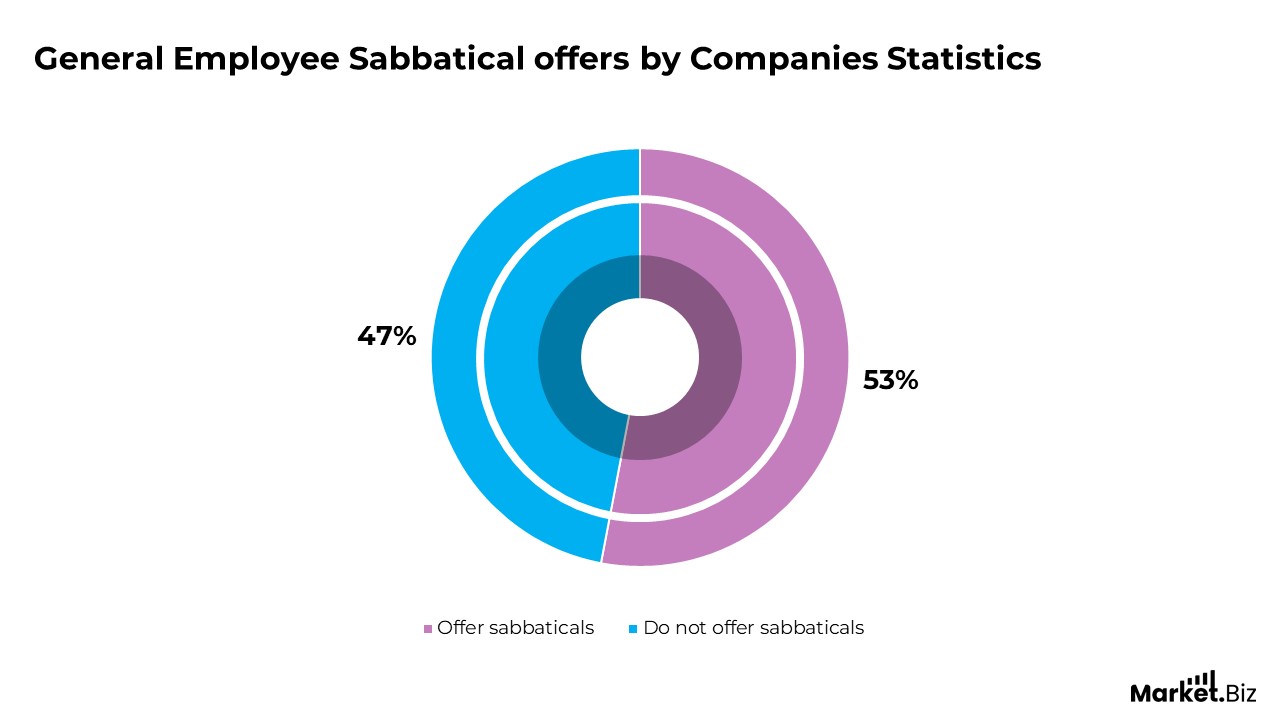
- 53% of UK employers now offer sabbatical leave, which is particularly widespread at public and charity organisations.
- In the United States, the share of employers offering paid sabbaticals rose from 5 percent in 2019 to 7 percent in 2023.
- Unpaid sabbaticals are more prevalent, with 11 percent of U.S. employers offering them as of 2023.
- Banks including Bank of America have rolled out formal sabbatical policies, lending four-week, paid sabbaticals to 15 year employees, and increasing to six weeks for 30-year employees.
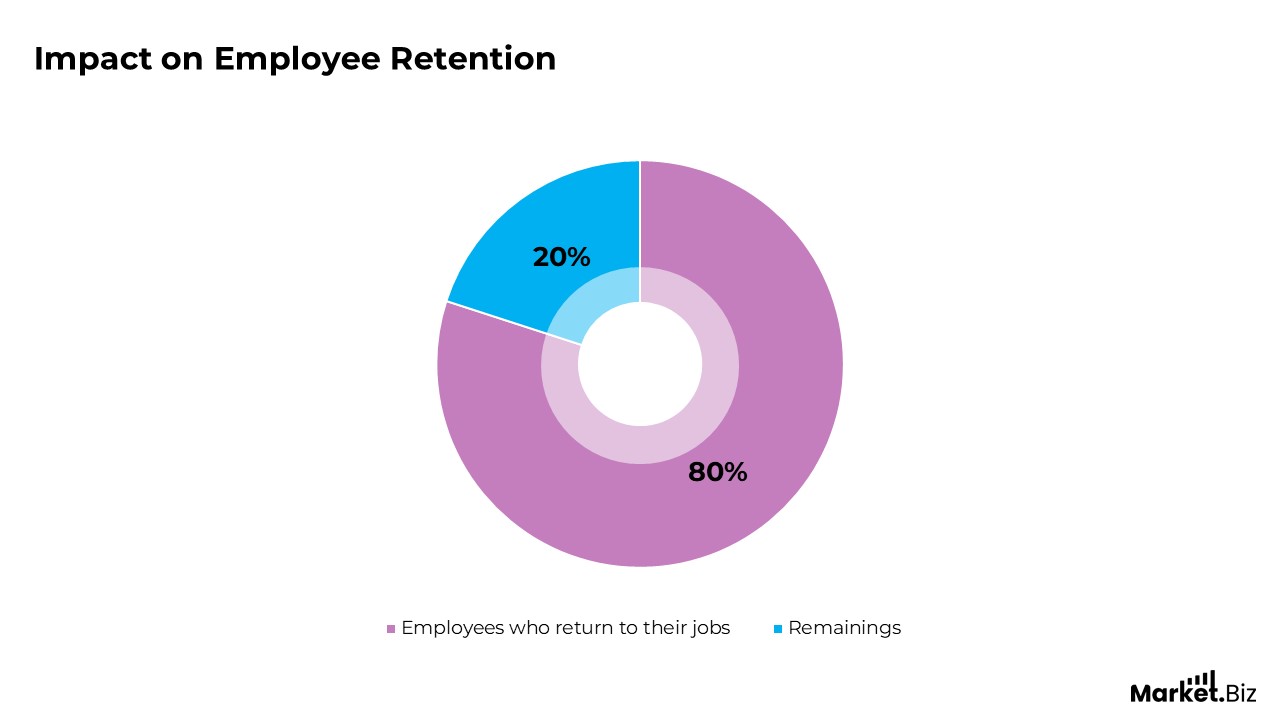
- 80 percent of workers who take sabbaticals return to work, and they usually come back more focused and energized.
- Sabbaticals are most common among those 25 to 35 years old, and then 35 to 44.
- Employers providing sabbaticals see them as a way to hold on to workers and stop burnout.
- Among employees aged 22 to 26, 8% were on sabbatical in 2024, up from 1.7% in 2019.
- The number of workers taking sabbaticals were doubled from 3.3% in January 2019 to 6.7% in January 2024.
- 7.4% employees were on sabbaticals in top services industry, with the technology sector seeing 9.3% on extended leave.
Impact on Employee Retention
- 80 percent of employees who go on sabbaticals return to their jobs afterwards, the report said.
- Firms with sabbatical programs have turnover rates as low as 705%, compared with an average 12% for the industry.
- After introducing a paid sabbatical policy, automatic’s turnover decreased by 4.5 percentage points (from 12% to 7.5%).
- That 7.5% turnover is 37.5% lower than the average 12%, indicating that sabbaticals have a positive effect on retention.
- 6% of workers took sabbaticals in January 2022, doubled the rate from January 2019, suggesting that more firms are using sabbaticals to retain staff.
- Bank of America, between the time, it introduced the program and six months later, had sabbatical requests from 5,000 employees, a strong approval.
- 5 percent of employers now offer paid sabbaticals, giving workers added incentive to stick around.
- 11% employer sponsored unpaid sabbaticals are a creative option for retention programs.
- According to LinkedIn, more than 500,000 people updated their status to “on sabbatical” in 2020 since March.
- Gusto data connects the 6% sabbaticals approval to fewer burnout-related resignations.
- Firms that offer sabbaticals tend to score better on surveys of employee loyalty, a marker of longer-term loyalty.
- More than 50 million people resigned in 2021 but 80% of return from taking a sabbatical it is a way to help with blending.
- Paid time off is a top benefit for nearly 70 percent of workers, so sabbaticals can be an effective retention tactic.
Benefits of Sabbatical
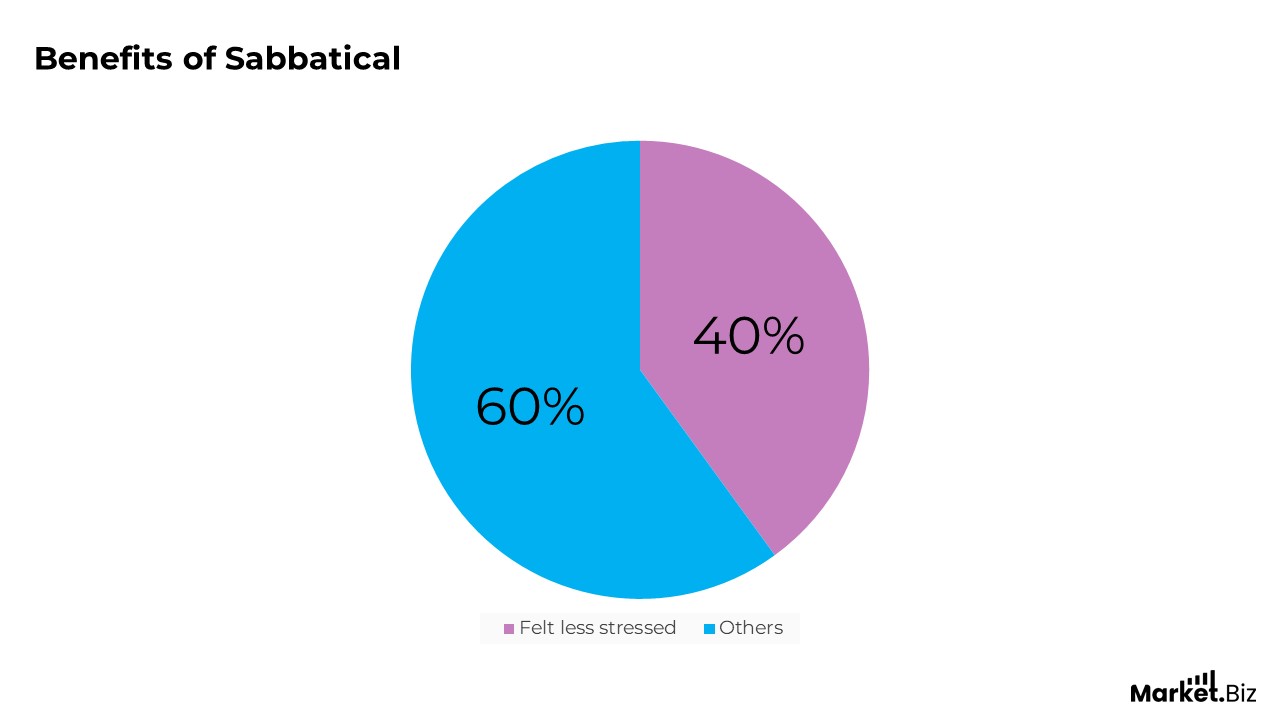
- Studies show employees who went on sabbatical felt 40% less stressed and burnt out when they returned to work.
- One consequence of sabbaticals were such gains in psychological resources as better health, control, and energy.
- Businesses that provide sabbaticals programs enjoy greater employee retention, as these hiatuses can strip off burnout and career irritability.
- Downtime gives employees an opportunity to see from another perspective and is proven to make people more creative and thoughtful when they return to work.
- Sabbaticals give employees the opportunity to complete additional education, research or skills to the benefit of the individual and the company.
- Giving sabbaticals shows that a company values work-life balance, which results in happier and more loyal employees.
- Sabbatical policies can be positioned as a compelling differentiator for hiring top talents from an increasingly sensitive workforce.
Duration and Eligibility for Sabbatical
- Intel provides 4 weeks of paid sabbaticals after 4 years, or 8 weeks after 7 years of service.
- Adobe offers a paid sabbatical month after 5 years of service, after that increasing to 6 weeks after 15 years of service.
- Workday provides a 6-week paid sabbatical at 10 years of service and every 10 years thereafter.
- Monzo offers 8 weeks of paid sabbaticals after 5 years of service.
- Collabora provides a 6-week paid sabbatical every 5 years (with a 6 month advance notice).
- Citibank allows up to 12 weeks of 25% paid sabbatical after 5 years of service.
- Bank of America offers 4 weeks of paid sabbatical after 15 years; up to 6 weeks sabbatical after 30 years of service (up to two sabbaticals are valid during your career).
- Goldman Sachs provides 6 weeks of unpaid sabbatical after 15 years, plus 2 weeks per 5-years beyond.
- After all, most companies expect that employees will have been with the company for a minimum of 4 or 5 years before they can even apply for sabbatical.
- And some make it a requirement to have met or surpassed performance goal over the last 3 years.
- The policy normally demands employees apply for sabbaticals 60 to 180 days before they are scheduled to begin.
- You may be eligible for more sabbaticals at 5 to 10 year intervals, as per company policy.
- Policy typically applies to full-time employees working at least 24 hours a week, according to most surveys.
- Apps need to be signed off by managers, heads of departments, and HR.
- Some organisations require you to take a sabbatical within a certain length of time after you qualify (such as two years).
Reasons to take Sabbatical Leave
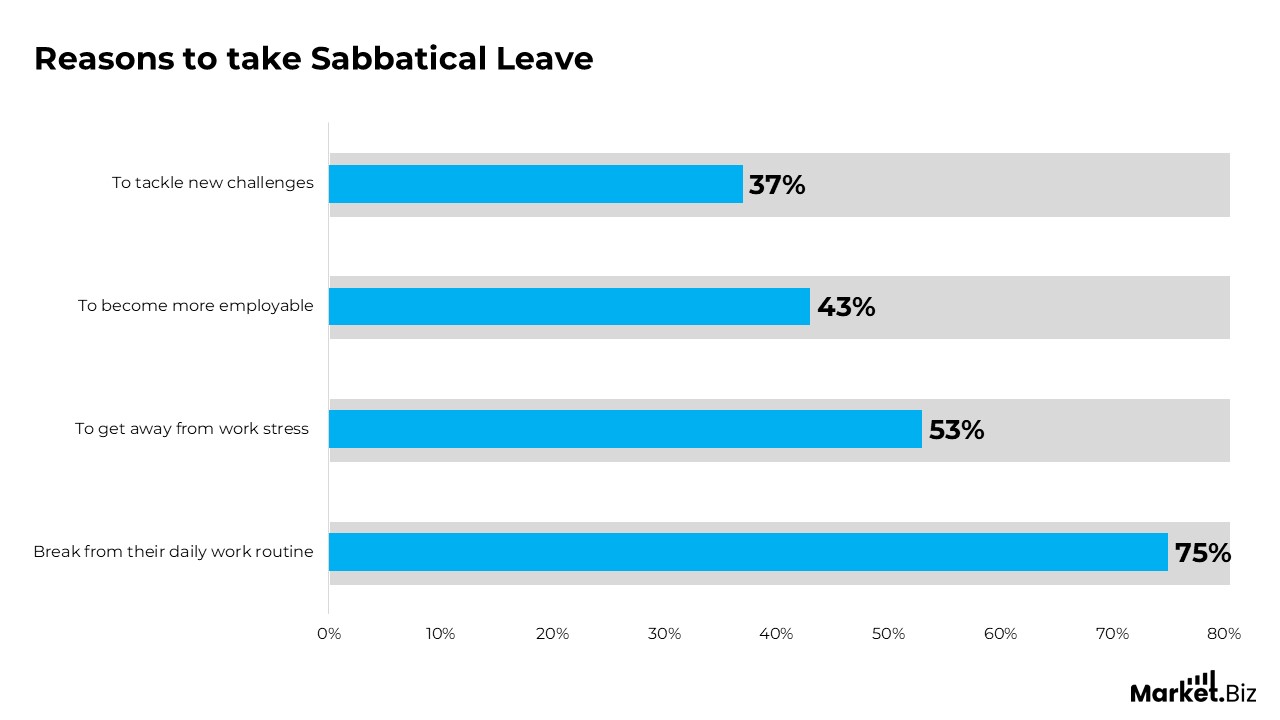
- Workers (75%) are interested in an extended break from their daily work routine.
- 53% of workers desire a sabbatical expressly to get away from work stress and return to work recharged.
- 43 per cent think that by doing a sabbatical, they will become more employable when they comeback.
- 37 percent say a sabbatical would give them the confidence and preparedness to tackle new challenges.
- 70% of the employees eligible actually uses sabbatical programs, or take an extended period off work.
- 70% of those that take sabbatical use it to refresh their mind and prevent burnout.
- 69% of users spend their sabbatical time pursuing interests, such as hobbies or study.
- Work-life-balance- SOWPs 70% travels during sabbatical or spends time with family.
- 70 percent of those who take sabbaticals say it allows them to come back with a fresh set of ideas and more focus.
Paid vs. Unpaid Sabbatical
- Paid sabbatical programs are offered by only 6% of U.S. employers, as of 2023.
- U.S. companies that offer unpaid sabbatical options are 11%.
- In the same period paid sabbatical improvements are up from 8 per cent, and unpaid 18 percent to 29 percent.
- Amazon provides 4 week paid sabbaticals after 15 years pf service, and adds 2 weeks after 30 years.
- Citibank offers up to 12 weeks of sabbatical at 25% pay after 5 years of service.
- It also provides 6 weeks of sabbatical after 15 years of service.
- HSBC provides leave of absence generally ranging from 3-6 months, with 1 month paid for employees with 5 years of service.
- Some 80% of employees who take sabbaticals return to their workplace, and when they do, they return more focused and with greater energy.
- Sabbaticals can be a greater way to decrease burnout, and result in better mental health and performance upon their return.
- Training or certifications are usually part of the deal in some sabbaticals, so employees can expand their skill sets.
- In the UK, 53% of companies offer unpaid sabbatical leave and 18% offer paid.
- Business, such as Credit Suisse and HSBC, introduce sabbatical policies to promote employee wellbeing and reduce turnover.
- The minimum amount of time an employee must be with the company is required is 5 years prior to being eligible for a sabbatical
- In some companies, sabbaticals are at full pay; others offer partial pay; and yet others provide no pay.
Sabbatical in Different Industries
- U.S. employers, only 16% have a sabbatical leave policy, and just 5% of those are paid sabbaticals.
- In January 2024, 0.141% of all employees were on a sabbatical, and younger millennials were leading the pack at 0.19%
- About 15% of health care employers issue sabbatical leave, and about 12% are thinking of putting something similar in place.
- Of those healthcare employers offering sabbaticals, 30% provide full income replacement, 17% offer partial par, and 54% offer no income replacement.
- Colleagues who have 15+ year of service are eligible for 4 weeks’ paid sabbatical, while 30+ years of service will get 6 weeks.
- Many banks, such as Citibank provides up to 12 weeks of sabbatical at 25 percent pay after 5 years of service.
- Credit Suiss offers 3 months sabbatical every 5 years at reduced pay.
- Adobe provides a 4 week paid sabbatical after 5 years of service.
- Paypal offers a 4 week paid leave at 5 years of employment.
- Typically offer faculty research and development sabbatical every 7 years.
- 62% of companies have sabbatical leaves, compared to 44% of the private sector.
- In 2021, 10% offered paid sabbatical and 27% offered unpaid sabbaticals, representing a trend towards the increase.
Future of Sabbatical Trends
- In January 2024, 7.2% of women were on sabbatical leave, up from 6.3% for men, suggesting a gender gap in sabbatical use.
- .19% of workers aged 27-34 were on sabbatical in January 2024, compared to 0.11% of those aged 45-59 there has been a generational shift to a demand for longer term leave.
- In the absence of significant financial resources, smaller companies are offering sabbatical benefits as a means to attract and retain talent.
- The rate of employees taking sabbaticals has doubled from 3.3% in January 2019 to 6.7% in January 2024.
- Sabbatical participation grew among 22 to 26-year-old workers from 1.7% in 2019 to 8% in 2024.
Conclusion
According to employee sabbatical statistics, interest is on the top and so is adoption, across all sectors. Some employers are now providing their workers with the option to take sabbatical leave as a way of increasing their well-being and decreasing turnover. This is being driven largely by younger workers, particularly members of Gen Z, who prioritize work-life balance.
Numbers say sabbaticals boosts job satisfaction, retention and productivity. As workplace culture shifts, sabbaticals are fast becoming an important element of modern employee benefits. Companies who support sabbaticals are in turn going to attract and retain the best talent in the long run.
FAQs
A sabbatical leave is a long leave of absence from work, typically unpaid or partially paid, that one can take after a couple of years of work to rest, travel or engage in another kind of activity.
Sabbaticals are one the rise, interest doubled to 6.7% in 2024 from 3.3% in 2019 of U.S. workers.
Sabbatical takers are more likely to be younger employees, particularly those who are members of Gen Z. In 2024, 8 percent of all employees, ages 22 to 26, were on sabbatical.
Yes, companies with sabbaticals do tend to have better retention. A little bit of support and a little bit of value can go a long way toward retaining employees.