









Introduction
Workplace Creativity and Innovation Statistics: In today’s ever-evolving business environment, workplace creativity and innovation are two of the most significant contributors to organizational success. As demonstrated in a McKinsey forum of R&D leaders in July 2024, adopting analytical and generative AI technologies can lead to:
- 50% increase in market fit.
- 15-60% improvement in product performance.
- 50% improvement in workplace productivity.
- 40% reduction to market.
Moreover, according to Gallup’s 2024 report, “State of the Global Workplace,” only 23% of employees are productive while at work. As a result, the global economy loses an estimated $8.9 trillion due to low engagement, approximately 9% of the global GDP. Statistics such as these highlight the important need to develop a culture that invites creativity and innovation to improve employee engagement, drive productivity, and keep innovative intentions competitive.
Editor’s Choice
- 77% of company owners believe that creativity plays an important role in driving growth in the business.
- 69% of creators prioritize brand importance to their audience when they partner with other organisations, thus creators are seen as strategic partners in creativity and growth plans.
- In 2022, the global creative industries market was valued at USD 2,669,224.0 million.
- The global computational creativity market size was projected to grow at a Compound Annual Growth Rate of 27.4%, with USD 204 million from 2018 to USD 685 million by 2023.
- Creative content is responsible for 49% of incremental sales, yet dealers often underestimate its impact, stating it accounts for only 19%.
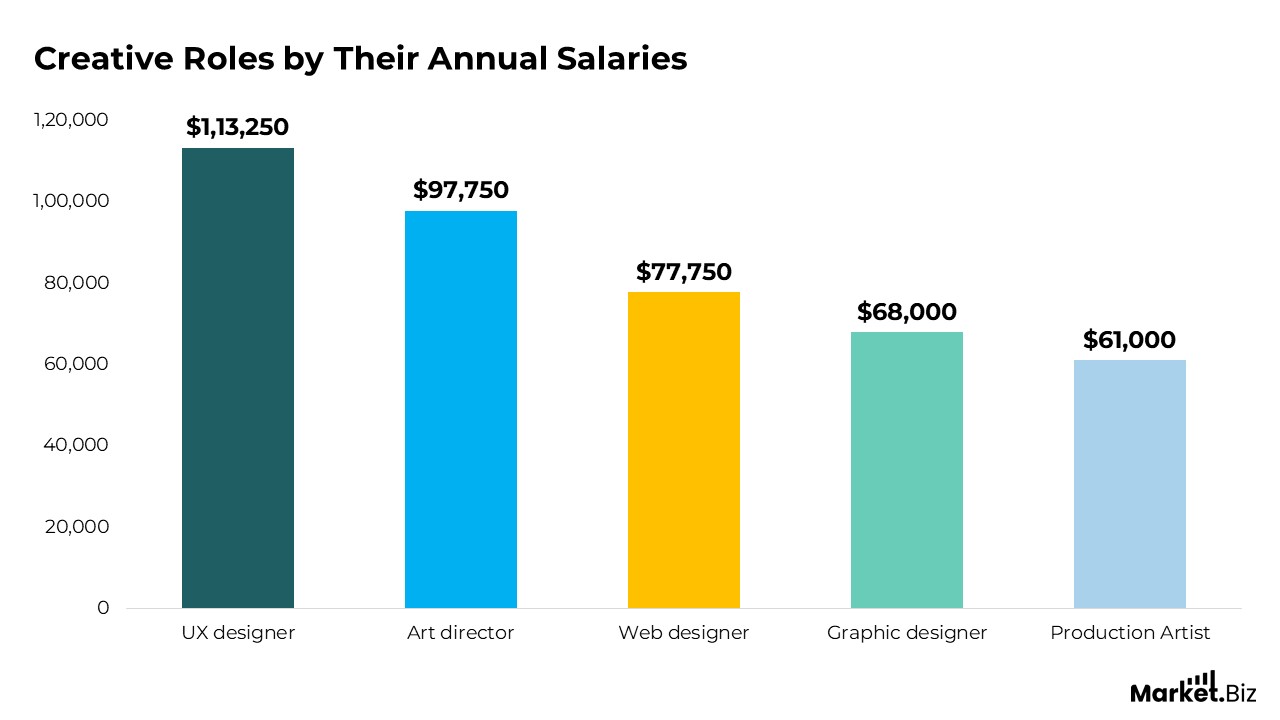
- UX/UI designers get approximately an annual salary of $113,250 dollars.
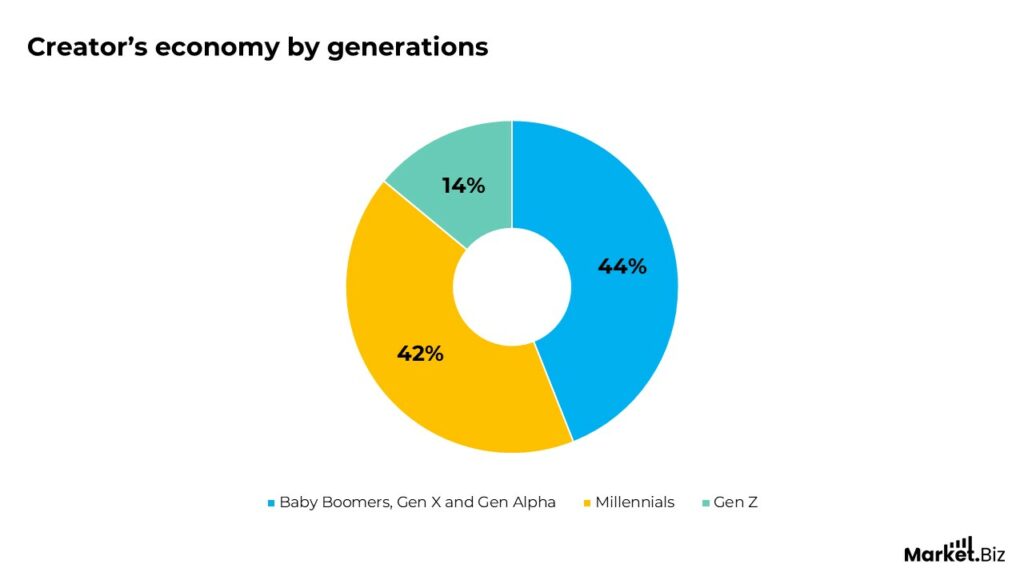
- Gen Z has secured almost 14% of the creator economy.
- 84% of employees reported experiencing more satisfaction with their company after employing workplace automation innovations.
- Google notably lets its workers invest 20% of their workweek to follow personal goals and projects.
- Gen AIs such as ChatGPT, Grok AI, Sora, and others already outperforms 99% of the human population in creating different and original ideas.
What is Workplace Creativity and Innovation?
Workplace creativity and innovation mean the process of creating new ideas, exploring new opportunities, and applying them to improve methods, assets, objects, or services. Creativity means exploring outside the box and generating brainstorming ideas; on the other hand, innovation refers to taking those ideas and transforming them into real improvements. Both of them are important for businesses to stay ahead in the competitive market and adapt to changing conditions.
General Workplace Creativity and Innovation Statistics
- 94% of HR professionals stated that considering creativity is very important in the workplace, thus creativity and innovation are gradually more recognized as an important part in the workplace.
- Culture and creativity contribute almost 3.1% of GDP to the global economy
- 77% of company owners believe that creativity play an important role in driving growth in the business.
- In the creativity and innovation field, the exports of cultural goods and services was estimated to reach at US$389.1 billion from 2005 to 2019.
- According to research, 75% of employees are asked to be more productive rather than creative at work.
- In the United Kingdom only 34% creative organisations are situated in London only, and 62% are located in the greater southeast of London.
- 90% of organisational professionals stated that creativity is important for staying in this competitive market.
- Groups that trained with creativity tools and principles can produced 350% of ideas when they attend creative problem-solving sessions, and its 415% more original than those groups who weren’t in the untrained groups.
Moreover
- According to a study, 89% of organisational professionals reported that creative work is essentials to meet organisational goals.
- According to survey’s groups who were trained will eventually outperform groups that are untrained in the creative problem-solving, where only 35% of employees have time for creative activities.
- 69% of creative creators prioritizing brand importance to their audience when they partnering with other organisations, thus creators are seen as a strategic partners in creativity and growth plans.
- According to 70% of working professionals creative thinking was the on demand skill in 2024.
- According to the a NASDAQ study, where 2,935 respondents found that campaigns who were using creative AI had an increase in return of investments on ad spend compared to those who doesn’t.
- 17% of business owners are content creators, and 39% of creators are being prepared to become business owners in the future.
- Around one in a four people, also means 23% of creators who’s engaged in photography, videography, creative writing, and other sources like social media and blogs.
- According to a survey, more than 70 percent of business expected a significant growth in the creative and analytical thinking skills by the end of 2027.
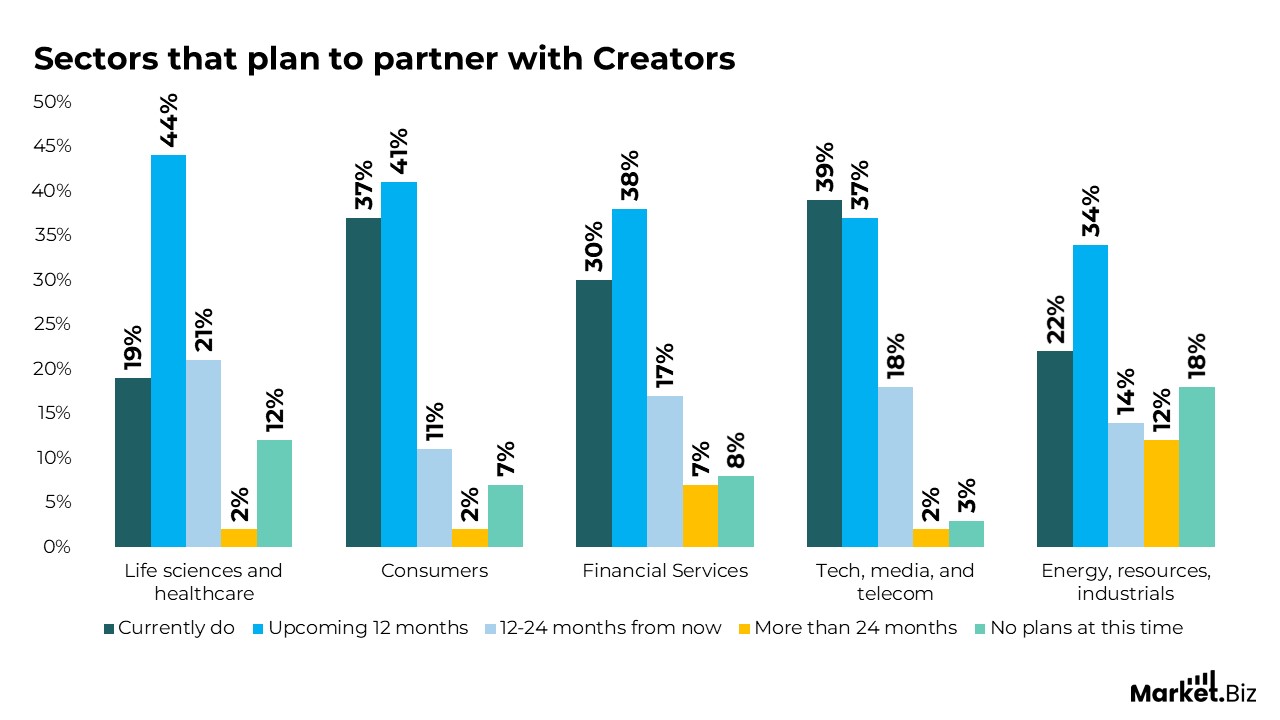
(Source: Deloitte)
Global Creativity Adoption Rate
- In 2022, the global creative industries market was valued at USD 2,669,224.0 million.
- According to the reports the global creative industries market is estimated to reach at USD 3,434,322.0 million by 2031, with a growing CAGR of 4.29%.
- From 2023, more than 165 million creators joined the global creative industries market.
- The creative economy is recorded to be 6% of the global GDP and is currently expanding at 2x the rate of the traditional economy.
- In Brazil, 73 million new creators joined the creators economy market, in Korea the number reached up to 11 million, and for Spain, its 10 million new creators.
- The global computational creativity market size was projected to grow at a Compound Annual Growth Rate of 27.4%, with USD 204 million from 2018 to USD 685 million by 2023.
- According to the findings, in 2024, the global creative management platform market was valued at USD 1.12 billion.
- The global creative management platform market size was estimated to grow from USD 1.20 billion in 2025 to USD 2.07 billion by 2032, with a growing compound growth rate of 8.1% throughout the forecast period.
- 80% of consumers stated that they are more willing to take advantage of opportunities from a brand that offers them custom-made experience, stated by Epsilon survey.
US & UK Creativity Statistics
- The numbers of creative workers in the United States, is growing quickly at a 38.3 million US citizens in the creative field, artists, engineers and innovators.
- The creator’s economy market size is increased at a rate of 40% in the US alone, making the market grow by 34 million new creators.
- According to 3 out of 4 of the survey, around 72% of US citizens reported to have a desire for increased involvement in creative searches.
- A survey conducted on 2,000 US adults reported that, almost 31% of them select leaving a creative legacy over wealth or 10% of humanitarian endeavours.
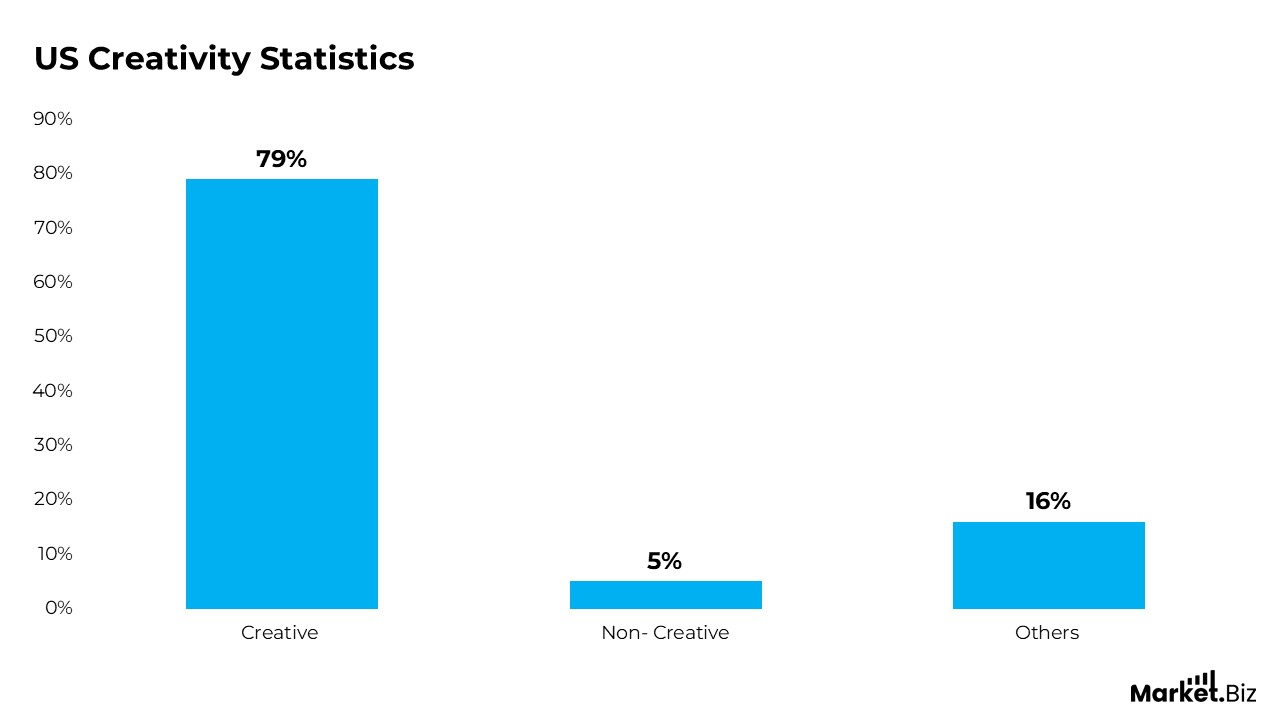
- According to a survey conducted on US citizens, where 79% of them reported as creative and only 5% of them reported to have less or no knowledge of creativity.
- Reports says United Kingdom’s creative sector is aiming for a 5.3% growth over the next 6 years.
- In the United Kingdom only 34% creative organisations are situated in London only, and 62% are located in the greater southeast of London.
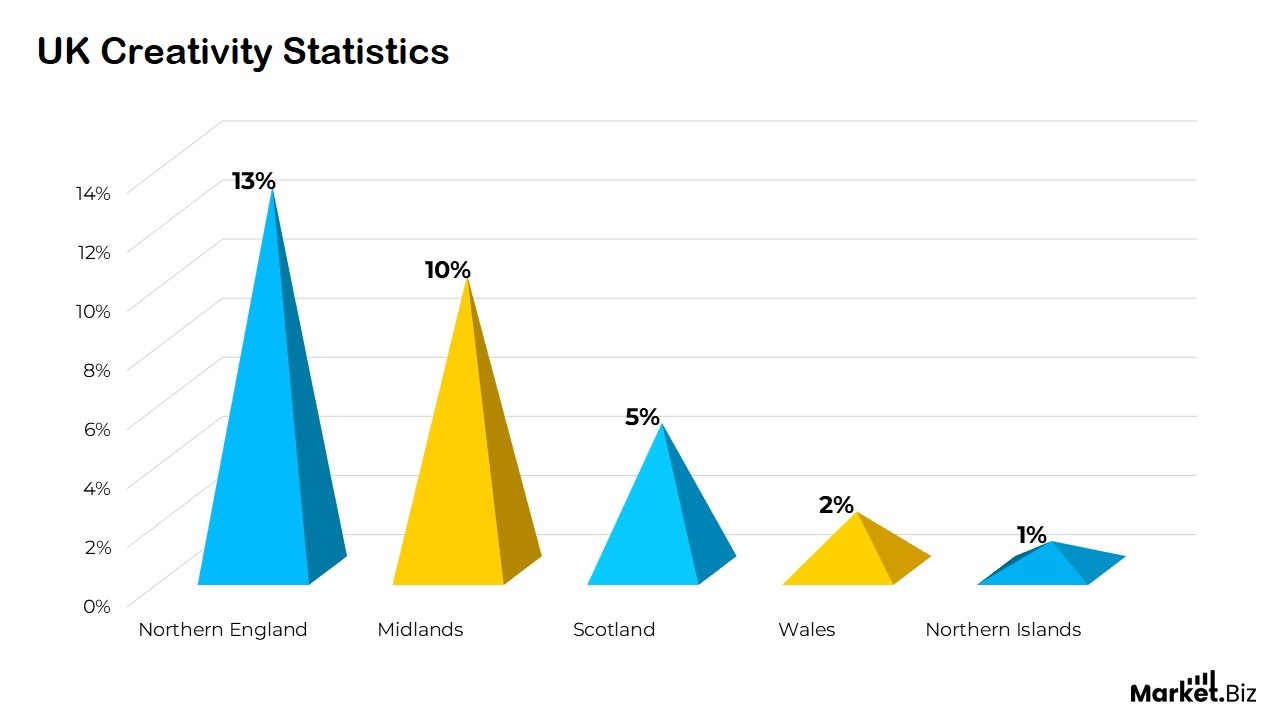
- In the creative market Northern England hosts almost a 13% of creative organisations, Wales holds 2% of it, the Midlands hosts 10% of it, as for Scotland, it owns 5%, and the Northern Islands hosts only 1% of it.
Creativity’s Impact on Revenue Growth
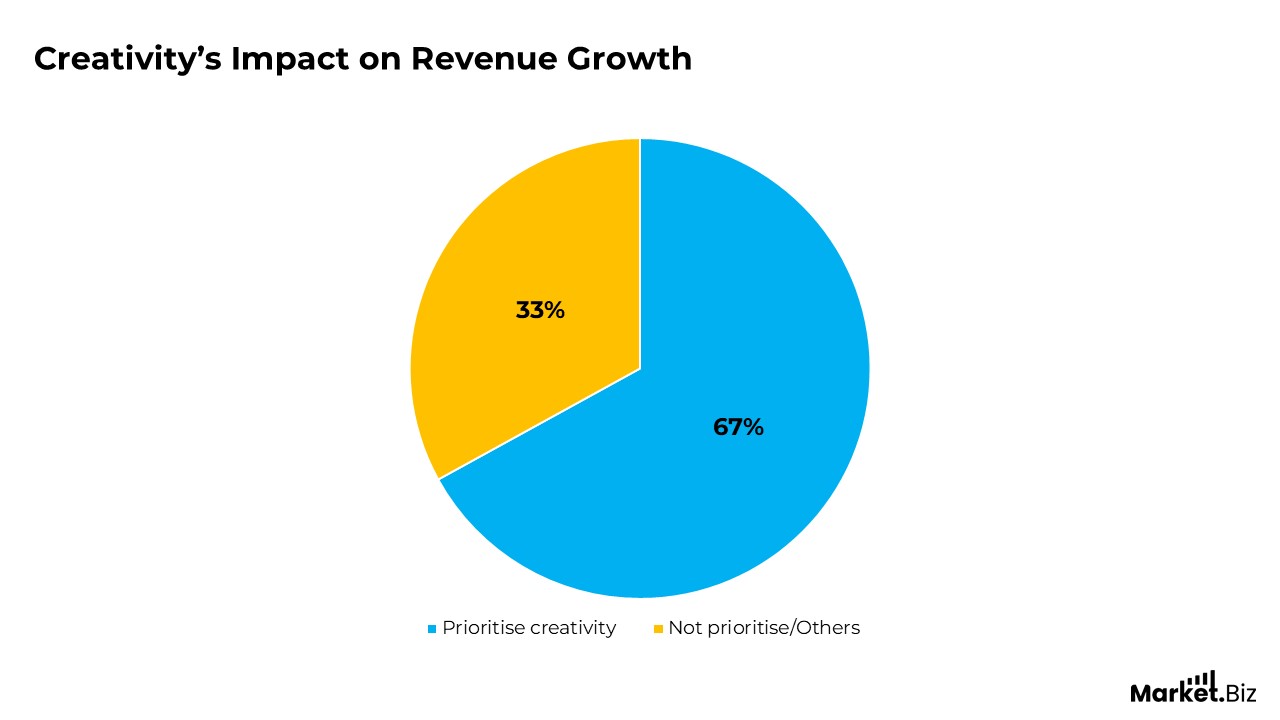
- Companies that prioritise creativity are 67% more likely to achieve remarkable organic revenue growth compared to their competitors.
- Organisations integrating creativity, analytics, and purpose reported that the revenue growth rates 2.3 times higher than those that aren’t.
- 70% of organisations recognised for their creative quality report gets remarkable total returns to shareholders.
- 74% of businesses that highlight creativity achieve higher net enterprise value compared to their colleagues.
- Creative content is responsible for 49% of incremental sales, yet dealers often underestimate its impact, stating it accounts for only 19%.
- 58% of companies adopting creativity reported revenue increase of 10% or more each and every year, while only 20% of less creative organizations saw similar growth.
- The creative sector contributes approximately 4% of the global economic output, underscoring its significance in driving revenue.
- Companies that prioritize creativity in advertising efforts see a 23% increase in revenue growth compared to those that don’t.
- Brands that partner with creators and focus on creative strategies report increased engagement on brands channels and revenue growth.
- Research indicates that creative ads and strategies lead to increased profits and financial performance, especially during economic challenges.
- Companies that highlight creativity are better positioned to attract and retain top talents, contributing to continuous revenue growth.
- Creative marketing efforts lead to a 30% increase in customer loyalty, directly impacting revenue positively.
Creative Roles by Their Annual Salaries
- UX designer: UX/UI designers get approximately an annual salary of $113,250 dollars.
- Art director: Art directors get an annual salary of $97,750 dollars.
- Web designer: Web designers earns approx. $77,750 dollars annually.
- Graphic designer: Graphic designers can make up to $68,000 dollars a year.
- Production Artist: Production artist get an annual salary of $61,000 dollars.
Creativity Statistics by Generation
By Gen Z
- Around 9 out of 10 Gen Z individuals reported themselves as creative, where half of them stated that they believe that their generation will surpass all others in terms of creativity.
- 77% of Gen Z individuals like to spend their free time offline doing activities like drawing, creating content such as videos, memes, social media posts, threads and journaling.
- Gen Z have secured almost 14% of the creator’s economy.
- According to 47% of Gen Z, social media is a way to increase their creativity and it serves as an inspiration for them.
- According to USA Today, 63% of Gen Z individuals engage in daily content pursuits as compared to 57% among other generations.
- According to 78% Gen Z individuals, daily creativity helps in their work or studies, compared to 63% among other generations.
- Gaming plays a crucial role among Gen Z, where 29% of them reported gaming as one of the most influential thing among all, compared to 13% among other generations.
- Same goes for music, with according to 67% of Gen Z it’s a primary source of inspiration behind their creativity, compared to 56% among other generations.
- 62% of Gen Z individuals find cooking as one of their second highest source of creativity, compared to 56% among other generations.
By Millennials
- Millennials have secured 42% in the creator’s economy.
- According to The Drum, last year in 2024, Millennials were known as the most financially stable and secure and also engaged generation, who will seek inspiration from street art, diverse communities and also from music.
- Reports says 41% of Millennials prioritize creativity at workplace.
- According to most millennials meaningful motivation driven by creative endeavours are mostly impactful, millennials believes in sharing their talents and impacting both individuals and communities.
Baby Boomers, Gen X and Gen Alpha
- Reports says 45% of Baby Boomers prioritize creativity at workplace.
- According to create and grow, 43% of Gen X prioritize creativity at workplace.
- According to psychology today’s research, creativity helps mid-lifers and old citizens in remaining engaged, productive, improves self-esteem and enthusiasm for life.
- In the current era, we can see that authors, composers, and artists making their best work at an early age, therefore its more important for creative people’s to bring out their creativity in their 40s and 50s.
- Among Gen Alpha gamers, games that improves creativity are the best choice for them.
Benefits of Creativity and Innovation
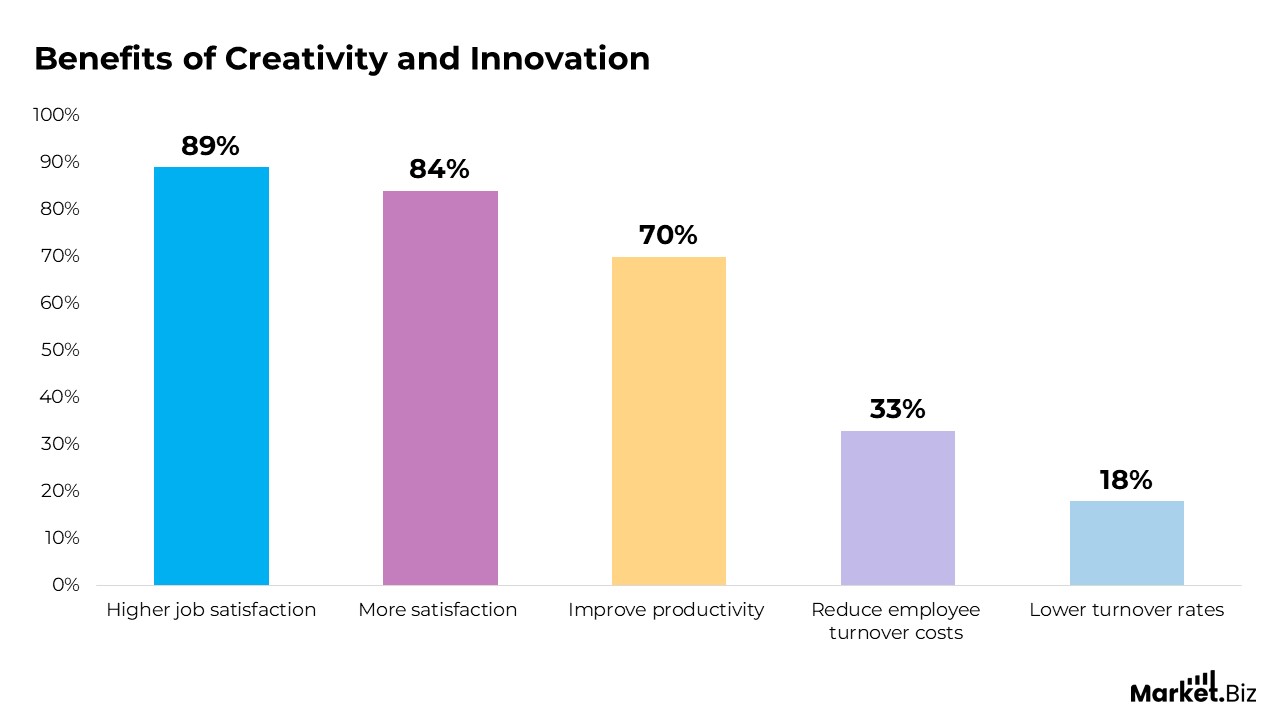
- According to a recent data, 89% of employees who were applying creativity and innovation stated that they experience higher job satisfaction.
- 84% of employees reported experiencing more satisfaction with their company after employing workplace automation innovations.
- According to 94% of employees, they will choose to stay at the same company for longer duration if their company invest in their personal developments. It shows how creativity and innovation can bring retention benefits for the organisations.
- According to recent statistical data, 70% of organisational workers believe that improved collaboration and partnerships can improve productivity and also can save time as well.
- Companies that incorporated HR systems reduce employee turnover costs by 33%. On the other hand organisations with highly engaged workforce reported 18% lower turnover rates.
- These above statistics shows the benefits that creativity and innovations can bring into the workplace management plus improve employee engagement.
Companies that Support Creativity and Innovation
- Google: Google notably lets its workers to invest 20% of their workweek to follow personal goals and projects.
- Pixar: Pixar’s exclusive “Braintrust” tactic involves in regular, candid feedback meetings where filmmakers openly share their work-in-progress and receive positive criticism from colleagues.
- LEGO: LEGO invites its followers to submit their own product ideas, and make sure that those products that receive the most support will considered for production.
AI’s Impact on Creativity and Innovation
- According to 55% of business leaders human creativity is more important than AI in their start-ups.
- Gen AI’s such as ChatGPT, Grok AI, Sora and others already outperforms 99% of the human population in creating different and original ideas.
- As gen AI already outperforms most human population, ChatGPT can created 7 time’s higher quality and brainstorming product ideas than most business owners.
- AI software’s and products are 40 times well-organized than most humans in idea generation speed.
- With ChatGPT you can match the top creativity that humans can think of for fluency and originality, and also the top 3% in flexibility.
- With GPT 4 you can peak in higher creative potential through a full range of different thinking tasks.
- According to a study, 83% of people reported that AI would positively impact on productivity, 62% of them believe that it will positively impact on profitability, 59% of them believes it will be impactful on creativity.
- According to Neuro Science News, GPT-4 was found to match top 1% human thinkers, their originality on a normal creativity test.
Moreover
- According to the Mercury Banking, around 80% of start-up owners/founders have employed AI into their creative processes.
- Same report stated that after AI’s advancements 22% of business founders have expanded their creative teams, on the other hand 15% of founders have reduced them.
- According to Mercury Banking’s report, 42% of start-up owners/founders use AI to analyse data for informed creative decisions, 36% of them use it for graphic design enhancement and product development and 25% of them use AI to identifying and prioritizing features or services.
- According to Skillademia, GPT-4 shows amazing imagination, it already move way ahead of human creativity levels, compared to only 9.4% of individuals outperforming it.
- According to 76% of creative individuals AI tools cannot entirely replace human originality in the creative process.
- At times 53% encountered cases where AI can be seen failed to meet expectations.
- AI’s impact can be seen mostly in creative professions, with 27% in content writing, and 21% of graphic designers.
Conclusion
Workplace creativity fuels growth. A published statistic about innovation indicates that when a company fosters new ideas, it can see up to 30% more revenue than those that do not encourage new employee’s creativity. Fostering a creative culture increases employees’ ability to innovate, which allows them to address problems faster and create better products.
When employees feel psychologically safe enough to share ideas with their team members, overall employee engagement increases by almost 20%, according to current data.
Investing in tools for creativity and training is worth it, as innovative companies have been found to outperform their competitors based on market share. As our businesses adapt to global changes, a focus on statistics about creativity and innovation will help guide strategies for long term success.
FAQs
According to studies, 82% of organizations reported that there’s a strong link between creativity and business success, making it a key skill in the modern workplace.
Yes, according to research by McKinsey, those organizations that encourage innovation are 3.5 times more likely to outperform their colleagues in revenue growth.
Yes. Teams that are inspired to be creative show up to 20% higher engagement levels and job satisfaction.