








Introduction
Work-Life Balance Statistics: Work-life balance has become a key concern for both employees and employers in today’s busy world. 53% of employees globally feel burned out, with poor work-life balance being a major cause. A National Sleep Foundation study revealed that 42% of workers feel their personal life is negatively affected by their work.
As more companies adopt flexible work options, understanding these statistics is crucial for creating healthier and more productive work environments. These numbers show just how important it is for businesses to prioritize work-life balance for the well-being of their employees.
Editor’s Choice
- 53% of employees globally experience burnout, primarily due to poor work-life balance.
- Work negatively impacts personal life for 42% of workers, highlighting the struggle for balance.
- Flexible work schedules improve work-life balance for 67% of employees, showing their effectiveness.
- Remote workers report a 25% better work-life balance compared to office-based employees.
- 60% of workers would accept a pay cut for more flexibility to improve their work-life balance.
- 76% of employees with flexible work hours report greater job satisfaction and happiness.
- For 39% of workers, managing work-life balance is the biggest workplace challenge.
- 58% of UK workers feel they don’t have a healthy work-life balance, revealing regional disparities.
- 65% of women report finding work-life balance harder than men, indicating a gender gap.
- 80% of employees believe their companies should do more to help with work-life balance.
General Work-Life Balance Statistics
- 53% of employees worldwide report experiencing burnout due to poor work-life balance.
- 42% of workers feel their personal life is negatively impacted by their work.
- 67% of employees say that flexible work schedules significantly improve their overall work-life balance.
- Remote workers experience a 25% improvement in work-life balance compared to those working full-time in the office.
- 60% of workers would accept a pay cut in exchange for more flexibility to improve their work-life balance.
- Managing work-life balance is the biggest challenge for 39% of workers.
- Employees with a good work-life balance are 21% more productive.
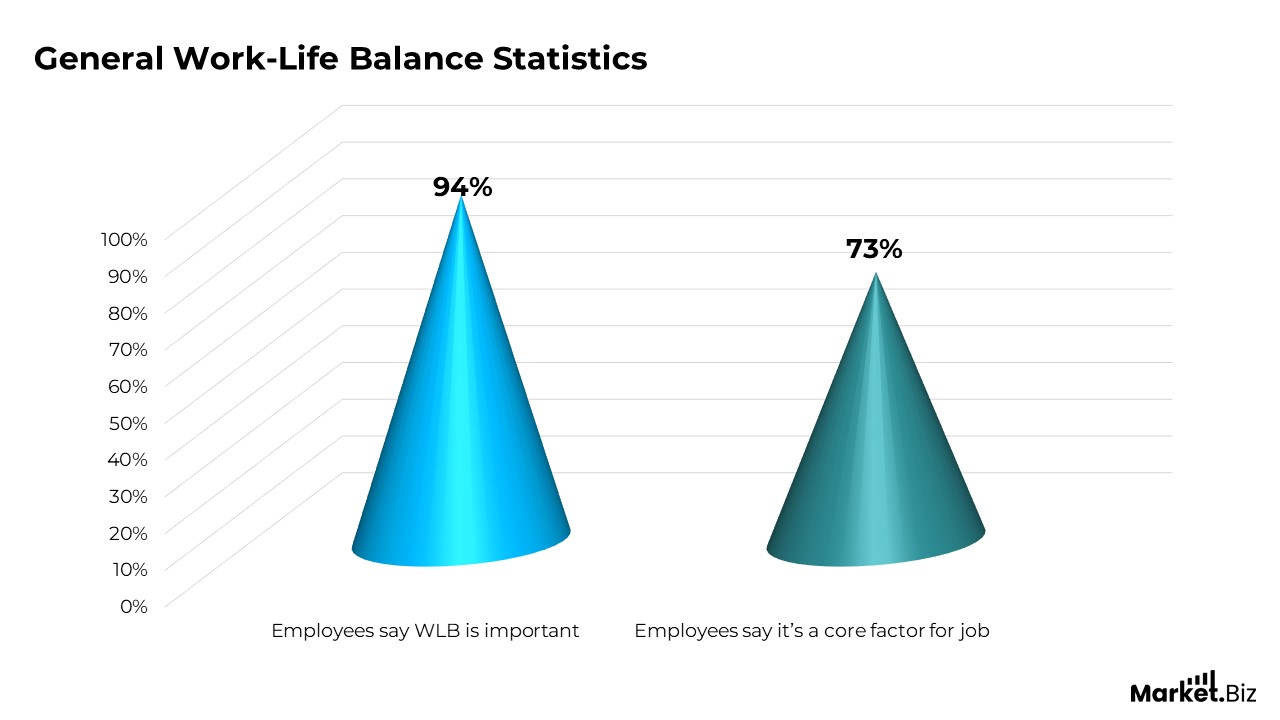
- 47% of U.S. employees report that work-life balance is the most important factor when choosing a job.
- 76% of employees with flexible work hours report being happier in their jobs.
- 58% of workers in the UK feel they don’t have a healthy work-life balance.
- 65% of women report finding it harder to achieve work-life balance compared to men.
- 80% of employees believe companies should do more to help them manage work-life balance.
- 44% of millennials say they would leave their current job for one with better work-life balance.
- Workers who achieve work-life balance have 12% lower stress levels.
- 32% of employees report that excessive work hours are the primary reason for poor work-life balance.
- The global average for time spent working per week is 42.5 hours, with employees in the U.S. working an average of 44.5 hours.
- 61% of remote workers feel they have better work-life integration than their in-office counterparts.
- 51% of employees say that their company’s mental health programs help them maintain a better work-life balance.
(Source: LifeHackMethod, WP-Content)
Work-life Balance By Country
(Source: LifeHackMethod, WP-Content)
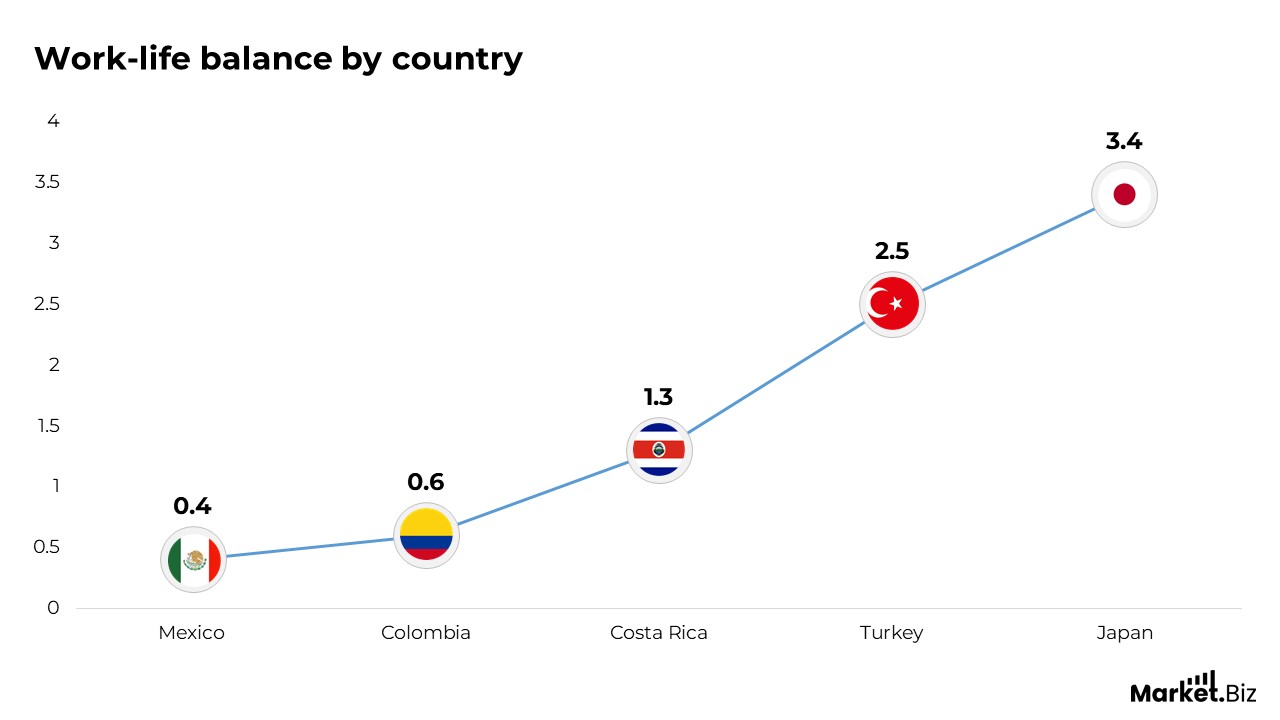
- Denmark ranks as one of the top countries for work-life balance, with 84% of employees feeling they have a good balance between work and personal life.
- In Germany, 66% of workers report high job satisfaction due to a favourable work-life balance, supported by strong labour laws and work-hour regulations.
- France offers significant vacation time, with 30 days of paid leave, helping employees maintain a healthy work-life balance.
- According to a 2023 study, Sweden ranks highly for work-life balance, with 70% of employees stating that their work hours allow them to balance family and personal life.
- Japan has made efforts to improve work-life balance, yet 58% of workers report long working hours, with many struggling to take full advantage of paid vacation days.
- In Norway, 80% of employees believe they have a healthy work-life balance, supported by policies like flexible work hours and generous parental leave.
- Canada sees 63% of employees satisfied with their work-life balance, although work culture varies by region, with urban centres showing more stress-related burnout.
- South Korea has seen a shift in work-life balance, with the government reducing the maximum workweek to 52 hours, but challenges remain for employees in competitive industries.
- The Netherlands is known for offering the shortest average workweek in Europe at 29 hours, leading to higher satisfaction in work-life balance, reported by 78% of workers.
- In Australia, 70% of workers report a good balance, and many benefit from workplace policies that encourage mental health awareness and flexible hours.
Impact of Poor Work-life Balance
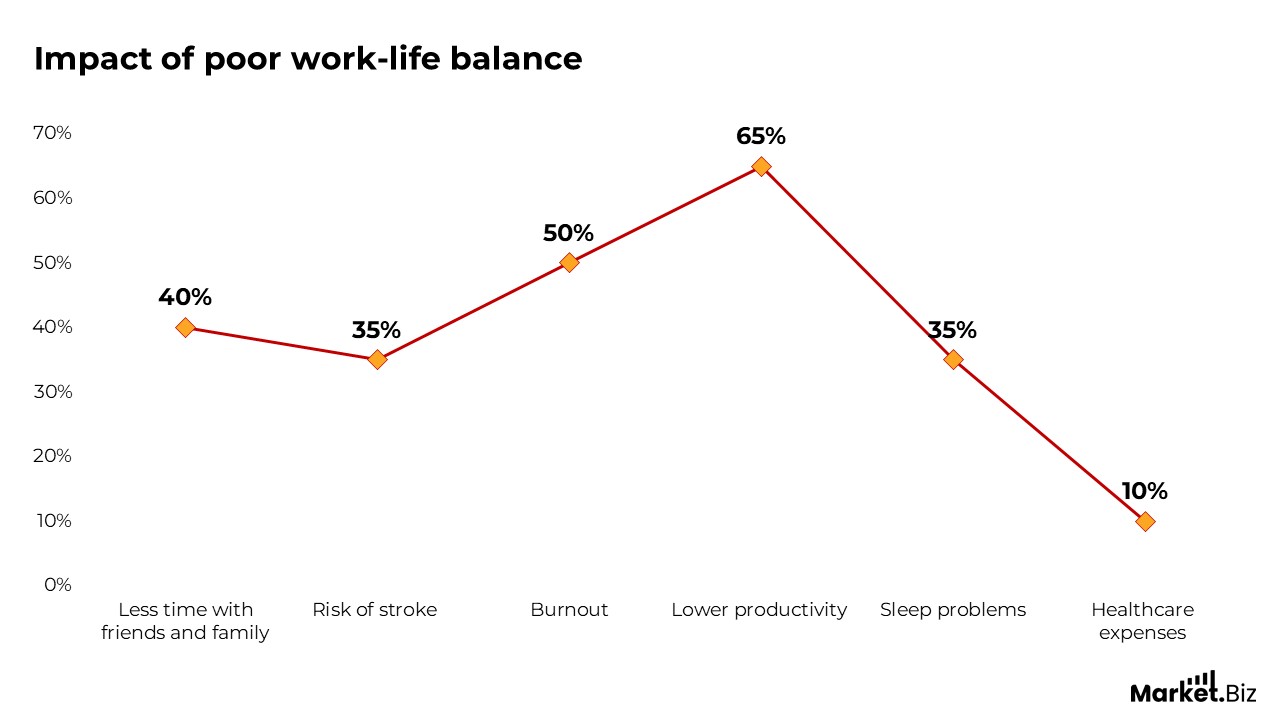
- According to 40% of respondents, having a bad work-life balance “ruins” their time with friends and family.
- When people work more hours, they perform worse and run the risk of making mistakes or getting hurt. After 50 hours a week, the risks of overwork rise dramatically.
- Over 55 hours of work increases the risk of stroke by 35% and the risk of dying from certain heart conditions by 17%.
- Over 50 hours of work per week is associated with a higher risk of anxiety and depression.
- An imbalance puts workers at serious risk for burnout, and they are 2.6 times more likely to be actively looking for another job.
- Poor work-life balance leads to burnout, with 50% of employees reporting feeling emotionally exhausted due to excessive work demands.
- Workers struggling with work-life balance are twice as likely to suffer from anxiety or depression compared to those with a healthy balance.
- 65% of employees experiencing poor work-life balance report feeling disengaged from their jobs, leading to lower productivity and performance.
- Employees with a poor work-life balance are 35% more likely to experience sleep problems, which can affect cognitive function and overall health.
- Companies face higher costs for healthcare and absenteeism, with poor work-life balance contributing to an estimated 10% increase in healthcare expenses per employee.
Remote Work and Work-life Balance
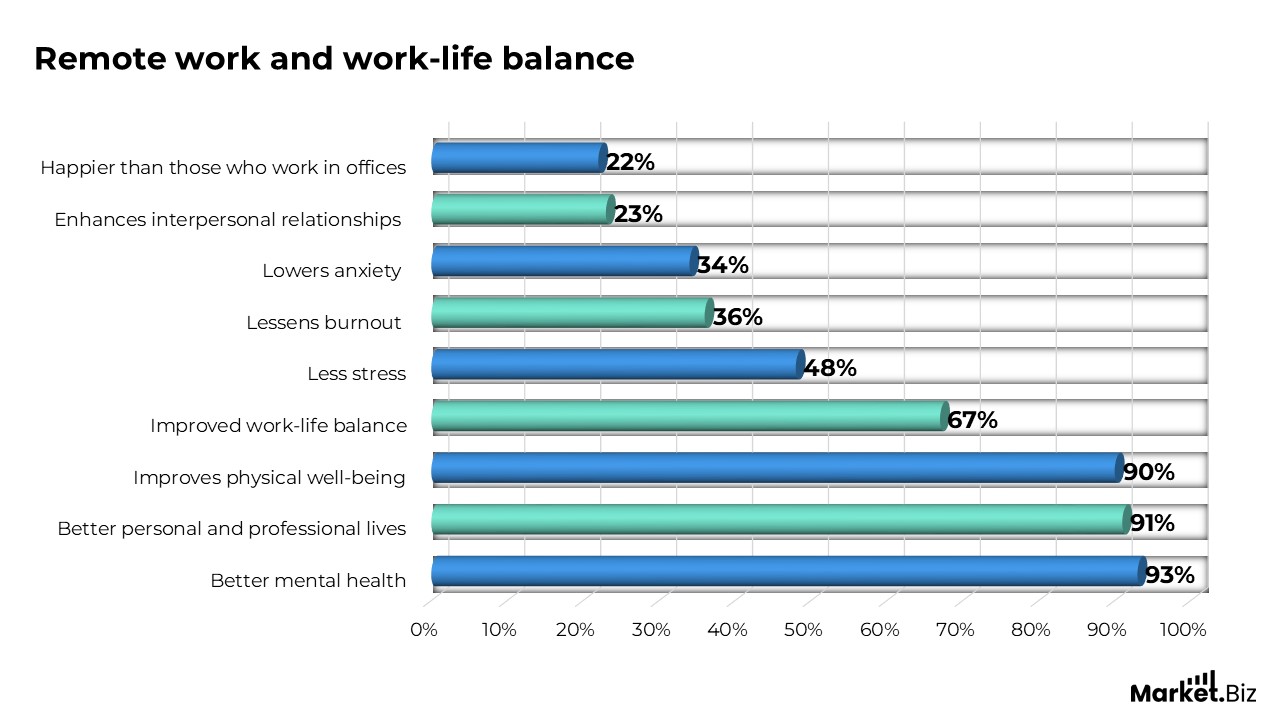
- 91% of workers say they would rather work from home in order to better balance their personal and professional lives.
- Additionally, working remotely enhances interpersonal relationships (23%), lowers anxiety (34%), and lessens burnout (36%).
- Furthermore, 90% of remote workers think it improves their physical well-being.
- Balance between Work and Life According to statistics, employees who work remotely report being 22% happier than those who work in offices.
- Approximately 67% report that moving to remote work improved their work-life balance.
- It’s interesting to note that remote workers typically put in 40 hours or more a week, which is even more than those who work in offices.
- 93% of remote workers report better mental health, and 48% report less stress.
- Data from 4,700 employees, mostly working remotely across multiple countries, forms the basis of the Remote Employee Experience Index (REEI).
- Knowledge workers around the world report a +25.7% improvement in work-life balance when working remotely as opposed to in an office.
- Of knowledge workers, 72.2% prefer a hybrid remote-office model, while just 11.6% want to return to full-time office work.
- Employees with flexible schedules outperform those with 9–5 jobs in every index component.
- When it comes to balancing work and childcare obligations, mothers in the United States frequently face greater challenges than mothers in other nations.
Work-Life Balance in the US Statistics
- In the professional services sector, 94% of employees put in more than 50 hours per week.
- According to 48% of Americans, they are workaholics. Every week, thousands of workers in the United States will put in more than four hours of free labour. These same employees will worry about their jobs for the same amount of time.
- The average weekday workday for full-time employees was 8.5 hours, while the average weekend and holiday workday was 5.5 hours.
- Even prior to the pandemic, 92% of those surveyed frequently worked on the weekends and in the evenings.
- Outside of regular business hours, 26% of the work is completed.
- According to HR leaders, outdated HR technology (20%), a lack of executive support (14%), and an excessive number of conflicting priorities (20%) are the main obstacles to eliminating burnout in the workplace.
- According to 16% of HR directors, the biggest barrier to increasing employee retention over the next 12 months is a lack of funding.
- According to 90% of HR directors, increasing employee retention is a top priority in order to prevent the negative effects of staff turnover.
- Over the next five years, 87% of employers think that increasing retention will be a top priority for their companies.
- According to 33% of employees, work-life balance is a crucial component of their jobs.
- 51% of employees claim that work obligations have caused them to miss significant life events.
- 11% of workers believe they are overworked.
- Of salaried workers, 26% report working after hours.
- At home, 70% of workers will read their emails while watching TV.
Work Life Balance Stats by Industry
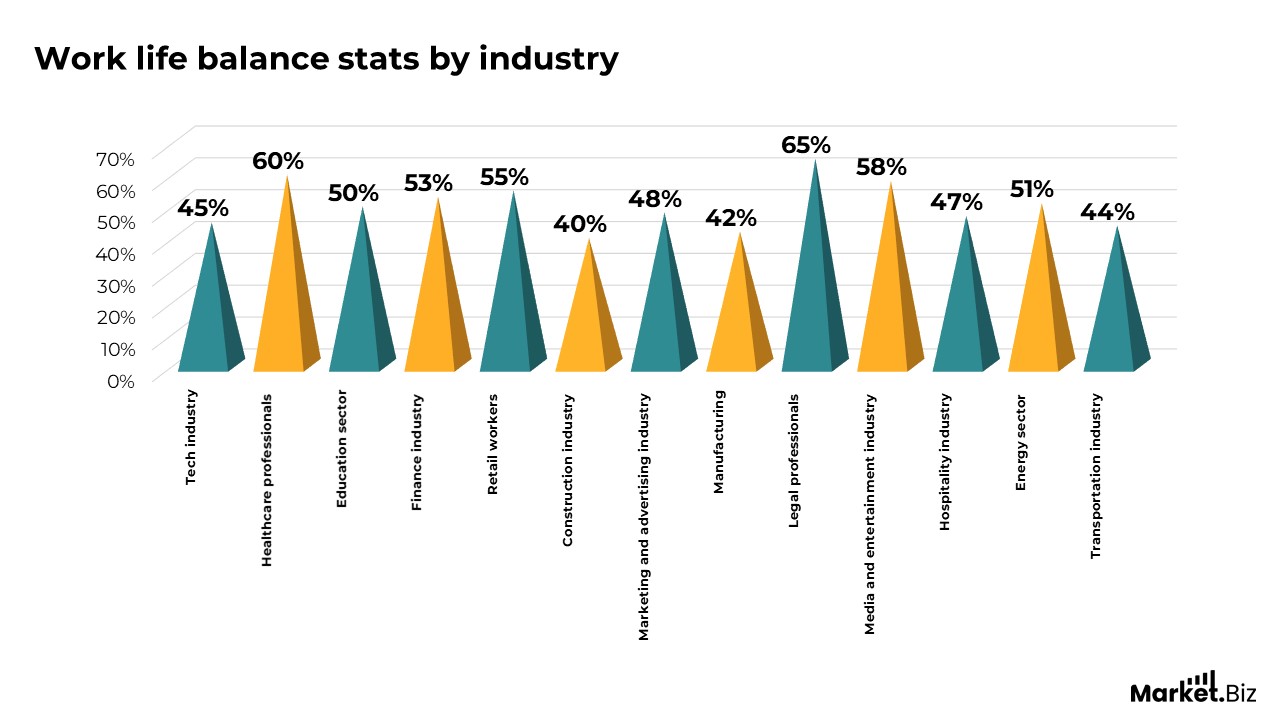
- In the tech industry, 45% of workers report struggling with work-life balance due to long hours and high demands.
- Healthcare professionals experience the worst work-life balance, with 60% reporting burnout and stress from irregular hours and heavy workloads.
- In the education sector, 50% of teachers feel their personal life is negatively impacted by work, with many working evenings and weekends.
- Employees in the finance industry face significant work-life balance challenges, with 53% reporting they often work overtime, impacting personal time.
- Retail workers have one of the lowest work-life balance ratings, with 55% stating their hours and shift work negatively affect their personal life.
- Construction industry workers report a 40% higher likelihood of experiencing poor work-life balance due to long, physically demanding hours.
- Workers in the marketing and advertising industry often struggle with balance, with 48% working over 40 hours a week and reporting burnout.
- In manufacturing, 42% of employees say their work-life balance is poor due to rigid schedules and high workplace demands.
- Legal professionals report the highest levels of work-life imbalance, with 65% saying their workload causes significant stress and lack of personal time.
- The media and entertainment industry has a high burnout rate, with 58% of workers facing work-life imbalance due to irregular schedules and deadlines.
- Hospitality industry workers experience a 47% higher rate of work-life dissatisfaction, driven by long shifts and weekend work.
- Employees in the energy sector report 51% having poor work-life balance due to remote locations, long shifts, and unpredictable schedules.
- The transportation industry sees 44% of employees struggling with work-life balance due to long hours on the road and irregular schedules.
Work-Life Balance Statistics by Burnout
- Approximately 70% of workers feel that their employers are not doing enough to address burnout.
- Burnout is more than twice as likely to occur in people who experience unfair treatment at work, making those who are impacted 2.3 times more likely to experience it.
- Employee burnout causes a 40% job turnover rate, which has a major effect on businesses’ capacity to retain their workforce.
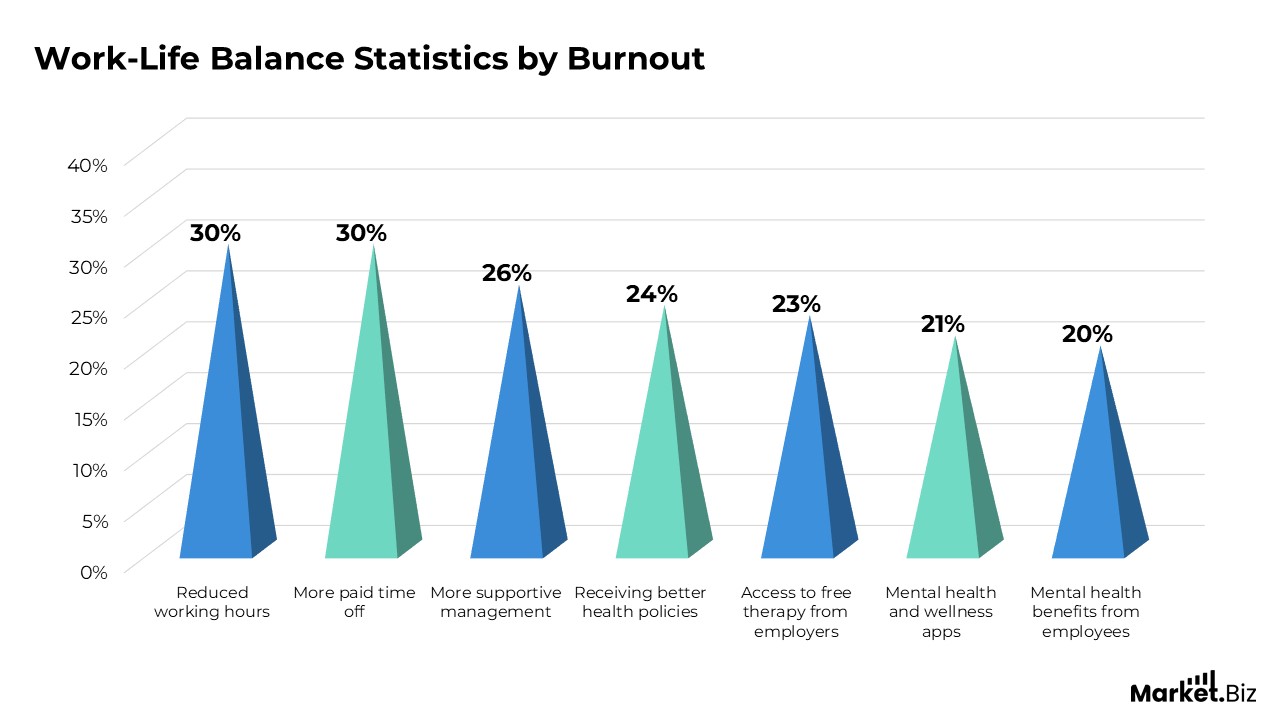
- Approximately 25% of employees believe that a better work-life balance and the implementation of more flexible work arrangements could help avoid burnout.
- Furthermore, 44% of workers say that their excessive workload is the cause of their burnout.
- Burnout is the leading cause of employee turnover in the United States, outweighing all other factors, and it costs the economy about $300 billion a year.
- Health-related costs brought on by worker absenteeism, decreased productivity, and occupational injuries account for $190 billion of the economic burden each year.
- Teacher burnout has a substantial financial impact on the US education system as well, costing roughly $7 billion a year.
- Burnout is a serious health issue that causes about 120,000 more deaths among American workers annually.
- Larger organizations with more than 5,000 employees are more likely to experience burnout.
- Workplace burnout intervention measures were only available to 21% of the sample surveyed.
- In addition, 41% of people who put in more than 50 hours a week do not have access to programs that prevent burnout.
- About 23% of workers report feeling burned out regularly or always, and 44% report feeling burned out occasionally.
(Source: Linearity)
Work-life Balance Stats Across the Globe
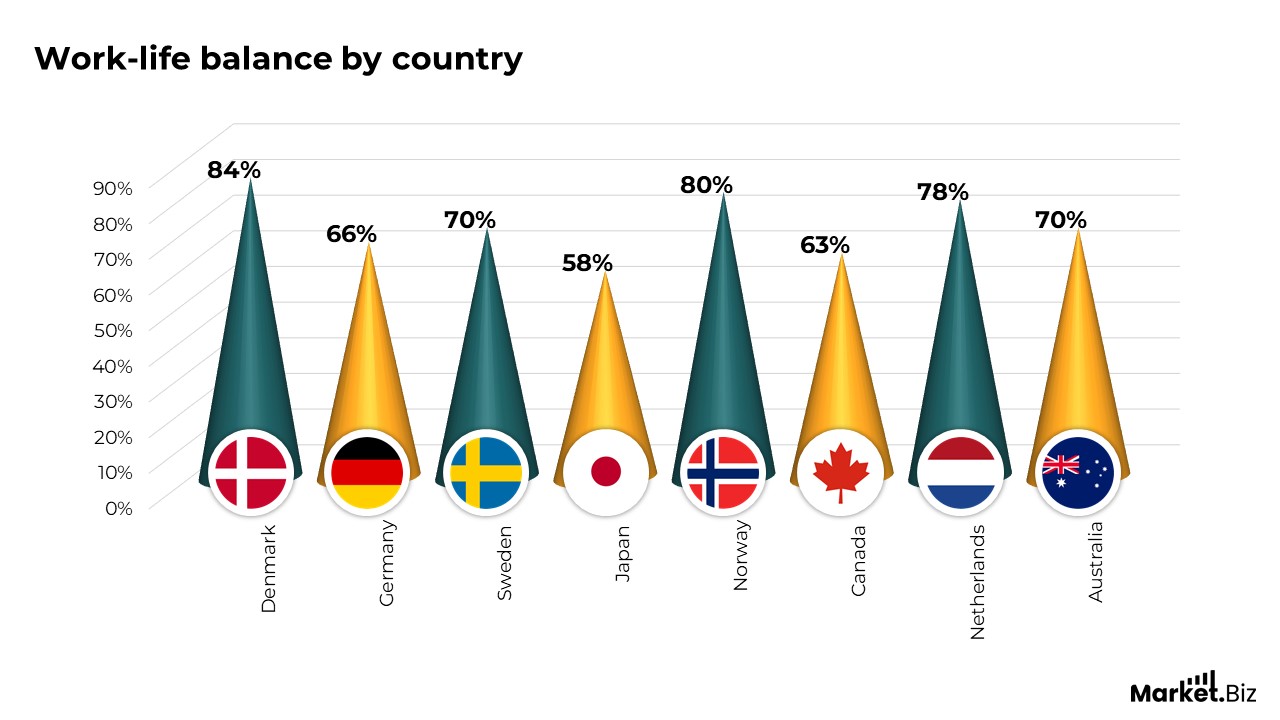
- In the Netherlands, just 0.4% of workers say they put in long hours.
- Nearly one-third of workers in Turkey put in more than fifty hours a week, making them the hardest workers in the world.
- Work-life balance is getting harder to manage, according to 49% of German survey participants.
- In Mexico, 28.7% of workers say they put in a lot of overtime.
- Mexican workers report that they only engage in leisure activities, such as sleeping, for 12.4 hours every day.
- In Colombia, 5.5% of workers believe they put in a lot of overtime.
- Of South Korean workers, 25.2% report feeling overworked.
- Eleven percent of workers worldwide reported putting in fifty or more hours a week on average.
- Around the world, the average worker sleeps and relaxes for about 15 hours, or 63% of the day.
- Just 14.4 hours, or 60% of the average American worker’s day, are spent sleeping and engaging in leisure activities.
- To better balance their work and family lives, 67% of men (compared to 57% of women) have changed jobs.
- Globally, millennials ranked working flexibly and without penalties as their third-highest priority, behind pay and benefits.
- Approximately one-third of professionals stated that striking a work-life balance is more difficult now than it has ever been.
- One group of people who struggle the most to balance work and home life is working parents.
- Paid parental leave is generally valued more by older millennials (those over 40) than by earlier generations.
Demographics
Work-Life Balance by Age Group
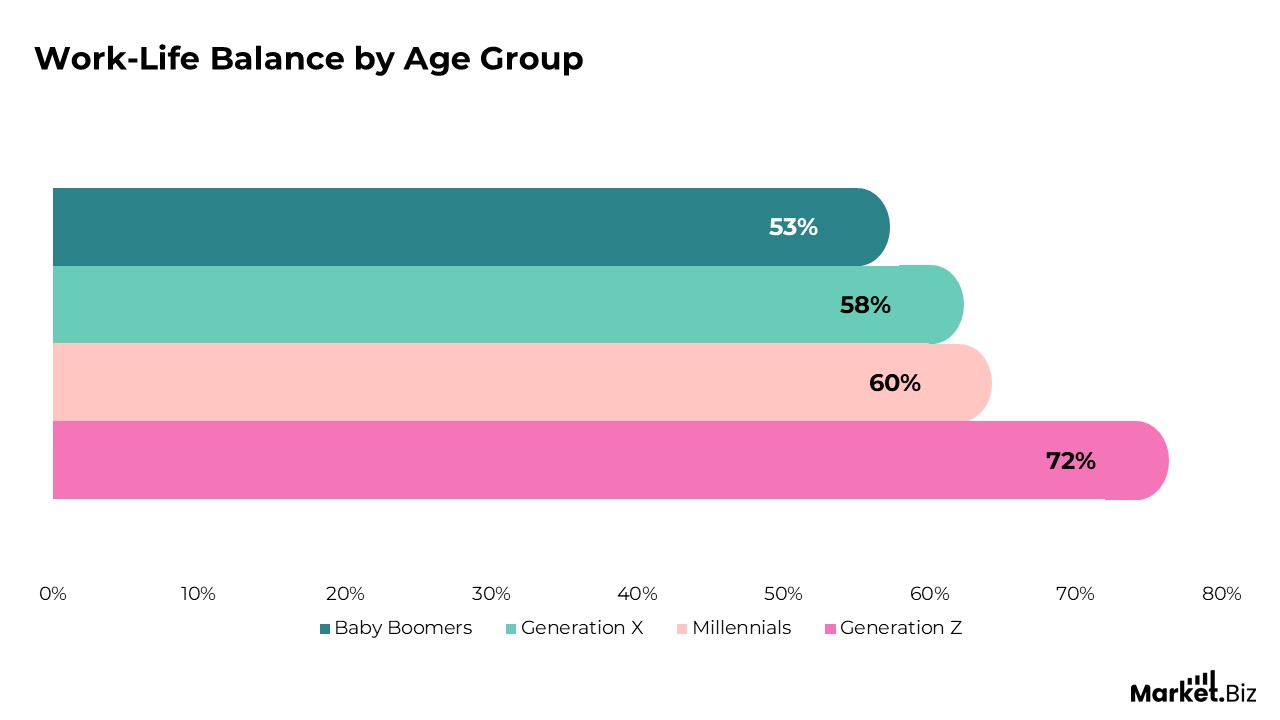
Millennials (ages 25-40) prioritize work-life balance more than other generations, with 60% stating it’s a key factor in job satisfaction.
- Generation Z (ages 18-24) reports the highest desire for flexibility, with 72% seeking jobs that offer remote work options to achieve a better balance.
- In contrast, Baby Boomers (ages 56-74) tend to have a stronger focus on job stability, with 53% reporting satisfaction with their work-life balance despite longer hours.
- Generation X (ages 41-55) struggles with work-life balance due to caregiving responsibilities, with 58% of this group citing family obligations as a barrier.
- Millennials are more likely to experience burnout, with 55% stating they often feel overwhelmed due to poor work-life balance.
- Generation Z values mental health, with 67% saying they would choose a lower-paying job for better work-life balance and flexibility.
- Baby Boomers are more likely to have longer work hours, with 48% working 50+ hours a week, impacting their overall work-life balance.
- Among Generation X, 50% report feeling stressed due to balancing work with raising children or caring for aging parents.
- Millennials are more likely to seek jobs with strong work-life balance policies, with 71% stating it would influence their job decision.
Work-Life Balance by Gender
- Women are more likely to experience poor work-life balance, with 65% reporting they struggle to juggle career and personal life compared to 50% of men.
- In the U.S., working mothers experience 25% more stress regarding work-life balance compared to their male counterparts.
- Men report 40% higher satisfaction with their work-life balance, mainly due to fewer family responsibilities and workplace support.
- Women in leadership roles report 45% more difficulty in achieving work-life balance due to added expectations at work.
- Male employees in the tech industry report 34% higher satisfaction with their work-life balance than women in the same field.
- Women with flexible work hours are 60% more likely to report a positive work-life balance compared to women with rigid schedules.
- Men working remotely report 52% greater work-life satisfaction compared to men working in office environments.
- Women are 29% more likely to face workplace discrimination that impacts their work-life balance, especially in male-dominated industries.
- Gender differences in work-life balance are more pronounced in cultures with fewer family-friendly policies, where 55% of women report stress versus 35% of men.
Challenges of Work-Life Balance
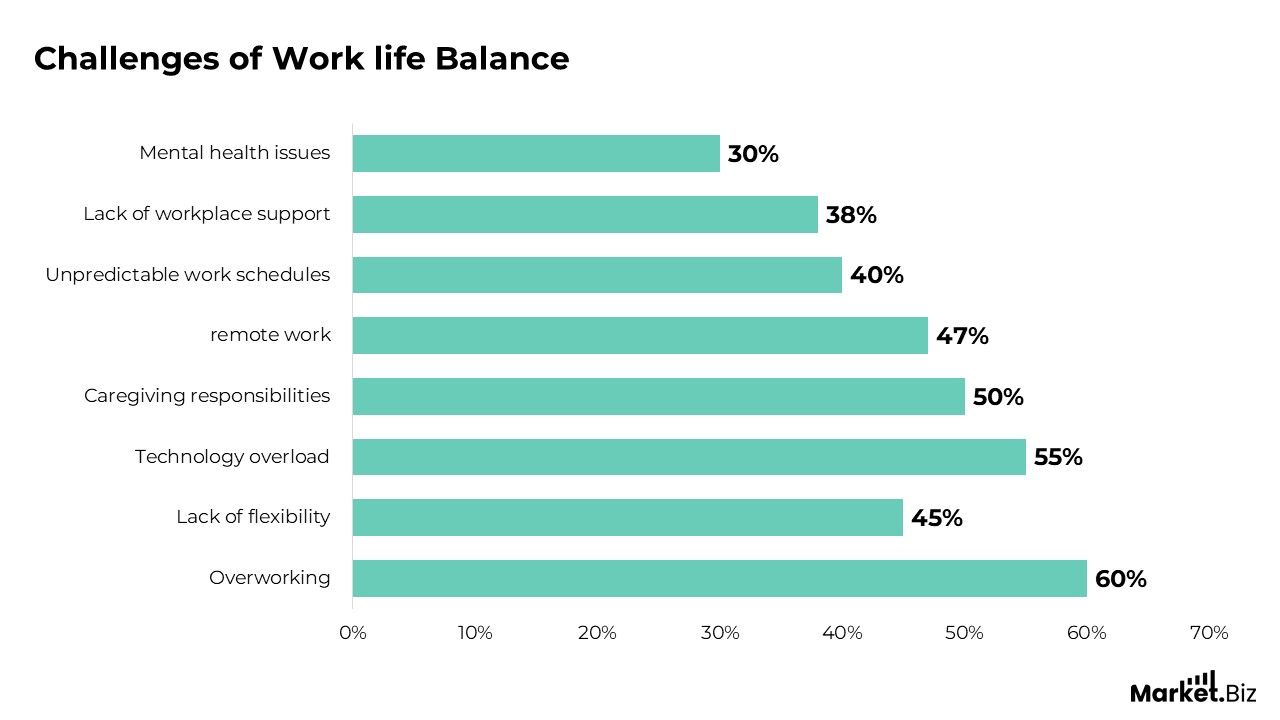
- Overworking is a major challenge, with 60% of employees working beyond regular hours, leading to higher burnout rates and lower job satisfaction.
- Lack of flexibility in the workplace is reported by 45% of workers, making it difficult for them to balance family and career commitments.
- Technology overload contributes to poor work-life balance, with 55% of employees feeling the pressure to stay connected outside work hours, impacting personal time.
- Caregiving responsibilities are a significant burden, with 50% of workers with children or older dependents reporting increased stress in managing work-life balance.
- The rise of remote work has blurred boundaries for 47% of employees, causing them to work longer hours and struggle with separating personal and professional life.
- Unpredictable work schedules in industries like healthcare and retail affect 40% of workers, making it hard to plan personal activities or family time.
- Lack of workplace support for work-life balance initiatives is reported by 38% of employees, reducing morale and leading to higher turnover.
- Mental health issues are exacerbated by poor work-life balance, with 30% of employees citing stress and anxiety as major outcomes of work imbalance.
Conclusion
The report highlights the critical importance of work-life balance for employee well-being and productivity. A significant portion of employees globally experience burnout, with many reporting that work negatively affects their personal lives, underscoring the need for businesses to prioritize balance. Flexible work arrangements have proven effective, with many employees citing improved balance and greater job satisfaction.
However, challenges persist, particularly for women, who often find it harder to achieve balance compared to men. Addressing these concerns is essential, as the majority of employees believe companies need to do more to support work-life balance. Ultimately, fostering a better work-life balance can improve productivity, reduce burnout, and enhance employee retention.
FAQ’s
Employees do care about work-life balance. 57% of job seekers say that a lack of work-life balance is a deal-breaker that will make them decline an offer, and 72% of employees think that work-life balance is a significant factor when evaluating the quality of a job.
Approximately 40% of people worldwide claim to have a good work-life balance. The figures highlight the necessity, however ill-defined, for the great majority of workers to successfully manage their work and other obligations.
In addition to removing the stress of commuting, working remotely offers freedom, but it also makes it difficult to determine when to end work. Structured work schedules allow for a separation between work and personal life, which may lessen burnout.