









Introduction
Workplace Collaboration Statistics: Workplace collaboration has become a critical factor in driving business success, with 86% of employees and executives citing ineffective communication as a primary cause of workplace failures. Recent studies show that organizations with high collaboration are 21% more profitable, and employees in collaborative environments report a 17% increase in engagement.
Collaboration not only boosts productivity but also enhances innovation, with teams experiencing a 33% increase in creative solutions. As businesses continue to adapt to digital transformation, understanding the impact of collaboration on performance, employee satisfaction, and organizational growth is more important than ever. This analysis explores key workplace collaboration statistics that highlight its significance in modern business operations.
Editor’s Choice
- 86% of employees and executives identify ineffective communication as the primary cause of workplace failures, emphasizing the need for better collaboration.
- Organizations with high collaboration are 21% more profitable, reflecting the impact of effective teamwork on business success.
- Employees in collaborative environments report a 17% increase in engagement, reducing turnover and improving job satisfaction.
- Teams that collaborate frequently are 5 times more likely to achieve higher productivity levels than those working in isolation.
- 33% of employees in collaborative settings experience a significant increase in innovation and creative solutions.
- 70% of employees report higher job satisfaction in collaborative settings, contributing to a positive and motivated workforce.
- 74% of employees feel that collaboration helps them solve problems faster by leveraging diverse perspectives and skills.
- Companies utilizing AI-powered tools for collaboration see a 52% increase in automation of workflows, streamlining tasks like scheduling and communication.
- 75% of organizations have adopted remote collaboration tools, reflecting the shift towards flexible, distributed work environments.
- 87% of businesses are using cloud-based platforms for collaboration, enhancing real-time file sharing and communication across locations.
- 68% of businesses report an increase in cross-department collaboration, breaking down silos and fostering innovation.
- 79% of companies plan to increase their investment in collaboration tools, focusing on integrating AI and automation to improve communication and efficiency in the next 3 years.
(Source: Jobera, WP-Content)
General Workplace Collaboration Statistics
- Teams that engage in frequent collaboration are 5 times more likely to achieve higher productivity levels compared to those who work in silos.
- Organizations with collaborative cultures experience up to 21% higher profitability, attributed to improved efficiency and idea-sharing.
- 33% of employees in collaborative environments report a significant increase in innovation and creative solutions.
- Companies that foster collaboration see a 17% rise in employee engagement, reducing turnover and enhancing job satisfaction.
- 86% of executives and employees blame ineffective communication for workplace failures, emphasizing the need for improved collaboration.
- Collaborative teams are 20% more likely to report strong cohesion, which enhances teamwork and interpersonal relationships.
- Teams with strong collaboration make decisions 2.5 times faster than those working independently, accelerating project timelines.
- Businesses with high collaboration experience 15% higher employee retention, as employees feel more connected to their roles and teams.
- Collaborative work environments lead to a 35% improvement in knowledge sharing, increasing the overall intellectual capital of the organization.
- Teams that collaborate effectively report a 30% reduction in workplace stress, thanks to shared responsibilities and mutual support.
- Collaboration reduces project rework and errors, leading to savings of up to 25% in project costs and operational expenses.
- Collaborative teams are 50% more adaptable to changes in the workplace, ensuring smoother transitions during organizational shifts.
- 70% of employees report higher job satisfaction in collaborative settings, fostering a more positive and motivated workforce.
- Teams that collaborate effectively report a 40% increase in customer satisfaction, as they can deliver more tailored solutions.
- 60% of workers say they learn more in collaborative environments, enhancing skill development and career growth opportunities.
Trends in Workplace Collaboration
- 75% of organizations have adopted remote collaboration tools, reflecting the growing trend of flexible and distributed work environments.
- Companies are using AI-powered tools to enhance workplace collaboration, with 52% automating workflows, scheduling, and communication tasks.
- 87% of businesses are utilizing cloud-based platforms for collaboration, improving real-time file sharing, project management, and team communication across locations.
- Video conferencing usage has surged by 200% since 2020, making it a critical tool for maintaining communication and engagement in hybrid and remote workplaces.
- 68% of businesses report an increase in cross-department collaboration, recognizing its importance in fostering innovation and breaking down silos within the organization.
- 60% of companies are consolidating collaboration tools, integrating chat, file sharing, and task management into a single platform to improve efficiency.
- 65% of employees prefer asynchronous communication, which allows them to collaborate across different time zones without needing real-time interaction.
- 54% of organizations are integrating wellness programs into collaboration tools to promote employee well-being and work-life balance in hybrid work environments.
- 78% of organizations are focusing on collaborative learning, using platforms that enable employees to share knowledge and develop new skills together.
- According to workplace collaboration statistics, unclear roles and too many meetings irritate 84% of marketers.
- Sixty percent of workers feel that strong teamwork fosters innovation, and seventy-three percent report improved performance.
- According to 70% of workers, ineffective teamwork reduces productivity.
- 64% of employees lose at least three hours every week as a result of ineffective teamwork.
(Source: Market.US, WP-Content)
Employee Opinion on Work Collaboration
- Employees believe that collaboration in the workplace enhances job satisfaction, with 70% reporting a more engaging work environment.
- 68% of employees say that collaborating with their colleagues directly contributes to higher productivity and more efficient work processes.
- When collaboration is encouraged, 63% of employees report feeling more connected to their team, fostering a stronger sense of unity and camaraderie.
- 74% of employees feel that collaboration helps them solve problems faster and more effectively by leveraging diverse perspectives.
- 59% of employees agree that collaboration increases creativity, as working together sparks new ideas and innovative solutions.
- 82% of employees believe that effective collaboration tools improve communication and reduce misunderstandings within teams.
- A collaborative work environment leads to higher workplace satisfaction for 77% of employees, contributing to better morale.
- 65% of employees report that collaboration helps build trust among team members, fostering more open communication and teamwork.
- 60% of employees feel that collaboration at work allows them to learn new skills and broaden their expertise through knowledge sharing.
- 71% of employees state that collaborative work environments make them feel more motivated and driven to contribute to team goals.
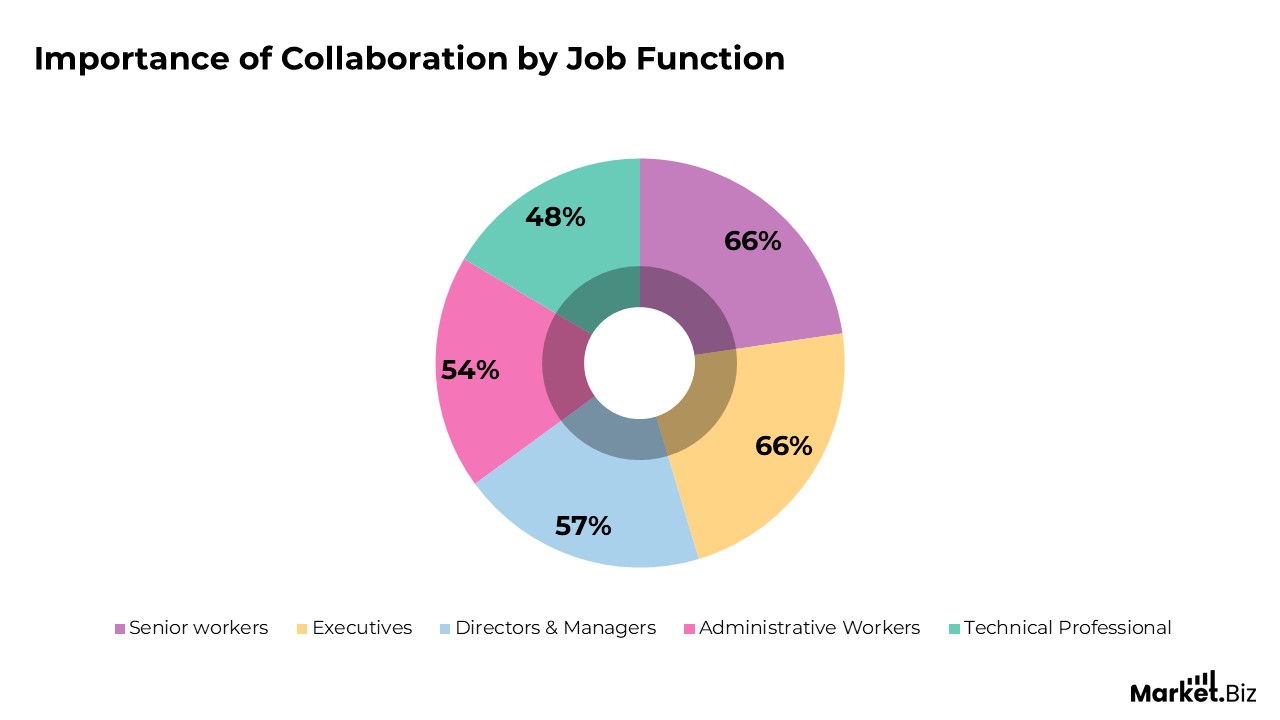
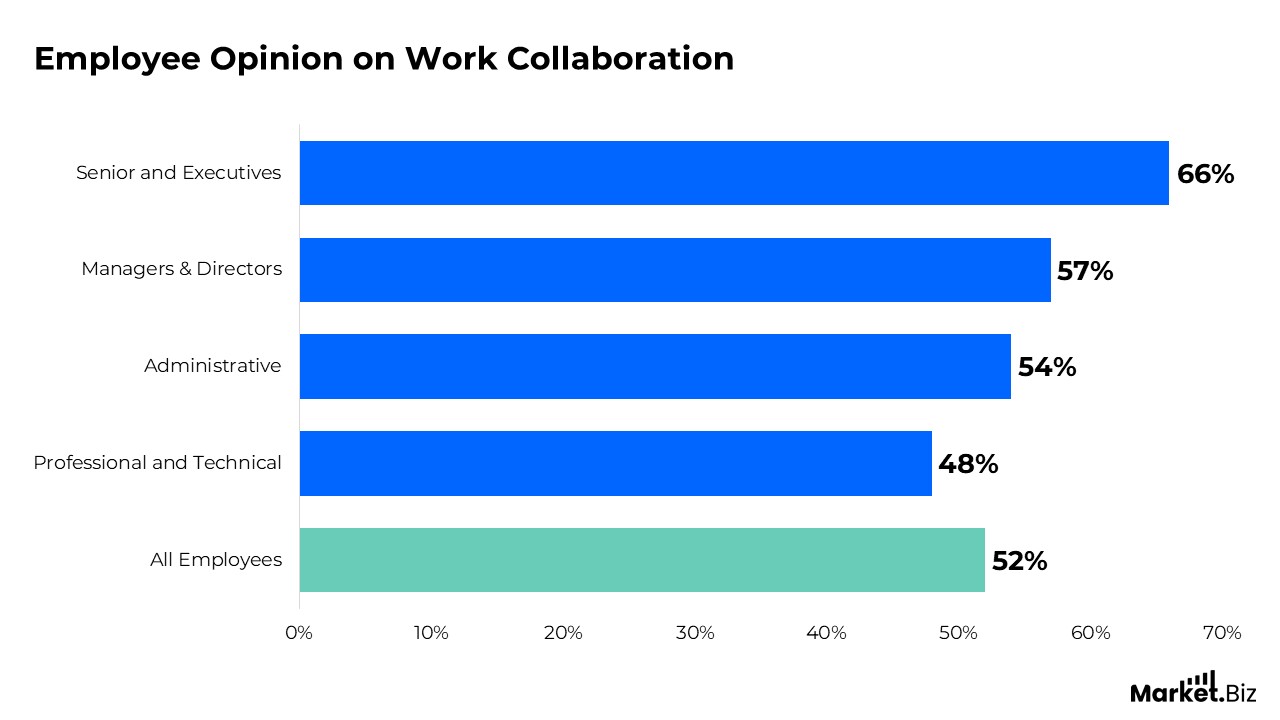
- According to statistics on workplace collaboration, 52% of respondents—who represent workers at all levels—believe that teamwork is a crucial component of the workplace.
- Teamwork is deemed essential by 66% of senior and executive-level employees.
- 57% of directors and managers think that teamwork is crucial.
- According to 54% of administrative staff, teamwork is essential in the workplace.
- According to 48% of technical and professional workers, teamwork is crucial.
(Source: Zippia, WP-Content)
Challenges in Workplace Collaboration
- Given that 39% of workers cite workload and 36% cite interpersonal conflicts as stressors, it is evident that ineffective team dynamics increase stress and highlight the necessity of efficient frameworks for collaboration.
- 28% of missed deadlines are due to miscommunication, demonstrating how ambiguous exchanges can result in mistakes and delays. To maintain team alignment and productivity, structured communication channels are crucial.
- There is a need for better coordination across organizational silos, as 41% of workers say it is harder to work with people from different departments than within their own teams.
- For 88% of remote workers, email is still their main form of communication. But this over-reliance on email frequently leads to problems that can impede productive teamwork and efficient communication.
- Fragmented work environments can result from the fact that more than half of American workers have little to no understanding of the goals of other teams. Transparency dismantles silos and encourages alignment.
- Isolated remote workers report a 21% decrease in productivity, underscoring the significance of inclusive, cohesive team environments for maintaining performance.
- An estimated $1.9 trillion in lost productivity occurs in the United States each year as a result of unengaged and actively disengaged workers.
- According to 72% of workers and 82% of leaders, it is challenging to finish crucial tasks when there is little time in between meetings.
- Poor collaboration causes about 64% of employees to lose at least three hours of productivity each week.
- The largest obstacles to adjusting from remote to in-office work, according to 49% of in-office employees, were maintaining motivation and team connections.
- 53% of people report experiencing stress, exhaustion, and burnout as a result of poor communication in their workplace.
- Poor communication skills are costing businesses business; 66% of customers have said they have switched to competitors as a result.
Benefits of Workplace Collaboration
- Teams that collaborate effectively are 5 times more likely to be productive, as collective problem-solving accelerates task completion.
- Collaborative environments encourage diverse ideas, boosting creativity and innovation by 33%.
- Studies show that teams with strong collaboration are 2.5 times more likely to make high-quality decisions.
- 86% of employees and executives cite a lack of effective communication as the main cause of workplace failures.
- Collaborative workplaces see a 17% increase in employee engagement, fostering loyalty and reducing turnover.
- Collaboration fosters knowledge sharing, leading to a 35% increase in organizational learning.
- Collaborative teams are 20% more likely to report feeling cohesive, which strengthens teamwork and morale.
- 70% of employees say that collaboration increases their job satisfaction, fostering a positive work culture.
- Companies with a culture of collaboration experience 15% higher employee retention rates compared to those with solo teams.
- Collaboration helps employees acquire new skills, with 60% of workers reporting they learn more in group settings.
- Effective team collaboration leads to better service delivery, improving customer satisfaction by 40%.
- Sharing responsibilities in collaborative settings reduces individual workload by 25%, leading to lower burnout rates.
- Teams that collaborate are 50% more adaptable to organizational changes, ensuring smoother transitions.
- Companies with high collaboration experience up to 21% higher profitability, driven by improved efficiency and innovation.
- Employee collaboration can decrease project completion times by 20%, helping teams meet deadlines more effectively.
- Collaborative workplaces contribute to a stronger company culture, with 78% of employees feeling more connected to their company’s mission.
- Teams with collaborative environments report a 30% reduction in stress levels due to shared problem-solving and mutual support.
- Collaboration reduces the chances of errors and rework, saving up to 25% in costs related to project mistakes and inefficiencies.
Technology in Workplace Collaboration
- Only 34% of employees who use fewer than five apps report communication problems, compared to 54% of employees who use more than ten apps.
- According to the Project.co, 26% of employees used an online chat tool 2022, whereas 55% of people used email to communicate with clients. The same source claims that only 7% of people communicate via phone.
- There was a 44% increase in the use of digital or mobile collaboration tools between 2019 and 2021.
- 83% of professionals say they can see the project’s status clearly when they only use a project management tool to communicate with clients and colleagues.
- Instruction on the use of communication and collaboration tools was given to 32% of staff members.
- According to 65% of employees, it is essential to use a single platform for both video conferences and instant messaging.
- AI-driven collaboration tools, such as automated workflows and chatbots, are used by 55% of organizations to handle repetitive tasks, allowing teams to focus on higher-level creative work.
- Video conferencing tools have made team collaboration more efficient for 65% of companies, enabling seamless communication in hybrid work environments.
- Instant messaging platforms have helped 80% of employees reduce email usage by 40%, speeding up communication and decision-making.
- 65% of teams using task management software report higher efficiency in tracking progress and meeting deadlines due to improved task allocation and clarity.
(Source: Coolest-Gadgets, WP-Content)
Online Collaboration Tools
- Online collaboration tools have improved team coordination for 92% of businesses, enabling smoother workflows and better alignment on projects.
- 67% of remote workers say online collaboration tools are essential for maintaining productivity and staying connected with their teams.
- 80% of companies use a combination of online collaboration tools, including project management software, instant messaging, and video conferencing, to increase overall efficiency.
- 56% of employees believe online collaboration tools help reduce work-related stress by improving communication and ensuring everyone stays on the same page.
- After adopting collaboration tools, 74% of businesses have experienced faster decision-making processes, thanks to quicker communication and real-time information sharing.
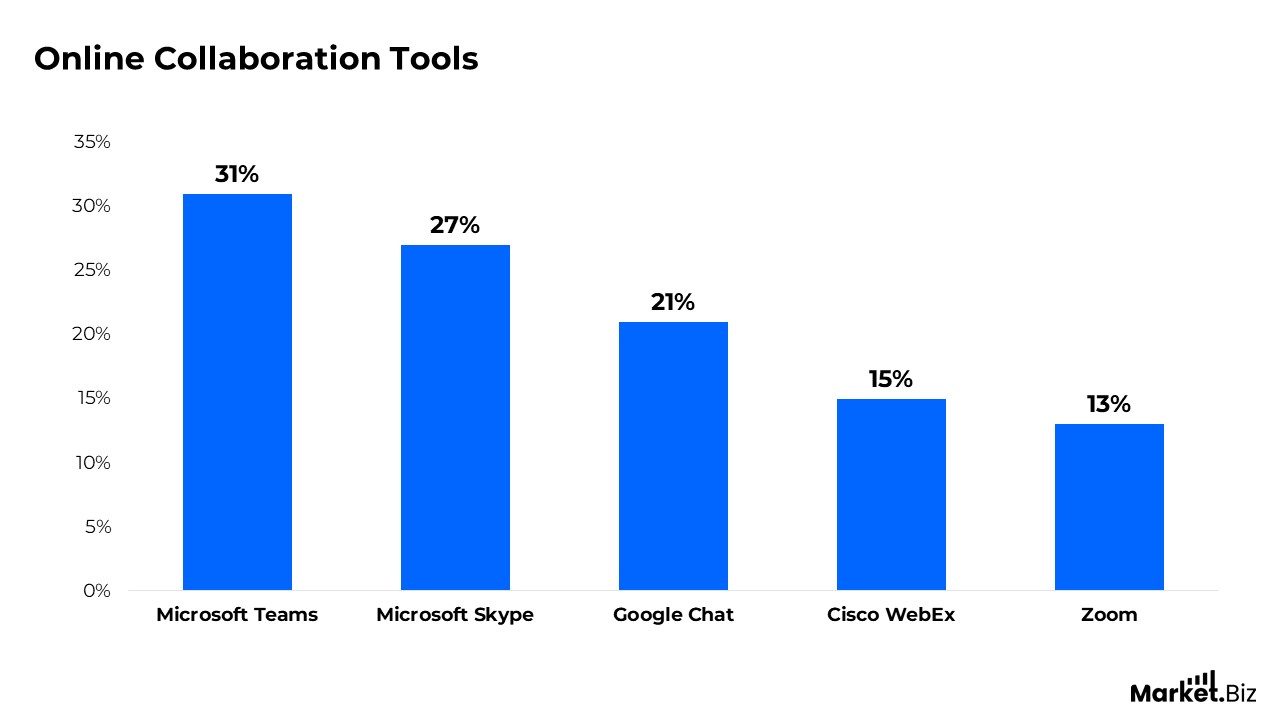
- Microsoft Team is ranked as the most popular online collaboration tool by 31% of respondents, according to workplace collaboration statistics.
- 21% of respondents said they prefer Google Chat over other online collaboration tools.
- 15% of respondents said they preferred using Cisco WebEx Teams for online collaboration.
- Zoom is the online collaboration tool of choice for 13% of those surveyed.
(Source: Electroiq, WP-Content)
AI Adoption in the Workplace
- Companies have already adopted AI technologies, with AI being used for customer service by 61% and for data analysis by 43%.
- After implementing AI tools that automate repetitive tasks and improve decision-making, 68% of organizations report a significant increase in employee productivity.
- AI adoption has led to cost reductions for businesses, with 56% seeing savings on labour and operational expenses thanks to task automation.
- Using AI-powered catboats and virtual assistants, 72% of businesses have seen improvements in customer satisfaction and faster response times.
- In recruitment processes, 51% of HR departments are using AI to streamline candidate selection and improve hiring decisions.
- Companies using AI to gather and analyse data report 63% effectiveness in providing actionable insights that improve strategies, products, and customer experiences.
- 58% of employees say AI tools have helped them improve their skills, with training programs on AI technology growing by 35% over the past two years.
- Business leaders expect AI adoption in the workplace to increase, with 80% predicting a rise in AI-driven innovation and efficiency over the next five years.
- According to workplace collaboration statistics, the AI use case in the workplace for 24% of respondents is service operations optimization.
- The AI use case in the workplace, according to 20% of respondents, is developing new AI-based products.
- Customer segmentation, customer service analytics, and new AI-based product enhancements are the workplace AI use cases cited by 19% of respondents.
- Lead generation and customer acquisition are the AI use cases in the workplace, according to 17% of respondents.
- According to 16% of respondents, contact centre automation and product feature optimization are two examples of AI’s applications in the workplace.
Future of Workplace Collaboration
- Businesses plan to increase their investment in collaboration tools, with 79% intending to focus on integrating AI and automation to improve communication and efficiency over the next 3 years.
- As remote work continues to rise, 68% of employees expect workplace collaboration to become more reliant on virtual tools, with a growing preference for hybrid work environments.
- 70% of companies believe that in 2025, collaboration platforms will be fully integrated with AI-driven features, enabling smarter, data-backed decision-making in real-time.
- 62% of employees anticipate that virtual reality (VR) and augmented reality (AR) will play a major role in transforming workplace collaboration by offering more immersive team interactions.
- Organizations predict that collaboration will become more cross-functional, with 74% expecting teams from different departments to work together in real-time on shared digital platforms to drive innovation.
- In 2023, 28.2% of full-time workers will use a hybrid model, and 12.7% will work from home.
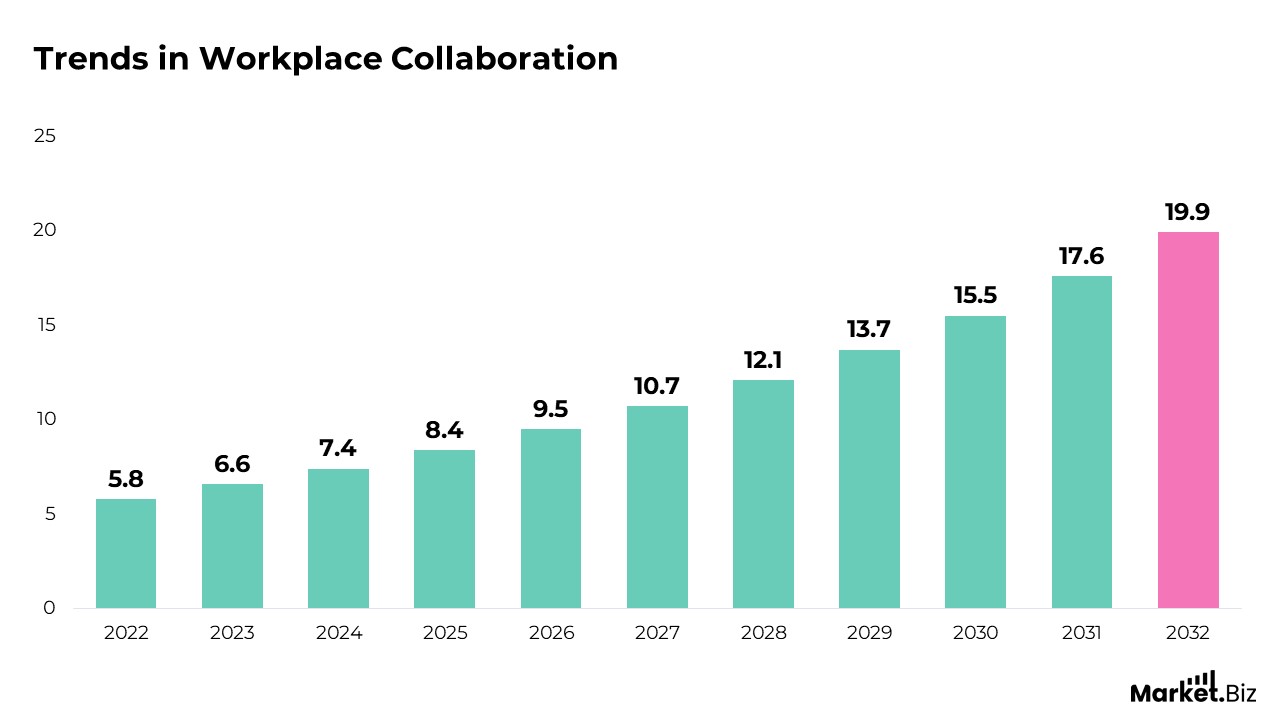
- At a compound annual growth rate (CAGR) of 12.7%, the global enterprise collaboration market is expected to reach $85.8 billion by 2026.
- Online collaboration tools and digital workspaces can increase productivity by as much as 30%.
- In order to improve remote work, 90% of businesses want to implement cognitive collaboration solutions that integrate AI and human intelligence.
- Over the previous 20 years, workplace collaboration has increased by at least 50%.
- Employee job satisfaction rises by 17% when they collaborate with others.
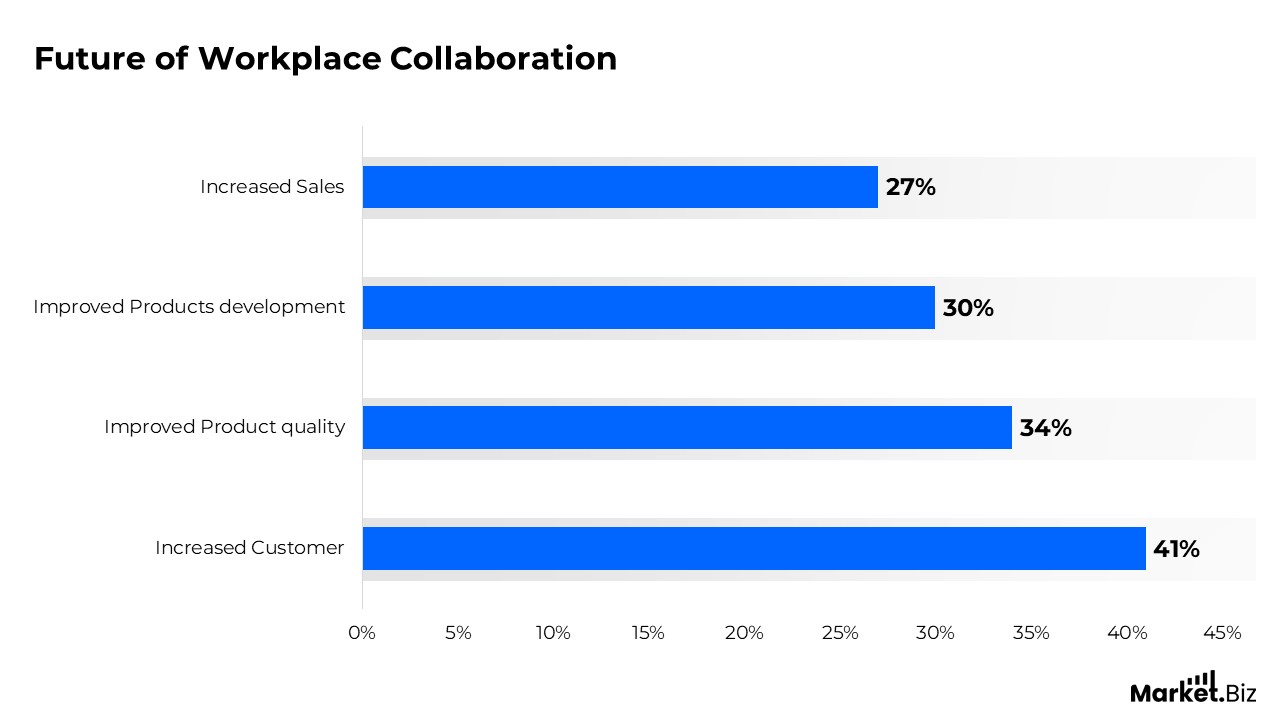
- Collaboration in the workplace can increase innovation by 30%.
- Businesses that prioritize cooperation and teamwork see a 27% boost in sales.
(Source: Zippia, WP-Content)
Conclusion
Workplace Collaboration Statistics: Workplace collaboration has proven to be a key driver of organizational success, with many employees and executives identifying communication inefficiencies as a major cause of failure.
Businesses with collaborative cultures tend to experience significantly higher profitability, and teams that collaborate effectively report a notable increase in employee engagement. Moreover, the widespread adoption of remote collaboration tools reflects the growing trend of flexible work environments.
The future of workplace collaboration looks promising, with companies planning to integrate AI and automation into collaboration tools to improve efficiency and communication. As collaboration continues to foster innovation, improve productivity, and boost employee satisfaction, businesses must invest in the right tools and strategies to maintain competitive advantages.
FAQ’s
The process of team building enables a collection of people to unite, cooperate, and accomplish shared objectives. It is significant because it encourages improved communication, raises spirits, increases output, and stimulates more creative teamwork.
Icebreakers, trust-building exercises, problem-solving games, outdoor excursions, and workshops are examples of typical team-building exercises. The purpose of these exercises is to increase team members’ trust, cooperation, and communication.
The particular needs and objectives of your team should guide the team-building activity you choose. Think about things like the team’s size, financial constraints, physical capabilities, and cohesiveness level at the moment. Making the best decision can also be aided by team consultation.
For remote teams, team building is essential to fostering rapport and trust between members who might not otherwise interact in person. Benefits include enhanced teamwork, better virtual communication abilities, and a feeling of community.
Virtual team building is both feasible and successful. It entails online pursuits such as cooperative project work, video conferencing, online games, and virtual escape rooms. These exercises can foster camaraderie and improve collaboration among remote teams.