








Introduction
Marketing Automation Statistics: Marketing automation has become a vital tool for businesses seeking to increase customer engagement, optimize lead conversions, and improve operational efficiency. By utilizing AI-driven tools, real-time analytics, and multi-channel campaign management, organizations are revolutionizing their marketing approaches to align with the demands of a digital-first environment.
As customer journeys become increasingly complex, the need for integrated and intelligent platforms intensifies, particularly in sectors such as e-commerce, financial services, and business-to-business (B2B) operations.
Marketing automation enables businesses to streamline processes, deliver personalized experiences, and make informed, data-driven decisions, ultimately leading to enhanced productivity and lower operational costs. These developments underscore the significant role automation plays in shaping the future of marketing strategies.
Editor’s Choice
- Marketing automation leads to a 14%+ boost in sales productivity.
- 83% of businesses with substantial marketing budgets extensively use marketing automation.
- 71% of marketers rely on marketing automation primarily for email marketing campaigns.
- 78% of users consider list segmentation the most valuable feature of marketing automation.
- Automated emails deliver 180% higher conversion rates compared to batch emails.
- 61% of marketers use Google Analytics to track social media performance.
- 60% of businesses report challenges when implementing marketing automation tools.
- Nearly 70% of users believe that marketing automation offers a worthwhile investment.
- 26% of B2B companies manage their marketing automation efforts internally.
- 80% of marketers recognize marketing automation as the key driver behind their success.
- Companies using marketing automation experience a 20% increase in productivity.
- HubSpot leads the market for marketing automation software with a 38.27% share, followed by other key players including Oracle Marketing Cloud (7.37%), Adobe Experience Cloud (7.97%), Welcome (7.68%), and ActiveCampaign (6.99%).
Moreover
- According to Oracle Marketing Cloud, 1/3 of marketers view marketing automation as essential for digital marketing.
- Implementing marketing automation has been shown to improve sales productivity by at least 14%.
- Marketing automation tools have been found to boost sales productivity by 12.2%.
- 75% of email revenue comes from triggered, personalized email campaigns.
- 96% of marketers have either used or plan to use a marketing automation platform shortly.
- 17.4% of marketers believe marketing automation is one of the most effective digital marketing techniques.
- 60% of marketers cite improved user experience and better communication with customers as key benefits of marketing automation.
- 61% of marketers leverage automation to generate more leads.
- By 2025, 80% of advertising efforts are expected to be automated.
- 35% of business owners state that the primary reason for using marketing automation is to generate leads and improve sales efforts.
- More than 50% of marketers have adopted marketing automation in recent years.
- 47% of marketers use social media automation to help expand their businesses.
- Video automation has led to a 451% increase in qualified leads.
General Marketing Automation Statistics
- 63% of marketers plan to increase their funding for marketing automation initiatives this year.
- 96% of marketers report using marketing automation platforms for their business operations.
- 91% of users consider marketing automation to be critical to the success of their online marketing efforts.
- 86% of users believe that ease of use is a crucial factor when selecting marketing automation tools.
- 27% of companies are still exploring marketing automation and are actively working to gain a deeper understanding of its potential.
- 59% of B2B marketing professionals in the US believe that actionable analytics and reporting are vital when choosing marketing automation software.
- 75% of businesses incorporate at least one form of marketing automation into their strategies.
- 71% of B2B marketers use marketing automation specifically for email marketing.
- Approximately 58% of marketers utilize automation for their email marketing campaigns.
- 77% of marketers utilize automation to create personalized content for their audiences.
- Marketers who use automation are 46% more likely to describe their marketing strategy as effective 49% of marketers depend on automation for managing social media activities.
- 51.43% of marketers use automation tools for customer profiling.
- 43% of marketers highlight improved customer experience as the leading benefit of using marketing automation.
- 80% of marketing automation users report generating more leads through automation.
- In 2024, 69% of marketing decision-makers plan to increase their investment in marketing automation.
- Nearly two-thirds of CFOs see automating traditionally employee-handled tasks as a key strategic priority.
- 41% of businesses have fully or mostly automated their customer journey processes.
- HubSpot leads the global marketing automation solution market with a 34.72% share.
(Source: DemandSage, Statista, Digital Silk)
Reasons to Implement Marketing Automation
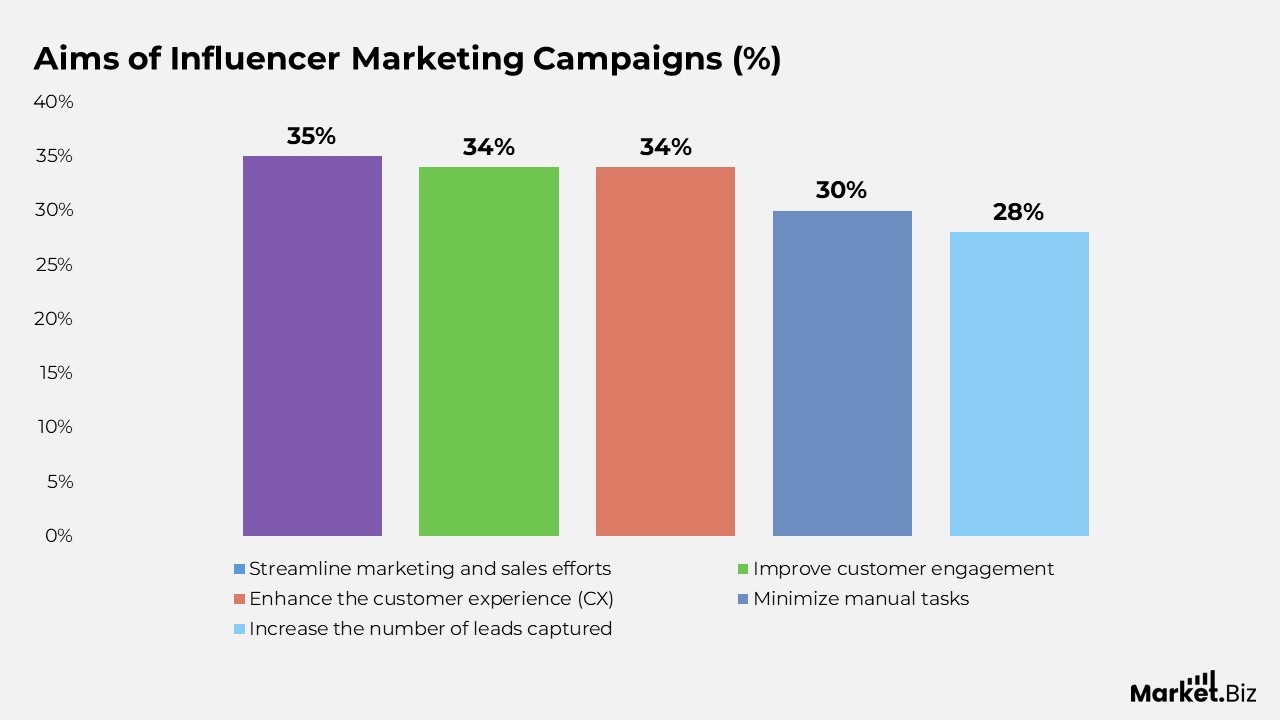
- 35% aim to streamline their marketing and sales processes.
- 34% seek to enhance customer engagement.
- 34% focus on improving the overall customer experience (CX).
- 30% want to reduce manual tasks and increase efficiency.
- 28% strive to boost the number of leads captured.
(Source: The State of Marketing Automation, Oracle)
Top Areas Where Marketers Most Frequently Use Automation
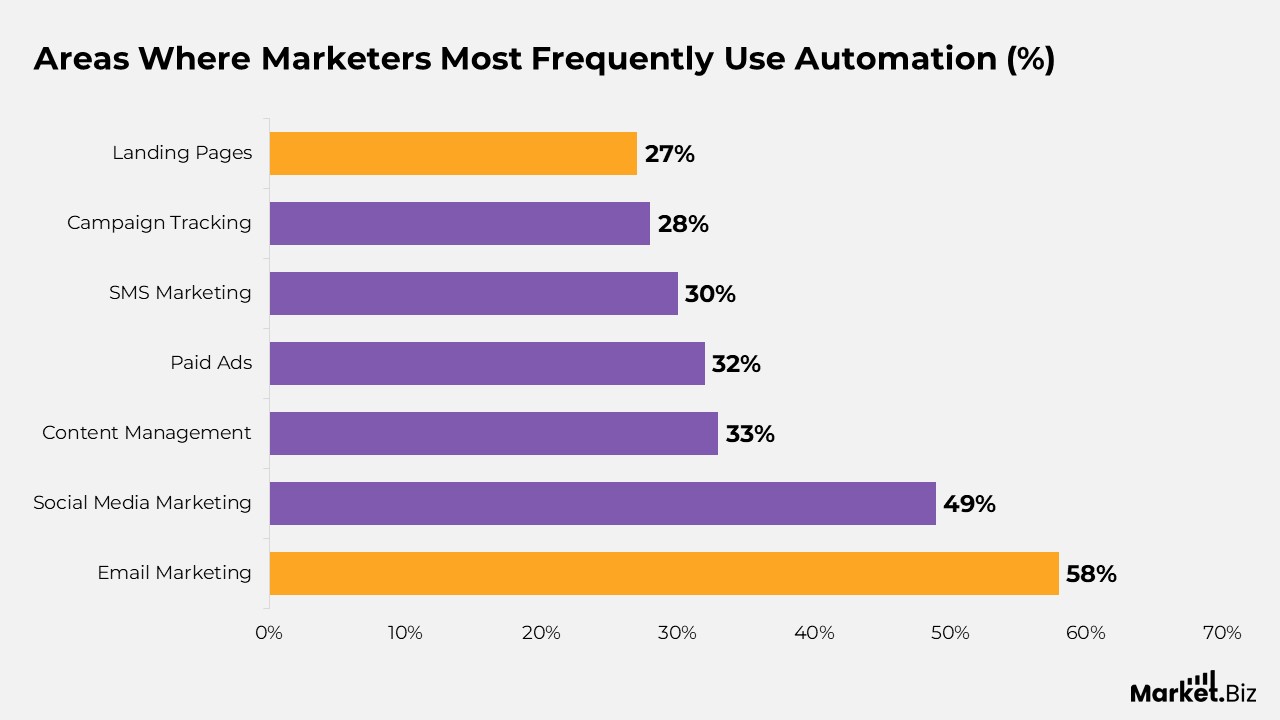
- 58% of marketers use automation to streamline their email marketing campaigns.
- 49% of marketers depend on automation to handle social media marketing tasks.
- 33% of marketers employ automation for managing content-related processes.
- 32% of marketers implement automation to enhance their paid advertising campaigns.
- 30% of marketers utilize automation for their SMS marketing strategies.
- 28% of marketers automate the tracking and analysis of their campaigns.
- 27% of marketers apply automation to create and manage landing page designs.
(Source: Digital Silk, Statista)
Use and Adoption of Marketing Automation
- 9% of marketers have fully automated their customer journey, while 69% have partially or mostly automated their processes.
- 79% of companies incorporate marketing automation into their overall marketing strategy.
- 75% of companies report successfully implementing an automated marketing solution in less than six months.
- Approximately 50% of marketing automation software users began using it in the last four years.
- 25% of marketers used marketing automation for SMS marketing in 2021, reflecting a 7% increase from the previous year.
- The most widely used channel for automation is email marketing, with 63% of marketing specialists utilizing it for their email campaigns.
- 50% of marketing professionals who use automation engage with it daily, while 33.2% use it frequently.
- 65% of professionals consider their marketing automation strategy to be either extremely or very effective.
- 75% of companies utilize one or more marketing automation tools.
- 30% of advertisers leverage marketing automation technology to assess the effectiveness of their digital advertising efforts.
Further,
- 82% of marketers integrate various “best-of-breed” marketing automation technologies into their comprehensive software portfolio, while 18% rely on a single vendor marketing cloud.
- The top 3 most widely used marketing automation techniques are email automation (64%), profiling and targeting (26%), and personalization through dynamic content (23%).
- In a survey, 76% of US workers reported that advanced marketing automation has made their jobs either “much easier” or “somewhat easier.”
- According to a survey by Act-On, 64% of 501 US marketers surveyed use marketing automation for CRM integration and transferring leads to the sales team.
- 94% of advertisers use data from their customer relationship management software to optimize their ad targeting.
- 58% of marketers use marketing automation for upselling purposes.
- Google searches for the term “marketing automation” have reached an all-time high.
- Among marketers employing automation, 23% use it for content delivery.
- In the same survey by Act-On, 48% of respondents are utilizing marketing automation for dynamic landing page creation.
(Source: Campaign Monitor Pty Ltd., WPShout, Hubspot, Ascend2, Zapier Inc., Salesforce, Smart Insights Ltd)
Marketing Automation Market Size
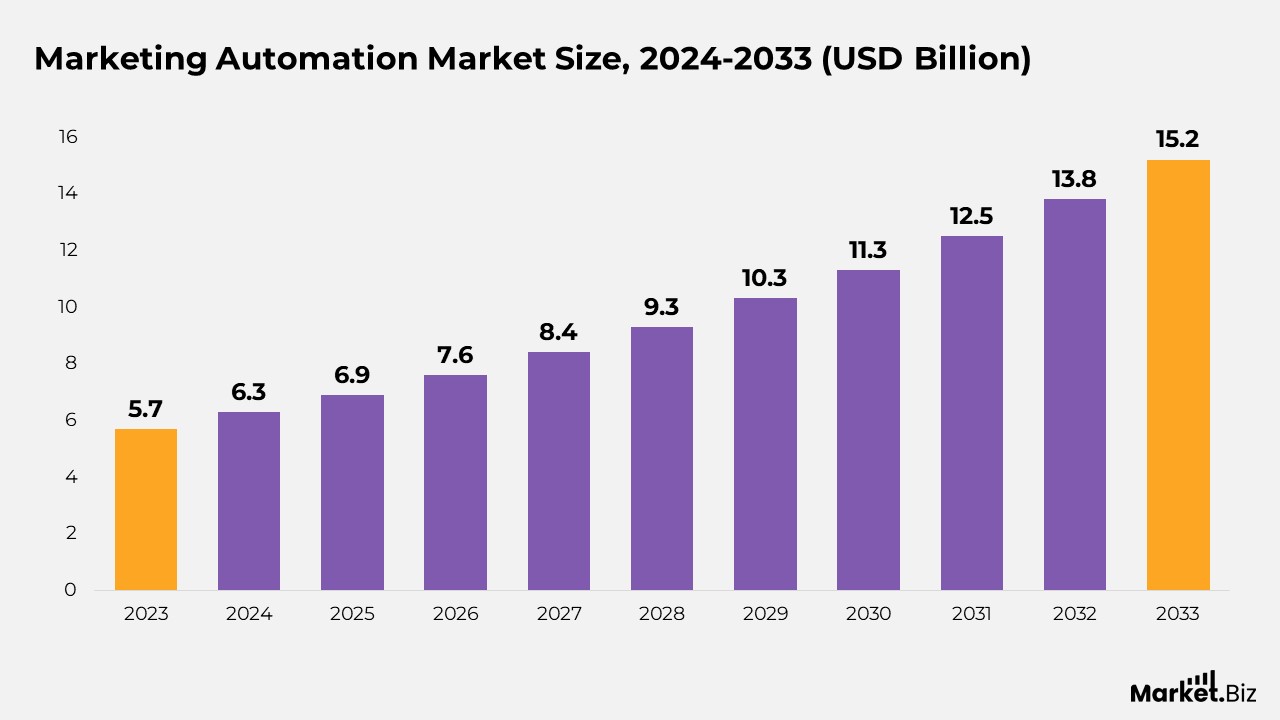
- According to Market.us, the marketing automation market is projected to grow from $6.3 billion in 2024 to $15.2 billion by 2033, representing a compound annual growth rate (CAGR) of 10.3% from 2024 to 2033.
- The marketing automation market is growing due to the increasing demand for automated digital marketing strategies, enabling businesses to save time, reduce resource usage, and achieve better campaign outcomes by streamlining processes and improving efficiency.
- In 2023, the software component segment dominated, capturing over 73.8% of the market share, driven by the widespread adoption of marketing automation tools to optimise marketing efforts and enhance customer interactions across various channels.
- Cloud-based deployment led the By Deployment Mode segment in 2023, securing more than 64.0% of the market share, primarily because of the scalability, flexibility, and cost-effectiveness that cloud solutions offer to organizations of all sizes and industries.
- In 2023, large enterprises held a dominant position in the Organization Size segment, with a share of more than 62.5%, thanks to their capacity to invest in advanced marketing automation platforms that integrate effectively into their large-scale operations and marketing strategies.
- Email Marketing led the application segment in 2023, accounting for more than 29.4% of the market share, owing to its continued success as a primary communication method for both B2B and B2C engagement, and its ability to deliver highly targeted, personalized content.
Further,
- In 2023, the IT and Telecommunications sector held a dominant position in the industry vertical segment, capturing more than 22.1% of the market share, largely driven by the need for sophisticated marketing solutions to engage a technology-savvy audience effectively.
- North America led the global marketing automation market in 2023, holding a significant 37.5% share, valued at approximately USD 2.13 billion, due to a well-established digital marketing ecosystem, a high concentration of industry innovators, and ongoing investments in AI, big data, and advanced analytics.
- According to Search Engine Journal, 4.8 billion people globally use social media, representing 59.9% of the world’s population, highlighting the growing importance of digital marketing platforms where automation is essential for improving engagement and sales performance.
- Marketing automation can lead to a 14.5% increase in sales productivity and a 12.2% reduction in marketing overhead, as it enhances lead nurturing, segmentation, and targeting, while simplifying the overall campaign execution process.
- HubSpot leads the marketing automation software market with a 38.27% share, followed by Adobe Experience Cloud at 7.97% and Oracle Marketing Cloud at 7.37%, due to their comprehensive features, ease of use, and scalability for businesses of varying sizes.
- 80% of marketing automation users have reported an increase in leads, and 77% have experienced higher conversion rates, proving that automation significantly enhances lead generation, nurturing, and overall conversion strategies.
- Businesses that leverage marketing automation tools are 46% more likely to report an effective marketing strategy, as automation empowers them with better insights, optimized processes, and data-driven decision-making, all of which contribute to more targeted and successful campaigns.
(Source: Market.us)
AI in Marketing Market Size
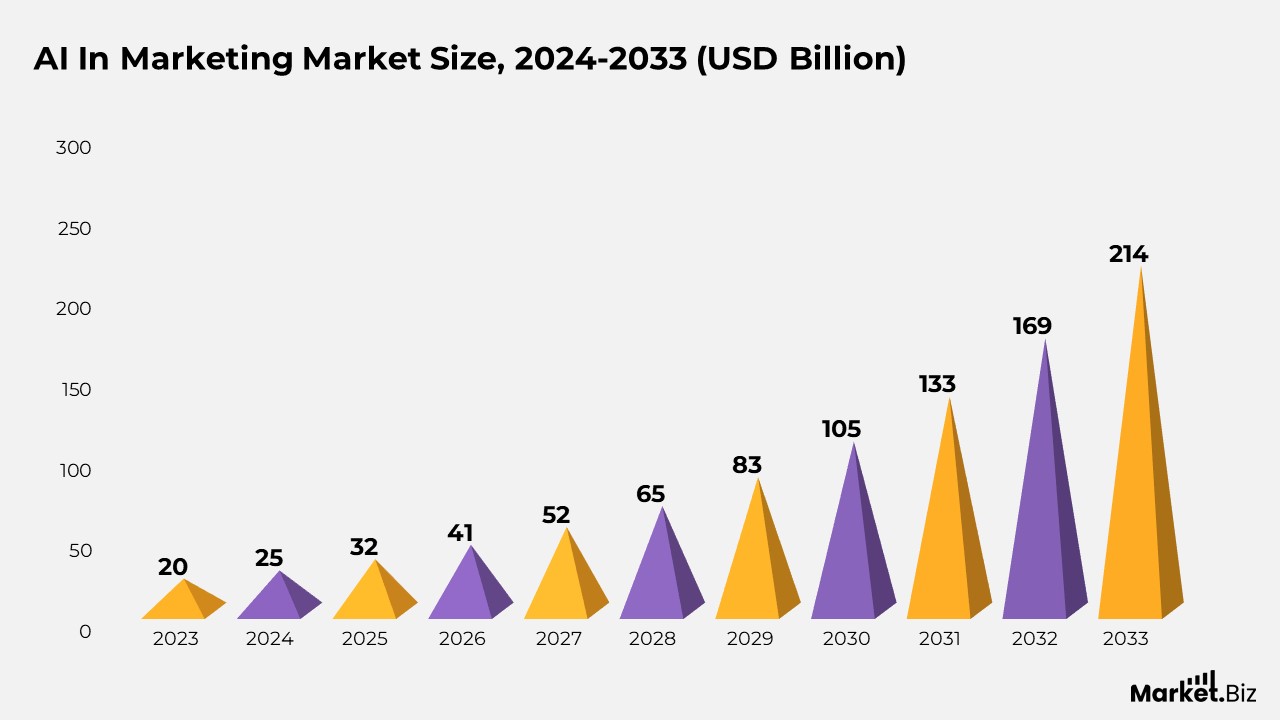
- According to Market.us, the AI in marketing market is projected to grow from $25 billion in 2024 to $214 billion by 2033, representing a compound annual growth rate (CAGR) of 26.7% from 2024 to 2033.
- Technological advancements and the increasing demand for personalized customer experiences drive the growth of the AI in Marketing market.
- In 2023, the software segment dominated the AI in Marketing market, holding more than 65% of the share, due to its crucial role in deploying and utilizing AI technologies in marketing strategies.
- In 2023, the cloud segment captured more than 55% of the market share in AI for marketing, driven by its scalability, flexibility, and cost efficiency, which are ideal for deploying AI technologies.
- In 2023, the Machine Learning segment led the market, accounting for more than 38% of the share, driven by its ability to analyze large datasets and uncover insights and patterns previously unavailable.
Moreover
- In 2023, the Content Curation segment held more than 23% of the AI in Marketing market share, due to the growing demand for high-quality, relevant, and engaging content on digital platforms.
- In 2023, the Media & Entertainment segment also captured more than 23% of the market share, fueled by the industry’s need for engaging content and personalized user experiences.
- In 2023, North America held a dominant market position in AI for marketing, with a 32% share, valued at US$6.4 billion, and is expected to grow significantly due to the region’s leadership in AI development and application.
- According to MailChimp, 50% of marketers identified insufficient adoption of AI technology as a key barrier to achieving marketing objectives, emphasizing the importance of AI in modern marketing.
- A survey by Influencer Marketing Hub found that only 4% of marketers have integrated AI into their operational frameworks. At the same time, IBM’s research indicates that 23% of professionals use AI in their organisations, with 29% utilising AI for natural language processing.
(Source: Market.us)
Customer Service Automation Statistics
- 1% of users have reported utilizing marketing automation specifically for customer retention efforts.
- Omnichannel marketing automation has been shown to achieve a 90% higher customer retention rate compared to single-channel approaches.
- Chatbots enable companies to cut their customer support costs by nearly 30%.
- The majority of customers expect a response to their queries and complaints on social media within 24 hours or less.
- 68% of customer service agents feel overwhelmed by the manual tasks they are required to handle.
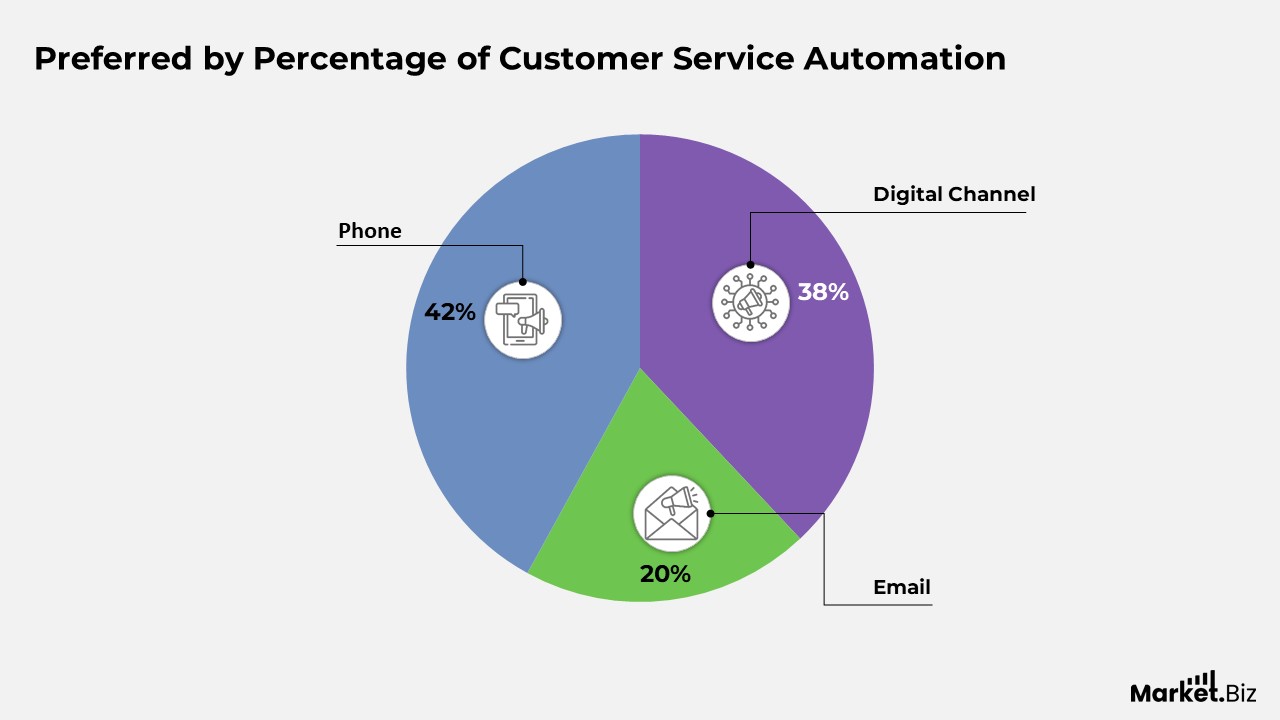
- 42% of customers prefer resolving service issues over the phone rather than other methods.
- 88% of marketers indicated that they would highly value an automation tool that helps reduce the time spent creating reports for customer interactions.
- 38% of customers prefer using digital channels to resolve service-related issues.
- 20% of customers opt for email as their preferred method for addressing service issues.
- 42% of customers favor using the phone to resolve service-related problems.
(Source: DemandSage, Statista)
Email Automation Statistics
- Marketing automation software enables targeted emails, which generate 18 times more revenue.
- 50% of small businesses utilize marketing automation software to send automated email campaigns.
- Triggered emails have an open rate of 38%, while newsletters achieve an open rate of 18.7%.
- Sending personalized and targeted automated emails results in a 46% higher open rate.
- Automated cart abandonment emails see an open rate of 29.64%.
- Welcome emails boast the highest open rates, reaching 86%.
- Businesses using automated emails are 133% more likely to send relevant and targeted messages to their customers.
- 75% of email revenue comes from triggered, personalized email campaigns.
- Triggered emails achieve a 152% higher click-through rate and a 70.5% higher open rate compared to generic newsletters.
- Email automation campaigns are recognized as the fourth most popular tactic for email marketing by companies.
(Source: Statista, DemandSage, email stats, Get Response)
Marketing Automation Return On Investment (ROI) Statistics
- 63% of businesses or marketers expect to see a return on investment (ROI) from marketing automation within 6 months.
- 77% of marketing automation users report an increase in conversions.
- 7 out of 10 marketers find it either easy or somewhat easy to measure the success of their marketing automation efforts.
- 80% of marketing automation users see a significant boost in lead generation.
- 76% of companies experience a return on investment within the first year of using marketing automation software.
- Revenue from email marketing automation is 18 times higher than sending irrelevant bulk emails.
- Engaging prospects through marketing automation leads to a 451% increase in qualified leads by delivering a personalized experience.
- On average, marketing automation can reduce administrative overhead by 3.4%.
- Businesses using marketing automation have reported a 14.5% increase in sales productivity.
- 65% of marketers believe their automation strategy is either extremely or very effective.
- 78% of marketers attribute their increased revenue to marketing automation.
- More than 10% of businesses report a 12.2% reduction in marketing overhead after implementing marketing automation.
- Common metrics used to measure the ROI of marketing automation include unsubscribe rate, open rate, and click-through rate.
(Source: SoftwarePath, Ascend2, Oracle, Marketo, HubSpot, Pepper, inviteReferrals.com)
Machine Learning and Artificial Intelligence (AI) In Marketing Automation
- AI-driven marketing automation enhances campaign efficiency by 35%.
- AI-powered chatbots manage 2.6 billion interactions annually.
- 61% of marketers leverage AI for data-driven personalization within their marketing automation efforts.
- Predictive analytics in automation boosts conversion rates by 30%.
- 87% of AI-driven marketing campaigns report a significant increase in customer engagement.
- AI automation can reduce marketing costs by 20-30%.
- AI-generated content leads to a 25% increase in engagement rates.
- Machine learning-powered automation enhances email targeting accuracy by 40%.
- 60% of marketers believe AI will completely transform their marketing automation strategies within the next five years.
- 70% of marketing teams using AI automation report improved productivity.
- AI-powered recommendation engines drive 35% more revenue in e-commerce.
- 78% of companies using AI-driven marketing automation experience a rise in customer satisfaction.
- AI-based automation improves segmentation accuracy by 45%.
- AI-powered automated copywriting tools boost conversion rates by 27%.
- AI-driven email personalization results in a 32% increase in open rates.
(Source: Salesforce, Adobe, Gartner, Forrester, McKinsey, Statista, HubSpot, Persado, Campaign Monitor, Deloitte, Marketo, PwC, Phrasee, Copy.ai.)
Advantages of Marketing Automation
- 36% of marketers identified handling repetitive tasks as the most important benefit of marketing automation.
- 80% of marketing automation users have experienced enhanced lead generation.
- Marketing automation has boosted 20% of marketers’ overall productivity.
- Video automation has led to a 451% increase in the number of qualified leads.
- Marketing automation contributed to a 14.5% increase in both sales and productivity.
- The implementation of marketing automation resulted in a 12.2% reduction in marketing overhead costs.
- 80% of users experienced a boost in lead generation thanks to marketing automation software.
- 63% of brands reported outperforming their competitors after adopting marketing automation.
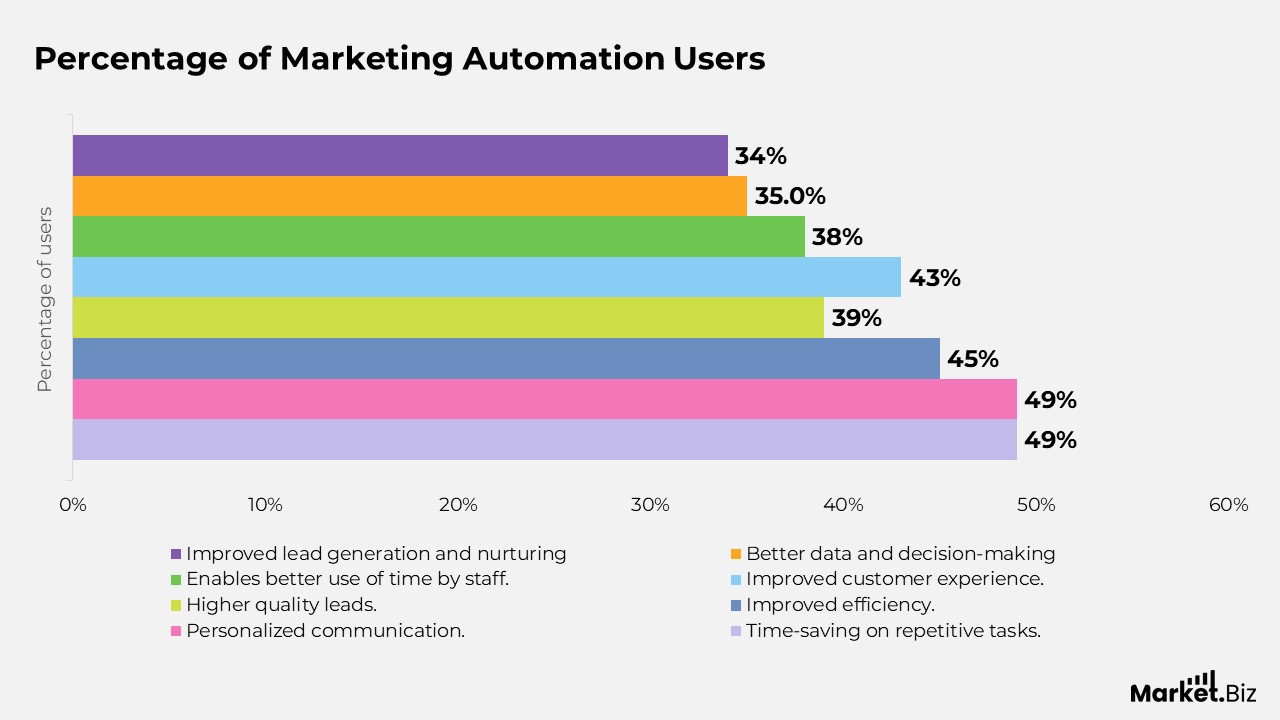
- 43% of users reported an improvement in customer experience thanks to marketing automation.
- 74% of users said marketing automation has helped them save valuable time.
- 77% of users have seen improved conversion rates due to marketing automation.
- 49% of marketers stated that marketing automation enables them to deliver personalized marketing communications.
- B2B marketers using marketing automation saw a 10% growth in their sales pipeline.
- 49% of users save time by automating repetitive tasks.
- 49% of users benefit from personalized communication enabled by automation.
- 45% of users report increased efficiency in their workflows.
- 39% of users observe a rise in the quality of leads generated through automation.
- 43% of users experience an enhanced customer experience with marketing automation.
- 38% of users find that automation helps optimize staff productivity.
- 35% of users gain better data insights, leading to more informed decision-making.
- 34% of users see improvements in lead generation and nurturing through automation.
(Source: Statista, DemandSage, Digital Silk)
Challenges in Marketing Automation Implementation
- 54% of marketers believe they are not fully utilizing the marketing automation tools they have.
- 26% of users are uncertain whether they are maximizing the potential of their marketing automation tools and software.
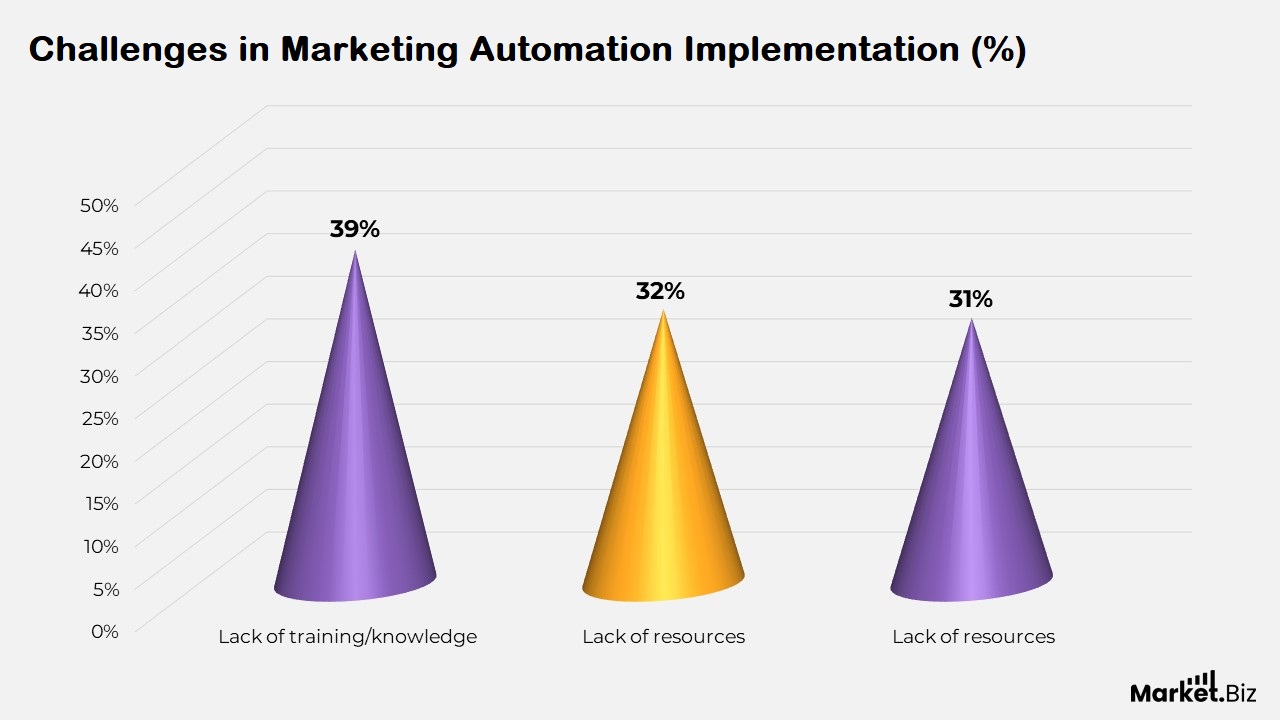
- 39% of businesses cited the lack of training and knowledge as the primary barrier to effectively using marketing automation tools.
- 25% of marketers identified the complex setup process of automation as the major challenge.
- 33% of companies stated that a lack of experience is the most significant hurdle in implementing business automation.
- 24% of companies reported that giving low priority to marketing automation was their main issue.
- 39% of businesses encounter difficulties due to a lack of proper training and knowledge when using marketing automation tools.
- 32% of businesses face challenges because of limited resources while implementing marketing automation.
- 31% of businesses cite insufficient budget as a major barrier to effectively utilizing marketing automation.
- 20% of marketers reported that the systems they use are too complex to implement marketing automation effectively.
- 16% of businesses find creating high-quality automation a significant challenge.
- The following table outlines the barriers faced by companies when implementing marketing automation:
| Barrier | Percentage of Businesses Facing It |
|---|---|
| Lack of expertise | 33% |
| Insufficient data | 24% |
| Lack of priority | 24% |
| Missing budget | 23% |
(Source: Statista, DemandSage)
Conclusion
Marketing automation is transforming the way businesses manage their marketing efforts, enhancing efficiency, personalization, and cost-effectiveness. Statistics show that most companies using marketing automation see notable improvements in lead generation, customer engagement, and conversion rates.
The integration of AI and machine learning further enhances these outcomes by improving targeting precision, personalization, and overall campaign success. As more companies adopt automation tools, they gain the ability to streamline operations, cut down on marketing expenses, and offer more customized experiences, providing a distinct competitive edge.
With clear returns on investment reflected in higher sales productivity and increased customer satisfaction, marketing automation is now a crucial tool for businesses aiming to thrive in the digital age.
FAQ’s
Marketing automation refers to the use of technology and software to automate repetitive marketing tasks such as social media management, email campaigns, and lead generation. It is essential because it boosts efficiency, minimizes manual work, enables personalized marketing strategies, and improves overall campaign performance, resulting in a higher return on investment (ROI).
Marketing automation plays a significant role in enhancing lead generation, with 80% of users reporting increased lead generation. It allows marketers to capture, nurture, and convert leads more effectively by providing timely, relevant content tailored to potential customers.
AI is pivotal in marketing automation by enhancing personalization and improving targeting accuracy. It automates tasks such as content recommendations, lead scoring, and customer segmentation. AI-driven campaigns are proven to boost customer engagement, increase conversion rates, and enhance lead quality.
Marketing automation can reduce marketing costs by 20-30%, as it helps eliminate inefficiencies, minimizes manual tasks, and optimizes the allocation of resources. It allows marketers to focus on high-impact activities while automating routine processes.
Key benefits of marketing automation include enhanced lead generation (80% of users), better customer engagement (87% of AI-driven campaigns), improved time management, more effective data-driven decision-making, and increased sales productivity.
Marketing automation enhances customer experience by automating personalized communication and responding promptly to customer needs. This results in a consistent and tailored experience across multiple channels. 43% of users cited improved customer experience as one of the primary benefits of marketing automation.

