









Introduction
Bard Statistics: Bard has garnered considerable attention for its application across various fields, including data, machine learning, science, and advanced analytics. This specialized branch of statistics is dedicated to developing methods that facilitate the understanding and analysis of large datasets, ensuring precise interpretations and forecasts.
Bard Statistics is particularly recognized for its focus on robust statistical techniques, model development, and the integration of intricate data structures. By blending traditional and cutting-edge approaches, it effectively tackles the challenges presented by modern data analysis.
Positioning itself as an essential tool for researchers and professionals seeking to derive valuable insights from expansive datasets. Its impactful applications play a crucial role in enhancing decision-making processes in industries such as healthcare, finance, and technology..
Editor’s Choice
- 1 in 8 people around the globe use Google Bard.
- Monthly visitors to Bard have surpassed 142 million.
- Google Bard is accessible in over 230 countries and territories worldwide.
- The chatbot is now available in more than 43 languages, including Hindi, Korean, Arabic, Chinese, and Spanish.
- The user base of Google Bard is made up of 60% males and 40% females.
- The age group of 25 to 34 years accounts for 35% of Bard’s users, with the 18 to 24 age group being the second-largest.
- The highest traffic to Google Bard comes from the United States, which accounts for 37.24% of its visits, followed by India with the second-highest traffic.
- The estimated cost per search query on Google Bard ranges from $0.006 to $0.031, based on available calculations and estimates.
- Direct traffic makes up over 76% of Bard’s overall traffic, while organic traffic accounts for 16.77%.
- Google Bard averaged 142.4 million monthly users in 2023.
- At the time of Bard’s launch, 62.6% of its users were from the United States.
- Bard’s user demographics consist of 40% females and 60% males.
- Around 40% of users search topics they are interested in while using Google Bard.
- Each search on Google Bard costs users between $0.006 and $0.031.
- The Infiniset dataset used by Google Bard contains 1.56 trillion words.
- 50% of Google Bard’s training dataset is derived from dialogue data from public forums.
- The United States accounts for the largest portion of global traffic to Google Bard, contributing 21.66%.
- Google Bard is accessible in more than 180 countries and territories.
- In May 2023, 380,567 devices were responsible for sending traffic to Google Bard.
Shift from Bard to Gemini
- Google introduced Gemini, initially known as Bard, on February 6, 2023. This chatbot uses generative AI technology and is powered by Google’s LaMDA language model, designed to engage users in natural dialogue.
- In March 2023, Google offered early access to Gemini, inviting users in the U.S. and the UK to join a waitlist for a preview of Bard’s capabilities.
- Bard captured attention at Google’s I/O keynote in May 2023, where Sundar Pichai and his team unveiled key updates, including the use of PaLM 2, better integration with Google products and third-party apps, expansion into 180 countries, support for more languages, and various new features.
- Google officially launched Bard on February 8, 2023, and the broader rollout began on March 21, 2023.
- In December 2023, Google introduced a new AI model called Gemini, claiming it to be the most advanced AI model they’ve created. They integrated a version of Gemini Pro into Bard and planned the release of Gemini Ultra to fund Bard Advanced in 2024.
- On February 8, 2024, Duet AI and Bard were merged under the Gemini brand. A new mobile app for Android was launched, and Bard was integrated into the Google app on iOS devices.
Moreover
- The stable release of Google Gemini occurred on May 21, 2024, making it widely available a few months ago.
- The name Bard is inspired by ancient Celtic bards, renowned for their skills as poets, storytellers, musicians, and historians.
- Google Gemini’s AI is based on the LaMDA model (Language Models for Dialog Applications), which has been enhanced using Transformer-based neural networks and comprises up to 137 billion parameters.
- Google has been developing LaMDA since 2017, making Bard a project with over six years of continuous development and innovation.
- The language model was pre-trained using over 750 GB of diverse data from sources like the web, books, and user-generated content, such as search queries and translations. Specific training datasets remain largely undisclosed.
- Gemini’s training dataset includes 1.56 trillion words from publicly available sources.
- In June 2024, Google extended the Gemini Android application to European markets and broadcasted plans to add new features, including support for Spotify and functionalities for setting timers and reminders.
(Source: Meetanshi Technologies LLP, Tech Target)
Natural Language Processing Market Size
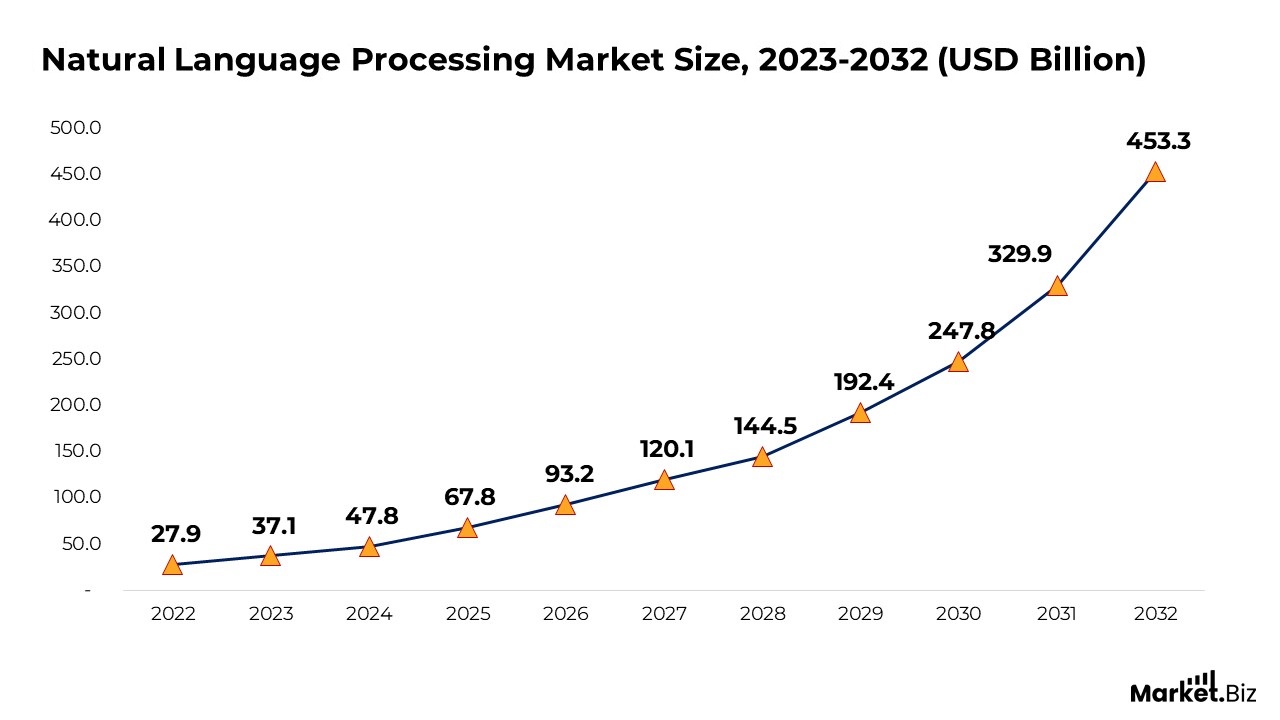
- According to Market.us, the natural language processing market is expected to rise from $37.1 billion in 2023 to $453.3 billion by 2032, representing a compound annual growth rate (CAGR) of 33.1% from 2023 to 2032.
- The market is expanding due to the growing adoption of NLP technologies, the need for enhanced data handling, and advancements in machine learning and AI.
- In 2022, the statistical NLP segment led the market with a 39.3% share, driven by its efficiency in processing vast datasets for various applications.
- In 2022, the solution segment dominated the NLP market with a 72.6% share, driven by the increasing use of NLP solutions to enhance operational efficiencies and customer engagement.
- In 2022, the on–premises segment held a significant share in the NLP market, driven by the enhanced security and control it offers to organizations, especially in sensitive sectors like finance, healthcare, and government.
- In 2022, the automatic summarization segment dominated the NLP market due to the rising demand for tools that condense lengthy texts into concise summaries for better decision-making.
- In 2022, the large enterprises segment captured more than 62.1% of the NLP market, benefiting from operational needs and technological capabilities suited to large organizations.
- In 2022, the healthcare segment dominated the NLP market with a 23.1% share, fueled by the growing need for improved patient care and operational efficiency.
- In 2022, North America held the largest market share in NLP, with over 30.7%, generating approximately USD 8.56 billion in revenue, supported by advancements in AI and the presence of major tech companies.
(Source: Market.us)
General Bard Statistics
- Google Bard people typically navigate over 5.54 pages per official visit.
- 88.4% of Google Bard’s traffic comes from mobile devices, highlighting its mobile-first usage.
- News is the maximum popular topic among Google Bard users.
- Google Bard has a 55.10% bounce rate, meaning 55.10% of visitors leave the site after viewing just one page.
- 56.31% of Google Bard’s social traffic originates from YouTube, showcasing its integration with social media platforms.
- The average visit duration on Google Bard is 6 minutes and 32 seconds, indicating solid user engagement.
- A notable 81.4% of Google Bard traffic comes from direct sources, reflecting strong brand recognition and user loyalty.
- On average, visitors browse 2.65 pages per visit on Google Bard.
- In 2024, approximately 1 in 8 people worldwide were using Google Bard for search queries.
- A demonstration error cost Google $120 billion when Bard gave incorrect information about the James Webb Telescope during a live preview.
- Google Bard’s language model was trained using 12.5% data from Wikipedia and 12.5% from public datasets.
Moreover
- The platform provides multiple response options for a single prompt, offering users a variety of answers.
- The United States generates the highest traffic for Google Bard, accounting for 37.24%, followed by India.
- Google Bard can provide answers in various formats, whether comprehensive or concise.
- Google Bard performs real-time searches as users type their prompts or queries.
- 35% of Google Bard users are aged between 25 and 34, followed closely by the 18 to 24 age group.
- 76% of the traffic on Google Bard is direct, while 16.77% comes from organic search, showing a significant amount of users access it directly or through search engines.
- Installing the Google Bard AI Chrome extension allows users to receive conversational responses alongside standard Google search results.
- The platform is designed to answer open-ended, strange, or difficult questions in any format.
- The platform can assist with creating letters, musical compositions, scripts, poems, and code in various text formats.
- Google Bard is capable of generating code in over 20 programming languages.
- Bard also offers code debugging capabilities to help users with error identification and fixes.
- Google Bard is considered reliable and safe to use.
(Source: Statista, Enterprise Apps Today, DemandSage)
Bard Traffic Statistics
- In June 2023, Google Bard recorded 140.6 million visits, slightly lower than the 142.6 million visits in May 2023.
- On average, users accessed 2.56 pages per visit on Google Bard.
- The bounce rate for Google Bard is 55.10%.
Google Bard Traffic – by Country
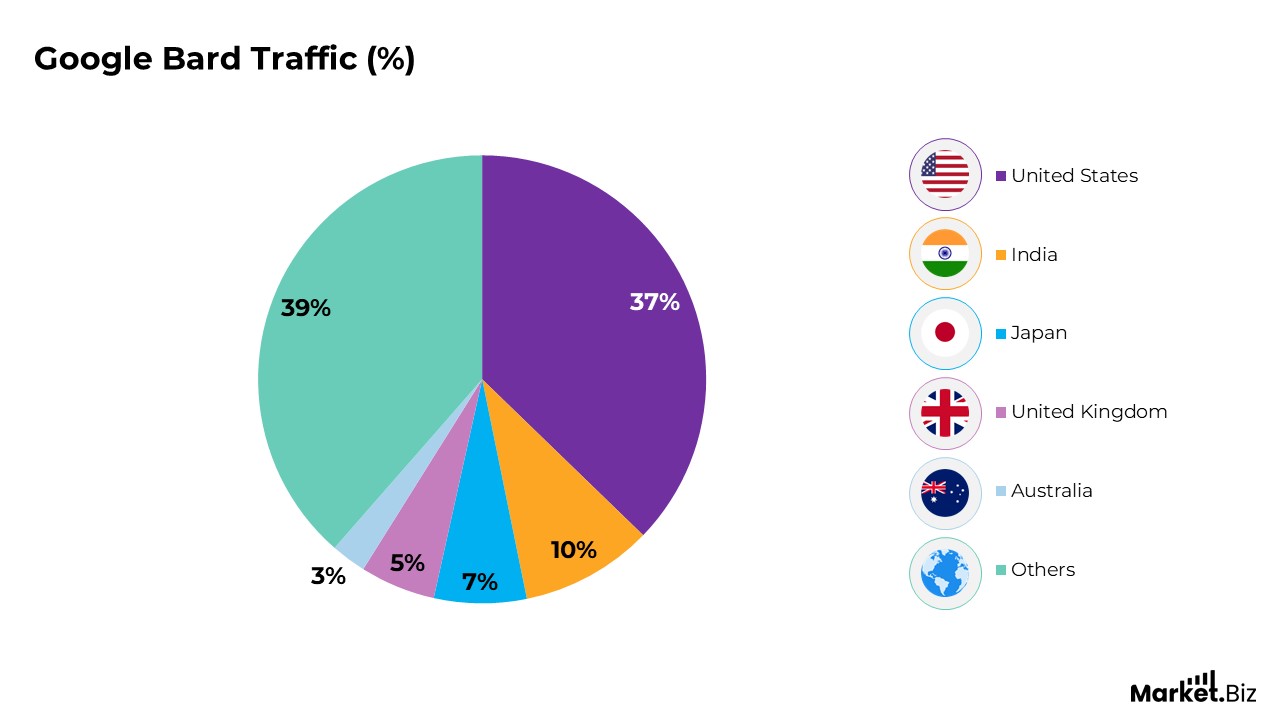
- The United States accounted for the largest share of traffic to Google Bard, contributing 37.24% of total visits.
- India is the second-largest contributor, with 9.56% of the traffic directed to Google Bard.
- Japan contributed 6.67% of the total traffic to Google Bard.
- The United Kingdom directed 5.44% of the traffic to Google Bard.
- Australia accounted for 2.53% of the traffic to Google Bard.
- The remaining 38.56% of the traffic came from other countries.
Bard Traffic – by Source
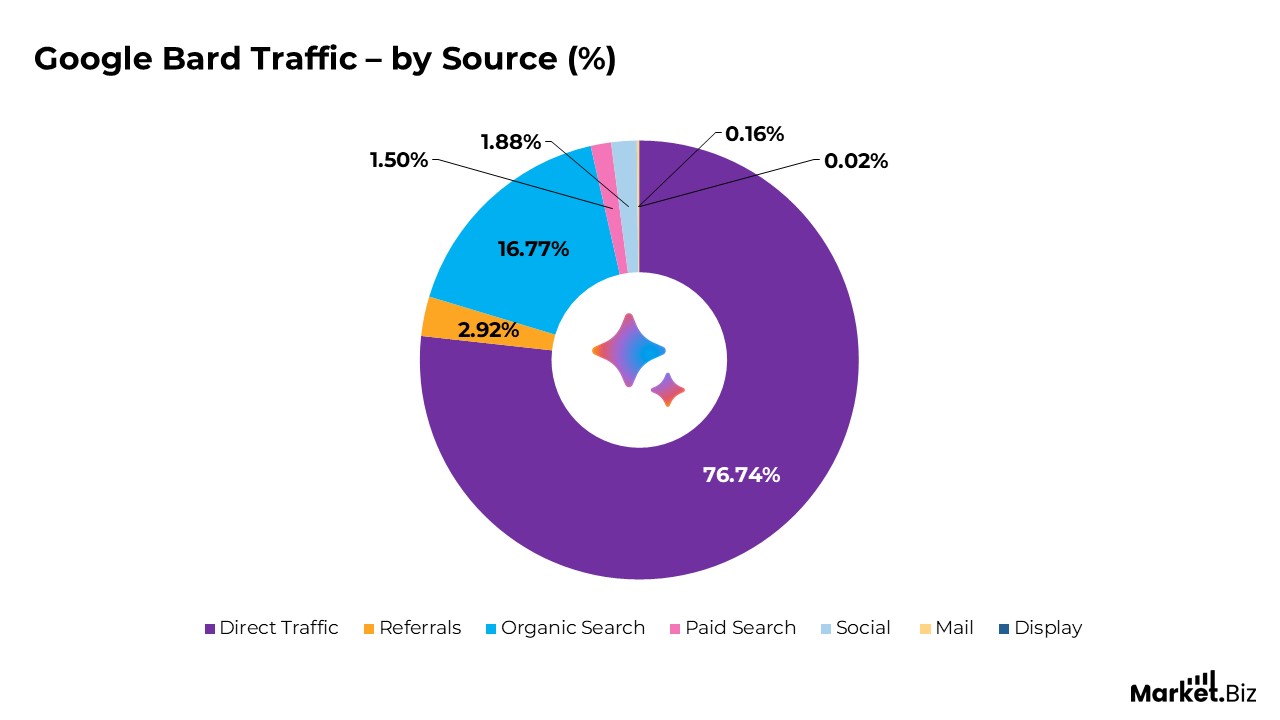
- 76.74% of the traffic to Google Bard originates from direct sources.
- 16.77% of the traffic is sourced from organic search.
- 2.92% of the traffic comes from referrals.
- 1.50% of the traffic is driven by paid search.
- 1.88% of the traffic is generated via social channels.
- 0.16% of the traffic is from mail.
- 0.02% of the traffic is attributed to display ads.
Google Bard Traffic – by Social Platforms
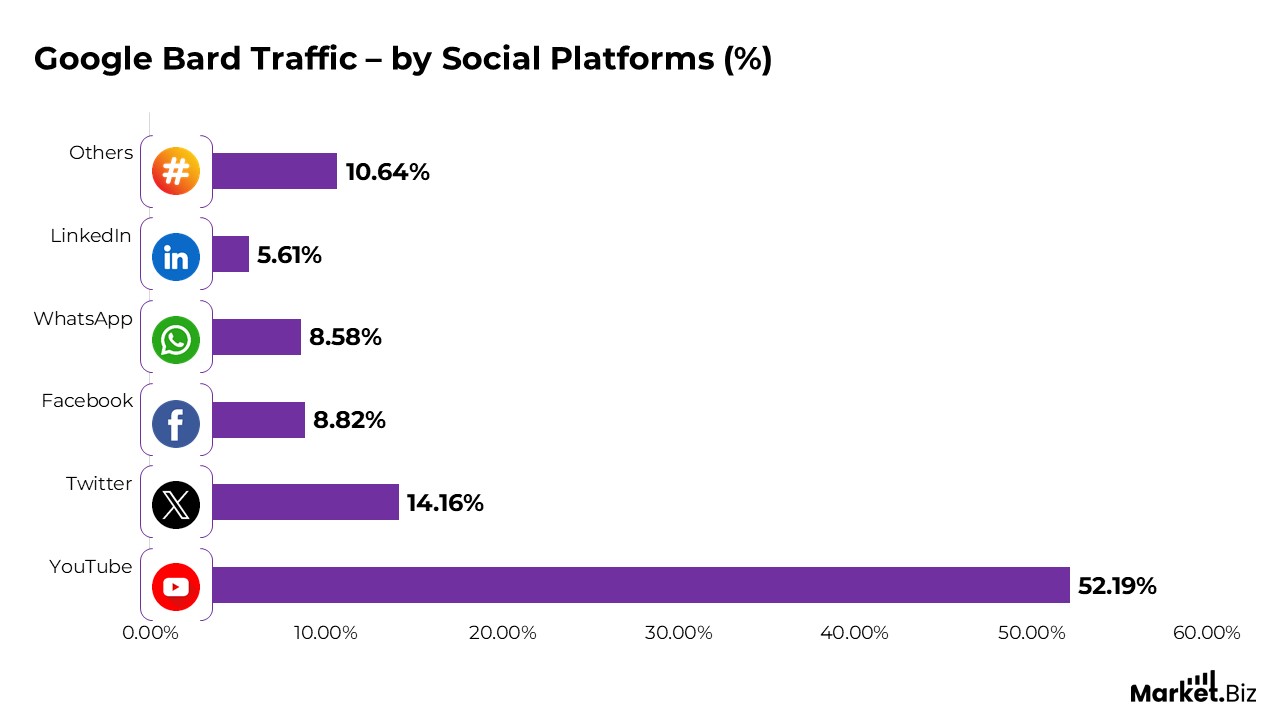
- YouTube drives 52.19% of the traffic to Google Bard.
- 14.16% of the traffic comes from Twitter.
- 8.82% of the traffic is sourced from Facebook.
- 8.58% of the traffic originates from WhatsApp.
- 5.61% of the traffic is attributed to LinkedIn.
- 10.64% of the traffic is directed from other social media platforms.
(Source: Statista, DemandSage, SimilarWeb, Reuters)
Google Bard Usage Statistics
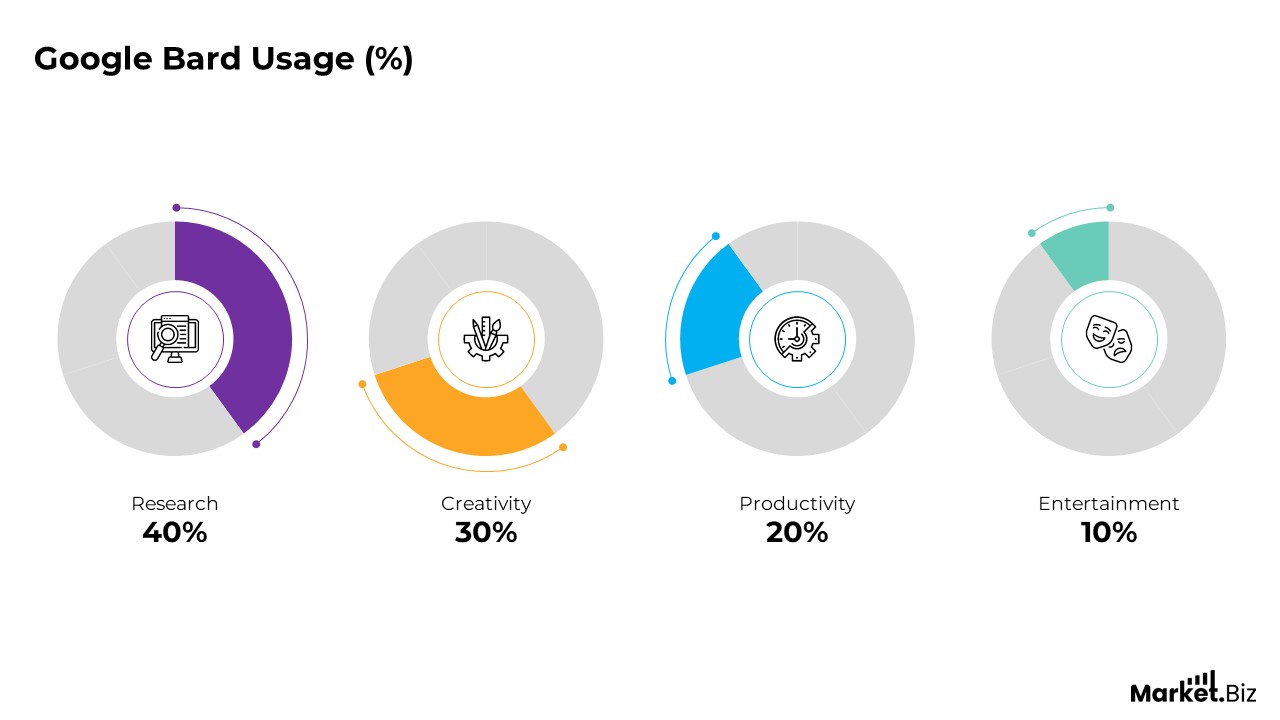
- 40% of users turn to Google Bard to search for topics of interest, amounting to 57.04 million people.
- Around 30% of Bard users utilize the platform for content creation, such as writing poems, scripts, and stories, which equals 42.78 million users.
- 20% of users use Google Bard for work or studies, which accounts for 28.52 million users.
- 10% of users use Bard for entertainment purposes, such as watching videos, listening to music, or gaming, which equals 14.26 million users.
- Google Bard is currently available in 43 languages, though it operates in over 180 countries.
- 40% of users use Google Bard to research topics they are interested in, which corresponds to 57.04 million users.
- 30% of users engage with Google Bard for creative activities like writing poems and scripts, totaling 42.78 million users.
- 20% of users turn to Google Bard for academic or work-related tasks, amounting to 28.52 million users.
- 10% of users use Google Bard for entertainment, including watching videos, listening to music, and gaming, which makes up 14.26 million users.
(Source: ML Yearning, answeriq, Semrush, Similar Web.)
Google Bard Cost
- The estimated cost per query on Google Bard is $0.003 per inquiry, with an additional charge ranging from $0.003 to $0.028 for each search.
- According to Morgan Stanley, Google would need to spend $1.2 billion for every 10% of queries that generate 50-word responses through AI.
- For 10% of AI-handled queries:
- Generating 25 words costs $0.6 billion.
- Generating 50 words costs $1.2 billion.
- Generating 75 words costs $1.8 billion.
- Generating 100 words costs $2.4 billion.
- For 20% of AI-handled queries:
- Generating 25 words costs $1.2 billion.
- Generating 50 words costs $2.4 billion.
- Generating 75 words costs $3.6 billion.
- Generating 100 words costs $4.8 billion.
- For 30% of AI-handled queries:
- Generating 25 words costs $1.8 billion.
- Generating 50 words costs $3.6 billion.
- Generating 75 words costs $5.4 billion.
- Generating 100 words costs $7.2 billion.
- For 40% of AI-handled queries:
- Generating 25 words costs $2.4 billion.
- Generating 50 words costs $4.8 billion.
- Generating 75 words costs $7.2 billion.
- Generating 100 words costs $9.6 billion.
- For 50% of AI-handled queries:
- Generating 25 words costs $3 billion.
- Generating 50 words costs $6 billion.
- Generating 75 words costs $9 billion.
- Generating 100 words costs $12 billion.
(Source: ML Yearning, answeriq, Reuters, Semrush, Similar Web)
Conclusion
This data underscores Google Bard’s pivotal role in shaping the future of AI-driven search and user interaction. By effectively integrating advanced technologies like NLP and machine learning, the platform addresses a wide range of user needs across various industries.
Bard’s focus on seamless integration with both Google products and third-party apps enhances its value, establishing it as a powerful entity in the generative AI field. As adoption of this technology continues to grow, its ability to boost brand recognition and transform digital experiences becomes increasingly clear.
Moreover, Bard’s continuous improvements and its expansion into new regions and languages are likely to reinforce its position as a leading force in the AI domain.
FAQ’s
Google Bard is a generative AI chatbot built on Google’s LaMDA language model. It is designed to facilitate natural conversations with users, delivering insightful and relevant responses on a wide range of topics. The platform employs advanced natural language processing (NLP) technologies to improve user interactions.
Google Bard was first introduced on February 6, 2023. After an initial limited release, the platform became more widely available on March 21, 2023, initially to users in the U.S. and the UK.
Approximately 88.4% of the traffic to Google Bard comes from mobile devices, highlighting the platform’s popularity among smartphone users.
Google Bard has a bounce rate of 55.10%, meaning that just over half of visitors leave after viewing a single page, which may indicate that some users do not find what they were seeking in their first interaction.
More than half (56.31%) of the social traffic to Google Bard comes from YouTube, indicating strong integration between the platform and popular social media channels to boost user interaction.