









Introduction
Data Breaches Statistics: In recent years, data breaches have emerged as a major threat to both businesses and individuals. As the digital world grows, the frequency, scale, and impact of these breaches have surged, resulting in significant financial, reputational, and legal repercussions for organizations. The number of data breaches hit record highs, compromising millions of sensitive records.
This increase can be attributed to several factors, including rising cybercrime, inadequate data security practices, and the growing sophistication of hacking techniques. Data from cybersecurity experts reveal a notable rise in breaches within the healthcare, financial, and retail industries.
As the fallout from these breaches intensifies, it has become increasingly important for both businesses and consumers to understand the trends and scope of these incidents. This introduction will explore the latest statistics and developments, offering insights into the evolving landscape of data breaches and their wide-reaching effects.
Editor’s Choice
- The average cost of a data breach hit a record high of US$4.88 million in 2024, reflecting a 10% increase from the previous year.
- Nearly 46% of all data breaches include the exposure of customer personally recognizable information (PII), which includes data such as tax IDs, emails, phone numbers, and home addresses.
- On average, organizations take 204 days to detect a data breach and 73 days to contain it.
- In 2023, the cost of breach notifications climbed to US$370,000, marking a 19.4% rise compared to 2022.
- Cyberattacks leveraging stolen or compromised credentials saw a 71% year-over-year increase.
- A significant 74% of all data breaches are credited to human factors.
- 12% of employees took sensitive intellectual property with them when leaving their organization, including customer data, employee details, health records, and sales contracts.
- 98% of organizations have at least one third-party vendor that has experienced a data breach.
- 61% of organizations are utilizing some form of security AI and automation in their operations.
(Source: National Cybersecurity Center of Excellence, National Institute of Standards and Technology, Semrush Inc., Estuary)
Cost of A Data Breach
- The average total cost of a data breach is $4.88 million.
- The per-record cost for a data breach is $165, which is one dollar higher than in 2022.
- Healthcare breach costs decreased by 10.6% to $9.77 million in 2024.
- Healthcare data breaches have been the most expensive for 14 years in a row.
- In 2023, detection and escalation accounted for the largest share of breach costs, at an average total cost of $1.58 million.
- The average cost of a breach lasting more than 200 days is $5.46 million.
- 51% of the costs are incurred in the first year following a data breach.
- In 2024, the United States had the highest average total cost for a data breach, at $9.36 million, followed by the Middle East at $8.75 million.
- The cost of a mega-breach, involving 50 to 60 million records, is $375 million in 2024, an increase of $43 million from 2023.
- Following a breach, hospitals spend 64% more on advertising in the two years after the breach.
- Phishing remains a costly initial attack vector, with an average cost of $4.88 million in 2024, slightly down from the previous year.
- Organizations with a high level of noncompliance face an average cost of $5.05 million, which is 12.6% higher than average.
(Source: Varonis, International Business Machines Corporation, American Journal of Managed Care)
Cyber Security Market Size
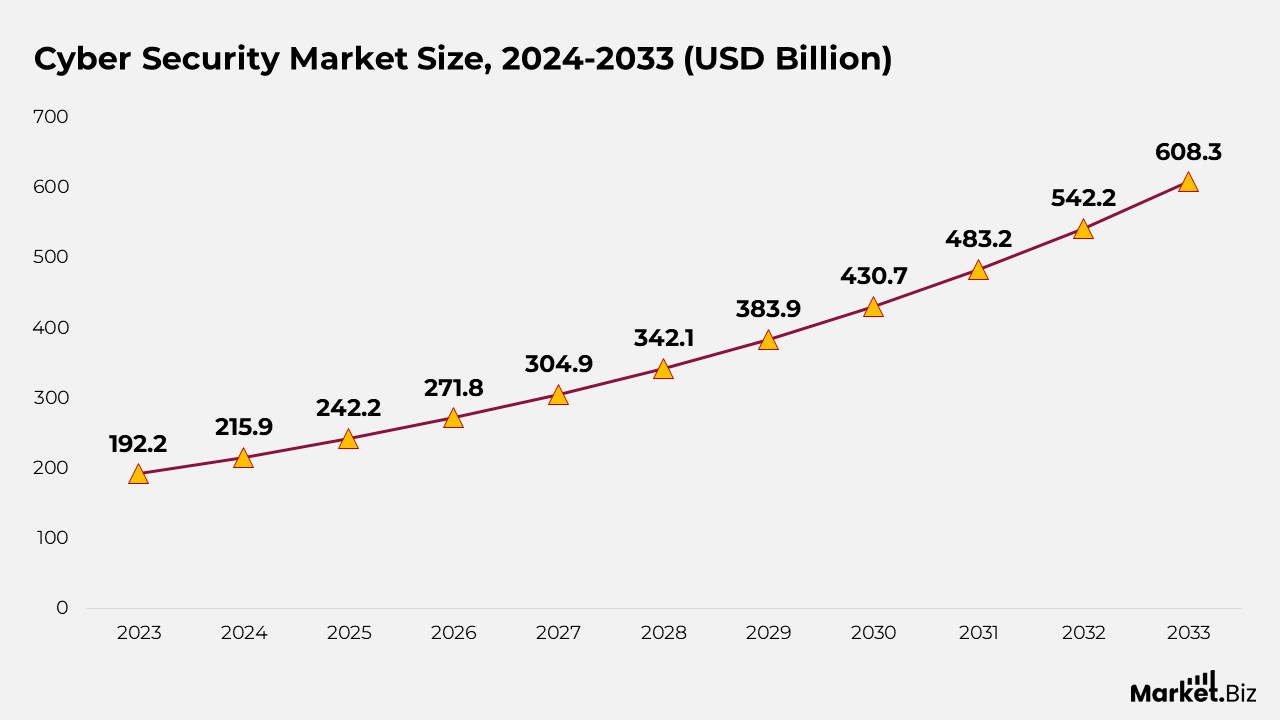
- According to Market.us, the cybersecurity market is projected to grow from $215.9 billion in 2024 to $608.3 billion by 2033, representing a compound annual growth rate (CAGR) of 12.2% from 2024 to 2033.
- The growth of this market is driven by the growing sophistication of cyber threats, which compels constant advancements and informs the development of security technologies. Government compliance and regulations value that mandate improved data protection measures.
- In 2023, the Solutions segment led the cybersecurity market with an over 57.6% share, driven by increasing demand for firewalls, antivirus, IDS, and encryption.
- In 2023, the On-premises segment held a dominant 62.4% market share, appealing to organizations seeking high control and data privacy.
- In 2023, the Network Security segment captured over 30% of the market, driven by a rise in cyber threats targeting enterprise networks.
- In 2023, large enterprises held a significant 69.2% share of the cybersecurity market, supported by substantial resources for advanced security solutions.
- In 2023, the BFSI sector dominated the cybersecurity market with a 25% share, driven by the critical need to protect sensitive financial data.
- In 2023, North America led the cybersecurity market with a 36.8% share and USD 70.8 billion in revenues, driven by top cybersecurity firms and innovation.
(Source: Market.us)
Healthcare Cybersecurity Market Size
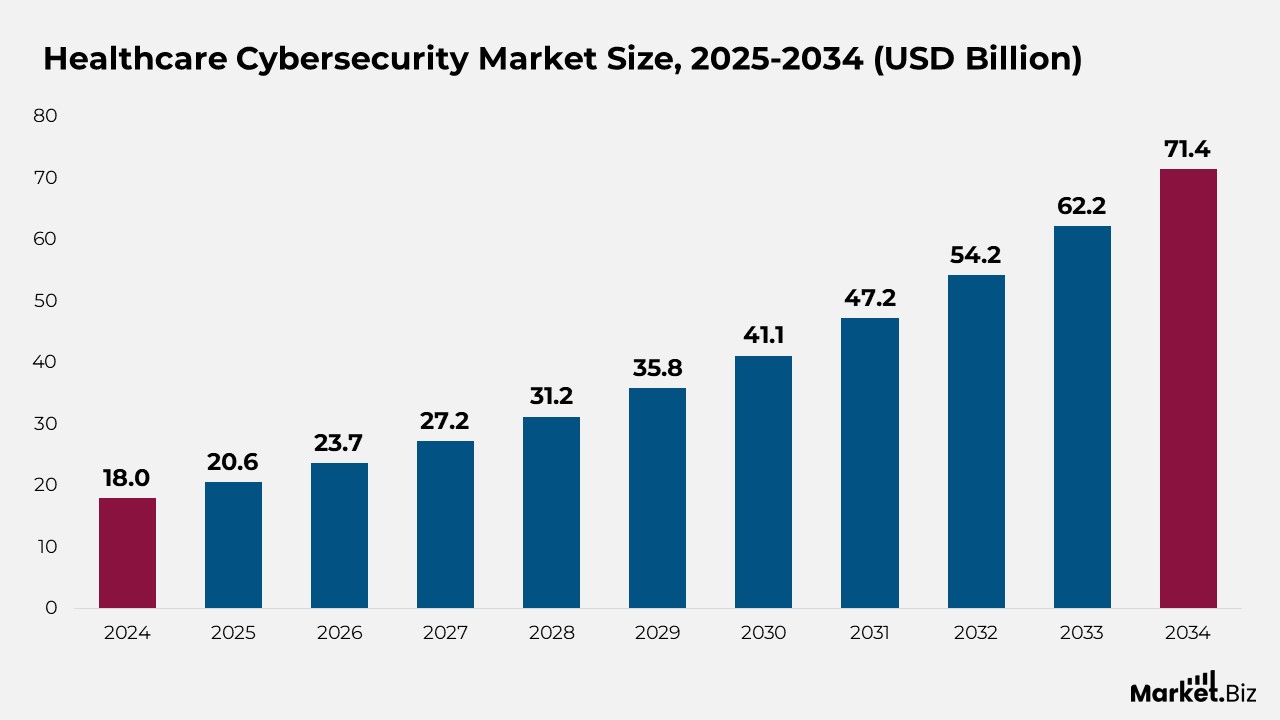
- According to Market.us, the healthcare cybersecurity market is probable to grow from $20.6 billion in 2025 to $71.4 billion by 2034, representing a compound annual growth rate (CAGR) of 14.8% from 2023 to 2032.
- The growth of the healthcare cybersecurity market is driven by increasing healthcare data breaches, rising adoption of IT solutions, and demand for cloud-based security.
- The Services segment dominated in 2024 with a market share of 55.6%, driven by the demand for managed security services in healthcare.
- Identity and Access Management (IAM) holds the largest market share of 19.7% in 2024, crucial for protecting sensitive patient data.
- Malware remains the dominant threat in the healthcare cybersecurity market, holding 25.9% of the market share in 2024.
- Network Security is the leading segment, accounting for 30.5% of the market share in 2024, essential for securing interconnected healthcare networks.
- Cloud-Based deployment dominates with 56.8% of the market share in 2024, fueled by the healthcare industry’s shift to cloud computing.
- Hospitals are the dominant end-user segment, with 40.2% market share in 2024, being prime targets for cyberattacks.
- North America led the healthcare cybersecurity market in 2023 with a market share of 30%, driven by rising cyber threats and digitalization in healthcare.
(Source: Market.us)
Data Breaches by the Numbers
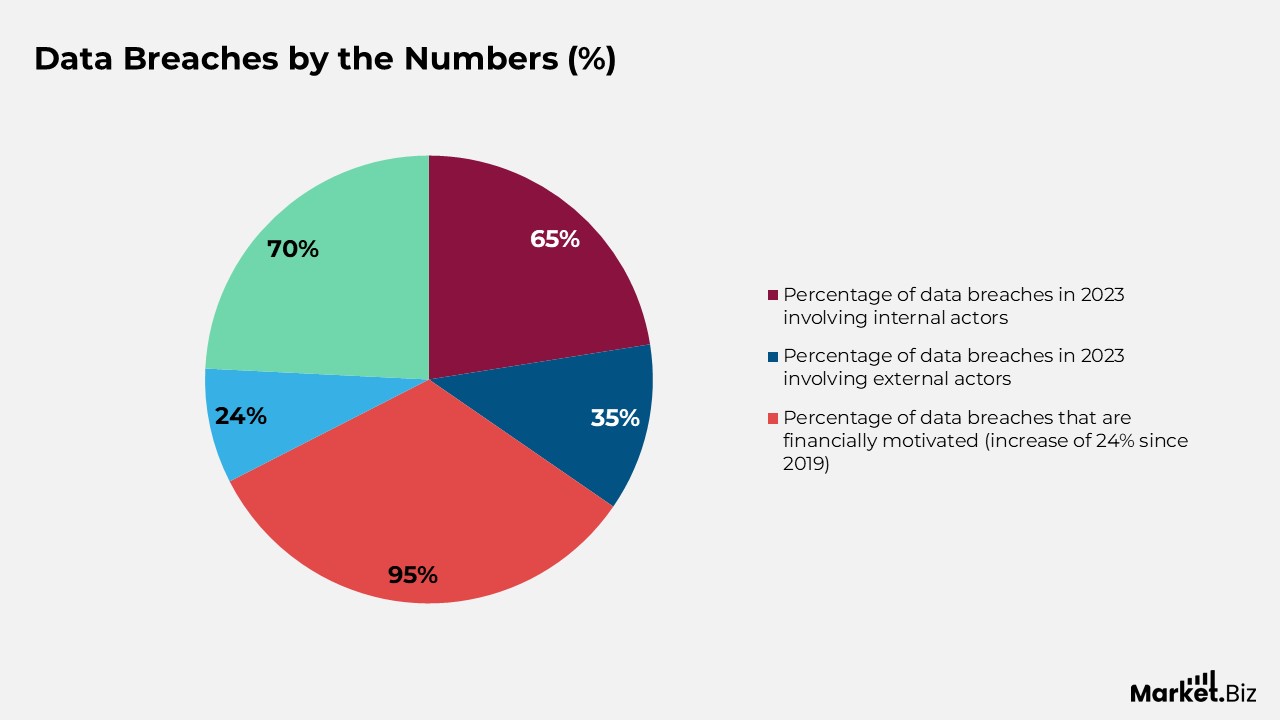
- 65% of data breaches in 2023 involved internal actors, while 35% involved external actors.
- 95% of data breaches are financially motivated, representing an increase of 24% since 2019.
- Ransomware is responsible for nearly 24% of incidents in which malware is used.
- In over 70% of cases, data breaches can be traced back to organized crime groups.
(Source: Varonis, Statista)
Data Breach Risk
- As of 2021, a financial services employee had access to 11 million files.
- The average duration of a distributed denial of service (DDoS) attack was 68 minutes in 2023.
- The most common DDoS spasm vectors in 2022 included NTP, memcached, amplification, and UDP attacks.
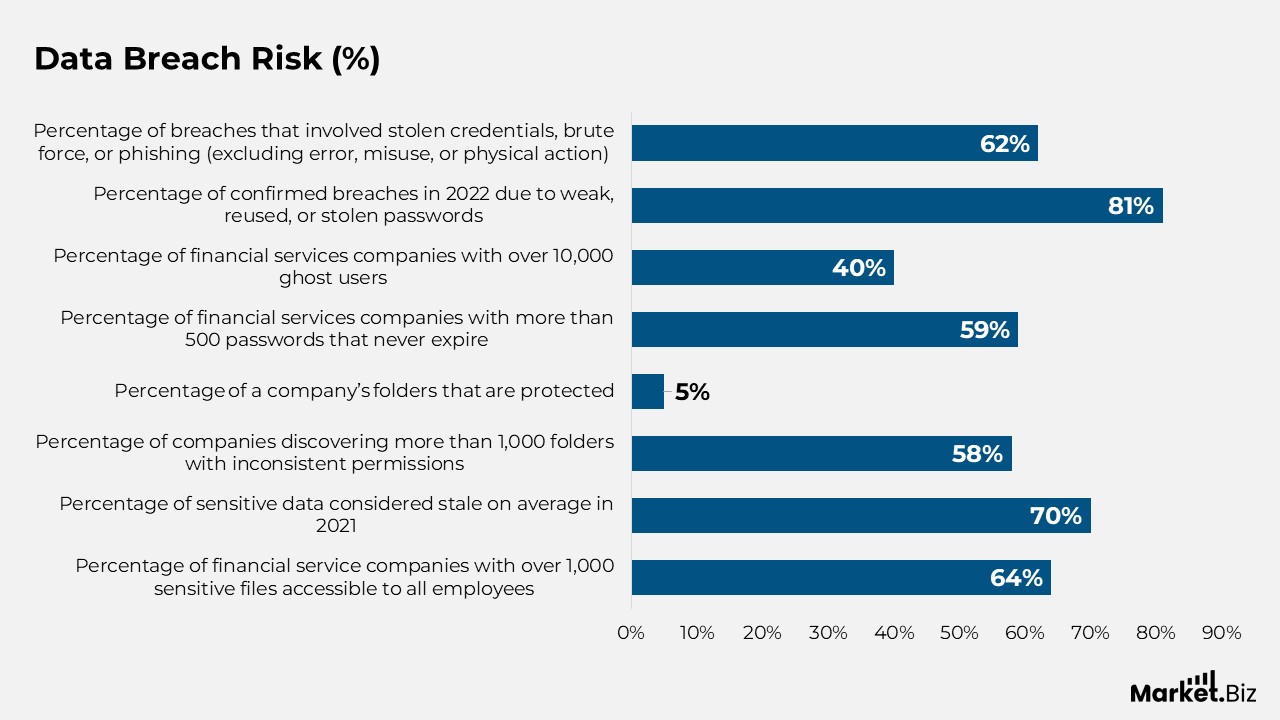
- More than 64% of financial service companies have over 1,000 sensitive files accessible to all employees.
- In 2021, 70% of all sensitive data was considered stale on average.
- 58% of companies discovered more than 1,000 folders with inconsistent permissions.
- Only 5% of a company’s folders are protected.
- 59% of financial services companies have more than 500 passwords that never expire, and nearly 40% have over 10,000 ghost users.
- Nearly three-quarters of US small business owners reported experiencing a cyberattack in 2022.
- 81% of confirmed breaches in 2022 were due to reused, weak, or stolen passwords.
- A cyberattack is estimated to occur every 39 seconds.
- The larger the data breach, the less likely the organization is to experience another breach in the following two years.
- Security system complexity has the greatest impact on the total cost of a data breach.
- 62% of breaches that did not involve a misuse, error, or physical action involved the use of brute force, stolen credentials, or phishing.
(Source: Varonis, THINK, Nexusguard, ITRC, LastPass, University of Maryland, IBM)
Impact of Data Breach Incidents
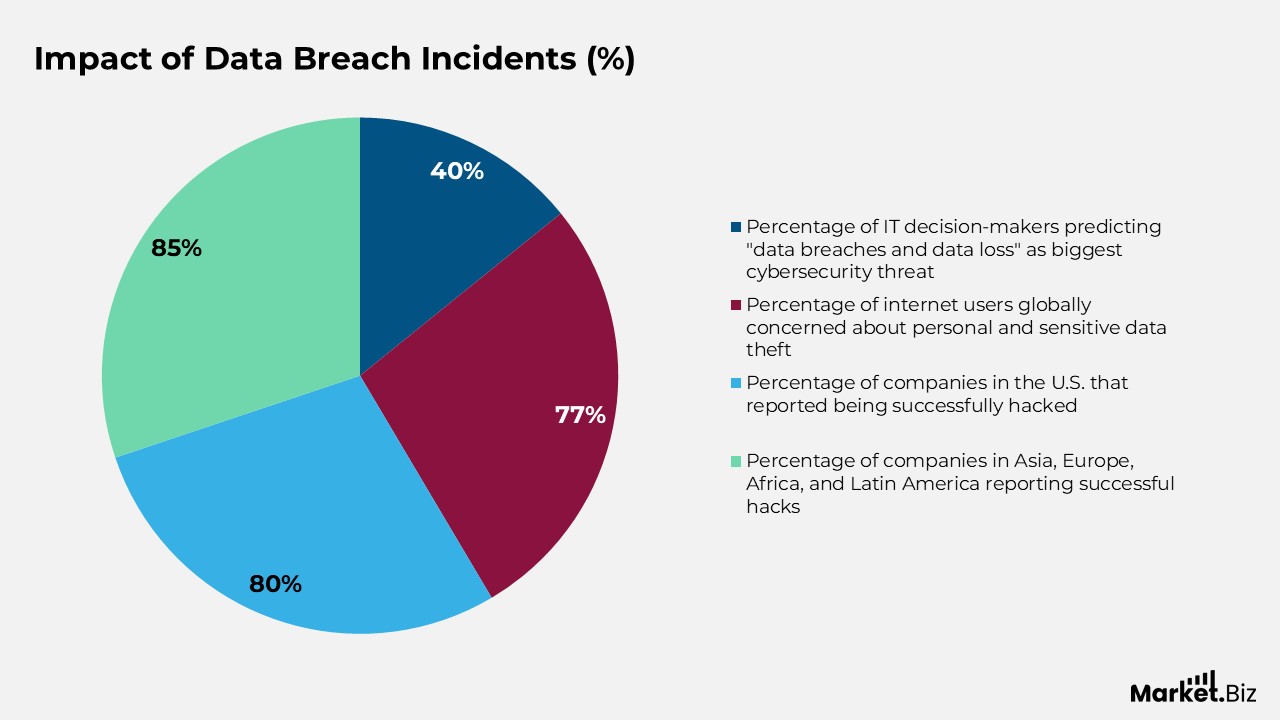
- 40% of IT decision-makers predict that “data breaches and data loss” will be the biggest cybersecurity threats to their organizations in the next 12 months.
- 77% of internet users globally express concern about the theft of their personal and sensitive data.
- 80% of companies in the US and 85% of companies in Asia, Europe, Africa, and Latin America report being successfully hacked in attempts to steal, alter, or expose critical data.
- In the first four months of 2024, healthcare emerged as the most breached sector in terms of publicly disclosed incidents, while IT services and software had the highest number of breached data records.
(Source: Cybersecurity Ventures, Experian)
Top Data Breach Statistics
- DarkBeam, a cybersecurity company based in the UK, had over 3.8 billion records breached in September.
- Real Estate Wealth Network, a construction/real estate company from the USA, experienced a breach of 1,523,776,691 records in December.
- The Indian Council of Medical Research (ICMR), a healthcare organization in India, had 815 million records breached in October.
- Kid Security, an IT services/software company from Kazakhstan, saw more than 300 million records breached in November.
- Twitter (X), an IT services/software company in the USA, had over 220 million records breached in January.
- TuneFab, an IT services/software company from Hong Kong, reported a breach of more than 151 million records in December.
- Dori Media Group, a media company in Israel, suffered a breach of over 100 TB of data in December.
- Tigo, a telecoms company in Hong Kong, had more than 100 million records breached in July.
- SAP SE Bulgaria, an IT services/software company from Bulgaria, experienced a breach of 95,592,696 records in November.
- Luxottica Group, a manufacturing company from Italy, had 70 million records breached in May.
(Source: IT Governance)
Data Breach Trends
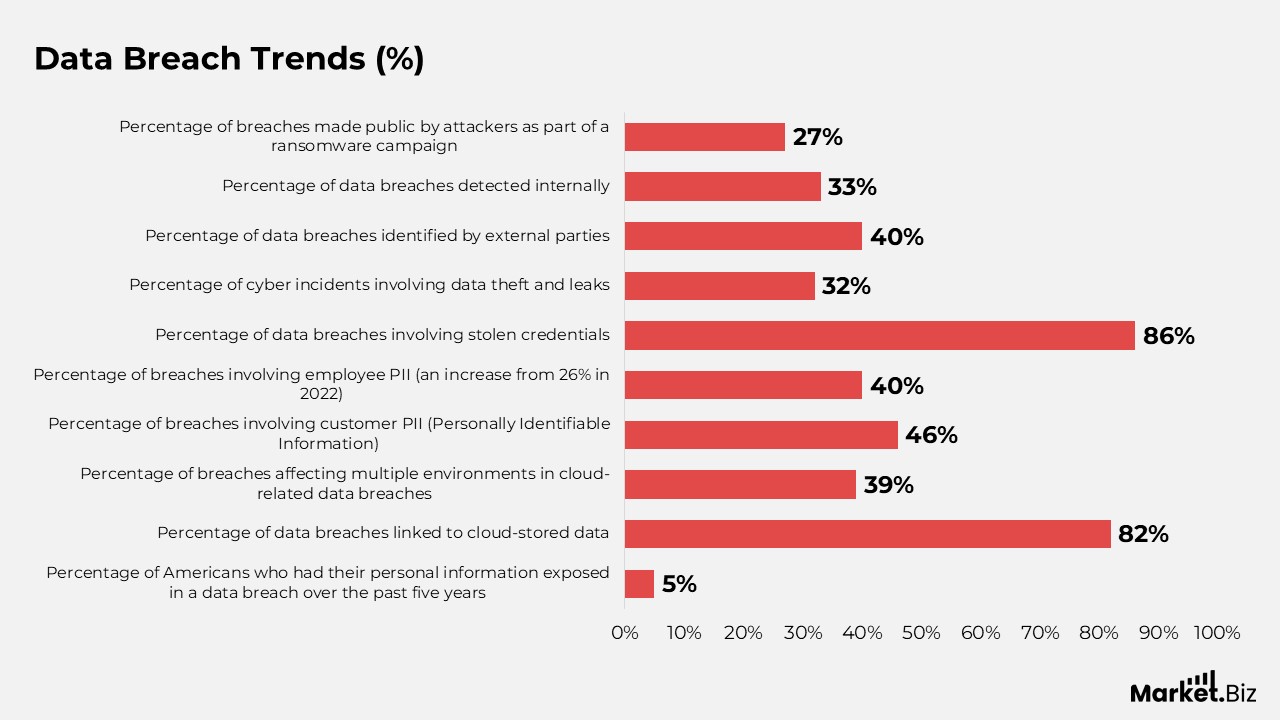
- Over the past five years, 5% of Americans have had their personal information exposed in a data breach.
- In 2024, one-third of data breaches involved shadow data, which is information stored outside the company’s centralized management system and beyond the control of the IT department.
- A significant 82% of data breaches are linked to cloud-stored data, and 39% of these breaches affect multiple environments, leading to an above-average cost of US$4.75 million per incident.
- Almost half (46%) of breaches involved customer PII, which includes data like tax IDs, emails, phone numbers, and home addresses.
- Employee PII made up 40% of compromised records, an increase from 26% in 2022.
- Stolen credentials were involved in 86% of data breaches, underlining a major security vulnerability.
- Data breaches involving sensitive personal information were the most prevalent in 2023.
- From September 2022 to September 2023, over 4,600 data breaches were recorded in the US, affecting more than 5 billion records.
- A significant 32% of cyber incidents involve data leaks and theft, with attackers increasingly focusing on stealing and selling data rather than encrypting it for ransom.
- More than half of organizations affected by data breaches in 2023 reported substantial security staffing shortages, a 26.2% increase compared to the previous year.
- In 2023, there were 3,122 data breaches, affecting 349 million individuals, along with 25 data exposures impacting nearly 1 million people, and 2 data leaks involving 2.7 million victims.
- External parties identified 40% of data breaches, while 33% were detected internally. Additionally, 27% of breaches were made public by the attackers as part of a ransomware campaign.
- The largest data breach of 2023 was recorded by T-Mobile, impacting an estimated 37 million individuals.
(Source: RSA, IBM, Verizon, Identity Theft Resource Center, Privacy Rights Clearinghouse)
Data Breach Prevention
- 63% of companies have either already implemented a biometric system or are planning to do so shortly.
- In 2023, security budgets saw an average increase of 6%, a decrease from the 17% rise observed in the previous budget cycle.
- 40% of organizations are set to boost their IT budgets in 2023, with cybersecurity being one of the primary areas receiving increased investment.
- Global cybersecurity spending was projected to surpass US$1.75 trillion cumulatively from 2021 to 2025.
- Worldwide IT security expenditures reached US$193 billion in 2022, with a projected 12.1% growth, bringing the total to US$219 billion by the end of 2023.
- After a significant surge in 2021, the number of ransomware attacks dropped to 494 million in 2022, though this still represents a 60% increase compared to 2020.
- By 2025, 58% of organizations are expected to have moved their application portfolios to a public cloud, necessitating new tools and strategies to prevent cyberattacks.
(Source: Veridium, Help Net Security, NordLayer, Cybercrime Magazine, ITC, Statista, CSO)
Historical Data Breach Statistics
- The first computer virus, named Creeper, was discovered in the early 1970s.
- In 2005, the Privacy Rights Clearinghouse began tracking and cataloging data breaches.
- The first-ever recorded data breach occurred in 2005 when DSW Shoe Warehouse exposed more than 1 million records.
- The largest insider attack in history occurred between 1976 and 2006, when Boeing employee Greg Chung stole US$2 billion worth of aerospace documents and provided them to China.
- AOL became the first known victim of phishing attacks in 1996.
- In 2017, Equifax, one of the major U.S. credit reporting agencies, accidentally exposed 145.5 million accounts, including sensitive information such as names, social security numbers, dates of birth, addresses, and in some cases, driver’s license numbers.
- Social media data breaches made up 56% of all data breaches in the first half of 2018.
- In 2022, the United States experienced 1,802 data breaches, with over 422 million records exposed.
- Data breaches in the first half of 2019 led to the exposure of 4.1 billion records.
- Cyberattacks are now regarded as one of the top 10 global risks to stability.
(Source: History of Information, Symantec, NBC, Phishing, ITWeb, Statista, Forbes, World Economic Forum, Varonis)
Healthcare Data Breaches Statistics
- From 2009 to 2022, there have been 5,150 healthcare data breaches in the United States, each involving 500 or more records, resulting in the exposure of over 382 million individual records.
- In the first half of 2023, 273 healthcare data breaches were reported.
- Healthcare data breaches are the costliest across all industries, with an average expense of US$10.1 million per incident.
- The healthcare sector accounts for 20% of all publicly reported data breaches.
- Hacking and IT-related incidents are the primary causes of data breaches within the healthcare industry.
- The largest healthcare data breach occurred in 2015 with the Anthem breach, which compromised the data of over 80 million current and former customers.
- The adoption of electronic health records in hospitals skyrocketed from 16% in 2010 to 97% by 2014, with this rate remaining constant since then.
(Source: Comparitech, Verizon, AICPA & CIPA, Immunefi, American Banker)
Finance Data Breaches Statistics
- Between 2018 and 2022, financial data breaches led to the exposure of 153.3 million records.
- 71% of data breaches are financially motivated.
- Within the financial sector, insurance companies have experienced the most breaches over the past five years, followed by banks and investment firms.
- 80% of Americans express concerns that businesses are failing to protect their financial information adequately.
- Losses from cryptocurrency theft increased by 57%, from US$2.3 billion in 2021 to US$3.7 billion in 2022.
- In 2022, at least 79 companies in the financial services sector reported data breaches that affected over 1,000 consumers, with Receivables Performance Management being the largest incident.
(Source: Comparitech, Verizon, AICPA & CIPA, Immunefi, American Banker)
Causes and Attack Vectors
- Multi-factor authentication (MFA) is highly effective, blocking over 99.9% of account-compromise attacks.
- In 2023, 65% of data breaches were attributed to internal actors, while external threats caused 35%.
- 95% of data breaches are financially motivated, marking a 24% increase since 2019.
- Ransomware now accounts for nearly 24% of all malware-related security incidents.
- On a global scale, detecting a data breach took an average of 194 days in 2024, showing slight progress from 2023.
- Organizations that utilize threat intelligence can detect breaches 28 days faster, on average.
- Breaches involving stolen or compromised credentials take the longest to resolve, averaging 88 days within a 292-day breach lifecycle.
- Scam emails result in a global financial loss of US$6.4 billion per day.
- In 2019, 967.7 million active malware programs were identified by cybersecurity professionals.
- System glitches account for 24% of all data breaches.
- In a typical organization, 21% of folders are accessible to all employees.
- Human error is responsible for 99.5% of data breaches among remote workers in the United States.
- Intrusions into cloud environments saw a 75% year-over-year increase in 2023.
- Between November 2021 and October 2023, Microsoft Office applications were the primary target for attacks, involved in 61% of global malicious attacks.
- Attempts to abstract top-secret keys and credential data from APIs and cloud metadata surged by 160% in 2023.
- Business Email Compromise (BEC) attacks now account for over 50% of all social engineering attacks.
- In 2023, the 3 most commonly described malware strains were Qakbot, MimiKatz, and Cobalt Strike.
- The main attack methods include stolen credentials, phishing, and exploiting security vulnerabilities.
(Source: EnigmaSoft Ltd, Statista, DemandSage)
Conclusion
Data breaches continue to represent a major threat to organizations worldwide, with financial gain being the primary motivation behind most attacks. While internal actors still account for a significant number of breaches, the rise in external threats, such as ransomware and cloud intrusions, highlights the evolving nature of cyber risks.
Breaches resulting from compromised credentials and human error persist as key challenges, emphasizing the need for stronger security measures like multi-factor authentication and threat intelligence. As attack methods become increasingly advanced, the financial damage from cybercrime, particularly through scam emails and social engineering tactics, continues to grow.
This data underscores the critical need for organizations to adopt robust cybersecurity protocols and for individuals to stay vigilant in protecting sensitive data to mitigate the escalating risks of data breaches.
FAQ’s
In 2023, 65% of data breaches were financially motivated, marking a significant increase in attacks aimed at financial gain compared to previous years.
Data breaches are predominantly caused by external threats like cyberattacks and internal factors, such as employees or contractors misusing their access privileges. Other contributing factors include malware, human error, and vulnerable systems.
Multi-factor authentication (MFA) is highly effective in blocking unauthorized access, preventing over 99.9% of account-compromise incidents, and significantly enhancing data security.
Ransomware plays a major role in data breaches, responsible for nearly 24% of malware-related incidents. The growing prevalence of ransomware reflects the rising trend of attackers demanding financial payments for the release of stolen data or to restore access to affected systems.
Between 2009 and 2022, 5,150 healthcare data breaches involved 500 or more individuals, highlighting the increasing risks to sensitive medical data.