









Introduction
AI in Healthcare Statistics: Artificial intelligence (AI) is swiftly reshaping the healthcare sector, transforming areas such as diagnostics, treatment planning, patient management, and drug development. By analyzing large volumes of data and delivering precise insights, AI is boosting clinical decision-making, enhancing patient outcomes, and optimizing healthcare operations.
Key advancements in machine learning, natural language processing, and other AI technologies are propelling this shift, with healthcare systems worldwide increasingly adopting these innovations to improve efficiency and offer more personalized care. The ongoing potential of AI to refine healthcare delivery is reshaping the industry’s future.
Editor’s Choice
- In South America, 64% of clinicians believe that AI will significantly improve the majority of their decisions.
- More than half (53%) of healthcare organizations in the EU plan to implement medical robotics by the end of 2024.
- A quarter (25%) of hospitals in the US already utilize AI-driven predictive analytics.
- 60% of patients would feel uneasy if their healthcare provider relied on AI.
- One-third (33%) of Americans are concerned that AI could result in worse outcomes for patients.
- Two-thirds (66%) of American women feel uncomfortable with AI becoming more prominent in healthcare.
- 80% of pathologists believe that AI will help extend life expectancy.
- Machine learning holds the largest market share in AI healthcare technology.
- Around 10% of healthcare professionals use AI tools such as Merative and Viz.ai to enhance care.
- Approximately one in six medical organizations worldwide has adopted AI models.
- 80% of healthcare professionals agree that AI and robotics will revolutionize healthcare, leading to more accurate diagnoses and treatments and increased life expectancy.
- 86% of AI companies currently use some form of AI technology.
- The number of AI-related jobs in healthcare is expected to grow by 13% by 2025.
- Many healthcare organizations have already implemented AI in some capacity.
- AI has the potential to lower the cost of discovering new drugs by 70%.
- 60% of Americans feel uneasy about their healthcare provider depending on AI.
- Predictive AI tools have the potential to cut hospital admissions by 50%.
AI Accuracy in Healthcare Diagnostics
- A meta-analysis of 83 studies revealed that generative AI models demonstrated an overall diagnostic accuracy of 52.1%, performing similarly to non-expert physicians but significantly below expert physicians’ accuracy.
- A 2025 study involving 158 cases found that AI-generated reports were 14.5% more accurate than those written by surgeons, with fewer clinically significant discrepancies.
- In a study of 14,606 patients, DeepRhythmAI achieved a 0.3% false-negative rate, significantly better than the 4.4% false-negative rate seen with technician analysis.
- To simplify, DeepRhythmAI missed only 0.3% of cases, whereas human technicians missed 4.4%, showing a clear improvement in accuracy with AI.
- Below are the results from the study:
| Metric | DeepRhythmAI | Human Technicians |
|---|---|---|
| False-Negative Rate (%) | 0.3% | 4.4% |
| Negative Predictive Value (NPV) | – | 99.1% |
| False Positives per 1,000 Patient-Days | 12 | 5 |
| Relative Risk of Missed Diagnosis | 1 (baseline) | 14.1× higher |
(Source: DemandSage, Nature Medicine, Journal Of The American College Of Surgeons)
Generative AI in Healthcare Market Size
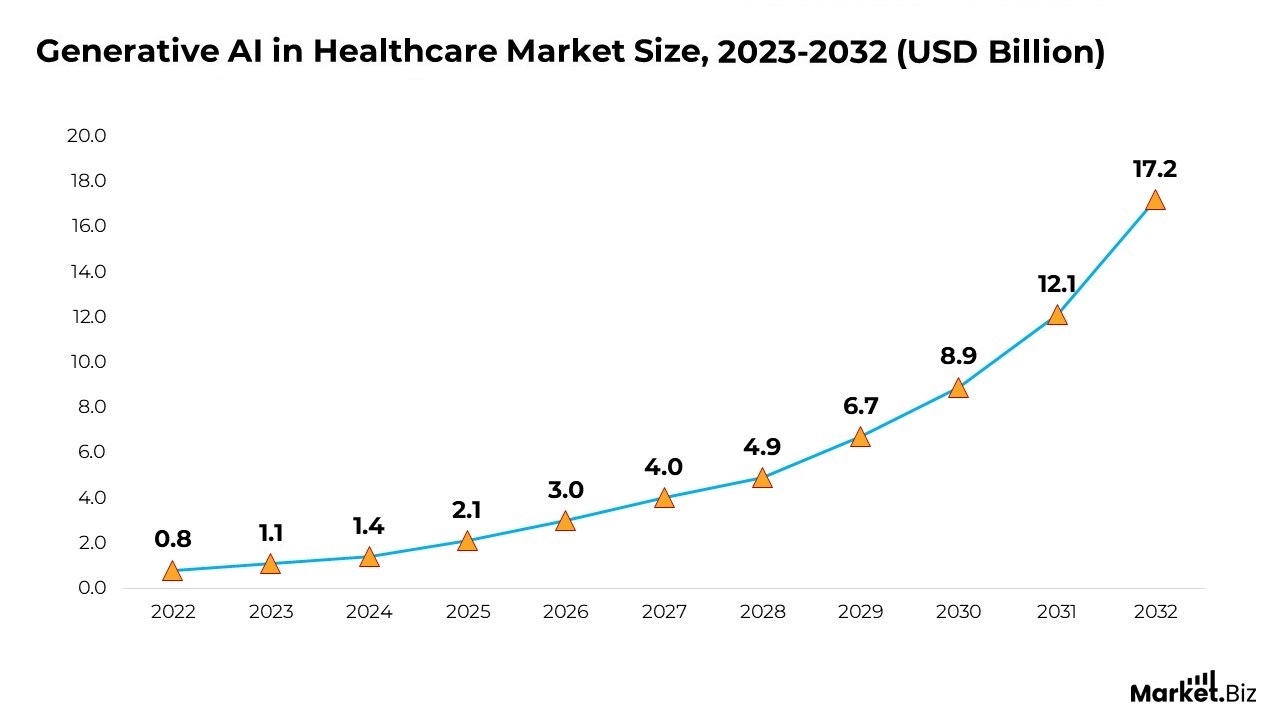
- According to Market.us, the generative AI in healthcare market is projected to grow from $1.1 billion in 2023 to $17.2 billion by 2032, representing a compound annual growth rate (CAGR) of 37.0% from 2023 to 2032.
- The growth of generative AI in the healthcare market is primarily fueled by its critical applications in virtual nursing assistant systems, technological advancements, and substantial governmental investments in the healthcare industry.
- The clinical application segment accounted for 65% of the market revenue share in 2022, driven by the increasing use of AI for precise diagnostics and personalized treatment strategies.
- Generative AI plays a significant role in diagnosing and providing personalized treatment for conditions like coronary artery disease, bolstered by enhanced algorithm accuracy and the availability of extensive healthcare data.
- The clinical judgment/diagnosis segment represented 32% of the market revenue share in 2022, with AI algorithms becoming essential for diagnosing diseases such as skin cancer.
- AI algorithms are increasingly adopted in detecting skin cancers, with dermatologists benefiting from advancements in image recognition technologies.
- The diagnostic center segment led the market with 35% revenue share in 2022, supported by the growing integration of AI-powered diagnostic tools and automation in medical imaging.
- North America held the largest market share with 36% of the revenue in 2022, driven by the rising prevalence of chronic diseases and robust governmental investments in healthcare innovation.
- The Asia Pacific region is projected to experience the fastest growth rate, with emerging economies like China, Japan, Singapore, and India leading the way, underpinned by increased healthcare spending and advancements in technology.
- The rapid pace of technological innovation and the growing demand for big data are positively influencing market growth in the Asia Pacific region, driven by the widespread adoption of healthcare technology and the increasing need for efficient healthcare data management.
(Source: Market.us)
Artificial Intelligence in Drug Discovery Market Size
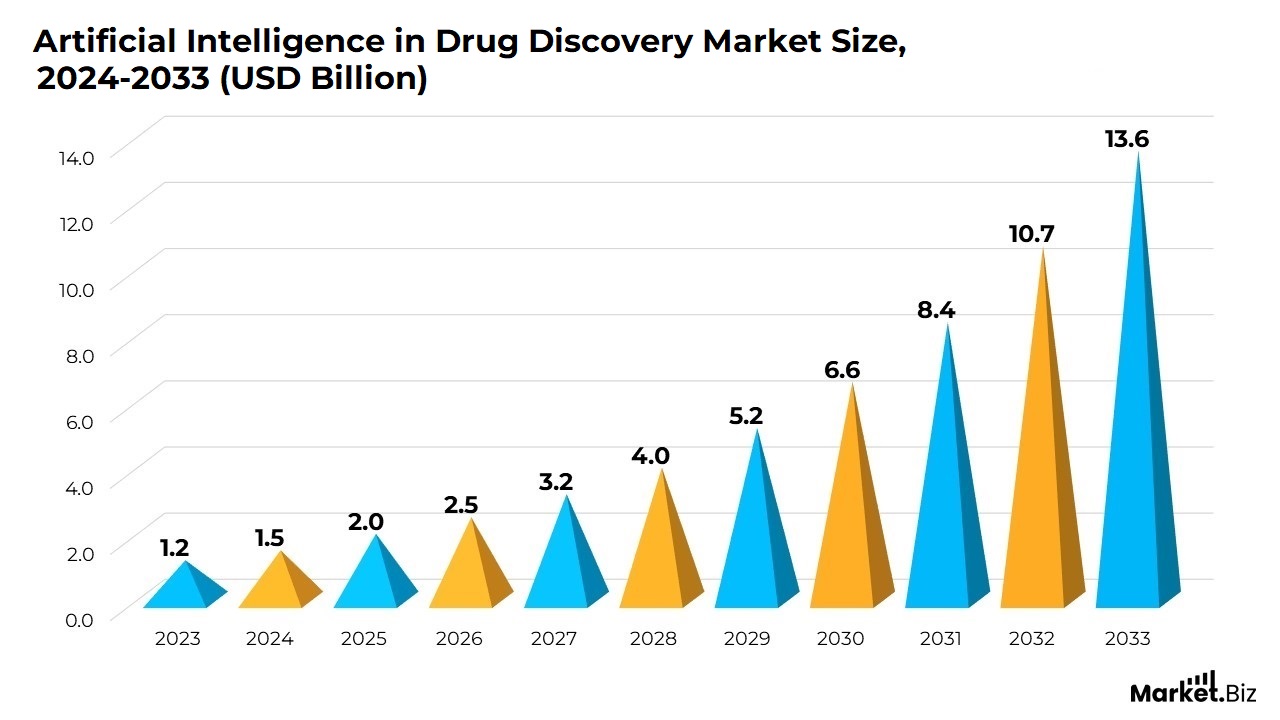
- According to Market.us, the artificial intelligence in drug discovery market is projected to grow from $1.5 billion in 2024 to $13.6 billion by 2033, representing a compound annual growth rate (CAGR) of 27.5% from 2024 to 2033.
- The growth of artificial intelligence (AI) in the drug discovery market is primarily driven by increasing investments in AI technologies for drug development and the time-saving benefits that AI offers in optimizing the drug discovery process.
- 52.7% of the technology segment market share in AI drug discovery is dominated by machine learning, owing to its ability to improve decision-making and utilize high-quality data efficiently.
- AI’s application in the discovery of drugs for neurodegenerative diseases holds 43.8% of the market share, driven by AI’s capability to process complex structures related to these diseases.
- Pharmaceutical and biotechnological companies account for 68.4% of the market share in AI drug discovery.
- The pharmaceutical and biotechnological companies segment leads the AI in drug discovery market, with 68.4% market share in the end-user category.
- North America holds the largest market share of 60.1% in the global AI drug discovery market, supported by a well-developed infrastructure for AI integration and the presence of major companies in the region.
(Source: Market.us)
The Role of AI in Enhancing Healthcare Efficiency
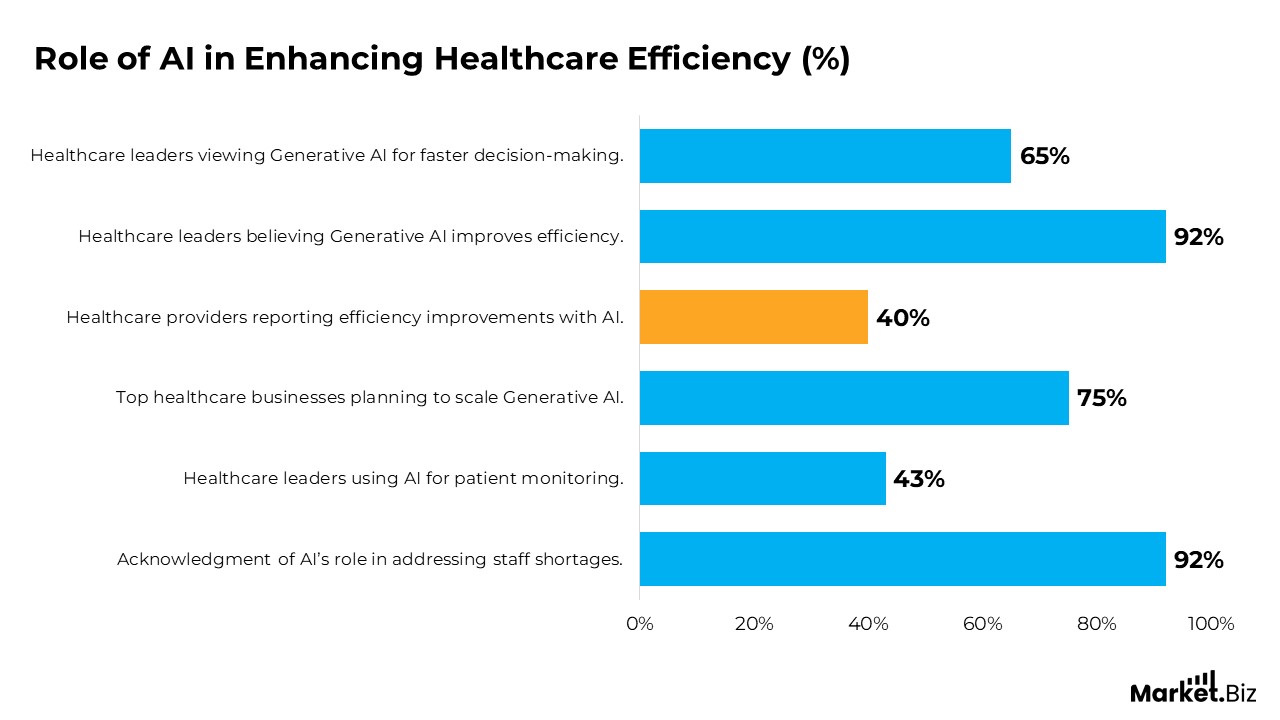
- 92% of healthcare influential acknowledge the importance of automation in addressing staff shortages, emphasizing AI’s potential to improve public health efficiency.
- 43% of healthcare leaders are already utilizing AI for in-hospital patient monitoring 75% of top healthcare businesses are either experimenting with or planning to scale Generative AI applications in the sector.
- 40% of healthcare providers report improved efficiency thanks to AI solutions in healthcare.
- 92% of healthcare leaders believe Generative AI enhances operational efficiency, with 65% viewing it as a tool for faster decision-making.
(Source: Docus, Inc., Royal Philips Future Health Index 2024, Deloitte, Accenture)
AI-Powered Lab Test Interpretations Statistics
- 78% of users reported a clearer understanding of their lab results when using AI-driven explanations, simplifying the interpretation of medical data.
- 28% of lab test interpretation cases are focused on cholesterol levels and blood sugar, highlighting concerns over diabetes and heart disease.
- Blood tests accounted for 62% of AI-interpreted lab results, with 40% being complete blood counts (CBC), 15% lipid profiles, and 7% other types.
- Urine tests made up 24% of the total, while other tests, such as semen analysis, swab tests, and stool tests, comprised 14%.
(Source: Docus, Inc.)
AI Doctor Consultations Statistics
- Over 60% of digital health users turned to an AI medical assistant for health insights and to assess symptoms.
- 65% of users accessing an AI Doctor inquired about chest pain, fever, or fatigue before seeking further medical advice.
- 32% of AI clinician inquiries were related to flu, cold, or respiratory infections, making them the most frequently asked-about conditions.
- 18% of users sought guidance from an AI Doctor regarding sexual health issues.
(Source: Docus, Inc., Statistics)
AI in Medical Imaging Statistics
- 90% of healthcare organizations have implemented AI tools for medical imaging to some extent, making it one of the most extensively adopted AI applications in clinical practice.
- In 2024, more than half of healthcare workers were actively using AI for at minimum one medical imaging task, a significant increase from just 17% in 2018.
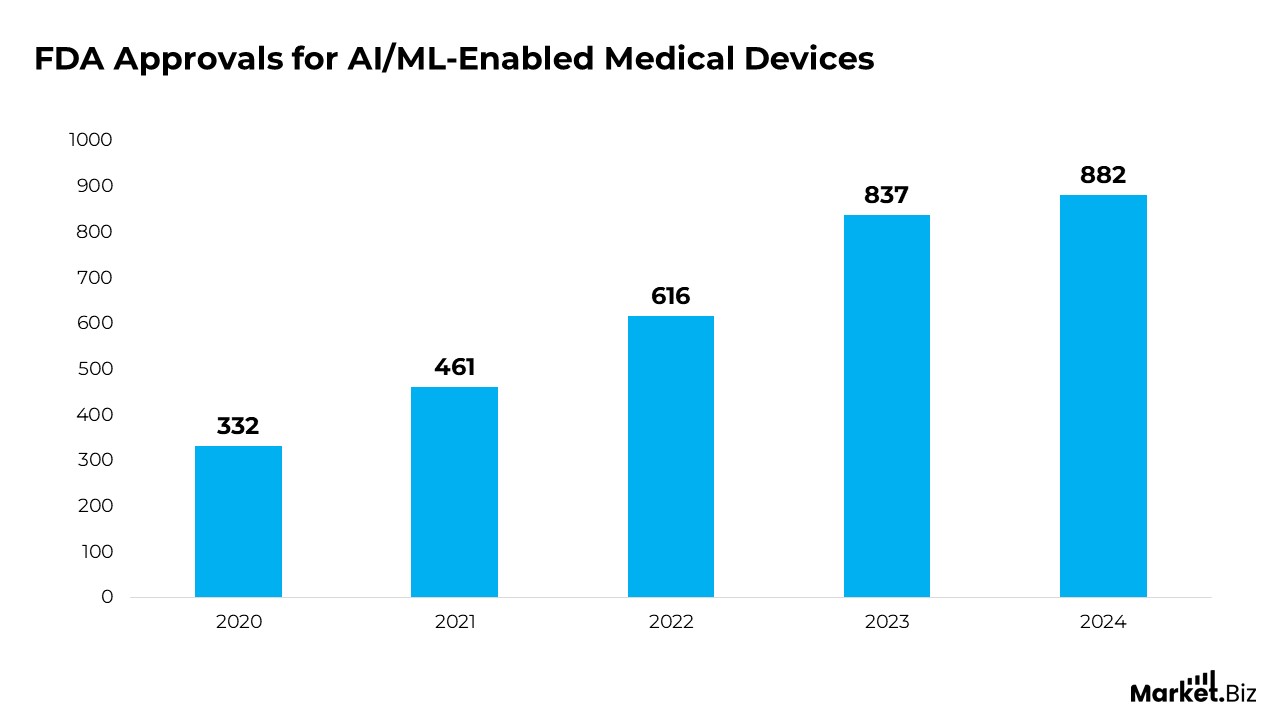
- By the end of 2023, the US FDA had approved 692 AI-enabled medical devices, with 77% of them in the field of radiology, totalling 531 devices.
- AI-based diagnostic systems have shown impressive accuracy, typically achieving 90-95% accuracy for specific tasks in detecting various conditions.
- Clinicians are already utilizing a wide range of imaging AI solutions. A US survey revealed that providers are using 65 different commercial AI tools for tasks such as stroke detection and tumor identification.
(Source: Docus, Inc., Statistics, TempDev Inc.)
AI and Robotics in Healthcare Statistics
- As of October 2023, the FDA had authorized 692 AI-enabled medical devices for marketing in the US, reflecting a 33% increase from the previous year. The majority of these devices are concentrated in imaging-focused specialties, with 77% in radiology, 10% in cardiovascular, and 3% in neurology.
- Robotic surgery adoption has seen significant growth. By the end of 2021, over 6,730 Da Vinci surgical robotic systems had been installed across 69 countries, with surgeons having performed more than 10 million robotic-assisted procedures to date.
- In 2022, 45% of US surgeons were performing robotic surgeries, a sharp rise from just 8.7% in 2012.
- Robotic assistance has become standard in certain surgeries. By 2019, approximately 87% of prostatectomies in the US were performed using surgical robots, and in 2018, about 61% of hysterectomies utilized robotic techniques.
- Clinical studies have shown that AI-assisted robotic surgeries can result in 20% fewer complications and shorter hospital stays, thanks to enhanced precision and stability, leading to improved surgical outcomes and faster recovery.
FDA Approvals for AI/ML-Enabled Medical Devices
(Source: TempDev Inc., Vention)
Adoption of Generative AI in Healthcare Statistics
- 75% of health system executives believe Generative AI can revolutionize the industry, though only 6% have a plan to implement it.
- Top Generative AI uses for healthcare in the coming year include structuring and analyzing patient data (37%), charge capture and reconciliation (39%), and workflow optimization and automation (36%).
- Long-term priorities for Generative AI in healthcare involve clinical decision support tools (41%), predictive analytics and risk stratification (44%), and diagnostics and treatment recommendations (37%).
- Key barriers to adopting Generative AI in healthcare are expertise (46%), lack of resources (46%), and regulation (33%).
- Over 10% of healthcare workers are already using AI technology, with half planning to adopt it in the future.
- ChatGPT is ranked highest among healthcare professionals for answering patient inquiries.
- 95% of healthcare professionals adjusted to a more positive perspective after reviewing AI-driven medical advice.
- 80% of Americans believe AI can improve healthcare quality, reduce costs, and increase access.
- 25% of Americans prefer interacting with a chatbot rather than therapy sessions.
- 25% of Americans would not see a healthcare provider who refuses to adopt technology.
(Source: Statistics, Master of Code, Brain & Company)
Consumer Preferences for AI in Healthcare
- 80% of consumers aged 18-34 have incorporated AI healthcare solutions, while less than 60% of those over 55 are open to using them.
- 53% of consumers believe AI enhances healthcare accessibility, while 46% think it helps reduce medical costs.
- 65% of survey respondents expressed a preference for AI-driven health plans, indicating a rising demand for personalized AI healthcare.
- 72% of Docus users reported that AI insights positively influenced their well-being and medical decision-making.
(Source: PwC Healthcare Survey 2024, HealthEdge Consumer Trends 2024, Deloitte 2024, Docus)
Adoption of AI-Driven Healthcare Tools Trends
- Searches for AI Symptom Checker saw a 134.3% increase in 2024 compared to 2023, indicating a growing reliance on AI-driven health assessments.
- Searches for ‘AI Doctor’ grew by 129.8% in 2024 compared to 2023, reflecting a surge in interest for AI-based medical consultations.
- Searches for ‘AI for medical diagnosis’ rose by 49.3%, highlighting increased trust in AI tools for healthcare diagnosis.
(Source: Google Trends, Docus, Inc.)
Concerns About AI in Healthcare Statistics
- 63% of respondents view data security risks as a major concern when implementing AI in healthcare.
- 68% of US adults fear that AI could decline patient-worker relationships, which is important for a decrease in human communication in healthcare.
- 42% of healthcare professionals in the US are also cautious about AI, citing concerns about reduced human interaction and data privacy risks.
- 52% of consumers worry that AI-driven medical decisions could introduce bias into healthcare.
- 40% of doctors trust on AI is promoted and will fall short of reflecting scepticism, meeting high expectations about its extended-term effectiveness.
(Source: Statista, The Intake, Forrester, Docus, Inc.)
Conclusion
AI in healthcare offers considerable potential, but several concerns must be addressed. Many consumers and healthcare professionals remain cautious, expressing doubts about AI’s impact on patient-provider relationships, with fears of reduced human communication and data privacy risks.
Other challenges include the possibility of bias in AI-driven medical decisions and ongoing concerns about data security. Nevertheless, there is a growing trend toward AI adoption, with consumers increasingly recognizing its potential to enhance accessibility, personalization, and efficiency in healthcare.
As AI technology continues to develop, it will be essential to balance innovation with addressing these concerns to unlock its full potential in the healthcare sector..
FAQ’s
68% of US adults worry that AI might reduce human collaboration in healthcare, potentially undermining the patient-provider relationship.
63% of respondents identify data security risks as a significant concern when integrating AI technologies into healthcare.
52% of consumers are concerned that AI-based medical choices could introduce bias into healthcare systems.
42% of healthcare professionals in the US are hesitant about AI, primarily due to fears of reduced human interface and concerns over data privacy.
40% of physicians believe AI is overhyped and that it may not live up to the high expectations set for its long-term influence in healthcare.
80% of US adults aged 18-34 are open to adopting AI healthcare solutions, whereas less than 60% of those over 55 are willing to embrace them.
10% of healthcare professionals have already implemented AI technology, with half planning to adopt it soon.
39% of healthcare executives believe that AI will be most effective for charge capture and reconciliation, followed by structuring and analyzing patient data (37%) and optimizing workflows (36%).