








Introduction
Data Centers Statistics: The data center industry is witnessing substantial growth, fueled by the increasing demand for cloud services, big data, and digital technologies. As businesses continue to expand their digital infrastructure, data centers around the world are housing an ever-growing number of servers.
However, energy consumption remains a key concern, as data centers contribute significantly to global electricity use, driving the need for enhanced energy efficiency and sustainable practices.
Many companies in the industry are prioritizing investments in renewable energy to mitigate their environmental impact. Cloud adoption is a major driver of growth, with cloud services making up a large portion of data center traffic.
Moreover, there is a rising demand for edge data centers as businesses strive to enhance service delivery and reduce latency. The Asia-Pacific region, particularly China and India, is experiencing rapid expansion in data center construction.
At the same time, North America continues to lead the market due to the presence of major technology firms and the ongoing shift toward cloud computing. This highlights the growing role of data centers in the digital economy and the industry’s increased focus on sustainability and innovation.
Editor’s Choice
- As of March 2024, around 11,800 data centers are operating globally.
- By March 2025, the United States is expected to maintain the largest number of data centers, with 5,426 facilities, followed by the UK (523), France (322), China (449), Germany (529), Australia (314), and additional countries like the Netherlands, Russia, and Japan.
- The global data center market is projected to surpass $1 trillion by 2027, driven by the rapid growth of artificial intelligence (AI) and associated technologies.
- Investments in AI-focused data centers are expected to reach $57 billion in 2024.
- Nvidia predicts that $1 trillion will be invested in upgrading data centers for AI, with significant contributions from tech giants such as Amazon, Google, Microsoft, and Meta.
- The US government’s $500 billion Stargate initiative is set to boost AI infrastructure, benefiting major tech firms and reinforcing the essential role of AI in economic growth.
- In 2025, Meta Platforms plans to invest between $60 billion and $65 billion in advancements in AI and data center infrastructure.
The Impact of AI on Data Centers
- In 2024, investments in AI-specific data centers reached a total of $57 billion.
- Nvidia forecasts that $1 trillion will be invested in data center upgrades for AI, with major contributions from companies like Amazon, Google, Microsoft, and Meta.
- The US government’s $500 billion Stargate initiative is set to enhance AI infrastructure, benefiting leading tech companies and highlighting AI’s critical role in economic development.
- Meta Platforms plans to allocate between $60 billion and $65 billion in 2025 for AI and data center investments.
- By 2034, the AI data center market is expected to grow to $157.3 billion, up from $14.3 billion in 2024.
- AI training facilities can demand more than 1 gigawatt of power, equivalent to the yearly consumption of 800,000 US homes.
- Approximately 20% of global data center capacity is currently dedicated to AI workloads.
- The combined spend on AI data center server infrastructure and operating expenses is projected to reach $76 billion by 2028.
- AI is pushing data center rack power capacities from under 10 kW in 2023 to between 50 kW and 100 kW, requiring a shift from air to liquid cooling systems.
- Next-generation GPUs are increasing rack density, with power requirements reaching up to 250 kW per rack.
- AI is expected to account for $75.3 billion in data center spending by 2028, representing about 35% of total market demand.
- Revenue from generative AI in data centers is projected to grow at a 58% compound annual growth rate from 2023 to 2028.
(Source: Datacenter Dynamics, Business Insider, McKinsey, WSJMarket.usJLL 2025 Global Data Center Outlook Research, Wall Street Journal, Forbes, SDXCentral, Cushman & Wakefield, CBRE)
Sustainable Data Center Market Size
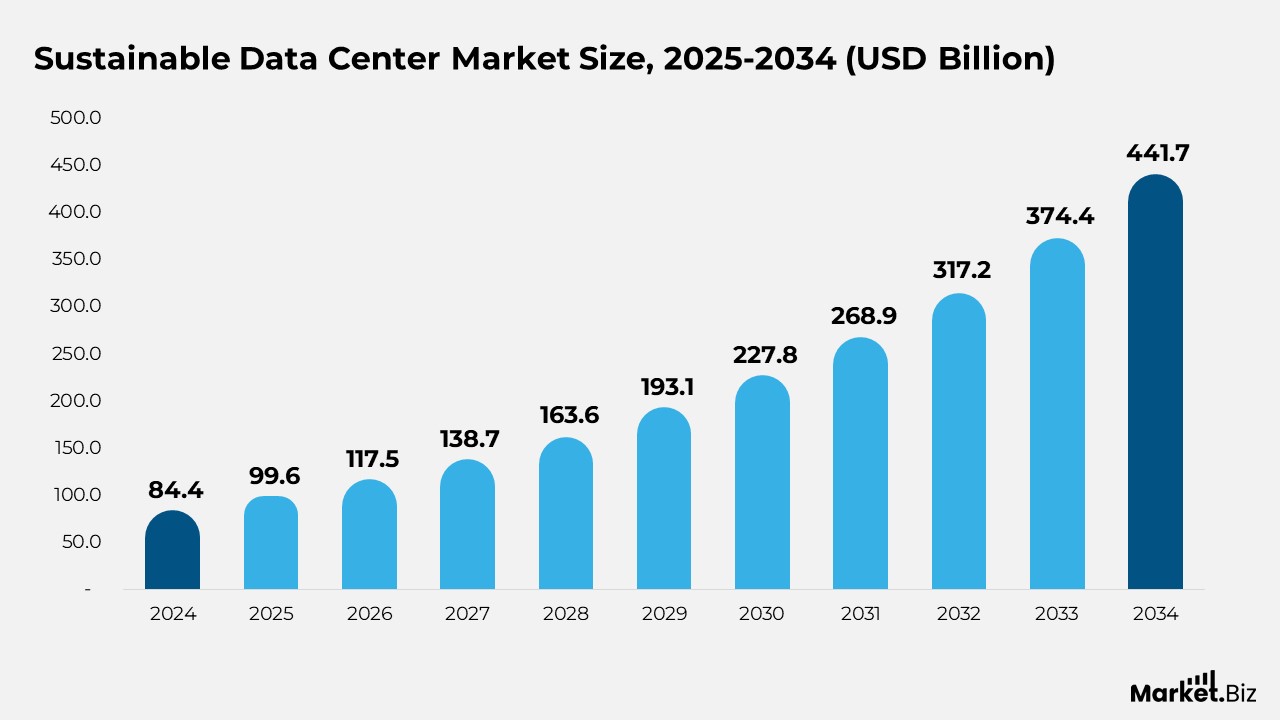
- According to Market.us, the sustainable data center market is projected to rise from $99.6 billion in 2025 to $441.7 billion by 2034, representing a compound annual growth rate (CAGR) of 18% from 2025 to 2034.
- The market’s growth is driven by the increasing demand for eco-friendly data storage solutions, with key factors including the surge in data generation, rising energy costs, and stricter environmental regulations.
- In 2024, the Solution segment led the sustainable data center market with over 70% market share, driven by the demand for energy-efficient and reliable infrastructure components.
- The Large Data Centers segment dominated the sustainable data center market in 2024, accounting for more than 58% share, fueled by the rise of AI, cloud computing, and big data analytics.
- The IT & Telecom segment held a prominent position in the sustainable data center market in 2024, capturing over 25% of the market due to increasing demand for scalable and energy-efficient infrastructure.
- Dell Technologies is set to launch the Dell PowerProtect All Flash Appliance and PowerStore Advanced Ransomware Detection in 2025, focusing on improving sustainability and data protection.
- Fujitsu, in partnership with Supermicro and Nidec, is developing a liquid-cooling solution to enhance data center energy efficiency by up to 40% over traditional air-cooling methods.
- The US sustainable data center market was valued at approximately USD 28.1 billion in 2024 and is projected to grow at a CAGR of 16.3% to reach USD 127.2 billion by 2034.
- North America dominated the sustainable data center market in 2024, capturing over 36% of the global market share and making around USD 30.52 billion in revenue, driven by investments in green technologies and strict environmental regulations.
(Source: Market.us)
AI Data Center Market Size
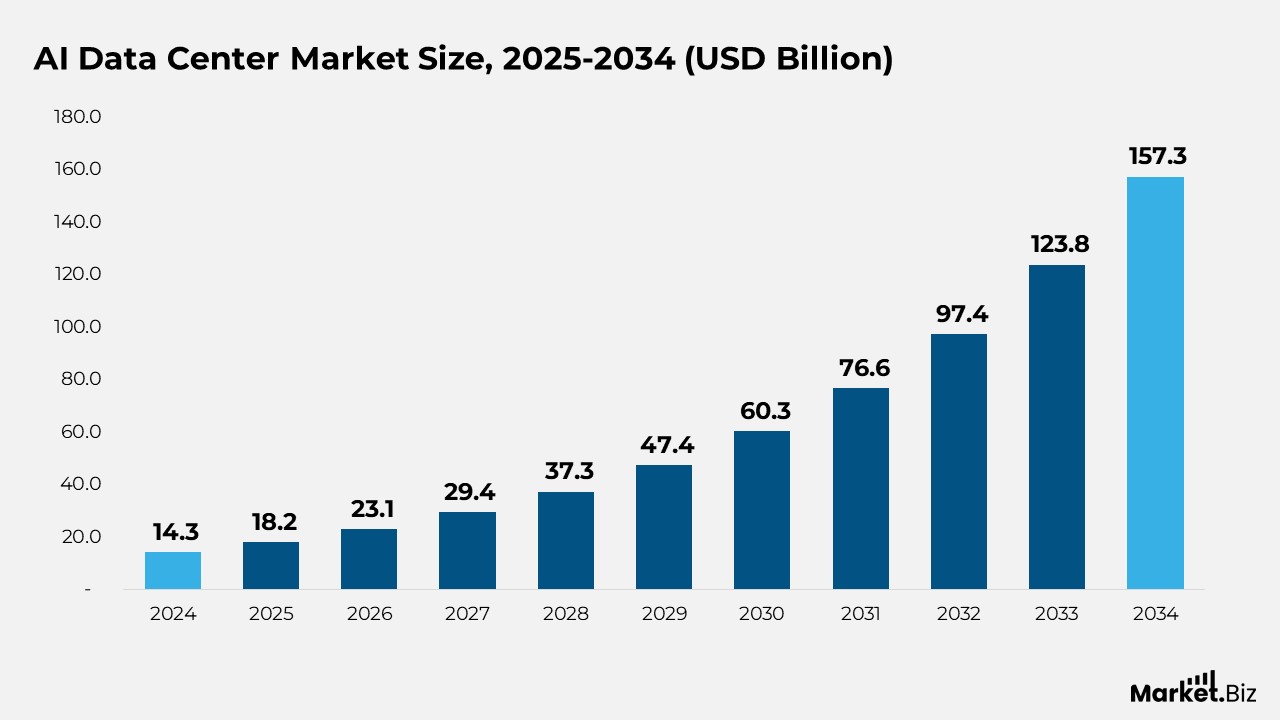
- According to Market.us, the AI data center market is anticipated to rise from $18.2 billion in 2025 to $157.3 billion by 2034, representing a compound annual growth rate (CAGR) of 27.1% from 2025 to 2034.
- Market growth is driven by the surge in data volume from digital transformations, AI and machine learning complexity, and the need for powerful computational capabilities to handle AI workloads.
- The GPU Data Center segment dominated the AI Data Center Market in 2024, holding over 55% of the market share, thanks to GPUs’ efficiency in handling parallel processing tasks crucial for AI model training and operations.
- The BFSI (Banking, Financial Services, and Insurance) segment led the AI Data Center Market in 2024, capturing more than 20% of the market share, driven by data-intensive operations where AI enhances decision-making, risk assessment, and customer service.
- The US AI Data Center Market was valued at approximately US$5.38 billion in 2024, with a projected CAGR of 26.4%, driven by increasing investments in AI technologies and advanced data center infrastructures.
- North America led the AI Data Center Market in 2024, capturing over 40% market share and generating USD 5.7 billion in revenue, due to advanced infrastructure and major tech firms investing in AI.
(Source: Market.us)
Expansion of Data Centers
- As of March 2024, there are approximately 11,800 data centers worldwide.
- By March 2025, the United States will lead with the most data centers, having 5,426, followed by the UK (523), France (322), China (449), Germany (529), Australia (314), and other countries like the Netherlands, Russia, and Japan.
- By 2027, the global data center market is anticipated to reach $1 trillion, fueled by the rapid expansion of AI and related technologies.
- In 2023, data centers consumed 7.4 Gigawatts of power, marking a 55% increase from 4.9 Gigawatts in 2022.
- Nvidia’s data center revenue grew by an astounding 427% year-over-year, jumping from $4.28 billion in Q1 FY2024 to $22.57 billion in Q1 FY2025.
- In the United States, data centers consume about 1.7 billion liters of water daily, a fraction of the country’s total daily water usage of 1,218 billion liters.
- Energy consumption in cloud computing grows annually by about 10% to 30%.
- The electricity consumed by data centers could power 6,482,400 average American homes.
- Data centers are responsible for 1% to 5% of global greenhouse gas emissions.
- By 2030, global data center carbon dioxide emissions are expected to rise to around 2.5 billion metric tons.
- The first half of 2023 saw the largest volume of data center construction in primary markets.
- The largest data center markets by total power in Megawatts include Northern Virginia, Beijing, London, and other major cities like Singapore and Tokyo.
- The global data center colocation market is expected to grow at a 6.5% compound annual growth rate (CAGR) from 2021 to 2027.
Moreover
- Equinix holds the leading market share in the data center industry at 13%, followed by Digital Realty (11%) and NTT (6%).
- The cloud service provider data center segment is expected to see the highest CAGR of 17.7% from 2022 to 2030.
- The edge data center market is projected to grow from $7.2 billion to $19.1 billion between 2021 and 2026, driven by the adoption of IoT and online streaming.
- The energy application sector of the data center services market is expected to consume over $8 billion by 2023.
- Media and entertainment industries are forecasted to account for 35% of global data center consumption in 2023.
- By 2025, IBM Cloud will operate approximately 60 data centers across 19 countries.
- The solution segment accounted for 77.9% of the data center market’s revenue in 2021.
- Hyperscale data centers under construction will total 921,458 square meters of space and nearly 2,000 MW of power.
- Hyperscale data centers, mainly operated by cloud providers such as Amazon, Microsoft, Google, and others, account for 35.14% of the market share.
- The average size of a data center worldwide is 100,000 square meters.
- China Telecom’s Inner Mongolia Information Park is the world’s largest data center, with over 10.7 million square feet of space.
- Google’s Council Bluffs data center in Iowa is the largest campus globally, costing around $5 billion to complete.
Further
- In September 2024, Microsoft plans to reopen the Three Mile Island nuclear power plant to provide 100% of the electricity for its AI data centers.
- Switch’s Tahoe Reno 1 is the world’s largest colocation data center at 1.3 million square feet, with up to 130 MW of power.
- Switch’s Citadel Campus in Las Vegas, the third-largest data center in the world, spans 7,750,015 square feet.
- Data centers account for around 4% of global energy consumption and 1% of global greenhouse gas emissions.
- Cloud data centers consume 3% of global energy.
- Data center construction reached a historic high in 2023, with 3,077.8 Megawatts under construction, marking a 46% year-over-year increase.
- Average server rack densities are rising, but most facilities still don’t support racks over 30 kW.
- By 2024, 200/400 Gb ports will account for 26% of network energy share, while sub-50 Gb ports will fall below 2%.
(Source: Statista, PWC, Cushman Wakefield, TechJury, Digital Reality, Carbon Collective, Channel News Asia, Data Center Dynamics, CBRE, Oilprice.com, Yahoo, IBM, Astute Analytica, Edu Dwar, Data Center Frontier, Ranked.com, Engie, Exploding Topics, Lawrence Berkeley National Laboratory)
Conclusion
The data center industry is playing a central role in driving technological progress, fueled by the rising demand for cloud services, big data analytics, and artificial intelligence. As digital transformation accelerates, data centers are critical in providing businesses with the scalable, efficient, and secure infrastructure they need.
Key trends, including the shift toward sustainable practices, the growth of edge data centers, and the increasing significance of AI and machine learning, are shaping the future of the industry. Regional growth, especially in North America and the Asia-Pacific region, highlights the global nature of the market, with substantial investments in renewable energy and cutting-edge technologies.
The data center industry serves as a fundamental pillar of the digital economy, enabling sustainability and operational efficiency in an interconnected world. Looking ahead, industry players must address challenges related to energy consumption and environmental impact while adopting innovative solutions to meet the evolving demands of businesses and consumers.
FAQ’s
The data center industry is growing due to the rising demand for cloud services, big data analytics, artificial intelligence, and the increasing need for scalable, secure infrastructure to support digital transformations across various industries.
Sustainability is a key focus in the data center sector as energy consumption rises and environmental regulations tighten. To mitigate these challenges, data centers are adopting eco-friendly practices, including energy-efficient technologies, renewable energy sources, and sustainable building designs.
Edge data centers are smaller, decentralized facilities that bring data processing closer to end-users, reducing latency and enhancing service delivery. These centers are essential for managing real-time data processing, especially with the rapid growth of IoT devices and AI applications.
North America leads the global data center market, thanks to its robust technological infrastructure and the presence of major tech companies. The Asia-Pacific region, particularly China and India, is also experiencing rapid growth driven by digitalization and increased demand for data storage and processing capabilities.
Data centers are the backbone of the digital economy, supporting essential services like cloud computing, big data analytics, AI, and IoT. They enable businesses to operate efficiently, securely, and at scale in an increasingly connected world.
AI is transforming the data center industry by creating a need for advanced computational power to handle AI workloads. As AI and machine learning models grow, specialized infrastructure, such as GPU-based data centers, is required to process large volumes of data efficiently.

