









Introduction
Workflow Automation Statistics: Workflow automation involves utilizing technology to design, implement, and optimize business processes with minimal human involvement. By incorporating tools like robotic process automation (RPA), artificial intelligence (AI), and low-code platforms, businesses can streamline operations, enhance accuracy, and speed up task execution.
Over the last decade, workflow automation has progressed from basic rule-based systems to sophisticated, adaptive technologies that manage intricate, cross-functional processes. The rise of cloud computing, remote work, and data-driven decision-making has contributed significantly to its growing adoption. Today, workflow automation is not merely an efficiency tool but a key strategic enabler that allows companies to scale, innovate, and swiftly adapt to market dynamics.
Analyzing workflow automation statistics offers critical insights into adoption rates, return on investment (ROI), industry-specific applications, and the emerging technologies that are shaping the future of automated processes.
Editor’s Choice
- Around 60% of companies currently incorporate automation solutions in their workflows.
- As much as 80% of transactional work in finance departments could potentially be automated.
- Implementing payment automation can save businesses more than 500 hours annually in their finance departments.
- HR automation has experienced an impressive 599% growth in recent years.
- In 2024, many marketing leaders adopted automation for their team’s processes, with 58% automating emails, 49% automating social media, and 33% automating content management.
- Automation enables 82% of sales teams to dedicate more time to building stronger client relationships.
- 90% of IT staff attribute improved cross-team collaboration to the use of automation.
- Despite its potential, 85% of CFOs face challenges when attempting to leverage technology and automation.
- 88% of employees using automation tools trust their accuracy and reliability.
- 88% of employees report increased job satisfaction, and 84% report greater company satisfaction due to automation helping streamline tasks and reduce workloads.
(Source: Duke University, Accenture, American Express, SHRM, Statista, Salesforce, PwC)
General Workflow Automation Statistics
- Only 4% of businesses have fully embraced workflow automation, highlighting a significant gap between the potential of automation and its current implementation.
- According to McKinsey, 50% of work activities are automatable, revealing substantial opportunities for enhancing efficiency and productivity.
- 31% of businesses have automated at least one function, marking a growing trend toward optimizing business processes.
- The global business process automation market is forecast to reach $19.6 billion by 2026, reflecting strong worldwide investment and adoption.
- 76% of companies utilize automation to standardize daily workflows, improving the speed and consistency of routine tasks.
- Companies report annual savings ranging from $10,000 to millions, depending on the complexity and scale of their automated workflows.
- Workflow automation boosts lead volume by 80%, increases conversions by 75%, and improves qualified leads by 451%, especially in marketing and sales.
- Organizations that automate email workflows see twice the number of leads and 58% higher conversions compared to manual email outreach efforts.
- 62% of businesses identify three or more major inefficiencies in their processes that could be addressed through automation.
- Smaller businesses adopting automation tend to experience higher success rates (65%) compared to larger enterprises (55%), due to their quicker execution and adaptability.
- 58% of organizations automate reporting and planning tasks, enhancing decision-making by providing real-time data insights.
(Source: Grand Plans LLC, Statista)
Trends in Workflow Automation
- McKinsey’s research reveals that 50% of all work activities are eligible for automation. Meanwhile, 31% of businesses have already automated at least one of their functions.
- Driven by the increasing need for efficient IT systems, seamless communication, and optimized resource management, the global business process automation market is expected to reach $19.6 billion by 2026.
- 75% of companies believe that implementing workflow automation provides them with a significant competitive edge.
- 62% of businesses have recognized three or more key inefficiencies or bottlenecks in their processes that could be effectively addressed through workflow automation. The most common inefficiencies are:
- 54% point to poor communication.
- 44% report repetitive errors.
- 42% highlight delays in project deployment.
- 24% mention compliance issues.
- 17% are concerned with rising costs.
- 76% of organizations utilize automation to standardize their daily workflows, while 58% apply it for data reporting and planning, and 36% use it to streamline compliance and regulatory tasks.
- Although smaller businesses have been slower to adopt workflow automation, those that have integrated it report higher success rates (65%) compared to larger organizations (55%).
- 62% of businesses have identified at least three major inefficiencies or bottlenecks in their processes that could be addressed through effective automation.
(Source: Intellistack, LLC., DemandSage)
Cognitive Process Automation Market Size
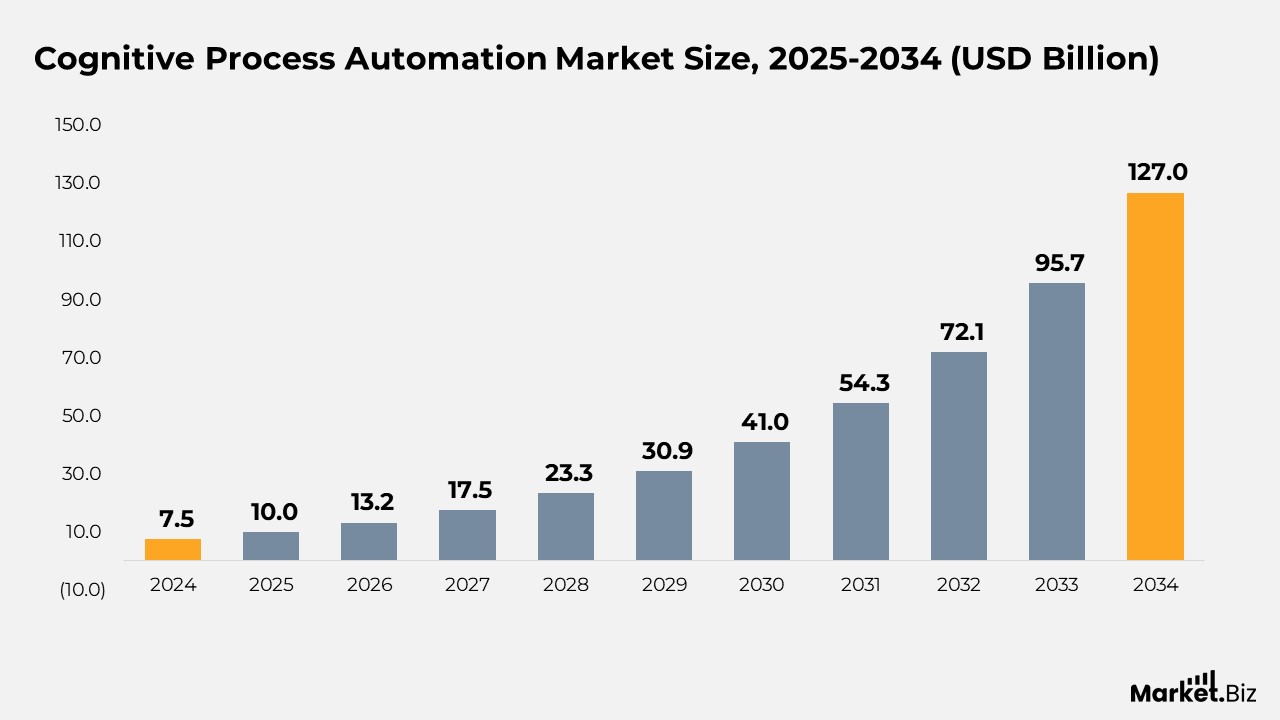
- According to Market.us, the cognitive process automation market is expected to rise from $10.0 billion in 2025 to $127.0 billion by 2034, representing a compound annual growth rate (CAGR) of 32.7% from 2025 to 2034.
- The growth of the Cognitive Process Automation (CPA) market is driven by the increasing demand for efficient, error-free automation solutions that combine AI, machine learning, NLP, and RPA to automate human-like cognitive functions.
- In 2024, the Robotic Process Automation (RPA) segment dominated the CPA market with over 65.7% of the global market share, particularly in finance, healthcare, and manufacturing.
- The Finance segment captured 40.5% of the global CPA market in 2024, reflecting the sector’s increasing reliance on AI-powered automation solutions.
- In 2024, Machine Learning accounted for 26.7% of the global CPA market, driven by its capabilities in self-learning, predictive analytics, and intelligent decision-making.
- The BFSI sector led the global CPA market in 2024, holding 68.4% of the market share, largely due to the adoption of cognitive automation technologies to boost efficiency and enhance customer experience.
- North America held 32.7% of the global CPA market in 2024, generating approximately USD 2.45 billion in revenue, driven by widespread AI-powered automation adoption in industries like finance, healthcare, and manufacturing.
- The US Cognitive Process Automation market was valued at USD 2.08 billion in 2024, experiencing a robust CAGR of 30.4%, fueled by the growing demand for efficient, cost-effective operations and resource optimization.
(Source: Market.us)
Real Estate Marketing Automation Software Market Size
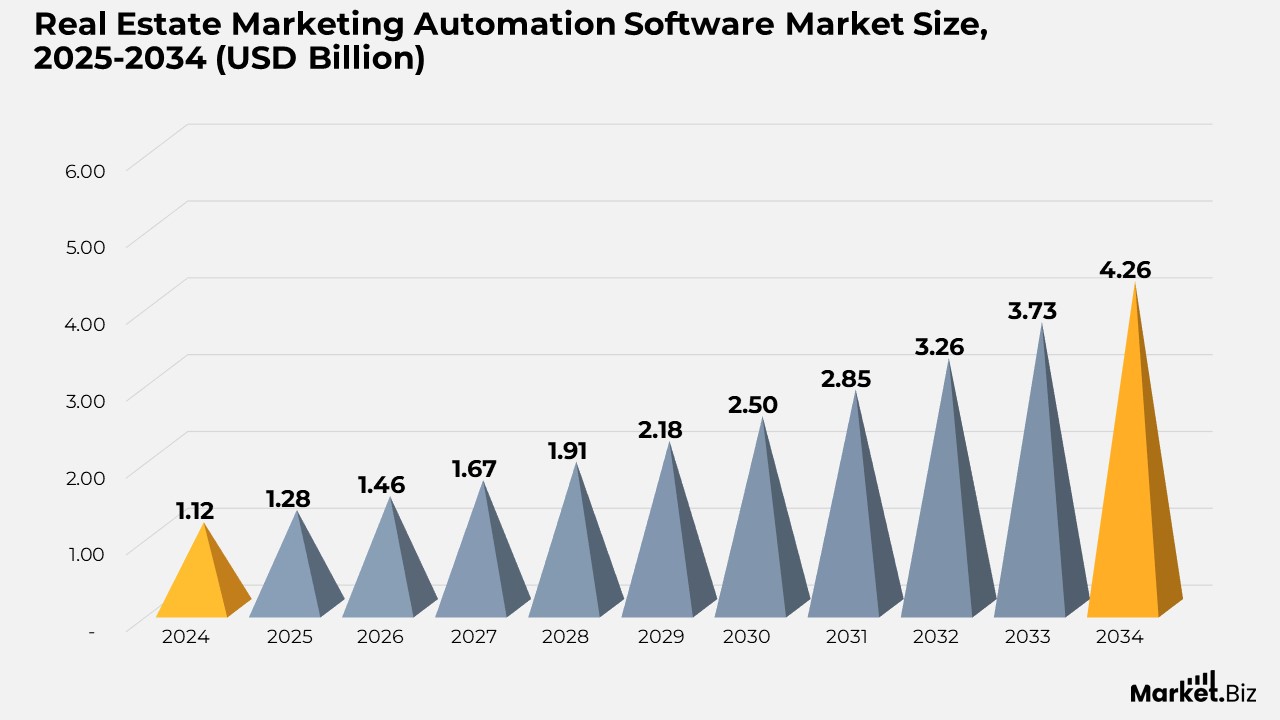
- According to Market.us, the real estate marketing automation software market is expected to rise from $1.28 billion in 2025 to $4.26 billion by 2034, representing a compound annual growth rate (CAGR) of 14.3% from 2025 to 2034.
- The growth of the Real Estate Marketing Automation Software market is driven by the demand for customized client experiences and the pressure for instant responses and relevant suggestions from property buyers.
- In 2024, the Email Marketing Platforms segment held 38.3% of the global market share, owing to its proven ability to deliver high ROI, simplify lead promotion, and personalize client announcements at scale.
- The Cloud-Based segment captured 68.4% of the global market share in 2024, driven by the need for flexible, scalable, and easily accessible solutions.
- The Large Enterprises segment dominated the market in 2024, holding 63.7% of the share, thanks to their robust financial capacity, advanced digital infrastructure, and focus on scalable marketing solutions.
- The US Real Estate Marketing Automation Software market is valued at USD 0.37 billion. It is expected to grow at a CAGR of 12.6%, driven by a competitive property landscape and the increasing adoption of proptech.
- North America held 36.9% of the global market share in 2024, generating USD 0.41 billion in revenue, due to early adoption of advanced technologies, the elevation of digital maturity, and the presence of leading software providers.
(Source: Market.us)
Workflow Automation and Employment Impact
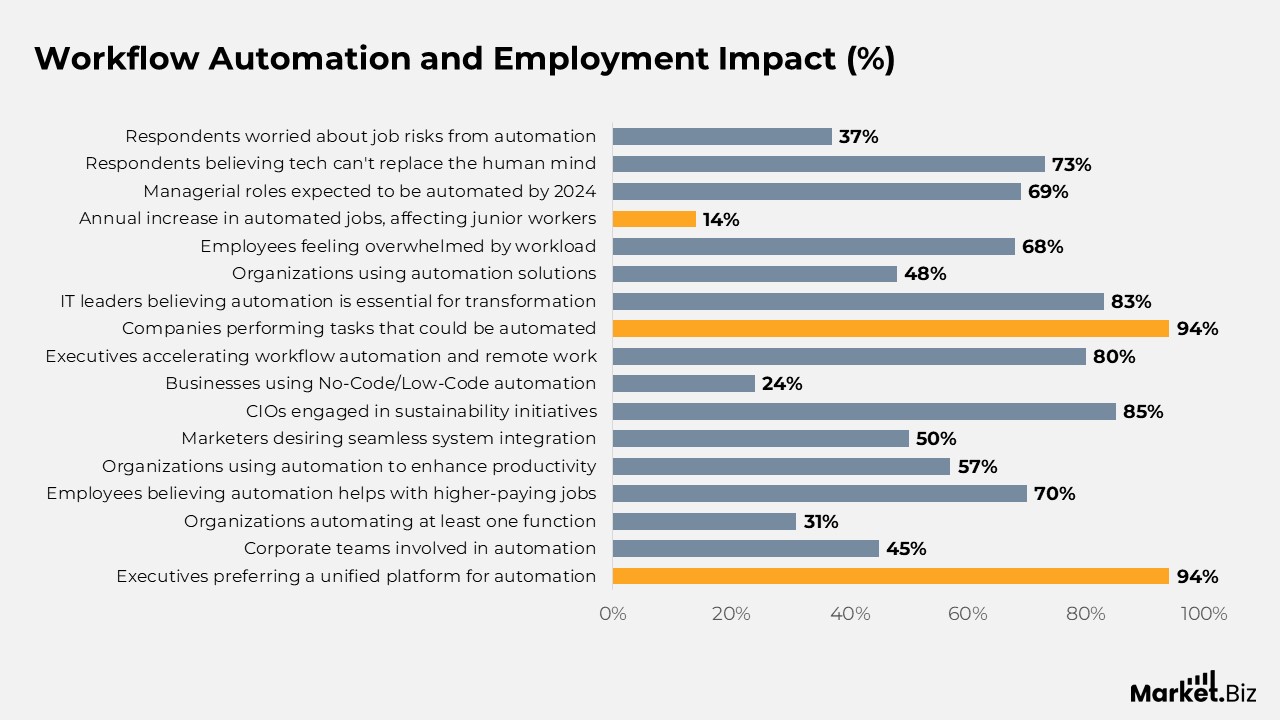
- 94% of corporate executives prefer using a unified platform for app integration and process automation, rather than relying on multiple platforms.
- Over one-third of businesses have automated at least five divisions within their organization.
- 45% of corporate teams are actively involved in the automation process.
- 31% of organizations have automated at least one function.
- Nearly 70% of employees believe that automation will help them qualify for higher-paying jobs.
- 57% of organizations aim to use automation to enhance employee productivity and performance.
- 50% of marketers desire seamless integration with existing content management, CRM, and ERP systems, as per survey findings.
- In a Gartner poll, 85% of CIOs were actively engaged in their company’s sustainability initiatives.
- One-third of new jobs in the US are in occupations that didn’t exist 25 years ago.
- 24% of businesses have implemented No-Code and Low-Code process automation solutions.
- Over 80% of corporate executives are accelerating workflow automation and expanding the use of remote workers.
- 94% of companies perform repetitive, time-consuming tasks that could be automated.
Moreover
- 90% of knowledge labors report that automation has enhanced their jobs, increasing productivity by 66%.
- 83% of IT leaders trust that workflow automation is essential for digital transformation.
- 48% of organizations have already installed automation solutions to eliminate manual tasks.
- 68% of employees report being overwhelmed by their daily workload, prompting companies to adopt business process automation to alleviate pressure.
- 36% of organizations currently use business process management software to automate workflows, with 50% of business leaders planning to automate more repetitive tasks.
- The Industrial Automation Services Market is projected to grow from $147.06 billion in 2019 to $264.69 billion by 2026.
- There’s a 14% annual increase in automated jobs, particularly affecting junior workers. By 2024, 69% of managerial roles may be automated. Men are expected to be more impacted than women.
- By 2023, 28% of employed men and 24% of women could lose their jobs due to automation. This is projected to affect 38% of jobs in the US, 35% in Germany, 30% in the UK, and 21% in Japan.
- 73% of respondents in a PwC survey believe that technology can never fully replace the human mind, while 37% worry that automation may put their jobs at risk. Additionally, automation could force 40 to 160 million women to change careers.
(Source: Frontdoor Labs Ltd., Statista)
Need for Workflow Automation Statistics
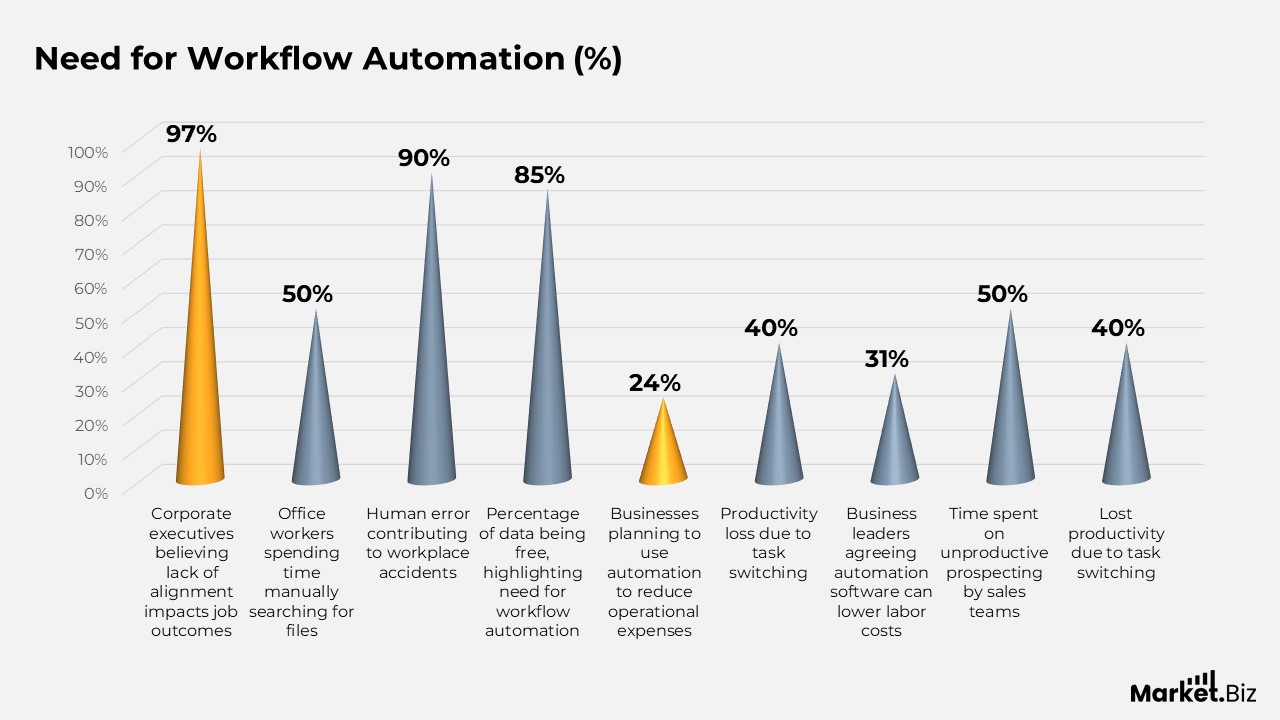
- 97% of corporate executives believe that a lack of alignment significantly impacts job outcomes.
- Office workers spend more than 50% of their time manually searching for files.
- Human error is a contributing factor in 90% of workplace accidents.
- With 85% of data being free, workflow automation is essential for businesses to save time and reduce errors.
- According to McKinsey, automation has the potential to increase global productivity by 0.8-1.4% annually.
- 24% of businesses plan to use job automation to reduce operational expenses.
- Task switching reduces productivity by 40%, but automation of repetitive tasks can help mitigate this loss.
- According to HBR, poor data quality costs US businesses a staggering $3 trillion each year.
- 31% of business leaders agree that automation software can help significantly lower labor costs.
- 50% of sales teams’ time is spent on unproductive prospecting efforts.
- 40% of productivity is lost due to task switching, but automating workflows can help address this issue.
- 70% of business leaders report spending 45 minutes to 3 hours on repetitive tasks throughout their 8-hour workday.
- Employees estimate that automating tasks could save them 240 hours per year, while company leaders believe automation could save up to 360 hours annually.
(Source: Frontdoor Labs Ltd., Statista)
Business Automation Statistics
- An Oxford report projects that automation in the manufacturing sector could contribute an additional $4.9 trillion annually by 2030, with the market expected to grow at a 6.6% CAGR from 2023 to 2028.
- According to the State of Process Orchestration Report, 81% of decision-makers are familiar with the concept of business process automation, and 90% confirmed their businesses are already using it. Among them, 49% said they are actively implementing it.
- Gartner predicts that investments in hyper-automation software solutions are set to exceed $720 billion shortly.
- An Accenture survey reveals that AI-driven automation will significantly boost profits across various industries by 2035, marking a key opportunity for businesses to enhance operations.
- 91% of respondents from the State of Process Orchestration Report stated that their companies plan to increase investment in process automation over the next 24 months, up from 88% the previous year.
(Source: Quixy, Statista)
Automation’s Impact on Business Efficiency and Workforce Productivity
- 90% of executives anticipate that their automation investments will enhance workforce capacity within the next three years.
- 73% of IT industry leaders report achieving time savings of 10-50% in task performance through automation.
- 51% of automation initiatives are primarily focused on improving business efficiency.
- 57% of IT leaders acknowledge that automation technology helps reduce business costs by 10-50% associated with manual processes.
- A majority of respondents agree that automation plays a key role in minimizing human error.
- 42% of business leaders believe automation accelerates the close of repetitive tasks.
- 85% of business leaders assert that automating their workload allows them and their teams to focus more on strategic, business-critical goals.
- 78% of business leaders believe automation boosts the productivity of all involved stakeholders.
- 31% of business leaders say automation contributes to reducing labor costs.
- Companies that have implemented automation solutions report a 12% increase in workforce capacity.
- There’s growing optimism about automation adoption, with expectations in 2020 that automation strategies would contribute to a 15% revenue increase.
- Organizations using automation have experienced a 24% cost reduction, up from 19% in 2019.
- 52% of business leaders believe that 10-30% of their daily tasks can be automated.
(Source: Cavintek, Inc, Statista)
Conclusion
Workflow automation is revolutionizing business operations by minimizing manual tasks, boosting efficiency, and improving overall productivity. As companies increasingly adopt cutting-edge technologies like robotic process automation, artificial intelligence, and cloud-based solutions, they are better equipped to navigate the demands of a fast-evolving business landscape.
By simplifying complex workflows and driving innovation, workflow automation not only enhances operational effectiveness but also serves as a key driver for growth and competitive advantage. As new technologies continue to advance and more industries integrate automation, the future of workflow automation presents vast opportunities for businesses to refine processes, reduce costs, and stay competitive.
Gaining insights through comprehensive statistics helps organizations make informed choices and strategically harness automation’s full potential.
FAQ’s
Workflow automation includes the use of technology to design, implement, and optimize business processes with minimal human input. It utilizes tools such as robotic process automation (RPA), artificial intelligence (AI), and cloud-based platforms to automate routine tasks, increase accuracy, and accelerate overall operations.
Workflow automation significantly improves operational efficiency by reducing manual efforts, boosting productivity, and minimizing errors. It enables businesses to scale their operations, enhance decision-making, and encourage innovation. Automation also allows companies to respond faster to market shifts, providing a competitive edge in a dynamic environment.
Key statistics include industry-specific adoption rates, the return on investment (ROI) from automation tools, cost reductions, and the time saved by automating processes. For instance, businesses implementing RPA have reported up to 30% time savings on manual tasks, while more than 70% of companies state that automation has enhanced their operational efficiency.
Workflow automation has progressed from basic rule-based systems to intelligent, adaptable solutions capable of managing intricate, cross-functional processes. Breakthroughs in AI, machine learning, and cloud technology have expanded automation’s capabilities, enabling businesses to automate more complex decision-making and task management across departments.
Sectors such as financial services, healthcare, manufacturing, and customer service are seeing the greatest benefits from automation. For example, financial institutions leverage AI to optimize transactions, while healthcare providers utilize automation for patient scheduling and medical record management.