









Introduction
Digital Workplace Statistics: The digital workplace has rapidly evolved into a core business enabler as organizations adopt cloud platforms, AI-driven tools, and hybrid communication technologies to enhance productivity, collaboration, and operational resilience. As remote and hybrid work models grow, companies are investing in advanced digital solutions that streamline workflows, support distributed teams, and strengthen security frameworks.
The rising adoption of automation, virtual communication platforms, and data-driven decision-making tools reflects a fundamental shift in how employees interact and perform daily tasks. Understanding key digital workplace statistics enables leaders to identify emerging workforce behaviors, assess capability gaps, and build future-ready digital ecosystems that enhance efficiency and employee experience.
Editor’s Choice
- Hybrid work is now the standard, with 84% of organizations offering flexible work options.
- Digital transformation continues to accelerate, supported by 91% of companies using cloud-based collaboration platforms.
- Multi-generational workforce dynamics are reshaping organizational culture and management expectations.
- AI is augmenting human work, with 78% of job roles being enhanced by technology rather than replaced.
- Continuous upskilling is essential as 81% of workers now require AI-related training.
- Workplace design is shifting to support collaboration and wellbeing in hybrid environments.
- The gig economy continues to expand, with 38% of the US workforce engaged in flexible employment.
- Employee well-being has become a priority, reflected in 82% of organizations offering structured wellness programs.
Moreover
- Global digital transformation spending reached 2.5 trillion in 2024.
- Only 1% of companies report reaching full maturity in AI adoption.
- Worker skill sets are expected to change significantly, with 39% projected to become transformed or outdated between 2025 and 2030.
- Organizations are dedicating around 7.5% of their revenue to digital transformation efforts.
- By 2026, 50% of digital workplace leaders will have a defined DEX strategy, up from approximately 30% in 2024.
- Digital transformation initiatives currently achieve a success rate of 48%, highlighting persistent implementation challenges.
- 78% of employees report higher productivity when offered flexible working arrangements.
- 62% of organizations have increased their spending on digital workplace technologies over the last year.
- 85% of employees now prefer either remote or hybrid work setups over traditional office-only models.
Further
- 69% of IT leaders acknowledge that they face security issues when implementing digital workplace solutions.
- Companies adopting digital collaboration platforms experience a 25% faster turnaround time for project completion.
- 60% of employees rely on collaboration tools in their daily workflow.
- 73% of workers say digital workplace tools strengthen communication across teams.
- 67% of organizations anticipate increasing their use of AI-powered workplace technologies over the next 2 years.
- 54% of remote employees experience some level of digital fatigue.
- 80% of organizations consider digital tools essential for maintaining business continuity.
- 55% of employees feel more engaged when working with digital collaboration solutions.
- 75% of organizations report improved employee experience through their digital workplace strategies.
- 43% of employees report that enhanced digital workflows have increased productivity.
Hybrid Work Adoption Patterns
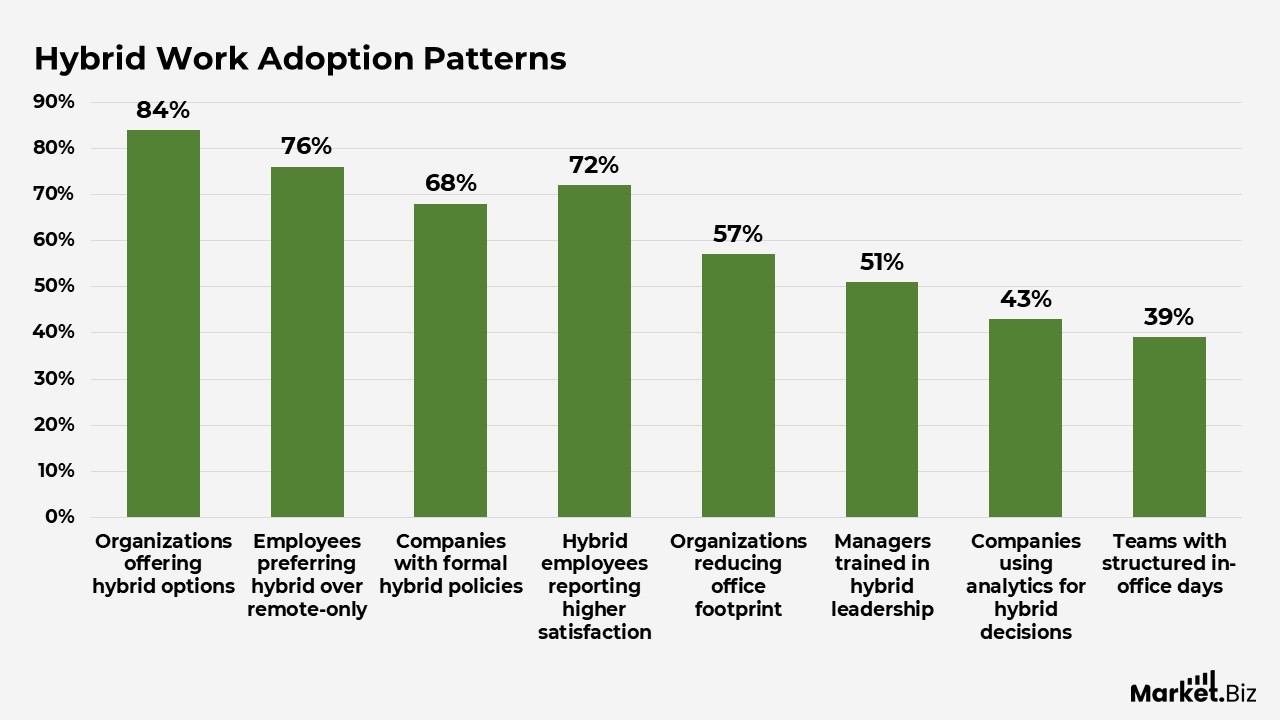
- 84% of organizations now provide structured hybrid work options as part of their workforce model.
- Employee preference continues to favor flexibility, with 76% choosing hybrid arrangements over fully remote setups.
- 68% of companies have established formal hybrid work policies to standardise expectations for employees.
- Job satisfaction is rising among hybrid employees, with 72% reporting a more positive work experience.
- Office space requirements are shifting as 57% of organizations scale down their physical footprint.
- Hybrid-specific leadership training has been provided to 51% of managers to support distributed teams effectively.
- Data-driven decision-making is growing, as shown by 43% of companies using analytics to optimize hybrid work practices.
- Structured in-office scheduling is implemented by 39% of teams to maintain coordination and collaboration.
(Source: Second Talent, Statista)
Digital Transformation Adoption Trends
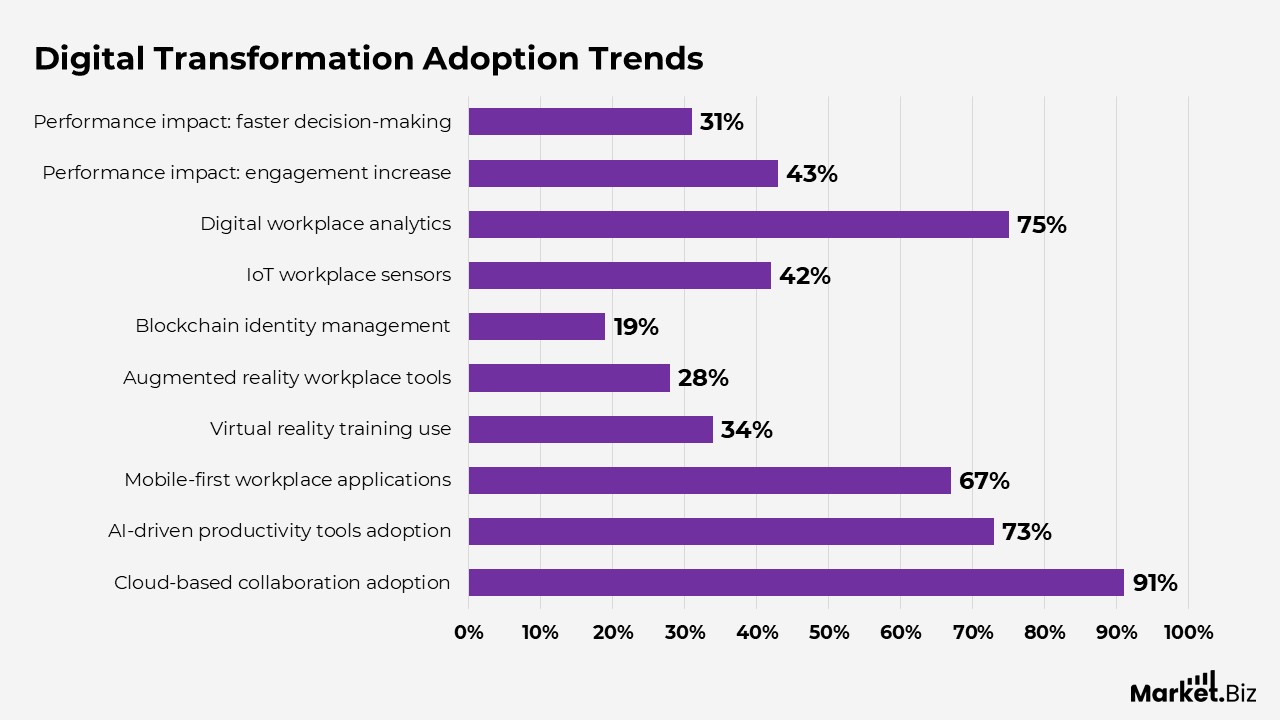
- Cloud collaboration continues to expand, with 91% of organizations relying on cloud-based platforms to support daily communication and teamwork.
- The use of AI-driven productivity tools has grown significantly, with 73% of companies adopting them to enhance workflow efficiency.
- Mobile-first workplace solutions are becoming standard, with 67% of organizations prioritizing mobile accessibility for employees.
- Virtual reality is emerging as a capability development tool, with 34% of companies using it for immersive training programs.
- Augmented reality tools are being introduced into workplace operations, with 28% adoption across various industries.
- Blockchain-based identity systems are gaining traction, with 19% of organisations implementing them for secure authentication.
- IoT-enabled workplace sensors are used by 42% of companies to optimize environmental monitoring and operational planning.
- Digital workplace analytics play an increasing role in decision-making, adopted by 75% of organizations.
- Organizations with advanced digital workplace strategies experience 43% higher employee engagement and 31% quicker decision-making.
(Source: Second Talent, Statista)
How Organizations Are Investing in Technology
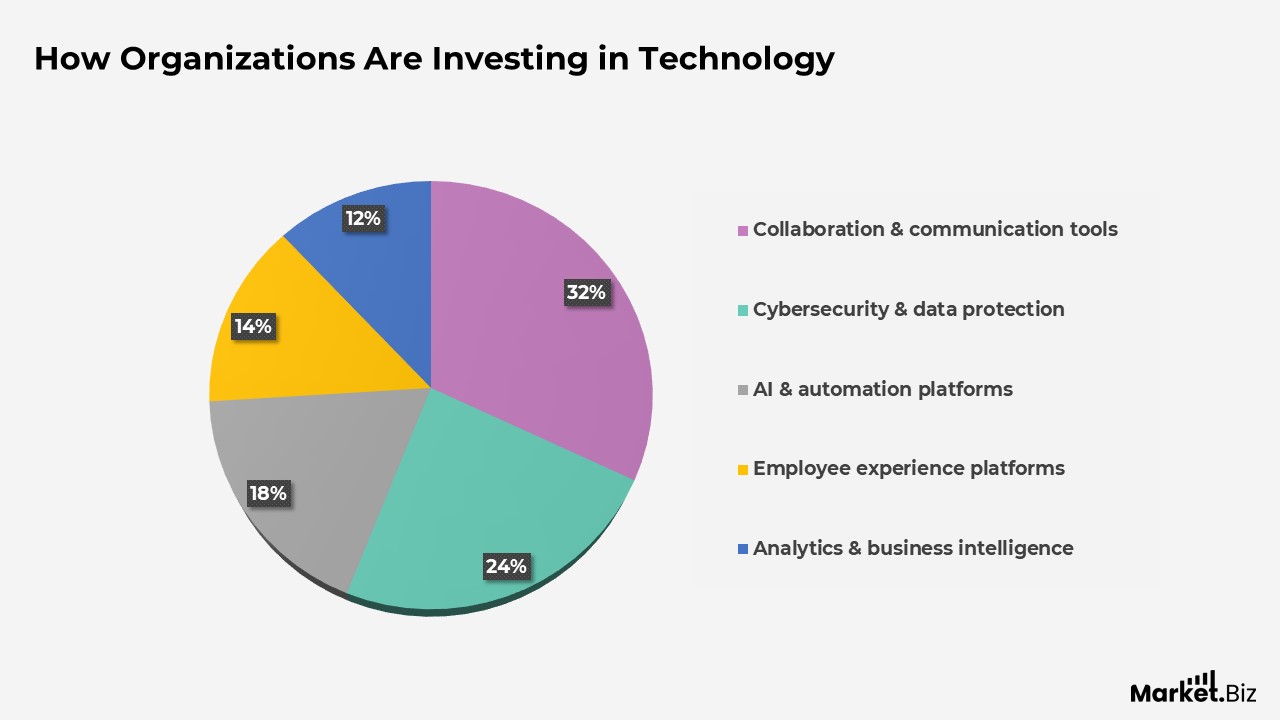
- Collaboration and communication platforms receive the highest allocation, accounting for 32% of total digital investment as organizations strengthen workforce connectivity.
- Cybersecurity and data protection remain critical priorities, with 24% of budgets dedicated to safeguarding digital infrastructure.
- AI and automation technologies secure 18% of spending as companies pursue smarter and more efficient operational models.
- Employee experience platforms represent 14% of investment, reflecting a growing focus on digital engagement and workplace satisfaction.
- Analytics and business intelligence tools capture 12% of budgets, supporting data-driven planning and strategic decision-making.
(Source: Second Talent, Statista)
How AI and Automation Are Redefining Skills and Productivity
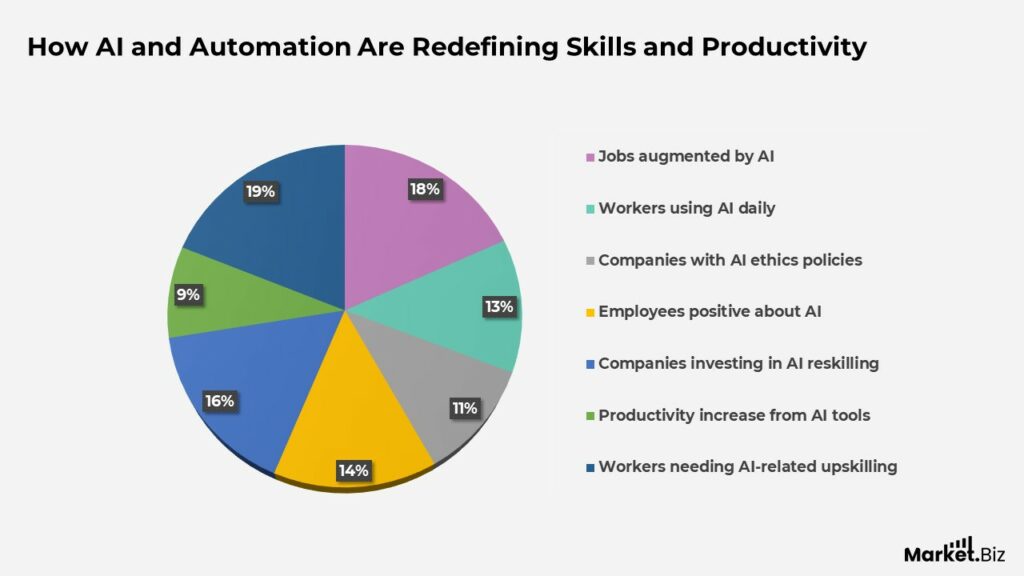
- AI is increasingly complementing human work, with 78% of roles being enhanced rather than replaced.
- Daily use of AI tools is rising, with 54% of employees integrating them into routine tasks.
- Ethical oversight is expanding, with 47% of organizations establishing formal AI governance policies.
- Employee sentiment toward AI is improving, with 62% expressing a positive outlook on its workplace integration.
- AI-driven advancements are generating new opportunities, contributing to an estimated 97 million emerging job roles globally.
- Investment in workforce development continues, as 69% of companies fund AI-focused reskilling programs.
- Productivity gains are evident, with AI-enabled tools contributing to a 37% increase in output.
- Skill transformation remains essential, as 81% of workers will require upskilling related to AI technologies.
(Source: Second Talent, Statista)
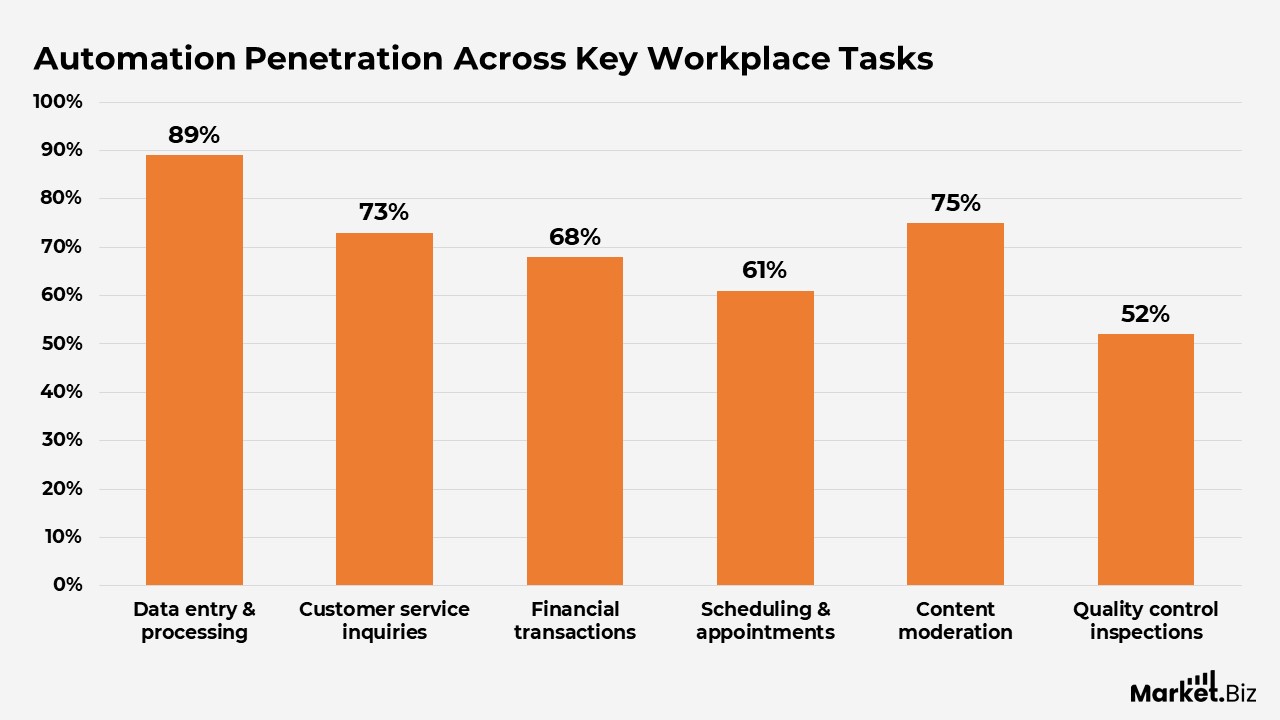
Automation Penetration Across Key Workplace Tasks
- Data entry and processing show the highest automation penetration, with 89% of tasks now handled by automated systems.
- Customer service functions are increasingly automated, with 73% of inquiries now supported by AI-driven tools.
- Financial transactions benefit from streamlined automation, with 68% of routine operations managed digitally.
- Scheduling and appointment handling are seeing growing automation, with 61% of related tasks executed by automated platforms.
- Content moderation relies heavily on automated systems, covering 75% of monitoring and review activities.
- Quality control processes incorporate automation in 52% of inspection tasks to improve accuracy and consistency.
(Source: Second Talent, Statista)
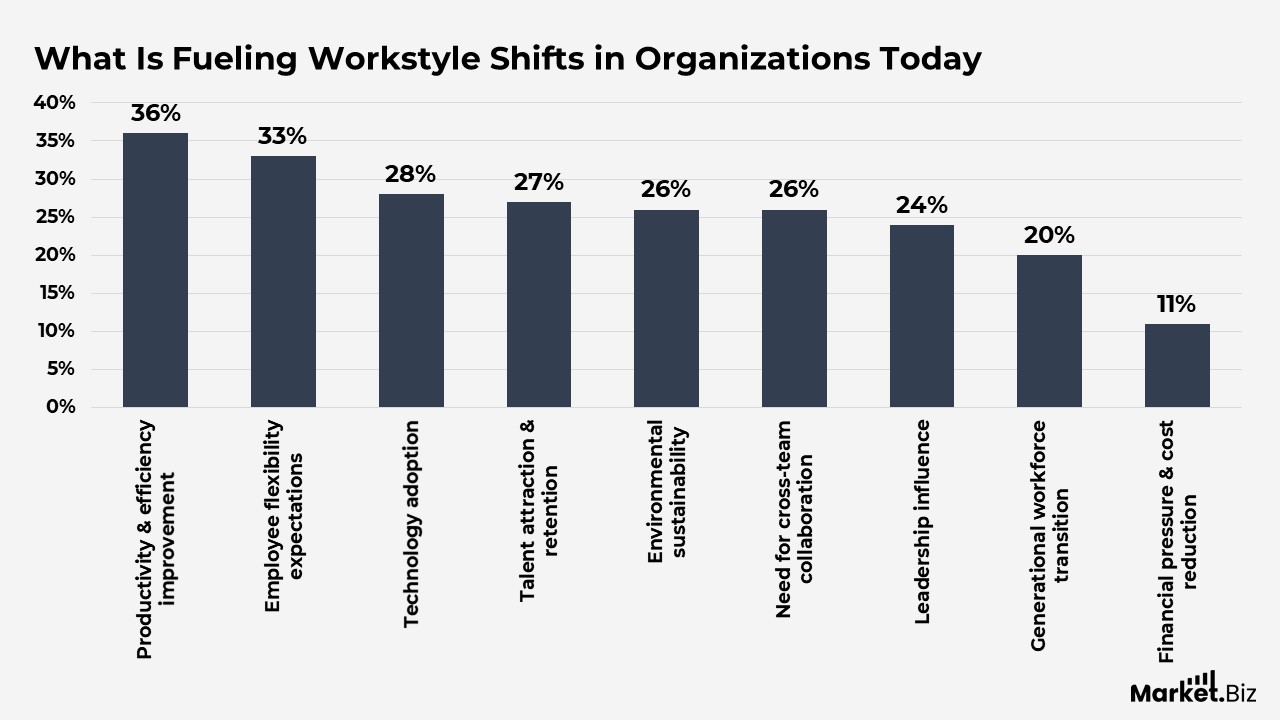
What Is Fueling Workstyle Shifts in Organizations Today
- The push for higher efficiency remains the strongest influence, with 36% citing productivity improvement as the primary driver of workstyle change.
- Growing employee expectations for flexibility and improved work-life balance are driving 33% of organisations to rethink workplace structures.
- The adoption of modern technology and digital tools motivates 28% of companies to update their workstyle approaches.
- Talent acquisition and retention needs influence 27% of organizational workstyle decisions.
- Environmental considerations shape workstyle strategies for 26% of organizations aiming for sustainable operations.
- The need to support seamless cross-team collaboration guides 26% of workstyle transformation efforts.
- Leadership involvement contributes to change, with 24% of management teams pushing for updated work approaches.
- Generational transitions in the workforce are driving 20% of organisations to evolve their workstyle to match employee expectations.
- Financial pressure and cost-reduction goals drive 11% of organizations to modify their workstyle.
(Source: Dimension Data)
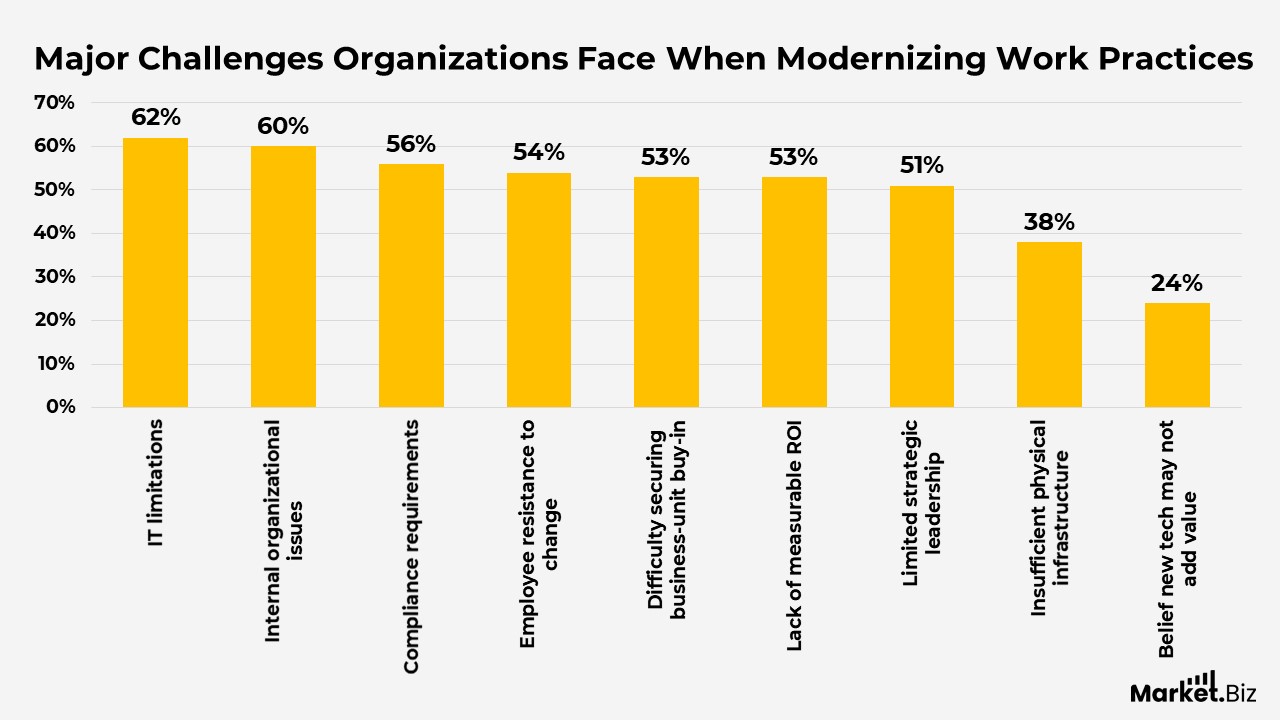
Major Challenges Organizations Face When Modernizing Work Practices
- IT-related challenges remain the most significant obstacle, with 62% of organizations struggling with technical limitations.
- Internal organizational issues follow closely, affecting 60% of companies attempting to shift to new workstyles.
- Compliance requirements create hurdles for 56% of organizations, slowing down transformation efforts.
- Staff reluctance to embrace change impacts 54% of workstyle adoption initiatives.
- Securing buy-in from different business units is difficult for 53% of organizations.
- A lack of measurable or clearly defined ROI concerns 53% of decision-makers during transformation.
- 51% of organisations face barriers due to a lack of strategic thought leadership.
- Insufficient physical infrastructure poses constraints for 38% of companies seeking to modernise their work processes.
- 24% of organizations believe new technologies may not deliver meaningful benefits, creating hesitation in adoption.
(Source: Dimension Data)
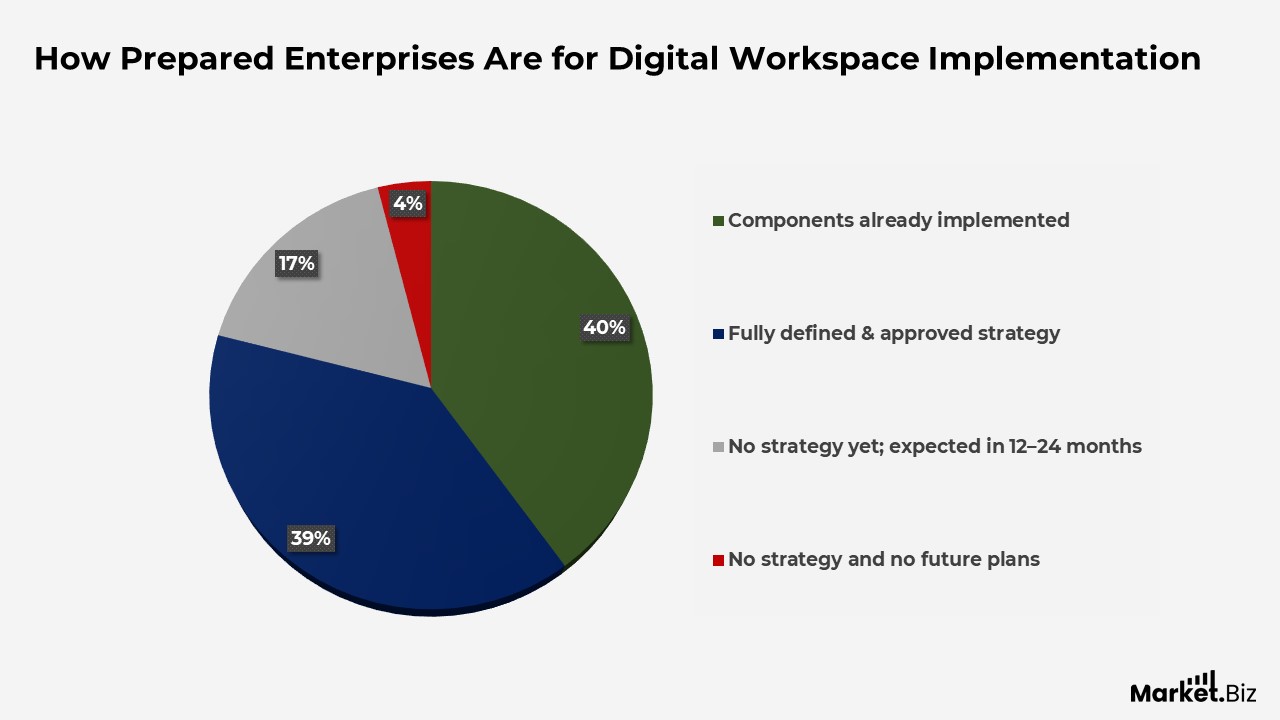
How Prepared Enterprises Are for Digital Workspace Implementation
- 40% of organizations report that several components of a digital workspace strategy are already in place.
- 39% indicate they have a fully defined, formally approved digital workspace strategy.
- 17% do not currently have a formal strategy but expect to develop one within the next 12–24 months.
- 4% of enterprises have no digital workspace strategy and no plans to create one in the foreseeable future.
(Source: Dimension Data)
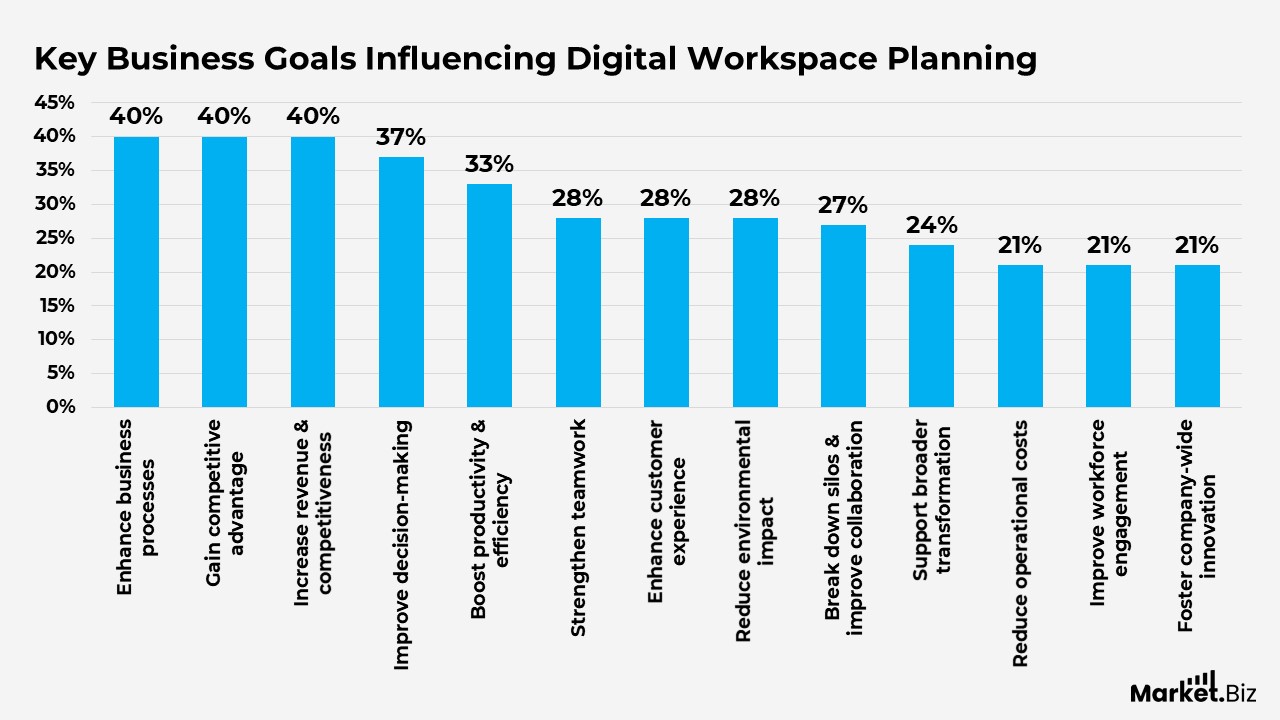
Key Business Goals Influencing Digital Workspace Planning
- Enhancing business processes is a top priority for 40% of organizations, identified as a core strategic objective.
- Gaining a competitive edge is equally important, with 40% of enterprises emphasizing this outcome.
- Increasing revenue and strengthening overall competitiveness are also key motivations for 40% of respondents.
- Faster, more informed decision-making is a goal for 37% of organizations implementing digital workspace strategies.
- Improving employee productivity and operational effectiveness is a focus for 33% of enterprises.
- Strengthening teamwork between employees, partners, and external collaborators is highlighted by 28% of companies.
- Enhancing customer experience is a strategic objective for 28% of organizations.
- Reducing environmental impact, including the carbon footprint, is targeted by 28% of respondents.
- Encouraging cross-company collaboration and eliminating workplace silos are goals for 27% of enterprises.
- Supporting broader organizational transformation initiatives is important to 24% of companies.
- Lowering operational costs is a priority for 21% of respondents.
- Building a more engaged and motivated workforce is also emphasized by 21% of organizations.
- Driving innovation across the company is identified as a key goal by 21% of businesses.
(Source: Dimension Data)
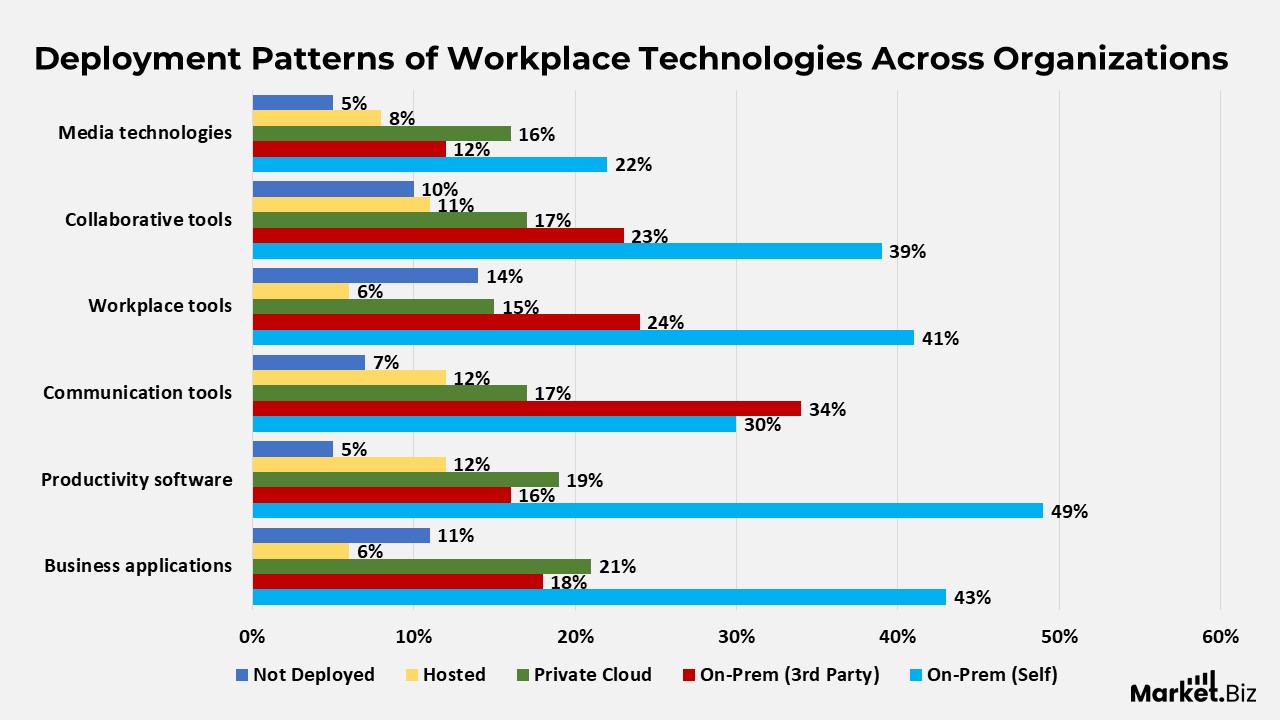
Deployment Patterns of Workplace Technologies Across Organizations
- Business applications are primarily deployed on-premises with self-management (43%), while 18% rely on third-party-managed on-premises setups, 21% use private cloud, 6% adopt hosted deployments, and 11% have not deployed them.
- Productivity software shows strong on-premise usage at 49%, followed by 16% using third-party managed on-premise, 19% on private cloud, 12% hosted externally, and 5% not deployed.
- Communication tools exhibit a varied mix: 30% self-managed on-premises, 34% third-party-managed on-premises, 17% in private cloud, 12% hosted externally, and 7% not yet deployed.
- Workplace tools follow a similar pattern: 41% use self-managed on-premises setups, 24% use third-party-managed on-premises setups, 15% use private cloud, 6% use externally hosted setups, and 14% remain undeployed.
- Collaborative tools are deployed on-premise by 39% of companies, 23% rely on third-party management, 17% use private cloud, 11% leverage hosted solutions, and 10% have not adopted them.
- Media technologies show 22% self-managed on-premises use, 12% third-party-managed deployments, 16% private cloud usage, 8% hosted deployments, and 5% undeployed.
(Source: Dimension Data)
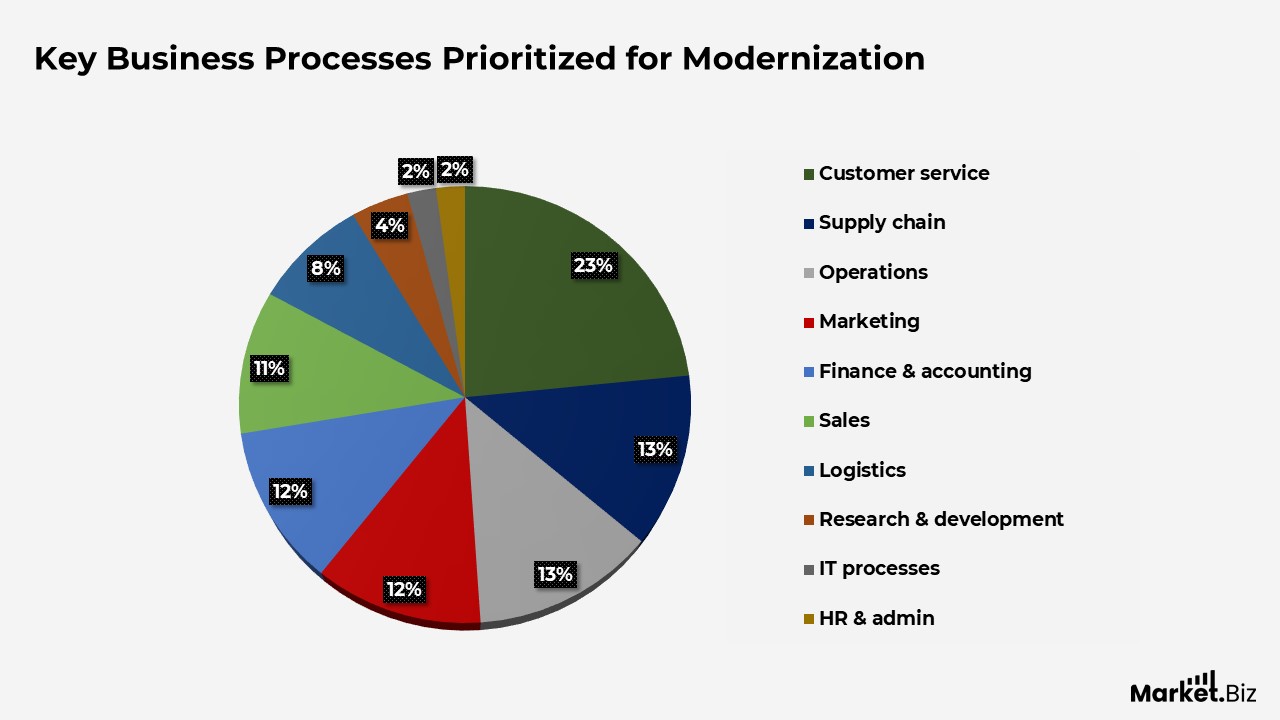
Key Business Processes Prioritized for Modernization
- Customer service stands as the top area identified for modernization, highlighted by 22% of organizations.
- Supply chain processes are the next target, with 12% emphasising the need for updated systems and improvements.
- Operations modernization is a priority for 12% of respondents, who aim to streamline internal workflows.
- 11% of organizations plan to improve their marketing functions.
- 11% of enterprises say finance and accounting processes require modernisation.
- Sales processes are identified by 10% as needing enhancement to remain competitive.
- 8% of companies plan logistics and distribution improvements to optimise movement and fulfilment.
- Research and development modernization is reported by 4% of organizations.
- IT processes are recognized for upgrades by 2% of respondents.
- HR and administrative functions account for 2% of modernization priorities as companies seek efficiency gains.
(Source: Dimension Data)
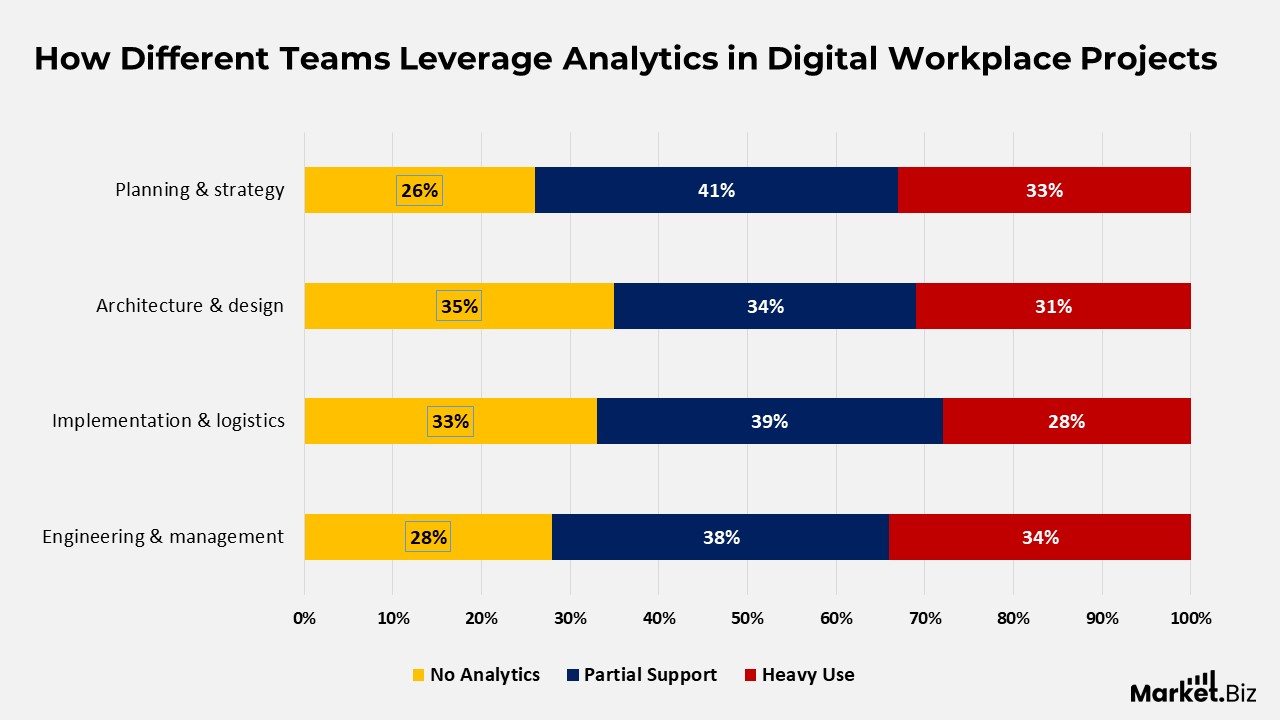
How Different Teams Leverage Analytics in Digital Workplace Projects
- Engineering and ongoing management activities vary in reliance on analytics, with 28% requiring no analytical input, 38% benefiting from partial support, and 34% depending on substantial analytical assistance.
- The implementation and logistics functions show similar diversity: 33% operate without analytics, 39% use moderate analytical support, and 28% rely heavily on advanced analytics.
- Architecture and design teams report 35% working without analytics, 34% integrating some analytical insights, and 31% utilizing significant analytical guidance.
- Planning and strategic functions increasingly depend on analytics: 26% require none, 41% use partial support, and 33% draw on extensive analytics for key decisions.
(Source: Dimension Data)
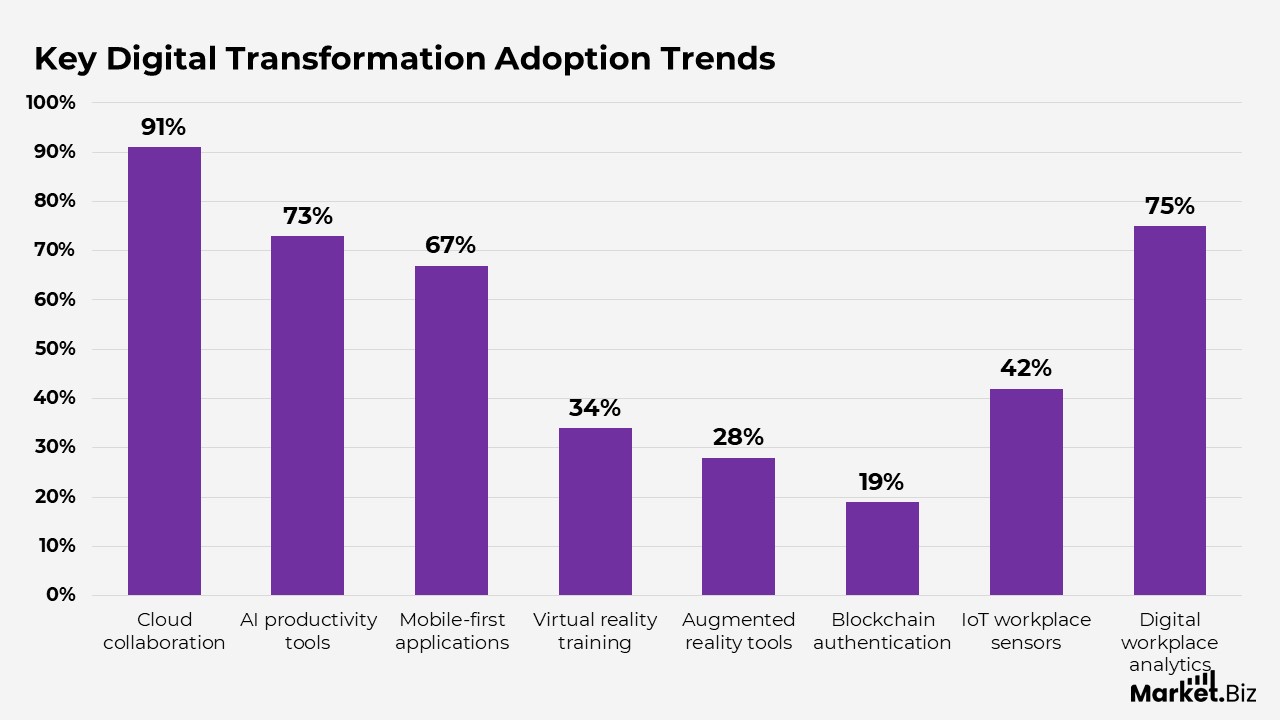
Key Digital Transformation Adoption Trends
- Cloud collaboration continues expanding rapidly, with 91% of organizations integrating cloud-based platforms into daily operations.
- AI-driven productivity tools are gaining strong traction, with 73% of companies adopting them to enhance workflow efficiency.
- Mobile-first applications are becoming the norm, with 67% of workplaces prioritizing mobile access for employees.
- Virtual reality is emerging as a training solution, with 34% of organizations implementing it for immersive skill development.
- Augmented reality tools are entering workplace workflows, with 28% adoption across various industries.
- Blockchain identity systems are slowly gaining ground, with 19% of companies using them to strengthen digital authentication.
- IoT-driven workplace sensors are used by 42% of organizations to improve monitoring and operational insights.
- Digital workplace analytics are widely adopted, with 75% of companies leveraging data insights to support decision-making.
(Source: Second Talent, Statista)
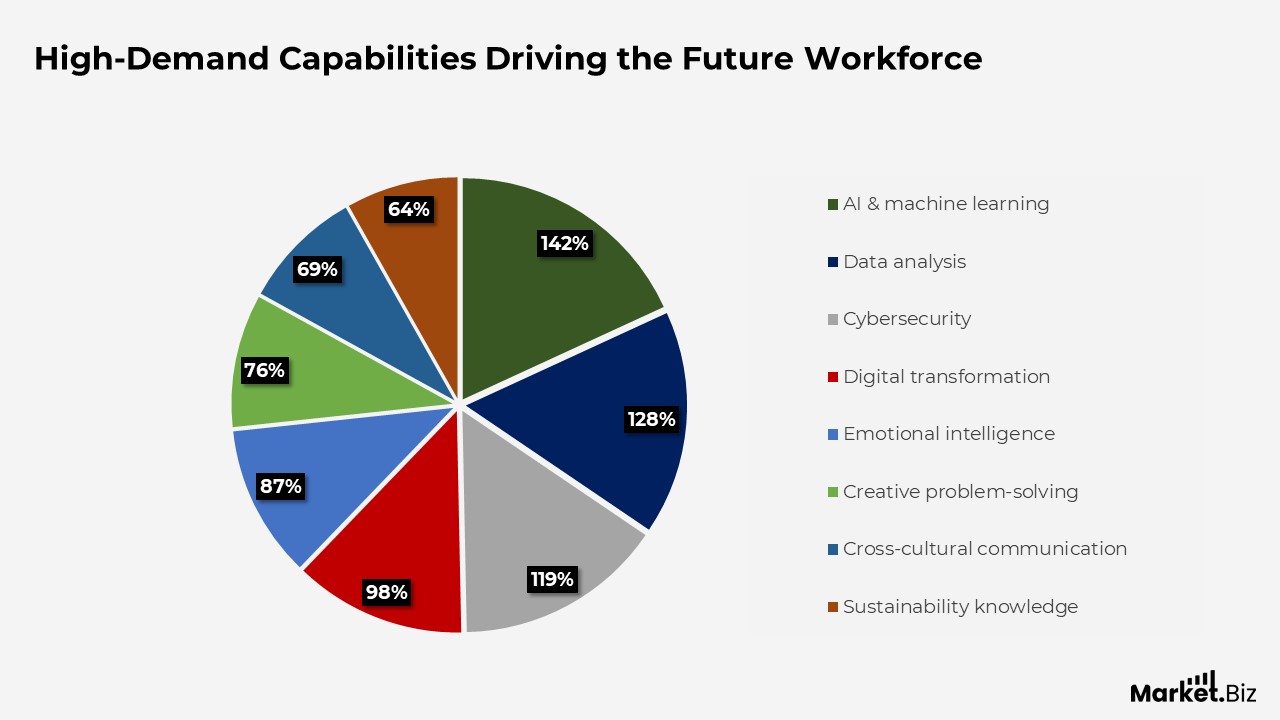
High-Demand Capabilities Driving the Future Workforce
- Skills in AI and machine learning are seeing the highest surge, with demand increasing by 142%.
- Data analysis and interpretation capabilities follow closely, experiencing a 128% rise in demand.
- Cybersecurity expertise is becoming essential, with a 119% increase in required proficiency.
- Digital transformation skills are gaining prominence, with demand growing by 98%.
- Emotional intelligence remains a critical soft skill, with employer demand increasing by 87%.
- Creative problem-solving skills are becoming increasingly important, with demand rising 76%.
- Cross-cultural communication skills are increasingly valued, reflecting a 69% increase in need.
- Knowledge of sustainability practices is becoming more relevant, with demand up by 64%.
(Source: Second Talent, Statista)
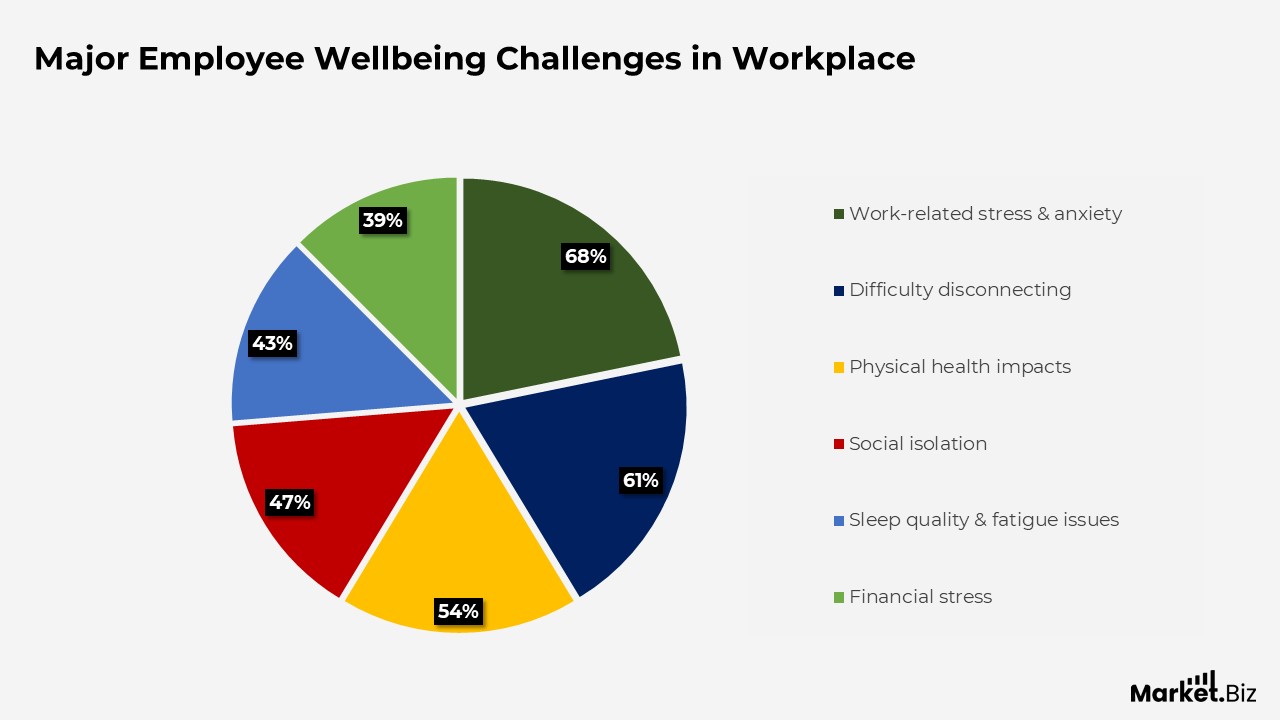
Major Employee Wellbeing Challenges in the Workplace
- Work-related stress and anxiety remain the most widespread concern, reported by 68% of employees.
- Difficulty disengaging from work after hours affects 61% of individuals, highlighting blurred boundaries in modern work setups.
- Remote work has contributed to physical health issues for 54% of employees, including posture and movement-related problems.
- 47% of the workforce experiences feelings of social isolation and loneliness.
- Sleep disturbances and persistent fatigue impact 43% of employees navigating evolving work demands.
- Financial pressures and uncertainty continue to trouble 39% of workers.
(Source: Second Talent, Statista)
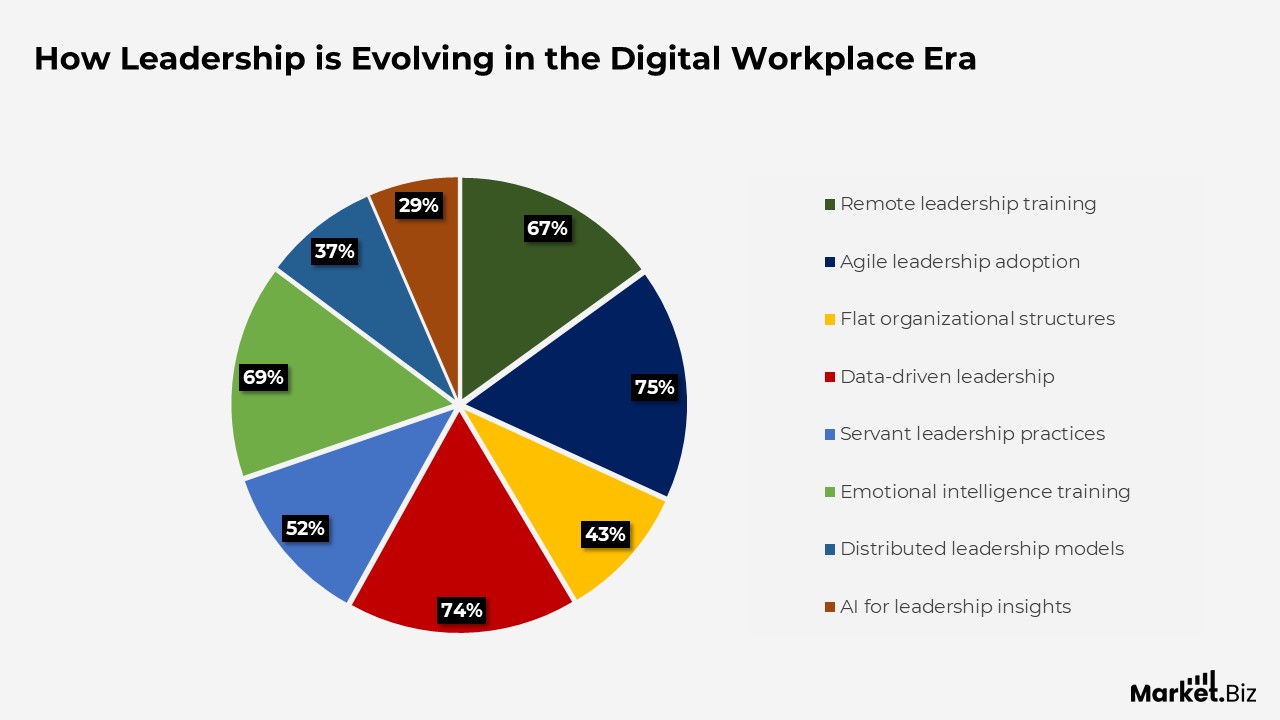
How Leadership is Evolving in the Digital Workplace Era: Statistics
- Training in remote management is becoming essential, with 67% of leaders receiving specialized preparation for distributed teams.
- Agile leadership practices are widely adopted, with 75% of organizations embracing flexible, adaptive leadership models.
- Flatter organizational structures are emerging, implemented by 43% of companies to encourage faster decision-making.
- Data-informed leadership is on the rise, with 74% of leaders relying on analytics to inform strategic decisions.
- Servant leadership principles are gaining momentum, with 52% of organizations practising them to foster supportive work environments.
- Emotional intelligence training is prioritized, with 69% of leaders receiving development in empathy and interpersonal skills.
- Distributed leadership models are adopted by 37% of companies, enabling shared responsibility across teams.
- AI-driven leadership insights are used by 29% of organizations to enhance managerial performance and planning.
(Source: Second Talent, Statista)
Conclusion
Digital Workplace Statistics: The digital workplace is rapidly reshaping how organizations function, collaborate, and deliver value in a technology-driven world. The statistics highlight a clear movement toward hybrid work models, stronger investments in digital tools, and increasing adoption of AI to boost performance and employee satisfaction.
As companies confront challenges such as cybersecurity risks, workforce fatigue, and evolving skill demands, building resilient and adaptable digital environments becomes essential.
Overall, the data shows that digital workplace advancement has become a strategic necessity rather than an optional improvement. Organizations that prioritize modern collaboration tools, continuous upskilling, intelligent automation, and employee well-being are better equipped to innovate and stay competitive.
These insights provide leaders with a solid foundation for making informed choices and building workplaces that support productivity, engagement, and long-term success.
FAQ’s
A digital workplace symbolizes a foundational move away from traditional, physically anchored work models toward technology-driven environments where productivity, collaboration, and organizational culture operate independently of geographical boundaries.
Such statistics serve as empirical indicators that demonstrate the extent to which digitalization is influencing business structures, workforce behaviors, management philosophies, and long-term strategic planning.
Hybrid work reframes the workplace as outcome-oriented rather than location-dependent, prompting a reevaluation of established beliefs surrounding supervision, employee engagement, social cohesion, and organizational identity.
Frameworks such as Diffusion of Innovation Theory, Sociotechnical Systems Theory, and Organizational Change Models clarify how digital tools evolve from early-stage experimentation into fully embedded organizational practices.
They highlight the shift from manual, effort-based productivity to digitally facilitated efficiency, where automation, reduced operational friction, and improved information flow redefine how work is executed and measured.

