








Introduction
Identity and Access Management Statistics: Identity and Access Management (IAM) is a vital framework that ensures the right individuals or systems can access the appropriate resources within an organization. IAM statistics offer valuable insights into how organizations manage and secure identities, access controls, and user permissions.
As digital environments become more complex and cyber threats continue to rise, there is a growing need for robust IAM systems to protect sensitive data and systems. With the shift toward cloud-based environments and remote work, IAM statistics highlight the adoption of technologies such as multifactor authentication (MFA), single sign-on (SSO), and identity governance and administration (IGA).
These statistics are crucial for tracking trends, ensuring regulatory compliance, and assessing the effectiveness of IAM strategies in mitigating security risks and breaches.
Editor’s Choice
- 80% of cyberattacks use identity-based attack methods.
- 99% of security decision-makers believe they will face a character-related compromise in the next year.
- 4.45 million dollars is the average cost of a data breach.
- 3 out of 4 CISOs consider collaboration tools pose significant new security risks, with 94% considering the built-in security tools of Microsoft 365 insufficient.
- 80% say that better identity and access management would have prevented some or all attacks on their organization.
- 24% of security professionals in the US report that their organization has experienced a brute force attack, such as password spraying or credential stuffing, within the past two years.
- Although 45% of breaches occur in the cloud, organizations with a hybrid cloud setup experienced lower average data breach costs, at USD 3.80 million, compared to those using public or private cloud models.
- Notably, 25% of those affected by cybercrime in the US and UK are managers or business owners, with 34% of identity-related breaches in the past two years targeting privileged user accounts.
(Source: CrowdStrike, CyberArk, IBM, Mimecast, One Identity, Expertinsights)
Identity and Access Management Trends
- 60% of medium-sized companies, impacting 250-5000 employees, reported being affected by a hack, with 56% of these organizations experiencing credential theft and 48% facing incidents of social engineering, such as phishing, after employees were requested to work remotely.
- 91% of companies state that the primary reason for adopting passwordless multifactor authentication (MFA) is to defend against cyberattacks, particularly to prevent credential theft and phishing attempts.
- According to Privileged Access Management in the Modern Threatscape reports, 74% of data breaches stem from the misuse of privileged credentials.
- Nearly 90% of financial organizations have been impacted by data breaches, with 60% of these incidents involving identity theft.
- A study revealed that 44% of security experts believe their current security vulnerabilities could be addressed by implementing an Identity and Access Management (IAM) solution.
- On average, the cost of a data breach is USD 4.24 million.
- A poll conducted by cybersecurity experts showed that when evaluating an Identity and Access Management (IAM) solution, 72% of organizations prioritize ease of integration, with 62% emphasizing end-user experience and 61% focusing on the product’s performance and effectiveness.
Moreover
- Last year, only 34% of companies with a culture of innovation in their security practices reported suffering an identity-connected security breach.
- An analysis of identity and access management suggests that automation can lead to cost savings of more than 17% for companies.
- 49% of businesses have at least one employee whose access rights exceed what is required for their job responsibilities.
- Despite the critical need for securing sensitive data, only 21% of companies have implemented multifactor authentication for privileged administrative access, and only 48% have implemented password vaults.
- 79% of companies surveyed have experienced a data breach in the last two years, which accounts for 94% of all reported breaches.
- According to the IDSA, 99% of participants who experienced an identity-related security breach believe the attacks could have been prevented.
- 61% of all security breaches involve credentials, either obtained through social engineering or hacked using brute force tactics.
- Phishing, a form of social engineering attack, accounts for 25% of all data breaches.
- A recent survey found that 8 in 10 individuals struggle with password management.
(Source: Expertinsights, Forbes, IBM, Identitymanagementinstitute, Webinarcare, Nordpass, Verizon, IDSA)
Identity and Access Management Market Size
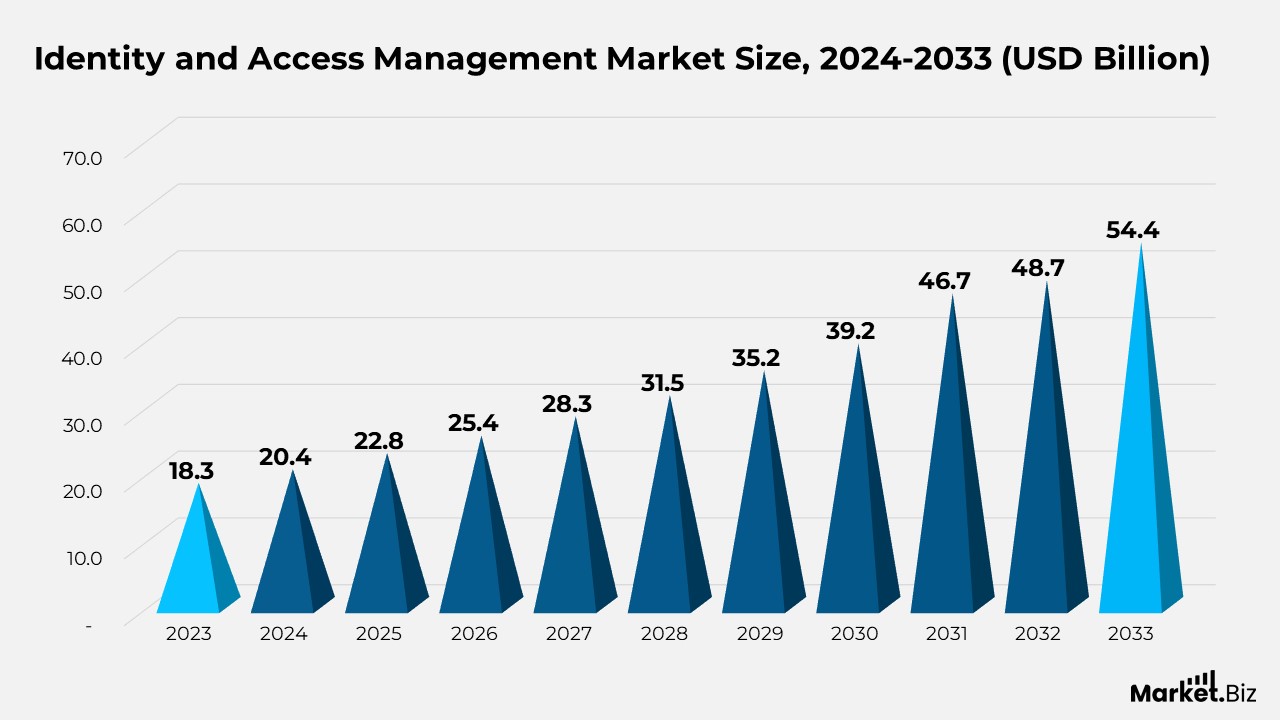
- According to Market.us, the identity and access management market is expected to rise from $20.4 billion in 2024 to $54.4 billion by 2033, representing a compound annual growth rate (CAGR) of 11.5% from 2024 to 2033.
- The growth of the IAM market is fueled by technological advancements like biometrics and machine learning, along with increasing cybersecurity needs and regulatory compliance requirements.
- The provisioning segment dominated the IAM market in 2023, holding over 32.5% of the market share due to its critical role in managing digital identities.
- The on-premises segment led the IAM market in 2023 with more than 54.1% of the market share, offering enhanced control and security for organizations.
- Large enterprises captured more than 65.8% of the IAM market in 2023, driven by their complex security needs and extensive infrastructure requirements.
- The BFSI segment maintained a dominant position in the IAM market with more than 23% of the market share in 2023, due to strict security and compliance demands in the financial sector.
- North America led the IAM market in 2023, securing more than 38.3% of the market share, generating USD 7.0 billion in revenues, attributed to strong cybersecurity frameworks and technology adoption.
(Source: Market.us)
Blockchain Identity Management Market Size
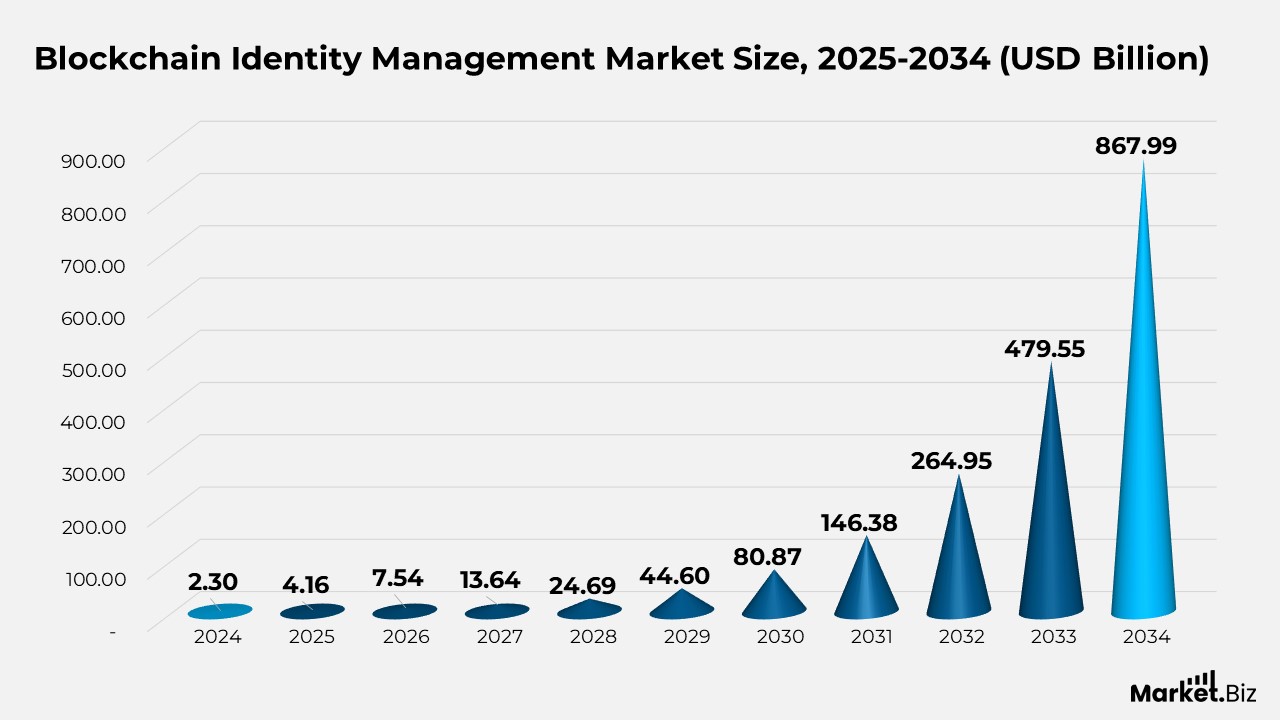
- According to Market.us, the blockchain identity management market is expected to rise from $4.16 billion in 2025 to $867.99 billion by 2034, representing a compound annual growth rate (CAGR) of 81% from 2025 to 2034.
- Increasing concerns about digital security breaches and the limitations of centralized identity systems drive the growth of the blockchain identity management market.
- In 2024, the Software segment led the blockchain identity management market, taking a 62% share due to the rising demand for flexible and customized identity management systems.
- The Application Provider segment held a 54% market share in 2024, driven by the growing need for user-friendly applications integrating blockchain for secure identity management.
- Large Enterprises accounted for over 57% of total industry revenues in 2024, supported by significant investments from sectors like BFSI, government, telecommunications, and healthcare.
- The Permissioned Network segment dominated the blockchain identity management market in 2024, securing a 72% share due to its ability to provide regulated compliance, privacy, and controlled access.
- The BFSI sector led the blockchain identity management market in 2024, holding more than 22% of the market share, driven by the need for enhanced security, streamlined KYC and AML processes, and regulatory compliance.
- North America maintained a leading position in the blockchain identity management market in 2024, capturing 38% of the global market share with revenues nearing USD 0.87 billion, thanks to robust digital infrastructure and early blockchain adoption.
(Source: Market.us)
IAM Adoption and Implementation Trends
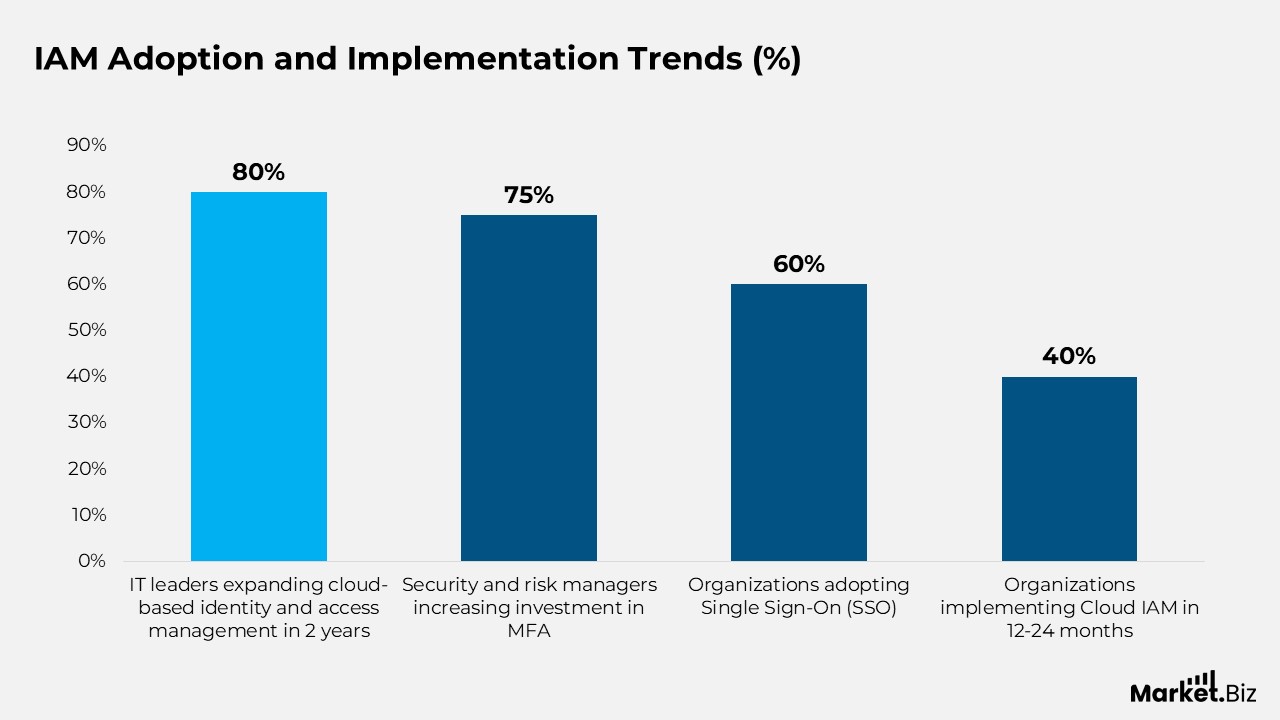
- Over 80% of IT leaders worldwide have either already implemented or plan to implement and expand cloud-based identity and access management within the next two years.
- Nearly 75% of enterprise security and risk managers aim to increase their investments in multifactor authentication (MFA) to strengthen security measures.
- 60-70% of organizations are expected to adopt or plan to adopt Single Sign-On (SSO) shortly, improving authentication processes across multiple platforms.
- 40-50% of organizations are projected to implement Cloud Identity and Access Management (CIAM) within the next 12 to 24 months, marking a significant shift towards cloud-based access controls.
(Source: TechRepublic, Bloomberg, vSecureLabs, BusinessWire)
IT Security Workforce Trends
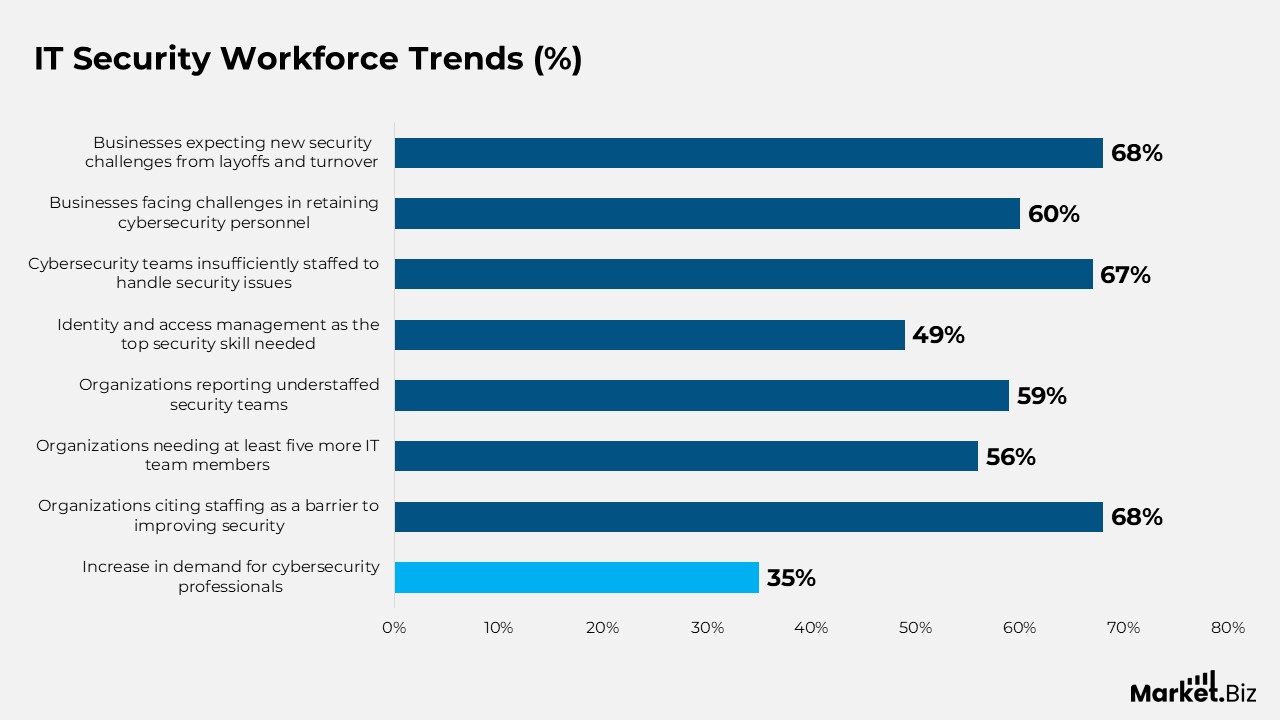
- The demand for cybersecurity professionals has risen by 35% compared to the previous year.
- 68% of organizations identify staffing as the primary barrier to improving their security efforts, with 56% stating that they would need at least five more full-time employees in their IT teams.
- A survey of 2,178 information security managers revealed that 59% of organizations are somewhat or significantly understaffed.
- 49% of organizations highlighted identity and access management as one of the top five most-needed security skills, the highest percentage among other responses.
- The global gap in the cybersecurity workforce is estimated to be approximately 4 million professionals.
- 67% of respondents indicated that their cybersecurity teams are insufficiently staffed to prevent and resolve security issues effectively.
- Companies report skill gaps in key areas such as zero-trust implementation (29%) and cloud computing security (35%).
- The primary factors negatively impacting job satisfaction for cybersecurity professionals are overwork (30%) and an overwhelming volume of emails/tasks (31%).
- 60% of businesses face challenges in retaining qualified cybersecurity personnel.
- 68% of businesses anticipate that layoffs and staff turnover will lead to new security challenges.
(Source: Microsoft, Arctic Wolf, ISACA, ISC2, Sosafe, CyberArk)
Challenges in Identity Threat Detection and Cybersecurity
- A survey by CyberArk reveals that 64% of organizations either currently prioritize or plan to prioritize Identity Threat Detection and Response (ITDR). The top reasons identified for identity-related attacks include:
- Digital transformation (22%)
- Weaknesses in IAM infrastructure (21%)
- Increasing volume and complexity of cyberattacks (20%)
- The same survey also found that 93% of organizations anticipate facing cybersecurity challenges related to AI.
- In a 2024 survey conducted by NordPass, the United States, the United Kingdom, and India were identified as the countries with the highest number of companies experiencing data breaches.
(Source: Microsoft, Expert Insights)
Conclusion
Identity and Access Management (IAM) underscores the growing need for robust security measures to defend organizations against evolving cyber threats. Given that identity-based attacks account for a substantial share of cyber incidents, the adoption of advanced IAM solutions such as multifactor authentication (MFA), privileged access management, and automation has become essential.
Organizations must proactively address security vulnerabilities to prevent data breaches, which can result in significant financial and operational consequences. As businesses increasingly move to hybrid and cloud-based environments, IAM strategies must adapt to ensure secure, seamless access while protecting sensitive data and maintaining regulatory compliance.
With most breaches involving compromised credentials, investing in IAM technologies is not just critical but a strategic necessity to protect both data and organizational trust in today’s digital landscape.
FAQ’s
IAM is a framework designed to ensure that only authorized individuals or systems have access to specific resources within an organization. It involves managing digital identities and controlling access to applications, systems, and data to safeguard against unauthorized entry and cyber threats.
IAM statistics offer valuable insights into how organizations are securing their digital assets, managing access controls, and defending against identity-based attacks. These statistics help track evolving security trends, assess the effectiveness of current IAM measures, and identify areas that require improvement to strengthen security.
Common IAM solutions include multifactor authentication (MFA), single sign-on (SSO), privileged access management (PAM), identity governance and administration (IGA), and automation tools to improve the efficiency and security of identity and access management processes.
IAM solutions help mitigate the risk of data breaches by ensuring that only authorized users can access sensitive data. Technologies such as MFA, PAM, and automated access controls protect against unauthorized access and reduce the impact of compromised credentials.
Industry reports show that 80% of cyberattacks involve identity-based tactics, including credential theft, phishing, and brute force attacks.
IAM statistics provide organizations with key data on common vulnerabilities, emerging security trends, and the effectiveness of their IAM solutions. Analyzing these statistics allows businesses to refine their security strategies, allocate resources effectively, and address gaps in access management practices.