








Introduction
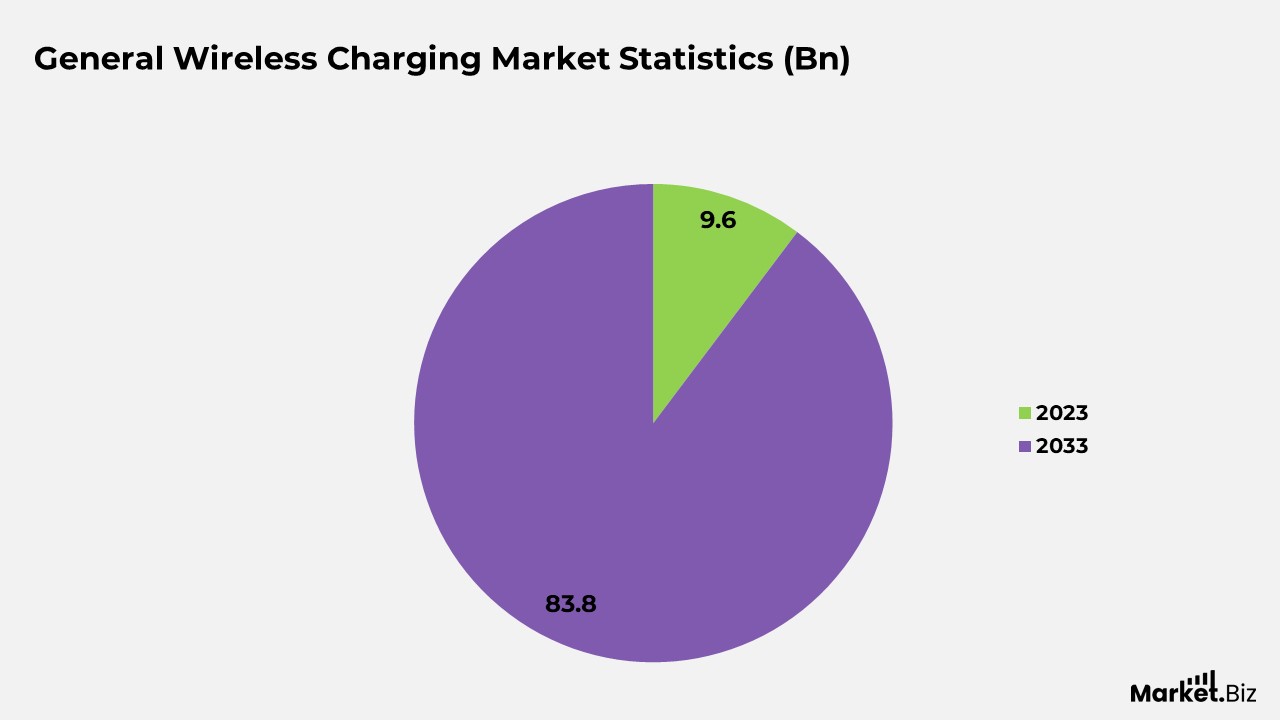
Wireless Charging Statistics: The Global Wireless Charging Market is projected to reach approximately USD 83.8 billion by the year 2033, a significant increase from USD 9.6 billion in 2023.
Wireless charging refers to a technology that facilitates the transfer of power to electronic devices via an electromagnetic field, thereby removing the necessity for physical connectors or cables. This technology is widely utilized in smartphones, tablets, and specific smart medical devices, offering a convenient and organized charging solution.
Wireless charging is a technology that employs electromagnetic induction to transfer energy between 2 coils, one located in a charging pad and the other within a device, without the use of cables. This technology provides convenience, minimizes wear on charging ports, and ensures a safer charging experience. Nonetheless, it is usually slower than wired charging, necessitates precise alignment between the coils, and has a limited range and efficiency.
Wireless charging is frequently utilized in consumer electronics such as smartphones and smartwatches. Additionally, it is being investigated for use in electric vehicles and medical devices. Despite its drawbacks, ongoing advancements are enhancing its capabilities and expanding its applications.
Editor’s Choice
- In 2023, the wireless charging industry generated a global revenue of USD 9.6 billion.
- The global revenue for the power bank industry is projected to reach $16.3 billion by 2028.
- The global wireless charging market is anticipated to witness significant growth over the next decade, with a compound annual growth rate (CAGR) of 24.2%.
- In 2022, the market size was recorded at 3.63 thousand units, indicating the early phase of adoption.
- As of October 2024, Anker Innovation Technology is at the forefront of the wireless charging market, leading in revenue with $2,000 million.
- In 2010, a total of 380 patents were submitted, which rose to 626 in 2011 and 924 in 2012.
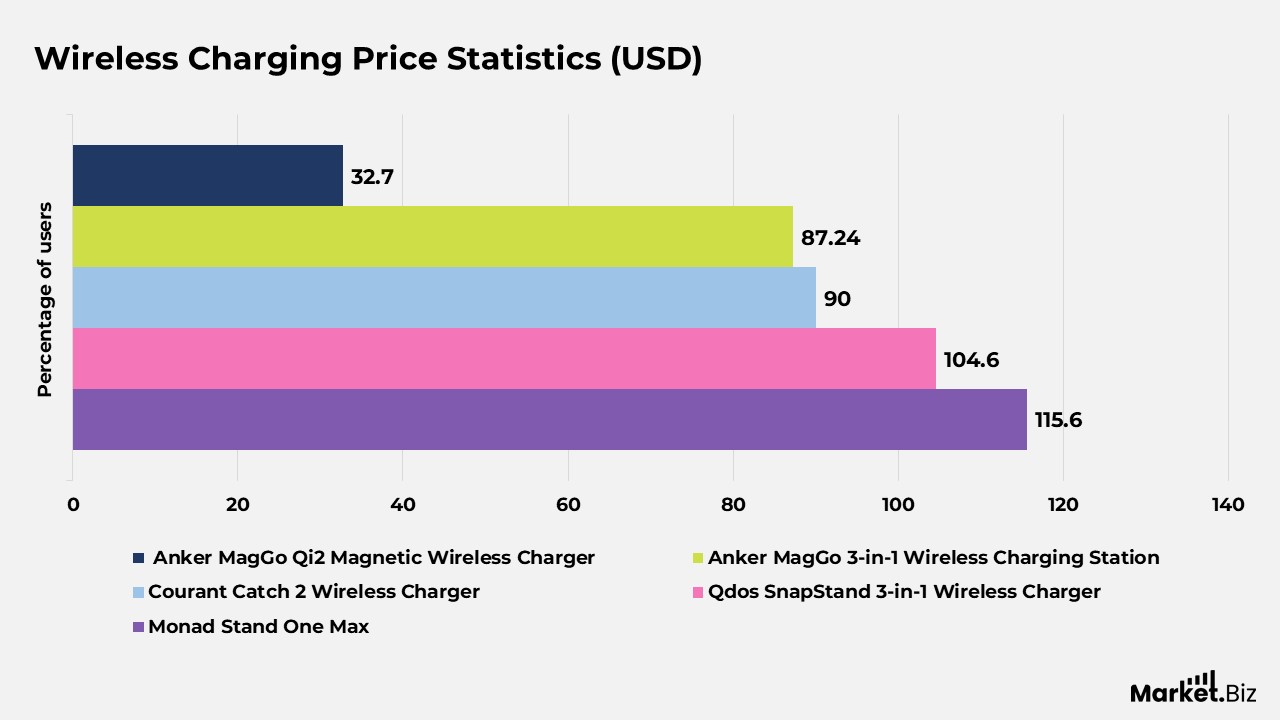
- The Monad Stand One Max dominates the market with a price tag of $115.6, closely followed by the Qdos SnapStand 3-in-1 Wireless Charger priced at $104.6.
General Wireless Charging Statistics
- In 2023, the wireless charging industry generated a global revenue of USD 9.6 billion.
- This sector encompasses various application areas, with consumer electronics leading the way, accounting for a 26% market share.
- The global revenue for the power bank industry is projected to reach $16.3 billion by 2028.
- As of October 2024, Anker Innovation Technology is leading the wireless charging market in revenue, achieving $2,000 million.
- The U.S. Department of Transportation is initiating a focused grant program designed to finance wireless electric vehicle charging infrastructure, with a budget of $250 million earmarked for multiple initiatives, including parking lots, roadways, and bus routes.
- In China, the Provisional Regulations on Radio Management of Wireless Charging Equipment have established particular technical specifications, which include specified frequency bands and power limitations for mobile and portable devices, in addition to electric vehicles, set to take effect from September 2024.
Wireless Charging Market Growth Statistics
- The global wireless charging market is anticipated to witness significant growth over the next decade, with a compound annual growth rate (CAGR) of 24.2%.
- This growth is expected to elevate the market size from USD 9.6 billion in 2023 to an impressive USD 83.8 billion by 2033.
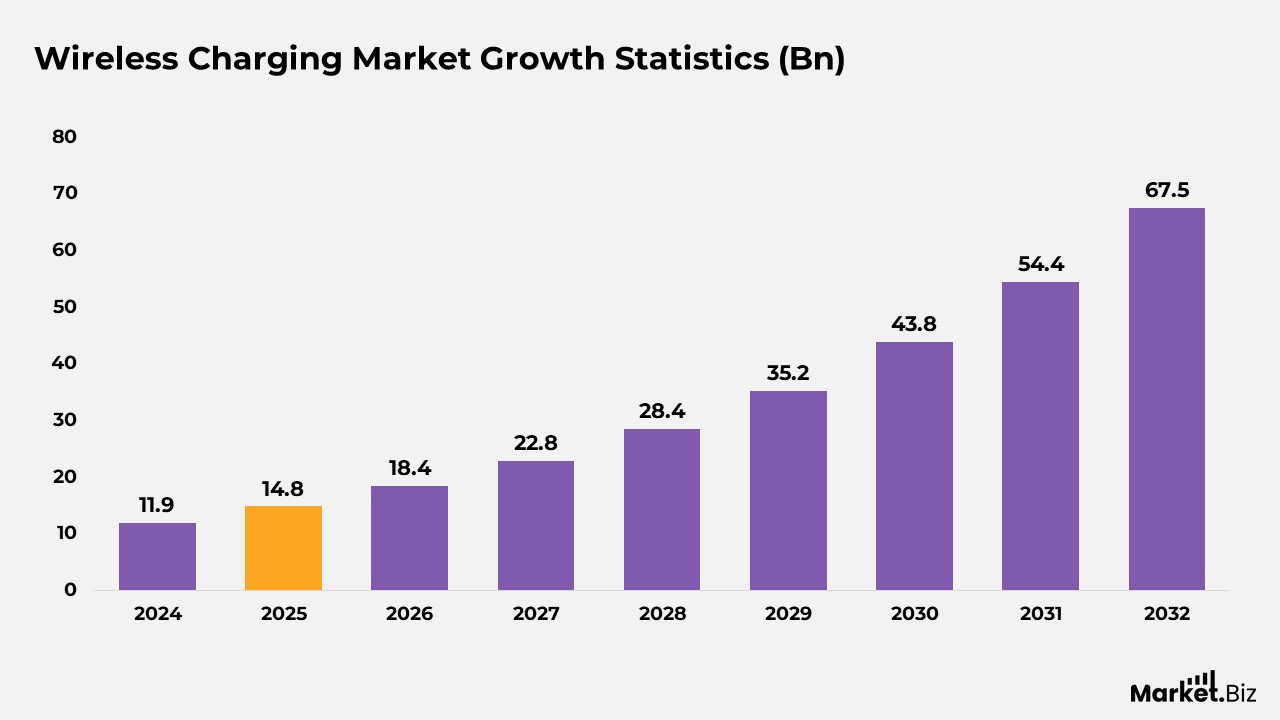
- This upward trajectory indicates a steady increase, with projections estimating the market will reach USD 11.9 billion in 2024, USD 14.8 billion in 2025, and USD 18.4 billion in 2026.
- By 2027, the market size is forecasted to expand to USD 22.8 billion, followed by an increase to USD 28.4 billion in 2028.
- The growth is expected to accelerate in the following years, with forecasts suggesting the market will achieve USD 35.2 billion in 2029 and USD 43.8 billion in 2030.
- By 2031, the market is projected to reach USD 54.4 billion before further expanding to USD 67.5 billion in 2032.
- Ultimately, this growth will culminate in a substantial valuation of USD 83.8 billion by 2033.
Wireless Electric Vehicle Charging Market Growth
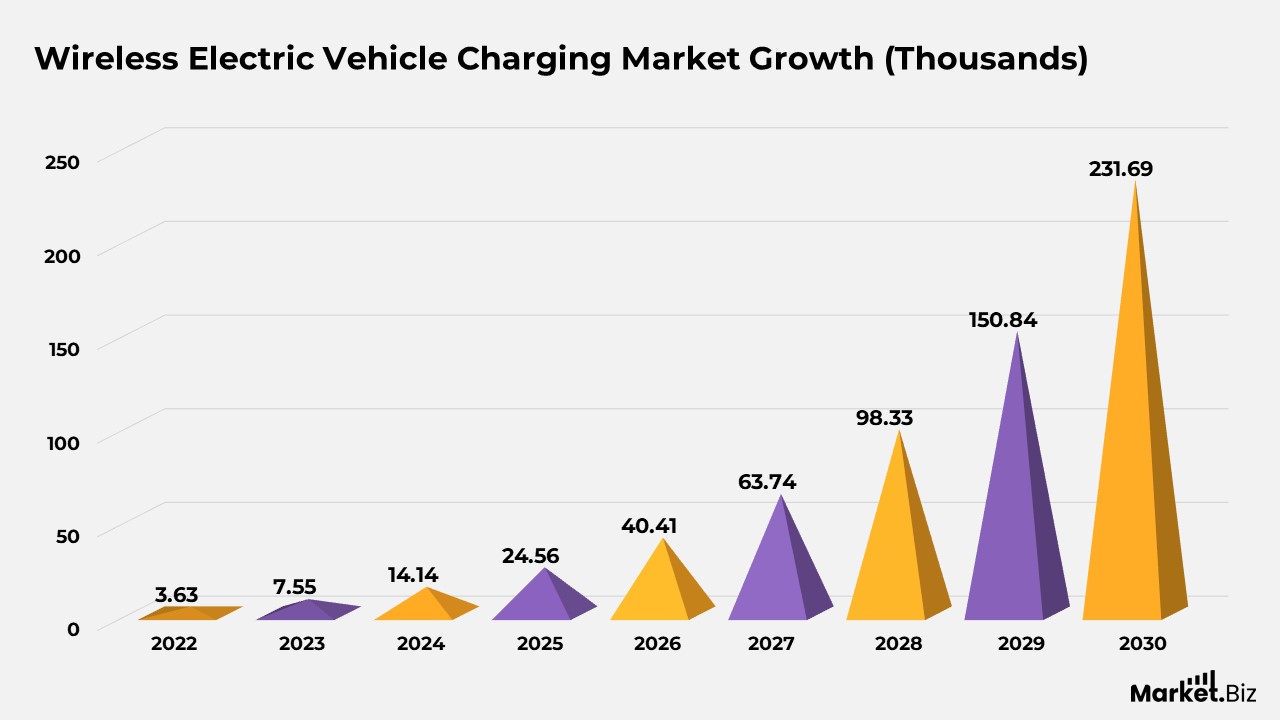
- In 2022, the market size was recorded at 3.63 thousand units, indicating the early phase of adoption.
- This number is anticipated to more than double by 2023, reaching 7.55 thousand units.
- The upward trend persists, with a projected market size of 14.14 thousand units in 2024 and 24.56 thousand units by 2025.
- The growth rate is expected to accelerate, with 40.41 thousand units forecasted for 2026 and 63.74 thousand units for 2027.
- By 2028, the market is predicted to attain 98.33 thousand units, exceeding the 100-thousand-unit threshold.
- This growth trajectory is projected to persist, with 150.84 thousand units expected in 2029, culminating in an estimated market size of 231.69 thousand units by 2030.
Power Bank Market Revenue Statistics
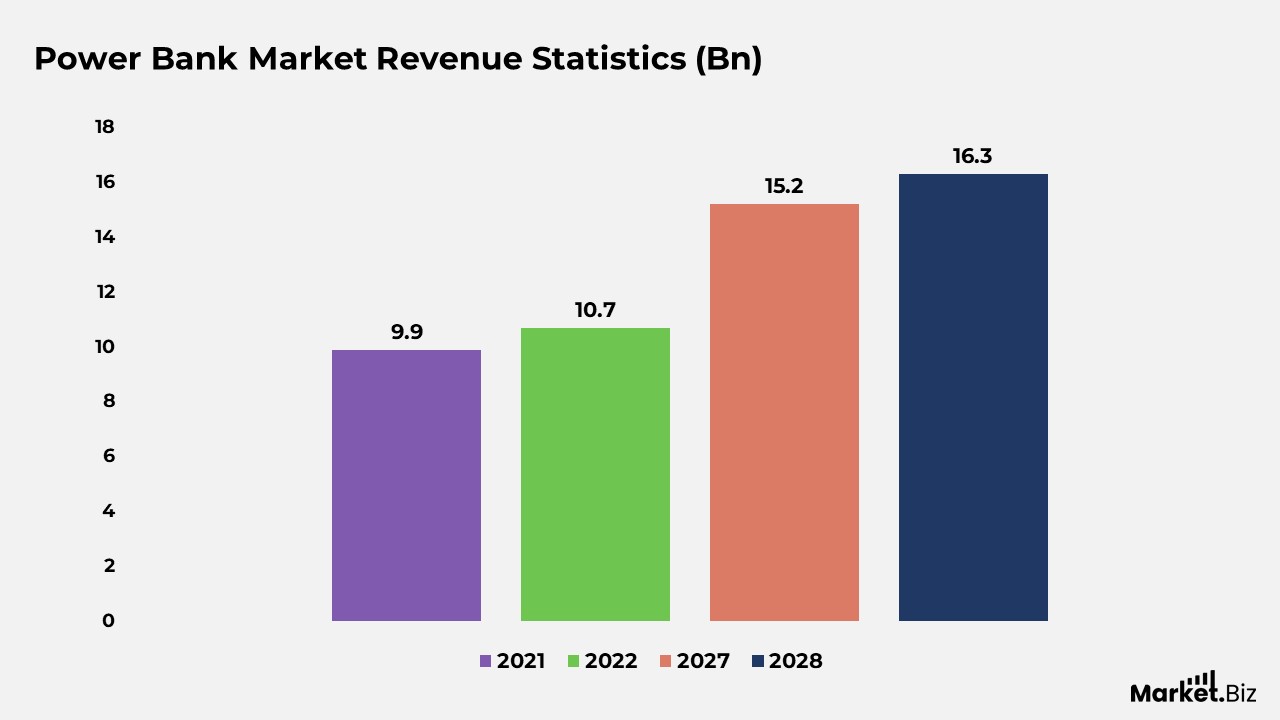
- The worldwide power bank market has demonstrated consistent growth, with revenue rising from $9.9 billion in 2021 to $10.7 billion in 2022.
- This positive trend is anticipated to persist in the forthcoming years, with expected revenues of $15.2 billion by 2027 and $16.3 billion by 2028.
Wireless Charging Companies Statistics
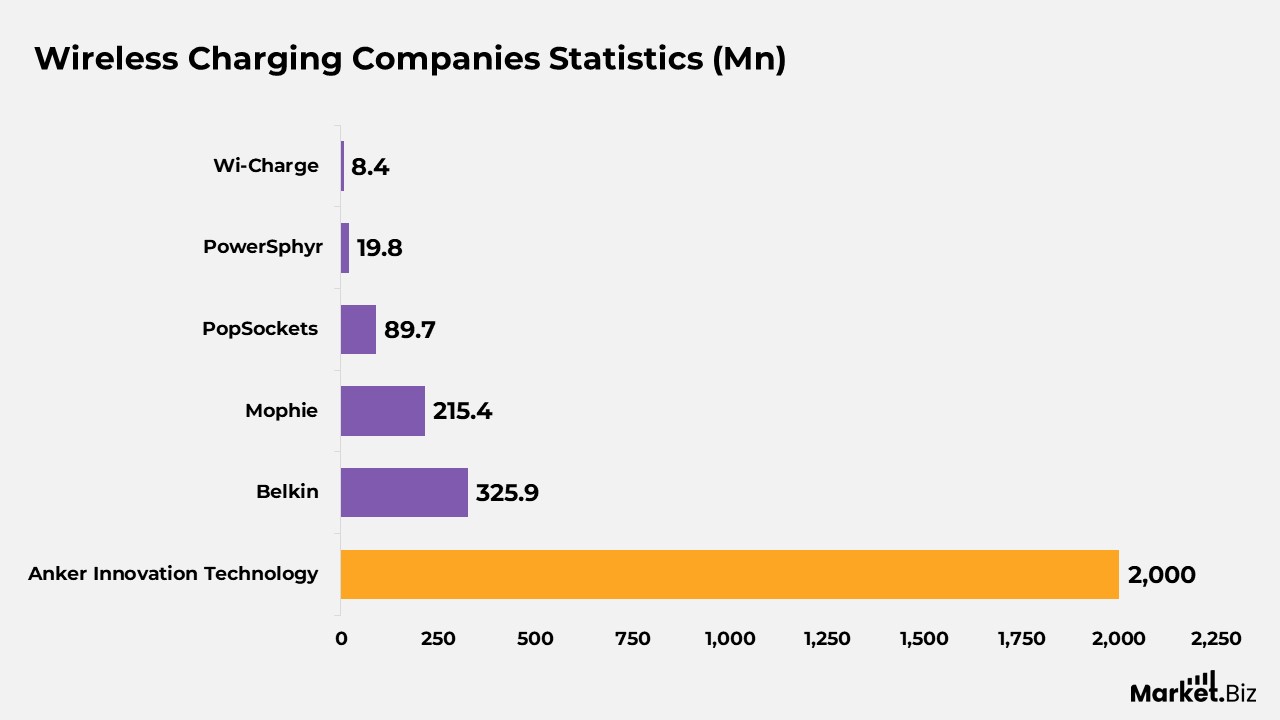
- As of October 2024, Anker Innovation Technology is at the forefront of the wireless charging market, leading in revenue with $2,000 million.
- Following Anker, Belkin occupies the second position with $325.9 million, while Mophie holds the third spot with $215.4 million.
- PopSockets generates a revenue of $89.7 million, establishing itself as a significant player in the industry.
- Wi-Charge and PowerSphyr, with revenues of $8.4 million and $19.8 million, respectively, are categorized as mid-tier companies.
- Additionally, several smaller firms, such as Casely, i-Blades, Courant, iOttie, iMuto, Nimble, Moft, Plus Cases, and Satechi, report revenues ranging from $5 to $5.3 million.
Employees By Wireless Charging Companies
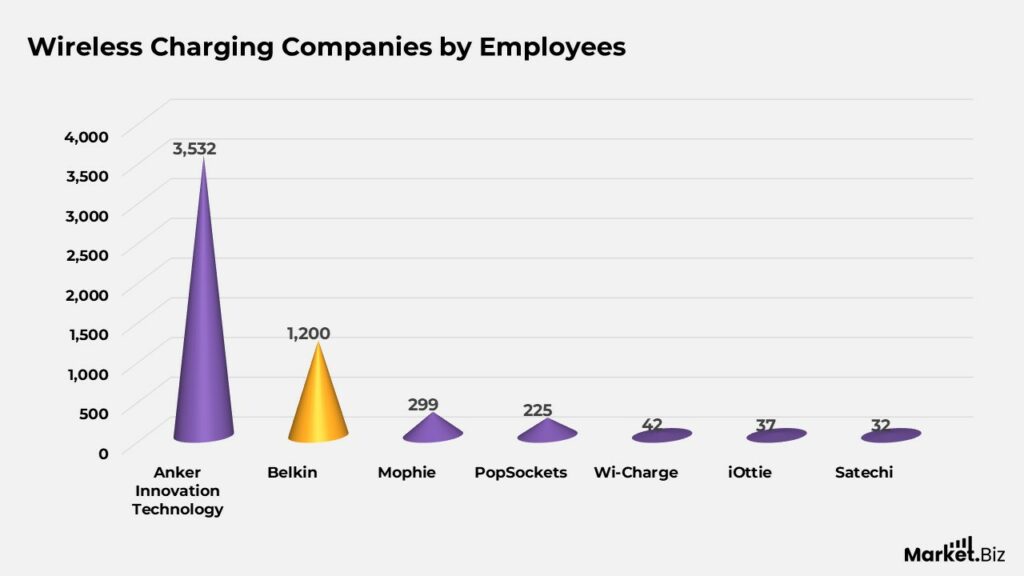
- As of September 2024, Anker Innovation Technology is at the forefront of the wireless charging sector, boasting a workforce of 3,532 individuals.
- Belkin holds the second position with 1,200 employees, followed by PopSockets with 225 and Mophie with 299.
- Wi-Charge has a notably smaller workforce, employing 42 individuals, while Satechi and iOttie have 32 and 37 employees, respectively.
- A number of companies, such as Casely, i-Blades, iMuto, Courant, Moft, Plus Cases, Nimble, and PowerSphyr, operate with streamlined teams of 25 employees each.
Wireless Charging Patents Statistics
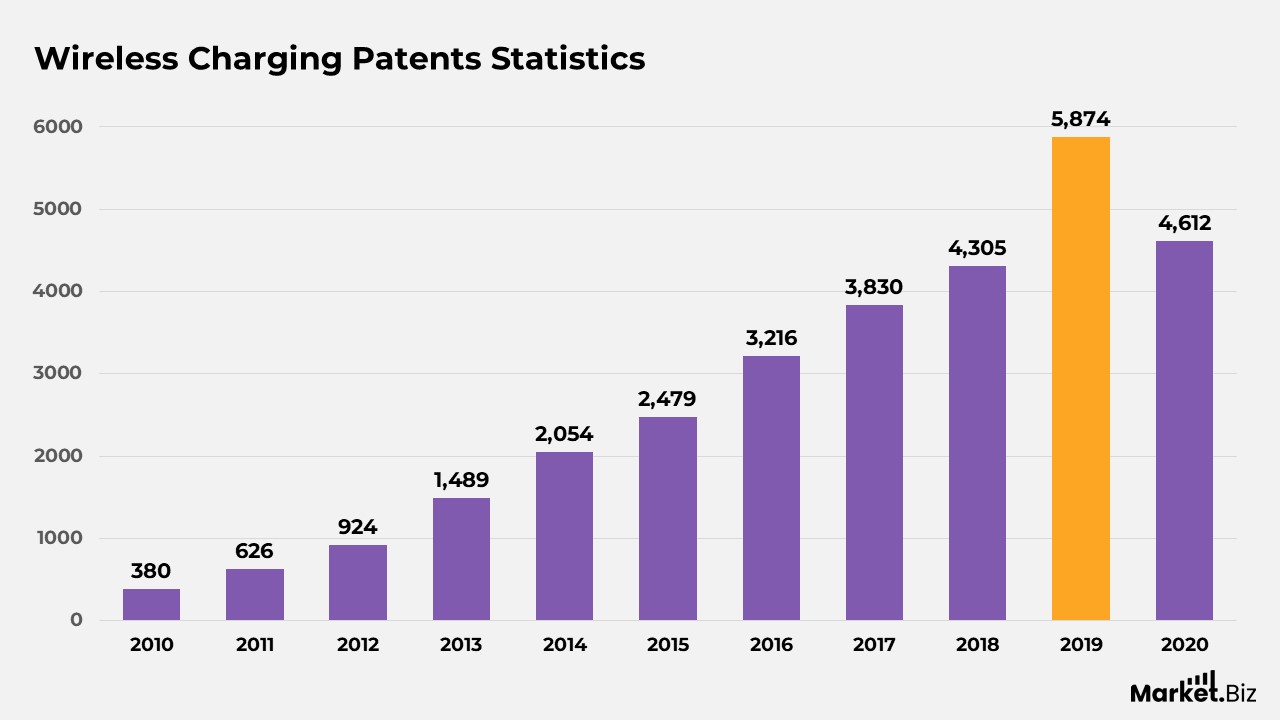
- In 2010, a total of 380 patents were submitted, which rose to 626 in 2011 and 924 in 2012.
- The rate of filings further accelerated, with 1,489 patents recorded in 2013 and exceeding 2,000 filings in 2014, culminating at 2,054.
- By 2015, the quantity of patents filed had increased to 2,479, followed by a significant rise to 3,216 in 2016 and 3,830 in 2017.
- This upward trend persisted with 4,305 patents filed in 2018, reaching a peak of 5,874 in 2019.
- Nevertheless, 2020 experienced a minor decrease to 4,612 patents, potentially indicating market maturity or other external influences.
Wireless Charging Price Statistics
- The Monad Stand One Max dominates the market with a price tag of $115.6, closely followed by the Qdos SnapStand 3-in-1 Wireless Charger priced at $104.6.
- The Courant Catch 2 Wireless Charger is offered at $90, presenting a premium choice for consumers.
- The Anker MagGo 3-in-1 Wireless Charging Station offers a slightly more economical option at $87.24.
- For those on a budget, the Anker MagGo Qi2 Magnetic Wireless Charger is available for $32.7, showcasing the extensive price range within the wireless charging pad market.
Recent Developments
- Qualcomm’s X85 5G Modem-RF, featuring integrated AI, was introduced at MWC Barcelona in March 2025. While the primary focus of the device was connectivity, it also highlighted Qualcomm’s broader leadership in chip innovation, which collaborates with wireless power platforms to enable seamless interaction between devices.
- In January 2025, Samsung launched the S2MIW06 power-management chip. This chip is designed to support the upcoming facilitate magnetic alignment (Qi Magnetic Power Profile), Qi 2.2 standard, and enable wireless charging of devices at a power level of up to 50W. This represents a significant enhancement compared to the conventional 15W Qi support.
- In June 2024, Texas Instruments and Delta Electronics inaugurated a joint innovation lab in Taiwan aimed at developing wireless power systems for high-efficiency onboard electric vehicle (EV) applications. The lab aims to produce 11 kW onboard chargers, create smaller devices (approximately 30% reduction in size), and achieve conversion efficiencies of up to 95%, thereby improving the wireless power infrastructure in the realm of e-mobility.
Conclusion
Wireless Charging Statistics: The wireless charging market is experiencing notable growth, driven by an increasing demand for convenient and efficient power solutions across multiple sectors, including consumer electronics, automotive, and healthcare. Technological advancements, such as inductive and resonance charging, have enhanced user convenience by eliminating the need for physical connectors.
In the automotive sector, wireless charging is gaining traction for electric vehicles, while consumer electronics are seeing widespread adoption. Although challenges such as standardization and energy efficiency persist, ongoing research and development initiatives are expected to promote further progress. As a result, wireless charging is poised to become a vital component of modern power solutions, offering significant growth prospects in the coming years.
FAQs
Wireless charging efficiency differs based on the technology and application used. Older phone chargers typically exhibit an efficiency of around 70%, whereas newer electric vehicle systems and advanced standards such as Qi2 can reach efficiencies of 88-95% or higher, competing with or even matching the efficiency of wired charging under ideal conditions.
Wireless charging may be considered safer since charging ceases immediately when the device is lifted. Additionally, there exists a lesser-known hazard related to using public USB chargers.
Wireless charging was invented by Nikola Tesla in the 1800s. He constructed the Tesla tower in 1904. This structure stood 187 feet tall and, before it radiated the surrounding area and self-destructed like a firework, it successfully transmitted electricity wirelessly over a distance of 30 feet.