









Introduction
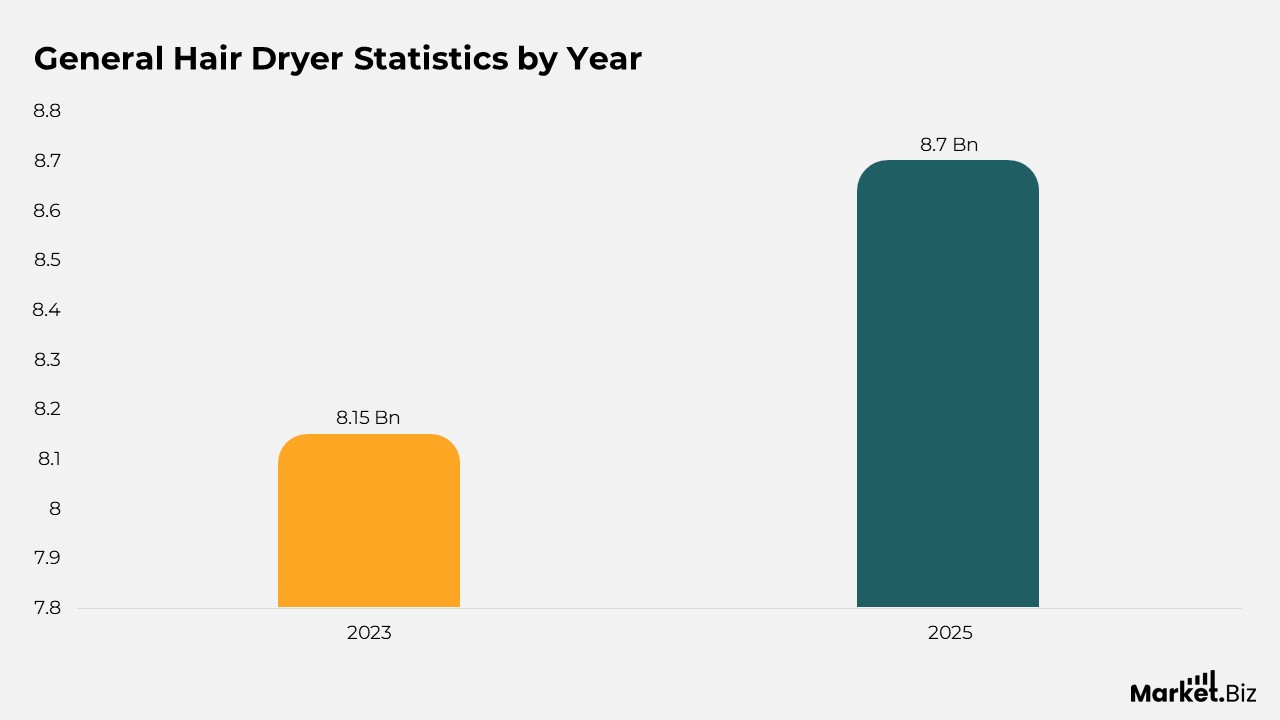
Hair Dryer Statistics: The worldwide hair dryer market was assessed at USD 8.15 billion in 2023 and is anticipated to expand at a compound annual growth rate of roughly 6.2% from 2025 to 2032, ultimately reaching USD 16.5 billion by 2032. The global hair dryer market is consistently on the rise, fueled by developing consumer grooming habits, the growing prevalence of personal care routines, and ongoing enhancements in products for both professional salons and home users.
The market is advancing with an increasing demand for advanced models that feature smart temperature control, ionic and ceramic technologies, and energy efficiency. Both compact, travel-friendly designs and professional-grade salon variants are gaining considerable popularity, particularly in urban and developing regions. Hair dryers are available in a variety of types, ranging from basic models with straightforward settings to sophisticated versions that provide multiple heat and speed settings.
Editor’s Choice
- In 2025, the global Hair Dryers market achieved a revenue of US$8.70 billion.
- The global hair dryer market has shown steady growth over the years, achieving notable revenue milestones from 2018 to 2029, with a compound annual growth rate (CAGR) of 4.17%.
- The average revenue per household was USD 3.55 in 2018, which saw a slight decrease to USD 3.54 in 2019.
- By 2027, the price is forecasted to rise to USD 32.64, followed by USD 33.49 in 2028.
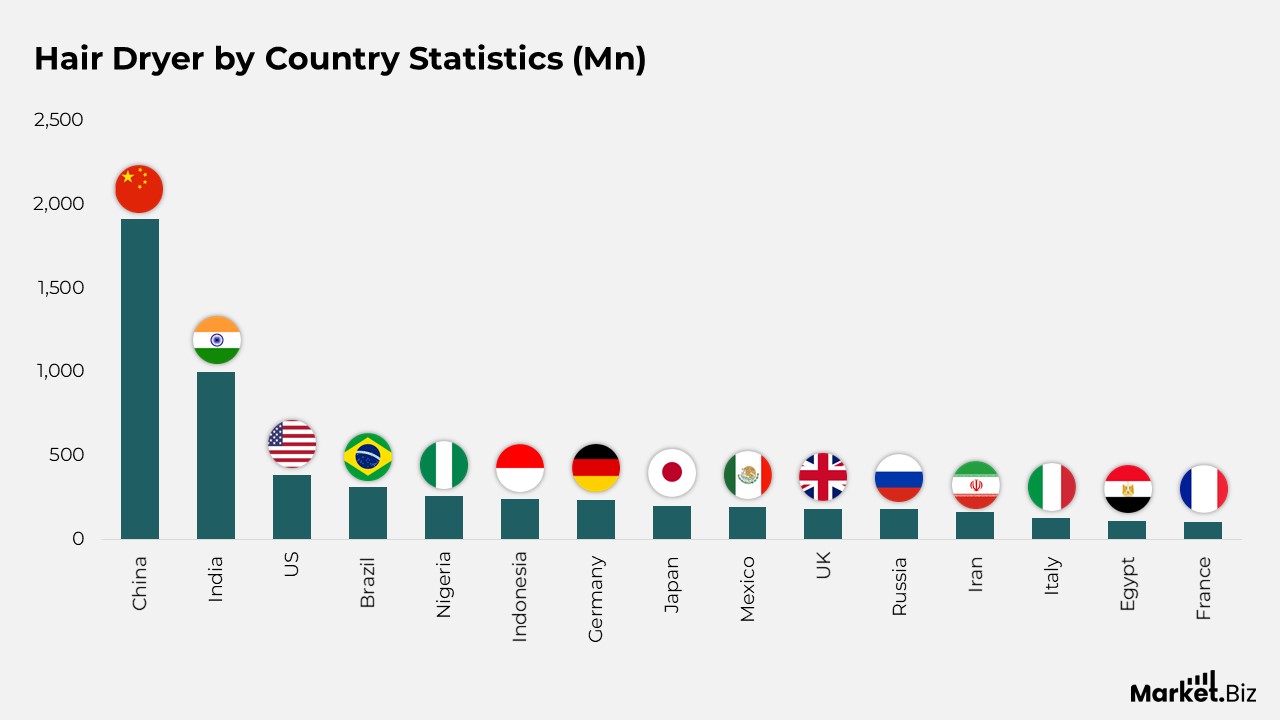
- In 2024, the global hair dryer market shows considerable regional revenue contributions, with China leading the way, achieving the highest revenue of USD 1,912 million.
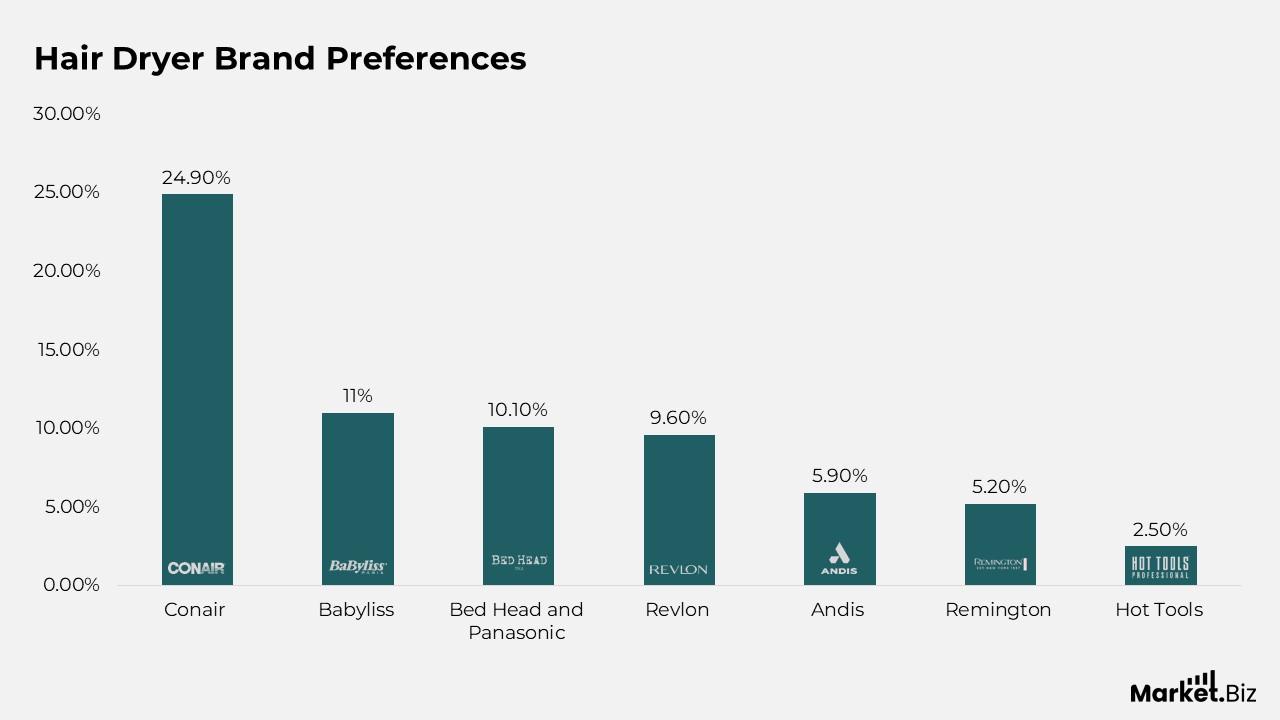
- Among individuals aged 18-34, Conair emerged as the most preferred brand, securing 24.9% of the market share, followed by Babyliss at 11%, and both Bed Head and Panasonic at 10.1% each.
General Hair Dryer Statistics
- In 2025, the global Hair Dryers market achieved a revenue of US$8.70 billion.
- The market is anticipated to grow at an annual rate of 4.12% from 2025 to 2030 (CAGR 2025-2030).
- When assessing global revenue, China emerges as the leading contributor, generating US$1.98 billion in 2025.
- Regarding revenue per household, the Hair Dryers market is projected to yield US$4.22 per household in 2025, based on the total number of households worldwide.
- Looking forward to 2030, the Hair Dryers market volume is expected to reach 302.47 million units.
- However, a minor decline of 1.42% in volume growth is predicted for 2026.
- Despite the global popularity of hair dryers, the United States continues to be the largest market for this product, offering a diverse array of high-end and innovative options available.
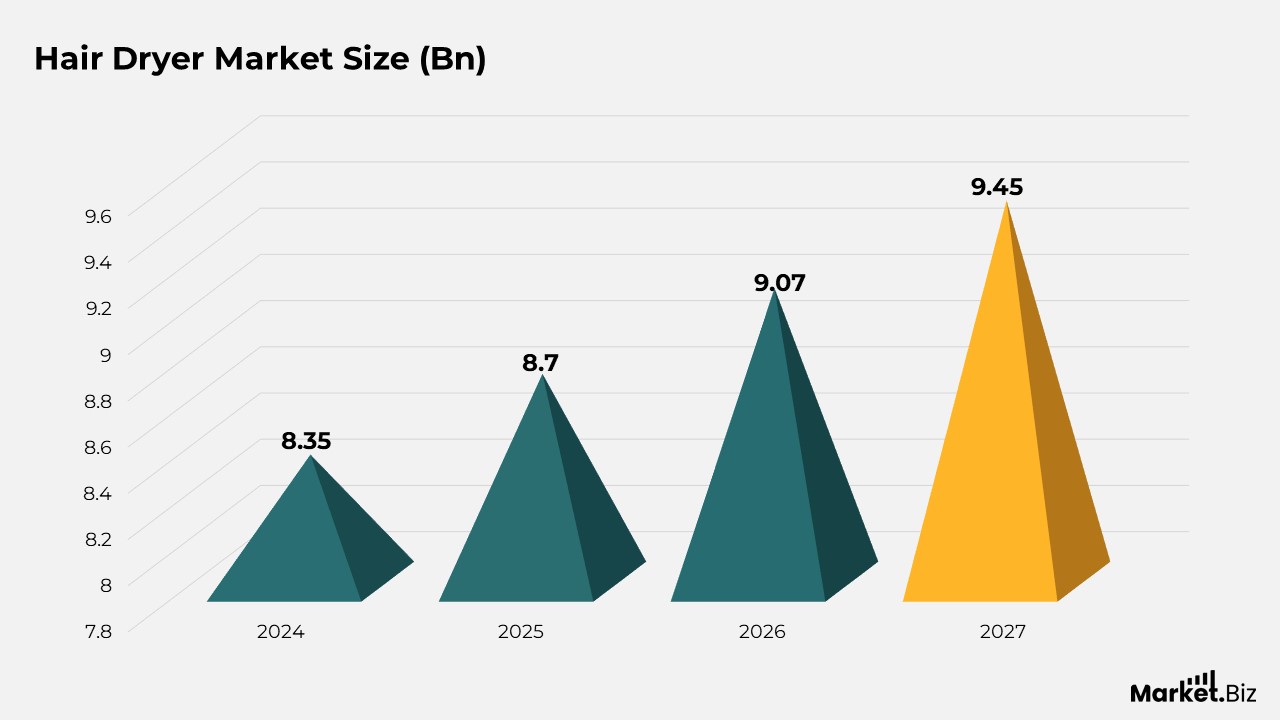
Hair Dryer Market Size
- The global hair dryer market has shown steady growth over the years, achieving notable revenue milestones from 2018 to 2029, with a compound annual growth rate (CAGR) of 4.17%.
- In 2018, the market revenue was recorded at USD 6.75 billion, which saw a modest increase in 2019 to USD 6.84 billion.
- The market continued its steady growth in 2020, reaching USD 7.46 billion, and further expanded in 2021, with revenues rising to USD 8.11 billion.
- Although there was a slight decrease in 2022 to USD 7.94 billion, the market swiftly recovered in 2023, achieving USD 8.15 billion.
- Forecasts for the upcoming years suggest strong growth, with the market anticipated to generate USD 8.35 billion in 2024 and USD 8.70 billion in 2025.
- By 2026, revenue is expected to reach USD 9.07 billion, maintaining an upward trend in 2027 at USD 9.45 billion.
- The growth path is projected to persist, with revenues increasing to USD 9.84 billion in 2028 and further advancing to USD 10.24 billion in 2029.
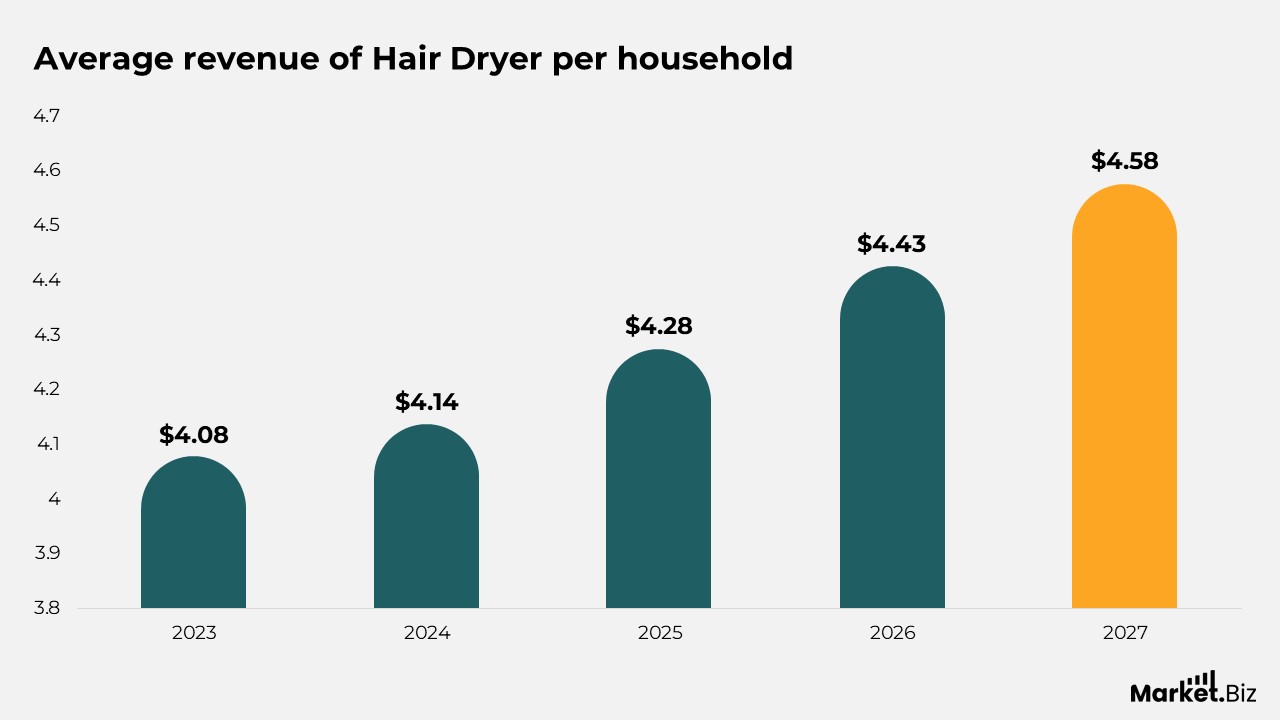
Hair Dryer Revenue Statistics
- The global hair dryer market has experienced a steady rise in average revenue per household from 2018 to 2029.
- The average revenue per household was USD 3.55 in 2018, which saw a slight decrease to USD 3.54 in 2019.
- However, it rebounded in 2020, reaching USD 3.83, and continued to grow consistently to USD 4.12 in 2021.
- A minor decline was noted in 2022, where the average revenue fell to USD 4.00, but it recovered in 2023, reaching USD 4.08.
- The upward trajectory is expected to persist in the upcoming years, with the average revenue per household anticipated to reach USD 4.14 in 2024 and USD 4.28 in 2025.
- Further growth is projected, with figures rising to USD 4.43 in 2026, USD 4.58 in 2027, and USD 4.74 in 2028.
- By 2029, the average revenue per household is forecasted to reach USD 4.90.
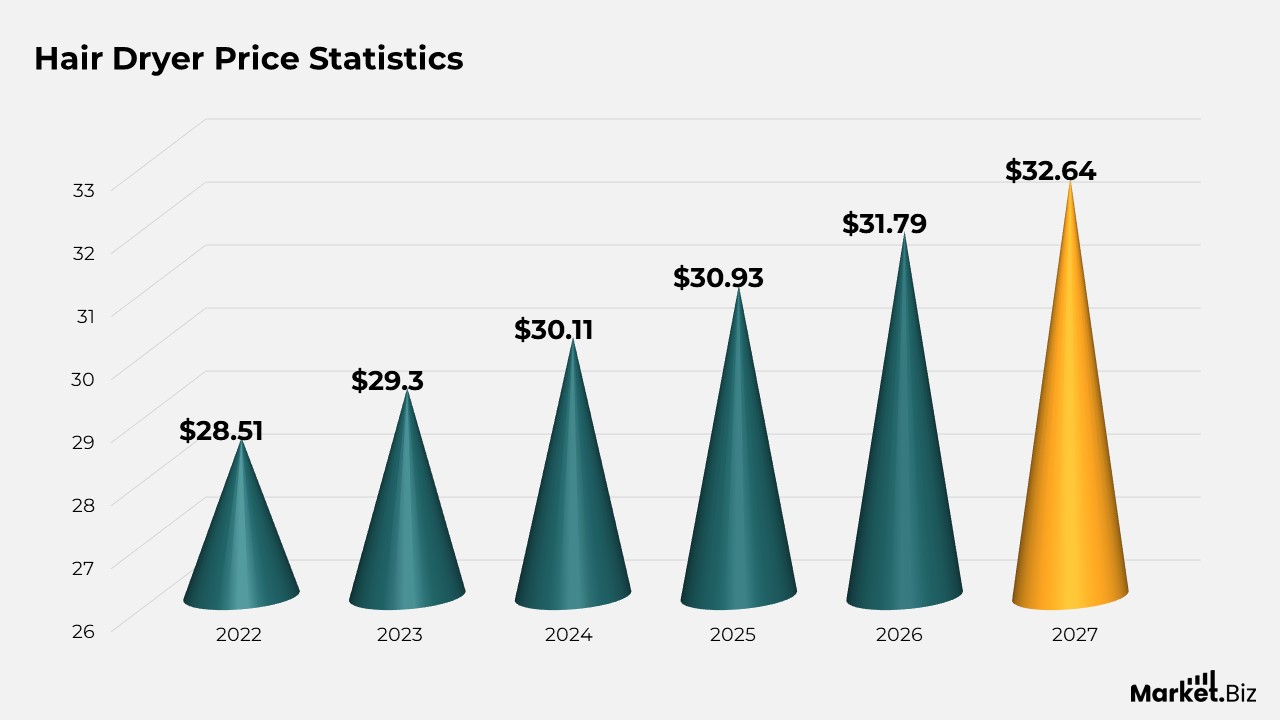
Price Statistics of Hair Dryers
- The average unit price of hair dryers has demonstrated a consistent increase from 2018 to 2029, indicating a steady growth in value over time.
- In 2018, the unit price was recorded at USD 26.44, which saw a slight rise to USD 26.47 in 2019 and USD 26.61 in 2020.
- A significant increase was noted in 2021, when the price escalated to USD 27.69, followed by additional growth to USD 28.51 in 2022 and USD 29.3 in 2023.
- The upward trajectory is expected to persist in the forthcoming years, with the unit price projected to attain USD 30.11 in 2024, USD 30.93 in 2025, and USD 31.79 in 2026.
- By 2027, the price is forecasted to rise to USD 32.64, followed by USD 33.49 in 2028.
- By the end of 2029, the unit price is anticipated to reach USD 34.35.
Hair Dryer by Country Statistics
- In 2024, the global hair dryer market shows considerable regional revenue contributions, with China leading the way, achieving the highest revenue of USD 1,912 million.
- India ranks as the second-largest market, producing USD 997 million.
- The United States holds the third position with USD 388 million, while Brazil adds USD 312 million to the total.
- Indonesia, Nigeria, and Germany report revenues of USD 243 million, USD 258 million, and USD 239 million, respectively.
- Followed by Japan at USD 200 million and Mexico at USD 196 million.
- Russia and the United Kingdom generate comparable revenues of USD 183 million and USD 185 million, respectively.
- Italy contributes USD 129 million, while Iran adds USD 165 million.
- Finally, France and Egypt complete the list with revenues of USD 104 million and USD 111 million, respectively.
Import Data of Hair Dryers
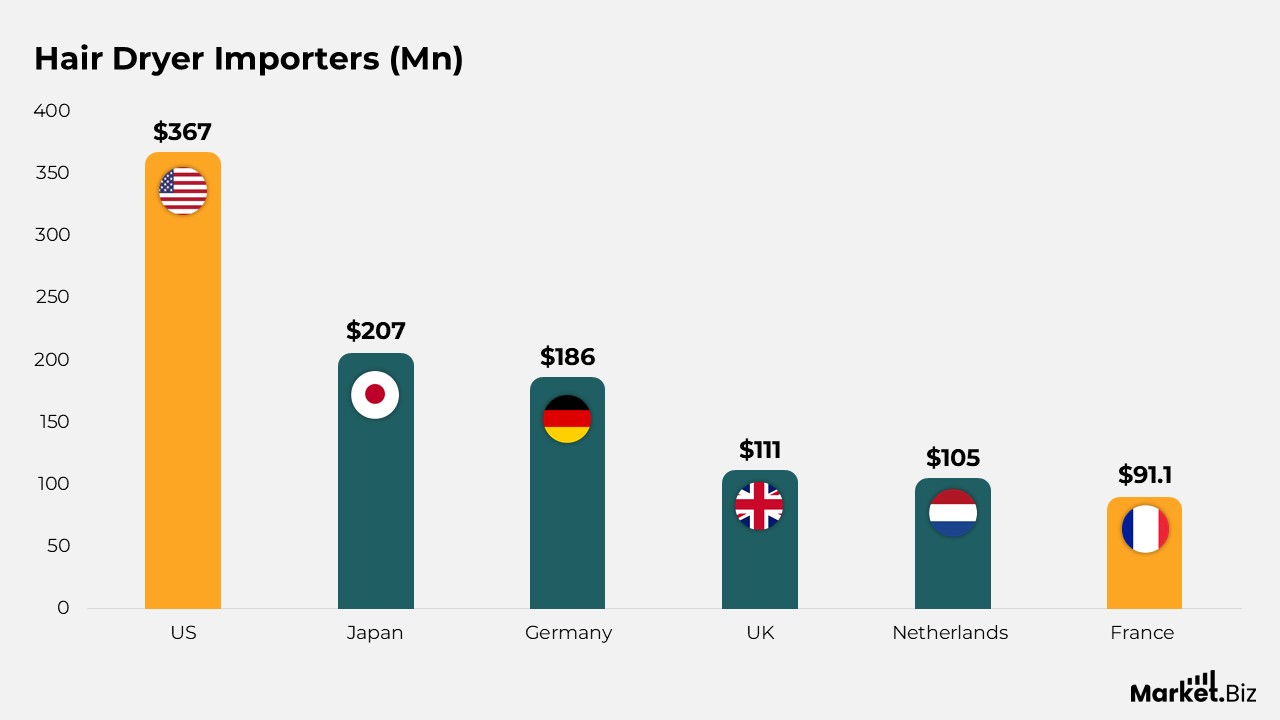
- In the year 2023, the primary importers of electric hair dryers included the United States ($367 million), Japan ($207 million), and Germany ($186 million).
- Subsequently, the United Kingdom ($111 million), the Netherlands ($105 million), and France ($91.1 million) followed.
Hair Dryer Exporters
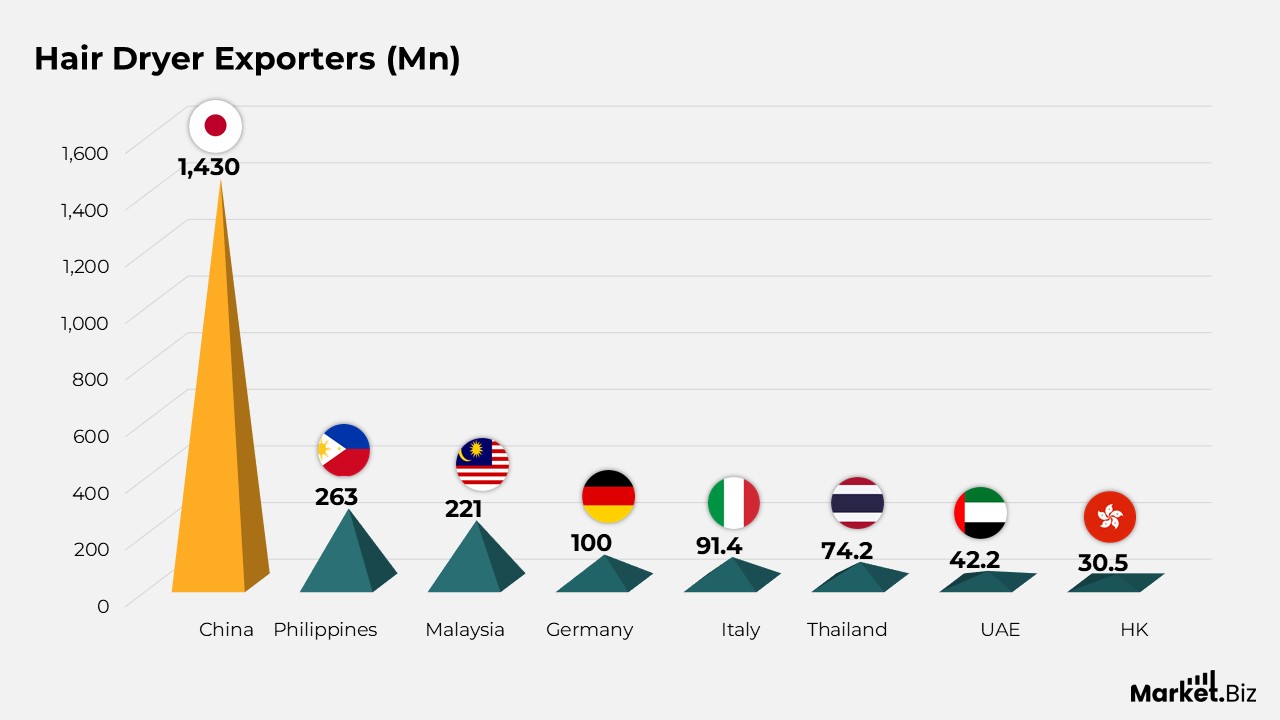
- In the year 2023, the foremost exporters of electric hair dryers included China, with exports valued at $1.43 billion, the Philippines at $263 million, and Malaysia at $221 million.
- Closely trailing were Germany at $100 million, Italy at $91.4 million, Thailand at $74.2 million, the United Arab Emirates at $42.2 million, and Hong Kong at $30.5 million.
Sales Trend Statistics
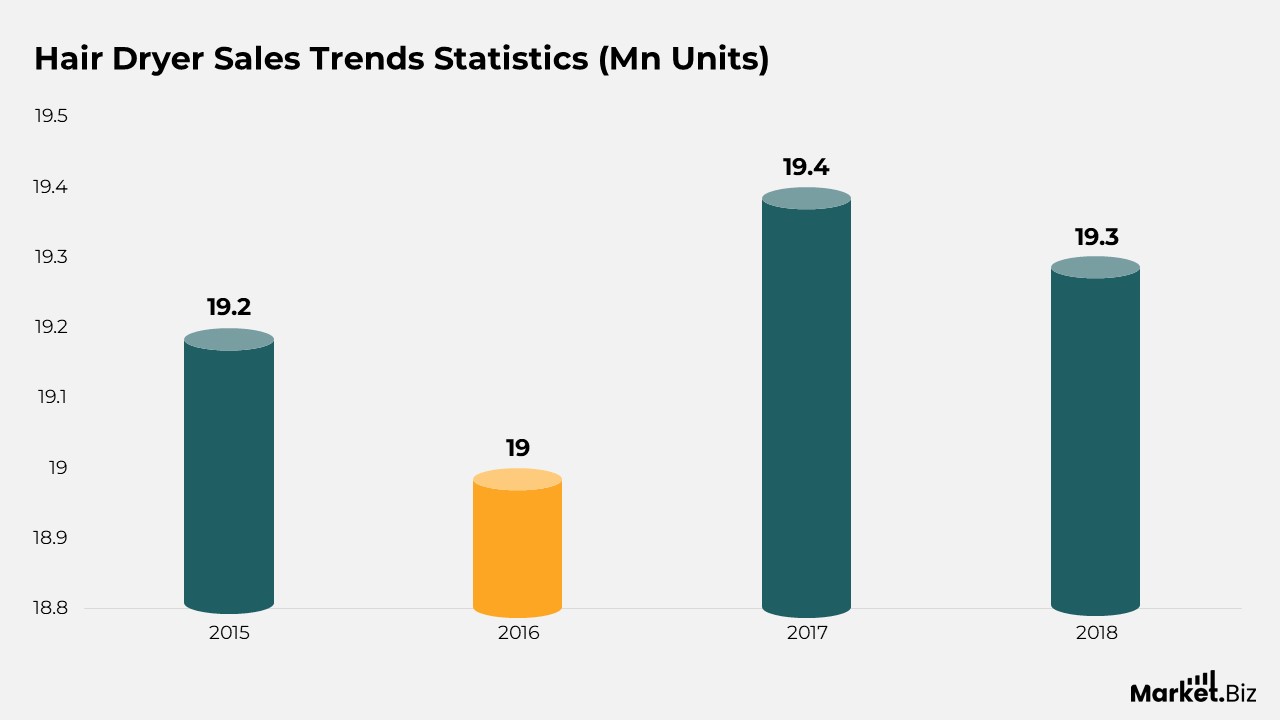
- The retail unit sales of hair dryers in the United States saw a steady decrease from 2010 to 2018, with some variations in specific years.
- In 2010 and 2011, unit sales were at 21 million, representing the peak during this timeframe.
- By 2012, sales had experienced a minor reduction to 20.7 million units.
- The downward trend persisted in the following years, with 19.6 million units sold in 2013 and 19.4 million in 2014.
- In 2015, unit sales fell further to 19.2 million, and by 2016, they had dropped to their lowest level at 19 million.
- A slight rebound was noted in 2017, with sales rising to 19.4 million units, but this was succeeded by a small decline in 2018, where sales were recorded at 19.3 million units.
Hair Dryer Brand Preferences
- Among individuals aged 18-34, Conair emerged as the most preferred brand, securing 24.9% of the market share, followed by Babyliss at 11%, and both Bed Head and Panasonic at 10.1% each.
- Revlon accounted for 9.6%, while Andis represented 5.9%.
- Hot Tools and Remington were less favored, with 2.5% and 5.2%, respectively, while other brands and Vidal Sassoon captured 1.6% and 2.2%.
- For those aged 35-49, Conair maintained its important position with an increased preference of 32.3%.
- Bed Head was in second place at 8.8%, closely followed by Revlon (9.4%) and Panasonic (7.1%).
- Babyliss fell to 6.1%, and Andis comprised 3.9%.
- Hot Tools and Remington held shares of 4.3% and 4.4%, respectively, while other brands and Vidal Sassoon saw slight increases to 2.3% and 3%.
- Among respondents aged 50 and above, Conair’s dominance was even more pronounced, with a preference of 47.4%.
- Panasonic followed with 8.7%, and Revlon was third with 7.2%.
- Other brands and Vidal Sassoon gained traction in this demographic, achieving 5.7% and 5.9%, respectively.
- Bed Head, Babyliss, and Andis experienced declines in preference, capturing 3.7%, 1.3%, and 1.6%, respectively.
Best Hair Dryers Statistics
T3 AireLuxe Hair Dryer
- The T3 AireLuxe is regarded as the top hair dryer overall, thanks to its user-friendly design, elegant appearance, durability, and useful accessories that rival those of much pricier models.
- It comes with two concentrator nozzles (one designed for drying and the other for styling), in addition to a flat brush for detangling and a 2.5-inch round brush for adding volume.
InStyler Turbo Max Ionic Hair Dryer
- The InStyler ionic hair dryer, which features a customizable heat dial, is notable for its lightweight construction, comfortable grip, and user-friendly buttons, all available for under $100.
Shark Beauty SpeedStyle High-Velocity Dryer
- This compact device includes three attachments: a diffuser, a smoothing brush, and a shine finishing brush.
SRI DryQ “Smart” Hair Dryer
- This model offers significant drying power within a lightweight, compact design, complete with a foldable handle.
Neuro Light Tourmaline Hair Dryer
- It is equipped with a digital LED display for adjusting heat and power settings, along with a “clean filter” indicator light. This dryer includes a diffuser, which is excellent for drying curly and natural hair, and it effectively minimizes frizz.
Recent Development
- In April 2025, Tineco introduced the MODA ONE dryer, equipped with advanced iLoop™ moisture sensors that monitor hair hydration more than 20 times per second. This technology automatically adjusts heat and airflow to guarantee optimal dryness while preventing over-drying. Additionally, it features LED feedback that transitions from red to blue and emits millions of ions for smooth, frizz-free results.
- In April 2025, T3 launched the Aire IQ, which incorporates its innovative Heat ID sensor technology. This feature customizes heat and airflow according to your individual hair profile. The dryer also includes a standby mode that halts operation when placed down and provides Smart Attachment Recognition, ensuring the best settings for each magnetic nozzle.
Conclusion
The hair dryer industry is witnessing significant expansion, fueled by an increasing consumer emphasis on personal grooming, beauty trends heightened by social media, and the need for innovative, user-friendly technologies such as ionic conditioning.
Nevertheless, the market encounters obstacles due to worries regarding the energy usage and environmental effects of hair dryers, resulting in a rising demand for more sustainable and energy-efficient models. Projecting trends encompass the surging popularity of tourmaline and smart hair dryers, along with a burgeoning market for professional salon-quality products.
FAQs
Hair dryers provide enhanced control over the form and styling of hair by speeding up and regulating the formation of temporary hydrogen bonds within a single hair strand. Although these bonds are strong, they are fleeting and highly susceptible to humidity. They vanish after a single wash of the hair.
Tourmaline technology guarantees rapid drying, a healthy shine, comprehensive care, and high-speed performance. These represent some of the finest (yet also most costly) options available in the market. When evaluating various types of hair dryers and seeking solutions appropriate for salons, it is advisable to consider titanium models.
Typically, hair dryers consume approximately 1,500 to 2,000 watts of electricity. Utilizing a hair dryer for 10 minutes daily will result in an electricity usage of about 9.13 kilowatt-hours per month and 109.5 kilowatt-hours per year. The average cost of using a hair dryer is around $1.30 per month and $15.54 annually.
If 2024 was recognized as the year of the scalp, then 2025 will be acknowledged as the year of the scalp microbiome. Koestline forecasts that the scalp microbiome will become a focal point next year, emphasizing the importance of balancing microbial diversity and fostering a healthy foundation for hair growth.