









Introduction
Digital content creation statistics offer a structured, insight-driven view of how creators, enterprises, and institutions create, share, and commercialise digital content across online platforms. These metrics convert creative output into quantifiable metrics, including creator base expansion, content production intensity, audience interaction rates, emerging format preferences, and revenue-generation models.
By monitoring trends across video, audio, image-based, and text-driven content, these statistics reveal the impact of advancing technologies, platform algorithms, and shifting user behavior on the broader digital media landscape.
They further support informed decision-making for businesses, marketers, platform operators, and regulators by enabling evidence-based assessment of the creator economy’s growth, changes in digital labour dynamics, platform reliance, and the long-term durability of content-led engagement across social, commercial, and enterprise use cases.
Editor’s Choice
- Around 83% of content marketers prioritize publishing high-quality content over increasing publishing frequency. Indicating a clear shift toward value-driven content strategies, as highlighted by HubSpot.
- Blog articles, customer success stories, videos, webinars, and case studies delivered the strongest performance outcomes for marketers. With video and blog content emerging as the most effective formats, according to Semrush insights.
- Content creation efforts are increasingly aligned with buyer journey stages: 53% of companies focus on mid-funnel content, 35% target top-funnel awareness, and 22% concentrate on bottom-funnel conversion-focused material.
- Beyond acquisition, 25% of organisations actively develop content to support customer retention. Reflecting a growing emphasis on long-term audience engagement and lifecycle marketing.
- Creating compelling and engaging content remains a major obstacle, cited by 27% of marketers alongside challenges such as reaching the right audience. Generating fresh content ideas, and accurately measuring return on investment.
Social Media Marketing Challenges Identified by Marketers
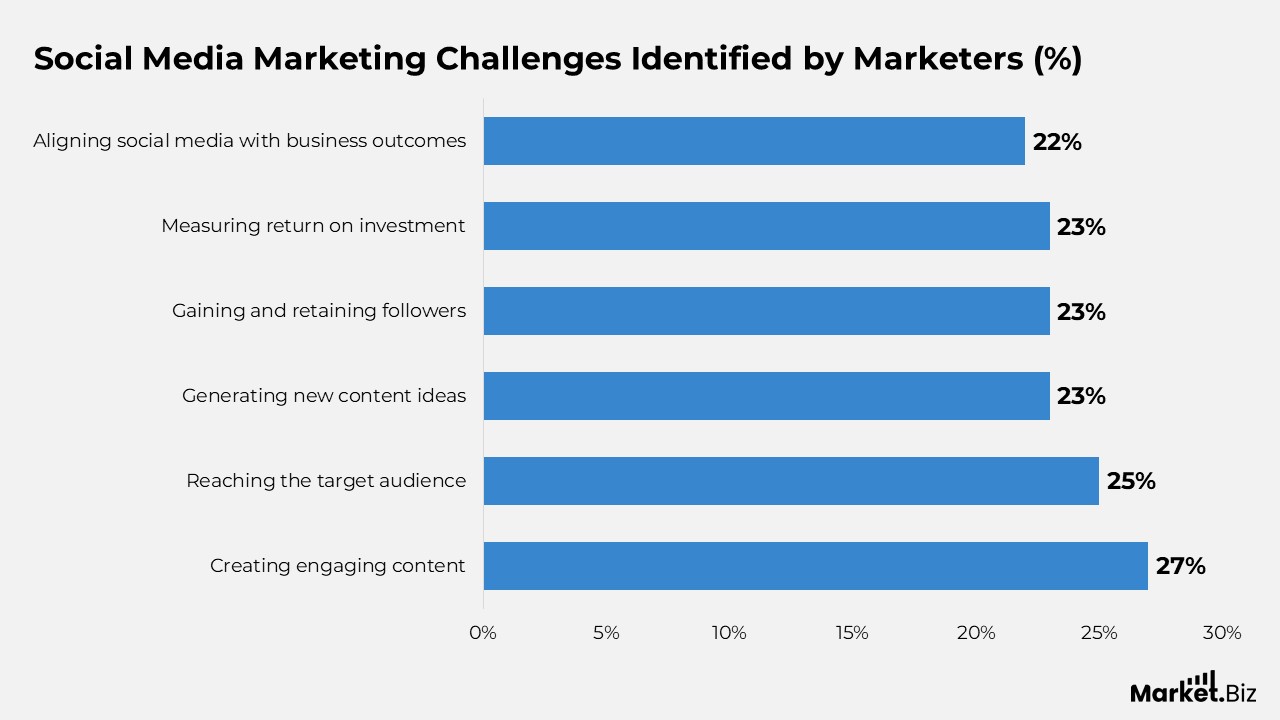
- Creating engaging content emerged as the most significant challenge, cited by 27% of marketers. Reflecting growing pressure to capture audience attention in crowded digital feeds.
- Reaching the intended target audience was highlighted by 25% of respondents, indicating difficulties with audience segmentation and algorithm-driven visibility.
- Generating fresh ideas for new content remains a constraint for 23% of marketers, suggesting rising creative fatigue across social platforms.
- Gaining and retaining followers was also reported as a challenge by 23% of professionals, emphasizing the competitive nature of audience growth.
- Measuring return on investment remains a concern for 23% of marketers, underscoring gaps in attribution and performance tracking.
- Aligning social media activities with tangible business outcomes was identified by 22% of respondents, reflecting challenges in linking engagement metrics to revenue and growth objectives.
(Sources: Narrato, Statista)
Global Content Creation Trends, Planning, and Performance Insights
- Nearly 49% of organizations favor outsourcing content development to specialized creators, reflecting a growing reliance on external expertise to maintain quality and scale.
- Content outsourcing is most prevalent among large enterprises, where 75% delegate part of their content and marketing activities, compared with 54% of mid-sized firms and 37% of smaller businesses.
- Measuring content success is primarily driven by organic traffic, used by 76% of marketers, while backlinks remain a secondary metric, tracked by only 22%.
- Marketing leaders are increasingly prioritising the recruitment of content creators, strategists, and content marketing managers to strengthen in-house capabilities.
- In 2021, content efforts were largely concentrated on social media marketing (69%) and email marketing (54%), highlighting their role as core engagement channels.
- Content creation consistently ranks among the top 5 most-discussed topics on Twitter, signalling strong industry-wide attention.
- Despite the rising adoption of voice-based technologies, just 12% of marketers actively optimise content for voice search.
(Sources: Narrato, Statista)
Content Planning and Strategy Development
- Optimal social media posting windows typically fall between 6 pm and 9 pm, with Tuesdays and Thursdays performing best for platforms such as Twitter and TikTok.
- Content calendars have become mainstream planning tools, with 73% of B2B organizations using them to structure content workflows.
- Strategic planning horizons vary: 34% of creators plan content 1–2 months ahead, 27% plan 3–4 months ahead, and 15% plan 3–4 weeks ahead.
- Around 41% of marketers are preparing to revise their media mix to adapt to evolving content consumption patterns.
(Sources: Narrato, Statista)
B2B and B2C Content Creation Dynamics
- B2B brands focus heavily on case studies, blogs, whitepapers, and interviews, while B2C brands generate stronger returns from short-form content.
- SEO remains central to content creation, with 77% of B2C marketers and 66% of B2B marketers using it.
- Video is projected as the most invested channel in B2B content marketing, though 59% of B2B marketers still identify blogging as the most effective communication format.
- Craft and creativity outweigh volume for 80% of B2B organizations, signaling a quality-first mindset.
(Sources: Narrato, Statista)
Blog, Video, and Social Media Content Insights
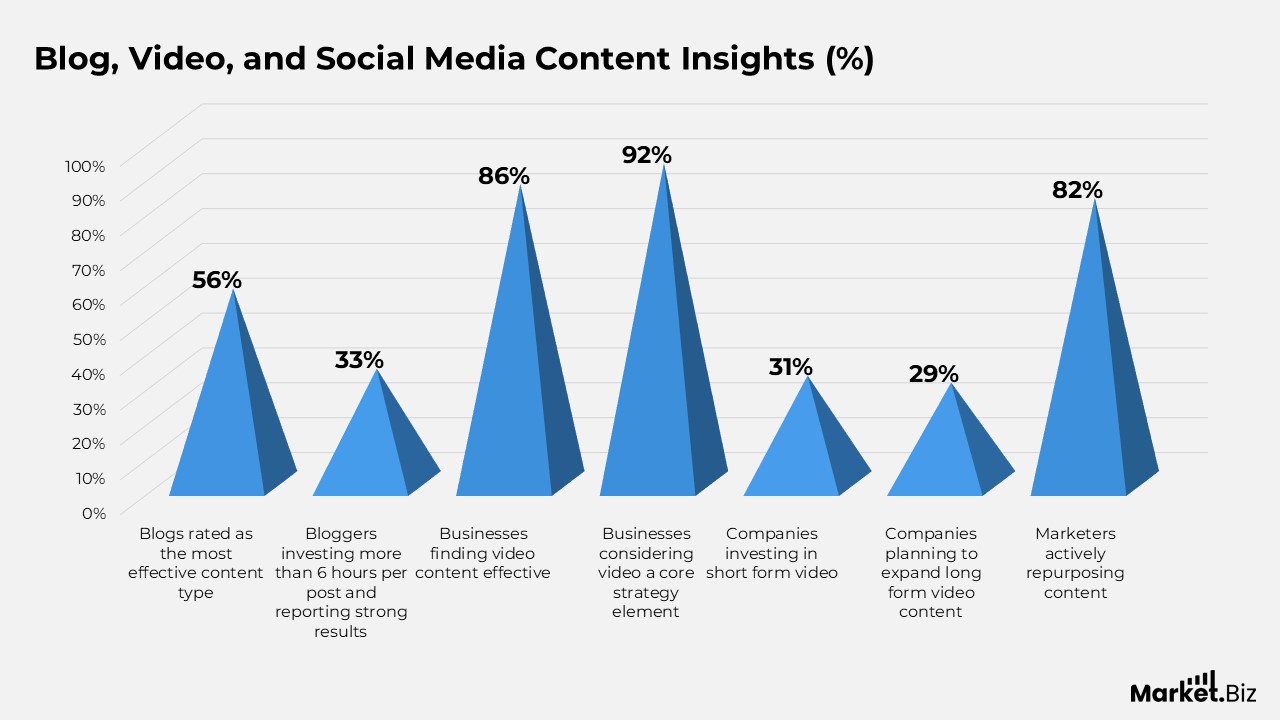
- Blogs are rated as the most effective content type by 56% of marketers, with 1 in 5 creators reporting strong results.
- The average blog length reached 1,416 words in 2021, with long-form content exceeding 2,000 words gaining momentum.
- Bloggers now spend over 4 hours per post on average, and 33% invest more than 6 hours to report strong outcomes.
- Video continues to dominate, with 86% of businesses finding it effective and 92% considering it a core element of their strategy.
- Short-form video attracted investment from 31% of companies, while 29% planned to expand long-form video output.
- Content repurposing is widespread, practiced by 82% of marketers, and short-form video delivers the highest social media ROI.
(Sources: Narrato, Statista)
Tools Adoption and Content Creation Challenges
- About 33% of marketers who are not currently using AI or automation plan to adopt it, while 34% already use automation for ideation and keyword research.
- Common tools include SEO planning platforms (41%), writing and editing software (37%), CMS systems (26%), and visual design tools (24%).
- AI-driven writing and SEO tools are viewed as growth enablers by 43% of marketers.
- Major challenges include sourcing subject matter experts (42%), creating value-focused content (36%), and maintaining consistent messaging (31%).
- Visual content consistency challenges affect 36.7% of marketers, while engaging social media content remains the top hurdle for 27%.
- In outsourced content creation, 65% of B2B marketers struggle to find writers with domain expertise, 41% cite gaps in audience understanding, and 40% face budget constraints.
Content Creation and Marketing Performance Insights
- Around 54% of marketers actively track content marketing return on investment within their organizations, reflecting a stronger focus on measurable outcomes.
- Nearly 29% of marketers dedicate 10–15 hours per week to content creation activities, highlighting the time-intensive nature of effective content strategies.
- About 54% of businesses plan to increase their content marketing budgets, signaling sustained confidence in content-led growth approaches.
- Visual-based content has a higher impact, proving 43% more persuasive to users than text-only formats.
- Content marketing was the primary marketing channel for 32% of marketers, underscoring its central role in digital strategy execution.
- Video remains the most widely used media format, adopted by 59% of marketers as part of their content mix.
- Regular performance evaluation is gaining importance, with 33% of marketers conducting content audits twice each year.
- Freshness matters: 27% of top-performing content across platforms is less than a month old.
- Readability plays a role in performance, with 33% of high-performing content maintaining a standard readability level.
- One of the most persistent challenges for B2B marketers is generating high-quality leads through content initiatives.
Moreover
- Content creation goals are largely centred on driving sales, strengthening customer relationships, and enhancing brand visibility.
- How-to guides emerged as the most popular content format, followed closely by list-based articles and news- or trend-focused content.
- A strong majority, 83% of marketers, favor producing high-quality content even if it reduces publishing frequency.
- As of 2021, approximately 82% of marketers reported being actively invested in content marketing efforts.
- Conversion rate tracking is a priority metric, monitored by more than 33% of marketing leaders.
- In 2022, interactive formats, behind-the-scenes content, and value-driven brand content ranked as the most effective types.
- Organic search accounted for 51% of total content consumption, reinforcing the importance of search visibility.
- Advancing from second to first position in search rankings can drive nearly a 50% increase in organic traffic.
- Content initiatives delivered measurable business impact, with 58% of B2B marketers reporting higher sales and revenue.
- Creating content that aligns precisely with audience needs remains the most cited challenge across content teams.
- When scaling production, 48% of marketers struggle with insufficient content repurposing, limiting efficiency and reach.
(Sources: HubSpot, Semrush, Content Marketing Institute, Orbit Media, BrightEdge, eMarketer, Siege Media, Zipdo, Venngage)
Content Marketing ROI and Blog Performance Insights
- Updating existing content delivers measurable impact: 53% of marketers report higher engagement after refreshing published material.
- Useful and informative brand content resonates strongly, as 60% of audiences enjoy reading value-focused material from businesses.
- Nearly 47% of marketers attribute their content marketing success to deeper audience research and insight-driven planning.
- A quality-first approach dominates strategy, with 83% of marketers confirming that publishing fewer, higher-quality pieces outperforms frequent, low-quality output.
- Increasing content volume and posting frequency helped 55% of marketers improve search visibility and content rankings.
- Branded content positively shapes perception: 82% of customers feel more favourably toward businesses after engaging with tailored content.
- Personalized content directly influences revenue outcomes, with 94% of marketers linking it to stronger sales performance.
- Compared with outbound tactics, content marketing generates 3x more leads while reducing acquisition costs by 62%.
Blog Content Creation and Engagement Statistics
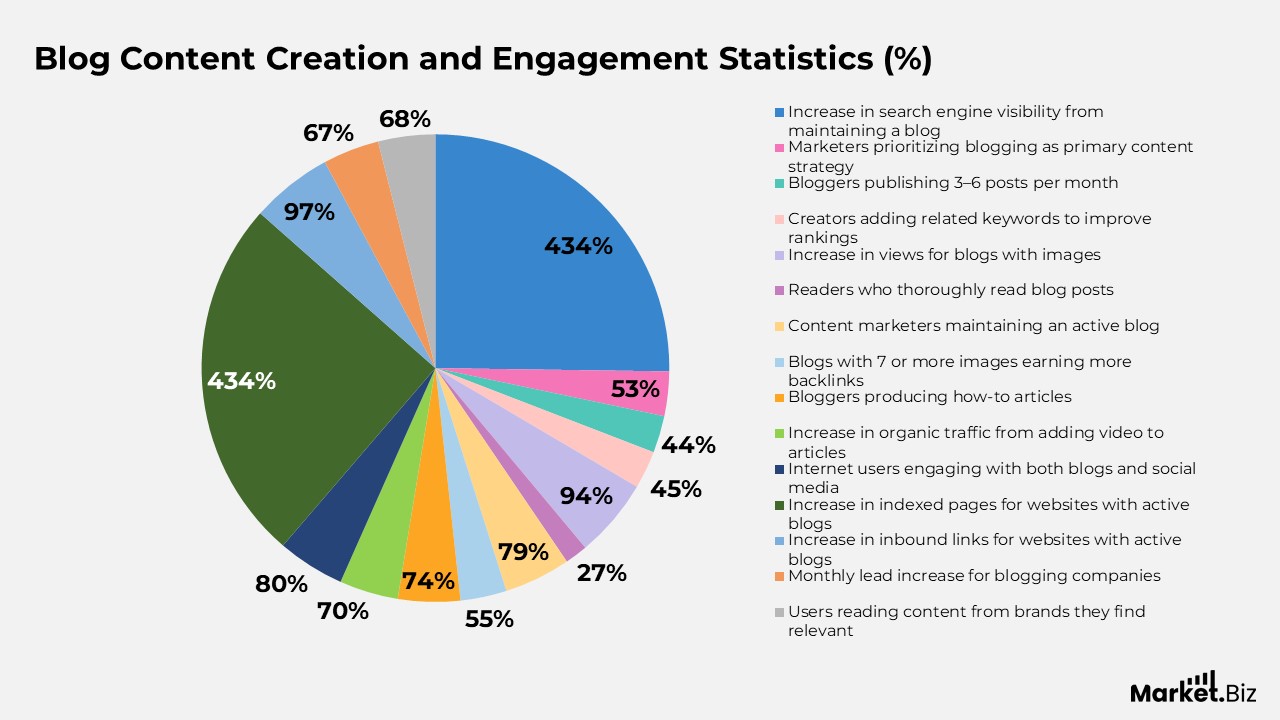
- Maintaining a blog significantly boosts digital presence, increasing search engine visibility by 434%.
- Blogging remains a strategic priority, selected by 53% of marketers as their primary content marketing approach.
- Long-form writing continues to dominate, with the average blog post reaching 1,416 words.
- Publishing consistency remains moderate, with 44% of bloggers posting 3-6 articles per month.
- Keyword optimization remains a core tactic, with 45% of creators adding related keywords to improve rankings.
- Visual enhancement matters: blogs with images attract 94% more views than text-only posts.
- Reader behaviour favours scanning: only 27% read blog posts thoroughly, while the majority skim.
- Active blogging is widespread, with 79% of content marketers maintaining a blog presence.
- Content volume continues to rise, with approximately 7.5 million blog posts published daily worldwide.
- Writing effort is increasing, as the average blog post takes around 3 hours and 51 minutes to produce and contains about 1,427 words.
- Blogs featuring 7 or more images earn 55% more backlinks, strengthening domain authority.
- How-to articles dominate blog formats, produced by 74% of bloggers, followed by lists, guides, e-books, and news-focused content.
- Adding video to articles enhances performance, driving 70% higher organic traffic.
- Reader engagement typically declines after 7 minutes, reinforcing the need for a concise, scannable structure.
- Content ecosystems overlap, with 80% of internet users engaging with both blogs and social media platforms.
- Websites with active blogs achieve 434% more indexed pages and 97% more inbound links.
- Blog-driven strategies contribute directly to growth, with blogging companies generating 67% more leads on a monthly basis.
- Brand affinity influences consumption, as 68% of users spend time reading content from brands they find relevant.
(Sources: HubSpot, Semrush, Content Marketing Institute, Demand Metric, OptinMonster, Backlinko, Ahrefs, MasterBlogging)
Conclusion
Digital content creation statistics collectively underscore the maturation of content-driven strategies across marketing, branding, and audience engagement ecosystems. The data reflects a clear shift toward quality-focused production, strategic planning, and the adoption of multi-format content, with video, blogs, and social media emerging as core pillars of performance.
The increasing reliance on outsourcing, automation, and AI-enabled tools highlights the need for scalable, efficient content workflows. At the same time, sustained investment in creativity signals the growing importance of differentiation in crowded digital spaces. At the same time, persistent challenges in engagement, measurement, and talent availability underscore the need for data-informed decision-making.
Overall, digital content creation statistics demonstrate that success increasingly depends on aligning content strategy with audience behavior, platform dynamics, and measurable outcomes, positioning content as a long-term driver of digital growth and competitiveness.
FAQ’s
Digital content creation statistics track quantifiable aspects of content production and performance, including content volume, creator participation, platform engagement, format effectiveness, monetisation trends, and tool adoption across digital channels.
These statistics help businesses evaluate which content formats deliver the highest engagement and return on investment, enabling data-driven decisions for marketing strategy, resource allocation, and audience targeting.
Video and blog content consistently rank among the top-performing formats, while short-form video and interactive content drive strong engagement on social media.
B2B brands focus more on blogs, case studies, whitepapers, and long-form educational content, whereas B2C brands achieve higher returns from short-form, visual, and entertainment-oriented content.
SEO remains a critical success factor, with most content creators measuring performance through organic traffic and optimising content to improve search visibility and audience reach.