









Introduction
AI Toolkit Statistics highlight how artificial intelligence tools are adopted, used, and scaled across industries, roles, and regions by consolidating data on usage patterns, tool categories, deployment models, and performance outcomes.
These statistics show how organizations and individuals interact with AI in real-world settings, where AI toolkits generate the most value, which functions experience the fastest uptake, and how adoption differs across enterprises, startups, developers, and non-technical users.
At the same time, they provide a practical lens into the maturity of the AI ecosystem by reflecting shifts in productivity, automation priorities, and decision-making processes, helping businesses, policymakers, and researchers make informed decisions around investment focus, skill demand, and operational impact as AI becomes embedded in everyday workflows.
Editor’s Choice
- Chatbots remain the most common AI tools in customer service, with 41% of organizations using them to handle service requests and customer interactions.
- Statista Consumer Insights survey of 1,249 U.S. adults aged 18–64, conducted between August and September 2024, shows mixed attitudes toward the use of AI tools.
- AI Toolkit Market size is expected to be worth around USD 404.1 Billion by 2033, from USD 24.6 Billion in 2023, growing at a CAGR of 32.3%
- In 2024, ChatGPT led AI development tools, with 81.7% of developers reporting regular use in their workflows.
- Despite growing awareness, 43.5% of professionals say they never or only rarely use generative AI tools in their daily work activities.
- Google Gemini achieved strong user adoption, reaching around 450 million monthly users in 2025, according to Resourcera.
- In workplace environments, generative AI tools delivered clear efficiency gains, with 42.48% of users reporting significant productivity improvements, according to FlexOS.
- AI adoption among marketers has become mainstream, with 88% now using AI tools in their everyday work, according to amraandelma.com.
- A 2025 Statista report shows strong AI adoption in India, with 41% of respondents saying AI tools are part of their daily activities.
- By 2025, the global number of AI tool users is estimated to range from approximately 378.8 million to 900 million, reflecting rapid, uneven adoption worldwide.
Adoption of AI Tools Across the Software Development Workflow
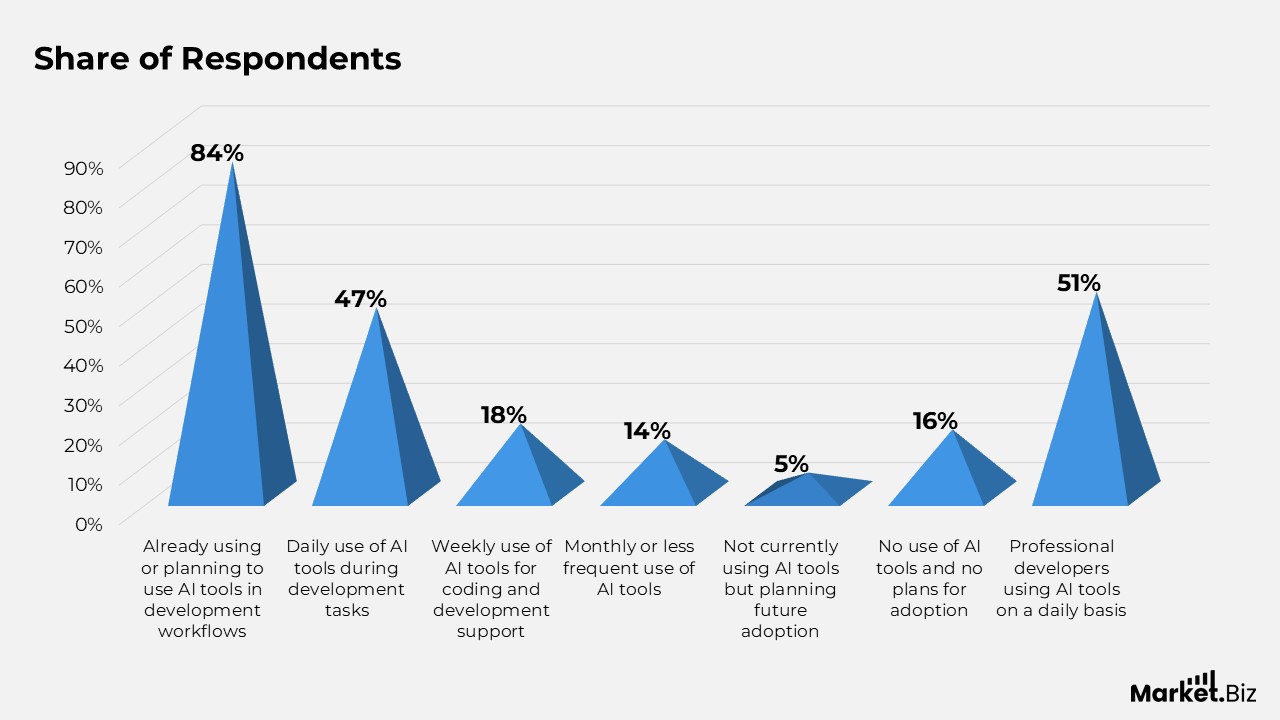
- A strong 84% of respondents report that they are either already using or actively planning to use AI tools within their development processes, up from 76% in the previous year.
- Daily use of AI tools is common: 47.1% of respondents report relying on them every day during development tasks.
- Weekly adoption remains notable, with 17.7% of participants using AI tools weekly to support coding and development activities.
- Limited but occasional engagement is seen among 13.7% of respondents, who use AI tools monthly or less frequently.
- A smaller group, representing 5.3%, does not currently use AI tools but plans to adopt them in the near future.
- Resistance to adoption persists among 16.2% of respondents, who indicate no current use of AI tools and no plans to integrate them into their workflows.
- Among professional developers specifically, 51% report using AI tools daily, highlighting deeper integration within experienced development roles.
(Sources: Statista, Stackoverflow)
Shifting Perceptions Toward AI Tools in the Development Community
- Overall positive sentiment toward AI tools has softened in 2025, declining to just over 60%, compared with levels above 70% recorded in 2023 and 2024, despite rising usage.
- Strong enthusiasm persists, with 22.9% of respondents describing their view of AI tools as very favourable.
- A larger share, 36.8%, expresses a generally favourable attitude toward using AI tools within development workflows.
- Neutral sentiment accounts for 17.6% of respondents, indicating cautious or situational acceptance rather than strong support or resistance.
- Uncertainty about AI tools is relatively limited, with only 2.3% of respondents reporting uncertainty about their stance.
- Negative perceptions persist among a minority: 10.8% report an unfavourable view and 9.6% express a very unfavourable opinion.
- Sentiment varies by experience level: professionals show higher overall favorability at 61%, compared with 53% among those learning to code.
(Sources: Statista, Stackoverflow)
Developer Confidence Levels in the Accuracy of AI Tool Outputs
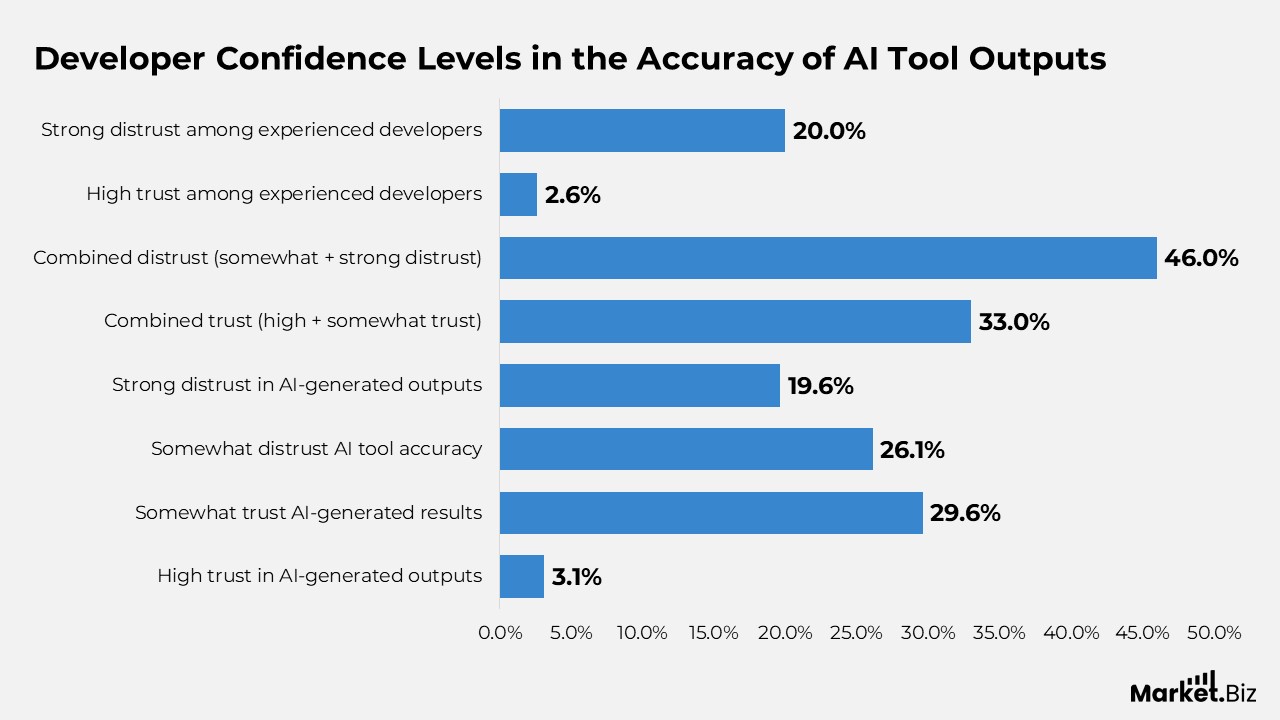
- Trust in AI tool accuracy remains limited, with only 3.1% of respondents reporting high trust in AI-generated outputs.
- A moderate level of confidence is more common, with 29.6% of developers reporting that they somewhat trust AI-generated results.
- Cautious scepticism is widespread, as 26.1% of respondents report somewhat distrust of the accuracy of AI tools.
- Strong doubt persists among 19.6% of developers, who report a high level of distrust in AI-generated outputs.
- Overall, more developers lean toward distrust, with 46% expressing some form of scepticism compared with 33% who express trust.
- Experienced developers show the greatest caution, recording the lowest level of high trust at 2.6% and the highest level of strong distrust at 20%, highlighting the continued reliance on human verification in accountability-driven roles.
(Sources: Statista, Stackoverflow)
Developer Views on AI Tools for Managing Complex Development Tasks
- Confidence in AI’s ability to handle complex tasks remains low, with only 4.4% of respondents saying AI performs very well at managing complex development work.
- A moderate share, 25.2%, believes AI tools are good but not strong enough when tasks become highly complex.
- Neutral opinions persist among 14.1% of respondents, who feel AI tools are neither effective nor ineffective for complex tasks.
- Scepticism is notable, as 22% of developers rate AI tools as bad at handling complex development challenges.
- 17.6% report strong dissatisfaction, believing AI tools perform very poorly on complex tasks.
- A separate group, accounting for 16.8%, avoid using AI tools entirely for complex tasks, preferring manual or human-led approaches.
- Among professional developers, concern has eased slightly, with the share believing AI struggles with complex tasks declining from 35% in 2024 to 29% this year, though caution remains consistent across experience levels.
(Sources: Statista, Stackoverflow)
Where Developers Apply AI Across the Software Development Lifecycle
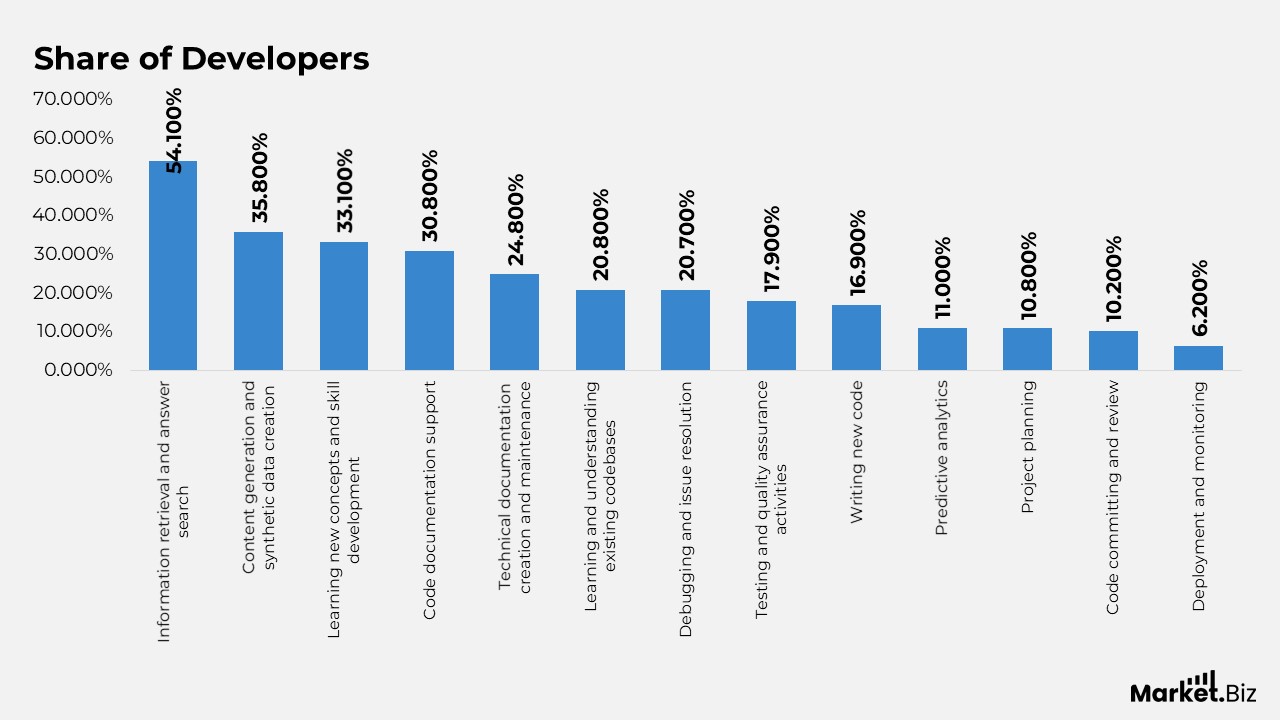
- AI is most widely used for information retrieval, with 54.1% of developers relying on AI tools to find answers during development.
- Content generation and synthetic data creation rank high, as 35.8% of respondents use AI to support these activities.
- Learning and skill development benefit strongly from AI adoption, with 33.1% using AI tools to understand new concepts or technologies.
- Code documentation tasks see steady AI usage, with 30.8% of developers applying AI to document code more efficiently.
- Maintaining or creating technical documentation is supported by AI for 24.8% of respondents, reflecting its role in reducing manual effort.
- Knowledge transfer within projects is aided by AI, as 20.8% use AI to learn about existing codebases.
- Debugging and issue resolution involve AI tools for 20.7% of developers, though reliance remains moderate.
- Testing activities show limited but growing AI use, with 17.9% integrating AI into testing workflows.
- Writing new code is the most selective form of AI adoption, reported by 16.9% of respondents.
- Advanced use cases remain limited, as only 11% use AI for predictive analytics and 10.8% for project planning.
- Governance-heavy tasks face the strongest resistance, with just 10.2% using AI for code committing and reviewing, and only 6.2% applying AI to deployment and monitoring, reflecting caution around high-responsibility system operations.
(Sources: Statista, Stackoverflow)
Key Points Developers Face When Using AI Tools
- The most common frustration with AI tools is receiving outputs that are nearly correct but require manual adjustment, reported by 66% of developers.
- Fixing and validating AI-generated code remains a major challenge, as 45.2% say debugging AI-generated outputs takes longer than expected.
- Irregular use reflects ongoing hesitation: 23.5% of respondents say they do not use AI tools regularly.
- Confidence concerns are emerging: 20% of developers say frequent AI use has reduced their trust in their own skills or judgment.
- ssssTransparency issues persist, with 16.3% of users finding it difficult to understand how or why AI tools produce certain results.
- Miscellaneous or less common issues are reported by 11.6%, indicating a range of additional, situational frustrations.
- A small minority, just 4%, report having no notable problems when using AI tools, suggesting that challenges remain widespread across users.
(Sources: Statista, Stackoverflow)
Why Human Expertise Remains Essential in an AI-Driven Development Future
- Even with advanced AI, trust remains the top reason for seeking human help, as 75.3% of developers say they would consult a person when they do not trust AI-generated answers.
- Ethical and security considerations continue to require human judgment, with 61.7% turning to people when facing concerns related to compliance, safety, or risk.
- Conceptual clarity drives collaboration: 61.3% prefer human input when they want to fully understand complex concepts, rather than relying solely on AI explanations.
- Learning quality practices remains human-led, with 58.1% seeking guidance from others to understand best practices and industry standards.
- Problem-solving limits are evident: 54.6% ask for human help when they are stuck and unable to explain issues clearly to AI tools.
- Complex debugging still favours human expertise, with 49.8% reaching out to others for help with advanced or high-impact problems.
- Comparative decision-making benefits from human insight, as 44.1% consult others when evaluating different solutions or approaches.
- Speed-based support is less common, with 27.5% seeking human help mainly for quick troubleshooting needs.
- Only a small share, 4.3%, believe they will not need help from other people in the future, reinforcing the ongoing role of human developers alongside AI.
(Sources: Statista, Stackoverflow)
Current Adoption Levels of “Vibe Coding” in Professional Development
- The majority of respondents do not use vibe coding in their development workflow, with 72.2% stating it is not part of their software development process.
- Strong resistance is evident, as 5.3% of developers say they emphatically reject vibe coding as a professional practice.
- Active adoption remains limited, with only 11.9% confirming that vibe coding is part of their regular development approach.
- Partial or experimental use is minimal, as 2.8% report using vibe coding only to some extent.
- Trial-based exposure is low: 2.1% say they have tried vibe coding but do not use it consistently.
- Uncertainty around the concept persists, as 1.2% of respondents remain unsure whether vibe coding fits into their workflow.
- A small portion of responses, about 4%, fall into uncategorized or unclear usage patterns, indicating mixed or undefined engagement.
(Sources: Statista, Stackoverflow)
Early Adoption Trends of AI Agents in Professional Workflows
- Daily use of AI agents at work remains limited, with only 14.1% of respondents reporting consistent, everyday adoption.
- Regular but less frequent use is reported by 9% of respondents, who use AI agents weekly.
- Occasional engagement is modest, with 7.8% reporting that they rely on AI agents monthly in their work.
- Interest in future adoption exists, with 17.4% of respondents not currently using AI agents but planning to do so.
- A notable share, 13.8%, relies on simpler AI tools such as copilots or assistants rather than full AI agents.
- Resistance remains high, as 37.9% of respondents say they do not use AI agents and have no plans to adopt them.
- Overall, AI agents have yet to reach mainstream status, with 52% of developers either avoiding them or limiting their use to more basic AI tools.
(Sources: Statista, Stackoverflow)
Impact of AI Agents on Developer Productivity Levels
- 16.3% of developers report a meaningful productivity uplift, saying AI tools or AI agents have improved their work to a great extent.
- Moderate benefits are more common, with 35.3% indicating that AI tools have somewhat improved their efficiency in completing development tasks.
- Limited impact remains the largest response group, as 41.4% report that AI tools have had little or no effect on their productivity.
- A small share, 2.6%, feels that their development productivity has declined slightly since using AI tools or agents.
- A more noticeable negative impact is rare but present, with 4.5% stating that their productivity has decreased due to AI adoption.
- Overall, positive sentiment outweighs negative outcomes: 52% of developers report some level of productivity improvement from AI tools or agents.
(Sources: Statista, Stackoverflow)
Primary Workplace Applications of AI Agents Across Functions
- Software engineering dominates AI agent usage at work, with 83.5% of users applying agents directly to development and coding activities.
- Data-driven roles show strong adoption, as 24.9% of respondents use AI agents for data analysis and analytics-related tasks.
- Operational efficiency benefits are evident, with 18% integrating AI agents into IT operations workflows.
- Process optimisation is a common use case, with 17.6% of respondents employing AI agents for business process automation initiatives.
- Decision support functions are gaining traction, with 11.3% relying on AI agents for decision intelligence activities.
- Customer-facing applications remain secondary, with 11.2% using AI agents to support customer service operations.
- Marketing teams show selective adoption, with 8.6% leveraging AI agents for campaign- and content-related work.
- Risk and protection tasks have limited uptake, with 7.4% using AI agents in cybersecurity roles.
- Advanced and specialised applications remain niche, with only 3.9% using AI agents for robotics-related tasks.
- Other minor or experimental use cases account for just 2.2%, highlighting the concentration of AI agent usage in core technical functions.
(Sources: Statista, Stackoverflow)
Common Non-Work Applications of AI Agents
- Language-related tasks drive general AI agent use: 49% of respondents rely on agents for language processing activities outside formal work settings.
- Cross-system connectivity is a major use case, as 38.3% use AI agents to integrate with external agents or tools.
- Backend and infrastructure support show steady adoption, with 34.4% using AI agents via MCP servers.
- Coordinating multiple agents is increasingly common, as 28.1% use AI agents for agent or multi-agent orchestration tasks.
- Data handling capabilities drive adoption, with 24.1% using vector databases to support AI-driven applications.
- Search functionality across platforms benefits from AI agents, as 19.4% enable multi-platform search through agent-based tools.
- Customization remains a secondary focus, with 18.3% creating personalized AI agents for specific individual needs.
- Other niche or experimental uses account for just 3%, indicating that general-purpose AI agent usage remains concentrated in a few core functions.
(Sources: Statista, Stackoverflow)
How AI Agents Are Shaping Developer Efficiency and Work Outcomes
- Time savings stand out as the most visible benefit, with nearly 70% of users agreeing that AI agents have reduced the time spent on specific development tasks.
- Productivity gains are widely recognised, with about 69% of respondents agreeing that AI agents have helped increase their overall productivity.
- Quality improvements show a moderate impact, with roughly 38% of developers agreeing that AI agents have improved the quality of their code.
- Collaboration is the weakest influence, with only around 17% of users agreeing that AI agents have meaningfully improved teamwork within their development teams.
- Problem-solving support is notable, with more than 48% agreeing that AI agents help solve complex development problems more effectively.
- The benefits of automation are clear, as nearly 64% of respondents agree that AI agents help automate repetitive development tasks.
- Learning acceleration is another key outcome, with approximately 63% agreeing that AI agents have helped them learn new technologies or codebases faster.
- Overall, the impact of AI agents is strongest at an individual level, driving personal efficiency and learning gains rather than broad team-level transformation.
(Sources: Statista, Stackoverflow)
Key Barriers Limiting Wider Adoption of AI Agents
- Accuracy remains the top concern, with nearly 87% of respondents agreeing that the reliability of information produced by AI agents is a major issue.
- Data security and privacy risks are also significant, as about 81% of user’s express concern over how sensitive information is handled when using AI agents.
- Cost sensitivity affects adoption, with many respondents agreeing that the expense of certain AI agent platforms creates a meaningful barrier to use.
- Organisational constraints play a role, as a notable share of respondent’s report that strict IT or InfoSec policies prevent the use of AI agents or related tools.
- The learning curve continues to slow uptake, with many users stating that mastering AI agents requires considerable time and effort.
- Workflow compatibility remains challenging, as a large portion of respondents agree that integrating AI agents with existing tools and systems is difficult.
- Overall, these challenges suggest that trust, governance, cost, and usability must improve before AI agents can achieve broader and more consistent adoption across teams.
(Sources: Statista, Stackoverflow)
Preferred Data Storage Solutions for AI Agent Memory and Management
- Traditional infrastructure tools continue to dominate AI agent data storage, with 42.9% of respondents using Redis for managing agent memory and data.
- GitHub MCP Server shows nearly equal adoption at 42.8%, highlighting strong reliance on developer-centric platforms for agent workflows.
- Modern backend platforms are gaining traction, as 20.9% of users rely on Supabase to support AI agent data needs.
- Vector-native databases are increasingly relevant, with 19.7% adopting ChromaDB for AI-focused storage and retrieval tasks.
- PostgreSQL-based vector extensions remain popular, with 17.9% using pgvector to handle AI agent embeddings.
- Graph-based data management appears more selective, with 12.3% using Neo4j in AI agent environments.
- Purpose-built vector databases see moderate use, including Pinecone at 11.2% and Qdrant at 8.2%.
- Emerging and specialised tools are showing limited but growing adoption, such as Milvus at 5.2%, Fireproof at 5%, LangMem at 4.8%, and Weaviate at 4.5%.
- Experimental and lightweight memory tools remain niche, with LanceDB at 4.4%, mem0 at 4%, Zep at 2.8%, and Letta at 2.5%, suggesting a fragmented long tail of solutions.
(Sources: Statista, Stackoverflow)
Leading Frameworks for AI Agent Orchestration and Management
- Open source solutions dominate AI agent orchestration, with 51.1% of developers using Ollama as their primary framework for building and managing agents.
- LangChain holds a strong secondary position, adopted by 32.9% of respondents, reflecting its widespread use in agent workflows and integrations.
- Emerging orchestration frameworks are gaining moderate traction, with LangGraph at 16.2% and Vertex AI at 15.1%.
- Cloud-native and enterprise options continue to gain steady adoption, with Amazon Bedrock Agents used by 14.5% of developers.
- Routing and model management tools remain relevant, with 13.4% relying on OpenRouter and 13.3% using LlamaIndex for agent orchestration.
- Microsoft-backed solutions are gaining visibility, with AutoGen used by 12% of respondents.
- Workflow automation platforms contribute selectively, as 11.8% integrate Zapier into agent-driven processes.
- Specialised agent frameworks remain niche, with CrewAI at 7.5%, Semantic Kernel at 6%, and IBM watsonx.ai at 5.7%.
- Long-tail tools show early-stage adoption, including Haystack at 4.4%, Smolagents at 3.7%, Agno at 3.4%, phidata at 2.1%, Smol-AGI at 1.9%, Martian at 1.7%, and lyzr at 1.5%, highlighting a fragmented but evolving ecosystem.
(Sources: Statista, Stackoverflow)
Common Tools Used for AI Agent Observability and Security
- Most developers rely on familiar DevOps monitoring stacks rather than AI-specific platforms, with 43% using Grafana combined with Prometheus for AI agent observability.
- Error tracking remains a priority, as 31.8% of respondents use Sentry to monitor and troubleshoot AI agent behaviour.
- Security scanning tools are actively repurposed for AI agents, with 18.2% adopting Snyk to manage vulnerabilities and risks.
- Application performance monitoring tools remain relevant, as 13% of developers use New Relic to oversee AI agent operations.
- AI-focused observability tools are gradually gaining traction, with 12.5% using LangSmith for tracing and evaluation.
- Logging and analytics platforms are used selectively, including Honeycomb and Langfuse, each adopted by 8.8% of respondents.
- Cloud and infrastructure security tools show modest adoption: 6.9% use Wiz and 6.2% rely on Galileo.
- Robustness and safety testing remain niche, with 5.5% using the Adversarial Robustness Toolbox and 5% adopting Protect AI.
- Specialized and emerging tools remain in early stages, including Vectra AI at 4.4%, arize at 3.7%, Helicone at 3.2%, Metero at 2.7%, and Opik at 2.3%, reflecting a fragmented and evolving observability landscape.
(Sources: Statista, Stackoverflow)
Most Widely Used Out-of-the-Box AI Agent Tools
- ChatGPT leads out-of-the-box AI agent adoption, with 81% of developers using it as a primary entry point for AI-assisted work.
- GitHub Copilot holds a strong second place, with 67.9% adoption, reflecting its deep integration into developer coding environments.
- Google Gemini shows broad mainstream usage, with 47.4% of respondents relying on it for general AI assistance.
- Claude Code is widely used for code-related tasks, with 40.8% of developers selecting it as an out-of-the-box AI tool.
- Microsoft Copilot extends AI assistance beyond coding, with 31.3% reporting regular use.
- Discovery- and research-oriented AI tools have moderate adoption, with 16.2% using Perplexity for AI-driven insights.
- Early-stage and niche tools show selective usage, including v0.dev at 9.1%, Bolt.new at 6.5%, and Lovable.dev at 5.7%.
- Agent-based automation tools remain emerging, with 5% using AgentGPT, 5% using Tabnine, and 5% using Replit.
- Autonomous experimentation tools see limited uptake: 4.7% use Auto-GPT and 3.9% rely on Amazon CodeWhisperer, highlighting a long tail of specialised options behind the market leaders.
(Sources: Statista, Stackoverflow)
Most Widely Used Out-of-the-Box AI Agent Tools
- ChatGPT leads out-of-the-box AI agent adoption, with 81% of developers using it as a primary entry point for AI-assisted work.
- GitHub Copilot holds a strong second place, with 67.9% adoption, reflecting its deep integration into developer coding environments.
- Google Gemini shows broad mainstream usage, with 47.4% of respondents relying on it for general AI assistance.
- Claude Code is widely used for code-related tasks, with 40.8% of developers selecting it as an out-of-the-box AI tool.
- Microsoft Copilot extends AI assistance beyond coding, with 31.3% reporting regular use.
- Discovery- and research-oriented AI tools have moderate adoption, with 16.2% using Perplexity for AI-driven insights.
- Early-stage and niche tools show selective usage, including v0.dev at 9.1%, Bolt.new at 6.5%, and Lovable.dev at 5.7%.
- Agent-based automation tools remain emerging, with 5% using AgentGPT, 5% using Tabnine, and 5% using Replit.
- Autonomous experimentation tools see limited uptake: 4.7% use Auto-GPT and 3.9% rely on Amazon CodeWhisperer, highlighting a long tail of specialised options behind the market leaders.
(Sources: Statista, Stackoverflow)
Conclusion
AI Toolkit Statistics indicate that AI tools have shifted from early experimentation to regular use in daily workflows, particularly in development, analytics, and knowledge-based tasks.
Adoption is highest where AI clearly saves time and improves individual efficiency, such as information discovery, coding support, task automation, and faster skill development. At the same time, users apply these tools with care, limiting their role in high-risk or decision-critical activities.
Overall, the findings reflect a pragmatic partnership between people and AI toolkits. Concerns about trust, accuracy, security, and system integration continue to influence the depth of adoption.
While AI toolkits are delivering measurable productivity benefits, human judgment remains central for validation, accountability, and complex reasoning. As these tools become more reliable and better governed, they are expected to move from supportive assistants toward more dependable collaborators in professional environments.
FAQ’s
AI Toolkit Statistics reflect the maturity of artificial intelligence as a practical technology rather than an experimental concept. High adoption in supportive tasks and cautious use in critical decision-making indicate a transitional phase where AI is reliable for assistance but not yet fully autonomous.
These statistics show a collaborative model in which humans and AI work together. AI handles speed, scale, and pattern recognition, while humans retain control over judgment, ethics, and accountability, reinforcing a human-in-the-loop framework.
Usage patterns suggest conditional trust. Users accept AI outputs for low-risk tasks but require validation for complex or high-impact work, highlighting trust as contextual rather than absolute.
The data aligns with gradual adoption models, in which organisations integrate new technologies incrementally. Resistance in high-risk areas reflects risk-management behaviour rather than technological rejection.
The statistics suggest AI will evolve from a productivity aid into a decision-support collaborator. As reliability, transparency, and governance improve, AI toolkits are expected to take on more complex roles while remaining guided by human oversight.

